SAHAJA SAMADHI (THE ‘NATURAL STATE’) – Sri Ramana Maharshi


Bhagavan Sri Ramana Maharshi explains the nature of self-realisation, also known as sahaja samadhi, or ‘the natural state’. He explains that in the natural state of self knowledge, the body, mind, world and three states of waking, dream and deep sleep are not perceived by the liberated sage (jnani), but only the ignorant onlookers see the sage with an apparent body and a mind:

Ramana Maharshi: ‘So also a Jnani in sahaja samadhi is unaware of the happenings, waking, dream and deep sleep…In sahaja samadhi the activities, vital and mental, and the three states are destroyed, never to reappear.

‘However, others notice the Jnani active e.g., eating, talking, moving etc. He is not himself aware of these activities, whereas others are aware of his activities. They pertain to his body and not to his Real Self, swarupa.

‘For himself, he is like the sleeping passenger – or like a child interrupted from sound sleep and fed, being unaware of it. The child says the next day that he did not take milk at all and that he went to sleep without it. Even when reminded he cannot be convinced. So also in sahaja samadhi.’

~ Talks with Sri Ramana Maharshi, Talk 82

AJATA: Ramana Maharshi, Shankara and Upanishads | Does ego becomes like a burnt rope? Prarabdha karma destiny and self-knowledge

This post is only for those who are deeply interested in liberation, and it was originally posted here on Facebook

There is a teaching that says that after liberation, the liberated sage’s ego becomes dead, like a burnt rope, in that it continues to exist in superficial appearance, in name and form, but doesn’t actually have any robust structure or power.

Similarly, the same teaching says that the liberated sage’s body & mind continues after liberation, but there is no longer any individual will at play, and it is just the destiny of the body mind (known as prarabdha karma in Sanskrit) that plays out. An analogy is given of how a fan continues to rotate even when the power has been turned off, the idea being that in a similar way the sage’s body continues to act in the world according to its pre-existing energy and destiny but without anybody’s individual will or ego being present any longer..

Sri Ramana often gave this teaching himself, but he also said this was a lower teaching for those who were unable to accept the higher teachings. In his writings, and to his closest devotees, he often explained that in truth, in liberation there is no karma (action or activity) whatsoever, and there is no body or mind or world for the Jnani. It only appears this way due to the ignorant view of the ignorant onlooker.

33. The statement that the jnani retains prarabdha while free from sanchita and agami is only a formal answer to the questions of the ignorant. Of several wives none escapes widowhood when the husband dies; even so, when the doer goes, all three karmas vanish.
~ Supplement to the 40 verses on reality, written by Sri Ramana Maharshi

and

The Self-Realised Sage knows not whether the transient body comes and stays, or dies and leaves, even as a senseless drunkard knows not what happens to his clothes.
~ Guru Vachaka Kovai, Sri Bhagavan 24 (a verse written by Sri Ramana Maharshi)

AJATA

This teaching is known as Ajata, which is the teaching that the appearance of the body mind and world only appear due to ignorance or ego, and that the world, including the body and mind, never really appeared or existed in the first place. Ignorance never really came about at all. Duality, meaning the appearance of any rising phenomena whatsoever, never actually occurred.

SHANKARA & UPANISHADS

This is why the scriptures describe the truth, the true self, as being homogeneous, without multiplicity or variety, devoid of appearances, objects, forms and imagination. The scriptures say in Brahman there are no hands or feet or eyes or ears or thoughts, etc etc, and this is the meaning of those verses, as Shankara has also explained in his commentaries.

eg. Shankara writes the following:

‘Because I am without an eye*, I have no sight. As I have no ear either*, how could I have hearing? As I have no voice I can have no speech. As I have no mind, how could I have thought? There cannot be action on the part of that which does not have life force (prana). There cannot be knowership on the part of that which has no mind. Neither can there be knowledge or ignorance on the part of me who am the Light of Pure Consciousness
~Sri Shankara, Upadesa Sahasri 13.1, 13.2

*Shankara is quoting from Brihadaranyaka Upanishad 3.8.8

BUT HOW CAN THERE BE DIFFERENT LEVELS OF A NON-DUAL TEACHING?

Here is how Lakshmana Sarma (LS), a direct devotee of Sri Ramana’s, describes this in Maha Yoga pages 59-60; here LS speaks of 2 levels of the teaching, the higher (true) and lower (ultimately untrue); note that LS uses the English word ‘revelation’ to refer to Shruti (the revealed scriptures consisting primarily of the Vedas and Upanishads):

The ancient lore is twofold. One part of it is addressed to those who are not conscious of being in ignorance, and therefore have no use for a teaching intended to dispel that ignorance. The other part of the ancient lore is addressed to those that are conscious of the ignorance and are in earnest to escape from it. These two parts are quite distinct. But this feature of the ancient Revelation is not known to these believers. Besides they are offended by the inevitable corollary that theirs is a lower position; they also feel it a grievance that the world, which they believe to be real, should be dismissed as unreal, and often want to quarrel with us who are followers of the Sages; we however have no quarrel with them, as the Sages have pointed out, because we realise that for them it is all right to believe as they do, and, so believing, to make the best of the world while it lasts. They are like dreamers who are persuaded that their dreams are real, and do not want to awake. We have begun to see that this worldly life is only a dream, because the Sages tell us so; and we want to awake.’

See this post below for more on this topic – I share more quotes from Sri Ramana and Sri Shankara which further explains the above in more detail:

Does the liberated Jnani or Sage see the body, the mind, the world or the 3 states of deep sleep, waking and dream according to Sri Ramana Maharshi and Sri Adi Shankara?

The Purpose behind the Various and Diverse Theories of Creation in the Vedas | Advaita Vedanta | Sri Ramana Maharshi

Why do the different portions of the Vedas describe creation in different ways? Their sole intention is not to proclaim a correct theory of creation, but to make the aspirant enquire into the Truth which is the Source of creation.

~ Sri Ramana Maharshi, Guru Vachaka Kovai, Verse 102

Here, in one of the earliest texts Sri Ramana authored he wrote the following in response to the following question:

Question: If the entire universe is of the form of mind, then does it not follow that the universe is an illusion? If that be the case, why is the creation of the universe mentioned in the Veda?

Sri Ramana Maharshi: There is no doubt whatsoever that the universe is the merest illusion. The principal purport of the Veda is to make known the true Brahman, after showing the apparent universe to be false. It is for this purpose that the Vedas admit the creation of the world and not for any other reason.

Moreover, for the less qualified persons creation is taught, that is the phased evolution of prakriti (primal nature), mahat-tattva (the great intellect), tanmatras (the subtle essences), bhutas (the gross elements), the world, the body, etc., from Brahman: while for the more qualified simultaneous creation is taught, that is, that this world arose like a dream on account of one’s own thoughts induced by the defect of not knowing oneself as the Self. Thus, from the fact that the creation of the world has been described in different ways it is clear that the purport of the Vedas rests only in teaching the true nature of Brahman after showing somehow or other the illusory nature of the universe.

That the world is illusory, every one can directly know in the state of realization which is in the form of experience of one’s bliss-nature.

~ Sri Ramana Maharshi, Self Enquiry (Vichara Sangraham)

Sri Sadhu Om also wrote a commentary on the above verse of Guru Vachaka Kovai (verse 102), as follows:

‘If creation were true, the scriptures would describe it in only one manner, but their diverse theories make it clear that creation is not the truth. To enable ripe aspirants to discover the falsity of the notion of creation, the Vedas purposely teach contradictory theories. However, such contradictions are found only in the descriptions of creation, they never occur when the Vedas attempt to describe the nature of Self, the Supreme. Concerning Self, they all agree and speak in one voice, saying ‘Self is One, Perfect, Whole, Immortal, Unchanging, Self-shining etc., etc.’ From this we should understand that the deep intention behind such conflicting theories of creation is to indirectly show aspirants the necessity of enquiring into Self, which is the Source of all ideas of creation.’

Misquoting Ramana Maharshi ‘neither destiny nor free will’ | Upanishads | Ramesh Balsekar

There is a quote I often see attributed to Sri Ramana Maharshi as follows:

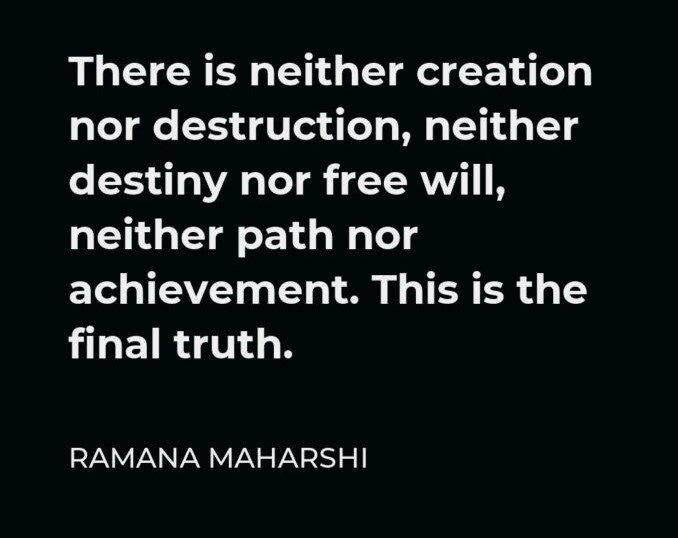
‘There is neither creation nor destruction, neither destiny nor free will, neither path nor achievement. This is the final truth.’

This verse is actually a mistranslation of a verse that is found in several vedanta scriptures including two Upanishads, the writings of Gaudapada and in Shankara’s writings too. Here is how the verse appears in these texts:

There is neither destruction (Nirodha) nor creation (Utpatti), none in bondage (Bandha) and none practicing disciplines (Sadhaka). There is none seeking Liberation (Mumukshu) and none liberated (Mukta). This is the ultimate or highest truth (Paramartha).’

Sri Ramana Maharshi did himself write a version of this verse, which has been captured in verse B28 in Guru Vachaka Kovai (it can be found after verse 1227), which reads as follows:

There is no creation, no destruction.
None bound, none seeking, striving,
Gaining freedom. Know that this
Is the Truth supreme.

As far as I can tell, the mistranslated version of the text, which erroneously refers to destiny and free will, was popularised by Ramesh Balsekar and itself was a quotation from a book by Wei Wu Wei called ‘The Open Secret’. Ramesh often placed prominence on the concepts of destiny and free will in his teachings, so perhaps this was why he gravitated towards this version (ie. mistranslation) of the verse?

Admittedly the verses are not all too different from each other, but they are different nonetheless. I’ll let you decide on the significance of these differences for yourself.

Namaste

Tom

Advaita Vedanta – all thoughts must go! (Manonasa) The need to still the mind and end all thinking according to the Upanishads and Shankara’s commentaries | Nirvikalpa Samadhi

There are so many verses both in the Upanishads and in Shankara’s commentaries which state that all thoughts must be extinguished for liberation to occur. This is known as Manonasa (Mano = mind; nasa = anihiliation or destruction or dissolution), which is a traditional synonym for liberation (Moksha) or Self-Knowledge (Atma-Jnana). Here are some of these verses (and there are many many more which I have not included!):

(Note I have not included the numerous verses from Shankara’s text called Vivekachudamani which repeatedly advocates the thoughtless state of Nirvikalpa Samadhi which can be found in a separate post here)

When the five organs of perception become still, together with the mind, and the intellect ceases to be active: that is called the Supreme State [Brahma-Vidya or Self Knowledge]
~Katha Upanishad 2.3.10

Shankara’s commentary on this above verse (Katha Upanishad, verse 2.3.10) states the following:

‘At the time when the five senses…, together with the mind…, which is now no longer functioning and thinking, are at rest in the Self alone, after turning away from objects, and with the intellect…no longer engaging with its functioning, that they call the highest state [Brahma-Vidya or Self-Knowledge].’

This is reminiscent of the Amritabindu Upanishad and also of the Adhyatma Upanishad, both of which are considered to be traditional Upanishads in the Advaita Vedanta/ Jnana tradition:

The mind severed from all connection with sensual objects, and prevented from functioning out, awakes into the light of the heart, and finds the highest condition. The mind should be prevented from functioning, until it dissolves itself in the heart. This is Jnana, this is Dhyana, the rest is all mere concoction of untruth.
~ Amritabindu Upanishad

Manonasa is also known as Nirvikalpa Samadhi, see here:

The knot of the ignorance in the heart is broken completely only when one sees his Self as secondless through Nirvikalpa Samadhi
~Adhyatama Upanishad 1.17

Gaudapada writes in verse 3.38 of his Mandukya Karika:

There can be no acceptance or rejection where all mentation stops. Then knowledge is established in the Self and is unborn, and it becomes homogenous [ie. all objects disappear]

Shankara’s commentary on this verse 3.38 is as follows:

…therefore there is no rejection or acceptance in It, where thought does not exist. That is to say, how can there be rejection or acceptance where no mentation is possible in the absence of the mind? As soon as there comes the realisation of the Truth that is the Self, then, in the absence of any object, knowledge (Jnanam) is established in the Self, like the heat of fire in fire. It is then birthless (ajati) and becomes homogenous.

‘…when the mind becomes quiescent and does not give rise to appearances, it verily becomes Brahman
~ Gaudapada, Mandukya Upanishad Karika 3.46

Shankara clarifies this further in his commentary on Mandukya Karika 3.46:

‘When the mind brought under discipline by the above-mentioned methods, does not fall into the oblivion of deep sleep, nor is distracted by external objects, that is to say, when the mind becomes quiescent like the flame of a light kept in a windless place; or when the mind does not appear in the form of an object – when the mind is endowed with these characteristics, it verily becomes one with Brahman.’

Anandagiri, a 13th century commentator on Shankara’s works, confirms this in his comments on Karika 3.46:
‘The external objects are nothing but the activities of the mind itself.’

So we can see that mind activity and external objects are one and the same, and that samadhi is devoid of both

The knowers of Brahman say that absolute Jnanam, knowledge, which is akalpakam [devoid of thoughts], and is therefore ajam, birthless…
~ Shankara’s commentary on Gaudapada Karika 3.33

This duality as a whole, that is mano-drsyam, perceived by the mind; is nothing but the mind, which is itself imagined – this is the proposition [Tom: ie. meaning of the verse]. For duality endures so long as the mind does, and disappears with the disappearance of the mind.
~ Shankara’s commentary on Gaudapada Karika 3.31

It has been said that when the mind is divested of ideation by virtue of the realisation of Truth that is Brahman, and when there is an absence of external objects (of perception), it becomes tranquil, controlled, and withdrawn, like fire that has no fuel. And it has further been said that when the mind thus ceases to be mind, duality also disappears.
~ Shankara’s commentary on Gaudapada Karika 3.33

‘The controlled mind is verily the fearless Brahman
~Gaudapada Karika 3.35

On p.149 of The Method of Vedanta by SSS, SSS quotes from Chapter 6 of the Bhagavad Gita to explain in more detail the method of Nididhyasana, as follows:

‘That yoga should certainly be practised with resolute mind. Giving up without exception all desires that come from individual, will, restraining the sense-organs on every side through the mind, one should gradually withdraw from all activity, with will and intellect firmly controlled; keeping the mind fixed on the Self, one should not think of anything. Wherever the fickle mind wanders, one should bring it back and fix it on the Self alone, under firm control. Supreme joy comes to such a yogi, whose mind is at perfect peace, whose lusts have subsided, who is sinless and who has become the Absolute.’

I thought I would end with Bhagavan Sri Ramana Maharshi’s view of the scriptures and their purpose:

All the jnana scriptures that teach the way to redemption proclaim in unison that restraining and stilling the mind is the best means for liberation. This is also emphasised by jnanis. If, after a certain amount of study, one knows this to be the inner purport of the scriptures, one should then direct ones whole effort towards that [practice]. What is the use of continuously studying more and more scriptures without doing this?
~Sri Ramana Maharshi, Guru Vachaka Kovai verse 141

There are so many more quotes I could have included, such as quotes from Yoga Vasistha and Ribhu Gita too!

Also see:

How can the Jnani (sage) function with NO THOUGHTS? Sri Ramana Maharshi

Does stillness of mind lead to liberation?

The ‘ultimate means’ to liberation
Q. Is it your view that Nirvikalpa Samadhi leads to Liberation? | Advaita Vedanta | The 108 Upanishads PDF Download

See below for the link to download the 108 Upanishads as a PDF file

Tom: note this is not my view, but the view of Vedanta, ie. the Upanishads, also known as Shruti. The Upanishads and Jnanis state this again and again in various ways. The highest authority in the Vedanta teachings are the Upanishads. In fact, strictly speaking, ‘Vedanta’ simply refers to the teachings found in the Upanishads. If we actually read the Upanishads for ourselves – there are 108* classical Upanishads – we will see this same teaching being given again and again.

eg.

The knot of ignorance in the heart is broken completely only when one sees his Self as secondless through Nirvikalpa Samadhi

~ Adhyatma Upanishad 1.17

Hasn’t Guru Bhagavan Sri Ramana Maharshi told us that all paths must end in Silence, also known as Nirvikalpa Samadhi, also known as Jnana, which is nothing other than the Pure Objectless Self!

However, to answer your question directly, it is also my own view. My views on this remain unchanged – what made you think otherwise?**

Namaste and Pranams 🙏

*There are classically 108 Upanishads, all of which are considered to be authoritative in Vedanta teachings. However 10-12 of the Upanishads have more recently been designated ‘Major Upanishads’ as these are the ones that Sri Shankara wrote commentaries upon, and the remaining 96-98 Upanishads are often referred to as ‘Minor Upanishads’. However strictly speaking the so-called Minor Upanishads are no less important than the so-called major ones, and traditionally many think the Minor Upanishads are for the more advanced students of Vedanta. Often the ‘Minor’ Upanishads teach a very clear and direct approach to Vedanta, so perhaps Shankara just commented on those Upanishads that were less easy to understand? Either way, read them for yourself if you get the chance. You can find them here:

**This reply was given to someone who thought my views on this matter had changed

Q. Why do the Upanishads repeatedly state the Self is located ‘within the body’ in the ‘Heart’ or ‘Cavern of the Heart’? | Advaita Vedanta

Tom: Why do the Upanishads constantly repeat and say the Self is located within the body, in the ‘heart’ or ‘cavern of the heart’ within the body? Why is this repeated time and time again? At the same time it is said the the Self is nothing to do with the body? And at the same time it is said the Self is All, everywhere?

Answer (also from Tom): It is because the Upanishads and vedanta scriptures again and again tell us to turn our attention away from objective phenomena and towards the Divine Within, which is nothing but Our True Self, the I Am, the Subject.

ie. It is only to help us turn within that the scriptures say ‘it is in the heart, located in the body, the size of a thumb’, etc, etc.

eg. from the Katha Upanishad:

2.1.12 The Puruṣa (Self), of the size of a thumb, resides in the middle of the body as the lord of the past and the future, (he who knows Him) fears no more. This verily is That.

and

2.3.17. The Purusha of the size of a thumb, the internal atman, is always seated in the heart of all living creatures; one should draw him out from one’s own body boldly, as stalk from grass; one should know him as pure and immortal; one should know him as pure and immortal.

See this post where Sri Ramana makes the teaching clear: Remove Nama-Rupa (Name & Form) to reveal Sat-Chit-Ananda (the Self)

Does prarabdha karma* and suffering persist after realisation/liberation?

Questioner: I have a question, if Ajnanam (ignorance) is removed* that means the whole source of Samsara is removed. In such a case why should the Jnani (realised sage) even have Prarabdha Karma*. That also should not be present right?

Tom: In Truth, there is not even any such thing as a Jnani (meaning a person or body-mind that is ‘realised’) – there is only That Objectless Subject-Self-Brahman. So there is no karma whatsoever for ‘a Jnani’ (a Jnani here meaning the Self). The self has no duality, and no karma. Karma is born of ignorance and is maya, unreal. They are one and the same – karma and ignorance – or one comes from the other. This is also what is taught in the Upanishads (eg. Adhyatma Upanishad) and by Shankara, both in his commentaries and in texts such as Vivekachudamani.

*Removal of ignorance is the same as Self-Realisation, so say the Upanishads, so says Shankara.

**Tom: Prarabdha Karma is the portion of karma that, according to the Vedas, gives rise to the body in the present birth and will play out and determine the specifics of the present life. A simple translation could be ‘destiny’ or ‘what is destined for this life’. The idea of this question is that, for example, if you have ‘been bad’ in the past and have accumulated negative karma as a result, even though you have realised the Self, this negative karma may continue and cause suffering for you even after Self-Realisation. The Upanishads are clear that all karmas and all suffering end upon Self-Realisation, so one need not even fear the negative results of one’s past actions if one realises the Self.

The Humour of the Upanishads | Advaita Vedanta

Dry Upanishadic Humour

Section 3 of the Brihadarankaya Upanishad consists of a conversation between King Janaka and the Sage Yajnavalkya. Now for those of you who have not encountered Sage Yajnavalkya, he is quite a character at times, demonstrating the dry humour present in many of the Upanishads. Here is an example from Section 3.1 of the Brihadaranyaka Upanishad:

3.1.1:   Om. Janaka, Emperor of Videha, performed a sacrifice in which gifts were freely distributed among the priests. Brahmin scholars from the countries of Kuru and Panchala were assembled there. Emperor Tanaka of Videha wished to know which of these brahmins was the most erudite Vedic scholar.  So he confined a thousand cows in a pen and fastened on the  horns of each ten padas of gold. 

3.1.2:    He said to them: “Venerable brahmins, let him among you who is the best Vedic scholar drive these cows home.”  None of the brahmins dared. Then Yajnavalkya said to one of  his pupils: “Dear Samsrava, drive these cows home.” He drove them away. The brahmins were furious and said: “How does he dare to call  himself the best Vedic scholar among us?” Now among them there was Asvala, the hotri priest of Emperor Janaka of Videha. He asked Yajnavalkya: “Are you indeed the  best Vedic scholar among us, O Yajnavalkya?” He replied: “I bow to the best Vedic scholar, but I just wish to  have these cows.” Thereupon the Hotri Asvala determined to question him. 

Here we have a scenario in which King Janaka effectively sets up a challenge to see who the best Vedic Scholar is, with the prize being one thousand cows. However before the challenge has even begun, Sage Yajnavalkya simply asks one of his students to take the cows. When challenged by the other scholars to see if he is really the most knowledgeable in the Vedas, Yajnavalkya dryly replies that irrespective of who the best scholar is, he just wants the cows! For me this demonstrates the humour, irony and rebellious spirit that is present throughout many of the Upanishads, but this humourous aspect of the teaching is often missed when the approach becomes overly intellectual and analytical.

The Guru wants to get paid!

Anyway, back to the three states and section 4 of the Brihadaranyaka Upanishad. In section 4.3 Yajnavalkya goes to King Janaka with the intent of not speaking, but because he had previously made a promise to King Janaka that he will answer any questions King Janaka asks, we obtain the dialogue of section 4.3 which pertains to the three states. In Shankara’s commentary on these verses he explains that the real reason Yajnavalkya visits King Janaka is to gain more wealth and cattle from the King, and throughout the following dialogue King Janaka keeps on gifting increasing numbers of cattle to Sage Yajnavalkya.

4.3.1 Yajnavalkya called on Janaka, Emperor of Videha. He said to  himself: “I will not say anything.”  But once upon a time Janaka, Emperor of Videha and  Yajnavalkya had had a talk about the Agnihotra sacrifice and  Yajnavalkya had offered him a boon. Janaka had chosen the  right to ask him any questions he wished and Yajnavalkya had  granted him the boon.  So it was the Emperor who first questioned him. 

Shankara’s commentary on the above verse reads as follows:

‘Yajnavalkya went to Janaka, Emperor of Videha. While going, he thought he would not say anything to the Emperor. The object of the visit was to get more wealth and maintain that already possessed….’

Note how this is contrary to how many nowadays state that a true teacher would not accept money or material objects for their teaching. In this, the oldest, longest and perhaps the most authoritative of Upanishads, we have the reverse situation! Again, such is the often dry humour of the Upanishads!

The above in an excerpt from a longer post which you can find here: Deep sleep is Brahman – the three states according to the Birhadaranyaka Upanishad with commentary by Shankara