The Chandogya Upanishad: Tat Tvam Asi (You Are That)

Upanishad vedanta satsang

Tat Tvam Asi is one of the most famous phrases from the ancient upanishadic texts. But what does it mean?

Tat = that
Tvam = thou or you
Asi = art or are
Tat Tvam Asi = That thou art, or thou art that, or you are that

‘That’ refers to the Absolute. ‘You’ normally refers to the limited separate body-mind identity  known in advaita vedanta as the jiva, but in this aphorism from the Upanishads it is implicitly declared, via the word ‘asi’, that you are not the jiva but the Absolute. Why does this matter? Well, when you know yourself as one with the Absolute, suffering ends.

This phrase, Tat Tvam Asi, is repeatedly uttered by Uddalaka to his son Shvetaketu as recorded in the Chandogya Upanishad, and is considered one of the four Mahavakyas (great utterances) of the Upanishads. Below are just two of the teaching exampes it occurs in, taken from sections twelve and thirteen of the Chandogya Upanishad:

Uddalaka: “Bring me a fruit from the banyan tree.”
Shvetaketu: “Here is one, Father.”
Uddalaka: “Break it open.”
Shvetaketu: “It is broken, Father.”
Uddalaka: “What do you see there?”
Shvetaketu: “These tiny seeds.”
Uddalaka: “Now break one of them open.”
Shvetaketu: “It is broken, Father.”
Uddalaka: “What do you see there?”
Shvetaketu: “Nothing, Father.”
Uddalaka: “My son, you know there is a subtle essence which you do not perceive, but through that essence the truly immense banyan tree exists. Believe it, my son. Everything that exists has its self in that subtle essence. It is Truth. It is the Self, and you, Shvetaketu, are that.”
Shvetaketu: “Please, Father, teach me more.”
Uddalaka: “I will, my son,”

——-

Uddalaka: “Place this salt in water, and come back to me in the morning.”
The son did as he was told.
Uddalaka (in the morning): “Bring me the salt you put in the water last night.”
Shvetaketu (after looking): “Father, I cannot find it.”
Uddalaka: “Of course not; it has dissolved. Now taste the water from the surface. How does it taste?”
Shvetaketu: “It’s salty.”
Uddalaka: “Taste the water from the middle of the bowl. How does it taste?”
Shvetaketu: “It’s salty.”
Uddalaka: “Now taste the water from the bottom. How does it taste?”
Shvetaketu: “It’s salty.”
Uddalaka: “Go, throw it away and come back to me.”
He did so, and returned.
Shvetaketu: “But, father, although I have thrown it away, the salt remains.”
Uddalaka: “Likewise, though you cannot hear or perceive or know the subtle essence, it is here. Everything that exists has its self in that subtle essence. It is Truth. It is the Self, and you, Shvetaketu, are that.”
Shvetaketu: “Please, Father, teach me more.”
Uddalaka: “I will, my son.”
Poetry: Know thyself

swan reflection

Not that which comes and goes,
But that which knows both comings and goings;

Not that which is confused or clear,
But that which sees both confusion and clarity;

Not that which is happy or depressed,
But that which knows both happiness and depression;

Not that which swells with pride, or is deflated by humiliation,
But that which sees both pride and humiliation, and their effects;

Not that which is damaged by disease or benefited by medicine,
But that which knows both disease and health;

Not that which has desires and fears,
But that which sees both attraction and aversion;

Not that which judges or is open-minded,
But that which knows judgement and open-mindedness.

Not that which thinks or acts,
But that to which both thoughts and actions appear;

Not the ear, tongue, skin, eyes or nose,
But that to which smell, taste, sensation, vision and sound appear;

That which, in our experience,
never changes,
is always present,
ever-aware,
and unblemished by experiences;

That which
looks with constancy,
is ever-patient,
unmoving,
always seeing things as they are;

That which
cannot be lost or removed,
is effortlessly present,
totally secure,
and is the innermost essence of your experience;

Know yourself to be that.

The paradox of yoga

The word yoga can be used to describe a series of specific methods which aid and direct the seeker towards the goal of the ending of suffering or of attaining realisation. So let me start by saying something quite obvious: all of the yogas* are practices to be performed or actions to be done. They are therefore meant to be performed by a person who thinks themselves to be a separate doer-entity.

The very existence of the (illusory) separate doer implies a duality – in fact the imagined doer is the essence of duality, the first conceptual step from which all other dualistic notions proceed from. The duality that it sets up is between that of the subject (the doer) and objects (the objects of the world in which actions are done).

The aim of all yogas is, through practice, to facilitate a seeing/realisation that the separate doer-entity is an illusion. And therein lies the apparent paradox. Yoga is action undertaken by the (imaginary) separate doer in order to see through this illusion of doership.

*Traditionally there are several key yogas outlined in the vedic texts, the main ones being Jnana Yoga (yoga of knowledge or understanding), Karma Yoga (yoga of action), Bhakti Yoga (yoga of devotion) and Raja Yoga (the king of yogas).

Also see:
How yoga works
The essence of yoga
Ramana Maharshi: The 4 paths to freedom (the 4 yogas)

Ramana Maharshi: Is the world an illusion?

Ramana smiling

In many spiritual traditions, such as some schools of of Buddhism, vedanta and yoga, seekers are advised to consider the world to be like a dream: ephemeral, transient and illusory. But is the world really an illusion, or is this merely a teaching method?

Many well-versed pandits and scholars have debated this very issue over the centuries, but for those that have glimpsed the reality that lies beyond mere verbal assertions, such debates are missing the essential point.

Here are two powerful quotes from Ramana Maharshi explaining how the teachings work:


Question: “Brahman (the Supreme Spirit) is real. The world is illusion” is the stock phrase of Sri Sankaracharya. Yet others say, “The world is reality.” Which is true?
Sri Ramana Maharshi: Both statements are true. They refer to different stages of development and are spoken from different points of view. The (spiritual) aspirant starts with the definition, that which is real exists always. Then he eliminates the world as unreal because it is changing.
The seeker ultimately reaches the Self and there finds unity as the prevailing note. Then, that which was originally rejected as being unreal is found to be a part of the unity. Being absorbed in the reality, the world also is real. There is only being in Self-realisation, and nothing but being.
From Talks with Sri Ramana Maharshi, talk no. 33

We can clearly see Ramana says the teaching that the world is an illusion is itself a ‘thorn used to remove a thorn’. The teaching is a concept, and it is used to remove another concept, before they are both thrown away.

Here is another instructive quote:

Sri Ramana Maharshi: At the level of the spiritual seeker you have got to say that the world is an illusion. There is no other way. When a man forgets that he is Brahman, who is real, permanent and omnipresent, and deludes himself into thinking that he is a body in the universe which is filled with bodies that are transitory, and labours under that delusion, you have got to remind him that the world is unreal and a delusion.
Why? Because his vision which has forgotten its own Self is dwelling in the external, material universe. It will not turn inwards into introspection unless you impress on him that all this external material universe is unreal.
When once he realises his own Self he will know that there is nothing other than his own Self and he will come to look upon the whole universe as Brahman.
There is no universe without the Self. So long as a man does not see the Self which is the origin of all, but looks only at the external world as real and permanent, you have to tell him that all this external universe is an illusion. You cannot help it.
Take a paper. We see only the script, and nobody notices the paper on which the script is written. The paper is there whether the script on it is there or not. To those who look upon the script as real, you have to say that it is unreal, an illusion, since it rests upon the paper. The wise man looks upon both the paper and script as one. So also with Brahman and the universe.
From letters from Sri Ramanasramam

Here in the next excerpt Ramana is asked directly if the world is perceived after realisation:

A visitor: Is the jagat (world) perceived even after Self-Realization?
M.: From whom is this question? Is it from a Jnani or from an ajnani?
D.: From an ajnani.
M.: Realise to whom the question arises. It can be answered if it arises after knowing the doubter. Can the jagat or the body say that it is?
Or does the seer say that the jagat or the body is? The seer must be there to see the objects. Find out the seer first. Why worry yourself now with what will be in the hereafter?

[Tom – Ramana is telling the questioner not to worry about this question and rather attend to himself ie. to do self-enquiry]

Sri Bhagavan continued: What does it matter if the jagat is perceived or not perceived? Have you lost anything by your perception of jagat now? Or do you gain anything where there is no such perception in your deep sleep? It is immaterial whether the world is perceived or not perceived.

[Tom: Now Ramana answers the question directly:]

The ajnani sees the Jnani active and is confounded. The jagat is perceived by both; but their outlooks differ. Take the instance of the cinema. There are pictures moving on the screen. Go and hold them.
What do you hold? It is only the screen. Let the pictures disappear.
What remains over? The screen again. So also here. Even when the world appears, see to whom it appears. Hold the substratum of the ‘I’. After the substratum is held what does it matter if the world appears or disappears?
The ajnani takes the world to be real; whereas the Jnani sees it only as the manifestation of the Self. It is immaterial if the Self manifests itself or ceases to do so.
From Talks with Sri Ramana Maharshi, talk no. 65

Ribhu Gita – Chapter 18

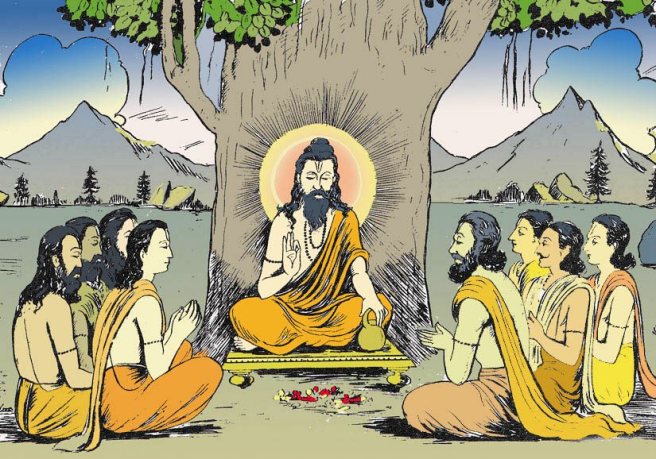
ribhu

Listen and read the Song of Ribhu. Let the words wash over you. These words are not to be analysed and contemplated; they are to sink into your bones and marrow and stir that Ancient Knowing that is already there within you.

Read, chant, have faith (let go into presence) and be free!

1. Ribhu: Listen again the the supreme knowledge that confers liberation immediately. All is Brahman alone, always. All is tranquility – there is no doubt.

Continue reading