
Why you need a practice/teaching
Also see:
–False enlightenment
–Are spiritual teachings prescriptions or descriptions? Sudden vs. gradual teachings
–3 stories of awakening: no path vs sudden path vs gradual paths to enlightenment
-The problem with radical non-duality or neo-advaita
Neo-Advaita (or ‘new advaita’), itself a modern-day term, is used to refer to teachings or communications that do not accept the existence of separation or duality in any way shape or form: there is no seeker, no separation, and therefore no need for a teaching or practice or communication even.
The term ‘neo-advaita’ is often used pejoratively by more traditional Advaita Vedantins, who do advocate teachings and practices, in order to discredit the neo-style ‘communications’. I use the word ‘communications’ when describing neo-advaita rather than teachings as often neo-advaita ‘speakers’ do not like to refer to themselves as teachers or as having teachings, as ‘teaching’ can imply a separation between a seeker who needs to be taught and a teacher who knows something and is teaching something to someone.
Below is a wonderfully instructive excerpt from Talks with Sri Ramana Maharshi that addresses the apparent conflict between the two types of teaching in talk number 57. It is well worth reading. See if you can see some of the parallels and issues that are raised. This excerpt also explains in brief the method of Advaita Vedanta but is also heavily littered with Sanskrit words which may obstruct the understanding for some. I therefore have added some comments in italicised red which I hope are helpful in fully explaining the text’s meaning:
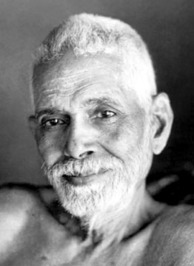
Ramana Maharshi: Some people think that there are different stages in jnana. The Self is nitya aparoksha, i.e., ever-realised, knowingly or unknowingly. Sravana [hearing the teachings], they argue, should therefore be aparoksha jnana (directly experienced) and not paroksha jnana (indirect knowledge). But jnana should result in duhkha nivriti (loss of misery) whereas sravana alone does not bring it about. Therefore they say, though aparoksha, it is not unshaken; the rising of vasanas is the cause of its being weak (not unchanging); when the vasanas are removed, jnana becomes unshaken and bears fruit.
In the first sentence of the above paragraph Ramana hints that there are no stages in Jnana. He then goes on to state that The Self is ever-realised. Sometimes the mind ‘knows’ this, sometimes it doesn’t. Either way the Self is ever-realised as it is what we are, already and always.
The argument that is therefore proposed by some is that because we are already the Self – limitless, whole and complete – just by hearing the teachings that point this out to us (sravana in Sanskrit), we will now knowingly ‘be the Self’ and have a direct experiential understanding of this (aparoksha jnana: ‘direct knowledge’ aparoksha means umediated or direct; jnana means knowledge or understanding and in a spiritual context means liberation or self-realisation), ie. through hearing the teachings alone self-realisation will result. This view is essentially stating that practices such as meditation and contemplation are not required for liberation as we are already fully realised and so no progressive path is required. Only direct pointing out alone is required and all else is illusion.
Ramana then points out the flaw in this argument. He states that the problem with this teaching is that liberation must lead to the cessation of suffering (duhkha nivriti in Sanskrit: duhkha means hurt or pain or suffering; nivriti in this context means cessation) and merely listening to teachings alone does not yield this result. Essentially, whilst mere sravana or listening to the direct teachings can yield direct insight (aparoksha jnana), this insight is weak and not stable, and therefore suffering does not end and the ananda (blissful) aspect of the Self does not materialise, so seeking (which is fuelled by suffering) continues.
This is also my experience with seekers who have been exposed to these teachings. Whilst the can be direct and profound and trigger a realisation of sorts, the effects are often short lived and do not end suffering. This can, in some cases, lead to flip-flopping, in which the sense of liberation seems to come and go, alternating with confusion, seeking and suffering. In many it can also lead to an over-emphasis on concepts, although I am sure this is not the intent.
Ramana explains that the reason why insight is weak is due to the vasanas. Vasanas is a Sanskrit word that I often use in my teachings. It refers to habitual egoic tendencies that, through the force and momentum of ingrained habit, cause us to seemingly re-identify and re-immerse ourselves back into egotism, separation, illusion and suffering. It is the energy and momentum of the egoic vasanas that prevent liberation from appearing to be stable and lasting, even though liberation or the Self is all there is already and always.
Lastly, Ramana states that once the vasanas are removed, then realisation becomes stable and bears the fruit of cessation of suffering, or Ananda (bliss). This is the point of spiritual practices – not to bring liberation about – as that is all there is already and ‘we are That’ – but to remove the habitual wrong notions/beliefs or vasanas that create suffering.
Ramana continues:
Others say sravana is only paroksha jnana [ie. hearing the teachings, sravana, leads only to indirect or intellectual knowledge, paroksha jnana]. By manana (reflection) it becomes aparoksha [direct knowledge] spasmodically. The obstruction to its continuity is the vasanas: they rise up with reinforced vigour after manana. They must be held in check. Such vigilance consists in remembering = “I am not the body” and adhering to the aparoksha anubhava (direct experience) which has been had in course of manana (reflection).
Such practice is called nididhyasana and eradicates the vasanas. Then dawns the sahaja state. That is jnana, sure.
Ramana here explains an alternative theory which in practical terms is a the same argument I explained above as the vasanas have to be removed, but with some technical differences. Here Ramana explains that another view is that listening to the direct teachings (sravana) leads only to intellectual understanding (indirect understanding or paroksha jnana). In order to have a direct understanding or genuine experiential understanding (aparoksha jnana), one has then to reflect on the conceptual teachings (manana) and see the truth of them for oneself in one’s own direct experience. This then leads to spasmodic direct realisation which comes and goes.
We can see that the only difference between this second theory and the first one is that the first theory states that listening to the teachings (sravana) alone leads to direct realisation where as this second theory adds in another stage in which sravana leads to indirect or mere intellectual understanding and this intellectual understanding is converted into direct experiential understanding through reflection (manana). In both cases what results from sravana or sravana-manana is spasmodic unstable direct realisation which comes and goes and alternates with confusion and suffering.
Ramana proceeds to point out that once we have attained a genuine direct insight, the egoic suffering-causing vasanas rise up with a newfound vigor and so the realisation we ‘attained’ is quickly dispelled.
How to dispel the suffering-causing vasanas? Through Nididhyasana, the 3rd stage of the traditional teaching in Advaita Vedanta (the first two stages are Sravana and Manana). The literal translation of Nididhyasana is ‘meditation’ and there are different forms and aspects of this part of the teaching. Here Ramana explains two aspects of Nididhyasana, firstly a conceptual aspect: knowing ‘I am not the body’ or ‘I am not the body-mind’. The second aspect is to remember the experiential insight or direct realisation-experience that was obtained from sravana-manana and remain there.
What then results is removal of the wrong notion ‘I am the limited body-mind’ and removal of the associated habitual tendencies (vasanas) that obstruct suffering. This then results in what is usually termed Samadhi (the 4th and last stage of the traditional Advaita Vedanta teachings), and the culmination of Samadhi is Sahaja Samadhi, what Ramana here calls the Sahaja state. Sahaja means ‘easy’ or ‘natural’ in Sanskrit, so this is the Easy State or Natural State, a synonym for Liberation itself (ie. ‘Jnana sure’ in the text).
I have written several more posts on this and done a few videos that go into this in more detail, so feel free to take a look:
–You are innate divine power
–How to recognise false or incomplete spiritual teachings
–Ramana Maharshi summarises the entire spiritual path in his Introduction to Shankara’s Vivekachudamani (Crest Jewel of Discrimination)
–Essential teachings for liberation: we need a ‘double teaching’ as we suffer from ‘double ignorance’| The ‘two wings’ of the teaching | Buddhism | Vedanta

D.: Is intellectual knowledge enough?
M.: Unless intellectually known, how to practice it? Learn it intellectually first, then do not stop with that. Practise it.
Talks with Sri Ramana Maharshi, Talk 40
Questioner: Is a teacher necessary for instructions?
Ramana Maharshi: Yes, if you want to learn anything new. But here you have to unlearn.
Questioner: Yet a teacher is necessary.
Ramana Maharshi: You have already got what you seek elsewhere. So no teacher is necessary.
Questioner: Is there any use of the man of Realisation for the seeker?
Ramana Maharshi: Yes. He helps you to get rid of your delusion that you are not realised.
Talks with Sri Ramana Maharshi, Talk 434
Questioner: Is an intellectual understanding of the Truth necessary?
Ramana Maharshi: Yes. Otherwise why does not the person realise God or the Self at once, ie. as soon as he is told that God is all or the Self is all? That shows some wavering on his part. He must argue with himself and gradually convince himself of the Truth before his faith becomes firm.
Talks with Sri Ramana Maharshi, Talk 596
Question: Is the study of science, psychology, physiology, etc., helpful for attaining Yoga-liberation or for intuitive understanding of the unity of Reality?
Ramana Maharshi: Very little. Some theoretical knowledge is needed for Yoga and may be found in books, but practical application is what is needed. Personal example and instruction are the most helpful aids. As for intuitive understanding, a person may laboriously convince himself of the truth to be grasped by intuition, of its function and nature, but the actual intuition is more like feeling and requires practical and personal contact. Mere book learning is not of any great use. After Realisation all intellectual loads are useless burdens and are to be thrown overboard.
Talks with Sri Ramana Maharshi, Talk 28
It is those who are not learned that are saved rather than those whose ego has not yet subsided in spite of their learning. The unlearned are saved from the relentless grip of the devil of self-infatuation; they are saved from the malady of a myriad whirling thoughts and words; they are saved from running after wealth. It is from more than one evil that they are saved.
Reality in forty verses – Supplement, verse 36
From ‘Who am I?’
Tom comments: Intellectual understanding has a certain importance – it gives the seeking mind direction and structure. This enables one to peel back the illusion of egotism or Maya, the cause of apparent separation and suffering. Then, theoretical knowledge, once it has fully served its purpose, can be discarded, like the metaphorical thorn used to remove a thorn.

Q: Would you say it’s a choice to pretend I am not Brahman ie. to believe I am the body mind?
Tom: This question is being asked from the ‘I am the body-mind’ point of view. In truth you are Brahman, you have always/will always be Brahman, there is only Brahman, there is no ignorance. The mind may ‘choose’ to identify as Brahman or as the body-mind, but you are not the mind either way.
Q: Does anything stop me from ending all egoic tendencies right now?
Tom: Egoic tendencies are based upon the ‘I am the body-mind notion’
Q. Would you say ignorance is a moment to moment choice?
Tom: Ignorance is not real, so there is no moment to moment choice – only from the point of view of the mind is there this choice – which is an illusory/ignorant point of view ie. to say ignorance is a moment to moment choice is to identify with the body-mind.

The search to end suffering, to gain spiritual knowledge, to attain true spiritual experience and to end confusion is all due to believing you are the body-mind.
The belief ‘I am the body-mind’ is the ignorance that causes all the trouble. This belief is also known as egotism, maya, illusion, duality, separation and samsara. It is a fiction.
In essence you are not the body-mind.
You are in essence That which is Infinite, Eternal, beyond words and speech and concepts.
This is known intuitively already. It is not more conceptual knowledge for the body-mind which is just more ignorance.The words are indicators and are not meant to be more beliefs for the body-mind.
You are That which was before the body-mind was born and will be when the body-mind has gone. You are That which is in deep dreamless sleep. Again this is already intuitively known without thought or words.
There is therefore nothing to seek, nothing to know, nothing to attain, no experience required.
🕉 You are That! 🕉
🕉 Tat Tvam Asi! 🕉
🕉 Be what you are! 🕉

Here are some recent posts from my Facebook page:
Laugh and be happy!
You are the Supreme Spirit!
Just don’t take on wrong identity
Ignorance = the belief that ‘I am limited’
Removal of any and all notions that ‘I am limited’ is Self-Realisation
Intuitively we already know we are beyond all limitation, that our true nature is loving expansive Spirit. This ‘intuitive knowing’ is prior to thought and concepts
As thoughts quieten, spontaneous Joy naturally arises, and we intuitively come to ‘know’ our True Nature as Timeless Being
It is thought that says ‘I am a man/woman, I was born, I will die, etc’
In our ❤️ we already ‘know’ ourselves as Eternal Being
When you (egoically) seek fulfillment and pleasure in sense objects, when you addictively seek pleasure, you are tacitly saying ‘I am limited, I am small, I am incomplete, I need something to complete me’.
In essence you are identified with the body (ie. ignorance is in operation) and thereby you deny your Innate Divinity and suffer.
Before you were born, what were you? You were Nothing/The Formless/The Absolute.
When you die you will go back to this Nothing/The Formless/The Absolute.
Now too you are That Formless Nothing, that which cannot be known by thought/the mind, but That-Which-Is.
Only taking yourself to be the body (body-mind) do you stress, ask questions, have doubts, argue, suffer and seek.
‘I WAS ONE WITH EVERYTHING’
All these ‘spiritual’ experiences such as ‘I had a wonderful experience in which I felt one with everything’ or ‘I felt as if I was Brahman’ or ‘There was a sense of timelessness’, etc, etc, etc…
…All these experiences are more illusion.
Why? All these experiences are for the body-mind that you falsely take yourself to be…these experiences come and go, they appear then disappear, like all experiences.
Are you the body-mind? Is that your primary identity?
…You are not the body-mind!
You are That!
That thou art!
🕉 Tat Twam Asi! 🕉
❤️❤️❤️
THE PURPOSE OF TRUE SPIRITUAL TEACHINGS
The purpose of all spiritual teachings and practices is to remove ignorance and the vasanas (egoic habitual tendencies), and so end suffering.
There is nothing to gain. No special knowledge or experience. You are already That. Just lose the ignorance.
In truth spiritual practices and teachings are more illusion. There is no teacher, there is no teaching, there is no taught. Ignorance itself is more illusion. There is no real ignorance.
However as a belief that ‘I am a body mind’ has arisen, the teacher and teaching appear to also arise. This is known as ignorance.
This is because you take yourself to be limited. You take yourself to be a body mind.
Do not take yourself to be the body-mind!
You are That!
You are That Eternal Nothingness!
❤
THE ROOT CAUSE OF SUFFERING
The search to end suffering, to gain spiritual knowledge, to attain true spiritual experience and to end confusion is all due to believing you are the body-mind.
The belief ‘I am the body-mind’ is the ignorance that causes all the trouble. This belief is also known as egotism, maya, illusion, duality, separation and samsara. It is a fiction.
In essence you are not the body-mind.
You are in essence That which is Infinite, Eternal, beyond words and speech and concepts.
This is known intuitively already. It is not more conceptual knowledge for the body-mind which is just more ignorance.The words are indicators and are not meant to be more beliefs for the body-mind.
You are That which was before the body-mind was born and will be when the body-mind has gone. You are That which is in deep dreamless sleep. Again this is already intuitively known without thought or words.
There is therefore nothing to seek, nothing to know, nothing to attain, no experience required.
🕉 You are That! 🕉
🕉 Tat Tvam Asi! 🕉
🕉 Be what you are! 🕉
The irony is that the entire spiritual teaching is literally and figuratively within us! Don’t be concerned with knowledge or experiences. They are all to do with the body. Be what you are! That which never comes and goes! That which is in deep sleep! That which was before the body was born! Tat Tvam Asi!

The conviction that your primary identity is this limited vulnerable perishable body-mind is itself intolerable suffering
🕉
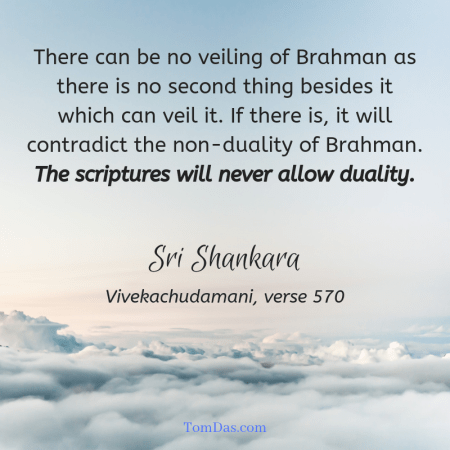
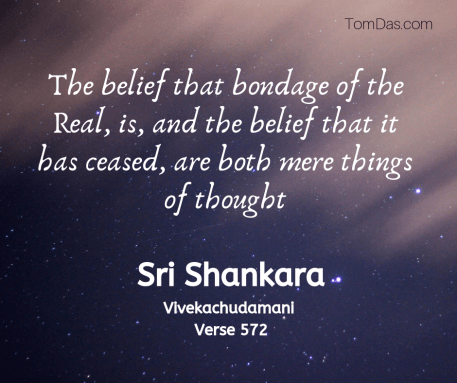
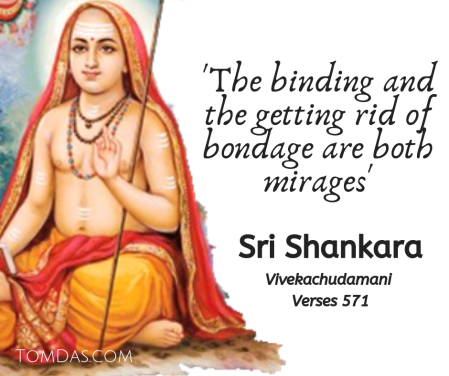
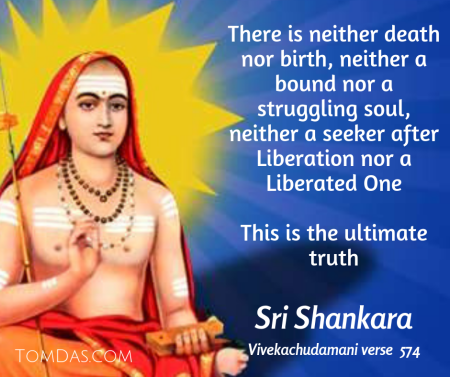
Right at the end of his masterpiece entitled Vivekachudamani (which essentially means ‘The Highest or Supreme Wisdom’), Shankara makes a series of radical and emphatic non-dual declarations which he states is the highest or ultimate truth.
In his usual style, he reinforces the point he wishes to make in successive verses, building up to a crescendo which culminates in verse 574, the most famous of these verses.
This well-known verse was actually copied by Shankara from The Upanishads and is also found in the works of Sri Gaudapada, Shankara’s guru’s guru.
In the following excerpt from Talks with Sri Ramana Maharshi, Ramana concisely outlines the problem (suffering), its cause (ignorance) and its remedy (self-knowledge). First Ramana says that the fact that one considers oneself to be limited is the essential problem. This arising of the notion of ‘I’ is a notion of limitation, and it is to this limited notion that ‘the world’ appears. It is this limited entity ‘I’ (ego) that then seeks various things, including self-realisation, and so suffers more.I have added bold type for emphasis and my comments are italicised in red:
The fact is that the man considers himself limited and there arises the trouble. The idea is wrong. He can see it for himself. In sleep there was no world, no ego (no limited self), and no trouble. Something wakes up from that happy state and says ‘I’. To that ego the world appears. Being a speck in the world he wants more and gets into trouble. How happy he was before the rising of the ego!
Now Ramana prescribed the remedy, after restating that it is this limited ‘ego’ that is the cause of the ‘trouble’, ie. suffering:
Only the rise of the ego is the cause of the present trouble. Let him trace the ego to its source and he will reach that undifferentiated happy state which is sleepless sleep. The Self remains ever the same, here and now. There is nothing more to be gained. Because the limitations have wrongly been assumed there is the need to transcend them.
To illustrate the point that there is nothing to be gained, that we are already essentially whole, and that the problem is simply one of ignorance or ‘wrong assumptions’, Ramana narrates two traditional stories – ‘the tenth man’ and ‘the woman wearing a necklace’:
It is like the ten ignorant fools who forded a stream and on reaching the other shore counted themselves to be nine only. They grew anxious and grieved over the loss of the unknown tenth man. A wayfarer, on ascertaining the cause of their grief, counted them all and found them to be ten. But each one of them had counted the others leaving himself out. The wayfarer gave each in succession a blow telling them to count the blows. They counted ten and were satisfied. The moral is that the tenth man was not got anew. He was all along there, but ignorance caused grief to all of them.
Again, a woman wore a necklace round her neck but forgot it. She began to search for it and made enquiries. A friend of hers, finding out what she was looking for, pointed out the necklace round the seeker’s neck. She felt it with her hands and was happy. Did she get the necklace anew? Here again ignorance caused grief and knowledge happiness.
Similarly also with the man and the Self. There is nothing to be gained anew. Ignorance of the Self is the cause of the present misery; knowledge of the Self brings about happiness.
Ramana now provides the seeking mind/ego with some elementary logic to underpin his case. If liberation were something to be gained, it could also be lost. How so? Because logically if something can be attained, it can also be lost. Therefore something gained cannot be permanent. Liberation, or ‘salvation’ as it is written below, is permanent only because it is already totally and fully here – already! Ramana continues writing that it only seems that ‘Wisdom’ seems to be attained once the ignorance is removed, but really wisdom was already ‘ever present’:
Moreover, if anything is to be got anew it implies its previous absence. What remained once absent might vanish again. So there would be no permanency in salvation. Salvation is permanent because the Self is here and now and eternal. Thus the man’s efforts are directed towards the removal of ignorance. Wisdom seems to dawn, though it is natural and ever present.
The visitor, while taking leave, saluted the master, and said, “It is said that the victim in the tiger’s mouth is gone for ever.” The reference is to a passage in Who am I? where it is stated that a disciple can never revert to the world after he has once fallen into the field of the Guru’s gracious look as surely as the prey in the tiger’s jaws cannot escape.
Excerpt from Talks with Sri Ramana Maharshi, Talk 63
Oh yes! Once we have felt the Guru’s gracious look, once we have felt the Presence of the Maharshi, we are already in the Tiger’s Mouth. We are already in His Clutches. There is no going back! The Self will surely reel us in and chew us (the ego or ignorance) up!
Below is a testimonial I have just received. I’m always grateful to receive a testimonial from someone who has benefited from what I share. Writing a testimonial is not only a wonderful way to express thanks, but it is an opportunity to reflect on the impact the teachings have made. It’s also nice for me to see how what I share has positively affected others, and to share that with you too.
I have been working in 1 to 1 sessions with people around the world over the last few years, and many have found that in just a few sessions they are able to find great clarity where perhaps before there was varying degrees of confusion.
If you would like to read other testimonials click here. Or if you have been positively impacted by what I share and would like to write a testimonial, or arrange a 1 to 1 session with me, then please contact me using the contact link above.
Here is the testimonial I received today:
‘I chanced upon Tom’s website at a very interesting time in my journey. I had studied traditional Vedanta for many years. I had some good understanding about the concepts and was doing some serious self inquiry or Atma Vichara. That’s when I started tying myself into all sorts of knots. I wasted a lot of time confused by concepts and was in a very frustrated place until I spoke to Tom.
I believe things happen for a reason and you meet the right people at the right time in the journey. Within a couple of sessions, Tom was able to help me unravel some of these knots. As the layers started peeling off and more layers and depth opened up the journey started taking a different shape. Throughout this, Tom was able to ask just the right question and clarified many concepts that would have otherwise taken a life of their own.
I found his teaching style refreshingly down to earth and humble and since he was able to speak from his direct experience, it made everything so real and relatable.’

