Shankara: the body and mind are symptoms of ignorance | Advaita Vedanta | Nisargadatta Maharaj

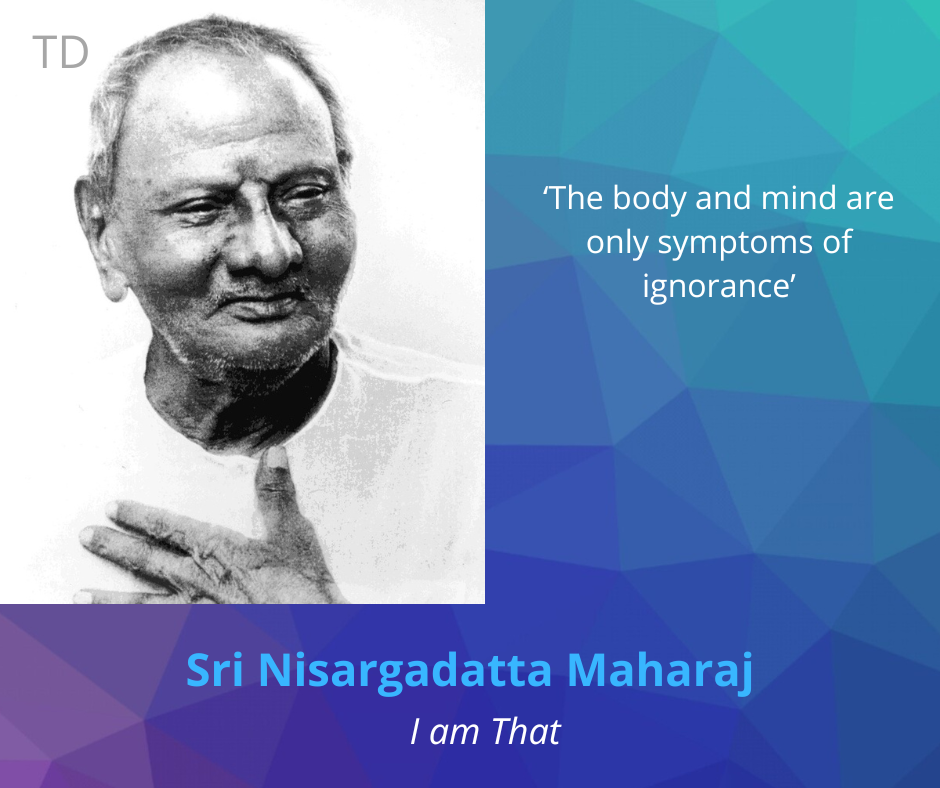
Sri Shankara, both in his commentaries and in his shorter works, often writes that the body and mind are symptoms (or effects) of ignorance, and when ignorance goes, the symptoms or effects of ignorance also go.

He also writes that the body, mind and world can never have any connection whatsoever with What You Truly Are, the Self, Pure Consciousness – and that only through ignorance can a connection between the two appear to be there.

eg. In Vivekachudamani Shankara writes:

195. But for delusion there can be no connection of the Self – which is unattached, beyond activity and formless – with the objective world, as in the case of blueness etc., with reference to the sky.

196. The Jivahood of the Atman, the Witness, which is beyond qualities and beyond activity, and which is realised within as Knowledge and Bliss Absolute – has been superimposed by the delusion of the Buddhi, and is not real. And because it is by nature an unreality, it ceases to exist when the delusion is gone.

197. It exists only so long as the delusion lasts, being caused by indiscrimination due to an illusion. The rope is supposed to be the snake only so long as the mistake lasts, and there is no more snake when the illusion has vanished. Similar is the case here.

198-199. Avidya or Nescience and its effects are likewise considered as beginningless. But with the rise of Vidya or realisation, the entire effects of Avidya, even though beginningless, are destroyed together with their root – like dreams on waking up from sleep. It is clear that the phenomenal universe, even though without beginning, is not eternal – like previous non-existence.

200-201. Previous non-existence, even though beginningless, is observed to have an end. So the Jivahood which is imagined to be in the Atman through its relation with superimposed attributes such as the Buddhi, is not real; whereas the other (the Atman) is essentially different from it. The relation between the Atman and the Buddhi is due to a false knowledge.

202. The cessation of that superimposition takes place through perfect knowledge, and by no other means. Perfect knowledge, according to the Shrutis, consists in the realisation of the identity of the individual soul and Brahman.

205. When the unreal ceases to exist, this very individual soul is definitely realised as the eternal Self. Therefore one must make it a point completely to remove things like egoism from the eternal Self.

Here Sri Nisargadatta also says the same:


The importance of spiritual practice to attain liberation | Sri Ramana Maharshi | Sri Shankara

The following is from a text written by Shankara called Vivekachudamani, as translated by Sri Ramana Maharshi. We will see the following points being made:

  1. Merely stating ‘I am Brahman’ does not in itself lead to liberation. Similarly we can infer that by mere affirmation of other similar spiritual slogans such as saying ‘I am free’ or ‘I am already the Self’ or ‘there is no ego/self’ or ‘all is already one’, etc, mere affirmation of these does not lead to liberation.
  2. In order to attain liberation, ignorance must be removed and the Self must directly be experienced.
  3. Similarly, merely by hearing the truth ‘I am Brahman’ , liberation is not (usually) attained
  4. One must first hear the truth from someone who has experienced the truth first-hand (for only they will be able to tell you the way to truth)
  5. Then one must meditate upon the truth heard and experience the truth directly though constant meditation.
  6. Unless this practice is carried out, maya (aka ignorance) will not be removed and liberation will not be attained.
  7. Every effort must be made to root out ignorance for liberation to result

‘Just as a person’s sickness is not removed without taking medicine, so too his state of bondage is not removed by scriptural texts such as “I am Brahman” without his own direct experience of the Self. One does not become a king by merely saying, “I am a king”, without destroying one’s enemies and obtaining the reality of power.

Similarly, one does not obtain liberation as Brahman Itself by merely repeating the scriptural text “I am Brahman”, without destroying the duality caused by ignorance and directly experiencing the Self.

‘A treasure trove hidden under the ground is not obtained by merely hearing about it, but only by being told by a friend who knows it, and then digging and removing the slab that hides it and taking it out from below the ground.

Similarly, one must hear about one’s true state from a Guru who knows Brahman, and then meditate upon It and experience It directly through constant meditation.

‘Without this, the true form of one’s own Self, that is hidden by maya [“that which is not”], cannot be realised through mere argumentation. Therefore, those who are wise themselves make every effort to remove the bondage of individual existence and obtain liberation, just as they would to get rid of some disease.’

Also see: Sri Ramana Maharshi: the necessity of Meditation

Vivekachudamani by Sri Shankara: Resources and PDF downloads | Translation by Sri Ramana Maharshi | Advaita Vedanta | Crest Jewel of Discrimination

Here are some resources and links relating to this superb traditional Advaita Vedanta text that gives us a step-by-step method for Self-Realisation and Liberation.

Attributed to Sri Shankara, written approximately 1400 years ago, Vivekachudamani (‘The Crest Jewel of Discrimination’ or the ‘The Highest Treasure of Wisdom’) was also recommended by Sri Ramana Maharshi who said this text explains ‘…in detail the points that have to be grasped by those who seek liberation, and thereby directing them to the true and direct path‘:

Shankara’s Vivekachudamani as translated by Sri Ramana Maharshi: https://tomdas.com/2019/03/04/vivekachudamani-as-translated-by-sri-ramana-maharshi/

Sri Ramana’s introduction to Vivekachudamani where he summarises the entire path to liberation: https://tomdas.com/2019/02/25/ramana-maharshis-introduction-to-shankaras-crest-jewel-of-discrimination-vivekachudamani-and-summary-of-its-teachings/

The 10 most important verses of Vivekachudamani as selected by Sri Ramana Maharshi: https://tomdas.com/2020/05/14/the-ten-most-important-verses-of-shankaras-vivekachudamani-according-to-sri-ramana-maharshi/

Is Vivekachudamani sexist? https://youtu.be/VPZw6cgczLw

A more traditional verse by verse translation of Vivekachudamani by Swami Madhavananda: https://tomdas.com/2018/10/01/vivekachudamani-crest-jewel-of-discrimination-by-shankara/

A more accurate verse by verse translation of Vivekachudamani with word for word transliteration and translation by Achyarya Pranipata Chaitanya:

Both thought and trying to get rid of thought are illusory mirages of separation

Objection:
The assumption that thought is an actual thing and that thought has a source, arises only in the realm of imaginary separation. There is, by definition, no way to determining the imaginary source of an imaginary thing.

Tom:
Whilst it is true that thought is ultimately an illusion, and trying to get rid of thought is also more of the same illusion, there is a logical flaw in this objection, as follows: thoughts may be imaginary, but that does not mean their source is imaginary. Fiction or imagination can have a real source. The teaching is to locate that Source (the Self) and abide there in Pure Being, which is devoid of thought, until the tendency to imagine duality (ie. thought) ceases.

Here are two quotes to illustrate the above points, one from Sri Shankara, and one from Sri Ramana:

The binding, and the getting rid of bondage, are both mirages. The belief that bondage of the Real, is, and the belief that it has ceased, are both mere things of thought

~Sri Shankara, Vivekachudamani verses 571 and 572

All doubts will cease only when the doubter and his source have been found. There is no use removing doubts. If we clear one doubt, another doubt will arise and there will be no end of doubts.

~Sri Ramana Maharshi, Day by Day with Bhagavan

Quieten your mind! (Shankara on Nirvikalpa Samadhi and Brahma-Vidya/Self-Realisation) Swami Chinmayananda’s commentary on Vivekachudamani

Vivekacchudamani Vivekachoodamani Shankara Swami Chinmayananda

Tom: I highly recommend this version of Shankara’s Vivekachudamani, which is complete with detailed commentary by Swami Chinmayananda on every verse in case there is any doubt of the meaning of the text. You can download a copy of the text here but I recommend you buy a print copy:

Talks on Vivekachoodamani

[Edit May 2023: I have asked to remove the PDF of this work by Chinmayamission]

Shankara’s Vivekachudamani, verse 366:

  1. By nirvikalpa samadhi the true nature of Brahman is clearly and definitely manifest, never otherwise, for then, the mind being unsteady, is apt to be mixed with other perceptions.

Swami Chinmayananda’s Commentary:

In the condition of nirvikalpa samadhi alone can this great Reality be apprehended with certainty. With cent per cent certainty you apprehend the Truth when all the waves and ripples in your mind have ended. Sankara is positive and declares, ‘Never by any other method’; bringing the mind to quietude is the only method.

To quieten the mind there are many methods. You may quieten your mind through devotion, or through knowledge, or through karma-yoga or through pranayama. Whether standing on the head or sitting down, whether by going to the Himalayas or by living in your own home – you have the freedom to choose these – but your mind you must quieten.

The mind’s nature is to be constantly active. ‘Thought flow’, it is called. Therefore, it is impossible to realise the changeless Self with the mind, which, by its very nature is unstable. Whenever you try to grasp anything through the mind and intellect, the object of knowledge gets entangled in your own thought patterns. Pure Self can never be understood [Tom: Brihadaranyaka Upanishad states that Brahman is unknowlable, see ‘Another definition of Jnana’ here for more], so all that you understand about the Atman through the mind and intellect is Saguna Brahman and not Nirguna Brahman.

The unconditioned Absolute is never understood; you just become It when the mind ends [Tom: also compare with Ulladu Narpadu – invocation verse 1 and verses 8, 12 and 21 which essentially state the same]. As long as you look at It through the mind. It is only the conditioned, the limited (Saguna) version of the eternal absolute Self.

Also see:

Do we need to turn away from the world of objects to realise the Self?

Shankara on the Mind, Samadhi (stillness of mind), Manonasa (destruction of mind), and Liberation

Sri Ramana Maharshi – Turn Within (Guided Meditation & Quotes)

HOW TO END EGO-SUFFERING (and why other spiritual paths tend not to ultimately work)

Turn Within? Really? Isn’t this dualistic and doesn’t this just strengthen the ego?

The Ten most important verses of Shankara’s Vivekachudamani according to Sri Ramana Maharshi

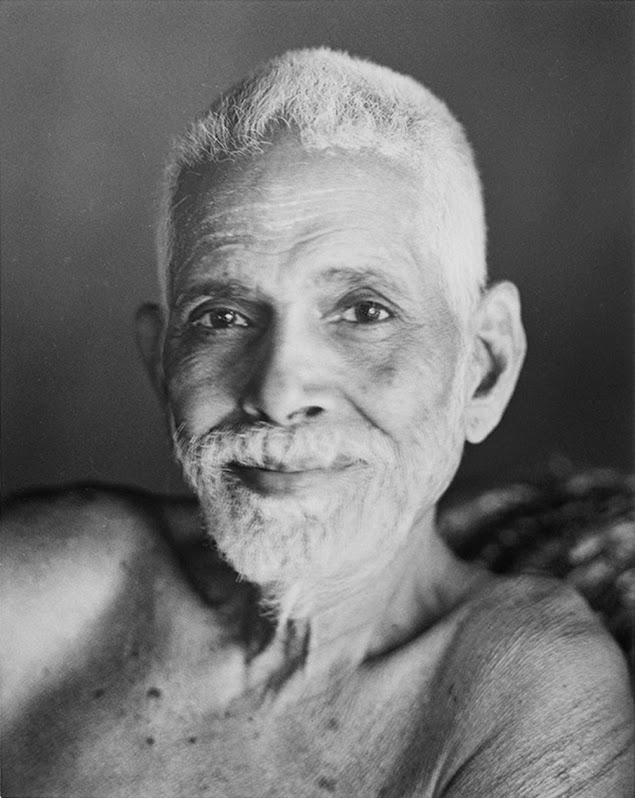
ramana-maharshi face
Sri Ramana Maharshi

Ramana Maharshi stated that Shankara’s text Vivekachudamani contains in detail all the points required for a seeker of liberation ‘thereby directing them to the true and direct path‘.

Vivekachudamani contains 580 verses. Ramana Maharshi evidently placed this text in high regard, so much so that he translated the entire text into Tamil for those who could not read or understand the original Sanskrit. He also selected what he felt were the ten most important verses, which are as follows:

The ten most Significant Verses From Sri Sankara’s Vivekachudamani

As selected by Sri Ramana Maharshi

1. Among things conducive to Liberation, devotion (Bhakti) holds the supreme place. The seeking after one’s real nature is designated as devotion. (Verse 31)

2. The Supreme Self, the eternal, indivisible, non-dual Consciousness, the Witness of buddhi and the rest, is other than the real (Sat) and the unreal (asat), and is the ultimate significance of the notion conveyed by the term ‘I’. It is the immediate Reality, the embodiment of Bliss. (Verse 351)

3. Different from matter (prakriti) and its modifications is the Supreme Self, of the nature of pure Knowledge. It is Absolute and directly manifests the entire gross and subtle universe, in waking and other states, as the substratum of the steady sense of egotism. It manifests Itself as the Witness of the intellect (buddhi). (Verse 135)

4. That which clearly manifests itself in the waking, dream and deep sleep states; that which shines inside uniformly and continuously as I-I; witnesses the ego, the intellect etc, which are of different forms and modifications; which shines as Eternal bliss (nitya ananda) and consciousness (chit), know this, within your heart, as your own Self. (Verse 217)

5. With a regulated mind and a purified intellect, directly know yourself as the essential Self, in the form ‘This I Am’. Cross the shoreless ocean of worldy existence (samsara) with its waves of births and deaths. Firmly established as Brahman, which is your own true essence, be blessed (Verse 136)

6. The self-shining witness (sakshi) of everything, this Atman shines eternally, in the sheath of the intellect (vijnanakosha). Making this Atman, which is distinct from the unreal, the aim of contemplation, meditate upon It as your own Self, eliminating all other thoughts (Verse 380)

7. Extremely subtle is the Truth of the Self Supreme, and it is not discernible to the gross vision (of the mind). It is knowable to the noble-minded of very pure intellect, through samadhi, brought about by an extraordinarily subtle mind. (Verse 360)

8. Thus purified by constant practice when the mind merges with Brahman, then Samadhi passes from the Savikalpa stage [where objects still arise] to the Nirvikalpa stage [where no objects arise], leading directly to the experience of the Bliss of Brahman, the Non-dual. (Verse 362)

9. By this [Nirvikalpa] Samadhi are destroyed all the knots of vasanas and all karma is destroyed. One‘s Real Nature (swarupa) manifests spontaneously and effortlessly, forever, everywhere and always, within and without. (Verse 363)

10. In the cave of the intellect, there is the Brahman, the Supreme non-dual Reality, distinct from [relative] truth (sat) and untruth (asat). One who dwells in this cave as Brahman has no rebirth*. (Verse 266)

*Tom: The literal rendering of this last line of verse 266 is a play on the word ‘cave’ and states ‘One who dwells in this cave as Brahman does not enter into the cave of the body’. The ‘word ‘cave’ is used in the Upanishads to describe the location of Brahman, whilst ‘cave of the body’ refers to the mother’s womb, which in turn refers to rebirth in samsara and continued suffering.


Sri Ramana Maharshi also said that the entirety of Advaita Vedanta can be found in in verse 170 of Vivekacudamani:

170. In dreams, when there is no actual contact with the external world, the mind alone creates the whole universe consisting of the experiencer, etc. Similarly in the waking state also, there is no difference. Therefore all this [phenomenal universe] is the projection of the mind.

Shankara: the highest truth

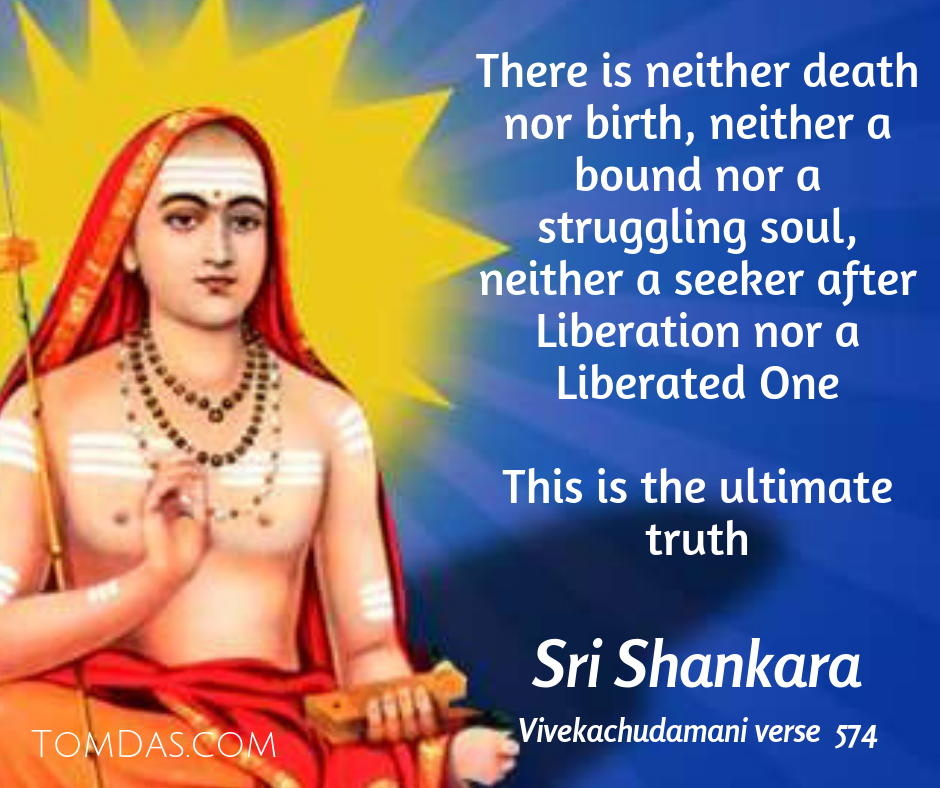
Right at the end of his masterpiece entitled Vivekachudamani (which essentially means ‘The Highest or Supreme Wisdom’), Shankara makes a series of radical and emphatic non-dual declarations which he states is the highest or ultimate truth.

In his usual style, he reinforces the point he wishes to make in successive verses, building up to a crescendo which culminates in verse 574, the most famous of these verses.

This well-known verse was actually copied by Shankara from The Upanishads and is also found in the works of Sri Gaudapada, Shankara’s guru’s guru.

Om and blessings!

🕉

Shankara the scriptures will never allow duality

Shankara bondage is mere thought

Shankara bondage is a mirage

Shankara no seeker no liberation

Shankara: Neither by Yoga, nor by Sankhya, nor by work, nor by learning, but by the realization of one’s identity with Brahman is Liberation possible, and by no other means.

5bcbc2e6adc6ac9dfb690a3edcb64ab2_l

Q. Tom, I appreciate this essay very much. I once got into quite an intense discussion with my Vēdānta teacher over this topic. We had just completed Panchadasi. The need for Silence (Samadhi) in conjunction with Self Inquiry was quite explicit in the text. And as you mention the Upanishads state the same.

I do have a question for you. In Vivekachudamani, Shankara makes contradictory statements about attainment. On one hand he extols the importance of meditation and knowledge. And then he seems to negate them. “Neither by Yoga, nor by Sankhya, nor by work, nor by learning, but by the realization of one’s identity with Brahman is Liberation possible, and by no other means.” (verse 56).

Krsna in Gita specifically says one can attain self realization by either approaches. (I understand that self realization, by some definitions is but a stage on the way to Unity.) This might be another conversation.

Is not realization of Brahman the final result of Yoga and Knowledge? If we understand Yoga to be Samadhi, which purifies deep rooted vasanas resulting in calmness. And Knowledge arrived at, on one hand, through direct experience in meditation and on the hand through scriptural study, finally resulting in discrimination between self and non self…

Then further on he extols Niddhyasana (long unbroken meditation/Nirvakalpa Samadhi) as the last step after hearing and contemplating the teachings. Patanjali defines Samadhi as Yoga. So Yoga seems to enter the picture again.

How do we reconcile these apparent contradictions?


Tom: Hi, this is a great question and thankfully is easily resolved in the context of the text Vivekachudamani.

Some modern Vedanta teachers insist that in Vedanta words are used in a very precise way, but for anyone who has read the scriptures in Sanskrit for themselves, nothing could be further from the truth. In the original Sanskrit language, the same words are used in a variety of different ways depending on the context, and it is up to the reader to discern this. eg. words such as Atman, Jnana, etc are used in a variety of ways, and traditional commentaries such as Shankara’s commentaries acknowledge this too.

It is usually quite easy to discern the meaning of the words you when you look at the context – usually this simply means to look at the verses either side of the verse in question. In most Vedanta texts, as with most texts in general, a single point is often made across a series of thematically related verses (or sentences). In Vedanta texts, the beginning and end of a section is not clearly marked, but they are easy to spot if you are looking for them:

Now with this in mind, lets look at Vivekachudamani verse 56, which you raise:

56. Neither by Yoga, nor by Sankhya, nor by work, nor by learning, but by the realisation of one’s identity with Brahman is Liberation possible, and by no other means.

Firstly, note the preceding verses that are in this section, starting at verse 51:

51. A father has got his sons and others to free him from his debts, but he has got none but himself to remove his bondage.

52. Trouble such as that caused by a load on the head can be removed by others, but none but one’s own self can put a stop to the pain which is caused by hunger and the like.

53. The patient who takes (the proper) diet and medicine is alone seen to recover completely – not through work done by others.

54. The true nature of things is to be known personally, through the eye of clear illumination, and not through a sage: what the moon exactly is, is to be known with one’s own eyes; can others make him know it?

55. Who but one’s own self can get rid of the bondage caused by the fetters of Ignorance, desire, action and the like, aye even in a hundred crore of cycles?

The theme is clearly that one has to do the work for oneself in order to attain liberation, and that no other, sage or otherwise, can do this work for you.

Now lets look at the verses that follow verse 56 in the same section:

57. The beauty of a guitar’s form and the skill of playing on its chords serve merely to please a few persons; they do not suffice to confer sovereignty.

58. Loud speech consisting of a shower of words, the skill in expounding the Scriptures, and likewise erudition – these merely bring on a little personal enjoyment to the scholar, but are no good for Liberation.

59. The study of the Scriptures is useless so long as the highest Truth is unknown, and it is equally useless when the highest Truth has already been known.

60. The Scriptures consisting of many words are a dense forest which merely causes the mind to ramble. Hence men of wisdom should earnestly set about knowing the true nature of the Self.

61. For one who has been bitten by the serpent of Ignorance, the only remedy is the knowledge of Brahman. Of what avail are the Vedas and (other) Scriptures, Mantras (sacred formulae) and medicines to such a one?

62. A disease does not leave off if one simply utter the name of the medicine, without taking it; (similarly) without direct realisation one cannot be liberated by the mere utterance of the word Brahman.

63. Without causing the objective universe to vanish and without knowing the truth of the Self, how is one to achieve Liberation by the mere utterance of the word Brahman? — It would result merely in an effort of speech.

64. Without killing one’s enemies, and possessing oneself of the splendour of the entire surrounding region, one cannot claim to be an emperor by merely saying, ‘I am an emperor’.

65. As a treasure hidden underground requires (for its extraction) competent instruction, excavation, the removal of stones and other such things lying above it and (finally) grasping, but never comes out by being (merely) called out by name, so the transparent Truth of the self, which is hidden by Maya and its effects, is to be attained through the instructions of a knower of Brahman, followed by reflection, meditation and so forth, but not through perverted arguments.

66. Therefore the wise should, as in the case of disease and the like, personally strive by all the means in their power to be free from the bondage of repeated births and deaths.

The theme here is a warning against superficial teachings and the lack of true spiritual practice. This is a warning about teachings that do not recommend meditation and deep spiritual practice and a warning against teachings of no-effort, such as what is sometimes nowaday called neo-advaita. Let us see:

Merely repeating the words (verse 58) and intellectual study of the scriptures (verses 59-61) is not enough. Just proclaiming ‘I am Brahman’ or ‘I am That’ (verse 62 and 64) is not enough. We have not only to read the teachings but put them into practice (‘take the medicine’ cf. verse 62).

Verse 63 lays it out more clearly – what is the practice we have to do? What is the medicine we have to not only read about but actually swallow? We have to efface the body, mind and world and enter into Samadhi (’cause the objective world to vanish’).

This is emphasised in verse 65 where Shankara once again recommends the path of sravana – hearing the teachings, manana – reflecting upon the teachings and nididhyasana – meditation as described in verse 63.

Verse 66 then encourages the seeker to make effort to strive along this path, and not to fall short, not to follow paths that are mere verbal talk without ‘causing the objective world to vanish’ (verse 63).

So in conclusion, it is clear, from the context, that Shankara is admonishing superficial teachings only, and not the true path that he subsequently goes on to explain and recommend.


Lastly, let us look to someone who always preached the true Vedantic teachings, from their heart, but also as found in the scriptures, our Bhagavan Sri Ramana Maharshi. What does he write in ‘Who am I?’, questions 4 and 5?

Question 4. When will the realization of the Self be gained?
Ramana Maharshi: When the world which is what-is-seen has been removed, there will be realization of the Self which is the seer.

Question 5. Will there not be realization of the Self even while the world is there?
Ramana Maharshi: There will not be.


Shankara: characteristics of a perfected sage or Jnani

Shankara shankaracharya

Om!

Praise to Sri Shankara!

Praise to those custodians of this wonderful knowledge and teaching!

Praise to the Self,

One and supreme in all its effulgent glory!

May we all be happy and free!

May we all realise the Self!

Om!
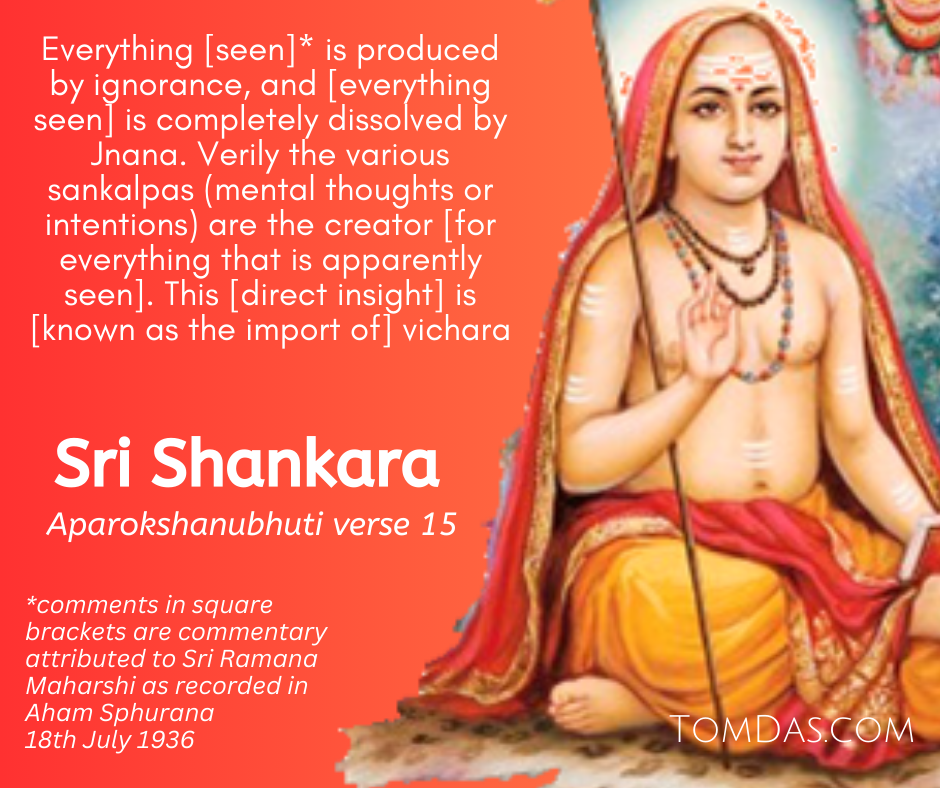
In his text Vivekachudamani Shankara writes 18 verses describing the Jnani (literally ‘knower’ or ‘one who knows’) or perfected sage, starting at verse 535. My comments are in blue throughout.

Unattached and self-satisfied:

In these first few of these verses, the theme is a lack of attachment to the phenomenal world. Shankara uses phrases such as ‘he is neither grieved nor elated by sense objects’…’neither attached nor adverse to them [sense objects]… ‘without anxiety or humiliation’…’without fear’…’unattached to external things’…’experiences all sorts of sense objects as they come’. We can see that while the sage is (naturally) unattached, there is also no attempt to be detached either (which would actually be a form of attachment or striving).

Often detachment from sense-objects is emphasised at the level of a seeker engaging in sadhana (spiritual practice), but now there is no ignorance, there is no need to emphasise either detachment or attachment. A natural state of balance has been naturally achieved now the distorting/unbalancing effect of ignorance is no longer at play:

535. Satisfied with undiluted, constant Bliss, he is neither grieved nor elated by sense-objects, is neither attached nor averse to them, but always disports with the Self and takes pleasure therein.

536. A child plays with its toys forgetting hunger and bodily pains; exactly so does the man of realisation take pleasure in the Reality, without ideas of “I” or “mine”, and is happy.

In these above 2 verses, it is interesting to note that the flip-side of natural detachment is a natural resting in the ‘undiluted, constant Bliss’ of the Self. The Sage, completely satisfied by the self, does not notice or mind the suffering of the body. The resultant natural side effect of this is lack of both attachment and aversion to sense objects. Note that this means there is no need for supression of emotions or feelings or fear of any other phenomena.

The next 2 verses comment on the free-living aspect of the Jnani. The jnani is without self-image and finds the earth to be their home. Being without self-image, they do not necessarily dress or look a certain way (‘wears no outward mark’), and they allow what comes to come, and what goes to go. This last point is the same as stating there is no attachment or aversion to sense objects, and in verse 538 it is compared to the innocence of a child:

537. Men of realisation have their food without anxiety or humiliation by begging, and their drink from the water of rivers; they live freely and independently, and sleep without fear in cremation grounds or forests; their clothing may be the quarters themselves, which need no washing and drying, or any bark etc., the earth is their bed; they roam in the avenue of the Vedanta; while their pastime is in the Supreme Brahman.

538. The knower of the Atman, who wears no outward mark and is unattached to external things, rests on this body without identification, and experiences all sorts of sense-objects as they come, through others’ wish, like a child.

You can’t tell a jnani by clothes, behaviour, sex or age:

539. Established in the ethereal plane of Absolute Knowledge, he wanders in the world, sometimes like a madman, sometimes like a child and at other times like a ghoul, having no other clothes on his person except the quarters, or sometimes wearing clothes, or perhaps skins at other times.

The sage can enjoy sense objects, but fundamentally cares not for them:

540. The sage, living alone, enjoys the sense-objects, being the very embodiment of desirelessness – always satisfied with his own Self, and himself present at the All.

The many appearances of a Jnani:

Not caring one iota for self-image, the Jnani may appear in multiple forms, but cares not about whether they are a king or a pauper, well revered or despised:

541. Sometimes a fool, sometimes a sage, sometimes possessed of regal splendour; sometimes wandering, sometimes behaving like a motionless python, sometimes wearing a benignant expression; sometimes honoured, sometimes insulted, sometimes unknown – thus lives the man of realisation, ever happy with Supreme Bliss.

542. Though without riches, yet ever content; though helpless, yet very powerful, though not enjoying the sense-objects, yet eternally satisfied; though without an exemplar, yet looking upon all with an eye of equality.

The ‘eye of equality’ naturally arises when one does not prefer one set of sense-objects (ie. experiences) over another set. This lack of preference naturally occurs when one realises the Self and is satisfied as the Self.

The next verse juxtaposes the relative (doing, experiencing, possessing a body, limited)  with the absolute (inactive, untouched, unidentified, omnipresent), indicating that we can speak of reality using either set of langauge:

543. Though doing, yet inactive; though experiencing fruits of past actions, yet untouched by them; though possessed of a body, yet without identification with it; though limited, yet omnipresent is he.

The next verse goes one step further, showing that in truth the Jnani is nothing but the absolute in which there is not even the idea of a body, despite the appearance of one appearing:

544. Neither pleasure nor pain, nor good nor evil, ever touches this knower of Brahman, who always lives without the body-idea.

545. Pleasure or pain, or good or evil, affects only him who has connections with the gross body etc., and identifies himself with these. How can good or evil, or their effects, touch the sage who has identified himself with the Reality and thereby shattered his bondage ?

Just as the sun appears to be ‘swallowed’ and destroyed when it sets, a jnani appears to have a body and act. In reality, just as the sun is not ‘swallowed’ or destroyed at sunset, the jnani is ever-bodiless, as are all of us. It is only ignorance that makes us believe otherwise:

546. The sun which appears to be, but is not actually, swallowed by Rahu, is said to be swallowed, on account of delusion, by people, not knowing the real nature of the sun.

547. Similarly, ignorant people look upon the perfect knower of Brahman, who is wholly rid of bondages of the body etc., as possessed of the body, seeing but an appearance of it.

549. As a piece of wood is borne by the current to a high or low ground, so is his body carried on by the momentum of past actions to the varied experience of their fruits, as these present themselves in due course.

This next verse employs the beautiful imagery of comparing the Self to a pivot on a potter’s wheel. Whilst the pedal on moved, the pivot remains stationary, just as the two ends of a sea-saw move, but the pivot remains still amidst the movement. Similarly, whilst this world-appearance seems to be full of motion, the Self/Jnani is eternally still, at peace and free:

550. The man of realisation, bereft of the body-idea, moves amid sense-enjoyments like a man subject to transmigration, through desires engendered by the Prarabdha work. He himself, however, lives unmoved in the body, like a witness, free from mental oscillations, like the pivot of the potter’s wheel.

Next the imagery of a passive witness or ‘unconcerned spectator’ is utilised.  This is to convey the point that the jnani is without egoic or volitional desire (‘unconcerned’, without ‘the least regard’) but is aware (‘spectator’):

551. He neither directs the sense-organs to their objects nor detaches them from these, but stays like an unconcerned spectator. And he has not the least regard for the fruits of actions, his mind being thoroughly inebriated with drinking the undiluted elixir of the Bliss of the Atman.

The Jnani cares not about meditation or any other sadhana. The Jnani has transcended ignorance, meditation and sadhana only being required as a remedy for ignorance. When ignorance is no longer present (ie. seen to never have been real), and when the egoic tendencies (vasanas) to identify as a ‘me’ or body-mind have gone, then what need is there for meditation? Just as what need is there to prepare and implement a cure when the disease has now gone?

552. He who, giving up all considerations of the fitness or otherwise of objects of meditation, lives as the Absolute Atman, is verily Shiva Himself, and he is the best among the knowers of Brahman.

The Jnani is only ever Brahman (there is only Brahman), regardless of appearances that may suggest otherwise:

553. As an actor, when he puts on the dress of his role, or when he does not, is always a man, so the perfect knower of Brahman is always Brahman and nothing else.

For the entire text of Vivekachudamani click here.

Om!

Praise to Sri Shankara!

Praise to those custodians of this wonderful knowledge and teaching!

Praise to the Self,

One and supreme in all its effulgent glory!

May we all be happy and free!

May we all realise the Self!

Om!