Oh, the ego and its fantasies!

Next ONLINE MEETING is Thursday at 8pm UK time.
For details and how to join see http://meetu.ps/e/.gfjdwmywhbgb/1GbHK/d
All we know are objects. The existence of a subject (eg. the witness or consciousness/awareness) is an inference, a belief.
Some versed in advaita-speak then counter by asking ‘Who/what is it that knows this?’. The problem is that the very question ‘who knows’ is based on the belief that there must be a subject, a knower.
It’s similar to an argument for the existence of God in which people say look at all this marvelous creation, who is the creator? Of course, the assumption is there must be a creator, a subject who creates, and this is a false assumption (ie. it is based on false logic).
Inference does not always work as a way of understanding and knowing things, as it is only as good as the logic that underpins it. We could go on with other examples of this faulty logic in which the notions of a subject is unnecessarily believed in: Who blows the wind? Who quakes the earth? Who grows the trees?
Now strictly speaking, we are not saying there is no subject, just as we are not saying there is no God. We are just saying there is no evidence for either of these, and therefore no need to believe one way or the other in a subject.
What we are left with is ‘what is’ or ‘life’ or ‘experience’. It all just happens. It’s already happening. Everything is a part of IT.
So simple, direct, and already fully known (seen), but in essence it is mysterious and uncapturable by words.
There is a great freedom in seeing this.

Not that which comes and goes,
But that which knows both comings and goings;
Not that which is confused or clear,
But that which sees both confusion and clarity;
Not that which is happy or depressed,
But that which knows both happiness and depression;
Not that which swells with pride, or is deflated by humiliation,
But that which sees both pride and humiliation, and their effects;
Not that which is damaged by disease or benefited by medicine,
But that which knows both disease and health;
Not that which has desires and fears,
But that which sees both attraction and aversion;
Not that which judges or is open-minded,
But that which knows judgement and open-mindedness.
Not that which thinks or acts,
But that to which both thoughts and actions appear;
Not the ear, tongue, skin, eyes or nose,
But that to which smell, taste, sensation, vision and sound appear;
That which, in our experience,
never changes,
is always present,
ever-aware,
and unblemished by experiences;
That which
looks with constancy,
is ever-patient,
unmoving,
always seeing things as they are;
That which
cannot be lost or removed,
is effortlessly present,
totally secure,
and is the innermost essence of your experience;
Know yourself to be that.
Atma Bodha is a short text attributed to Shakara and was written approximately 1400 years ago. It literally means ‘Self Knowledge’ (atma = self, bodha = understanding or knowledge) and it outlines a methodology to lead a seeker from suffering to liberation. Incidentally, bodha is the same root word that forms the word Buddha, which means ‘the one who knows or understands’.
It comprises a class of scriptures called prakarana granthas. Prakarana means ‘procedure’ or ‘task’ and grantha means ‘text’. Taken together prakarana grantha means ‘instruction manual’. These instruction manuals were written for those who do not have the capacity or time to read the voluminous traditional texts such as the vedas and upanishads or for those who were looking for a synopsis of their vedantic studies, and so give us a summary teaching which we can practically apply to our lives.
Ramana Maharshi thought this text important enough to translate it from Sanskrit to Tamil so that Tamil-speaking locals who could not understand Sanskrit could still benefit from its teachings. In his introduction to his translation, Ramana describes Shankara as the one who brings forth enlightenment. Similarly in the Inchegarei Sampradaya, the lineage to which Nisargadatta Maharaj belonged, Shankara is considered an enlightened sage and his writings are studied as a matter of course.
Below are some selected quotes from Shankara’s Atma Bodha. We will see how in these quotes the basic methodology (after the entry criteria for this teaching are briefly alluded to) is:
1) Firstly viveka, or distinguishing between what is Brahman and what is not. Brahman is identified as the unchanging subject and the world of objects (ie. the body, mind and world) is said to be not-Brahman. This is an artificial duality that is temporarily set up in order to counter and remove the deeply ingrained belief in the doer-entity or ego (ahamkara). We will see how this duality is later resolved into non-duality and furthermore into non-conceptuality.
2) Once the subject-object distinction (viveka) has been properly made then this knowledge or understanding is to be practised. This is done by the practise of identification with the subject, Brahman, and turning away from the phenomena that arise in our awareness.
3) Eventually, after long practice of this, the doer-entity that we once took ourselves to be is seen to be an illusion. This ignorance is removed.
4) Once the doer-entity is seen to be unreal, then the interpretive notions of subject and object can also be done away with. Having completed their purpose, the concepts of subject and object are also seen to be false beliefs and are allowed to fall away.
5) Everything is ‘resolved into Brahman’, not literally, but in the way we label reality. Before, at the first step of viveka, the unchanging subject was considered Brahman/Atman and the changing world of objects (the mind, body and world) were said to be not-Brahman/Atman. Now ignorance is removed, everything is seen to be Brahman and the duality set up by viveka is removed.
6) Eventually we stop needing to label reality at all. What we are left with is just this, this present experience, devoid of concepts of self or reality or even Brahman. So simple, so direct, how can it be put into words?
Verse 5. The knowledge [I am Brahman], when unceasingly practiced, drives out all ignorance, then itself disappears.
37. The mental impression ‘I am Brahman’, created by ceaseless practice, destroys ignorance and the resultant suffering, just as medicine destroys disease.
41. There are no distinctions such as ‘Knower’, the ‘Knowledge’ and the ‘Object of Knowledge’ in the Supreme Self

64. All that is perceived, or heard, is Brahman and nothing else

Annamalai Swami: Bhagavan watched me very closely in the years that I served him in the ashram. One time I went to the Mother’s temple where many people were talking about worldly matters.
Bhagavan called me back, saying, ‘Why should you go to that crowd? Don’t go to crowded places. If you move with the crowd, their vasanas will infect you.’
Bhagavan always encouraged me to live a solitary life and not mix with other people. That was the path he picked for me. Other people got different advice that was equally good for them.
But while he actively discouraged me from socialising, he also discouraged me from sitting quietly and meditating during the years that I was working in the ashram. In this period of my life, if Bhagavan saw me sitting with my eyes closed he would call out to me and give me some work to do.
On one of these occasions he told me,
‘Don’t sit and meditate. It will be enough if you don’t forget that you are the Self. Keep this in your mind all the time while you are working. This sadhana will be enough for you. The real sadhana is not to forget the Self. It is not sitting quietly with one’s eyes closed. You are always the Self. Just don’t forget it.’
Bhagavan’s way does not create a war between the mind and the body. He does not make people sit down and fight the mind with closed eyes. Usually, when you sit in meditation, you are struggling to achieve something, fighting to gain control over the mind. Bhagavan did not advise us to engage in this kind of fight. He told us that there is no need to engage in a war against the mind, because mind does not have any real, fundamental existence. This mind, he said, is nothing but a shadow. He advised me to be continuously aware of the Self while I did the ordinary things of everyday life, and in my case, this was enough.
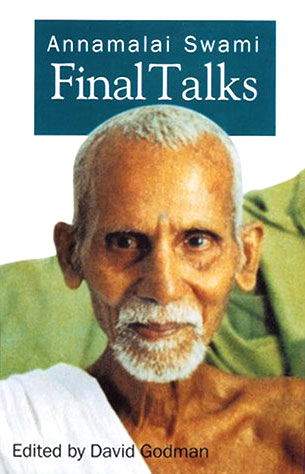
The above is an excerpt taken from Final Talks by Annamalai Swami, p. 67
The following are adapted from recent Facebooks posts of mine
http://www.facebook.com/tomdas.nd
The body-mind entity can accept, reject or be indifferent to things. This is relative acceptance and is an action that can be performed. Awareness is all-accepting, always embracing ‘what is’. This is total/absolute acceptance and is not something that you can do, but something that can be recognised as already being here.
Awareness cannot accept or reject anything, as it does nothing. It just is: present and aware. All actions occur at the level of the body and mind (and world).
Awareness could be said to unconditonally/choicelessly ‘accept’ everything that occurs within it, in the same way a mirror ‘choicelessly accepts’ the reflection within it.
…but actually, as this example illustrates, the mirror-like awareness is not actually doing anything apart from ‘being itself’.
In the way I speak about this, awareness cannot identify with anything. It is only the mind that identifies with/as the mind.
Or to put it differently, thought imagines it’s a thinker and believes itself.
Awareness is ever-free, just like the mirror in the example above
Through identifying with choiceless awareness/consciousness for sometime, the ego/doer is seen through and no longer identified with. Then the identification as being choiceless awareness/consciousness also can be dropped.
What we are left with is ‘just this’: simple, direct, beyond words. This is the ‘realm beyond verbal teachings’.
Here the apparent duality conceptualised by differentiating (viveka) between that-which-changes (objects) and that which doesn’t change in our experience (the subject, I) is resolved into non-duality.
 Tom Das