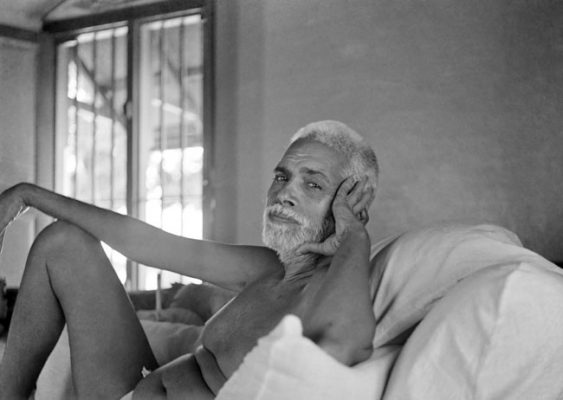
In the text Guru Vachaka Kovai are recorded some of the most important teachings of Sri Ramana Maharshi. Here are verses 148 and 149 which come under the heading ‘The Truth of Vedanta’ in the text. I have also included commentary from Sri Sadhu Om, a direct disciple of Sri Ramana Maharshi’s:
THE TRUTH OF VEDANTA
148. Those who know nothing but sense-pleasure,
To ruin and destruction doomed,
Resent transcendence of the senses
And call this fresh and fruitful wisdom
Dry Vedanta!
Tom’s comments: many seekers often resent the idea of turning away from sense pleasures, saying this is a dry or repressive path that is ‘anti-life’. Here Ramana calls this path ‘fresh and fruitful’ instead!
149. The experience of Vedanta comes
Only to those who are utterly
Without desire. Far, far it is
From those who still retain desires.
For such the penance is prescribed
Of longing for the Lord who knows
No desire, so as to end
Forever all desire.
Commentary from Sri Sadhu Om:
The term Vedanta is commonly understood to mean a particular system of philosophy, but its true meaning is the experience of Jnana which is gained as the conclusion [anta] of the Vedas.
The desire for sense objects, which are all 2nd or 3rd persons, is directly opposed to the desire for God, and so it is quite clear that God is not merely one among the many 2nd and 3rd personal objects, but that He must be the Reality of the 1st person. Therefore, we should understand that discarding all desires for 2nd and 3rd personal objects and having love for Self alone is the true devotion towards God.
Verse B 13 [which comes after verse 731] also asserts this same point.
731. The way of knowledge and the way of love
Are interwoven close. Don’t tear
Asunder these inseparables.
But practise both together holding
In the heart the two as one.
SRI BHAGAVAN 13: Meditation on the Self
Is devotion to the Lord
Supreme, since He abides as this,
Our very Self.
Tom: we see a similar teaching to verse 149 above from Sri Shankara, when he emphasises that the sage/jnani truly has no desires; this is from his commentary on the Brihadaranyaka Upanishad 2.4 (I have written a post on this here which explains the method of self-realisation outlined by both Shankara and the Brihadaranyaka Upanishad):
But there are some who hold that even a knower of Brahman has desires. They have certainly never heard the Brihadaranyaka Upanishad, nor of the distinction made by the Shruti that the desire for a son and so forth belongs to an ignorant man, and that with regard to the domain of knowledge, the statement, ‘What shall we achieve through children, we who have attained this Self, this world?’ and so on, is applicable. They do not also know the contradiction, based on incongruity, between the attainment of knowledge, which obliterates all action with its factors and results, and ignorance together with its effects [Tom: ie. all objects, duality, actions and suffering are removed with liberation, so there is no possibility of either desire or an object to desire in liberation].
 Tom Das