Q. Hi Tom, when Ramana says in the book ‘Who am I’ ‘cultivate the constant and deep contemplative ‘remembrance’ (smrti) of the true nature of the Self’ – would this be like repeatedly bringing the attention back to what is here now with the understanding that the Self is all that is?
Tom: Not quite, although that can be part of it. It means to know:
(1) the essence of who you are, experientially, is unchanging and is also unaffected by gross and subtle objects
(2) there is no lasting fulfillment in objects, which are all transient
(3) the essence of you does nothing (the self is not a doer)
(4) it means to lose interest in objects as sources of pleasure, happiness or fulfillment as we bathe in the bliss of simply being (ourselves).
All this is captured by the words sat-chit-ananda (being-consciousness-bliss), which indicate the nature of the Self.
Turn away from the gross and subtle world-objects.
Not allowing the concept/thought ‘I’ to rise up, wielding the weapon ‘who am I’ to strike down any such thoughts, remain as the Self.
If this all sounds too complex, don’t worry: it is intuitively ‘grasped’, so to speak, through simply allowing the mind to rest and be still and allowing ‘the truth’, so to speak, to arise within naturally.
It’s important not to get mixed up between what is true in our experience (experiential truth) and what is true scientifically. Realising the difference between these two types of truth and how they are related will allow us to have a much clearer enquiry into suffering and how it can be ended. Let me illustrate these two ideas with a few brief examples:
Specific truths for you and scientific truths which are applicable for all cases
If you are scared of spiders, maybe every time you see a spider, a strong sensation of fear arises. This is an experiential truth, for you. For you, every time you see a spider, fear arises. This is the truth of your experience. However it does not mean that spiders are intrinsically scary. ie. it is not a scientific truth. We can conclude that at this moment in time you are scared of spiders, but we cannot extrapolate this finding that specifically related to a single individual and say it is always true for everyone.
Just because something is true for us, doesn’t mean it is true for everyone.
We can make this example even more obvious by using a more ridiculous example, such as someone being scared of ice cream. The experiential truth is that fear arises whenever ice cream is encountered, but we cannot conclude that scientifically speaking ice creams are scary.
This is contrary to something like the medication ibuprofen, which is, scientifically speaking, an analgesic or ‘pain killer’. It, broadly speaking, has the same effect on almost everyone, both scientifically, and also experientially.
The basic point here is that we must be careful when taking a specific example that is true for ourselves and then extrapolating this to make a general case that something is scientifically true.
Appearances vs reality
Here is another example. Take the sun rising and setting. Experientially it is true to say that each morning the sun rises in the East, then moves up and across the sky to be high up at midday, then gradually lowers and finally sets in the West. We can say that, experientially speaking, the sun’s path in the sky forms an arc. We can say, experientially speaking, the earth appears stationary and the sun is moving around it.
However scientifically speaking we know this is not true. A more complete scientific explanation that also accounts for this experience is that the earth moves around the sun which gives rise to the above described experience of the sun rising and setting.
Just because something appears to be true in our experience, doesn’t mean that is actually the case.
The point in this example is to illustrate that just because something appears to be true ie. is experientially true, it doesn’t mean that is actually the way it is, ie. scientifically true. However it is worth noting that understanding the scientific truth that the earth moved around the sun doesn’t actually change the experience that the sun rises and set. The raw sensory experience remains unchanged, it is just our understanding of the what gives rise to the experience that changes, and that in turn can change our perspective and our attitude and the decisions we make.
Optical illusions
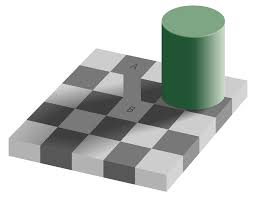
Another simple example it the example of an optical illusion which appears to be one thing, but actually in reality is quite different. One of my favourite optically illusions is the checkerboard and cylinder illusions. This is an example of how the brain actually alters the way we perceive physical objects based upon is preconceptions of how things should look:
It’s difficult to believe if you have never seen this before, but the 2 squares marked A and B are actually exactly the same colour, but our brain change the way the colours are perceived as it ‘knows’ that in the shadow of the cylinder the squares ‘should’ appear darker. If you cover up the cylinder in the picture or look at the diagram below the illusion should become more obvious:
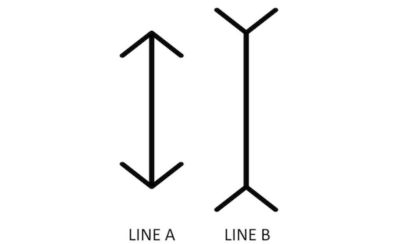
There are many more optical illusions you can see. Here is another simple one – both these lines are actually the same length scientifically speaking, but the experience is that line B appears longer that line A:
Why is this important?
This is particularly important in non-dual teachings where we are seeing there is no evidence for a doer, even though we think that it feels like a doer is present.
Just because it appears that we are the author of our thoughts and actions, doesn’t mean this is actually the way things are.
It also has ramifications for what I call The Awareness Teachings, in which we are taught that awareness or consciousness is ever-present experientially speaking whilst we are awake (ie. in the waking state), but that does not mean that scientifically speaking it is true that the essence of who we really are is awareness. This is an experiential truth, sure, but it may or may not be true scientifically speaking. Even if it is not true scientifically, that doesn’t mean the teaching has no value. In fact The Awareness Teachings in my view has incredible value, and that is why I teach it, but I teach it in a specific way that makes sense both experientially and scientifically.
Just because awareness/consciousness seems to be an unchanging part of our experience, doesn’t necessasarily mean that this is true scientifically speaking.
The other reason it is so important is that suffering itself is an experience. Therefore, freedom from suffering is also to do with our experience: learning to examine aspects of our experience and changing both our interaction with experience, our understanding of experience and even also changing the content of experience, such as changing our reactive habitual thoughts and behaviours if they are causative of suffering into something that is based on more truth, is less destructive in our relationships and society, and generates less suffering for ourselves and those around us.
Experiential truth is very important – why? Because suffering itself is an experience, and it is this that we are trying to understand and remove.
There is a notion going around some spiritual circles that ‘real gurus’ don’t advertise: they don’t have websites; they don’t go on Facebook or Twitter; and they definitely don’t have a blog. Of course, many genuinely awakened people don’t do any of these things – but the same could be said the the un-awakened too. ‘Real gurus’, apparently, sit around all day wearing nothing but a loin cloth, always speak in profound dolcit tones, and have a nice long wispy beard. Gotta have the beard.
Let me ask you, is life so limited? Is it really such a transgression to want to share something you’ve found? Listening to some people it does seem that way. I make no qualms about the fact that I do advertise, that there is a desire to reach out to others to share this wonderful discovery that I call Freedom. It’s not as if I try to hide it! And many people who have found ‘my teachings’ have benefitted from my sharing – not that I take any personal credit for any of this.
There is a natural desire to want to share what I have found. I don’t think this has to be the way it is for everyone, but it does seem to be the way it is over here in this body-mind called Tom. It doesn’t mean I’m not sharing something genuine. It doesn’t mean my realisation is only half-baked. It certainly doesn’t mean that I’m only in it for the money. If one day the desire to share this teaching stopped, and who knows, it might one day, then that would be fine too. For now, I’ll just keep on going. Why? Because that’s what’s happening.
Ramana Maharshi
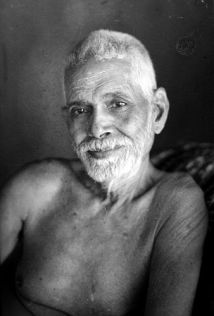
Let’s look at a good example where the myth of not advertising comes from – the example of Ramana Maharshi. Now, many of you know that I have a deep resonance with his teachings and that a sense of devotion towards him spontaneously arose in me quite unexpectedly towards the end of my seeking journey. So I mean no offense at all when I use him as an example. Ramana Maharshi primarily taught in silence and wasn’t obviously/outwardly trying to share any teaching to the masses in an evangelical kind of way. Ramana didn’t travel around the world or even around India – he never really left the mountain of Arunachala once he got there as a teenager, and when he wasn’t being silent, he sometimes talked about the power of silence. Here is an example:
‘Silence of a realised being is most powerful. He sends out waves of spiritual influence which draw many people towards him. Yet he may sit in a cave and maintain complete silence. He never needs to go out among the public. If necessary he can use others as his instrument.’
Here is another example, again from Ramana Maharshi:
‘Contact with an enlightened sage is good. They will work through silence. By speaking their power is reduced. Silence is most powerful. Speech is always less powerful than silence…’
So there we have it. One of the most revered enlightened sages of modern times has said it clear as day. We can therefore deduce that if you’re on Facebook, you’re definitely not realised…right? Well not quite. Let’s take a look.
Shankara
If we take the example of Shankara, a giant of Vedic spirituality and considered to be the founder of Advaita Vedanta, we have a very different character outwardly. Shankara fervently travelled the length and breadth of 8th century India preaching and debating those who disagreed with him, setting up schools all across the subcontinent and advertising how his teachings were better and superior to those around him.
Interestingly Ramana Maharshi clearly considered Shankara to be somebody who was fully awakened or self-realised, and yet Shankara clearly went out ‘among the public’. Ramana translated several of Shankara’s works from Sanskrit into Tamil for the benefit of his devotees who were unable to read Sanskrit and described how Shankara’s teachings could lead to liberation. In Ramana’s translation of Shankara’s vivekachudamai, Ramana says of Shankara ‘Sri Sankara, guru of the world (jagathguru), shines as the form of Lord Shiva‘. A worthy complement indeed.
And yet this was a person who certainly did not just stay quiet or stay silent, and he definitely did go out into the public, contrary to the quotes from Ramana Maharshi above. What can we make of this apparent contradiction?
Nisargadatta Maharaj and his lineage
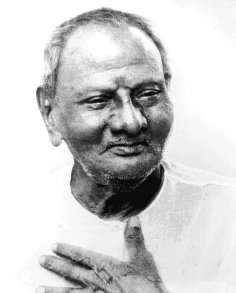
Lets take another example – that of Nisargadatta Maharaj, another revered sage from the 20th centuty. Whilst he did travel widely prior to his awakening, and a small amount afterwards too, he taught mainly from a room in a noisy street in Bombay. As far as I’m aware he didn’t really advertise much himself, but like Ramana, he permitted books about his teachings to be written and sold. So in this way, Nisargadatta would fit the model of a guru who did not solicit disciples and did not, overtly at least, go out to spread the word in public.
However, interestingly, Nisargadatta’s guru, Siddharameshwar Maharaj, travelled extensively around the state of Maharastra teaching those who came to him, sharing his teachings ‘out in the world’. He actively travelled around this part of India sharing his teahings with anyone who resonated with or who would listen to what he was saying.
In Nisargadatta’s lineage, they also teach using texts from Shankara. In verse 38 of Shankara’s Vivekachudamani it is written:
It is the very nature of the great souls to move of their own accord towards removing other’s troubles’
And in verse 37:
They themselves have crossed the dreadful ocean of the world. Without any selfish motive they help others to cross.
One of Ramana Maharshi’s favourite books is a Tamil Advaita classic called Kaivalya Navaneeta, or the Cream of Liberation. In verses 34 and 35 this is written:
I have already told you that the sages, liberated while alive, appear to be active in many ways according to their parabdha*. My good boy, hear me further, the activities of the sage are solely for the uplift of the world. He does not stand to lose or gain anything.
*Parabdha, refers to parabdha karma, which means the results of past actions that have not yet manifested. ie. the playing out of conditioning, or, if you want, destiny.
Samarth Ramdas
Sri Samarth Ramdas is one of the leading figures in Nisargadatta’s lineage from the 17th century. His written text Dasbodh became one of the main texts, perhaps the main text in Nisargadatta’s lineage. There is a story of Samarth Ramdas meeting Guru Hargobind, the sixth of the ten Sikh gurus. It goes like this:
Samarth Ramdas questions Guru Hargobind about his expensive attire, comparing him to the more austere Guru Nanak: “Guru Nanak was a Tyagi sadhu – a saint who had renounced the world. You are wearing arms and keeping an army and horses. You allow yourself to be addressed as Sacha Patshah, the True King. What sort of a sadhu are you?”
Guru Hargobind replied, “Internally a hermit, and externally a prince. Arms mean protection to the poor and destruction of the tyrant. Baba Nanak had not renounced the world but had renounced Maya, i.e. ego”
Ramdas responded by stating: “This appeals to my mind”.
Guru Hargobind here was teaching Ramdas that what is important is not the outward appearance, but the inward state of mind. Some saints are renunciates, like Guru Nanak, others are more ‘worldly’, at least in outward appearance. This is just the way it is. There is no choice in the matter.
Ramdas subsequently went on to do many things out in the world, contrary to what Ramana says in his statement above. Ramdas started to go out and gather many people around him in order to counter the recent Islamic teachings that had spread into India and convince people of the superiority of the Vedic traditions. He built temples, schools and even statues to promote his cause. In fact much of Ramdas’s magnum opus, Dasbodh, is about living in and dealing with the real world. Ramdas was also quite political, actively opposing the caste system, promoting women’s rights in both spiritual and non-spiritual arenas, recruiting female disciples and also backing a Hindu king to overthrow a Muslim one.
In start contrast to Ramana’s silent power, Ramdas said that sages who sat in one place were lesser saints than the ones who engaged in the world. Also in stark contrast to Ramana, Ramdas said that when he died it would be his books, ie. his words, that would carry the teachings forwards and these words should be cherished.
What a contrast! Here we have a silent sage promoting silence, and an active politically-inclined one promoting activity! What can we make of this?
Other examples in brief
I could go on: King Janaka is often given as an example of an enlightened sage who is wealthy and of the world. Vidyaranya, who wrote Pancadasi, a staple text in the Shankara’s Advaita Vedanta tradition, was very active politically and was political advisor to several kings of the day. More recently Swami Vivekananda and Swami Chinmayananda both set up ‘missions’ to spread the word and both travelled and advertised widely in order to do this.
Conclusion
I hope to any discerning reader, even without citing all these examples, it should be obvious that there is nothing intrinsically wrong with advertising, having a website or even, god-forbid, ‘tweeting’. These activities don’t automatically mean you are an ‘unenlightened’ waste of space. What is important is the purity of motivation and genuineness of insight-realisation. We don’t have to just believe what Ramana or Ramdas said, but we can think and see the reality of it all for ourselves.
As Guru Hargobind said, it is not about renouncing the world, but renouncing the ego. By this I mean seeing through the illusion of believing yourself to be a separate doer entity that authors its thoughts and actions (ie. insight), and the removal of the compulsive habitual tendencies (vasanas) that stem from that false belief (ie. purification).
I’ll leave you with a traditional description of an enlightened sage. It describes how a sage may be silent, but also may be active ‘like a python attacking its prey’! The point is that the unique conditioning of the purified body-mind of a ‘sage’ plays itself out in unique and often varied ways. Again we are quoting from Shankara’s Vivekachudamani, starting at verse 536 (apologies for the male chauvinist language assuming the sage is a ‘he’):
The enlightened sage (the knower of Brahman)…if people provide him with comforts and luxuries, he enjoys them and plays with them like a child. He bears no outward mark of a holy man…He may wear costly clothing or none…He may seem like a madman or like a child, or sometimes like an unclean spirit…Sometimes he appears to be a fool, sometimes a wiseman…Sometimes he is calm and silent. Sometimes he draws people to him, as a python attacks its prey. Sometimes people honor him greatly, sometimes they insult him. Sometimes they ignore him…He acts, yet is not bound by his action. He reaps the fruit of past actions, yet is unaffected by them.
Ramana Maharshi rarely left Arunachala for over 50 years and did not seek crowds of people to teach. One time someone asked him:
Question: Why does not Bhagavan [Ramana Maharshi] go about and preach the Truth to the people at large?
Ramana Maharshi: How do you know I am not doing it?*
Another time Ramana was asked:
Question: How can silence be so powerful?
Ramana Maharshi: A realised one sends out waves of spiritual influence, which draw many people towards him. Yet he may sit in a cave and maintain complete silence. We may listen to lectures upon truth and come away with hardly any grasp of the subject, but to come into contact with a realised one, though he speaks nothing, will give much more grasp of the subject. He never needs to go out among the public. If necessary he can use others as instruments.**
❤️❤️
*quote taken from Maharshi’s gospel
**quote taken from Conscious Immortality
The following is a letter written almost 1000 years ago by the great Chinese master Yuanwu (1063-1135). Yuanwu is perhaps best known for compiling the Blue Cliff Record, a classic zen text which comprises a collection of stories and sayings famous for their ability to arouse enlightenment in those who pondered them, together with advice on how to best approach them.
In Yuanwu’s letters, he reveals precise instructions in the ways of Zen that are written with a heartfelt tenderness for his student. This letter is taken from a compilation called ‘Zen Letters’ (translated by JC Cleary and Thomas Cleary). The letters in this compilation are all written by Yuanwu, and they cover a variety of subjects including how to teach and how to appoint a successor, but in this letter we find a clear and thorough overview of the path, perhaps the clearest within the entire compilation, with a focus on how to actually attain enlightenment: a description of the fundamental ground, how to approach it, how to realise it, and how to practice thereafter.
I hope the reader doesn’t mind that I have taken the liberty of interspersing my comments in italicised red and I have also bolded some lines for emphasis. Yuanwu starts by introducing the reader to the ‘fundamental ground’ that is inherent in each and every one of us. Here starts the letter:
Fundamentally, this great light is there with each and every person right where they stand – empty clear through, spiritually aware, all-pervasive, it is called the scenery of the fundamental ground.
He then describes the characteristics of this ‘ground’, stating that it is the basis of everything including the body and perceived world, but that it remains untouched and still nonetheless:
Sentient beings and buddhas are both inherently equipped with it. It is perfectly fluid and boundless, fusing everything within it. It is within your own heart and is the basis of your physical body and of the five clusters of form, sensation, conception, motivational synthesis, and consciousness. It has never been defiled or stained, and its fundamental nature is still and silent.
Then Yuanwu describes how realisation is obscured (ie. the nature of ignorance, avidya) , first through false thoughts or conceptual beliefs, and then how this conceptualisation leads to grasping which in turn leads to suffering or ‘the toils of birth and death’.
False thoughts suddenly arise and cover it over and block it off and confine it within the six sense faculties and sense objects. Sense faculties and sense objects are paired off, and you get stuck and begin clinging and getting attached. You grasp at all the various objects and scenes, and produce all sorts of false thoughts, and sink down into the toils of birth and death, unable to gain liberation.
In order to disillusion you of any fantastical and fanciful notions of enlightenment, in his compassion Yuanwu informs us that all Buddhas merely woke up to this essence (here called ‘fundamental basis’), that very essence that is within us all, and therefore Buddhahood is within all our reaches:
All the buddhas and ancestral teachers awakened to this true source and penetrated clear through to the fundamental basis. They took pity on all the sentient beings sunk in the cycle of birth and death and were inspired by great compassion, so they appeared in the world precisely for this reason. It was also for this reason that Bodhidharma came from the West with the special practice outside of doctrine.
Next, how to ‘clearly awaken’ to this fundamental ground/essence/basis/mind:
The most important thing is for people of great faculties and sharp wisdom to turn the light of mind around and shine back and clearly awaken to this mind before a single thought is born. This mind can produce all world-transcending and worldly phenomena. When it is forever stamped with enlightenment, your inner heart is independent and transcendent and brimming over with life. As soon as you rouse your conditioned mind and set errant thoughts moving, then you have obscured this fundamental clarity.
Before a single thought is born, that essence is already here, shining, untouched, unscathed, and in this way it is ‘independent and transcendent’. Therefore still your mind, quieten your mind, and see.
This essence is also not apart from life, so here Yuanwu describes it as ‘brimming over with life’. This essence is the basis of all perceived worldly phenomena. However, he warns that by buying into and believing in mental concepts (‘rousing your conditioned mind’), we have already made the cardinal mistake, entered into the world of suffering, and seemingly obscured that which cannot be obscured.
If you want to pass through easily and directly right now, just let your body and mind become thoroughly empty, so it is vacant and silent yet aware and luminous. Inwardly, forget all your conceptions of self, and outwardly, cut off all sensory defilements. When inside and outside are clear all the way through, there is just one true reality. Then eyes, ears, nose, tongue, body, and conceptual mind, form, sound, smell, flavor, touch, and conceptualized phenomena – all of these are established based on that one reality. This one reality stands free of and transcends all the myriad entangling phenomena. The myriad phenomena have never had any fixed characteristics – they are all transformations based on this light.
The method is to let everything go, let go of body and mind, forget everything so the mind is ’empty and vacant and silent’. However we are not to fall asleep. The mind should remain awake, ‘aware and luminous’.
To elaborate and be more specific, we are instructed inwardly to ‘forget all conceptions of self’. This is to remove the basic error of belief in separation. We are to forget about the distinction between ‘I’ and ‘not-I’, or between ‘me’ and ‘the world’, both of which depend on a concept of self.
Outwardly we are instructed to ‘cut off all sensory defilements’, which essentially means the compulsive or ego-driven desires which Yuanwu will touch upon later in this letter. These sensory defilements are themselves contingent on ‘conceptions of self’, but it is important to cut these off too as due to force of habit they may persist even when the illusory separation is seen through. Hence the need for practice.
Yuanwu now beautifully describes the fruit of this practice and in having faith in what is realised:
If you can trust in this oneness, then with one comprehended, and with one illuminated, all are illuminated. Then in whatever you do, it can all be the indestructible true essence of great liberation from top to bottom.
Thus far Yuanwu has instructed the reader how to realise the all-pervading yet unchanging essence, and also to realise that perceived life is non-separate from this essence. Now he goes further to explain what we should do once this essential mind has been realised.
Note that so far he has used the words ‘fundamental ground’, ‘fundamental basis’, ‘mind’, ‘inner heart’, ‘true reality’, ‘oneness’, and ‘essence’ all as synonyms to beautifully point to that-which-has-no-name. Here, in the next passage he refers to it as ‘mind’:
You must awaken to this mind first, and afterward cultivate all forms of good. Haven’t you seen this story? The renowned poet Bo Juyi asked the Bird’s Nest Monk, “What is the Way?” The Bird’s Nest Monk said “Don’t do any evils, do all forms of good.” Bo Juyi said “Even a three-year-old could say this.” The Bird’s Nest Monk said, “Though a three-year-old might be able to say it, an eighty-year-old might not be able to carry it out.”
This is a classic teaching of insight first, followed by cultivation or purification. Realisation of the fundamental essence which remains untouched is good as a start, but without purifying the mind or ‘cultivating goodness’, the enlightenment is not complete. The age-old habitual afflictions may otherwise continue. At worst they can wrestle away the realisation resulting in a ‘I got it! I lost it’ syndrome where the seeker goes back and forth wondering why their realisation of yesterday is not firm and secure, and at best the afflictions continue and this causes suffering and discomfort in the relative phenomenal world, both to the seeker and those around him/her.
Purification or ‘cultivation of all forms of good’ can occur prior to and/or after realisation of the fundamental essence (a part of the insight teachings, as I teach them), but can only gain deeper fruition post-realisation when the illusion of separation is starting to be seen through.
Yuanwu continues:
Thus we must search out our faults and cultivate practice; this is like the eyes and the feet depending on each other. If you are able to refrain from doing any evil and refine your practice of the many forms of good, even if you only uphold the elementary forms of discipline and virtue, you will be able to avoid sinking down to the of animals, hungry ghosts and hell-beings. This is even more the case if you first awaken to the indestructible essence of the wondrous, illuminated true mind and after that cultivate practice to the best of your ability and carry out all forms of virtuous conduct.
Yuanwu reiterates the same point again, stating that we should actively find our faults and seek to remedy them. This is the case prior to awakening-to-essence, but even more effective once awakening has occurred.
Let no one be deluded about cause and effect. You must realize that the causal basis of the hells and the heavens is all formed by your own inherent mind.
Here Yuanwu is talking about karma, or cause and effect, stating that it is nothing but our own minds and our afflictions (or lack of them) that will create our future ‘hells and heavens’.
Next Yuanwu goes into more details on how to cultivate this good, or how to purify the mind:
You must keep this mind balanced and in equanimity, without deluded ideas of self and others, without arbitrary loves and hates, without grasping and rejecting, without notions of gain and loss. Go on gradually nurturing this for a long time, perhaps twenty or thirty years. Whether you encounter favorable or adverse conditions, do not retreat or regress—then when you come to the juncture between life and death [the last moment of your life], you will naturally be set free and not be afraid. As the saying goes “Truth requires sudden awakening, but the phenomenal level calls for gradual cultivation”.
This instruction is similar to Krishna’s injunction to Arjuna in Chapter 2 of the Bhagavad Gita when he states that ‘yoga is evenness of mind’. Yuanwu reiterates the importance of being equanimous and again not to engage in concepts of self (and others), and the outward manifestation of this as love/hate, grasping/rejecting, loss/gain.
Whilst awakening to the essence is sudden, changes on the phenomenal level take time. Therefore ‘go on nurturing this for a long time’.
This last line, which I have bolded, is one of my favourites. Yuanwu nicely captures in words something I have often struggled to articulate: ‘Truth requires sudden awakening, but the phenomenal level calls for gradual cultivation’. Beautiful!.
Next Yuanwu goes on to warn against an intellectual egoic approach that he sees all too commonly. In his other letters he also warns against an overly sentimental or emotional approach too, and recommends ‘forgetting thoughts and feelings and finding independent realisation’ (Letter entitled Leaping out of the Pit, p. 78). Again, the solution is to remain inwardly quiet in mind and not to just dabble in conceptual understanding:
I often see those who are trying to study Buddhism just use their worldly intelligence to sift among the verbal teachings of the buddhas and ancestral teachers, trying to pick out especially wondrous sayings to use as conversation pieces to display their ability and understanding. This is not the correct view of the matter. You must abandon your worldly mentality and sit quietly with mind silent. Forget entangling causes and investigate with your whole being. When you are thoroughly clear then whatever you bring forth from your own inexhaustible treasury of priceless jewels is sure to be genuine and real.
Next is a summary: awaken to essence, then cultivate good: arouse compassion, have no (inward) concept of self/others, remove (outward) attachments. Then wisdom will manifest.
So first you must awaken to the Fundamental and clearly see the true essence where mind equals Buddha. Detach from all false entanglements and become free and clean. After that, respectfully practice all forms of good, and arouse great compassion to bring benefits to all sentient beings. In all that you do, be even and balanced and attuned to the inherent equality of all things – be selfless and have no attachments. When wondrous wisdom manifests itself and you penetrate through to the basic essence, all your deeds will be wonder-working. Thus it is said, ‘Just manage to accept the truth – you won’t be deceived.”
Implicit in this is that ‘wondrous wisdom’ has not yet manifested when the Fundamental Essence has been realised. The ‘wondrous wisdom’ requires both realisation of the Fundamental essence (what in my teachings I call insight) together with a removal of all that is not good (what I call purification in the way I teach).
Make enlightenment your standard, and don’t feel bad if it is slow in coming. Take care!
Here ends this wonderful letter from Yuanwu!
He reminds the student not to desire anything less than full and complete enlightenment. Yes, it may take time, but do not be disheartened and get to work now!
My gratitude to Yuanwu, his student, the translators who made the reading of this text in English possible, and to all other beings and objects that contributed towards this wonderful expression. I hope you have found it, and my commentary, of benefit.
As some of you know, I love a good zen story, and this one is one of my favourites – not to mention that it is a classic.
Since I’ve started teaching and sharing this realisation, I can doubly appreciate how important this teaching is. So many seekers come loaded with their preconceived ideas, and it makes the simple essence difficult to pierce through. This version of the story is taken from the wonderful book ‘Zen Flesh, Zen Bones’ compiled by Paul Reps, and is the first of the Zen stories given – and with good reason too. Here is it:
Nan-in, a Japanese master during the Meiji era (1868-1912), received a university professor who came to inquire about Zen.
Nan-in served tea. He poured his visitor’s cup full, and then kept on pouring.
The professor watched the overflow until he no longer could restrain himself. ‘It is overfull. No more will go in!’
‘Like this cup,’ Nan-in said, ‘you are full of your own opinions and speculations. How can I show you Zen unless you first empty your cup?’
❤
Empty your cup completely, then insight can arise by itself, naturally and spontaneously. Empty yourself completely.
Relax into Unknowing
What does that mean?
It means to relax, to let go of everything.
What are you left with?
You are left with whatever is.
You are left with this, Justthis.
No matter how much you let go, This is.
Or you could say:
No matter how much you let go, You are.
This Letting Go,
Is the coming into contact with being.
This is what it means to abide as the ‘I am’.
This is what it means to ‘remember who you are’.
It’s can become obvious that
All perceived things,
All phenomena,
Come and go.
The objects of the external world come and go,
Thoughts come and go,
Feelings come and go.
Knowledge comes and goes,
Expericences come and go,
States of consciousness come and go.
The body is a process
Of constant change,
As is everything else.
It too comes and goes.
In this sense independent objects do not exist in of themselves.
All there is is movement,
Constant movement appearing as form,
But no static unchanging form can be found
– Not even for a moment.
This Being/Unknowing is always here.
It can be consciously known when you relax and notice it,
Notice that which is ever present and unchanging in your experience.
When this unchanging essence/being is realised
And understood to always be here,
Undisturbed by comings and goings,
Then we do not need to keep on returning
to the practice of relaxing into unknowing/being.
Instead we can have Faith In Being.
This is Self-Knowledge.







 Tom Das