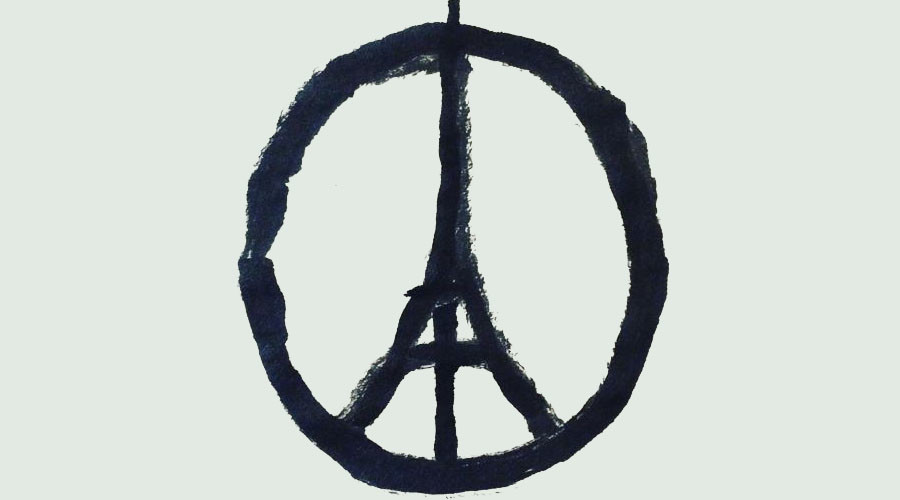
In the wake of the tragic atrocities in Paris that took place on Friday, I would like to offer my condolences and sympathies to all those victims who have been affected and their families and loved ones. It is truly shocking to have this happen, and yes, it feels more shocking to me that it has happened in Northern Europe (my own personal bias, I know).
Author: Tom Das
Satsang
If you have no questions,
We can sit here,
Selfless,
Self seen through,
And be.
This is the real sadhana:
Just an unforced appreciation of the way things are.
If you have questions, ask them, do not hold back.
The true answer is when the question disappears.
Do not cling to knowledge.
This is the advanced path for advanced seekers.
Two types of Happiness: Joy and Pleasure
I was invited to contribute a few articles for naturalhealthstar.com. The first one was published today and is on the two types of happiness, which I have called Joy and pleasure.
If you are interested please click here to read more.
[Update: the above link no longer works so I have reproduced the article below:]
Imagine strolling barefoot along a sandy tropical beach watching the sunset. Can you imagine what it feels like? Now imagine winning the lottery, and what that feels like. These two scenarios, whilst both pleasant, feel different don’t they? Take a few moments to feel both these imaginary scenarios in turn and get a sense for how they each feel.
For me with the sunset the feeling is more peaceful, connected, warm and gentle. With the lottery there is more excitement at the sense of gain. If you explore your feelings and sensations further, you can see that with the sunset the sense of self is diminished, perhaps even absent, and in its place is a sense of wholeness or connectedness. With the lottery the sense of self is reinforced and strengthened.
Here’s another example: imagine how it feels to interact with a young child, perhaps one you know, laughing and playing with them. Now contrast this with a situation when someone respected you or admired you and how that felt. You could take it one step further perhaps and remember how it felt when you were in a position of power over someone, when you were in control. Again, whilst these feelings are probably all positive feelings, interacting with a child is gentler and there is more of a sense of connection. When you are being respected or dominating someone there is a sense of self-aggrandisement.
So why am I pointing out this distinction? Because genuine fulfillment always comes when the sense of self lessens. I call this Joy. When this happens we feel more at ease, more connected, gentler and more loving. It is how we feel when we are with our loved ones, when we are following our hearts desire and when we are with nature. It is a completely natural unlearnt emotion. We feel it more with the heart and abdomen – this may sound strange, but look for yourself where you feel the emotion in your body.
The positive feelings that come from self-reinforcement on the other hand are relatively short lived and actually fuel a sense of emptiness or lack that keeps us unfulfilled. I call this pleasure. We feel it more in the mind. It is ego-based, driven by a sense of lack, and something that has to be taught to us. We have to be conditioned through our society and upbringing to value social status, good grades, cheap-thrills and domination over others.
So, reflect on your life. How much time is spent chasing pleasures and thrills, and how much time is spent experiencing Joy? Pleasure comes though acquisition. Acquiring things, titles, sensations and experiences. It is essentially addictive in nature and leads to more suffering. Joy comes through letting go, through being with something, through playing, and through giving and service. It is a natural expression of who we really are deep down.
Tao Te Ching: Mastery of the world
This is one of my favourite verses from the Tao Te Ching, an ancient Chinese text overflowing with wisdom (If you have not read it, I highly recommend you do – it is easy to find a translation online).
Here in this verse we are instructed to let go, let go and let go again, until not even the notion of our very self remains. Here we have let go of all ideas of spiritual practice, of spiritual paths and of even letting go.
Then, perhaps, non-action will ‘happen’. This is the culmination of the so-called spiritual path: no-doer, nothing more remains to be done, nothing remaining undone – this is ‘mastery of the world’.
One who seeks knowledge,
learns something new everyday.
One who seeks the Tao,
unlearns something new everyday.
Less and less remains,
until you arrive at non-action.
When you arrive at non-action,
nothing will be left undone.*
Mastery of the world is achieved,
by letting things take their natural course.
You can not master the world,
by changing the natural way.
Tao Te Ching verse 48
*An alternative translation is:
‘When there is no doer,
nothing remains to be done’
Krishnamurti’s Method
The following is an excerpt from a talk of Jiddu Krishnamurti that took place in Hamburg, Germany on 5th September 1956. For those of you who are familiar with Krishnamurti’s teachings, you will know that he abhorred the idea of a set method for liberation. However, in his talks he often outlined something that could be called a method in the wider sense, so I have rather cheekily titled this post ‘Krishnamurti’s Method’ 🙂
“So a serious person must surely ask himself this question: is it possible to experience something…beyond the fabrications of the mind? And if it is possible, then what is one to do? How is one to set about it? Continue reading
Being in the zone
We stumble across the ‘selfless-state’
quite naturally
all the time.
It goes by different names,
dependent on context.
In sport,
It is called ‘the zone’.
In relationship to nature,
It is called Beauty.
Insight
Insight is not personal insight.
With personal insight, you have an insight,
You realise this or that,
You realise x, y or z.
All personal insight is based on concepts or thought,
– they are all subject to change,
– they are all subject to doubt.
With Insight it is the person that is seen through;
Insight is there without a person having an insight:
Everything is just Insight,
There is only Insight.
Like realising the lake is a mirage:
Your personal insights and doubts were just ripples on its surface;
Then the whole of spirituality is done for,
No need for any of it anymore,
What else is there to do?
What can be done when there is no doer?
Unknowable yet known (Upanishads, Sufism, Ramana and Taoism)
If you think: “I know Brahman well,” then surely you know but little of Its form
Kena Upanishad
One of the astounding things about this is that it is impossible to put this into words. Put what into words you may ask?….this! Just this! Call it Tao, God or call it Brahman – these are really just meaningless words unless we understand what the words are pointing to.
All the great teachings have tried to express the Inexpressible. They have tried to indicate That which gives meaning to life but is beyond meaning, That which is transformative but at the same time nothing changes when It is ‘realised’ (how can that be?), That in which suffering and separation are seen to be imaginary and illusory. When That is understood, all the scriptures can be made sense of, and all of the scriptures are also seen to be ultimately inaccurate.
The Tao Te Ching, that wonderful poem from ancient China, starts with the confession that what it is writing about cannot be written about:
The Tao that can be spoken of is not the eternal Tao
Tao Te Ching, verse 1
What you are seeking is constantly being realised, whether you realise it or not! One of the advantages of the concept of God is that God is not meant to be knowable. However with the concept of self-realisation and the ever increasing preponderance of the all-knowing guru on the spiritual scene, it is often thought that this is something that can be known by the mind. Here’s what our Sufi friend Abol-Hasan has to say about it.
One may speak of those absent,
but one who is Ever Present,
one can say nothing of
Sheikh Abol-Hasan, saying 92
Throughout the ages, people from all walks of life have spontaneously awoken to this ‘understanding’: scholars and illiterates, men and women and children, those with a spiritual tradition and those without one.
All true knowers of truth are always fuzzy when it comes to how to realise this for oneself, for there is no single path and no single practice that has the monopoly here. This is not always a popular message, and certainly not one that is easy to grasp (it’s impossible to grasp) and pass on through the generations.
Here we can see the Kena Upanishad trying to express the futility of organising a spiritual system around this understanding:
The one who has thought it out does not know it.
It is not understood by those who understand it;
it is understood by those who do not understand it.
Kena Upanishad
This is ever present, it is none other than Our-True-Self, which is simply life devoid of the illusion of doership. It is here, yet cannot be known by the mind or senses. It cannot be captured in words.
I do not think I know It well, nor do I think I do not know It.
He among us who knows the meaning of “Neither do I not know, nor do I know”
— knows Brahman.
Kena Upanishad
This realisation is nothing to be gained. When you realise, there is no realisation at all. It all just falls away. What is there to realise? Who is there to realise? There is just this. This is enough. Realisations come and go in this. And this is not a concrete thing that you can grasp or possess, but it is life just happening right now as it is.
Boddhidharma, the Indian monk and founder of Zen (Chan) Buddhism tells us just this, and he says it repeatedly – here is just one example:
“To say he attains anything at all is to slander a Buddha. What could he possibly attain?”
Boddhidharma from the Bloodstream Sermon
Ramana Maharshi was someone who had a spontaneous realisation of all of this as a teenage boy. He had no guru and knew little of any spiritual teaching. Over the years he learnt the language of Advaita Vedanta and found that its teachings described that which he was already experiencing. Here’s what he has to say about self-knowledge (Atma-Jnana in Sanskrit):
Q: When a man realises the Self, what will he see?
M: There is no seeing. Seeing is only being. The state of Self-realisation, as we call it, is not attaining something new or reaching some goal which is far away, but simply being that which you always are and which you always have been.
All that is needed is that you give up your realization of the not-true as true…At one stage you will laugh at yourself for trying to discover the Self which is so self-evident.
Ramana Maharshi
And he repeats this again and again (italics added by me):
If we talk of knowing the Self, there must be two selves, one a knowing self, another the self which is known, and the process of knowing.
The state we call realisation is simply being oneself, not knowing anything or becoming anything. If one has realised, one is that which alone is and which alone has always been. One cannot describe that state. One can only be that.
Ramana Maharshi
So if this is unknowable, how to reach this ‘understanding’ at all? Let us listen to the Maharshi:
Q: But how is one to reach this state?
M: There is no goal to be reached. There is nothing to be attained. You are the Self. You exist always. Nothing more can be predicated of the Self than that it exists. Seeing God or the Self is only being the Self or yourself. Seeing is being.
You, being the Self, want to know how to attain the Self. It is something like a man being at Ramanasramam asking how many ways there are to reach Ramanasramam and which is the best way for him.
Ramana Maharshi
Sensations, fresh and clear
Everything appears fresh,
Fresh, crisp and clear;
A sparkling mirror,
everything perfectly reflected.
Body, mind and senses function by themselves,
As they have always done,
Light! Sensations! Movement!
Is reality impersonal?
This is a question that often comes up, and many teachers often state that reality is impersonal. I myself have written a piece stating just this (complete with an impersonal looking image). However, like so many things we can write and say about reality, it is often correct in one way but false in another. As I’ve stated many times before, reality cannot be captured in words.
We could say that reality is impersonal or both personal and impersonal, or we could say that it is neither personal or impersonal. All these statements would be correct in the correct context.
But are these statements helpful? To say that reality is either personal or impersonal is ultimately besides the point. The essential point is to see things as they are, or rather to stop believing in all our concepts about reality – then reality shines, as it always has done. Who cares if it’s personal or impersonal?