This image is taken from a story in the Mahabharata and represents the situation we are in if we are ignorant.
Our past deeds (elephant) are chasing us, our future karma (snakes) and eventual death (snakes) awaits us, the present moment (the branch) is being eaten away by mice – our time is slowly running out as days (white mouse) and nights (black mouse) pass by.
Meanwhile Vishnu holds out his saving hand of Moksha (liberation) to us but we are too entranced by the honey (pleasure) dripping from Maya (honeycomb) that we endure the pains of life (bees stinging us) and we stay in this ridiculous and precarious situation rather than take Vishnu’s hand of Moksha.
Translated by Swami Vimuktananda, this version edited by Tom Das
Swami Vimuktananda: Shankara discusses the identity of the individual Self and the universal Self through the direct experience of the highest Truth.
Tom: the original text has no subheadings – I have added these. My brief comments and annotations are in square brackets. I have added bold type for emphasis of what I feel are key points. Occasionally I have removed some verses or I have changed the order of some verses where I have felt this makes sense thematically. I hope these additions are of benefit for sincere seekers of liberation.
Om Shanti, Shanti, Shanti
INITIAL VERSES
I bow down to Him – to Sri Hari (the destroyer of ignorance), the Supreme Bliss, the First Teacher, Ishwara, the All-pervading One and the Cause of all Lokas (the universe).
Herein is expounded (the means of attaining to) Aparokshanubhuti (Self-Realization) for the acquisition of final liberation. Only the pure in heart should constantly and with all effort meditate upon the truth herein taught.
FOUR PRELIMINARY QUALIFICATIONS
(Sadhana Chatushtaya)
[Q. Who is ‘pure in heart’?
A: He who has the 4 qualifications listed below
Q: How to become ‘pure in heart’?
A: Devotion to God, renunciation and karma yoga as per verse 3]
The four preliminary qualifications (the means to the attainment of knowledge), such as Vairagya (dispassion) and the like, are acquired by men by propitiating [gaining favour of] Hari (the Lord), through austerities and the performance of duties pertaining to their social order and stage in life.
The indifference with which one treats the excreta of a crow – such an indifference to all objects of enjoyment from the realm of Brahma to this world (in view of their perishable nature), is verily called pure [1] Vairagya.
Atman (the seer) in itself is alone permanent, the seen is opposed to it (ie., transient) – such a settled conviction is truly known as [2] discrimination [Viveka].
[[3] The 6 treasures]
Abandonment of desires at all times is called [3i] Shama and restraint of the external functions of the organs is called [3ii] Dama.
Turning away completely from all sense-objects is the height of [3iii] Uparati, and patient endurance of all sorrow or pain is known as [3iv] Titiksha which is conducive to happiness.
Implicit faith in the words of the Vedas and the teachers (who interpret them) is known as (3v) Shraddha, and concentration of the mind on the only object Sat (i.e., Brahman) is regarded as [3vi] Samadhana.
When and how shall I, O Lord, be free from the bonds of this world (i.e., births and deaths) – such a burning desire is called [4] Mumukshuta.
Only that person who is in possession of the said qualification (as means to Knowledge) should constantly reflect with a view to attaining Knowledge, desiring his own good.
VICHARA SUMMARISED
Knowledge is not brought about by any other means than Vichara [inquiry], just as an object is nowhere perceived (seen) without the help of light.
[Question]
Who am I ? How is this (world) created ? Who is its creator ? Of what material is this (world) made ? This is the way of that Vichara (enquiry).
[Answer – what I am not, neti-neti, via negativa]
I am neither the body, a combination of the (five) elements (of matter), nor am I an aggregate of the senses; I am something different from these. This is the way of that Vichara.
[The philosophical paradigm: all phenomena is a creation of thoughts/ignorance:]
Everything is produced by ignorance, and dissolves in the wake of Knowledge. The various thoughts must be the creator. Such is this Vichara.
[All is Brahman, what I am, via positiva]
The material (cause) of these two (i.e., ignorance and thought) is the One (without a second), subtle (not apprehended by the senses) and unchanging Sat (Existence), just as the earth is the material (cause) of the pot and the like. This is the way of that Vichara.
[What I am – I am Brahman]
As I am also the One, the Subtle, the Knower, the Witness, the Ever-Existent, and the Unchanging, so there is no doubt that I am “That” (i.e., Brahman). Such is this enquiry.
ATMAN (The Self)
Atman is verily one and without parts, whereas the body consists of many parts; and yet the people see (confound) these two as one ! What else can be called ignorance but this? [repeating refrain]
Atman is all consciousness and holy, the body is all flesh and impure; and yet, etc.,
Atman is the (supreme) Illuminator and purity itself; the body is said to be of the nature of darkness; and yet, etc.,
Atman is eternal, since it is Existence itself; the body is transient, as it is non-existence in essence; and yet etc.,
How strange is it that a person ignorantly rests contented with the idea that he is the body, while he knows it as something belonging to him (and therefore apart from him) even as a person who sees a pot (knows it as apart from him) !
I AM BRAHMAN
I am verily Brahman, being equanimous, quiescent, and by nature absolute Existence, Knowledge, and Bliss. I am not the body which is non-existence itself. This is called true Knowledge by the wise. [repeating refrain]
I am without any change, without any form, free from all blemish and decay. I am not, etc.,
I am not subjected to any disease, I am beyond all comprehension, free from all alternatives and all-pervading. I am not, etc.,
I am without any attribute or activity, I am eternal, ever free, and imperishable. I am not, etc.,
I am free from all impurity, I am immovable, unlimited, holy, undecaying, and immortal. I am not, etc.,
IGNORANCE
O you ignorant one ! Why do you assert the blissful, ever-existent Atman, which resides in your own body [ie. is your essence] and is (evidently) different from it, which is known as Purusha [The Person] and is established (by the Shruti as identical with Brahman), to be absolutely non-existent?
[ie. Why do you say ‘There is no Atman/Self’?]
O you ignorant one ! Try to know, with the help of [1] Shruti and [2] reasoning, your own Self, Purusha, which is different from the body, (not a void but) the very form of existence, and very difficult for persons like you to realize.
[This will be explained below]
1. REASONING
The Supreme (Purusha) known as “I” (ego) is but one, whereas the gross bodies are many. So how can this body be Purusha?
“I” (ego) is well established as the subject of perception whereas the body is the object. This is learnt from the fact that when we speak of the body we say, “This is mine.” So how can this body be Purusha?
It is a fact of direct experience that the “I” (Atman) is without any change, whereas the body is always undergoing changes. So how can this body be Purusha?
Even the subtle body [ie. mind] consists of many parts and is unstable. It is also an object of perception, is changeable, limited and non-existent by nature. So how can this be the Purusha?
The immutable Atman, the substratum of the ego, is thus different from these two bodies [ie. gross and subtle bodies], and is the Purusha, the Ishwara (the Lord of all), the Self of all; It is present in every form and yet transcends them all.
2. SHRUTI
[Shruti literally means ‘heard’ or ‘that which is heard’, and refers to revealed scripture, the highest form of scripture in Vedic tradition, and the examples are the Vedas and Upanishads. Traditionally Shruti is not of human origin but of Divine origin, as opposed to Smriti or ‘remembered’, which comes from the minds of human beings. This text, not being the Vedas or Upanishads would be considered to be Smriti. Most epics such as Ramayana, Mahabharata and Bhagavad Gita are all Smriti scriptures]
Wise men have ascertained the (real) nature of Purusha from that Shruti text, “(There is nothing) higher than He (Purusha),” etc. So how can this body be Purusha ?
Again the Shruti has declared in the Purusha Sukta that “All this is verily the Purusha”. So how can this body be Purusha ?
So also it is said in Brihadaranyaka that “The Purusha is completely unattached”. How can this body wherein inhere innumerable impurities be the Purusha ?
There again it is clearly stated that “the Purusha is self-illumined”. So how can the body which is inert (insentient) and illumined by an external agent be the Purusha ?
Moreover, the Karma-kanda also declares that the Atman is different from the body and permanent, as it endures even after the fall of the body and reaps the fruits of actions (done in this life).
The Shruti in the form of the Brihadaranyaka has declared that this Atman, which is the Self of all, is verily Brahman.
ADVAITA
[So far we have discerned the difference between Self and Not-Self (ie. the phenomenal world including the body and mind). Now we see this too is an artificial duality and now the focus is on Advaita, or non-duality:]
Thus the view that the body is the Atman has been denounced by the enunciation of the difference between the Atman and the body. Now is clearly stated the unreality of the difference between the two.
No division in Consciousness is admissible at any time as it is always one and the same. Even the individuality of the Jiva must be known as false, like the delusion of a snake in a rope.
As through the ignorance of the real nature of the rope the very rope appears in an instant as a snake, so also does pure Consciousness appear in the form of the phenomenal universe without undergoing any change.
There exists no other material cause of this phenomenal universe except Brahman. Hence this whole universe is but Brahman and nothing else.
From such declaration (of the Shruti) as “All this is Atman”, it follows that the idea of the pervaded and the pervading is illusory. This supreme truth being realized, where is the room for any distinction between the cause and the effect?
[The Mahavakya or great saying ‘Sarvam Khalvidam Brahma’ or ‘All this is Brahman’ is taken from the Chandogya Upanishad 3.14.1]
Certainly the Shruti has directly denied manifoldness in Brahman. The non-dual cause being an established fact, how could the phenomenal universe be different from It ?
Moreover, the Shruti has condemned (the belief in variety) in the words, “The person who”, being deceived by Maya, “sees variety in this (Brahman), goes from death to death”.
Inasmuch as all beings are born of Brahman, the supreme Atman, they must be understood to be verily Brahman.
The Shruti has clearly declared that Brahman alone is the substratum of all varieties of names, forms and actions.
Just as a thing made of gold ever has the nature of gold, so also a being born of Brahman has always the nature of Brahman.
Just as a jar is all earth, so also isthe body all consciousness. The division, therefore, into the Self and non-Self is made by the ignorant to no purpose.
SUFFERING
Fear is attributed to the ignorant one who rests after making even the slightest distinction between the Jivatman and the Paramatman.
[ie. duality causes fear]
When duality appears through ignorance, one sees another; but when everything becomes identified with the Atman, one does not perceive another even in the least.
In that state when one realizes all as identified with the Atman, there arises neither delusion nor sorrow, in consequence of the absence of duality.
[ie. lack of duailty, or nonduality, removes suffering]
THE THREE STATES
[ie. The 3 states change, they come and go, and so are without any enduring essence, as opposed to Atman]
This world, though an object of our daily experience and serving all practical purposes, is, like the dream world, of the nature of non-existence, inasmuch as it is contradicted the next moment.
The dream (experience) is unreal in waking, whereas the waking (experience) is absent in dream. Both, however, are non-existent in deep sleep which, again, is not experienced in either.
Thus all the three states are unreal inasmuch as they are the creation of the three Gunas [ie. tamas, rajas, sattva]; but their witness (the reality behind them) is, beyond all Gunas, eternal, one, and is Consciousness itself.
ILLUSION
[The illusion of duality: the illusion of the individual person or Jiva, the illusion of the manifold universe]
Just as (after the illusion has gone) one is no more deluded to see a jar in earth or silver [irridescence] in the nacre [mother of pearl], so does one no more see Jiva in Brahman when the latter is realized (as one’s own self).
Just as earth is described as a jar, gold as an ear-ring, and a nacre as silver, so is Brahman described as Jiva.
Just as blueness in the sky, water in the mirage, and a human figure in a post (are but illusory), so is the universe in Atman.
Just as the appearance of a ghost in an empty place, of a castle in the air, and of a second moon in the sky (is illusory), so is the appearance of the universe in Brahman.
Just as it is water that appears as ripples and waves, or again it is copper, that appears in the form of vessel so it is Atman that appears as the whole universe.
Just as it is earth that appears under the name of a jar, or it is threads that appear under the name of a cloth, so it is Atman that appears under the name of the universe. This Atman is to be known by negating the names.
MITHYA
Just as there ever exist the relation of cause and effect between earth and a jar, so does the same relation exist between Brahman and the phenomenal world; this has been established here on the strength of scriptural texts and reasoning.
METAPHORS FOR ILLUSION
(YOU ARE NOT THE BODY!)
[Note: If I think I am the body, then this is taking the Self (myself) to be the body]
Just as a rope is imagined to be a snake and a nacre to be a piece of silver, so is the Atman determined to be the body by an ignorant person. [repeating refrain]
Just as earth is thought of as a jar (made of it) and threads as a cloth, so is Atman, etc.,
Just as gold is thought of as an ear-ring and water as waves, so is the Atman, etc.,
Just as the stump of a tree is mistaken for a human figure and a mirage for water, so is the Atman, etc.,
Just as a mass of wood work is thought of as a house and iron as a sword, so is the Atman, etc.,
Just as one sees the illusion of a tree on account of water, so does a person on account of ignorance see Atman as the body.
Just as to a person going in a boat everything appears to be in motion, so does one, etc.,
Just as to a person suffering from a defect (jaundice) white things appear as yellow, so does one, etc.,
Just as to a person with defective eyes everything appears to be defective, so does one, etc.,
Just as a firebrand, through mere rotation, appears circular like the sun, so does one, etc.,
Just as all things that are really large appear to be very small owing to great distance, so does one, etc.,
Just as all objects that are very small appear to be large when viewed through lenses, so does one, etc.,
Just as a surface of glass is mistaken for water, or vice versa, so does one, etc.,
Just as a person imagines a jewel in fire or vice versa, so does one, etc.,
Just as when clouds move, the moon appears to be in motion, so does one, etc.,
Just as a person through confusion loses all distinction between the different points of the compass, so does one, etc.,
Just as the moon (when reflected) in water appears to one as unsteady, so does one, etc.,
THE END OF IGNORANCE
Thus, through ignorance, arises in Atman the delusion of the body, which, again, through Self-realization, disappears in the supreme Atman.
When the whole universe, movable and immovable, is known to be Atman, and thus the existence of everything else is negated, where is then any room to say that the body is Atman?
O enlightened one, pass your time always contemplating on Atman while you are experiencing all the results of Prarabdha [Fate or destiny]; for it ill becomes you to feel distressed.
PRARABDHA KARMA
The theory one hears of from the scripture, that Prarabdha does not lose its hold upon one even after the origination of the knowledge of Atman, is now being refuted.
After the origination of the knowledge of Reality, Prarabdha verily ceases to exist, inasmuch as the body and the like become non-existent; just as a dream does not exist on waking.
Just as the body in a dream is superimposed (and therefore illusory), so is also this body. How could there be any birth of the superimposed (body), and in the absence of birth (of the body) where is the room for that (i.e., Prarabdha) at all ?
The Vedanta texts declare ignorance to be verily the material (cause) of the phenomenal world just as earth is of a jar. That (ignorance) being destroyed, where can the universe subsist ?
Just as a person out of confusion perceives only the snake leaving aside the rope, so does an ignorant person see only the phenomenal world without knowing the reality.
The real nature of the rope being known, the appearance of the snake no longer persists; so the substratum being known, the phenomenal world disappears completely.
The body also being within the phenomenal world (and therefore unreal), how could Prarabdha exist ? It is, therefore, for the understanding of the ignorant alone that the Shruti speaks of Prarabdha.
“And all the actions [Karmas] of a man perish when he realizes that (Atman) which is both the higher and the lower”. Here the clear use of the plural by the Shruti is to negate Prarabdha as well.
If the ignorant still arbitrarily maintain this, they will not only involve themselves into two absurdities but will also run the risk of forgoing the Vedantic conclusion. So one should accept those Shrutis alone from which proceeds true knowledge.
FIFTEEN STEPS TO MEDITATION & LIBERATION
Now, for the attainment of the aforesaid (knowledge), I shall expound the fifteen steps by the help of which one should practice profound meditation at all times.
[The need for practice]
The Atman that is absolute existence and knowledge cannot be realized without constant practice. So one seeking after knowledge should long meditate upon Brahman for the attainment of the desired goal.
102-103. The steps, in order, are described as follows: the control of the senses, the control of the mind, renunciation, silence, space, time, posture [asana], the restraining root (Mulabandha), the equipoise of the body, the firmness of vision, the control of the vital forces, the withdrawal of the mind, concentration, self-contemplation and complete absorption.
[These above stages are similar to and include the classical 8 stages of Patanjali’s Raja Yoga. Shankara will redefine these steps in the next few verses giving them a non-dual spin]
The restraint of all the senses by means of such knowledge as “All this is Brahman” is rightly called Yama, which should be practiced again and again.
[Yama or self-control is usually defined as being ethical, truthful, not stealing, etc]
The continuous flow of only one kind of thought to the exclusion of all other thoughts, is called Niyama [discipline], which is verily the supreme bliss and is regularly practiced by the wise.
[The one kind of thought are those of the Mahavakyas such as ‘I am Brahman’, etc]
[Niyama, or discipline usually includes virtuous habits to externally and inwardly cleanse the body and mind respectively]
The abandonment of the illusory universe by realizing it as the all-conscious Atman is the real renunciation honored by the great, since it is of the nature of immediate liberation.
[as in verse 104, the underlying method utilised is the realisation that ‘All is Brahman-Atman’. The emphasis is on a shift of perspective rather than just taking yourself to be the body-mind and renouncing objects from that ignorant perspective]
The wise should always be one with that Silence wherefrom words together with the mind turn back without reaching it, but which is attainable by the Yogins.
[The Silence refers to the Self, Atman/Brahman, which is what we are. ‘Mind turns back without reaching it’ refers to Taittiriya Upanishad II.9]
108-109. Who can describe That (i.e., Brahman) whence words turn away ? (So silence is inevitable while describing Brahman). Or if the phenomenal world were to be described, even that is beyond words. This, to give an alternate definition, may also be termed silence known among the sages as congenital. The observance of silence by restraining speech, on the other hand, is ordained by the teachers of Brahman for the ignorant.
[True Silence is Self-Knowledge and not mere cessation of speech]
That solitude is known as space, wherein the universe does not exist in the beginning, end or middle, but whereby it is pervaded at all times.
[True solitude is Self-Knowledge, in which there is only One without a Second, the implication is that solitude is not the mere retiring to a forest in seclusion]
The non-dual (Brahman) that is bliss indivisible is denoted by the word ‘time’, since it brings into existence, in the twinkling of an eye all beings from Brahman downwards.
One should known that as real posture in which the meditation on Brahman flows spontaneously and unceasingly, and not any other that destroys one’s happiness.
[Shankara’s humour that the true Yogic asana/posture are not mere contortions of body that ‘destroy one’s happiness’ but meditation upon Brahman]
That which is well known as the origin of all beings and the support of the whole universe, which is immutable and in which the enlightened are completely merged … that alone is known as Siddhasana [a seated meditation pose] (eternal Brahman).
That (Brahman) which is the root of all existence and on which the restraint of the mind is based is called the restraining root (Mulabandha) which should always be adopted since it is fit for Raja-yogins.
Absorption in the uniform Brahman should be known as the equipoise of the limbs (Dehasamya). Otherwise mere straightening of the body like that of a dried-up tree is no equipoise.
Converting the ordinary vision into one of knowledge one should view the world as Brahman itself. That is the noblest vision, and not that which is directed to the tip of the nose.
Or, one should direct one’s vision to That alone where all distinction of the seer, sight, and the seen ceases and not to the tip of the nose.
The restraint of all modifications of the mind by regarding all mental states like the Chitta as Brahman alone, is called Pranayama.
119-120. The negation of the phenomenal world is known as Rechaka (breathing out), the thought, “I am verily Brahman”, is called Puraka (breathing in), and the steadiness of that thought thereafter is called Kumbhaka (restraining the breath). This is the real course of Pranayamafor the enlightened, whereas the ignorant only torture the nose [more humour from Shankara here].
The absorption of the mind in the Supreme Consciousness by realizing Atman in all objects is known as Pratyahara (withdrawal of the mind) which should be practiced by the seekers after liberation.
The steadiness of the mind through realization of Brahman wherever the mind goes, is known as the supreme Dharana (concentration).
Remaining independent of everything as a result of the unassailable thought, “I am verily Brahman”, is well known by the word Dhyana (meditation), and is productive of supreme bliss.
The complete forgetfulness of all thought by first making it changeless and then identifying it with Brahman is called Samadhi known also as knowledge.
[The method is to make thought changeless, which means to only have one thought such as ‘I am Brahman’ as per verses 119 and 123, and then to realise this thought as nothing else but Brahman or Atman (self), and then forget all thought. Shankara equates this Samadhi with Knowledge]
THE FRUIT OF PRACTICE
The aspirant should carefully practice this (meditation) that reveals his natural bliss until, being under his full control, it arises spontaneously, in an instant when called into action.
Then he, the best among Yogis having attained to perfection, becomes free from all practices. The real nature of such a man never becomes an object of the mind or speech.
OBSTACLES
127-128. While practicing Samadhi there appear unavoidably many obstacles, such as lack of inquiry, idleness, desire for sense-pleasure, sleep, dullness, distraction, tasting of joy, and the sense of blankness. One desiring the knowledge of Brahman should slowly get rid of such innumerable obstacles.
ENCOURAGEMENT AND A WARNING
While thinking of an object the mind verily identifies itself with that, and while thinking of a void it really becomes blank, whereas by the thought of Brahman it attains to perfection. So one should constantly think of (Brahman to attain) perfection.
Those who give up this supremely purifying thought of Brahman, live in vain and are on the same level with beasts.
Blessed indeed are those virtuous persons who at first have this consciousness of Brahman and then develop it more and more. They are respected everywhere.
[Against the intellectual approach:]
Only those in whom this consciousness (of Brahman) being ever present grows into maturity, attain to the state of ever-existent Brahman; and not others who merely deal with words.
Also those persons who are only clever in discussing about Brahman but have no realization, and are very much attached to worldly pleasures, are born and die again and again in consequence of their ignorance.
The aspirants after Brahman should not remain a single moment without the thought of Brahman, just like Brahma, Sanaka, Suka and others.
ANALYSIS OF ‘CAUSE’ AND ‘EFFECT’
The nature of the cause inheres in the effect and not vice versa; so through reasoning it is found that in the absence of the effect, the cause, as such also disappears.
[Cause and effect refers to karma and the phenomenal world. When this world is removed, only Brahman remains:]
Then that pure reality (Brahman) which is beyond speech alone remains. This should be understood again and again verily through the illustration of earth and the pot.
[ie. When the pot is destroyed, the earth from which it is made remains]
In this way alone there arises in the pure-minded a state of awareness (of Brahman), which is afterwards merged into Brahman.
One should first look for the cause by the negative method and then find it by the positive method, as ever inherent in the effect.
[Here the cause is Brahman and the effect is the world, ie. by removing all objects from perception through meditation (negative method 1) or by negating all objects of perception as being not-self (negative method 2) the Self should be discovered, but then the Self should be seen being in All Objects (positive method)]
One should verily see the cause in the effect, and then dismiss the effect altogether. What then remains, the sage himself becomes.
A person who meditates upon a thing with great assiduity and firm conviction, becomes that very thing. This may be understood from the illustration of the wasp and the worm.
UNITY OF FORMLESS AND FORM
The wise should always think with great care of the invisible, the visible, and everything else, as his own Self which is consciousness itself.
Having reduced the visible [objects of perception] to the invisible [formless Brahman], the wise should think of the universe as one with Brahman. Thus alone will he abide in eternal felicity with mind full of consciousness and bliss.
Thus has been described Raja-Yoga consisting of these steps (mentioned above). With this is to be combined Hatha-Yoga for (the benefit of) those whose worldly desires are partially attenuated.
[The above described Raja Yoga is purely mental, having been stripped of the more external practices. Therefore for those whose minds have not been purified, the external and physical aspects of yoga, denoted here as Hatha Yoga, should also be performed]
For those whose mind is completely purified this (Raja-Yoga) alone is productive of perfection. Purity of the mind, again, is speedily accessible to those who are devoted to the teacher and the Deity.
[Devotion to and faith in Guru and God are recommended methods of purification of mind. When the mind is sufficiently pure, then Shankara’s form of Raja Yoga on the mental levels alone leads directly to liberation]
Kashmir Shaivism is a non-dual tantric tradition in which Pratyabhijna or ‘recognition’ is the goal. In Kashmir Shaivism, the absolute is termed ‘Shiva’ and the relative world of people and objects is termed ‘Shakti’ (which means energy or power). Shiva and Shakti are given equal status and are said not to exist apart from each other – where one exists, the other also exists.
In Non-Dual (Advaita) Vedanta, the Self (Atman) is the Absolute (Brahman) and it is said to project Maya-Shakti which in turn projects the world of people and objects. Maya is said to be dependent on the Absolute Self and not vice-versa, so the two are not given equal status.
This obviously causes confusion in some seekers, so here Ramana explains them both:
The following is an excerpt from Talks with Sri Ramana Maharshi, Talk 288:
Explaining Maya of Vedanta and swatantra [tantra] of Pratyabhijna (independence of recognition), Sri Bhagavan said:
The Vedantins say that Maya is the sakti of illusion premised in Siva. Maya has no independent existence. Having brought out the illusion of the world as real, she continues to play upon the ignorance of the victims. When the reality of her not being is found, she disappears.
‘Recognition’ [ie. Kashmir Shaivism] says that Sakti (power) is coeval with Siva. The one does not exist without the other. Siva is unmanifest, whereas Sakti is manifest on account of Her independent will swatantra. Her manifestation is the display of the cosmos on pure consciousness, like images in a mirror.
The images cannot remain in the absence of a mirror.
So also the world cannot have an independent existence. Swatantra becomes eventually an attribute of the Supreme. Sri Sankara says that the Absolute is without attributes and that Maya is not and has no real being. What is the difference between the two? Both agree that the display is not real. The images of the mirror cannot in any way be real. The world does not exist in reality (vastutah).
Both schools mean the same thing. Their ultimate aim is to realise the Absolute Consciousness. The unreality of the cosmos is implied in Recognition (Pratyabhijna), whereas it is explicit in Vedanta. If the world be taken as chit (consciousness), it is always real. Vedanta says that there is no nana (diversity), meaning that it is all the same Reality.
There is agreement on all points except in words and the method of expression.
Tom: note that in both Advaita Vedanta and Kashmir Shaivism, the essential teaching is the same – ie. one is advised to turn within, that is turn away from objects, and realise the Pure Consciousness, the Self Within, devoid of objects. Only the conceptual framework and superficial aspects of the teachings vary.
Tom: Is there even such a thing as Moksha? Even to speak of Moksha is more ignorance, as it implies some entity that can be liberated, or something to be liberated from.
However…In more conventional terms we could say there are no levels of Moksha (as there is only Moksha), but there are various levels of ignorance. So all apparent levels of realisation appear in maya/are illusory/are based in ignorance.
Gaudapada in his commentary of the Mandukya Upanishad hints at this: see the first 2 verses I quote from him here together with my commentary: Advaita Vedanta: Gaudapada’s Method
There are also different types of Moksha, apparently (meaning from the point of view of ignorance), such as jivanmukti and videhamukti and numerous other classifications in the scriptures. But in essence we don’t have to worry about these as this is just more book knowledge. The scriptures and sages (such as Ramana) remind us that this is really more ignorance for the mind. Instead, keep it simple and just keep on with your basic Sadhana:
1. Be still (raja yoga)
2. Know who you are (jnana yoga)
3. Adore your God-Guru-Self (bhakti yoga)
4. Give thanks for all that comes your way (karma yoga)
Note – all of the above leads to a peaceful open indestructible stillness (Mouna or Atman/Brahman)
5. Dissolve into Divine Love (Moksha/Advaita/Bhakti/Jnana)
I’m still asking people to subscribe to my YouTube Channel (Please subscribe!). YouTube responds to increased subscriptions & likes by sharing the video content more widely, so your support is greatly appreciated.
As an incentive I’ll be posting further videos in the next few days that cover the essential teachings, so if you’re subscribed you’ll automatically be notified of them.
There have always been spiritual teachers who claim to have gone beyond the traditional notions of enlightenment and who claim that they have had a special enlightenment that is somehow unique to them. Often their teachings, in my view, leave much to be desired and wreak of egotism, and those seekers who know what to look for sense this fairly quickly. Their teachings often rehash a mixture of traditional and non-traditional methods, which is fine in itself as far as I am concerned, but then they mix in a good helping of old fashioned ego and narcissism: ‘I am the best, follow me’. The teachings are often presented in a more glamorous way which is ultimately less effective at best and very damaging at worst.
It may interest you to know that Ramana Maharshi was also asked about these types of teachers who claim something more that ‘traditional realisation’ and something special for themselves, and in this post I will give you an example of what Ramana said in response to this.
The following excerpt is from Talks with Sri Ramana Maharshi, Talk 201, and Ramana is initially asked about Sri Aurobindo who apparently stated that Self-Realisation was only the beginning of the journey and not the end:
They further asked for Maharshi’s opinion of Sri Aurobindo’s Yoga, and his claim to have probed beyond the experiences of the Vedic rishis and the Mother’s opinion of the fitness of her disciples to begin with the realisation of the Upanishadic rishis.
Tom’s comment: ‘The Mother’ or Mirra Alfassa was a westerner from Paris who taught alongside Sri Aurobindo and set up Sri Aurobindo’s Ashram
M.: Aurobindo advises complete surrender. Let us do that first and await results, and discuss further, if need be afterwards and not now. There is no use discussing transcendental experiences by those whose limitations are not divested. Learn what surrender is. It is to merge in the source of the ego. The ego is surrendered to the Self. Everything is dear to us because of love of the Self.
Tom’s comments: you can see how Ramana Maharshi’s first response is not to criticise another teacher or teaching but to find some common ground and focus upon this. This would presumably be of most benefit for the seeker, which is Ramana’s primary concern, rather than engaging in some intellectual debate or trying to prove his teaching style to be superior
The Self is that to which we surrender our ego and let the Supreme Power, i.e., the Self, do what it pleases. The ego is already the Self’s. We have no rights over the ego, even as it is. However, supposing we had, we must surrender them.
D.: What about bringing down divine consciousness from above?
Tom’s comments: this presumably was another of Sri Aurobindo’s teachings, namely that divine consciousness should descend onto us from above. Here Ramana responds by quoting various scriptures:
M.: As if the same is not already in the Heart? “O Arjuna, I am in the expanse of the Heart,” says Sri Krishna “He who is in the sun, is also in this man”, says a mantra in the Upanishads. “The Kingdom of God is within”, says the Bible. All are thus agreed that God is within. What is to be brought down? From where? Who is to bring what, and why?
Realisation is only the removal of obstacles to the recognition of the eternal, immanent Reality. Reality is. It need not be taken from place to place.
D.: What about Aurobindo’s claim to start from Self-Realisation and develop further?
M.: Let us first realise and then see.
Tom’s comments: Again, Ramana’s instinct is to sidestep any intellectual argument and instead encourage the seeking in practical terms. Ramana now considers other theories on enlightenment and liberation, and again gives a practical response:
Then Maharshi began to speak of similar theories: The Visishtadvaitins say that the Self is first realised and the realised individual soul is surrendered to the universal soul. Only then is it complete. The part is given up to the whole. That is liberation and sayujya union. Simple Self-Realisation stops at isolating the pure Self, says Visishtadvaita.
The siddhas say that the one who leaves his body behind as a corpse cannot attain mukti [liberation]. They are reborn. Only those whose bodies dissolve in space, in light or away from sight, attain liberation. The Advaitins of Sankara’s school stop short at Self-Realisation and this is not the end, the siddhas say.
There are also others who extol their own pet theories as the best, e.g., late Venkaswami Rao of Kumbakonam, Brahmananda Yogi of Cuddappah, etc.
The fact is: There is Reality. It is not affected by any discussions. Let us abide as Reality and not engage in futile discussions as to its nature, etc.
The fact is: There is Reality.
It is not affected by any discussions.
Let us abide as Reality and not engage in futile discussions as to its nature, etc.
Question: During deep meditation peace is there all the time. But there is still a feeling that peace is something that can come and go. I know that this is just an idea, but I want to eliminate this idea and have the direct experience of the peace that never comes and goes.
Bhagavan says, ‘You are always the Self. It is just your notion that you are not the Self that has to be got rid of.’ How does this happen?
Annamalai Swami: The Self is peace and happiness. Realizing peace and happiness within you is the true realization of the Self. You cannot distinguish between peace, happiness and the Self. They are not separate aspects. You have this idea that peace and happiness is within you, so you make some effort to find it there, but at the moment it is still only an idea for you.
The Self is peace and happiness...You cannot distinguish between peace, happiness and the Self.
So, ask yourself, ‘To whom does this idea come? Who has this idea?’
You must pursue this line if you want to have the idea replaced by the experience. Peace is not an idea, nor is it something that comes and goes. We are always That. So, remain as That. You have no birth and no death, no bondage and no freedom. It is perpetual peace, and it is free from all ideas.
The ‘I am the body” idea is what is concealing it. This is what has to go.
The ‘I am the body” idea is what is concealing it. This is what has to go.
Question: So the notion of being the body and the mind comes back and covers the experience?
Annamalai Swami: Yes, yes. This idea, ‘I am the body’ is not there during sleep. Everyone enjoys sleeping, and the reason we enjoy it is because there are no thoughts there. It is the thoughts that arise that cause us all our trouble. There is no separate entity during sleep because no thought has arisen to create the image of one.
When waking comes, this first rising thought, ‘I am the body,’ brings separation, doubts, and confusion. If you can be without it in the waking state there will be the knowledge, ‘I am Ramana, I am Arunachala. Everything is myself.’
…this first rising thought, ‘I am the body,’ brings separation, doubts, and confusion. If you can be without it in the waking state there will be the knowledge…
Rama, Krishna, etc., are all you. It is just this limiting ‘I am the body’ thought that keeps this knowledge, this awareness from you.
In the waking state, the jnani has no limiting thoughts, no ego that identifies with a name and a form. His state is crystal clear. Ramana Bhagavan had no ego, no limiting thoughts, which is why he knew himself to be this peace, this happiness.
Ramana Bhagavan had no ego, no limiting thoughts, which is why he knew himself to be this peace, this happiness
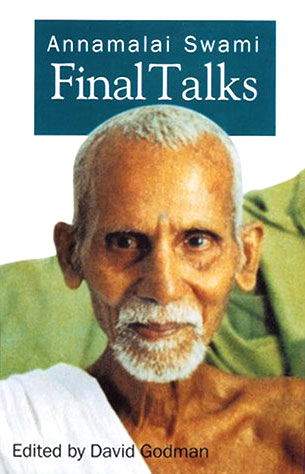
The above excerpt is taken from Annamalai Swami Final Talks, Chapter 14
Perhaps the most important single text that traditionally outlines the Jnana Marga (Path of Knowledge) is Shankara’s Vivekachudamani. This text has been used for centuries as a step by step manual to take one from (apparent) ignorance to Moksha (liberation) in which there is no suffering and it has been recommended by all the great Advaita sages including Sri Ramana Maharshi.
There are many gems littered throughout the text, and here is one of them which you may have missed:
160. The stupid man thinks he is the body, the book-learned man identifies himself with the mixture of body and soul, while the sage possessed of realisation due to discrimination looks upon the eternal Atman as his Self, and thinks, “I am Brahman”.
In verse 160 Shankara tells us that the one who is book-learned in Vedanta considers himself to be a mix of ‘body and soul’. In doing so, the one with mere book-learning still retains identification with the body, and so remains in ignorance and continues to suffer. In verse 162 Shankara, as is characteristic of the writing in Vivekachudamani, repeats his point and elaborates on it to make the meaning clear and beyond doubt:
162. As long as the book-learned man does not give up his mistaken identification with the body, organs, etc., which are unreal, there is no talk of emancipation for him, even if he be ever so erudite in the Vedanta philosophy.
There are many who know the scriptures, know the teachings, but still identify with the body in some way. These verses are a warning against this view. Shankara concludes this small section as follows, dispensing his sagely advice:
163. Just as thou dost not identify thyself with the shadow-body, the image-body, the dream-body, or the body thou hast in the imaginations of thy heart, cease thou to do likewise with the living body also.
164. Identifications with the body alone is the root that produces the misery of birth etc, of people who are attached to the unreal; therefore destroy thou this with the utmost care. When this identification caused by the mind is given up, there is no more chance for rebirth [ie. liberation is attained].
So don’t take yourself to be the body, just as you do not take your shadow to be yourself, do not take your body to be your-Self. Also, do not take yourself to be both the body and something else and in doing so retain a sense of limitation. You are That alone, you are the Self.
Tom is the only one [teacher] I’ve seen who doesn’t come from his point of view, he always comes directly from the silence and meets the seeker exactly where they’re at. If they need a practice, he has it, if they already have one but are stuck he knows how to move them, if they’re just beginning he knows how to guide them…it’s wonderful to see. Danny, UK
To arrange a 1 to 1 session with me please contact me via the contact page.
I offer 1 to 1 sessions either in person or via zoom. These sessions can be a wonderful way of clearing apparent blocks and confusion and can provide a much needed short-cut on your spiritual journey.
My Approach
I meet you wherever you are in your journey and guide you from there – whether you’re completely new to this or are a seasoned seeker, whether you want to focus purely on non-duality or instead want to heal emotional issues, deal with practical aspects of life or explore relationship issues.
Even if you don’t have a specific question or issue in mind, I often find I can intuitively feel where you are and advise you accordingly.
Guidance
Here are just some of the many things I have helped guide those who have approached me:
Total Freedom – right here, right now!
Clarity around the teachings with a focus on ending suffering in daily life
Awakening & enlightenment experiences: making sense of what may have happened to you and where to go from this
Going ‘in and out’ of enlightenment – why this is happening for you and what to do about it
Reconciling various traditional approaches such as Buddhism, Christianity, Gnosticism, Zen, Advaita, Vedanta as well as non-traditional approaches such as law of attraction, new-age teachings, direct teachings, neo-advaita, etc.
Dealing with practical issues such as various aspects of daily life and earning money
Relationship issues eg. with partners, family and children
Not really feeling happy, peaceful, whole & complete despite intellectually understanding the teachings
Healingemotional trauma and distress
Resolvingaddictive or habitual egoic tendencies (vasanas)
Addressing various issues related to being a ‘spiritual seeker’, eg:
asense of isolation or loneliness
loss of interest or passion for various pursuits
other more specific issues such as psychic and energetic experiences.
Cost
Cost for an online 1 to 1 session: £75 for 1 hour; £50 for 30 minutes
Cost for in-person 1 to 1 meeting (in the London area, UK): £100 for 1 hour
To arrange a 1 to 1 session with me please contact me via the contact page
Disclaimer
Meetings and sessions are not intended as a substitute for professional therapy, medical care, or legal advice. Please consult a licensed professional in these matters.
Testimonials
Tom is the easiest person to talk to and he gave me the support I needed.
Outi, Finland
Tom’s teaching is unique. His guidance is a non-dual lighthouse emitting a bright light-beam across life’s turbulent expanse to steer the seeker from crashing on the rocks of ignorance, misunderstanding and delusion, to reach the shore of Timeless Being.
His gift is discerning where the individual seeker is at and what is required specifically for that ‘individual’ to support them in their thirst for freedom from suffering. His maturity, as a guide, is evident in how he can appreciate the wisdom teachings, the ‘treasure in the field’, in traditions not generally associated with non-duality.
This breadth of understanding sets him apart from the smorgasbord of spiritual snake-oil merchants, pedlars, ‘evangelical’ non-dual purists and genuine teachers which, in practical terms, allows a welcoming and genuine spirit of inclusivity for anyone attending his satsangs. Gerry, UK
I find Tom’s teachings clearer, simpler, and less encumbered by BS than just about anyone out there whom I have encountered. I’ve had teachers from Alan Watts to Adi Da, to Andrew Cohen, and others. Tom has the least ‘baggage’ I think…
Your words always affect me like a clear, clean breath of fresh air in the midst of what is often a lot of misconception and gobbledygook about what there is to ‘attain’ and all the rest of it. Carl, USA
I chanced upon Tom’s website at a very interesting time in my journey. I had studied traditional Vedanta for many years. I had some good understanding about the concepts and was doing some serious self inquiry or Atma Vichara. That’s when I started tying myself into all sorts of knots. I wasted a lot of time confused by concepts and was in a very frustrated place until I spoke to Tom.
I believe things happen for a reason and you meet the right people at the right time in the journey. Within a couple of sessions, Tom was able to help me unravel some of these knots. As the layers started peeling off and more layers and depth opened up the journey started taking a different shape. Throughout this, Tom was able to ask just the right question and clarified many concepts that would have otherwise taken a life of their own.
I found his teaching style refreshingly down to earth and humble and since he was able to speak from his direct experience, it made everything so real and relatable. Arvind, India
In the traditional path of Knowledge or Jnana, first we are to know our True Self (Atman) and know this to be the same as the Absolute (Brahman). Then we are to be still and renounce all desires.
This spiritual knowledge (Jnana) of ‘I am Brahman’ (Aham Brahmasmi) allows the mind to become still and desireless. Note this does not mean that the body becomes totally inert – no – rather it continues to function naturally according to its destiny (Prarabdha Karma) until the body dies.
Shankara states this multiple times, eg, in Vivekachudamani, and also in his many commentaries, eg. in his commentary upon the Kena Upanishad – in his introduction to the Kena Upanishad Shankara writes:
And [the Self] being eternal, it is not to be secured by any means other than the cessation of ignorance. Hence the only duty is to renounce all desires after the realisation of the unity of the indwelling Self and Brahman.
This is akin to Self-Surrender, as spoken by Sri Ramana Maharshi:
There is no destiny. Surrender, and all will be well. Throw all the responsibility on God. Do not bear the burden yourself. What can destiny do to you then?”
(Talks 244)
and again here:
Question: Surrender is said to be Bhakti [the path of devotional love]. But Sri Bhagavan [Ramana Maharshi] is known to favour enquiry [ie. the path of Knowledge or Jnana] for the Self. There is thus confusion in the hearer.
Ramana Maharshi: Surrender can take effect only when done with full knowledge. Such knowledge comes after enquiry. It ends in surrender.




 Tom Das