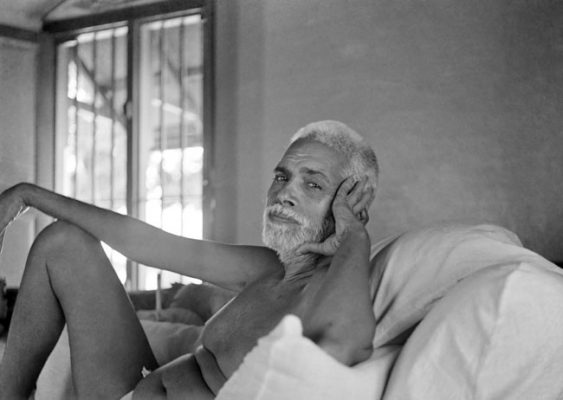
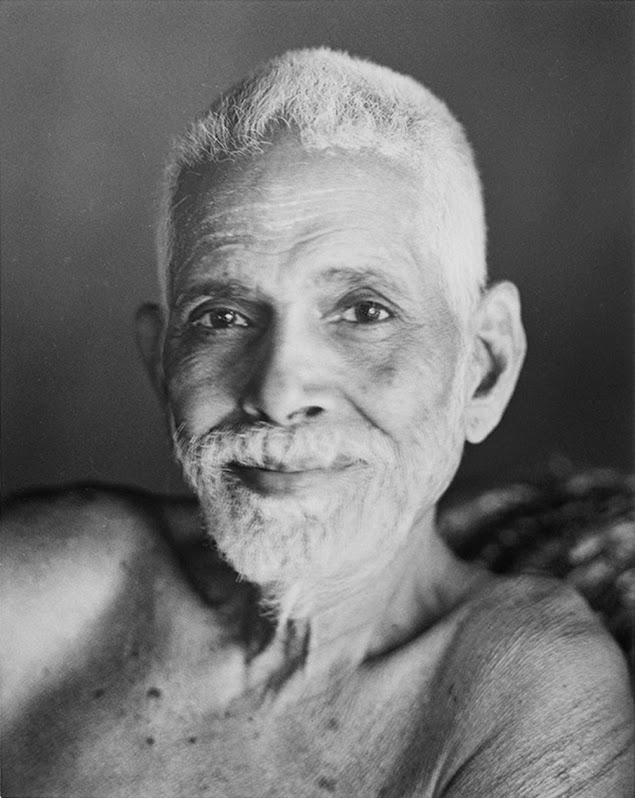
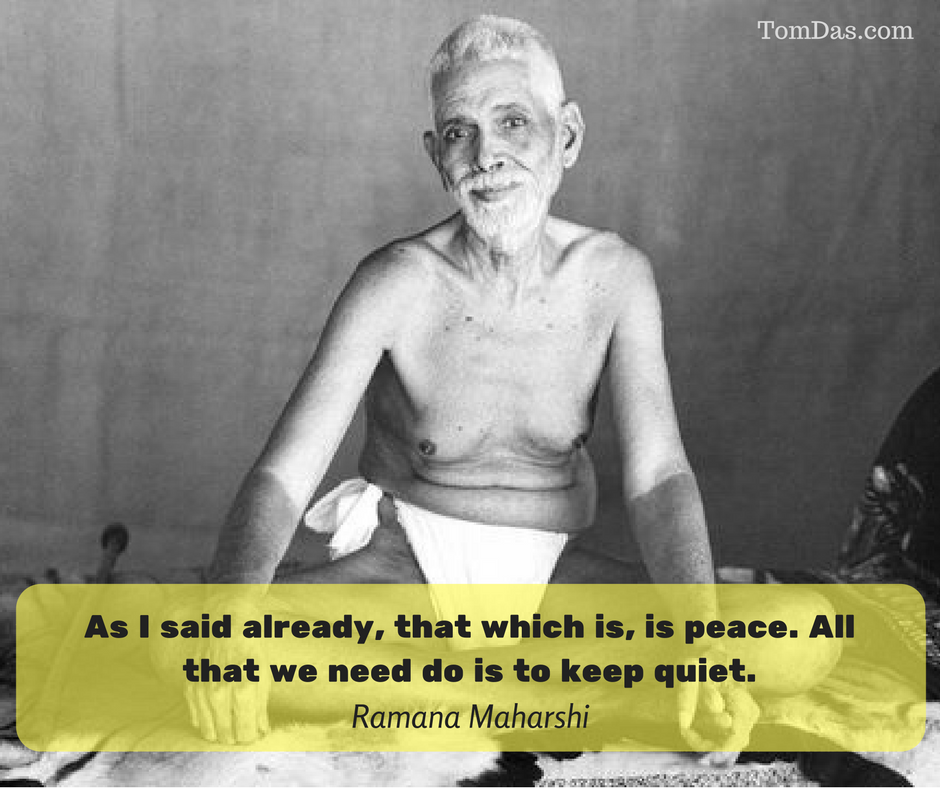
Ramana Maharshi on the two types of liberation: (1) liberation in this life (Jivanmukti) and (2) liberation after death (Videhamukti)


ramana all that we need do is to keep quiet

The following dialogue is taken from Talks with Sri Ramana Maharshi, Talk number 265, my additions are in red:

Questioner: There are said to be sadeha mukta (liberated in body) and videha mukta (liberated without body).

Sri Ramana Maharshi: There is no liberation, and where are muktas [the liberated ones]?

Questioner: Do not Hindu sastras [scriptures] speak of mukti [liberation]?

Sri Ramana Maharshi: Mukti is synonymous with the Self. Jivan mukti (liberation while alive) and videha mukti (liberation after the body falls) are all for the ignorant. The Jnani  [liberated one] is not conscious of mukti or bandha (bondage).

Bondage, liberation and orders of mukti are all said for an ajnani [ignorant or unliberated one] in order that ignorance might be shaken off.

There is only mukti and nothing else.


The following is the taken from Vichara Shangraham, a text attributed to Sri Ramana Maharshi. Vichara Sangraham is often translated simply as ‘Self Enquiry’ and literally means ‘A compendium of (Self) Enquiry’. This excerpt is very the last section of the text:

Question: What are the characteristics of the jivan-mukta (the liberated in life) and the videha-mukta (the liberated at death)?

Sri Ramana Maharshi: ‘I am not the body; I am Brahman which is manifest as the Self. In me who am the plenary [absolute] Reality, the world consisting of bodies etc, are mere appearance, like the blue of the sky’. He who has realized the truth thus is a jivan-mukta.

Yet so long as his mind has not been resolved, there may arise some misery for him because of relation to objects on account of prarabdha (karma which has begun to fructify and whose result is the present body) [ie. due to destiny], and as the movement of mind has not ceased there will not be also the experience of bliss.

The experience of Self is possible only for the mind that has become subtle and unmoving as a result of prolonged meditation. He who is thus endowed with a mind that has become subtle, and who has the experience of the Self is called a jivan-mukta. It is the state of jivan-mukti that is referred to as the attributeless Brahman and as the Turiya.

When even the subtle mind gets resolved, and experience of self ceases, and when one is immersed in the ocean of bliss and has become one with it without any differentiated existence, one is called a videha-mukta. It is the state of videha-mukti that is referred to as the transcendent attributeless Brahman and as the transcendent Turiya. This is the final goal.

Because of the grades in misery and happiness, the released ones, the jivan-muktas and videha- muktas, may be spoken of as belonging to four categories — Brahmavid, vara, variyan and varishtha. But these distinctions are from the standpoint of the others who look at them; in reality, however, there are no distinctions in release [liberation] gained through jnana [self-knowledge].

The simple way to Liberation (Moksha)

infinity birds swallows

The simple way to Liberation or Moksha is to (1) allow the mind be still and (2) not take yourself to be the body-mind.

That’s it

However, if you still want to know more about this kind of approach, I wrote an article about it here that goes into more detail.

Shankara: the world or universe is a projection of the mind

Shankara bondage is a mirage

From Shankara’s Vivekachudamani:

170. In dreams, when there is no actual contact with the external world, the mind alone creates the whole universe consisting of the experiencer etc. Similarly in the waking state also; there is no difference. Therefore all this (phenomenal universe) is the projection of the mind.

171. In dreamless sleep, when the mind is reduced to its causal state, there exists nothing (for the person asleep), as is evident from universal experience. Hence man’s relative existence is simply the creation of his mind, and has no objective reality.

Swami Chinmayananda on the Ashtavakra Gita

41en6sx4x6l._sx299_bo1204203200_

Swami Chinmayananda writes in the introduction to his commentary upon the Ashtavakra Gita of how in a way it is superior to the Upanishads, Brahma Sutras and Bhagavad Gita (these are the Prasthana Traya or ‘Holy Trinity’ of scriptures in Advaita Vedanta) in communicating the nature of the Supreme Reality.

Note the final paragraph in which all concepts, including that of ‘Supreme Reality’ or ‘Brahman’ are also dissolved:

In communicating to the seekers the unsurpassing beauty and indefinable perfections of the Absolute, the Upanisads stammer; the Brahma sutras exhaust itself and the Bhagavat Gita hesitates with an excusable shyness. A theme, in dealing with which, even these mighty books of Hinduism are thus, at best, unsatisfactory; we must, in sheer gratitude, admire Astavakra Samhita for the brilliant success it has achieved in communicating, through words, perhaps, more clearly the nature and glory of the Supreme Reality, than by the Prasthana Traya.

The student of this Samhita is himself giving the autobio-data of the liberated in life. We have here in this book a revealing autobiography of the Saint, the Liberated-in-life in King Janaka.

Beyond all assertions and denial, beyond the concepts of bondage and liberation, lies this Realm of the Self, wherein there is neither the individual-ego(jiva), nor is there even the Supreme-Reality (Brahman)!

The above was written by Swami Chinmayananda, taken from his introduction to the Ashtavakra Gita

Robert Adams: nothing to accomplish, you are already free

Robert Adams Advaita

Robert Adams Advaita

Recently someone briefly mentioned Robert Adams to me and for some reason it prompted me to take a look through some of his teachings. I chanced upon what I felt to be a highly powerful set of teachings given in Satsang in 1992, and this post is the result.

Here are a selection of quotes from Robert Adams that point the way to That which is beyond words and That which we already are/already is. The quotes are largely in order they were given during a single talk and I have inserted sub-headings which I hope makes the key points stand out more. Even though the teachings are largely self-explanatory, and there is something powerful in the phrasing of the actual quotes below, I have also summarised the teachings at the end of the post:


Trust in the Power that Knows The Way

The power that knows the way will take care of you. The one who makes the sun shine, the grass grow, the apples grow perfectly on apple trees, the food that sustains us, nourishes us. Everything has been lovingly provided for us. Have faith, trust the power that knows the way.

This is the first step, to have total faith and total trust in the infinite, the one. You may call this God, if you want to. Makes no difference what you call it. It is within you. It is without you. It is everywhere. All you have to do is to surrender to it. Surrender all of your doubts, your frustrations, your fears, everything that has besieged you for so long. Give it all up. It doesn’t belong to you. Be free of it.

No Body, no Mind, no World

When you’re able to do this, you can go further, and understand that there never was a body to begin with. The world, as it appears, does not exist. The universe, as it appears does not exist. Yet you are, and you will always be. What are you and what will you always be?

Silence.

There is no answer for that, for the mind can never comprehend the unknown, the transcendental, the Self. The mind can never know these things. The mind only knows itself as a body, as a doer. Therefore you have to transcend the mind, transcend the thoughts, transcend the world, transcend the universe, and enter the silence, where there is total bliss, and peace and harmony.

Do not be in conflict with yourself

Do not be in conflict with your thoughts and the self. When there is no conflict there are no thoughts. Thoughts only appear because there’s conflict. By conflict I mean, you’re worrying about getting rid of your thoughts, you’re doing sadhana, meditation, pranayamas, japa. All of these things cause conflict.

For aren’t you saying, ‘I’m doing these things to become liberated. I’m doing these things to become free.’ The reason there’s a the conflict is because you’re already free and liberated. Therefore when you give yourself the information that you have to do something to become liberated, there is immediately conflict.

Your programmed belief in being a body-mind causes this conflict

This is the only problem you have. It is your conflict. And this conflict comes from programming when you were a child, from samskaras, … This is where the conflict comes from. For it tells you, ‘I’m just a human being, I’m just a frail body. I have to suffer sometimes, sometimes I have to be happy.’ This is all a lie. There never was a you that has to suffer. There never was a you that has to be happy.

Nobody needs to be happy

There is no one in you who needs to be happy. There is no one in you who needs to be miserable. They are both impostors. So every time you try to exchange negative conditioning to positive conditioning, you’re causing conflict. This is the reason psychology and psychiatry does not work. For they’re trying to make you normal. Who wants to be normal? How boring.

Wish for nothing

The truth is do not wish to be anything. There is nothing you wish to be. There is nothing you have to become. There is no future, for you to become anything. Right this moment you are the one, and there never was another. Right this moment you are totally free, without thinking a thought, without trying to make anything happen.

Nothing to accomplish

Why not awaken to this truth? Why not awaken to the fact that there is nothing that you have to become, there are no goals to accomplish.

Your beliefs about karma

You want to believe everything is preordained, and it’s been mapped out for you. Or you believe that you’re just a victim of circumstance, going through many experiences, to learn a lesson. It’s really funny to me when people tell me, ‘Something happened in my life, but I guess that’s the lesson that I have to learn,’ or, ‘That’s my karma.’

Forget about karma.

Forget about lessons you have to learn. No one has to learn any lessons. No one has to go through their karmic experiences. Put an end to it all. Drop it all. After all, for whom is there karma? For whom are there experiences? Only for the I-thought, for the mind, not for you. You are bright and shining. You are the absolute reality, Brahman.

Words: ‘Reality’ and ‘Brahman’

Yet even those words are superfluous, redundant. For what do these words actually mean to you, absolute reality, Brahman? They’re just names that are given to the absolute reality, to the Self. Yet everything has to go. The absolute reality has to go. The Self has to go. The reason it has to go is because you’re thinking about this with your finite mind, and every answer you come up with is erroneous.

Always remember the finite mind can never know the infinite. It’s impossible. And there’s absolutely nothing you can do about it. Consequently the wise person becomes silent, quiescent. You’re not even trying to change your thoughts or stop your thoughts. For how can you try to stop something or change something that never existed to begin with.

The cause of conflict

Can you see now why you’re in conflict? You’re trying to correct something, you’re trying to become something, you’re trying to do something, and something does not exist.

Also what you’re trying to correct does not exist. What you’re trying to change does not exist. You get nowhere. This is why I tell you so often: leave everything alone. Have no opinions for or against. Do not be judgemental. Be nothing and you’ll be everything.

So why come to satsang?

Why do most of you come to satsang? As long as you have a reason it’s the wrong reason. There should be no reason. There shouldn’t be any valid reason why you come to satsang. For if you think back on what I’ve been referring to, you will see every reason is erroneous. For the reason that you’re trying to come to satsang doesn’t exist at all. You say you come to satsang to become enlightened, to know the truth. Who has to know the truth? Who has to become enlightened?

You come to sit with me. You can always sit with me, wherever you are. What I’m trying to tell you, do not look for reasons why you do something. When you start giving up all reasoning, all ambition, when you start surrendering all of your so called power, your human power that you think you have, this is when the mind begins to slow down.

Methods for stilling the mind

The mind will never slow down by trying to make it slow down. I don’t care what method you use. When you are using Vipassana meditation, when you’re using breathing, whatever method you’re using… Whatever method you’re using, you’re using your mind. It is your mind that you’re still using. That’s why you can never get anywhere.

You must use your mind, no matter what you do. Therefore stop doing anything. I know many of you have been practising sadhana for 25 years, 40 years, practising many forms of meditation, going to teachers, reading many books. And what becomes of you? You may get a good feeling, then it goes away, and you’re back where you started from.

The only practice

The only thing that you should do, or must do, is not to be in conflict with anything. Do not be in conflict with anyone or anything. When you’re not in conflict with anything, the mind begins to surrender itself, and goes back into the heart, and you become your Self. This is the easiest thing that you ever had to do. It’s simplicity itself. It’s simplicity itself because there’s nothing you have to do. There’s nothing you have to become. There’s no one you have to change. You are that.

Be open

Do not analyze what I am saying. Do not even agree with what I’m saying. Just be open. Open your heart by remaining still, silent. Allow the thoughts to come, do try not to stop them. Do not judge your thoughts, analyse your thoughts, or try to change your thoughts, or try to remove your thoughts. This will put you back in conflict with your thoughts.

No need to observe or be the witness

Do not even observe your thoughts. Do not even be the witness to your thoughts. Why? Because in reality there are no thoughts. The thoughts that you think you’re thinking, are an optical illusion. It is false imagination. Don’t you see? Everything that you’re thinking about is false. There is no thinker and there are no thoughts. So why have you been practising all these exercises all of your life? It’s like a person in the ocean going in search for water.

Awaken. Be free. Be yourself.

True Self

You are the joy of the world, the light that shines in darkness. You are a blessing to the universe. Love yourself always. When you love yourself, you love God. Forget about the past. Never dwell on the past. Remember, time and space does not exist. If time and space does not exist, then there cannot be a past or a future, for the past and the future is about space and time. If there is no time and space, there cannot possibly be a past or a future. So who thinks about the past? Who thinks about the future?

Beyond Self-Enquiry

Even to say the I does, the I-thought does, this again is mostly for beginners. Self-inquiry is very important, don’t get me wrong. But the day has to come when you go beyond self-inquiry, when you just realize and understand that there is no I-thought at all. It never existed. Therefore you do not have to get rid of it. There is nothing to get rid of, because nothing exists. You are total freedom, right this instant, right this minute.

The unreality of thoughts and things

Whenever your thoughts dwell on the past, do not become angry with yourself.

Leave them alone. Do not observe them. Do not watch them. Do not be the witness to them. Just leave them alone. They will disappear of their own volition, due to the fact that they never existed. This is an important point. This is the reason why you leave everything alone. Now if things existed, if there was such a thing as negative thinking, karma to get rid of, then you’d have a job on your hands. You’d have to do all sorts of things to get rid of your karma, your past sins. You’d be working continuously, practising all kinds of japa, mantras, everything, to remove all of these thoughts of the past. But I say to you since these things never existed to begin with, why do any work at all?

Oh, it’s okay, if you like to work, but I’m very lazy myself, and the less work I have to do, the better.

Do not look for results

Do not look for results. Because it’s your true nature, sooner or later the results must presume themselves, but it comes without your help. You cannot help God. God does not need your help. Just be yourself. It’s difficult to be totally honest with yourself, yet this is exactly what you have to do. Forget about being a Jnani, or enlightened, or having self-realisation.

Nobody becomes enlightened

First of all, what does the word enlightenment mean? I’m not talking about a dictionary definition. To the path of Jnana what does enlightenment mean? The answer is, there is no such word.

No one becomes enlightened. There is no body, no I, no me, there is no thing that can ever become enlightened. The word enlightenment is used by the ajnani, by students. Absolute reality, choiceless awareness, sat-chit-ananda, parabrahman, those are all words that do not exist, except to the student, in order to explain that there is a state beyond the so called norm, a state of total transcendence. And we give a name to this, enlightenment.

When this actually happens or transpires in a person the I has been totally destroyed, totally annihilated. The me no longer exists. And to that being there is absolutely no one who became enlightened. That being is resting in his true nature, in nothingness, absolute nothingness. No one can become enlightened. No one can be liberated, for the you that thinks it can be liberated doesn’t even exist. There is no you. There is no person.

There is no human being who is a human being one day and the next day becomes liberated. There is only the liberated Self and you are that. There is not you as you appear. The appearance of you, which you think you are, is false.

Your problems do not exist

This is why I say all of your problems, all of your nonsense that you go on with, all your worries, all your cares, all your emotions, they do not exist. They never have existed and they will never exist. It is all the game of maya, the leela. It doesn’t exist. No one in this room exists. There is no you and there is no me. There is only the Self. And when the self becomes the Self it is no longer the self, for there never was a real Self to begin with.

This is the reason why I emphasise, stop thinking. Your thoughts pull you deeper into maya, into illusion. Do not think of enlightenment, or awakening, or being liberated, or finding a teacher who can help you. You are beyond help. No one can do anything for you.

The process of Realisation

Actually what happens is this. As you begin to realise you are not your thoughts, you are not your body, you are not your mind, you are not the world, you’re not even liberated, you are nothing, as you begin to think this way whatever has to happen in your evolution will transpire without you doing anything. If you are meant to be with a teacher you will be with a teacher. If you are meant to be by yourself you will be by yourself, yet you have absolutely nothing to do with these things. Remain in the no-thought state.

No need to look for liberation

The worst thing you can ever do is to search for enlightenment, for liberation. This keeps you back. It keeps you back because there is a self that is searching. There is an I that is searching. There is a me that is trying to become something and the whole idea is to remove something from your consciousness.

You are No Thing

Therefore the process of realization is removal, not adding. Removing this and removing that. Removing all concepts and all preconceived ideas. Removing all of your thoughts, no matter what kind of thoughts they are.

Good thoughts, bad thoughts, they all must go, and what is left will be nothing, no thing.

You are that. You are that no thing.

Leave the world alone

Leave the world alone. Leave people alone. Do not come to any conclusion. Do not judge anyone. Everything will take care of itself.

Doesn’t it feel good to be nothing instead of believing you are thoughts, and you are human, and you have a job to fulfill, and you have a mission? There are many spiritual people you know who think they have a mission. They have come to save the world. They can’t even save themselves and they’re looking to save the world. The world will go on the way it’s going on without your help, for or against. Leave the world alone.

The Current That Knows The Way

There is a power and there is a presence, which I like to call the current that knows the way, that takes care of everything. It is all part of the grand illusion. And even in this illusion, which appears in front of your eyes, there is a presence and a power that lifts you up. It will lift you up as high as you can allow it to, until it lifts you up completely out of your body, out of your thoughts, out of the universe, to a completely new dimension.

You’ll appear to be the same person as always to people, but you’ll not be that person any longer, for that person is gone, no longer exists. You have become Brahman. You have become all-pervading. You have become your Self without trying to do so.

Give thanks and love thyself

You must always have gratitude for the way you are. Do not feel sorry for yourself. Love yourself just the way you are. By loving yourself just the way you are you will transcend those things that have appeared to annoy you, to bother you, to cause you pain.

They will all go. You’ll no longer be aware of them. Let go of everything. Have no desires whatsoever. Dive deep within the Self. Do not react to the outside world or to your body. All is well.

When you are without thoughts, you are God

When you are without thoughts, when you are without needs, without wants, without desires, then you are God. You are the universe. You are divine love. You are beautiful. Yet when you begin to think about these things you deny it, for you think about the past and the future instead of staying centred in the eternal now. You think of the mistakes you made in life. You think about the dastardly things going on in this world.

You think about your future, about the so called recession. You are enmeshed in Maya. Do not continue to think this way.


Tom’s Summary:

You will see that the essential themes are:

1) Do not take any phenomena such as Body, Mind (eg. thoughts and feelings), World, Time or Space to be real (ie. all is illusion, part of the Jnana yoga teachings such as ajata). This means there is no real ‘you’ or ‘me’ or thoughts or practices or teachings, etc.

2) Be still/silent/without thoughts (ie. be still or the Raja Yoga/Dhyana yoga teachings)

3) All is well and nothing is required as:

a) you are already Indestructible Eternal and Free Timeless Being beyond words and things so there is nothing to do and nothing to worry about (ie. the Self-Knowledge or Jnana yoga teachings)

b) in the illusory world there is an illusory power that is already doing everything and this power will continue to look after everything in the absence of an illusory ‘me’ or ego, so there is nothing to do and nothing to worry about (ie. the Surrender or Bhakti yoga teachings)

4) Give thanks have have gratitude for what comes your way (ie. the gratitude or Karma yoga teachings)

What do you think – are the points I summarised above a correct representation of the quotes below? (clue: if you take point (1) to heart, where is the need for (2), (3) and (4)?) Feel free to let me know your thoughts in the comments below.


Tom’s Super-Brief Summary:

Therefore trust in The Power that Knows The Way, allow the mind to be still, know all is well for you are the Self and be thankful! Do not take the world (including your phenomenal body-mind self) to be real –  nothing needs to be done or not done – it is all illusion!

Mahabharata – the human condition and freedom from it

vishnu sugar

This image is taken from a story in the Mahabharata and represents the situation we are in if we are ignorant.

Our past deeds (elephant) are chasing us, our future karma (snakes) and eventual death (snakes) awaits us, the present moment (the branch) is being eaten away by mice – our time is slowly running out as days (white mouse) and nights (black mouse) pass by.

Meanwhile Vishnu holds out his saving hand of Moksha (liberation) to us but we are too entranced by the honey (pleasure) dripping from Maya (honeycomb) that we endure the pains of life (bees stinging us) and we stay in this ridiculous and precarious situation rather than take Vishnu’s hand of Moksha.


Aparokshanubhuti by Shankara (with brief explanatory notes)

5bcbc2e6adc6ac9dfb690a3edcb64ab2_l

Aparokshanubhuti 

[Aparoksha = direct; Anubhuti = experience]

By Adi Sankaracharya (788-82 CE)

Translated by Swami Vimuktananda, this version edited by Tom Das

Swami Vimuktananda: Shankara discusses the identity of the individual Self and the universal Self through the direct experience of the highest Truth.

Tom: the original text has no subheadings – I have added these. My brief comments and annotations are in square brackets. I have added bold type for emphasis of what I feel are key points. Occasionally I have removed some verses or I have changed the order of some verses where I have felt this makes sense thematically. I hope these additions are of benefit for sincere seekers of liberation.

Om Shanti, Shanti, Shanti

INITIAL VERSES

  1. I bow down to Him – to Sri Hari (the destroyer of ignorance), the Supreme Bliss, the First Teacher, Ishwara, the All-pervading One and the Cause of all Lokas (the universe).
  1. Herein is expounded (the means of attaining to) Aparokshanubhuti (Self-Realization) for the acquisition of final liberation. Only the pure in heart should constantly and with all effort meditate upon the truth herein taught.

FOUR PRELIMINARY QUALIFICATIONS 

(Sadhana Chatushtaya)

[Q. Who is ‘pure in heart’?
A: He who has the 4 qualifications listed below
Q: How to become ‘pure in heart’?
A: Devotion to God, renunciation and karma yoga as per verse 3]

  1. The four preliminary qualifications (the means to the attainment of knowledge), such as Vairagya (dispassion) and the like, are acquired by men by propitiating [gaining favour of] Hari (the Lord), through austerities and the performance of duties pertaining to their social order and stage in life.
  1. The indifference with which one treats the excreta of a crow – such an indifference to all objects of enjoyment from the realm of Brahma to this world (in view of their perishable nature), is verily called pure [1] Vairagya.
  1. Atman (the seer) in itself is alone permanent, the seen is opposed to it (ie., transient) – such a settled conviction is truly known as [2] discrimination [Viveka].

[[3] The 6 treasures]

  1. Abandonment of desires at all times is called [3i] Shama and restraint of the external functions of the organs is called [3ii] Dama.
  1. Turning away completely from all sense-objects is the height of [3iii] Uparati, and patient endurance of all sorrow or pain is known as [3iv] Titiksha which is conducive to happiness.
  1. Implicit faith in the words of the Vedas and the teachers (who interpret them) is known as (3v) Shraddha, and concentration of the mind on the only object Sat (i.e., Brahman) is regarded as [3vi] Samadhana.
  1. When and how shall I, O Lord, be free from the bonds of this world (i.e., births and deaths) – such a burning desire is called [4] Mumukshuta.
  1. Only that person who is in possession of the said qualification (as means to Knowledge) should constantly reflect with a view to attaining Knowledge, desiring his own good.

VICHARA SUMMARISED

  1. Knowledge is not brought about by any other means than Vichara [inquiry], just as an object is nowhere perceived (seen) without the help of light.

[Question]

  1. Who am I ? How is this (world) created ? Who is its creator ? Of what material is this (world) made ? This is the way of that Vichara (enquiry).

[Answer – what I am not, neti-neti, via negativa]

  1. I am neither the body, a combination of the (five) elements (of matter), nor am I an aggregate of the senses; I am something different from these. This is the way of that Vichara.

[The philosophical paradigm: all phenomena is a creation of thoughts/ignorance:]

  1. Everything is produced by ignorance, and dissolves in the wake of Knowledge. The various thoughts must be the creator. Such is this Vichara.

[All is Brahman, what I am, via positiva]

  1. The material (cause) of these two (i.e., ignorance and thought) is the One (without a second), subtle (not apprehended by the senses) and unchanging Sat (Existence), just as the earth is the material (cause) of the pot and the like. This is the way of that Vichara.

[What I am – I am Brahman]

  1. As I am also the One, the Subtle, the Knower, the Witness, the Ever-Existent, and the Unchanging, so there is no doubt that I am “That” (i.e., Brahman). Such is this enquiry.

ATMAN (The Self)

  1. Atman is verily one and without parts, whereas the body consists of many parts; and yet the people see (confound) these two as one ! What else can be called ignorance but this? [repeating refrain]
  1. Atman is all consciousness and holy, the body is all flesh and impure; and yet, etc.,
  1. Atman is the (supreme) Illuminator and purity itself; the body is said to be of the nature of darkness; and yet, etc.,
  1. Atman is eternal, since it is Existence itself; the body is transient, as it is non-existence in essence; and yet etc.,
  1. How strange is it that a person ignorantly rests contented with the idea that he is the body, while he knows it as something belonging to him (and therefore apart from him) even as a person who sees a pot (knows it as apart from him) !

I AM BRAHMAN

  1. I am verily Brahman, being equanimous, quiescent, and by nature absolute Existence, Knowledge, and Bliss. I am not the body which is non-existence itself. This is called true Knowledge by the wise. [repeating refrain]
  1. I am without any change, without any form, free from all blemish and decay. I am not, etc.,
  1. I am not subjected to any disease, I am beyond all comprehension, free from all alternatives and all-pervading. I am not, etc.,
  1. I am without any attribute or activity, I am eternal, ever free, and imperishable. I am not, etc.,
  1. I am free from all impurity, I am immovable, unlimited, holy, undecaying, and immortal. I am not, etc.,

IGNORANCE

  1. O you ignorant one ! Why do you assert the blissful, ever-existent Atman, which resides in your own body [ie. is your essence] and is (evidently) different from it, which is known as Purusha [The Person] and is established (by the Shruti as identical with Brahman), to be absolutely non-existent?

[ie. Why do you say ‘There is no Atman/Self’?]

  1. O you ignorant one ! Try to know, with the help of [1] Shruti and [2] reasoning, your own Self, Purusha, which is different from the body, (not a void but) the very form of existence, and very difficult for persons like you to realize.

[This will be explained below]

1. REASONING

  1. The Supreme (Purusha) known as “I” (ego) is but one, whereas the gross bodies are many. So how can this body be Purusha?
  1. “I” (ego) is well established as the subject of perception whereas the body is the object. This is learnt from the fact that when we speak of the body we say, “This is mine.” So how can this body be Purusha?
  1. It is a fact of direct experience that the “I” (Atman) is without any change, whereas the body is always undergoing changes. So how can this body be Purusha?
  1. Even the subtle body [ie. mind] consists of many parts and is unstable. It is also an object of perception, is changeable, limited and non-existent by nature. So how can this be the Purusha?
  1. The immutable Atman, the substratum of the ego, is thus different from these two bodies [ie. gross and subtle bodies], and is the Purusha, the Ishwara (the Lord of all), the Self of all; It is present in every form and yet transcends them all.

2. SHRUTI

[Shruti literally means ‘heard’ or ‘that which is heard’, and refers to revealed scripture, the highest form of scripture in Vedic tradition, and the examples are the Vedas and Upanishads. Traditionally Shruti is not of human origin but of Divine origin, as opposed to Smriti or ‘remembered’, which comes from the minds of human beings. This text, not being the Vedas or Upanishads would be considered to be Smriti. Most epics such as Ramayana, Mahabharata and Bhagavad Gita are all Smriti scriptures]

  1. Wise men have ascertained the (real) nature of Purusha from that Shruti text, “(There is nothing) higher than He (Purusha),” etc. So how can this body be Purusha ?
  1. Again the Shruti has declared in the Purusha Sukta that “All this is verily the Purusha”. So how can this body be Purusha ?
  1. So also it is said in Brihadaranyaka that “The Purusha is completely unattached”. How can this body wherein inhere innumerable impurities be the Purusha ?
  1. There again it is clearly stated that “the Purusha is self-illumined”. So how can the body which is inert (insentient) and illumined by an external agent be the Purusha ?
  1. Moreover, the Karma-kanda also declares that the Atman is different from the body and permanent, as it endures even after the fall of the body and reaps the fruits of actions (done in this life).
  1. The Shruti in the form of the Brihadaranyaka has declared that this Atman, which is the Self of all, is verily Brahman.

ADVAITA

[So far we have discerned the difference between Self and Not-Self (ie. the phenomenal world including the body and mind). Now we see this too is an artificial duality and now the focus is on Advaita, or non-duality:]

  1. Thus the view that the body is the Atman has been denounced by the enunciation of the difference between the Atman and the body. Now is clearly stated the unreality of the difference between the two.
  1. No division in Consciousness is admissible at any time as it is always one and the same. Even the individuality of the Jiva must be known as false, like the delusion of a snake in a rope.
  1. As through the ignorance of the real nature of the rope the very rope appears in an instant as a snake, so also does pure Consciousness appear in the form of the phenomenal universe without undergoing any change.
  1. There exists no other material cause of this phenomenal universe except Brahman. Hence this whole universe is but Brahman and nothing else.
  1. From such declaration (of the Shruti) as “All this is Atman”, it follows that the idea of the pervaded and the pervading is illusory. This supreme truth being realized, where is the room for any distinction between the cause and the effect?

[The Mahavakya or great saying ‘Sarvam Khalvidam Brahma’ or ‘All this is Brahman’ is taken from the Chandogya Upanishad 3.14.1]

  1. Certainly the Shruti has directly denied manifoldness in Brahman. The non-dual cause being an established fact, how could the phenomenal universe be different from It ?
  1. Moreover, the Shruti has condemned (the belief in variety) in the words, “The person who”, being deceived by Maya, “sees variety in this (Brahman), goes from death to death”.
  1. Inasmuch as all beings are born of Brahman, the supreme Atman, they must be understood to be verily Brahman.
  1. The Shruti has clearly declared that Brahman alone is the substratum of all varieties of names, forms and actions.
  1. Just as a thing made of gold ever has the nature of gold, so also a being born of Brahman has always the nature of Brahman.
  1. Just as a jar is all earth, so also is the body all consciousness. The division, therefore, into the Self and non-Self is made by the ignorant to no purpose.

SUFFERING

  1. Fear is attributed to the ignorant one who rests after making even the slightest distinction between the Jivatman and the Paramatman.

[ie. duality causes fear]

  1. When duality appears through ignorance, one sees another; but when everything becomes identified with the Atman, one does not perceive another even in the least.
  1. In that state when one realizes all as identified with the Atman, there arises neither delusion nor sorrow, in consequence of the absence of duality.

[ie. lack of duailty, or nonduality, removes suffering]

THE THREE STATES

[ie. The 3 states change, they come and go, and so are without any enduring essence, as opposed to Atman]

  1. This world, though an object of our daily experience and serving all practical purposes, is, like the dream world, of the nature of non-existence, inasmuch as it is contradicted the next moment.
  1. The dream (experience) is unreal in waking, whereas the waking (experience) is absent in dream. Both, however, are non-existent in deep sleep which, again, is not experienced in either.
  1. Thus all the three states are unreal inasmuch as they are the creation of the three Gunas [ie. tamas, rajas, sattva]; but their witness (the reality behind them) is, beyond all Gunas, eternal, one, and is Consciousness itself.

ILLUSION

[The illusion of duality: the illusion of the individual person or Jiva, the illusion of the manifold universe]

  1. Just as (after the illusion has gone) one is no more deluded to see a jar in earth or silver [irridescence] in the nacre [mother of pearl], so does one no more see Jiva in Brahman when the latter is realized (as one’s own self).
  1. Just as earth is described as a jar, gold as an ear-ring, and a nacre as silver, so is Brahman described as Jiva.
  1. Just as blueness in the sky, water in the mirage, and a human figure in a post (are but illusory), so is the universe in Atman.
  1. Just as the appearance of a ghost in an empty place, of a castle in the air, and of a second moon in the sky (is illusory), so is the appearance of the universe in Brahman.
  1. Just as it is water that appears as ripples and waves, or again it is copper, that appears in the form of vessel so it is Atman that appears as the whole universe.
  1. Just as it is earth that appears under the name of a jar, or it is threads that appear under the name of a cloth, so it is Atman that appears under the name of the universe. This Atman is to be known by negating the names.

MITHYA

  1. Just as there ever exist the relation of cause and effect between earth and a jar, so does the same relation exist between Brahman and the phenomenal world; this has been established here on the strength of scriptural texts and reasoning.

METAPHORS FOR ILLUSION

(YOU ARE NOT THE BODY!)

[Note: If I think I am the body, then this is taking the Self (myself) to be the body]

  1. Just as a rope is imagined to be a snake and a nacre to be a piece of silver, so is the Atman determined to be the body by an ignorant person. [repeating refrain]
  1. Just as earth is thought of as a jar (made of it) and threads as a cloth, so is Atman, etc.,
  1. Just as gold is thought of as an ear-ring and water as waves, so is the Atman, etc.,
  1. Just as the stump of a tree is mistaken for a human figure and a mirage for water, so is the Atman, etc.,
  1. Just as a mass of wood work is thought of as a house and iron as a sword, so is the Atman, etc.,
  1. Just as one sees the illusion of a tree on account of water, so does a person on account of ignorance see Atman as the body.
  1. Just as to a person going in a boat everything appears to be in motion, so does one, etc.,
  1. Just as to a person suffering from a defect (jaundice) white things appear as yellow, so does one, etc.,
  1. Just as to a person with defective eyes everything appears to be defective, so does one, etc.,
  1. Just as a firebrand, through mere rotation, appears circular like the sun, so does one, etc.,
  1. Just as all things that are really large appear to be very small owing to great distance, so does one, etc.,
  1. Just as all objects that are very small appear to be large when viewed through lenses, so does one, etc.,
  1. Just as a surface of glass is mistaken for water, or vice versa, so does one, etc.,
  1. Just as a person imagines a jewel in fire or vice versa, so does one, etc.,
  1. Just as when clouds move, the moon appears to be in motion, so does one, etc.,
  1. Just as a person through confusion loses all distinction between the different points of the compass, so does one, etc.,
  1. Just as the moon (when reflected) in water appears to one as unsteady, so does one, etc.,

THE END OF IGNORANCE

  1. Thus, through ignorance, arises in Atman the delusion of the body, which, again, through Self-realization, disappears in the supreme Atman.
  1. When the whole universe, movable and immovable, is known to be Atman, and thus the existence of everything else is negated, where is then any room to say that the body is Atman?
  1. O enlightened one, pass your time always contemplating on Atman while you are experiencing all the results of Prarabdha [Fate or destiny]; for it ill becomes you to feel distressed.

PRARABDHA KARMA 

  1. The theory one hears of from the scripture, that Prarabdha does not lose its hold upon one even after the origination of the knowledge of Atman, is now being refuted.
  1. After the origination of the knowledge of Reality, Prarabdha verily ceases to exist, inasmuch as the body and the like become non-existent; just as a dream does not exist on waking.
  1. Just as the body in a dream is superimposed (and therefore illusory), so is also this body. How could there be any birth of the superimposed (body), and in the absence of birth (of the body) where is the room for that (i.e., Prarabdha) at all ?
  1. The Vedanta texts declare ignorance to be verily the material (cause) of the phenomenal world just as earth is of a jar. That (ignorance) being destroyed, where can the universe subsist ?
  1. Just as a person out of confusion perceives only the snake leaving aside the rope, so does an ignorant person see only the phenomenal world without knowing the reality.
  1. The real nature of the rope being known, the appearance of the snake no longer persists; so the substratum being known, the phenomenal world disappears completely.
  1. The body also being within the phenomenal world (and therefore unreal), how could Prarabdha exist ? It is, therefore, for the understanding of the ignorant alone that the Shruti speaks of Prarabdha.
  1. “And all the actions [Karmas] of a man perish when he realizes that (Atman) which is both the higher and the lower”. Here the clear use of the plural by the Shruti is to negate Prarabdha as well.
  1. If the ignorant still arbitrarily maintain this, they will not only involve themselves into two absurdities but will also run the risk of forgoing the Vedantic conclusion. So one should accept those Shrutis alone from which proceeds true knowledge.

FIFTEEN STEPS TO MEDITATION & LIBERATION

  1. Now, for the attainment of the aforesaid (knowledge), I shall expound the fifteen steps by the help of which one should practice profound meditation at all times.

[The need for practice]

  1. The Atman that is absolute existence and knowledge cannot be realized without constant practice. So one seeking after knowledge should long meditate upon Brahman for the attainment of the desired goal.

102-103. The steps, in order, are described as follows: the control of the senses, the control of the mind, renunciation, silence, space, time, posture [asana], the restraining root (Mulabandha), the equipoise of the body, the firmness of vision, the control of the vital forces, the withdrawal of the mind, concentration, self-contemplation and complete absorption. 

[These above stages are similar to and include the classical 8 stages of Patanjali’s Raja Yoga. Shankara will redefine these steps in the next few verses giving them a non-dual spin]

  1. The restraint of all the senses by means of such knowledge as “All this is Brahman” is rightly called Yama, which should be practiced again and again.

[Yama or self-control is usually defined as being ethical, truthful, not stealing, etc]

  1. The continuous flow of only one kind of thought to the exclusion of all other thoughts, is called Niyama [discipline], which is verily the supreme bliss and is regularly practiced by the wise.

[The one kind of thought are those of the Mahavakyas such as ‘I am Brahman’, etc]

[Niyama, or discipline usually includes virtuous habits to externally and inwardly cleanse the body and mind respectively]

  1. The abandonment of the illusory universe by realizing it as the all-conscious Atman is the real renunciation honored by the great, since it is of the nature of immediate liberation.

[as in verse 104, the underlying method utilised is the realisation that ‘All is Brahman-Atman’. The emphasis is on a shift of perspective rather than just taking yourself to be the body-mind and renouncing objects from that ignorant perspective]

  1. The wise should always be one with that Silence wherefrom words together with the mind turn back without reaching it, but which is attainable by the Yogins.

[The Silence refers to the Self, Atman/Brahman, which is what we are. ‘Mind turns back without reaching it’ refers to Taittiriya Upanishad II.9]

108-109. Who can describe That (i.e., Brahman) whence words turn away ? (So silence is inevitable while describing Brahman). Or if the phenomenal world were to be described, even that is beyond words. This, to give an alternate definition, may also be termed silence known among the sages as congenital. The observance of silence by restraining speech, on the other hand, is ordained by the teachers of Brahman for the ignorant.

[True Silence is Self-Knowledge and not mere cessation of speech]

  1. That solitude is known as space, wherein the universe does not exist in the beginning, end or middle, but whereby it is pervaded at all times.

[True solitude is Self-Knowledge, in which there is only One without a Second, the implication is that solitude is not the mere retiring to a forest in seclusion]

  1. The non-dual (Brahman) that is bliss indivisible is denoted by the word ‘time’, since it brings into existence, in the twinkling of an eye all beings from Brahman downwards.
  1. One should known that as real posture in which the meditation on Brahman flows spontaneously and unceasingly, and not any other that destroys one’s happiness.

[Shankara’s humour that the true Yogic asana/posture are not mere contortions of body that ‘destroy one’s happiness’ but meditation upon Brahman]

  1. That which is well known as the origin of all beings and the support of the whole universe, which is immutable and in which the enlightened are completely merged … that alone is known as Siddhasana [a seated meditation pose] (eternal Brahman).
  1. That (Brahman) which is the root of all existence and on which the restraint of the mind is based is called the restraining root (Mulabandha) which should always be adopted since it is fit for Raja-yogins.
  1. Absorption in the uniform Brahman should be known as the equipoise of the limbs (Dehasamya). Otherwise mere straightening of the body like that of a dried-up tree is no equipoise.
  1. Converting the ordinary vision into one of knowledge one should view the world as Brahman itself. That is the noblest vision, and not that which is directed to the tip of the nose.
  1. Or, one should direct one’s vision to That alone where all distinction of the seer, sight, and the seen ceases and not to the tip of the nose.
  1. The restraint of all modifications of the mind by regarding all mental states like the Chitta as Brahman alone, is called Pranayama.

119-120. The negation of the phenomenal world is known as Rechaka (breathing out), the thought, “I am verily Brahman”, is called Puraka (breathing in), and the steadiness of that thought thereafter is called Kumbhaka (restraining the breath). This is the real course of Pranayama for the enlightened, whereas the ignorant only torture the nose [more humour from Shankara here].

  1. The absorption of the mind in the Supreme Consciousness by realizing Atman in all objects is known as Pratyahara (withdrawal of the mind) which should be practiced by the seekers after liberation.
  1. The steadiness of the mind through realization of Brahman wherever the mind goes, is known as the supreme Dharana (concentration).
  1. Remaining independent of everything as a result of the unassailable thought, “I am verily Brahman”, is well known by the word Dhyana (meditation), and is productive of supreme bliss.
  1. The complete forgetfulness of all thought by first making it changeless and then identifying it with Brahman is called Samadhi known also as knowledge.

[The method is to make thought changeless, which means to only have one thought such as ‘I am Brahman’ as per verses 119 and 123, and then to realise this thought as nothing else but Brahman or Atman (self), and then forget all thought. Shankara equates this Samadhi with Knowledge]

THE FRUIT OF PRACTICE

  1. The aspirant should carefully practice this (meditation) that reveals his natural bliss until, being under his full control, it arises spontaneously, in an instant when called into action.
  1. Then he, the best among Yogis having attained to perfection, becomes free from all practices. The real nature of such a man never becomes an object of the mind or speech.

OBSTACLES

127-128. While practicing Samadhi there appear unavoidably many obstacles, such as lack of inquiry, idleness, desire for sense-pleasure, sleep, dullness, distraction, tasting of joy, and the sense of blankness. One desiring the knowledge of Brahman should slowly get rid of such innumerable obstacles.

ENCOURAGEMENT AND A WARNING

  1. While thinking of an object the mind verily identifies itself with that, and while thinking of a void it really becomes blank, whereas by the thought of Brahman it attains to perfection. So one should constantly think of (Brahman to attain) perfection.
  1. Those who give up this supremely purifying thought of Brahman, live in vain and are on the same level with beasts.
  1. Blessed indeed are those virtuous persons who at first have this consciousness of Brahman and then develop it more and more. They are respected everywhere.

[Against the intellectual approach:]

  1. Only those in whom this consciousness (of Brahman) being ever present grows into maturity, attain to the state of ever-existent Brahman; and not others who merely deal with words.
  1. Also those persons who are only clever in discussing about Brahman but have no realization, and are very much attached to worldly pleasures, are born and die again and again in consequence of their ignorance.
  1. The aspirants after Brahman should not remain a single moment without the thought of Brahman, just like Brahma, Sanaka, Suka and others.

ANALYSIS OF ‘CAUSE’ AND ‘EFFECT’

  1. The nature of the cause inheres in the effect and not vice versa; so through reasoning it is found that in the absence of the effect, the cause, as such also disappears.

[Cause and effect refers to karma and the phenomenal world. When this world is removed, only Brahman remains:]

  1. Then that pure reality (Brahman) which is beyond speech alone remains. This should be understood again and again verily through the illustration of earth and the pot.

[ie. When the pot is destroyed, the earth from which it is made remains]

  1. In this way alone there arises in the pure-minded a state of awareness (of Brahman), which is afterwards merged into Brahman.
  1. One should first look for the cause by the negative method and then find it by the positive method, as ever inherent in the effect.

[Here the cause is Brahman and the effect is the world, ie. by removing all objects from perception through meditation (negative method 1) or by negating all objects of perception as being not-self (negative method 2) the Self should be discovered, but then the Self should be seen being in All Objects (positive method)]

  1. One should verily see the cause in the effect, and then dismiss the effect altogether. What then remains, the sage himself becomes.
  1. A person who meditates upon a thing with great assiduity and firm conviction, becomes that very thing. This may be understood from the illustration of the wasp and the worm.

UNITY OF FORMLESS AND FORM

  1. The wise should always think with great care of the invisible, the visible, and everything else, as his own Self which is consciousness itself.
  1. Having reduced the visible [objects of perception] to the invisible [formless Brahman], the wise should think of the universe as one with Brahman. Thus alone will he abide in eternal felicity with mind full of consciousness and bliss.
  1. Thus has been described Raja-Yoga consisting of these steps (mentioned above). With this is to be combined Hatha-Yoga for (the benefit of) those whose worldly desires are partially attenuated.

[The above described Raja Yoga is purely mental, having been stripped of the more external practices. Therefore for those whose minds have not been purified, the external and physical aspects of yoga, denoted here as Hatha Yoga, should also be performed]

  1. For those whose mind is completely purified this (Raja-Yoga) alone is productive of perfection. Purity of the mind, again, is speedily accessible to those who are devoted to the teacher and the Deity.

[Devotion to and faith in Guru and God are recommended methods of purification of mind. When the mind is sufficiently pure, then Shankara’s form of Raja Yoga on the mental levels alone leads directly to liberation]

Kashmir Shaivism, Tantra and Advaita Vedanta – Ramana Maharshi’s view

ramana-maharshi face
Sri Ramana Maharshi

Kashmir Shaivism is a non-dual tantric tradition in which Pratyabhijna or ‘recognition’ is the goal. In Kashmir Shaivism, the absolute is termed ‘Shiva’ and the relative world of people and objects is termed ‘Shakti’ (which means energy or power). Shiva and Shakti are given equal status and are said not to exist apart from each other – where one exists, the other also exists.

In Non-Dual (Advaita) Vedanta, the Self (Atman) is the Absolute (Brahman) and it is said to project Maya-Shakti which in turn projects the world of people and objects. Maya is said to be dependent on the Absolute Self and not vice-versa, so the two are not given equal status.

This obviously causes confusion in some seekers, so here Ramana explains them both:


The following is an excerpt from Talks with Sri Ramana Maharshi, Talk 288:

Explaining Maya of Vedanta and swatantra [tantra] of Pratyabhijna (independence of recognition), Sri Bhagavan said:

The Vedantins say that Maya is the sakti of illusion premised in Siva. Maya has no independent existence. Having brought out the illusion of the world as real, she continues to play upon the ignorance of the victims. When the reality of her not being is found, she disappears.

‘Recognition’ [ie. Kashmir Shaivism] says that Sakti (power) is coeval with Siva. The one does not exist without the other. Siva is unmanifest, whereas Sakti is manifest on account of Her independent will swatantra. Her manifestation is the display of the cosmos on pure consciousness, like images in a mirror.

The images cannot remain in the absence of a mirror.

So also the world cannot have an independent existence. Swatantra becomes eventually an attribute of the Supreme. Sri Sankara says that the Absolute is without attributes and that Maya is not and has no real being. What is the difference between the two? Both agree that the display is not real. The images of the mirror cannot in any way be real. The world does not exist in reality (vastutah).

Both schools mean the same thing. Their ultimate aim is to realise the Absolute Consciousness. The unreality of the cosmos is implied in Recognition (Pratyabhijna), whereas it is explicit in Vedanta. If the world be taken as chit (consciousness), it is always real. Vedanta says that there is no nana (diversity), meaning that it is all the same Reality.

There is agreement on all points except in words and the method of expression.

Tom: note that in both Advaita Vedanta and Kashmir Shaivism, the essential teaching is the same – ie. one is advised to turn within, that is turn away from objects, and realise the Pure Consciousness, the Self Within, devoid of objects. Only the conceptual framework and superficial aspects of the teachings vary.

Q. Are there different levels of Moksha (Liberation) or Realisation? If so, how many are there?

Tom: Is there even such a thing as Moksha? Even to speak of Moksha is more ignorance, as it implies some entity that can be liberated, or something to be liberated from.

However…In more conventional terms we could say there are no levels of Moksha (as there is only Moksha), but there are various levels of ignorance. So all apparent levels of realisation appear in maya/are illusory/are based in ignorance.

Gaudapada in his commentary of the Mandukya Upanishad hints at this: see the first 2 verses I quote from him here together with my commentary: Advaita Vedanta: Gaudapada’s Method

There are various stages that the seeker tends to go through, however, see this link for more: Q. What are the stages of awakening?

There are also different types of Moksha, apparently (meaning from the point of view of ignorance), such as jivanmukti and videhamukti and numerous other classifications in the scriptures. But in essence we don’t have to worry about these as this is just more book knowledge. The scriptures and sages (such as Ramana) remind us that this is really more ignorance for the mind. Instead, keep it simple and just keep on with your basic Sadhana:

1. Be still (raja yoga)

2. Know who you are (jnana yoga)

3. Adore your God-Guru-Self (bhakti yoga)

4. Give thanks for all that comes your way (karma yoga)

Note – all of the above leads to a peaceful open indestructible stillness (Mouna or Atman/Brahman)

5. Dissolve into Divine Love (Moksha/Advaita/Bhakti/Jnana)

🙂

Discerning True Self & Emotions

I’m still asking people to subscribe to my YouTube Channel (Please subscribe!).  YouTube responds to increased subscriptions & likes by sharing the video content more widely, so your support is greatly appreciated.

As an incentive I’ll be posting further videos in the next few days that cover the essential teachings, so if you’re subscribed you’ll automatically be notified of them.

Here is my latest video offering: