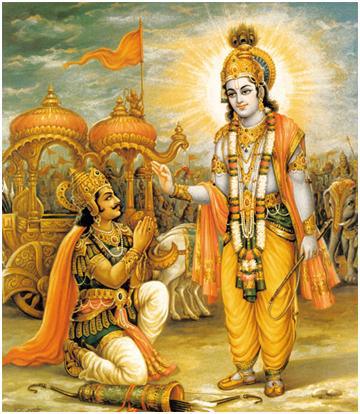
Under the influence of false ego one thinks himself to be the doer of activities, while in reality all the activities are carried out by nature as natural process
Bhagavad Gita, Chapter 3 verse 27
Here, in the Bhagavad Gita (The Lord’s Song), Krishna tells his friend Arjuna a great truth: that the notion of there being any separate entity that takes itself to be the doer is false. There is no doer, the ego is a false entity; there is only nature acting according to its own inherent principles.
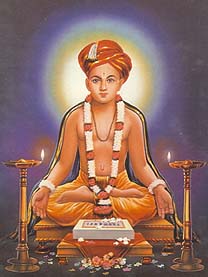
Jnaneshvar (1275–1296), also known as Jnanadev is widely acclaimed as a great self-realised master and teacher whose poetry and writings have influenced many generations after him. He was part of the Nath tradition, an ancient lineage of spiritual masters, which has become recently famous in the West due to Nisargadatta Maharaj (1897-1981), a more recent initiate in the Nath tradition. Continue reading →
In many spiritual traditions, such as some schools of of Buddhism, vedanta and yoga, seekers are advised to consider the world to be like a dream: ephemeral, transient and illusory. But is the world really an illusion, or is this merely a teaching method?
Many well-versed pandits and scholars have debated this very issue over the centuries, but for those that have glimpsed the reality that lies beyond mere verbal assertions, such debates are missing the essential point.
Question: “Brahman (the Supreme Spirit) is real. The world is illusion” is the stock phrase of Sri Sankaracharya. Yet others say, “The world is reality.” Which is true?
Sri Ramana Maharshi: Both statements are true. They refer to different stages of development and are spoken from different points of view. The (spiritual) aspirant starts with the definition, that which is real exists always. Then he eliminates the world as unreal because it is changing.
The seeker ultimately reaches the Self and there finds unity as the prevailing note. Then, that which was originally rejected as being unreal is found to be a part of the unity. Being absorbed in the reality, the world also is real. There is only being in Self-realisation, and nothing but being.
From Talks with Sri Ramana Maharshi, talk no. 33
We can clearly see Ramana says the teaching that the world is an illusion is itself a ‘thorn used to remove a thorn’. The teaching is a concept, and it is used to remove another concept, before they are both thrown away.
Here is another instructive quote:
Sri Ramana Maharshi: At the level of the spiritual seeker you have got to say that the world is an illusion. There is no other way. When a man forgets that he is Brahman, who is real, permanent and omnipresent, and deludes himself into thinking that he is a body in the universe which is filled with bodies that are transitory, and labours under that delusion, you have got to remind him that the world is unreal and a delusion.
Why? Because his vision which has forgotten its own Self is dwelling in the external, material universe. It will not turn inwards into introspection unless you impress on him that all this external material universe is unreal.
When once he realises his own Self he will know that there is nothing other than his own Self and he will come to look upon the whole universe as Brahman.
There is no universe without the Self. So long as a man does not see the Self which is the origin of all, but looks only at the external world as real and permanent, you have to tell him that all this external universe is an illusion. You cannot help it.
Take a paper. We see only the script, and nobody notices the paper on which the script is written. The paper is there whether the script on it is there or not. To those who look upon the script as real, you have to say that it is unreal, an illusion, since it rests upon the paper. The wise man looks upon both the paper and script as one. So also with Brahman and the universe.
From letters from Sri Ramanasramam
Here in the next excerpt Ramana is asked directly if the world is perceived after realisation:
A visitor: Is the jagat (world) perceived even after Self-Realization?
M.: From whom is this question? Is it from a Jnani or from an ajnani?
D.: From an ajnani.
M.: Realise to whom the question arises. It can be answered if it arises after knowing the doubter. Can the jagat or the body say that it is?
Or does the seer say that the jagat or the body is? The seer must be there to see the objects. Find out the seer first. Why worry yourself now with what will be in the hereafter?
[Tom – Ramana is telling the questioner not to worry about this question and rather attend to himself ie. to do self-enquiry]
Sri Bhagavan continued: What does it matter if the jagat is perceived or not perceived? Have you lost anything by your perception of jagat now? Or do you gain anything where there is no such perception in your deep sleep? It is immaterial whether the world is perceived or not perceived.
[Tom: Now Ramana answers the question directly:]
The ajnani sees the Jnani active and is confounded. The jagat is perceived by both; but their outlooks differ. Take the instance of the cinema. There are pictures moving on the screen. Go and hold them.
What do you hold? It is only the screen. Let the pictures disappear.
What remains over? The screen again. So also here. Even when the world appears, see to whom it appears. Hold the substratum of the ‘I’. After the substratum is held what does it matter if the world appears or disappears?
The ajnani takes the world to be real; whereas the Jnani sees it only as the manifestation of the Self. It is immaterial if the Self manifests itself or ceases to do so.
Listen and read the Song of Ribhu. Let the words wash over you. These words are not to be analysed and contemplated; they are to sink into your bones and marrow and stir that Ancient Knowing that is already there within you.
Read, chant, have faith (let go into presence) and be free!
1. Ribhu: Listen again the the supreme knowledge that confers liberation immediately. All is Brahman alone, always. All is tranquility – there is no doubt.
The following is an excerpt from the book ‘Annamalai Swami Final Talks’ (bold added by me):
Annamalai Swami: ….Your mind is an insubstantial shadow that will follow you around wherever you go. Attempts to eliminate or control it cannot succeed while there is still a belief that the mind is real, and that it is something that can be controlled by physical or mental activity.
Question: But this shadow mind must still be eliminated by some means. Continue reading →
The following is an excerpt from the book ‘Annamalai Swami Final Talks’ (bold added by me):
Question: One can have a temporary experience of the Self, the underlying reality, but then it goes away. Can you offer any guidance on how to stabilise in that state? Continue reading →
Questioner: If my real self is peace and love, why is it so restless?
Nisargadatta Mahara: It is not your real being that is restless, but its reflection in the mind appears restless because the mind is restless. It is just like the reflection of the moon in the water stirred by the wind. The wind of desire stirs the mind and the ‘me’, which is but a reflection of the Self in the mind, appears changeful. But these ideas of movement, of restlessness, of pleasure and pain are all in the mind. The Self stands beyond the mind, aware, but unconcerned. Continue reading →




 Tom Das