Relax into Unknowing
What does that mean?
It means to relax, to let go of everything.
What are you left with?
You are left with whatever is.
You are left with this, Justthis.
No matter how much you let go, This is.
Or you could say:
No matter how much you let go, You are.
This Letting Go,
Is the coming into contact with being.
This is what it means to abide as the ‘I am’.
This is what it means to ‘remember who you are’.
It’s can become obvious that
All perceived things,
All phenomena,
Come and go.
The objects of the external world come and go,
Thoughts come and go,
Feelings come and go.
Knowledge comes and goes,
Expericences come and go,
States of consciousness come and go.
The body is a process
Of constant change,
As is everything else.
It too comes and goes.
In this sense independent objects do not exist in of themselves.
All there is is movement,
Constant movement appearing as form,
But no static unchanging form can be found
– Not even for a moment.
This Being/Unknowing is always here.
It can be consciously known when you relax and notice it,
Notice that which is ever present and unchanging in your experience.
When this unchanging essence/being is realised
And understood to always be here,
Undisturbed by comings and goings,
Then we do not need to keep on returning
to the practice of relaxing into unknowing/being.
Instead we can have Faith In Being.
This is Self-Knowledge.
In Mahayana and Vajrayana (Tibetan) Buddhism, our True Nature (also known as Buddha nature, Reality, Mind, Ground, Knowledge, Awareness, etc.) is said to be beyond all concepts and all definitions. Typically this is expanded upon as follows:
Mind/True Nature is beyond all concepts or philosophical notions:
1. It cannot be said to ‘exist’
2. It cannot be said to ‘not exist’
3. It cannot be said to ‘both exist and not exist’
4. It cannot be said to ‘neither exist or not exist’
As far as I’m aware, the first Buddhist commentator to put it in these terms was Nagarjuna, who wrote a much more comprehensive analysis along these lines in around 200 years BCE in his text Fundamental Verses on the Middle Way (Mula-madhamaka-karika). Since Nagarjuna, countless other Buddhist schools including most of the Tibetan Buddhist schools, have also adopted this phrasing in order to help steer themselves away from the danger or wrong/false conceptual views.
If we adopt this understanding, we are safeguarded against wrong views and the suffering that results from that. Many philosophical or spiritual systems fall into one of more of these traps. For example, by positing some kind of True Nature that definitely exists (ie. point 1), we can fall into the trap of eternalism in which we (the ego) cling to a concept of (belief in) an eternal permanent essence or self. Or we can go to the opposite extreme and say there is no essence of Mind or True Nature (point 2), which is nihilism, saying that there is no ‘me’ or ‘essence of me’ at all.
…we can fall into the trap of Eternalism in which we cling to a concept of an eternal permanent essence or self…Or we can go to the opposite extreme of Nihilism and say there is no True Nature…that there is no ‘me’ or ‘essence of me’ at all.
However, the analysis does not stop there. It goes on to warn about those who cling to the concept that ‘our True Nature/Mind is beyond both existence and non-existence’ (point 3). This is really a belief in a type of transcendence, which is really just believing in another type of existent permanent self, and so we have unwittingly fallen back into eternalism again.
Lastly Nagarjuna says you also cannot cling to the view that the true nature is ‘none of the above’. Basically Nagarjuna leaves us with nowhere to stand at all. The ego-mind is constantly trying to find a conceptual position on which it can lay its hat, but Nagarjuna has removed all the pegs from the hat-stand!
Basically Nagarjuna leaves us with nowhere to stand at all. The ego-mind is constantly trying to find a conceptual position on which it can lay its hat, but Nagarjuna has removed all the pegs from the hat-stand!
Nagarjuna called this the ‘middle way’ between eternalism and nihilism, or Madhamaka, and a new Madhamaka school of Buddhism was founded upon this work. Note this is different from the middle way of the original Buddha whose middle way between extreme asceticism/self-mortification and addiction to indulging in sense pleasures.
Nagarjuna also warns us that this ‘middle way’ itself should not be lent upon as some kind of truth where the ego can safely hang its hat.
Nagarjuna also warns us that this ‘middle way’ itself should not be lent upon as some kind of truth where the ego can safely hang its hat.
The purpose of this exposition is to allow us to see how we cling to concepts and then remove these false views/beliefs. Like all Buddhist teachings, when the job of the teaching is done, in this case when the false beliefs have been seen for what they are, we should also let go of the teaching and not rest on this either: ‘The essence of mind is beyond all concepts and definitions’.
So many people cling to beliefs, either knowingly or unknowingly, caught up in confusion, sometimes teaching it to others.
If you really want truth, would you accept a belief, a concept, an idea? Would you accept second-hand words, teachings and phrases uttered by others? Would you worry about what others think and get preoccupied in puerile semantic debate?
Or would you continue to seek, genuinely investigate, until you have genuinely found, in your own direct experience, the end to your suffering, an end to your seeking?
Those who have poured their minds, as a food offering to Sivam, into the surging and radiant sacrificial fire which is the discipline of true knowledge [mey jnana tavam], will truly become Siva-swarupa. Having reached this conclusion, the proper course is to worship courageously in this way and merge with the formless Sivam.
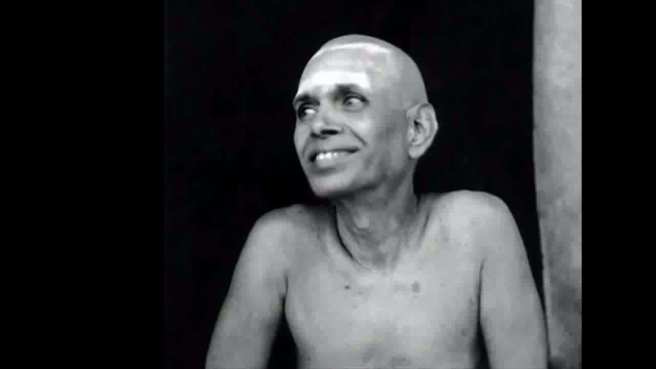
Ramana Maharshi Guru Vachaka Kovai Verse 353
Tom’s comments:
I chose this verse to write about because not only does it prescribe a sure footed way to the absolute, but also because I love the poetic imagery of ‘pouring your mind’ into the mouth of God in order to merge with Him. For me this ‘pouring’ invokes a sense of surrender which is effortless and complete, a total giving over of yourself to Him. And then we realise all is Him all always was Him, and what we called ‘me’ or ‘I’ was also Him.
When we merge with Him, we do not really ‘merge’ with Him, as that implies two entities becoming one. What happens is that the illusion of individuality and separation dissolves away and the reality that always was is seen for what it is.
The imagery of the verse also conjures up a sacrificial fire which envelopes and burns away the ignorance of separation, and it is this sacrifice of ego that is the real form of ‘courageous worship’. This worship is the same as ‘the discipline of true knowledge’.
The next verse drives the essential point home further:
Amongst those who have not realised that the individual-consciousness is fake, let not any of them doubt unnecessarily what state will be attained if the individual-consciousness is abandoned completely. Just as someone who lets go of a branch of a tree to which he had been clinging will automatically fall onto the ground with a thud, he who has abandoned individual-consciousness will not fail to reach the state of Self, the true consciousness
What’s more important – the so-called inner guru, or the outer guru that points you to that inner guru? And is there really a difference between inner and outer guru at all, or is this just a false dichotomy?
Some people say that silence is the real teacher, but do they also see the irony that they are saying this? The fact that they say this indicates at least a role for speech and words in the teaching, doesn’t it?
Some people say that someone who is self-realised doesn’t look for students, have a structured teaching, or even have a website. My question would be – how do you know? Do you know this for sure or are you just following what someone else says and falling prey to the stereotype of a self-realised brown-skinned male? Have you seen this for yourself or is this just a limiting belief?
I could inform you the traditional scriptures repeatedly state you cannot know who is self-realised by outward criteria alone, and I could name some examples of gurus who sought students and advertised, but the basic point is that people are willing to believe all sorts of unverified spiritual slogans and then base their seeking upon that. This is akin to building castles on sand: the foundations are poor and nothing lasting is achieved.
…the basic point is that people are willing to believe all sorts of unverified spiritual slogans and then base their seeking upon that.
This is a huge problem for many spiritual seekers, and points to me that there is a lack of interest in what is actually true. There may be a slight or middling interest in what is true, but when the desire to understand/find out what is true really intensifies, we naturally question and then drop all such beliefs, only depending on what we know for sure, rejecting that for which there is no evidence. We do not accept statements or platitudes along the way without verifying them first.
It should be obvious that most spiritual seekers don’t know what they are talking about when it comes to Realisation of Freedom. Why? Because most of them are still suffering, still seeking, and still do not understand the simplicity and depth of it all.
…when the desire to understand/find out what is true really intensifies, we naturally question and then drop all such beliefs, only depending on what we know for sure, rejecting that for which there is no evidence.
My advice is to realise first, and talk later. Sure you can share your experiences and insights and talk in that way, and of course you can ask questions, but do not set yourself up as an authority unless you are actually sure you know what you are talking about. Act within the limits of your competence. Be honest about what you know and don’t know.
Some more advice: trust no-one when it comes to spiritual things. Find out for yourself. And certainly don’t buy into the age-old dogmas and stereotypes that frequent the spiritual market place. Instead dare to question everything. It is this earnestness combined with a sharp inquiring mind and an open heart that will yield fruit. This keenness of mind and inquiry may then lead you to faith and devotion, but it will be different. It will be based on something real, and not on mere conceptual belief.
Instead dare to question everything. It is this earnestness combined with a sharp inquiring mind and an open heart that will yield fruit.
Going back to the beginning of this post, about gurus, what do you think about this for a progression? First the outer (physical) guru may direct us towards the inner guru (within us). Then we will see this duality is also a fiction, and finally we may rhetorically ask ‘what guru?’.
Anyone else think that your personality has to be perfect and that every pore of your being has to exude an energy of loving kindness in order for the Freedom that already is to be realised? What a prison!
With respect to seeking enlightenment, what’s wrong with THIS, right now?
Freedom is already totally completely here.
Stop all this worrying and obsessing over the apparent individual and here it is, full and complete. No need to improve the individual or the world. Then things start to right themselves naturally, according to natural law. Not that you care. It’s just the way it is.
No need to judge and evaluate apparent ‘teachers’ – that’s more obsessing about the apparent individual, the individuality you project onto them.
Now there is nothing wrong with desire to improve oneself or the world. It is quite natural in certain circumstances. The desire to change something happens by itself when it happens. It too is Spontaneous Arising, a part of ‘what is’.
Look! See! Notice! All these phenomena are empty of any independent doer-self-entity.
Freedom is already here. What does it feel like? It feels like THIS. No need to seek a new or better experience, although that too is allowed.
This Thursday in our ONLINE meeting we start another run through ‘The Structured Teachings’. As many of you already know, this way of teaching is proving to be highly effective with several attendees already ‘getting it’ in recent months, ending their seeking and watching their suffering slip away…
We start with the basics and gradually build up from there. Eventually we go beyond all verbal teachings. The aim is to create crystal clarity, dispel the confusion that exists in the spiritual market place, and allow each and everyone of you to understand and realise the Freedom that already is here for yourself. Not to just have a conceptual understanding, but actually have a genuine lived realisation for ‘yourself’.
There are many ways to this, beliefs are not required and you can discover all of this for yourself. The Structured Teachings take you through this, step-by-step.
When:
Starting this Thusday 20th July online (8pm UK time) and the following Thursday 27th July in Kingston UK (7pm)
Suffering is ok. When it’s ok, it’s no longer suffering. Just sensations, some more comfortable than others, the body-mind organism naturally responding to the feedback provided by the senses.