The following is from the text Aham Sphurana from the entry dated 15th September, 1936. Some of the language is quite difficult so I have summarised the points in my comments which, as usual, are in italicised red:
Questioner: The Jnani [Tom: knower, enlightened sage] and ajnani [Tom: non-knower, the ignorant one] both have a body; what is the difference between them?
Tom: See Sri Ramana’s text ’40 Verses on Reality’ (Ulladu Narpadu), Bhagavan writes in verse 17:
17. To those who do not know the Self and to those who do, the body is the ‘I’. But to those who do not know the Self the ‘I’ is bounded by the body; while to those who within the body know the Self the ‘I’ shines boundless. Such is the difference between them.
Bhagavan Sri Ramana Maharshi: The mistake made by the ajnani is that he limits his “I” to the body. Both the Jnani and the ajnani have a body, and both say ‘I am the body’. The difference lies in the fact that in the case of the Jnani the diaphanous [Tom: subtle] stream of consciousness needed to sustain life in the body is an upadhi [Tom: adjunct, superimposed object], whereas in the case of the other, that macilent [Tom: thin or subtle] ray of reflected consciousness [known as body-consciousness] is the one and only consciousness he is aware of.
I Am is the truth. Body-consciousness is an obnubilating [Tom: obscuring] limitation which obscures Revelation of the Self in the case of the ajnani and an upadhi in the case of the Jnani. You are always the same “I”, whatever state it is that may be passing in front of you. In sleep “I” remains without a body. That same “I” remains undisturbed and unmutilated in the jagrat [Tom: waking] and swapna [Tom: dream] states also.
Tom: To summarise the above paragraph, which contains some convoluted language, Bhagavan says that for the Jnani, the body is a mere appearance in Consciousness (Upadhi) which doesn’t cover his true identity as Self/Consciousness, whereas for the ajnani, the body is the sole identity and this obscures the vision of Truth of ‘I’ or ‘I AM’ or ‘True Self’. However, we will see below that this description is only from the relative point of view, and that truly there is no body for the Jnani in Truth.
Only, in these states, we abandon our actual identity with “I” and imagine ourselves to be perishable bodies made of matter. Despite this confusion on our part, “I” remains happily without a body in truth always, although we assume that we are within the body. Although by us imagined to be within the body, the Real “I” ever is without any body or other limitation, being the Absolute Immutable Self Itself. One’s ignorant outlook is not merely ‘I am the body.’; it lies in having confounded the Self with the not-Self, such as the mind, intellect or body. Does the Real “I” formulate or proclaim the idea of it being this or that? Is it not always perfectly silent? It is the spurious “I” which is capable of rumbustiousness or obstreperousness, and which says, ‘I am this.’ or ‘I am that.’.The body is insentient and cannot say so. Our mistake lies in thinking “I” to be what “I” is not. “I” cannot be insentient; therefore “I” is not the inert body. What then is this “I”? “I” means Sentience or Awareness which is not adumbrated by the faculty of thought-manufacture- i.e., the aham vritti.
The body’s movements are confounded with “I” and excruciating agony is the result. Whether the body and mind work or not, “I” remains free and happy i.e., in its nativistic or intrinsic state of ecstatic, Eternal Emancipation. The ajnani’s “I” is limited to his body and mind only; that is where his whole error lies. The Jnani’s “I” includes the body and everything else. For the Emancipated-one there cannot be anything apart from “I” the Self. He sees no other. Verily everything is only Himself. In the case of the ajnani, some phantasmagoric, intermediate entity known as ahankaram [Tom: ego] arises between the body and the Self and gives rise to all sorts of trouble. If its source is sought, it disappears, leaving the Self alone behind, as the solitary residue. Continuous and intense inward-pointed scrutiny of the mind results in its disappearance.
Tom: similar to my previous comments, Bhagavan is saying essentially the same thing here, namely that the Jnani is not identified with the body whereas the ajnani is. There is also a hint that in truth there is no body, and this is made slightly clearer below.
Bhagavan also says that it is this phantom ego which arises and claims to be I and also claims to be the body, and it is this that ‘gives rise to all sorts of trouble’. The method of self-enquiry is thereafter briefly described – seek the source of this ego, and via this continuous intense inward pointedness of mind, the mind disappears and Self-knowledge remains.
Q.: Since the Jnani has a tangible body, what happens to the soul in that body after its death?
B.: Others say that the Jnani has a body, and talk of jivanmukti, videhamukti, mukti by means of making the body disappear in a flash of blazing light, etc.; the Jnani’s experience of Reality is altogether unconditioned and totally absolute. His experience is that he has no body. If others see him as being one with a body, or as possessing a body, can that affect him? He does not identify himself with the body even whilst the body is yet alive. Can the death of the body then affect him?
Tom: for a moment here Bhagavan Sri Ramana speaks in absolute terms, declaring that for the Self or Jnani, there is no body at all. Below, however, Bhagavan will flip back into speaking in relative terms, presumably due to the nature of the question and the state of the questioner:
Q.: But just now Bhagawan said that the Jnani also says “I am the body.”.
B.: Yes. His “I” includes the body. His experience is that for him there cannot be anything apart from “I”. If the body is destroyed there is no loss for the “I”. “I” remains the same as ever. If the body feels dead let it raise questions. Can it? No; being inert it cannot. “I” never dies and it does not ask any question. Who then dies and who asks questions?
Q.: For whom are all the sacred-books then? They cannot be for the real “I”. They must be for the unreal “I”. The real one would not require them. Am I correct?
B.: Yes, yes.
Q.: Is it not strange that an unreal entity should have so many sacred-books written for him?
B.: Quite so. Death is merely a thought and nothing more. He who thinks raises questions and experiences troubles. Let the thinker tell us what happens to him in death.
This is one of a series of introductory articles – please see the homepage of tomdas.com for more introductory articles.
The following was originally posted here on Facebook
For me, Guru Bhakti was such an important feature of my path. Worshipping the name and form of Bhagavan Sri Ramana took me, eventually, to the formless objectless Guru in my Heart, whereupon, through the revelation of self-inquiry, He consumed me, totally and utterly, making me One with Him:
(Non-Dual) Love, Being, Consciousness and Bliss, beyond (dualistic) love, being, consciousness and bliss.
It was only later, retrospectively, that I analysed and realised what had happened and what had been happening. The intellectual understanding and appreciation of His Teachings came later.
Prior to this I never cared much for Bhagavan Sri Ramana’s written/spoken teachings – in my mind I had actually dismissed them. I just, for some reason, had a love for Him. I actually preferred Buddhist-style teachings or intellectualised versions of Advaita Vedanta, or even the teachings of Sri Nisargadatta Maharaj, as they made more sense to my rational scientific mind. Before I thought I had seen many flaws and holes in His Teachings.
Now, in retrospect, I can see how perfect His verbal and written teachings in fact are! Now I love to share his teachings. Sharing his teachings for me is a spontaneous expression of devotion, not an act of teaching at all!
At the time I was simply loving my Beloved, at the time I simply felt compelled to surrender myself to my Beloved, throw myself down at his feet. Everything else, such as Self Enquiry and Silence, spontaneously flowed from this Love and Bhakti without my being conscious at the time of what was happening or why.
This is why I often say that if you have some kind of connection to Sri Ramana, nurture that, and surrender to that, and know you are already saved. Metaphorically speaking, once you have come to Sri Ramana, your head is now in the tiger’s mouth!
Thus, in my experience, is the power of Genuine Heartfelt Guru Bhakti in which you surrender yourself to Him.
Tom: Many people say ‘I know that I am not the body-mind’, not realising that:
1) if that were truly known, genuinely known, then that is full liberation, and there would be no more questions (or answers) possible, and that is the end of the spiritual journey/search, that is unending bliss and the end of all suffering forever*, transcendence of time and space and the sense of individuality.
2) when someone says ‘I know I am not the body-mind BUT…’ (and then goes on to ask a question/express some kind of doubt or dissatisfaction), this means the entity that (thinks it) knows it is not the body-mind is in fact the mind. ie. it is the mind that is stating ‘I know I am not the body-mind’. This is essentially conceptual knowledge for the mind, even if it is based in some deeper intuitive knowing. This means the basic reference point for knowledge is still the mind, ie. we are still looking to our mind/thoughts for knowledge, and this indicates ongoing identification with the (body-)mind.
3) it is not truly or actually possible for the mind to understand ‘I am not the body-mind’. It is not something the mind can ever understand or know. The mind can repeat the phrase ‘I know I am not the body-mind’ and convince itself it knows something but this is not the true understanding at all.
TRUE UNDERSTANDING
The true understanding is not of the mind at all. It is beyond the mind. The true understanding is not of the mind at all. The true understanding is simply being the Self, also known as Silence.
HOW TO KNOW TRUTH?
How to know or be the Self? And are we not already always the self?
Yes, we are already the self. We are always the self. This self-knowledge we are looking for is always and already here. We already know, in our hearts, not in our minds, all we need for the spiritual journey. Self-knowledge is always and already here with us. There is never a need to discover anything new. Never.
THE PROBLEM
So what is the problem, and why does it appear that ‘I am not liberated’?
The issue is we ignore our self knowledge, and instead we pay attention to our thoughts, our mind, and we believe the contents of our thoughts. All we have to do is come back to our own inner self knowing.
Again, the issue is that we pay attention to our thoughts and we believe the contents of our thoughts.
**READ THIS PART CAREFULLY**
Now here is an important point that many people miss: it is not possible to pay attention to thoughts and not eventually start to believe the contents of the thoughts. I repeat, it is not possible to pay attention to thoughts and not eventually get involved in the contents of the thoughts.
This is an important point which many people miss. Try this for yourself and see.
You may feel you can dispassionately observe or witness your thoughts for a short time, but they will always draw you back in again. For placing attention to thoughts is ALREADY believing their content at the root level. Placing attention to thoughts means the root thought, ‘I am the body-mind’ is ALREADY there.
For it is not possible to dispassionately pay attention to thoughts and not believe already in the concept ‘I am the body mind’.
AS SOON AS YOU PAY ATTENTION TO THOUGHTS, THE ROOT THOUGHT, THE ROOT IGNORANCE ‘I AM THE BODY-MIND’ IS ALREADY THERE.
Yes, the root thought is the thought ‘I am the body mind’. It is this root concept or thought that gives rise to all other thoughts. This root thought, also known as ignorance, also gives rise to all perception of all objects, but more on this another time perhaps.**
As soon as we pay attention to thought, this root thought ‘I am’ or ‘I am the body mind’ is already fully there.
The same goes for gross and subtle objects. As soon as we are aware of objects, even gross objects such as cars and trees or the body, the root thought ‘I am the body mind’ is ALREADY fully there. Ignorance is ALREADY fully there.
If you are not sure about this, you can try it for yourself. You can try to remain aware of objects without the idea that you are a person and see how that goes!
AS SOON AS YOU PAY ATTENTION TO THOUGHTS, OR ANY OBJECT, INCLUDING GROSS OBJECTS SUCH AS A CAR OR A TREE, THE ROOT THOUGHT, THE ROOT IGNORANCE ‘I AM THE BODY-MIND’ IS ALREADY THERE.
If this is not understood, then the solution to this ignorance, which is outlined below, may not be accepted by the mind, and liberation may not ensue.
To remove ignorance we must turn away from all gross and subtle objects, meaning all names and forms and external objects, as well as all internal objects such as thoughts and feelings.
The only way to do this is to attend to the subject, your very own self, your own inner self knowing, that which always is, and that which is always known. The clear way to do this becomes clear through the practice, which I explain more about below.
See Sri Ramana’s teaching in Guru Vachaka Kovai verse 291. Note he says that this is the ‘essential’ advice. Notice also the use of the word ‘alone’:
291. ‘If one wants to be saved, one is given the following true and essential advice: just as the tortoise draws all its five limbs within its shell, so one should draw the five senses within and turn one’s mind Selfward. This alone is happiness.’
Compare with Bhagavad Gita 2.58:
2.58 ‘One who is able to fully withdraw the senses from their objects, just as a tortoise withdraws its limbs into its shell, is established in Divine Knowledge’.
Many people try to distort the meaning of these verses, but the imagery of the tortoise is used to make the meaning clear. There are many more verses like this I could cite, and with these other verses, again the true meaning of these verses is very clear (see here for many more of these verses, and follow the links within that post for even more).
Please note THIS IS NOT A PATH OF SUPPRESSION OR REPRESSION OR AVOIDANCE. THIS IS NOT A PATH OF SPIRITUAL BYPASSING. It is actually a path of love, a flowering of love and self-knowledge. I touch upon this further below, and have written on this topic on tomdas.com (use the search bar). there are also many videos on this on my YouTube channel, explaining how this can be the case.
This is why all genuine spiritual traditions and teachings (ie. teachings that genuinely lead to liberation) tend towards introversion, meditation and silence in some way shape or form.
This is why, historically, many traditions across geography and time all end up in some form of silent contemplation or meditation.
It is also why, if we look inwards to our own hearts, we already intuitively know that the Truth (of ourselves) arises only in Silence, deep within our very own selves, and NOT through words, concepts or the mind.
This self-attention is also known as devotion or bhakti, for the true form of your self is God absolute, it is pure holiness, pure divinity, pure oneness devoid of ignorance and duality.
A PRACTICAL WAY FORWARD
How to practically put these teachings into practice? My suggestion, as this is what worked for me (you will need to find out what works for you!), is to listen to the teachings of Sri Ramana Maharshi. Personally I have not found another teacher or teaching that comes close, even though some other teachers and teachings sound very similar, as you go deeper you will start to see the differences more and more.**** At least this is my experience.
If you are lucky, you will feel some love and devotion and connection with Him. If this love, devotion and connection occurs, it is very wonderful and in my opinion this is something you should nurture and treasure. This connection and love and devotion is a very important part of the teaching in my experience. Unfortunately this aspect of the teaching cannot be taught and spontaneously arises when the time is right.
For most of my ‘seeking career’, not only did I NOT feel love and devotion for Ramana, but this is something I was not actively looking for, and something I actively looked down upon in fact. I never wanted a guru, I never wanted to follow another human being, I wanted to figure out for myself, like the Buddha or like J Krishnamurti. I share this as if you do not feel love or devotion in your hearts, please do not be deterred or discouraged, as this is how it was for me for many years.
But as the fates would have it, this was not to be my path, and the teachings I share are coloured by my own personal experience, so this is what I will share with you:
1) Allow the love and connection with Bhagavan Sri Ramana to develop and grow. Think about him, perhaps learn a little about his life, pray to him, praise him, adore him, prostrate yourself to him, bow to him, etc etc, as you please, find your way in this regard to connect with him and love him and, very importantly, surrender to him. This surrender is very important and often missed by some devotees. This is my view at least. At the same time know in your heart that He is You, meaning your true self. You are He, You are That, connect with that inner knowing that is your Self and that is also He.
2) regularly listen to his teachings (sravana, listening/being exposed to the teachings), regularly read his teachings, become familiar with his deeper teachings, not just the teachings he gave to the masses, many of whom were not truly interested in liberation***. See my recommended reading list for my suggestions of what to expose your mind to in terms of truly liberating teachings, and also read the introductory articles on the homepage of this site, which give a broad but thorough introduction to all aspects of the teaching. Everything you need for step two is available free of charge on tomdas.com and my YouTube channel. You will find the answer to almost any question you have somewhere on this website! There is enough content for about 20+ books on tomdas.com, all of it freely available, so use the search bar and explore the introductory articles too. Similarly my YouTube channel has hundreds of videos on it covering all aspects of the journey. Most of these videos were put together by volunteers, so hopefully the videos are particularly relevant to seekers as they have been selected and created by seekers. Do let me know if there are any areas that are not covered.
3) you will find that the more you do (1) and (2) above, the more your mind will be pulled inwards towards the self (nididhyasana, going towards or abiding as the self). When this happens, allow yourself to naturally go back to yourself. If you are unclear what this means, the more you do (1) and (2) above, the clearer it will become to you. Do not force this, allow it to happen naturally through exposure to Bhagavan Ramana’s Presence and His Teachings. (ie. nididhyasana naturally follows from sravana and manana) If you force this, it is just ego perpetuating itself. Everything should be allowed to happen naturally. THIS IS NOT A PATH OF SUPPRESSION OR REPRESSION (NO ‘SPIRITUAL BYPASSING‘ HERE PLEASE), but a natural outcome, a flowering of self-knowledge and love and bliss. 🙏❤️
4) consider attending a group, such as the satsang group I hold twice a week online, which supports both devotion (bhakti) to Sri Ramana and a knowledge and exploration of his deeper teachings (sravana and manana, manana means thinking about and reflecting upon the teachings), as well as allows time for meditation, silence and deep self attention (nididhyasana), ie. a group that supports (1), (2) and (3) above. Contact with a teacher can be very helpful, both for motivation, regular reminders and for clarification of the true way. This can supercharge and cut years off your spiritual path, as a teacher can often point something out in a few seconds that may have taken you years to realise yourself. If you don’t have access to a teacher, please don’t worry, as Devotion/Surrender and Connection will bring to you/attract to you all you need. See here for what Sri Ramana Maharshi said about satsang.
The above can be summarised as Intuitive Connection/Surrender/Bhakti, Satsang, Sravana, Manana and Nididhyasana, to use some of the traditional Sanskrit words. The term Self-Enquiry can be used to mean just Nididhyasana or alternatively it can mean the trio of sravana, manana and nididhyasana, depending on context. So we can summarise the above further as Bhakti, Satsang and Self-Enquiry being the essence of the path. Going further we will actually find that the true Satsang is to be with the Guru in our Heart, namely be with our Self as our Self, and that this is also the highest form of Bhakti, so all of these are actually One.
These are just my suggestions, and of course it is for you to decide if this is for you. My suggestion here is that if you resonate even slightly with this, then you should go with it, at least for a bit, give it a go. Of course if you do not resonate, there is likely a different way for you, at least for now… We all have our own path, at least superficially this is the way it seems. Eventually we have to come back to our self.
I hope this has been of help
Namaste and best wishes
Tom
❤️🙏 Om Namo Bhagavate Sri Arunachala Ramanaya Om 🙏❤️
❤️🙏❤️
*Forever is used figuratively as it is beyond time, not infinite time
**Bhagavan Sri Ramana explains this clearly in the first few paragraphs of his short text, ‘Who am I?’ Which explains all the teachings you need to know for liberation. The book I recommend to understand this is a book called The Path of Sri Ramana (click here to download for free) which fully explains the teachings found in the small booklet, ‘Who am I?’. This book also has a very good translation of ‘Who am I?’ in the appendix of the book, as many other translations of ‘Who am I?’ contain distortions added by the translator that are not present in the original Tamil.
***When somebody asks a question, and that seeker is not truly interested in liberation, the sage, who is like a mirror, merely reflects a superficial teaching back at them. This is spontaneous response, and not a deliberate attempt to give a superficial teaching. The teaching is given spontaneously by the true teacher according to the earnestness and sincerity and degree of desire for liberation in the seeker who is asking the question. Therefore the deeper teaching is usually only given when a seeker who has a deep and genuine desire for liberation asks a question or approaches the teacher.
****Some people think I am being partial towards my own guru (and maybe I am, despite my best efforts to be objective) but this is my personal experience, so this is what I share. If there were other teachers whose writings and teachings were as clear, I would happily say so! See my recommended reading list for the teachers that I think are equally as clear. Note I am not saying that Sri Ramana Maharshi is the only truly liberated sage, but I am merely commenting here on the quality and fidelity of the teachings that have come down to us. There may be other realised teachers, but the verbal/written teachings that have come to us may be less clear. Because we are relatively close in time to Sri Ramana, because we have his written works in his own handwriting, and because of the clarity and simplicity in which he explained the teachings, this is a huge advantage for those who are interested in these written/verbal formulations of his teaching. Of course, if you have another Guru, then by all means stick with your Guru. Ultimately, all is One and there is only truly One Guru anyway.
For those seekers who are attached to the world, the world is considered to be a divine manifestation. For the more advanced seeker, the world is considered to be an illusion. Many teachers teach this the wrong way around – this, of course, is itself due to their attachment to the world, ie. this wrong teaching is due to ignorance.
This is why Sri Ramana says, right at the start in the beginning few verses of The Garland of Gurus Sayings (Guru Vachaka Kovai), in verse 21:
21. For those who take the world appearance as real and enjoy it, it is the Lord’s creation. But for those who, free from fear, have known the Truth, the undeluded Self, it is no more than a mere mental image projected by desire.
For those who are fearful of the world, Sri Ramana gives the following even more radical advice in the same text, verse 28:
28. Ye who in fear shrink from the world, know that the place has no existence. Fear of this phenomenal world is like being frightened by a rope mistaken by you for a snake.
In verse 35 he uses the same analogy as Gaudapada (in his commentary on Mandukya Upanishad, Mandukya Karika), of a glowing flame whirled in a circle:
35. The empirical world of jostling names and forms is false and has no real existence in bright, full Awareness. Like a ring of fire formed in the dark when one whirls fast a glowing joss-stick, ’tis an illusion, mind-created.
The idea here is that in the dark (ie. in ignorance), a whirling flame appears as a world (that is a body, a mind and a world), but in the light (ie. in self-knowledge or self-realisation, also known as liberation), it is not seen at all.
Sri Ramana explains this in page 193 of Day by Day with Bhagavan when he states:
‘In reality, saying ‘We must see Brahman in everything and everywhere’ is also not quite correct. Only that state is final, where there is no seeing, where there is no time or space. There will be no seer, seeing and an object to see. What exists then is only the infinite eye.’
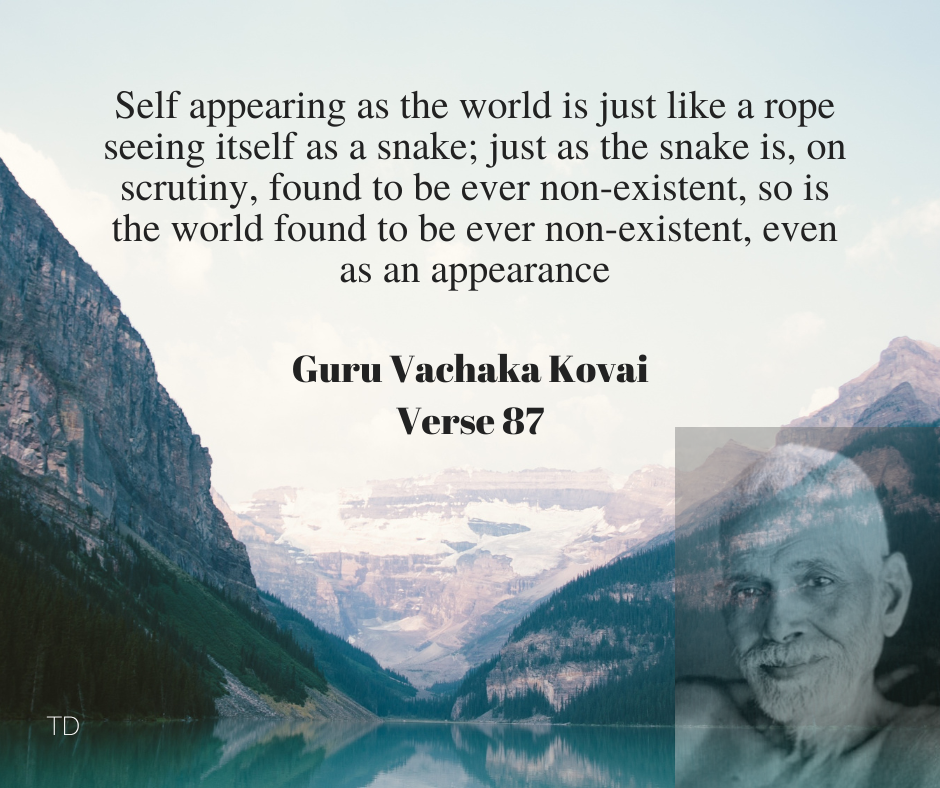
Similarly, Sri Ramana says in Guru Vachaka Kovai, verse 87:
‘…just as the snake is, on scrutiny, found to be ever non-existent, so is the world found to be ever non-existent, even as an appearance‘
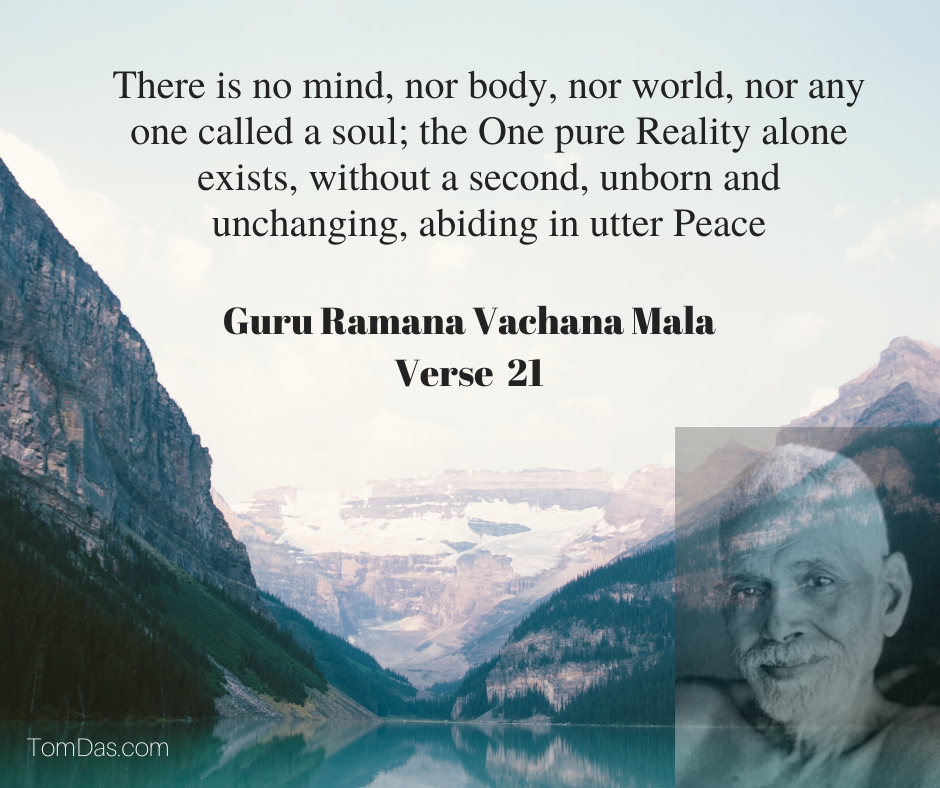
And in Guru Ramana Vachana Mala, verse 21, Sri Ramana gives us the Ajata teaching, that no-thing ever really came into existence at all:
‘There is no mind, nor body, nor world, nor anyone called a soul; the One pure Reality alone exists, without a second, unborn and unchanging, abiding in utter Peace’
Q. Tom, do you believe that the neo advaita teachings do point to the same realisation as Sri Ramana’s teachings? Because from what I have read of the neo advaita teachings, they do not even point to the Absolute Self in a clear way and are not even talking about the same realisation. They don’t speak of the Absolute Self but “the absolute appearing as the relative” in their words, so I think that following those teachings do not lead to the same realisation.
Tom: I agree, the neo-advaita teachings do not lead to the same genuine realisation in my view. They do not lead to genuine absolute love, non-duality and cessation of suffering. Please see the introductory articles on the tomdas.com homepage and my recommended reading list for more on this.
Tom: it varies. Here in the UK there are quite a lot of neo-advaita teachers and being UK based myself, over the years I have dealt with many people who have been very traumatised by these teachings and I have guided them through the process of undoing many of the false concepts and beliefs present in neo-advaita teachings.
The neo-advaita ‘non-teachings’ can be very abrupt and triggering and not leave (apparent) people with any sense of agency or empowerment to deal with the consequences.
I have seen near psychotic breakdowns, severe anxiety and panic disorder, depersonalisation and derealisation, relationships fall apart, people losing their jobs, lots of confusion and disorientation, depression…
In my experience Neo-advaita tends to be a feel-good teaching in the moment for those it helps, and mainly is for the intellect.
It feels good in the moment but the sense of duality and confusion keeps on returning, and it doesn’t lead to a genuine realisation of truth or love. When one engages with genuine self-enquiry we come to see just how superficial the neo-advaita teachings are
Neo-Advaita is actually far away from the true teachings even though some of the words sound similar. In some ways neo-advaita is more intellectually coherent than true Advaita teachings, but that doesn’t make it true or effective.
In my experience the true teachings, such as the teachings of Sri Ramana Maharshi, guide us directly and unfailingly to realisation, the shortest route so to speak, with the minimal amount of suffering along the way.
Tom: Neo Advaita says all is already one, there is already no ego-self, and no need for any practice. In fact, any practice just perpetuates and strengthens the illusory notion of an ego-self. Suffering and worldly happenings are just things that occur to ‘nobody’.
Advaita says all is already one, there is already no ego-self, but due to ignorance there appears to be a world consisting of many people and things, of which you are one. Through self-enquiry, in which one places ones attention onto ones own self, the Subject, and ignores/turns away from objective phenomena, one can destroy this ignorance and realise that the apparent mutiplicity is an unreal illusion and there is only the formless self which is devoid of suffering. It is then seen that ignorance never actually occurred and there were never any actual people or things at all.
My own experience is that neo-advaita, whilst sounding intellectually coherent, does not lead to liberation at all and suffering, duality and egotism all actually continue, whereas Advaita, whilst appearing to be dualistic in some ways, is totally liberating and ends suffering and duality completely. They are actually quite distinct teachings that both claim to be ‘non-duality’.
Note that in my experience many prominent Advaita and Advaita Vedanta teachers actually teach distorted teachings, and that the genuine teachings of Sri Ramana Maharshi are the best teachings I have come across to point the way to liberation.
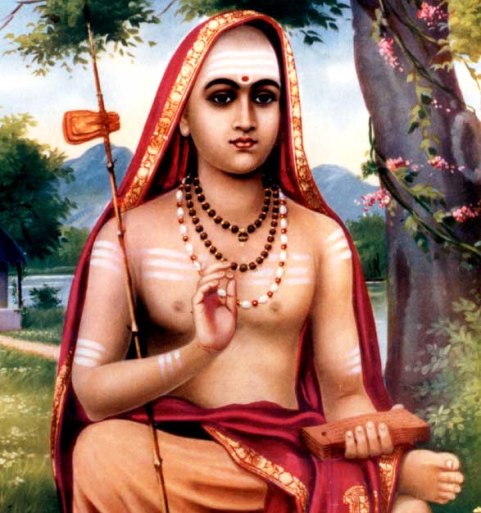
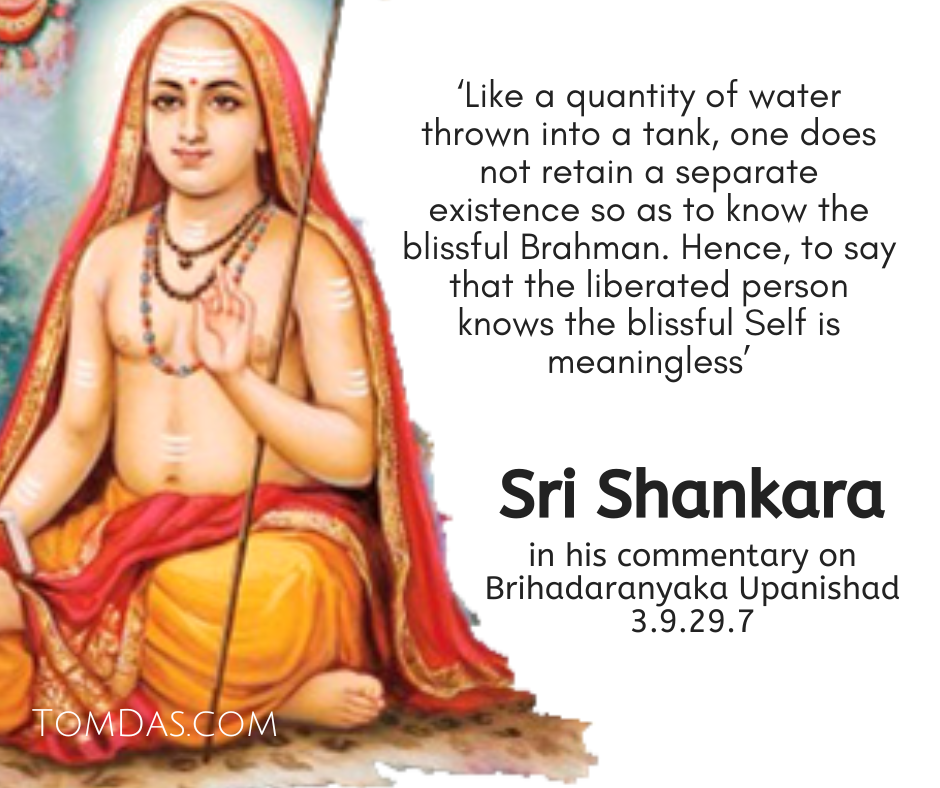
Tom: Shankara writes the following in his commentary of Brihadaranyaka Upanishad 3.9.29.7. My comments are interspersed in italicised red with Shankara’s writings in black.
Here Shankara is making the point that strictly speaking there is no knowing or knowledge in Self-Knowledge/Self-Realisation/The Self, meaning there is no existence of or involvement of the mind in Self. He gives the analogy of water being thrown into a larger tank of water – that initial water does not retain its separateness by which it can know the larger body of water into which it was thrown. Self-knowledge is just a phrase used to point to That which cannot be put into words.
If there was an entity that could know Brahman or know of Brahman, then that would imply 2 entities, Brahman and and knower of Brahman. Or it would imply differentiation of Brahman. Either of these would contradict shruti (revealed scripture/revealed knowledge).
Similarly, Shankara states that bliss is not cognised in Self-Realisation for the same reasons. Rather Bliss is the nature of Self, not something experienced by the Self or by some self-realised entity or person (which is another illusion).
Incidentally, Shankara also reveals just how radical liberation is, stating that in liberation there is no body, no organs, no mind, no knowledge:
[Shankara:] Absolute separation from the body is liberation, and when there is no body there can be no organs, for they will have no support . Hence too there will be no knowledge, there being no body and organs. If knowledge could arise even in the absence of the body and organs, there would be no necessity for any one to possess them. Moreover (if Brahman as Knowledge Absolute cognises the bliss in liberation), it will contradict the oneness of Brahman.
Tom: Shankara clearly states in liberation there is total or absolute separation from Body, and then says there is no body in liberation. Without a body, there can be no mind and without a mind there can be no cognition or knowledge (in the ordinary sense of these words).
We see similar teachings from Sri Ramana Maharshi: in Ulladu Narpadu verse 12, Sri Ramana Maharshi writes:
True Knowledge is Being, devoid of knowledge as well as ignorance of objects. Knowledge of objects is not true knowledge. Since the Self shines self-luminous, with nothing else for It to know, with nothing else to know It, the Self is Knowledge. Nescience [ignorance] It is not.
In Upadesa Saram verse 27, Sri Ramana Maharshi writes:
That is true knowledge which transcends Both knowledge and ignorance, For in pure knowledge Is no object to be known.
OBJECTION: Suppose we say that the Supreme Brahman, being eternal Knowledge, ever knows Itself as Bliss Absolute?
REPLY: No, (this has just been answered). Even the person under bondage, when freed from relative existence, would regain one’s real nature (Brahman). (So the same argument would apply also) .
Like a quantity of water thrown into a tank, one does not retain a separate existence so as to know the blissful Brahman. Hence, to say that the liberated person knows the blissful Self is meaningless. If, on the other hand, the liberated one, being different from Brahman, knows the bliss of Brahman and the individual self as, “I am the Bliss Absolute”, then the oneness of Brahman is contradicted, which would be against all Srutis; and there is no third alternative.
Tom: See my explanation in the introduction above
Moreover, if Brahman ever knows Its own bliss, it is superfluous to distinguish between awareness and unawareness. If It is constantly aware of this bliss, then that is Its nature; hence there is no sense in maintaining that It cognises Its own bliss.
Tom: the point here is that if Brahman is ‘constantly aware of it’s own bliss’, then this bliss is simply the nature of the Self, as Self is One, and it doesn’t make sense to think of an entity that cognises or perceives bliss in some way in Self-Realisation.
Such a view would be tenable if ever there was the possibility of Its not knowing that bliss, as for instance one knows oneself and another (by an act of will). There is certainly no sense in distinguishing between a state of awareness and one of unawareness in the case of one whose mind is uninterruptedly absorbed in making an arrow, for instance.
Tom: Shankara’s argument here is saying that to speak of ‘constantly knowing bliss’ during self-realisation would only make sense if there would be a possibility of not knowing bliss during self-realisation, which is not possible, so again, bliss is the nature of Self and not a cognised object.
If, on the other hand, Brahman or the Self is supposed to be knowing Its bliss interruptedly, then in the intervals when It does not cognise Itself, It must know something else; and the Self would become changeful, which would make It non-permanent.
Tom: If the bliss of Brahman came and went, or increased and decreased, then that would mean the Self is subject to change (which it isn’t) and is therefore impermanent (which it isn’t).
Hence the text, ” Knowledge , Bliss “, etc, must be interpreted as setting forth the nature of Brahman, and not signifying that the bliss of the Self is cognised.
Tom: Regarding the initial statement of Shankara’s above, namely that there is no body in Liberation, here are some quotes of Sri Ramana Maharshi’s that say the same, taken from Guru Vachaka Kovai:
86 Don’t ask, “How did this error rise, Why this ignorance that the Self Itself is as the world transformed?” Seek rather and find out to whom This happened, and the error [Tom: of the world appearance] will Persist no more.
87 What is the Self’s self-transformation As the world? A coil of straw Appearing as a snake? Look hard, You see no snake at all. There is No transformation, no creation, none, No world at all. [Tom: ie. ajata vada]
97 Only the mind, by maya’s might Deluded, and looking outward sees The body. The true Self knows no body. To call the Self of Pure Awareness The body’s owner or indweller Is an error.
[Tom: This is reference to Chapter 13 of the Bhagavad Gita where Krishna states the Self is the knower of the body, and various other scriptures which advise that the Self is somewhere deep within the body, dwelling in each and everyone’s body, here Bhagavan Ramana is saying even this is not true, pointing us to a deeper teaching]
1230 The things you think of as existing Do not exist. But That of which You know not if it does exist Or does not [Tom: ie. the supreme birthless deathless unchanging ever-pure blissful Self], That alone exists.
Tom: Here in this post I have selected some key teachings from Zen Master Huang Po that outline his view of the ‘Path’ to Liberation. In addition to this, I have also selected some specific teachings in order to compare and contrast Huang Po’s teachings to that of Advaita Vedanta and of Sri Ramana Maharshi (see here for some essential teachings of Sri Ramana Maharshi).Whilst I make no claim that these teachings are all exactly the same, in this particular post I have emphasised commonalities rather than differences.
As usual my comments will be in italicised red. To gain the most from this post please explore the related posts that are hyperlinked throughout, such as the one above on the Essential Teachings of Sri Ramana Maharshi. So you can read Huang Po’s zen teachings in their full context, I have provided the complete translation of Huang Po’s teachings as a PDF file below from which the various quotes below are taken:
The first teaching I cite is in fact the entire first teaching given in the above book, The Zen Teaching of Huang Po, teaching 1 from the Chun Chou record. Here is Huang Po:
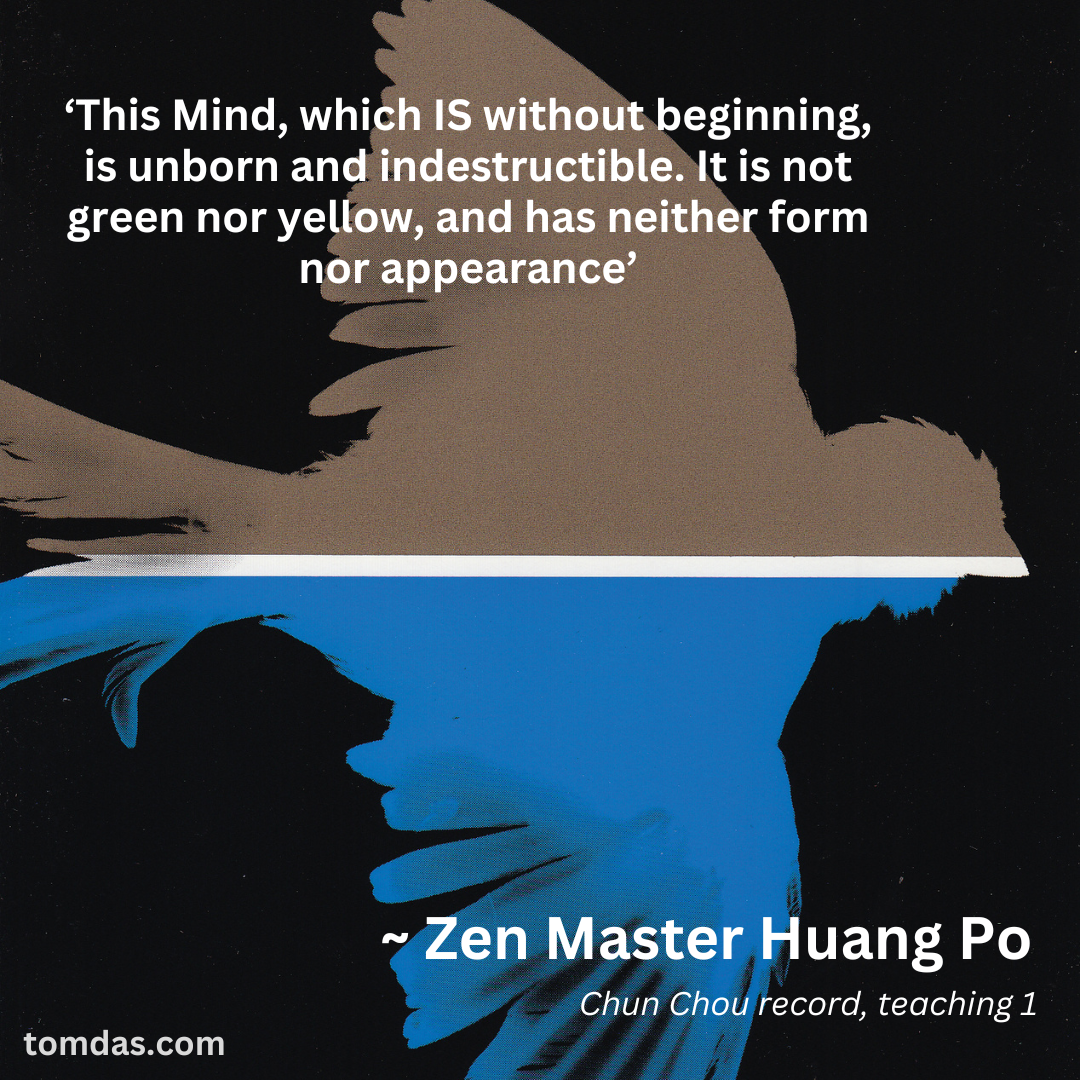
‘The Master [Huang Po] said to me: All the Buddhas and all sentient beings are nothing but the One Mind, beside which nothing exists. This Mind, which IS without beginning, is unborn (Unborn not in the sense of eternity, for this allows contrast with its opposite; but unborn in the sense that it belongs to no categories admitting of alteration or antithesis) and indestructible.
‘It is not green nor yellow, and has neither form nor appearance. It does not belong to the categories of things which exist or do not exist nor can it be thought of in terms of new or old. It is neither long nor short, big nor small, for it transcends all limits, measures, names, traces, and comparisons. It IS that which you see before you – begin to reason about it and you at once fall into error. It is like the boundless void which cannot be fathomed or measured.
‘The One Mind alone is the Buddha, and there is no distinction between the Buddha and sentient things, but that sentient beings are attached to forms and so seek externally for Buddhahood. By their very seeking they lose it, for that is using the Buddha to seek for the Buddha and using mind to grasp Mind. Even though they do their utmost for a full aeon, they will not be able to attain to it.
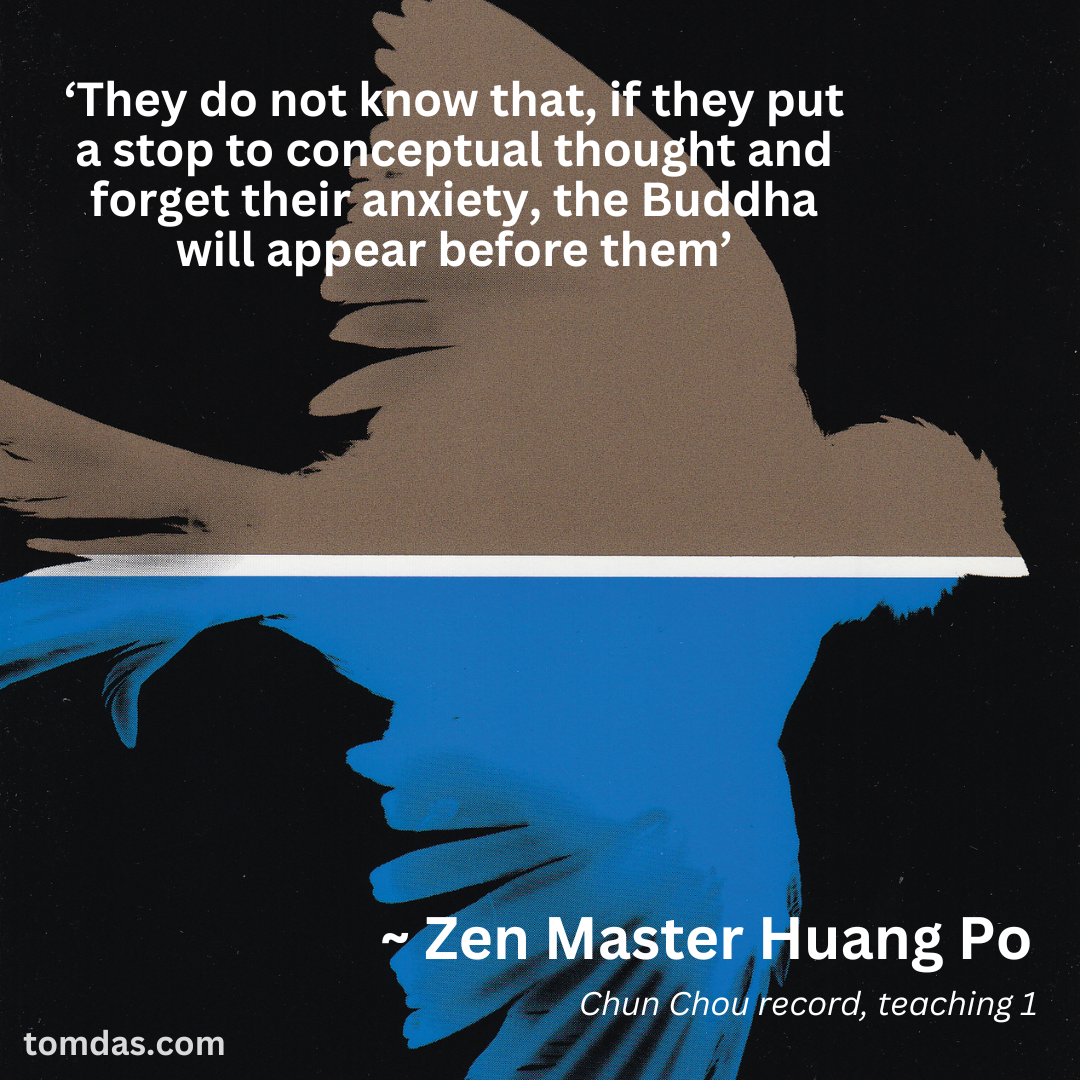
‘They do not know that, if they put a stop to conceptual thought and forget their anxiety, the Buddha will appear before them, for this Mind is the Buddha and the Buddha is all living beings. It is not the less for being manifested in ordinary beings, nor is it greater for being manifested in the Buddhas.’
~ the first teaching from The Chun Chou record of Zen Master Huang Po, translated by John Blofeld, as found in the book ‘The Zen Teaching of Huang Po’
Tom’s Comments
Tom comments:
(1) The nature of Mind. All is Mind. Mind is That which is unborn, devoid of objectivity and objective characteristics and is unending/indestructible. It has no form or appearance according to Huang Po, indicating its pure Subjectivity, form and appearance pertaining only to objects. It also cannot be understood. Mind here is equivalent to Sri Ramana Maharshi’s concept of the Self. The implication of this is that it is something you already ‘have’ and/or already ‘are’. Huang Po writes:
‘This Mind, which IS without beginning, is unbornand indestructible. It is not green nor yellow, and has neither form nor appearance‘
Compare this with Shankara writing in Vivekachudamani, a major text in the Advaita Vedanta tradition:
‘254. That which is beyond caste and creed, family and lineage; devoid of name and form, merit and demerit; transcending space, time and sense-object – that Brahman art thou.‘
In teaching number 8 from this same text, the Chun Chou record, Huang Po states the following, confirming the lack of objects in Buddha-Mind:
‘Our original Buddha-Nature is, in highest truth, devoid of any atom of objectivity. It is void, omnipresent, silent, pure; it is glorious and mysterious peaceful joy – and that is all’
In teaching number 6 Huang Po states that Mind has nothing to do with conceptual thought (ie. the intellect) and it has nothing to do with forms:
‘This Mind is no mind of conceptual thought and it is completely detached from form‘
We see this in echoed in Shankara’s Vivekachudamani here, where he describes the Absolute as being distinct from the Universe/Maya (Maya means the illusion of the world, also known as duality):
‘261. That which is free from duality; which is infinite and indestructible; distinct from the universe and Maya, supreme, eternal; which is undying Bliss; taintless – that Brahman art thou‘
And from teaching number 2 Huang Po says:
‘The Mind IS the Buddha, nor are there any other Buddhas or any other mind. It is bright and spotless as the void, having no form or appearance whatever.’
From teaching 18 Huang Po says:
‘the real Mind as formless and neither coming nor going; his nature as something neither commencing at his birth nor perishing at his death, but as whole and motionless in its very depths’
And from teaching 22 of Wan Ling record Huang Po says (capitalisation present in the original translation):
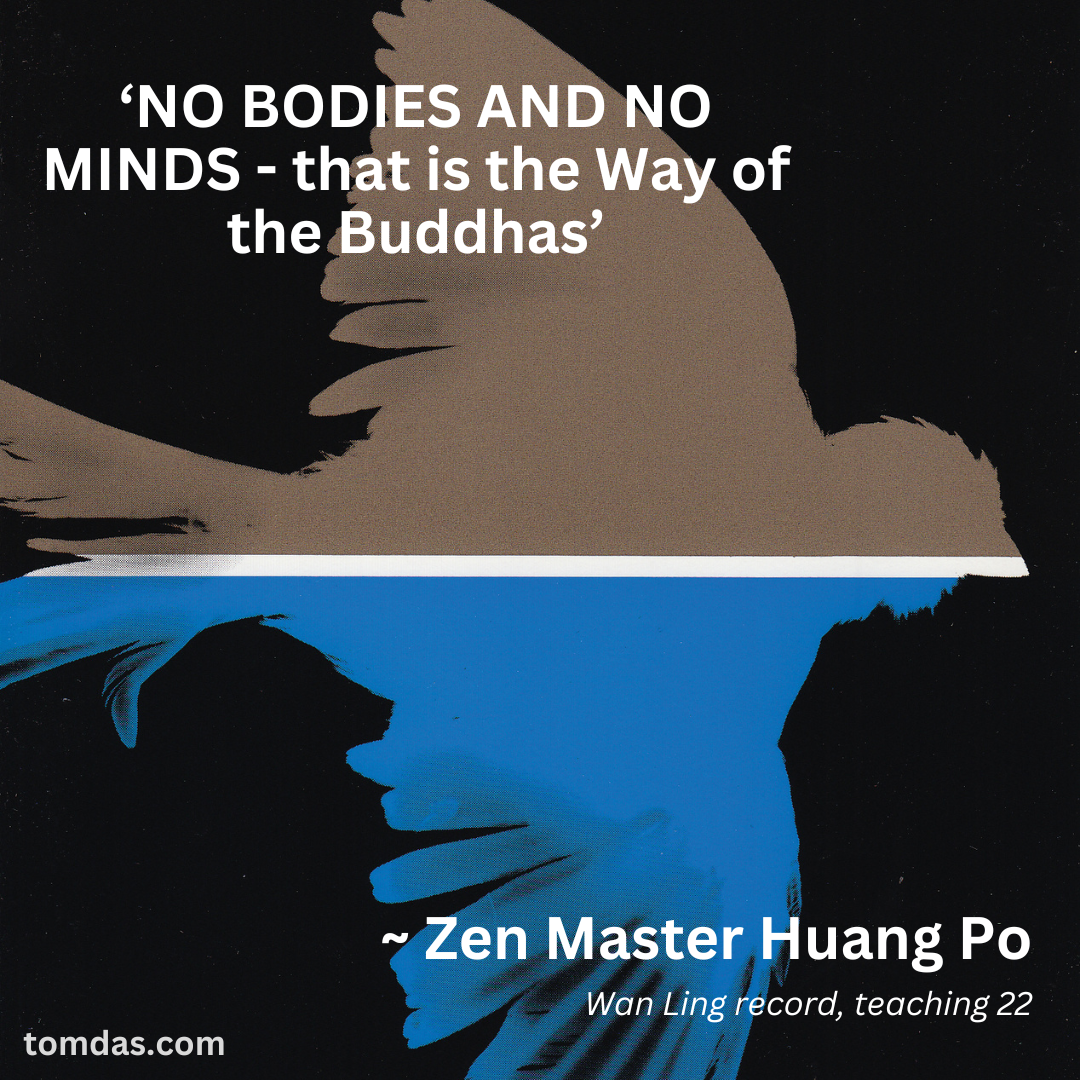
‘NO BODIES AND NO MINDS – that is the Way of the Buddhas!‘
(2) Mind vs sentient beings (Self vs jiva): All is Mind, BUT Huang Po points out a very important distinction: when Mind seeks externally in forms, ie. when the mind goes out towards objects/objective phenomena, that characterises ‘sentient beings’, meaning jivas or apparent individual people. So we can see that the term ‘sentient being’ roughly translates as ‘jiva’ (apparent individual people). Huang Po writes ‘sentient beings are attached to forms and so seek externally for Buddhahood‘, the implication being that Buddhahood cannot be attained in this way through seeking externally.
This is similar to Sri Ramana Maharshi stating In Day by Day with Bhagavan:
‘The mind turned inwards is the Self; turned outwards, it becomes the ego and all the world’
Similarly the great Advaita text Yoga Vasishta states:
‘Consciousness which is undivided imagines to itself desirable objects and runs after them. It is then known as the mind.’
and
‘After knowing that by which you know this (world) turn the mind inward and then you will see clearly (i.e. realize) the effulgence of the Self.’
and
‘O Rama, the mind has, by its own activity, bound itself; when it is calm it is free.’
Similarly Huang Po states in teaching 5:
‘You students of the Way who do not awake to this in your own minds, and who are attached to appearances or who seek for something objective outside your own minds, have all turned your backs on the Way’
Again, Huang Po admonishes seeking Buddhahood/liberation externally via objective phenomena.
(3) Ego cannot know Mind or Self: John Blofeld capitalises the ‘M’ in Mind in some places and leaves it uncapitalised when it is referring to ego-mind: Huang Po says ‘By their very seeking they lose it, for that is using the Buddha to seek for the Buddha and using mind to grasp Mind’, meaning Mind cannot be known by mind, or Self cannot be known by ego/mind/jiva (a person).
In the Wan Ling record, Huang Po states in teaching 18:
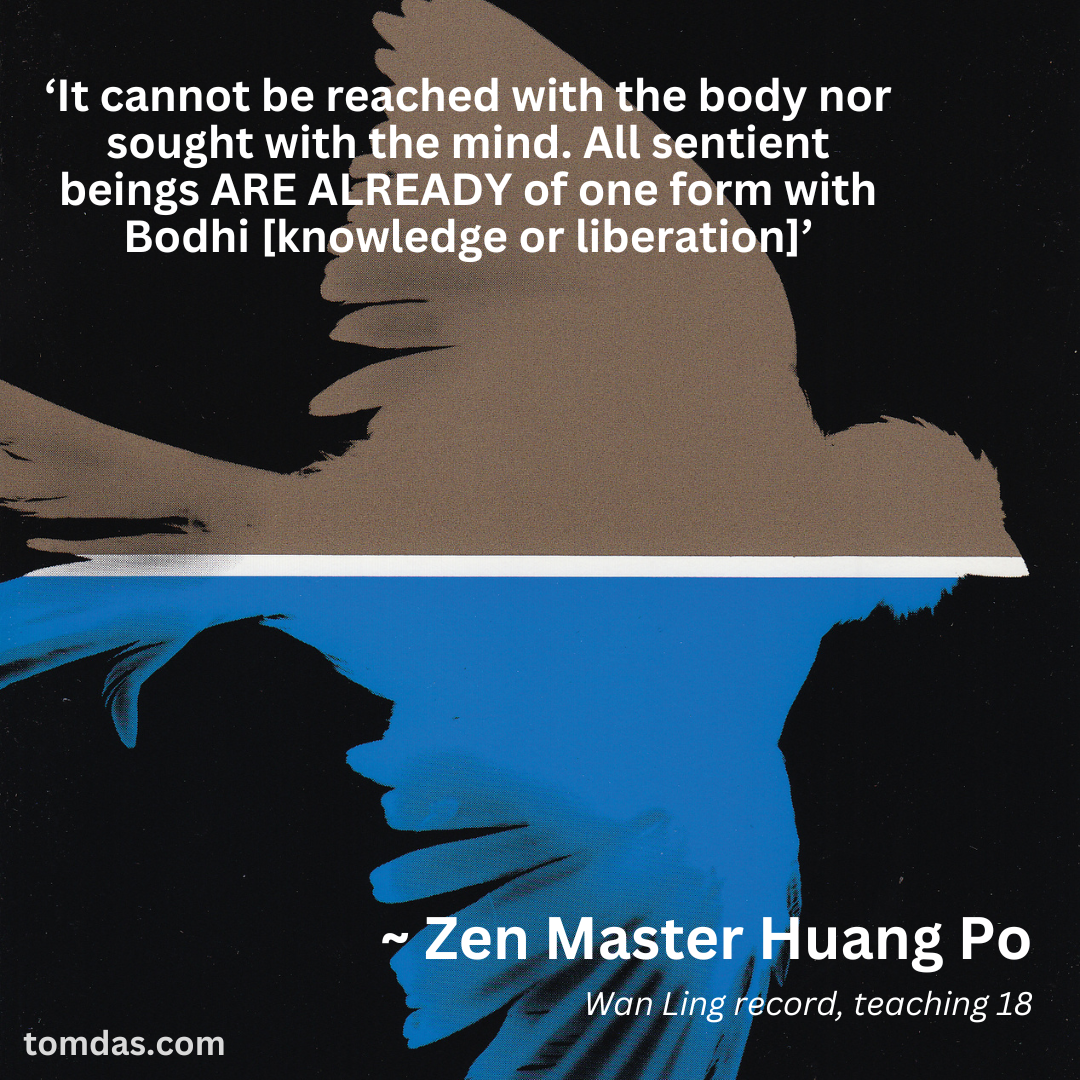
‘It cannot be reached with the body nor sought with the mind. All sentient beings ARE ALREADY of one form with Bodhi [Tom: Bodhi means Knowledge or liberation/enlightenment]‘
Similarly, Shankara in Vivekachudamani states the Absolute (Brahman) cannot be known with the Mind or intellect (Buddhi):
‘256. That which is untouched by the sixfold wave; meditated upon by the Yogi’s heart, but not grasped by the sense-organs; which the Buddhi [intellect] cannot know; and which is unimpeachable – that Brahman art thou’
(4) The remedy is to end all thoughts(by knowing your true nature): What is the remedy? Huang Po says ‘Put a stop to conceptual thoughts and forget ones anxieties’. How to do this is not explained in this teaching. However, if all is one already, why the need to do this at all? Why not just allow things to be as they are? Why the need to stop thoughts? The reason is that only then does Buddha reveal himself as Mind (or Self). Otherwise, if thoughts are not stopped, the illusion of being a ‘sentient being’ (ie. the illusion of being a jiva, ie. an apparent individual person with an apparent individual and separate consciousness) continues unabated and unchallenged. This ignorance must be removed. When divested of its objectivity and seeming multiplicity, only then does Mind or Buddha or Self or God reveal itself as Self, only then does illusion cease and suffering end and unity and absolute love fully shine.
Amritabindu Upanishad, verse 5 states:
‘The mind should be prevented from functioning, until it dissolves itself in the heart. This is Jnana [Tom: knowledge (of our true nature)], this is Dhyana [Tom: meditation (on our true nature)], the rest is all mere concoction of untruth.’
In teaching 23 of the Wan Ling record, Huang Po answers a question:
Q: If I follow this Way, and refrain from intellectual processes and conceptual thinking, shall I be certain of attaining the goal? A: Such non-intellection IS following the Way!
We see this unambiguous teaching of needing to stop ALL thoughts given repeatedly by Huang Po. See here from teaching 23 of the Wan Ling record in which Huang Po explains further the method of liberation, explaining how thoughts create karma and the entire world/universe (or 3 worlds of samsara, see below):
Were you now to practice keeping your minds motionless at all times, whether walking, standing, sitting or lying; concentrating entirely upon the goal of no thought-creation, no duality, no reliance on others and no attachments; just allowing all things to take their course the whole day long, as though you were too ill to bother; unknown to the world; innocent of any urge to be known or unknown to others; with your minds like blocks of stone that mend no holes – then all the Dharmas [Tom: teachings] would penetrate your understanding through and through. In a little while you would find yourselves firmly unattached. Thus, for the first time in your lives, you would discover your reactions to phenomena decreasing and, ultimately, you would pass beyond the Triple World; and people would say that a Buddha had appeared in the world. Pure and passionless knowledge [Enlightenment] implies putting an end to the ceaseless flow of thoughts and images, for in that way you stop creating the karma that leads to rebirth – whether as gods or men or as sufferers in hell [Tom: this refers to ending the ‘triple world’ of suffering of (1) gods in heaven, (2) men on earth and (3) sufferers in hell].
Once every sort of mental process has ceased, not a particle of karma is formed. Then, even in this life, your minds and bodies become those of a being completely liberated. Supposing that this does not result in freeing you immediately from further rebirths, at the very least you will be assured of rebirth in accordance with your own wishes. The sutra declares: ‘Bodhisattvas are re-embodied into whatsoever forms they desire.’ But were they suddenly to lose the power of keeping their minds free from conceptual thought, attachment to form would drag them back into the phenomenal world, and each of those forms would create for them a demon’s karma!
Contrast this with Sri Ramana Maharshi himself writing in his poem Atma Vidya (Self-Knowledge), verse 5, in which he recommends stilling the mind completely in order to end karma and rebirth, ie to end samsara and suffering:
5. For loosening karma’s bonds and ending births, This path is easier than all other paths. Abide in stillness, without any stir Of tongue, mind, body. And behold The effulgence of the Self within; The experience of Eternity; absence Of all fear; the ocean vast of Bliss.
And Sri Ramana also writes in ‘Who Am I?’ in his answer to question 23 that the purpose of teaching is only to silence thoughts but discovering the Self, which is analogous to Huang Po saying end any and all conceptual thoughts and discover your true nature as Mind:
‘All the texts say that in order to gain liberation one should render the mind quiescent; therefore their conclusive teaching is that the mind should be rendered quiescent; once this has been understood there is no need for endless reading. In order to quieten the mind one has only to inquire within oneself what one’s Self is; how could this search be done in books?’
And here are some more teachings from Sri Ramana on the role of stilling thoughts:
True wealth is but the gracious silence of steady, unswerving Siva-awareness. This bright, rare treasure can be gained only by those who earnestly strive for extinction of all thoughts. Sri Ramana Maharshi, Guru Vachaka Kovai, verse 1066
When all thoughts cease, including thought of God, this thought-free state, this Pure Awareness Sri Ramana Maharshi, Guru Vachaka Kovai, verse 1207
Be still. Apart from this the mind has no task to do or thought to think Sri Ramana Maharshi, Guru Vachaka Kovai, verse 773
If you remain still, without paying attention to this, without paying attention to that, and without paying attention to anything at all, you will, simply through your powerful attention to being, become the reality, the vast eye, the unbounded space of consciousness. Sri Ramana Maharshi, Guru Vachaka Kovai, verse 647
Because that state is taught by silence, and also because it is attained by remaining in silence, it is called silence. The sage is in silence always, even when he speaks. Sri Ramana Maharshi, Sri Ramana Paravidyopanishad, verse 539
Further teachings on this by Huang Po from the Wan Ling record:
All phenomena cease in liberation/nirvana
In teaching 24 of the WanLing record Huang Po states all the 3 worlds of hell, earth and heaven will end in liberation:
‘For you also the Three Worlds [Tom: Trailoka – (1) hell – the world of desire, kamaloka, (2) earth – the world of form, rupaloka, and (3) heaven – the formless realm of heavenly beings, arupaloka; sometimes referred to as the 3 worlds of desire, form and formlessness] will vanish if you can reach the state beyond thought. On the other hand, if you still cling to the notion that something, even if it be as small as the hundredth part of a grain, might exist objectively, then even a perfect mastery of the entire Mahayana Canon will fail to give you victory over the Three Worlds. Only when every one of those tiny fragments [of the world or universe] is seen to be nothing can the Mahayana achieve this victory for you.’
Compare with Sri Ramana Maharshi as he writes in ‘Who Am I?’ in his response to Question 7:
‘When the mind, which is the cause of all cognition and of all actions, becomes quiescent, the world will disappear.’
Know your true nature
Later we will see Huang Po state all we have to do is awake to Mind, or as I sometimes say, awake to what we Really Are. This is similar to Sri Ramana Maharshi emphasising knowing Self rather than ending all thoughts. This is from teaching 2 of the Chun Chou record of Huang Po:
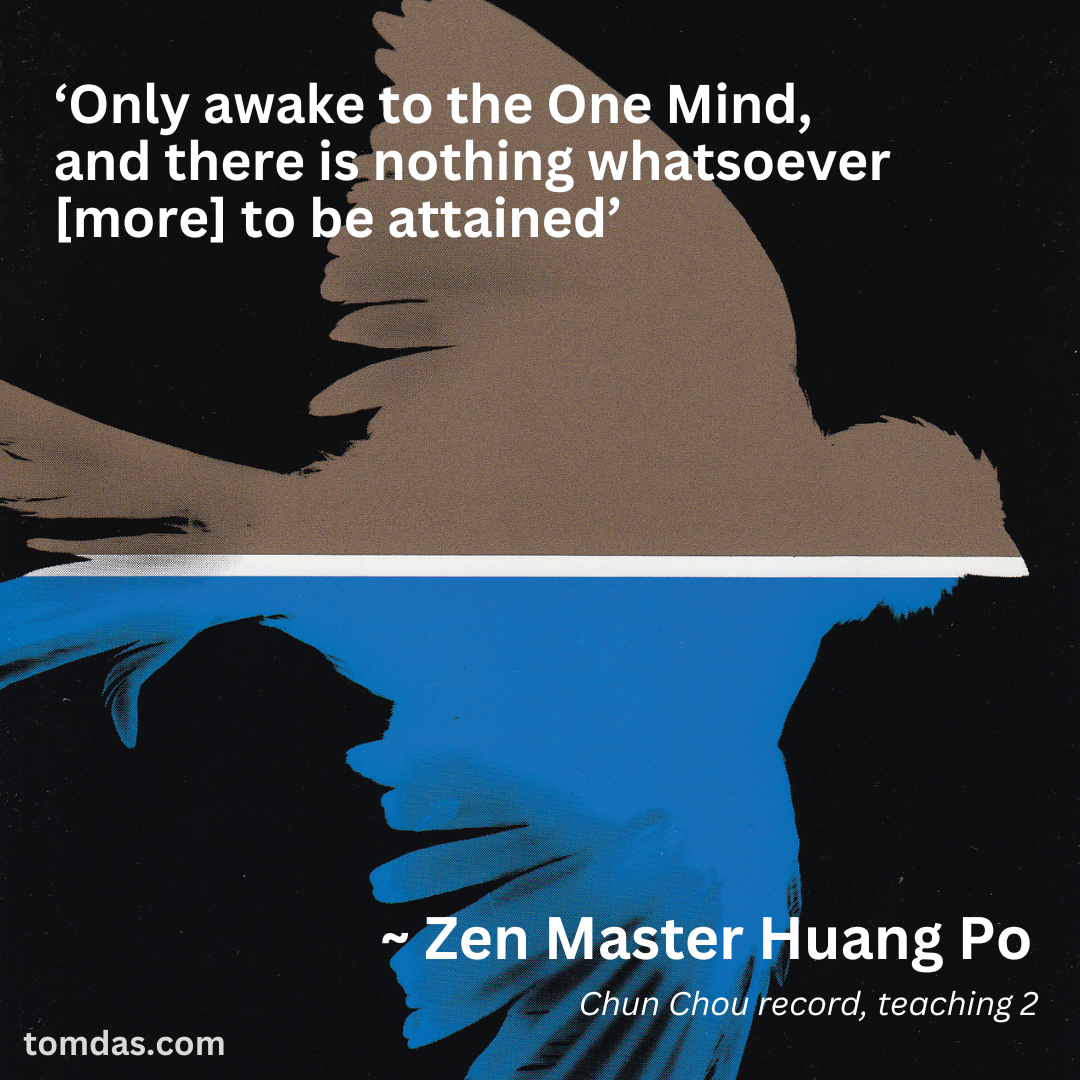
‘Only awake to the One Mind, and there is nothing whatsoever [more] to be attained.’
Here in teaching 26 of the Wan Ling record, Huang Po explains more on how to realise your true nature:
Q: How, then, does a man accomplish this comprehension of his own Mind? A: That which asked the question IS your own Mind [Tom: ie. you are the Mind/Self] but if you were to remain quiescent and to refrain from the smallest mental activity, its substance would be seen as a void [Tom: ie. devoid of objects] – you would find it formless, occupying no point in space and falling neither into the category of existence nor into that of non-existence. Because it is imperceptible Bodhidharma said: ‘Mind, which is our real nature[Tom; Here Huang Po confirms Mind is in fact the same as our real or true nature], is the unbegotten and indestructible womb [Tom: womb, ie. The Source, or the source of all phenomena or creation is Mind]; in response to circumstances, it transforms itself into phenomena[Tom: ie. Mind creates all phenomena]….Every one of the sentient beings [Tom: ie. Jivas] bound to the wheel of alternating life and death is re-created from the karma of his own desires! [Tom: ie. the illusion of samsara, the cycle of repeated birth, death and suffering experienced by the illusionary jiva/ego/person is created by our own desires, which is turn is born from ignorance of our true nature!]… We can see from this that every sort of dharma[Tom: note the use of a Sanskrit term here by Huang Po – dharma here means any phenomenal arising or ‘thing’, or Dharma can also mean teaching, meaning that every teaching or thing is just a creation of the mind] is but a creation of Mind. And all kinds of beings – humans, devas, sufferers in hell, asuras and all comprised within the six forms of life – each one of them is Mind-created[Tom: here it is clear that Huang Po is stating all phenomena are mind-created]. If only you would learn how to achieve a state of non-intellection [Tom: ie. no thoughts], immediately the chain of causation would snap…Chih Kung says: ‘Our bodies are the creations of our own minds.’ [Tom: ie. the above teachings tell us the body mind and world are all projections of Mind only] But how can one expect to gain such knowledge from books? If only you could comprehend the nature of your own Mind and put an end to discriminatory thought, there would naturally be no room for even a grain of error to arise. [Tom: the emphasis is on genuine Self-knowledge through cessation of mental activity and not book-knowledge]‘
Your True Nature
Still from teaching 26 of the Wan Ling record, Huang Po says:
‘Your true nature is something never lost to you even in moments of delusion, nor is it gained at the moment of Enlightenment [Tom: ie. Analogous to the Self in Vedanta]. It is the Nature of the Bhutatathata [Tom: Bhutatathata, this means the Unitary Substratum of Being or Isness/Thusness as opposed to the multiplicity of objective phenomena]. In it is neither delusion nor right understanding [Tom: both of which are of the ego-mind or thought]. It fills the Void everywhere and is intrinsically of the substance of the One Mind. How, then, can your mind-created objects exist outside the Void? The Void is fundamentally without spatial dimensions, passions, activities, delusions or right understanding. You must clearly understand that in it there are no things, no men and no Buddhas; for this Void contains not the smallest hairs-breadth of anything that can be viewed spatially; it depends on nothing and is attached to nothing. It is all-pervading, spotless beauty; it is the self-existent and uncreated Absolute. Then how can it even be a matter for discussion that the REAL Buddha has no mouth and preaches no Dharma, or that REAL hearing requires no ears, for who could hear it? [Tom: for there is no body, mind, world, thoughts or things in the real Buddha, so Buddha has no mouth and no ears, ie. in reality there is no mouth, ears, bodies, etc.]Ah, it is a jewel beyond all price!’
Conclusion
Here is a brief summary of some of the key points of Huang Po’s teachings taken from the above quotes:
Your true nature is Mind.
Mind is your true nature so it can never be lost (or ‘found’). This is the only Buddha there is, your True Nature. This is already what you ARE.
Mind is unborn and cannot be destroyed. It has no form and no objective qualities. It is unchanging and still/silent.
All we need to do is awaken to our own Mind
Mind is Liberation. It cannot be found outside yourself.
Mind is devoid of thought and completely detached from forms.
Mind cannot be understood or known by thought, and it is beyond the duality of knowing or not-knowing, ‘…that REAL hearing requires no ears…’
Mind creates or projects the body, thoughts and world and in this then roams among these objective phenomena that it itself has created, experiencing pleasure and pain and repeated births and deaths (samsara) according to desire/karma. The implication is that this is due to ignorance or lack of knowing our true nature.
‘You must clearly understand’ that in the true Buddha/ in true liberation there is no body, no mind, no world, no people, no things, no forms and nothing that has any spatial dimension whatsoever.
Implied in the above 2 points is that thoughts/Mind projects the multiplicity of the universe, including the various bodies and minds and things, and these thought-phenomena are impurities born of delusion/ignorance. ie. it is implied that through ignorance of one’s true nature that samsara is projected.
Even the idea of a teacher, a teaching or a seeker who could listen to the teaching is illusion – ‘the REAL Buddha has no mouth and preaches no Dharma…’.
The true Buddha or Mind is not a ‘nihilistic ‘nothing’, it is (and I quote) ‘spotless beauty’ or ‘a jewel beyond all price’ or ‘a glorious mysterious peaceful joy’.
Mind or True Buddha Nature cannot be known by thought, by a person/ego/sentient being, through the body, or by practices relating to the objective sphere. Seeking outside of yourself and attachment to objects is to abandon the path.
You can discover your true nature and thus end this illusion/delusion of samsara. This is by intuiting Mind/True Nature and ending all thoughts.
Mind divested of all thoughts and spontaneous recognition of Mind is the way to liberation.
All of these points are consistent with the path to realisation as outlined by Sri Ramana Maharshi and Upanishads in my view. There are many other teachings present in the Zen Teaching of Huang Po and I have just selected some that align with the teaching of Sri Ramana Maharshi. Perhaps some of the other teachings do not fully align, or perhaps they are distortions due to the one recording the teachings or due to the translation/translator. Or perhaps not. Regardless, I hope this post has been of interest and is perhaps even inspiring for you.
The method of how to still the mind and stop all conceptual thought/realise the One Mind (ie. the practice of Self-Enquiry) is not explained more fully by Huang Po, but in my view the method of self-enquiry is implied – ie. knowing Mind directly through Mind (and not through body, sense organs, mentation or thought), ending all karma/ phenomena/ thoughts, how going out towards objects/arising phenomena blocks the way and describing Mind as One, as formless and as essentially without time, space, dimension, and ultimately and essentially distinct from form/objects – all these together imply direct intuition of Self via Self-Enquiry as opposed to going out towards objective phenomena (when Huang Po denies practices, he is denying practice that involve objective phenomena, in my interpretation at least).
I will leave you the quote from teaching 22 of the Wan Ling record, perhaps the most radical of the teachings I found, in which Huang Po says, with the capitalisation being present in the original translation:
‘NO BODIES AND NO MINDS – that is the Way of the Buddhas!‘
I have also written an article contrasting traditional Buddhism with Vedanta. In this post you will also see references to other posts exploring themes in both these great traditions. Let me know what you think in the comments, best wishes:
Over the last few months several people have wrote testimonials for me which I have only just got around to putting onto tomdas.com (tomdas.com/testimonials). Here is what Hesther writes about attending Satsang and occasional 1 to 1 meetings with me:
I don’t understand how it works, but Tom’s guidance gives me added strength and energy to do Self-enquiry, to study and to meditate. I feel I am not alone on this path. The recommended readings, the satsangs, and the occasional 1-1 meetings are all so trustworthy.
Instead of confronting me with my ‘short-comings’ as a seeker I feel free, validated and encouraged to follow my path. The path is full of paradoxes, that Tom allows for, enhancing the sense of freedom and trust that I have. I have never felt that I am being pushed into a mould that fits his vision. On the contrary, he doesn’t fill in the blanks that I have but gives me pointers so that I can discover things in my own experience. He doesn’t give me direct advice so much as that he seems to create a context in which I blossom as a seeker of spiritual truth.
Thank you so much for all your help and guidance, love, Hesther, Portugal


 Om Nama Bhagavate Sri Arunachala Ramanaya Om

 Tom Das