Removal of any and all notions that ‘I am limited’ is Self-Realisation
Intuitively we already know we are beyond all limitation, that our true nature is loving expansive Spirit. This ‘intuitive knowing’ is prior to thought and concepts
As thoughts quieten, spontaneous Joy naturally arises, and we intuitively come to ‘know’ our True Nature as Timeless Being
It is thought that says ‘I am a man/woman, I was born, I will die, etc’
In our ❤️ we already ‘know’ ourselves as Eternal Being
When you (egoically) seek fulfillment and pleasure in sense objects, when you addictively seek pleasure, you are tacitly saying ‘I am limited, I am small, I am incomplete, I need something to complete me’.
In essence you are identified with the body (ie. ignorance is in operation) and thereby you deny your Innate Divinity and suffer.
Before you were born, what were you? You were Nothing/The Formless/The Absolute.
When you die you will go back to this Nothing/The Formless/The Absolute.
Now too you are That Formless Nothing, that which cannot be known by thought/the mind, but That-Which-Is.
Only taking yourself to be the body (body-mind) do you stress, ask questions, have doubts, argue, suffer and seek.
‘I WAS ONE WITH EVERYTHING’
All these ‘spiritual’ experiences such as ‘I had a wonderful experience in which I felt one with everything’ or ‘I felt as if I was Brahman’ or ‘There was a sense of timelessness’, etc, etc, etc…
…All these experiences are more illusion.
Why? All these experiences are for the body-mind that you falsely take yourself to be…these experiences come and go, they appear then disappear, like all experiences.
Are you the body-mind? Is that your primary identity?
…You are not the body-mind!
You are That!
That thou art!
🕉 Tat Twam Asi! 🕉
❤️❤️❤️
THE PURPOSE OF TRUE SPIRITUAL TEACHINGS
The purpose of all spiritual teachings and practices is to remove ignorance and the vasanas (egoic habitual tendencies), and so end suffering.
There is nothing to gain. No special knowledge or experience. You are already That. Just lose the ignorance.
In truth spiritual practices and teachings are more illusion. There is no teacher, there is no teaching, there is no taught. Ignorance itself is more illusion. There is no real ignorance.
However as a belief that ‘I am a body mind’ has arisen, the teacher and teaching appear to also arise. This is known as ignorance.
This is because you take yourself to be limited. You take yourself to be a body mind.
Do not take yourself to be the body-mind!
You are That!
You are That Eternal Nothingness!
❤
THE ROOT CAUSE OF SUFFERING
The search to end suffering, to gain spiritual knowledge, to attain true spiritual experience and to end confusion is all due to believing you are the body-mind.
The belief ‘I am the body-mind’ is the ignorance that causes all the trouble. This belief is also known as egotism, maya, illusion, duality, separation and samsara. It is a fiction.
In essence you are not the body-mind.
You are in essence That which is Infinite, Eternal, beyond words and speech and concepts.
This is known intuitively already. It is not more conceptual knowledge for the body-mind which is just more ignorance.The words are indicators and are not meant to be more beliefs for the body-mind.
You are That which was before the body-mind was born and will be when the body-mind has gone. You are That which is in deep dreamless sleep. Again this is already intuitively known without thought or words.
There is therefore nothing to seek, nothing to know, nothing to attain, no experience required.
🕉 You are That! 🕉
🕉 Tat Tvam Asi! 🕉
🕉 Be what you are! 🕉
The irony is that the entire spiritual teaching is literally and figuratively within us! Don’t be concerned with knowledge or experiences. They are all to do with the body. Be what you are! That which never comes and goes! That which is in deep sleep! That which was before the body was born! Tat Tvam Asi!
The conviction that your primary identity is this limited vulnerable perishable body-mind is itself intolerable suffering 🕉
Sri Ramana Maharshi is better known for his teachings on Self-Inquiry. As a general rule he did not encourage guru worship and usually directed seekers towards Silence and Self-inquiry. However, he did speak about Bhakti (the path of devotion and love) on many occasions, and here are a few quotes:
One learns more and more that no number of objects we experience (this includes worldly objects, people, thoughts, feelings, experiences, praise, adoration, etc) will ever bring lasting satisfaction. These objects (which includes all experiences), each being temporary and limited, will bring only temporary and limited pleasures at best. This pleasure will inevitably end which results in stress and suffering as we try to prevent the ending of our association with the desired objects. So seeking fulfillment in objects results in the perpetuation of suffering, and this is learnt over and over again ever more deeply over the course of time.
Simultaneously, we realise that lasting fulfillment only comes from not-seeking, ie. when we are resting as our-Self in the Natural Condition. Again, this insight-realisation deepens and our conviction that this is true grows stronger over time, as we psychologically and spiritually mature.
How quickly we learn this depends on our ability to observe, listen, discern and learn the lessons life is teaching us (this is called Viveka in Sanskrit, often translated as discrimination or discernment, but also can be translated as wisdom).
This natural turning away from gross and subtle objects and dropping away of desire for them is known as dispassion or vairagya in Sanskrit, and this vairagya naturally occurs to spiritual seekers (ie. the ego) as they spiritually mature and internalise these above lessons.
When vairagya becomes fully mature there is just constant abiding as Self. Self is satisfied as Self, not needing pleasure or good feelings from ‘outside’ limited objects. The seeking mind (which is the egoic mind or the functioning of the separate ‘I’ concept), then never emerges and is eventually destroyed through sustained inactivity.
This total Vairagya is where the separate ‘I concept’ never rises and is essentially dead. This is known as destruction of the Mind (Manonasa) or extinction of the vasanas (the habitual egoic tendencies, the extinction of which is called Vasana Kshaya). It is also known as Self-Realisation (Atma Sakshatkara) or Self-Knowledge (Atma Jnana). It is not realisation or knowledge in the traditional sense, as there is not necessarily any knowledge in the mind. Rather it is the non-emergence of egotism (egotism is also known as ignorance or separation, so knowledge is simple the lack of ignorance or the lack of separation). It is also known as Silence (Mauna) or the Absolute (Brahman).
Bhagavan Sri Ramana Maharshi gives us a practical definition of Silence here when he states:
‘The Self is that where there is absolutely no “I”-thought. That is called silence [mauna]’ and again he states ‘That state in which the “I”-thought does not rise even in the least is silence [mauna].’
In the same vein Advaita Bodha Deepika states:
‘What is variously described as Knowledge [Jnana], Liberation [Moksha], etc., in the scriptures, is but stillness of mind.’
In the Amritabindu Upanishad it is written:
‘When the mind, with its attachment for sense-objects annihilated, is fully controlled within the heart and thus realises its own essence, then that is the Supreme State (Brahman is gained)’
The Advaitic giant, Sri Gaudapada, (Shankara’s guru’s guru) writes in his Mandukya Karika:
‘The controlled mind is verily the fearless Brahman’ (Chapter 3, verse 35)
Regarding Vairagya and Jnana, in the text ‘Who am I?’, Bhagavan Ramana Maharshi writes:
‘Not to desire anything extraneous to oneself constitutes vairagya (dispassion) or nirasa (desirelessness). Not to give up one’s hold on the Self constitutes jnana (knowledge). But really vairagya and jnana are one and the same.’
Later in the same text, ‘Who am I?’, he writes:
‘It is pleasant under the shade of a tree, and scorching in the heat of the sun outside. A person toiling in the sun seeks the cool shade of the tree and is happy under it. After staying there for a while, he moves out again but, unable to bear the merciless heat of the sun, he again seeks the shade. In this way he keeps on moving from shade to sun and sun to shade.
It is an unwise person who acts thus, whereas the wise man never leaves the shade: in the same way the mind of the Enlightened Sage (Jnani) never exists apart from Brahman, the Absolute. The mind of the ignorant, on the other hand, entering into the phenomenal world, suffers pain and anguish; and then, turning for a short while towards Brahman, it experiences happiness. Such is the mind of the ignorant.’
May these teachings, through repeated hearing and contemplation, grow in your hearts and mind and give rise to stillness of mind and eventually Mauna, that is Self-Realisation itself.
May vairagya and viveka grow and blossom into timeless Jnana!
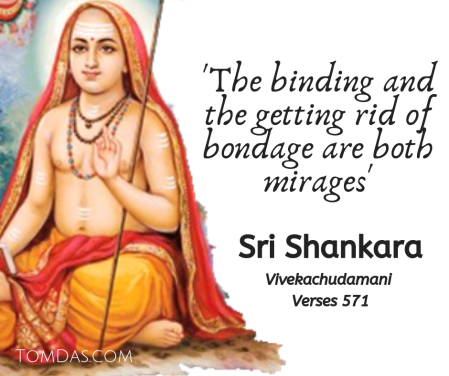
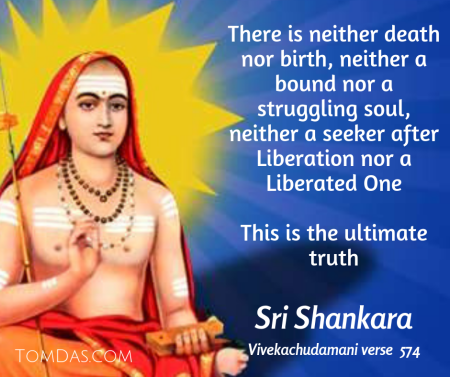
Right at the end of his masterpiece entitled Vivekachudamani (which essentially means ‘The Highest or Supreme Wisdom’), Shankara makes a series of radical and emphatic non-dual declarations which he states is the highest or ultimate truth.
In his usual style, he reinforces the point he wishes to make in successive verses, building up to a crescendo which culminates in verse 574, the most famous of these verses.
This well-known verse was actually copied by Shankara from The Upanishads and is also found in the works of Sri Gaudapada, Shankara’s guru’s guru.
In the following excerpt from Talks with Sri Ramana Maharshi, Ramana concisely outlines the problem (suffering), its cause (ignorance) and its remedy (self-knowledge). First Ramana says that the fact that one considers oneself to be limited is the essential problem. This arising of the notion of ‘I’ is a notion of limitation, and it is to this limited notion that ‘the world’ appears. It is this limited entity ‘I’ (ego) that then seeks various things, including self-realisation, and so suffers more.I have added bold type for emphasis and my comments are italicised in red:
The fact is that the man considers himself limited and there arises the trouble. The idea is wrong. He can see it for himself. In sleep there was no world, no ego (no limited self), and no trouble. Something wakes up from that happy state and says ‘I’. To that ego the world appears. Being a speck in the world he wants more and gets into trouble. How happy he was before the rising of the ego!
Now Ramana prescribed the remedy, after restating that it is this limited ‘ego’ that is the cause of the ‘trouble’, ie. suffering:
Only the rise of the ego is the cause of the present trouble. Let him trace the ego to its source and he will reach that undifferentiated happy state which is sleepless sleep. The Self remains ever the same, here and now. There is nothing more to be gained. Because the limitations have wrongly been assumed there is the need to transcend them.
To illustrate the point that there is nothing to be gained, that we are already essentially whole, and that the problem is simply one of ignorance or ‘wrong assumptions’, Ramana narrates two traditional stories – ‘the tenth man’ and ‘the woman wearing a necklace’:
It is like the ten ignorant fools who forded a stream and on reaching the other shore counted themselves to be nine only. They grew anxious and grieved over the loss of the unknown tenth man. A wayfarer, on ascertaining the cause of their grief, counted them all and found them to be ten. But each one of them had counted the others leaving himself out. The wayfarer gave each in succession a blow telling them to count the blows. They counted ten and were satisfied. The moral is that the tenth man was not got anew. He was all along there, but ignorance caused grief to all of them.
Again, a woman wore a necklace round her neck but forgot it. She began to search for it and made enquiries. A friend of hers, finding out what she was looking for, pointed out the necklace round the seeker’s neck. She felt it with her hands and was happy. Did she get the necklace anew? Here again ignorance caused grief and knowledge happiness.
Similarly also with the man and the Self. There is nothing to be gained anew. Ignorance of the Self is the cause of the present misery; knowledge of the Self brings about happiness.
Ramana now provides the seeking mind/ego with some elementary logic to underpin his case. If liberation were something to be gained, it could also be lost. How so? Because logically if something can be attained, it can also be lost. Therefore something gained cannot be permanent. Liberation, or ‘salvation’ as it is written below, is permanent only because it is already totally and fully here – already! Ramana continues writing that it only seems that ‘Wisdom’ seems to be attained once the ignorance is removed, but really wisdom was already ‘ever present’:
Moreover, if anything is to be got anew it implies its previous absence. What remained once absent might vanish again. So there would be no permanency in salvation. Salvation is permanent because the Self is here and now and eternal. Thus the man’s efforts are directed towards the removal of ignorance. Wisdom seems to dawn, though it is natural and ever present.
The visitor, while taking leave, saluted the master, and said, “It is said that the victim in the tiger’s mouth is gone for ever.” The reference is to a passage in Who am I? where it is stated that a disciple can never revert to the world after he has once fallen into the field of the Guru’s gracious look as surely as the prey in the tiger’s jaws cannot escape.
Excerpt from Talks with Sri Ramana Maharshi, Talk 63
Oh yes! Once we have felt the Guru’s gracious look, once we have felt the Presence of the Maharshi, we are already in the Tiger’s Mouth. We are already in His Clutches. There is no going back! The Self will surely reel us in and chew us (the ego or ignorance) up!
Bhagavan Sri Ramana Maharshi was often said to have had no guru, but he himself considered the mountain-hill Arunachala to be his Guru.
Ramana considered the actual form of Arunachala to be the divine Self, the Pure Consciousness dwelling in the Heart. This is a very strange notion for the rational Western mind, but for those who have tasted Bhakti, or devotional love, it makes complete sense.
Maybe some of you have experienced this: the Guru grips you, magnetically pulls you towards Him (or Her or It) and showers you with His Grace – you have no choice but to Obey. You somehow become convinced that the Guru’s form is itself the Absolute, the Pure Consciousness that Alone Is, and have no choice but to fall at His feet in Loving Devotion.
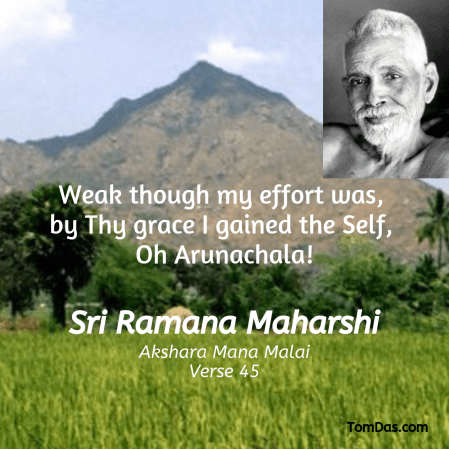
Ramana wrote very little himself, but of his written works he did write several devotional poetic works effusively praising and thanking Arunachala, his Guru, for bestowing the Guru’s Grace and swallowing him whole.
Oh Arunachala!
Grant us the good fortune to fall in Love with Thee!
To experience your Grace!
Oh Ramana!
I am blessed with knowledge of your form!
May I spend my days contemplating your form!
May your Grace continue to pull me towards you and consume me in Divine Love!
May I attain that Great Peace, my Own Very Self, in your Loving Embrace!
Oh Ramana!
You are Arunachala!
You are the True Guru!
You Dwell in me as Me,
Unchanging Pure Consciousness Love!
Om Namo Bhagavate Sri Ramanaya Om
❤️🙏❤️
Here is a video in which the above post is read by a devotee:
In classical Advaita (Non-Dual) Vedanta, there are three main theories or viewpoints of reality, called shristi-dristi vada, dristi-shristi vada and lastly ajata vada. Whilst these Sanskrit words may appear complex, the idea is actually very simple, and Bhagavan Sri Ramana Maharshi explains the meaning of these terms below.
It may be helpful to note that ‘vada’ means ‘theory’ or ‘viewpoint’, ‘shristi’ means ‘the world’ or ‘creation’, ‘dristi’ literally means ‘sight’ but in this context refers to consciousness, and ‘jata’ means ‘birth’ (or creation). Adding ‘a’ as a prefix to ‘jata’ negates the meaning so that ‘ajata’ means ‘unborn’ or ‘no creation’.
Therefore:
1) Shristi-dristi vada is the view that the world is primary and gives rise to consciousness, which is the most commonplace model of the universe, ie. that first there was a universe in which life gradually evolved on planet Earth and eventually human life and human consciousness evolved. In Western philosophy this is known as the Realist view of reality. This view also broadly corresponds to the waking state and to the Dvaita (dualistic) world view.
2) Dristi-shristi vada is the view that consciousness is primary and gives rise to the world appearance, ie. like in a dream, consciousness exists first and then this consciousness manifests the apparent dream-world and dream-subject/object duality. In Western philosophy this is known as the Idealist view of reality. This view broadly corresponds to the dream state and the view of Vasistadvaita (qualified non-duality or partial non-duality as I like to call it). This view is also known as, or at least is very similar to vivarta vada, which is the view that the world and individual are both projected illusions that simultaneously appear, and that the world and individual appear to appear but do not actually appear, rather like a dream. Vivarta vada could therefore be considered to be a sub-type of Drist-Shristi-Vada.
and
3) Ajata vada is the radical view that there never was any creation at all, and that there is only The Absolute, and that there never has even been the appearance of creation. This view broadly corersponds to the deep sleep state and also to Turiya, the ‘fourth’ state. This is the true Advaita (non-duality). In Vivarta-vada, it is said that Maya (the entire phenomenal appearance) appears to exist, but actually doesn’t, but in ajata vada it is almost imcomprehensibly stated that Maya never even came into existence, not even as an appearance. Hence the difference between Vivarta Vada and Ajata Vada. Vivarta vada states the snake appears to exist in the dimly lit rope, but that it isn’t real, whereas ajata vada states that the snake never even appeared to exist at ‘any time’ (‘any time’ is in quotes as the notion of time and space are also ‘seen’ to never have existed).
Note that whilst (1) and (2) can be understood conceptually with the mind, Ajata vada is an advanced and highly radical teaching that is very difficult to comprehend and it makes little sense to the mind. This is why liberation is said to be unfathomable. Ajata Vada is usually associated with Gaudapada’s commentary on the Mandukya Upanishad but also features in several other scriptures such as Ribhu Gita, Yoga Vasishtha, the final few verses of Shankara’s Vivekachudamani, the Ashtavakra Gita and Avadhuta Gita to name a few. Shankara’s commentaries on the Upanishads also commonly point to the radical ajata teachings.
Vedanta teachings often start by working in a Realist framework, which is the default conceptual framework of reality for most seekers especially at the start of their journey. Then the Idealist conceptual framework is introduced, and later the Ajata or no-creation viewpoint is brought in when the seeker is ready, in step-wise progression depending on how the seeker is progressing with the teachings. The nature and content of teachings differ depending on what framework of reality is being used. Note the purpose of the teachings is not that they are true, but the view is to be adopted in order to remove ignorance and reveal THAT which cannot be taught, explained or expressed in words – THAT which you – THAT which is all there is – beyond words.
Note that the stronger the ego (ie. the identification with being a body-mind), the stronger the attachment to the belief-concept that the world is real, and this means that the higher teachings are more likely to be rejected by the ego-mind. Conversely, the weaker the attachment to body-mind, the weaker the attachment to the belief in the world being real, and the more likely the higher teachings are to be accepted. This in turn facilitates Self-Enquiry and ‘attainment’ of Moksha (liberation).
Similarly, whenever we come across a teaching, it can be very helpful to see which of the 3 levels the teaching belongs to – this can be very helpful to avoid unnecessary confusion in what can otherwise seem to be contradictory teachings.
To explain further, here is an excerpt from Day by Day with Bhagavan from 15th March, 1946:
[Ramana Maharshi:] I do not teach only the ajata doctrine. I approve of all schools. The same truth has to be expressed in different ways to suit the capacity of the hearer. The ajata doctrine says, “Nothing exists except the one reality. There is no birth or death, no projection or drawing in [of the world], no sadhaka [no seeker], no mumukshu [no one seeking liberation], no mukta [no liberated person], no bondage, no liberation. The one unity alone exists ever.”
‘To such as find it difficult to grasp this truth and who ask. “How can we ignore this solid world we see all around us?” the dream experience is pointed out and they are told, “All that you see depends on the seer. Apart from the seer, there is no seen.”
Tom: Note here how Sri Ramana is distinguishing and differentiating vivarta vada/drist-sristi vada from ajata vada. Many people erroneously think that ajata vada states that world appears as a dream and non-creation means that the world is merely a dream-like appearance (as a dream appears, but is not real, and in that sense has not been created) – ie. many people erroneously equate ajata vada with vivarta vada/dristi-sristi vada. However here in the section above, if we read carefully, we can see that Sri Ramana is stating the Ajata vada is actually different to the idea that ‘all appears as the Self’. See here and here for more on this. In Sri Ramana Paravidyopanishad we also see this same teaching in verses 147 and 330:
147. Creation is not other than seeing; seeing and creating are one and the same process. Annihilation is only the cessation of seeing and nothing else, for the world comes to an end by the right awareness of oneself.
330. There is no creation apart from seeing; seeing and creation are one and the same. And because that seeing is due to ignorance, to cease seeing is the truth of the dissolution (of the world).
‘This is called the drishti-srishti vada, or the argument that one first creates out of his mind and then sees what his mind itself has created.
‘To such as cannot grasp even this and who further argue, “The dream experience is so short, while the world always exists. The dream experience was limited to me. But the world is felt and seen not only by me, but by so many, and we cannot call such a world non-existent,” the argument called srishti-drishti vada is addressed and they are told, “God first created such and such a thing, out of such and such an element and then something else, and so forth.” That alone will satisfy this class. Their mind is otherwise not satisfied and they ask themselves, “How can all geography, all maps, all sciences, stars, planets and the rules governing or relating to them and all knowledge be totally untrue?” To such it is best to say, “Yes. God created all this and so you see it.”’
Dr. M. said, ‘But all these cannot be true; only one doctrine can be true.’
Bhagavan said, ‘All these are only to suit the capacity of the learner. The absolute can only be one.’
In Guru Vackaka Kovai (Garland of Guru’s Sayings), Ramana says the following (with a comment by Sri Sadhu Om):
100. Although Guru Ramana taught various doctrines according to the level of understanding of those who came to Him, we heard from Him that ‘Ajata’ alone is truly His own experience. Thus should you know.
Sri Sadhu Om’s comments: ‘Ajata’ is the knowledge that nothing – neither the world, soul nor God – ever comes into existence, and that ‘That Which Is’ ever exists as IT is.
Tom: here in Sri Sadhu Om, we have a close and direct devotee of Sri Ramana’s clearing stating what Ajata Vada actually is.
114. When the limited light [which is used to project pictures on the cinema screen] is dissolved in the bright sunlight [which enters the cinema], the pictures also will disappear instantaneously. Similarly, when the limited consciousness [chittam] of the mind is dissolved in supreme Consciousness [Chit], the picture show of these three prime entities [God, world and soul] will also disappear.
Here Sri Ramana explains why the teachings may initially concede the existence of the three primal entities (the individual or jiva, the world or jagat, and God the ordainer or Isvara):
115. Thus, since the Truth of the Source is One, why do all religions [and sometimes even Sages] start their teachings by at first conceding that these three prime entities are real? Because the mind, which is tossed about by objective knowledge, would not agree to believe in the One unless the Sages condescended to teach It as three.
122. Whatever high and wonderful state of tapas one may have attained, if one still identifies oneself with an individuality, one cannot be a Sahaja-Jnani [i.e. One in the State of Effortlessness]; one is only an aspirant of, perhaps, an advanced stage.
Here it is explained that for the teaching to ‘condescend’ to vivartha vada is the most practical method for seekers:
83. From his condescending opening words, “Because we see the world”, it is to be understood that the Great Master, Bhagavan Sri Ramana, who gives the most practical assistance to aspirants, sets aside all other doctrines and teaches that only the ‘Doctrine ofVivartha’is suitable to be taken as true.
Sri Sadhu Om’s comments: Though His experience of the Truth can only be adequately expressed by the ‘Doctrine of Ajata’, Bhagavan Sri Ramana uses only the ‘Doctrine of Vivartha’ for His Teachings…The ‘Doctrine of Vivartha’ is recommended to explain the standpoint of Advaita, ie. to explain how the world-appearance, its seer, and the seer’s knowledge of the appearance all come into existence simultaneously, unconditioned by cause and effect. However, since this accepts the appearance of the world, souls and God, it is only a working hypothesis to help aspirants. The‘Doctrine of Ajata’, on the other hand, never accepts even the appearance of this trinity, but proclaims that the One Self-shining Reality alone exists eternally and without modification; Ajata is therefore the highest of all doctrines and it is only suitable for the fully-ripened aspirants. Bhagavan Sri Ramana therefore comes down condescendingly and, setting aside ‘Ajata’ and the two lower doctrines He advocates through His Forty Verses on Reality the ‘Doctrine of Vivartha’ which is suitable for the ripe aspirants who have no faith in the lower doctrines, yet do not have the maturity to grasp the highest, ‘Ajata’.
Below is a testimonial I have just received. I’m always grateful to receive a testimonial from someone who has benefited from what I share. Writing a testimonial is not only a wonderful way to express thanks, but it is an opportunity to reflect on the impact the teachings have made. It’s also nice for me to see how what I share has positively affected others, and to share that with you too.
I have been working in 1 to 1 sessions with people around the world over the last few years, and many have found that in just a few sessions they are able to find great clarity where perhaps before there was varying degrees of confusion.
If you would like to read other testimonials click here. Or if you have been positively impacted by what I share and would like to write a testimonial, or arrange a 1 to 1 session with me, then please contact me using the contact link above.
Here is the testimonial I received today:
‘I chanced upon Tom’s website at a very interesting time in my journey. I had studied traditional Vedanta for many years. I had some good understanding about the concepts and was doing some serious self inquiry or Atma Vichara. That’s when I started tying myself into all sorts of knots. I wasted a lot of time confused by concepts and was in a very frustrated place until I spoke to Tom.
I believe things happen for a reason and you meet the right people at the right time in the journey. Within a couple of sessions, Tom was able to help me unravel some of these knots. As the layers started peeling off and more layers and depth opened up the journey started taking a different shape. Throughout this, Tom was able to ask just the right question and clarified many concepts that would have otherwise taken a life of their own.
I found his teaching style refreshingly down to earth and humble and since he was able to speak from his direct experience, it made everything so real and relatable.’
The following text is a summary of Nisargadatta Maharaj’s teaching and was written by Maurice Frydman, the translator and editor of ‘I Am That’, Nisargadatta’s most widely read work. The text was entitled ‘Nisarga Yoga’ which, as Maurice Frydman explains below, means ‘the easy or natural yoga’, and it was originally published as an appendix to ‘I Am That’.
The text below is essentially the same as how it was originally published except for my addition of bold type for emphasis of what I felt were key points for a seeker of liberation.
In the humble abode of Sri Nisargadatta Maharaj, but for the electric lights and the noises of the street traffic, one would not know in which period of human history one dwells. There is an atmosphere of timelessness about his tiny room; the subjects discussed are timeless – valid for all times; the way they are expounded and examined is also timeless; the centuries, millennia and yugas fall off and one deals with matters immensely ancient and eternally new.
The discussions held and teachings given would have been the same ten thousand years ago and will be the same ten thousand years hence. There will always be conscious beings wondering about the fact of their being conscious and enquiring into its cause and aim. Whence am I? Who am I? Whither am I? Such questions have no beginning and no end. And it is crucial to know the answers, for without a full understanding of oneself, both in time and in timelessness, life is but a dream, imposed on us by powers we do not know, for purposes we cannot grasp.
Maharaj is not a learned. There is no erudition behind his homely Marathi; authorities he does not quote, scriptures are rarely mentioned; the astonishingly rich spiritual heritage of India is implicit in him rather than explicit. No rich Ashram was ever built around him and most of his followers are humble working people cherishing the opportunity of spending an hour with him from time to time.
Simplicity and humility are the keynotes of his life and teachings; physically and inwardly he never takes the higher seat; the essence of being on which he talks, he sees in others as clearly as he sees it in himself. He admits that while he is aware of it, others are not yet, but this difference is temporary and of little importance, except to the mind and its ever-changing content. When asked about his Yoga, he says he has none to offer, no system to propound, no theology, cosmology, psychology or philosophy. He knows the real nature – his own and his listeners’ – and he points it out. The listener cannot see it because he cannot see the obvious, simply and directly. All he knows, he knows with his mind, stimulated with the senses. That the mind is a sense in itself, he does not even suspect.
The Nisarga Yoga, the ‘natural’ Yoga of Maharaj, is disconcertingly simple – the mind, which is all becoming, must recognise and penetrate its own being, not as being this or that, here or there, then or now, but just as timeless being.
This timeless being is the source of both life and consciousness. In terms of time, space and causation it is all-powerful, being the causeless cause; all-pervading, eternal, in the sense of being beginningless, endless and ever-present. Uncaused, it is free; all-pervading, it knows; undivided, it is happy. It lives, it loves, and it has endless fun, shaping and re-shaping the universe. Every man has it, every man is it, but not all know themselves as they are, and therefore identify themselves with the name and shape of their bodies and the contents of their consciousness.
To rectify this misunderstanding of one’s reality, the only way is to take full cognisance of the ways of one’s mind and to turn it into an instrument of self-discovery. The mind was originally a tool in the struggle for biological survival. It had to learn the laws and ways of Nature working hand-in-hand can raise life to a higher level. But, in the process the mind acquired the art of symbolic thinking and communication, the art and skill of language. Words became important. Ideas and abstractions acquired an appearance of reality, the conceptual replaced the real, with the result that man now lives in a verbal world, crowded with words and dominated by words.
Obviously, for dealing with things and people words are exceedingly useful. But they make us live in a world totally symbolic and, therefore, unreal. To break out from this prison of the verbal mind into reality, one must be able to shift one’s focus from the word to what it refers to, the thing itself.
The most commonly used word and most pregnant with feelings, and ideas is the word ‘I’. Mind tends to include in it anything and everything, the body as well as the Absolute. In practice it stands as a pointer to an experience which is direct, immediate and immensely significant. To be, and to know that one is, is most important. And to be of interest, a thing must be related to one’s conscious existence, which is the focal point of every desire and fear. For, the ultimate aim of every desire is to enhance and intensify this sense of existence, while all fear is, in its essence, the fear of self-extinction.
To delve into the sense of ‘I’ – so real and vital – in order to reach its source is the core of Nisarga Yoga. Not being continuous, the sense of ‘I’ must have a source from which it flows and to which it returns. This timeless source of conscious being is what Maharaj calls the self-nature, self-being, swarupa.
As to the methods of realising one’s supreme identity with self-being, Maharaj is peculiarly non-committal. He says that each has his own way to reality, and that there can be no general rule. But, for all the gateway to reality, by whatever road one arrives to it, is the sense of ‘I am’. It is through grasping the full import of the ‘I am’, and going beyond it to its source, that one can realise the supreme state, which is also the primordial and the ultimate. The difference between the beginning and the end lies only in the mind. When the mind is dark or turbulent, the source is not perceived. When it is clear and luminous, it becomes a faithful reflection of the source. The source is always the same – beyond darkness and light, beyond life and death, beyond the conscious and the unconscious.
This dwelling on the sense ‘I am’ is the simple, easy and natural Yoga, the Nisarga Yoga.There is no secrecy in it and no dependence; no preparation is required and no initiation.Whoever is puzzled by his very existence as a conscious being and earnestly wants to find his own source, can grasp the ever-present sense of ‘I am’ and dwell on it assiduously and patiently, till the clouds obscuring the mind dissolve and the heart of being is seen in all its glory.
The Nisarga Yoga, when persevered in and brought to its fruition, results in one becoming conscious and active in what one always was unconsciously and passively. There is no difference in kind – only in manner – the difference between a lump of gold and a glorious ornament shaped out of it. Life goes on, but it is spontaneous and free, meaningful and happy.
Maharaj most lucidly describes this natural, spontaneous state, but as the man born blind cannot visualise light and colours, so is the unenlightened mind unable to give meaning to such descriptions. Expressions like dispassionate happiness, affectionate detachment, timelessness and causelessness of things and being – they all sound strange and cause no response. Intuitively we feel they have a deep meaning, and they even create in us a strange longing for the ineffable, a forerunner of things to come, but that is all. As Maharaj puts it: words are pointers, they show the direction but they will not come along with us. Truth is the fruit of earnest action, words merely point the way.





 Tom Das