Poetry: Know thyself

swan reflection

Not that which comes and goes,
But that which knows both comings and goings;

Not that which is confused or clear,
But that which sees both confusion and clarity;

Not that which is happy or depressed,
But that which knows both happiness and depression;

Not that which swells with pride, or is deflated by humiliation,
But that which sees both pride and humiliation, and their effects;

Not that which is damaged by disease or benefited by medicine,
But that which knows both disease and health;

Not that which has desires and fears,
But that which sees both attraction and aversion;

Not that which judges or is open-minded,
But that which knows judgement and open-mindedness.

Not that which thinks or acts,
But that to which both thoughts and actions appear;

Not the ear, tongue, skin, eyes or nose,
But that to which smell, taste, sensation, vision and sound appear;

That which, in our experience,
never changes,
is always present,
ever-aware,
and unblemished by experiences;

That which
looks with constancy,
is ever-patient,
unmoving,
always seeing things as they are;

That which
cannot be lost or removed,
is effortlessly present,
totally secure,
and is the innermost essence of your experience;

Know yourself to be that.

​POETRY: TAKE A REST, MY FRIEND

crimea-998539_1920

Turn away from thought.

Turn away from that web of chatter,
from that activity of apparent separation and all the existential pain it brings.

Turn away from all that self-imposed suffering.

Rest a while, my friend:
You deserve it, you deserve that much.

Take a rest…
…be that space in which all things appear but on which nothing leaves a mark.
know yourself as that.

(you are already that)

Shankara’s way to Enlightenment, with verses from Atma Bodha

Atma Bodha is a short text attributed to Shakara and was written approximately 1400 years ago. It literally means ‘Self Knowledge’ (atma = self, bodha = understanding or knowledge) and it outlines a methodology to lead a seeker from suffering to liberation. Incidentally, bodha is the same root word that forms the word Buddha, which means ‘the one who knows or understands’.

It comprises a class of scriptures called prakarana granthas. Prakarana means ‘procedure’ or ‘task’ and grantha means ‘text’. Taken together prakarana grantha means ‘instruction manual’. These instruction manuals were written for those who do not have the capacity or time to read the voluminous traditional texts such as the vedas and upanishads or for those who were looking for a synopsis of their vedantic studies, and so give us a summary teaching which we can practically apply to our lives.

Ramana Maharshi thought this text important enough to translate it from Sanskrit to Tamil so that Tamil-speaking locals who could not understand Sanskrit could still benefit from its teachings. In his introduction to his translation, Ramana describes Shankara as the one who brings forth enlightenment. Similarly in the Inchegarei Sampradaya, the lineage to which Nisargadatta Maharaj belonged, Shankara is considered an enlightened sage and his writings are studied as a matter of course.

Below are some selected quotes from Shankara’s Atma Bodha. We will see how in these quotes the basic methodology (after the entry criteria for this teaching are briefly alluded to) is:

1) Firstly viveka, or distinguishing between what is Brahman and what is not. Brahman is identified as the unchanging subject and the world of objects (ie. the body, mind and world) is said to be not-Brahman. This is an artificial duality that is temporarily set up in order to counter and remove the deeply ingrained belief in the doer-entity or ego (ahamkara). We will see how this duality is later resolved into non-duality and furthermore into non-conceptuality.

2) Once the subject-object distinction (viveka) has been properly made then this knowledge or understanding is to be practised. This is done by the practise of identification with the subject, Brahman, and turning away from the phenomena that arise in our awareness.

3) Eventually, after long practice of this, the doer-entity that we once took ourselves to be is seen to be an illusion. This ignorance is removed.

4) Once the doer-entity is seen to be unreal, then the interpretive notions of subject and object can also be done away with. Having completed their purpose, the concepts of subject and object are also seen to be false beliefs and are allowed to fall away.

5) Everything is ‘resolved into Brahman’, not literally, but in the way we label reality. Before, at the first step of viveka,  the unchanging subject was considered Brahman/Atman and the changing world of objects (the mind, body and world) were said to be not-Brahman/Atman. Now ignorance is removed, everything is seen to be Brahman and the duality set up by viveka is removed.

6) Eventually we stop needing to label reality at all. What we are left with is just this, this present experience, devoid of concepts of self or reality or even Brahman. So simple, so direct, how can it be put into words?

Verse 5. The knowledge [I am Brahman], when unceasingly practiced, drives out all ignorance, then itself disappears.

Shankara - the knowledge then itself disappears

37. The mental impression ‘I am Brahman’, created by ceaseless practice, destroys ignorance and the resultant suffering, just as medicine destroys disease.

Shankara - I am Brahman destroys ignorance (1)

41. There are no distinctions such as ‘Knower’, the ‘Knowledge’ and the ‘Object of Knowledge’ in the Supreme Self

Shankara- there are no distinctions in the Supreme Self.

64. All that is perceived, or heard, is Brahman and nothing else

Shankara- All that is perceived is Brahman and nothing else

Am I the body? Am I not the body?

This post is continued from a prior post: Integrating knowledge, spontaneous action

Q. I’ve been reading Ramana Maharshi recently and he keeps on saying ‘I’m not the body’.

Tom: Yes, that’s right.

Q: But I don’t really hear you talk about not being the body.

Tom: Yes, that’s because it’s a ‘thorn’. Remember the phrase I’ve mentioned: ‘Use a thorn to remove and thorn and throw them both away’?

Q: Yes, I’ve heard you say that. Please can you explain it again?

Tom: Sure. The first thorn represents a wrong concept that is active in your mind and causes suffering, just as a thorn in your foot causes suffering. You then take a second thorn and use it as a tool to remove the first thorn, but then you throw them both away. If you don’t throw away the second thorn, then you now have a new thorn (concept) that will cause you to suffer.

Ramana often talks about rooting out the ‘I-am-the-body’ concept, and the concept ‘I-am-not-the-body’ is just to negate the initial thorn. But then you throw it away too.

Q: So I am not the body is not true either?

Tom: Exactly. Or, lets put it like this: for a moment just forget what Ramana says, forget what I say – for all you know we could both be talking a load of rubbish! Afterall, lots of intelligent people believe strange and silly things, and we could be no different, right? So forget what we say.

So let me ask you a question: do you know for sure that you are a body?

Q: Well it often seems like I am a body…

Tom: But do you know for sure?

Q: No, not for sure.

Tom: Good. Now, do you know for sure that you are not the body?

Q: No, not for sure.

Tom: Good. That’s our basic experience. We don’t know either way. The body appears and follows us around, as it were, but we don’t know exactly what it means. Is the body me? Is it not me? The truth is I don’t know. That’s it. That’s the truth. We don’t know. Isn’t that right?

Q: But when I say to myself ‘I am not the body’, it feels so good, it just feels really nice.

Tom: Yes, of course, because you are negating the concept (I-am-the-body) that causes so much suffering. It’s a good thing to practice, it’s a great practice in fact. If it works for you I recommend you practice it.

Q: Oh, I see, so it’s a practice.

Tom: Exactly. We are not saying don’t practice. We may need the second thorn, that’s why it is there, that’s why it is taught. So use that thorn, use that tool, practice ‘I am not the body’. When it has done its work, when it has weeded out the ‘I am the body’ concept, then you won’t need it any more and you can throw it away too.

Q: OK, I got it now. Wow, there are so many thorns, aren’t there?

Tom: Yes!

Q: I often get confused about whether or not the world is a dream or illusion or not, but that’s just another thorn too, right?

Tom: Exactly. ‘The world is an illusion’ – it’s a very powerful thorn, one that benefited me a lot whilst I was seeking. But again, do you know for sure if the world is an illusion?

Q: No, not for sure…I know what you’re going to ask next…

Tom: …And do you know for sure that the world is not an illusion?

Q: No, not for sure . I knew you’d say that.

Tom: (laughing) That’s it! We don’t know either way! It’s so simple – Got it?

Q: (laughing) Got it.

Tom: so you can practice these, all these thorns. All these thorns are concepts. Use them – they are most definately useful – use them if you need them. The concepts are used to weed out the beliefs. You may need to practice them for weeks or months, but when their work is done, and the suffering has dissipated, throw them away.

Also see Ranjit Maharaj talk about this.

 

Annamalai Swami: ‘Don’t sit and meditate’

Annamalai Swami: Bhagavan watched me very closely in the years that I served him in the ashram. One time I went to the Mother’s temple where many people were talking about worldly matters.

Bhagavan called me back, saying, ‘Why should you go to that crowd? Don’t go to crowded places. If you move with the crowd, their vasanas will infect you.’

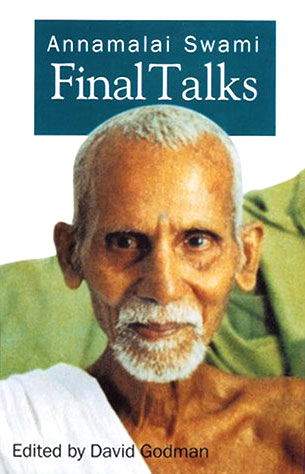
annamalai swami final talks

Bhagavan always encouraged me to live a solitary life and not mix with other people. That was the path he picked for me. Other people got different advice that was equally good for them.

But while he actively discouraged me from socialising, he also discouraged me from sitting quietly and meditating during the years that I was working in the ashram. In this period of my life, if Bhagavan saw me sitting with my eyes closed he would call out to me and give me some work to do.

On one of these occasions he told me,

‘Don’t sit and meditate. It will be enough if you don’t forget that you are the Self. Keep this in your mind all the time while you are working. This sadhana will be enough for you. The real sadhana is not to forget the Self. It is not sitting quietly with one’s eyes closed. You are always the Self. Just don’t forget it.’

Bhagavan’s way does not create a war between the mind and the body. He does not make people sit down and fight the mind with closed eyes. Usually, when you sit in meditation, you are struggling to achieve something, fighting to gain control over the mind. Bhagavan did not advise us to engage in this kind of fight. He told us that there is no need to engage in a war against the mind, because mind does not have any real, fundamental existence. This mind, he said, is nothing but a shadow. He advised me to be continuously aware of the Self while I did the ordinary things of everyday life, and in my case, this was enough.

The above is an excerpt taken from Final Talks by Annamalai Swami, p. 67

Integrating knowledge, spontaneous action

This post is continued from Discarding Knowledge as Ignorance

Do you go around repeatedly saying your name so that you remember it? Do you have to walk around saying “I am Tom, I am Tom, I am Tom?” (obviously substitute in your name).

Or do you spend most of your life not even thinking about your name, but when someone calls out your name, the understanding ‘My name is Tom’ automatically acts: you turn your head and respond?

It’s the same with understanding there is no doer: initially you may need to think about it, go through the reasoning, and realise there is no evidence for a doer. It is a conscious process. Because we have been conditioned to think of ourselves as being a doer, there is often a process of deconditioning.

It may also take time for all the suffering based on the ‘I am the doer’ notion to fall away. Other notions such as ‘I am to blame’ or ‘I could/should have done it differently’ or ‘I am not worthy’ may still all be at play. All these depend on the root belief ‘I am a separate doer-entity’. Again, there may be a conscious process of applying this understanding in order to deal with suffering as it arises and uprooting the associated beliefs upon which suffering depends.

But once this has been done, then we don’t need to think about it. The knowledge of ‘there is no doer’ has been ingrained into us. We do not need to think about it, we no longer need to repeat the process of understanding.

But just as when someone asks your name, you can spontaneously respond ‘My name is ____’, when someone asks you ‘Are you a doer?’, you can instantly reply ‘there is no doer’.

This post is continued here: Am I the body? Am I not the body?

Discarding knowledge as ignorance

This post is continued from my previous post: Practicing knowledge

Discarding knowledge as ignorance

Once the purpose of the tool has been fulfilled, then the tool can be dispensed with. There are two main problems with this. Firstly, you can dispense with the tool too quickly, before it has done its work of rooting out ignorance. Secondly, you can cling onto the tool for too long, which essentially means that you have started to believe in it.

I see both of these errors happening all the time. People often dismiss the need for practice completely. While there are different paths to follow (including no-path ‘paths’), that does not mean that for some a path or teaching cannot be of benefit. All teachings are provisional which means that they produce limited results. This is true of all teachings and all actions/practices – they are all limited and produce limited results. But these limited results can still be of use to us in recognising what is already (and always was) present , ie. Freedom. 

Other people believe the conceptual tool. They have merely substituted one concept for another, one ignorance for another.

Hence the traditional advice is to liken these conceptual tools as being thorns, to remind you not to hold onto the second thorn, useful as it was:

Then, like the thorn used to remove a thorn, throw them both away.

See Ranjit Maharaj discuss this here.

This post is continued in the next article: Integrating knowledge/spontaneous action

Practicing knowledge

This is continued from a previous post Problems with utilising conceptual tools:

Practicing knowledge

This brings us to the idea of practicing knowledge. Just to be clear, the knowledge we are talking of here is in the form of concepts, as described previously above. In this case whenever we notice ourselves suffering, we notice it is because we have identified as being the doer/body-mind. We then take up the sword of knowledge ‘I am not the body’ and use it to slay the ignorance ‘I am the body’.

Other similar ideas are concepts of identifying as being the witness or identifying as consciousness or considering the world and body-mind to be an illusion. These concepts all which work in a similar way to negate the identification as the doer/body-mind. Here’s an example from Yoga Vasisthta:

You are bound firmly on all sides by the idea, I am the body’. Cut that bond by the sword of knowledge ‘I am Consciousness’ and be happy.
Yoga Vasisthta

Whenever ignorance rises, we cut it down. When it doesn’t rise, we can leave it alone. Initially we may have to repeat the phrase ‘I am not the body’ or ‘I am Consciousness’ or ‘I am Brahman’ in our heads repeatedly, like a mantra, until it sinks in, but after sometime it is ingrained into us and we only unsheathe the sword when it is required.

To be continued in a future post: Discarding knowledge as ignorance

Problems with utilising conceptual tools

Continued from 2 previous posts:

  1. Why seeing/understanding alone may not be enough
  2. Integrating the understanding of no-doer

Problems with utilising conceptual tools

Generally speaking, the more you believe in the concept, the better it works, but conversely the harder it is to throw it away once the task at hand (rooting out the ego/’I am the body’ notion) has been completed.

Other problems with believing in the concepts is that it sets you against other traditions and teachings that either utilise other concepts, thus breeding division and sectarianism, and also it can lead to some unintended consequences, some of which can be quite unpleasant.

These include spiritual bypassing, which is where emotional and psychological issues are not dealt with properly as ‘I am not the body-mind so I have no issues’ or where the body is neglected and not properly respected as it is deemed to be ‘insentient, inert and not me’.

Another problem with utilising concepts is that the ego is perpetuated and can even be strengthened during this part of the teaching. Eventually it can be seen that all teachings are also subtle ways of continuing/perpetuating the egoic process which is itself based on the illusion of being a separate doer-entity. Until then, these conceptual teachings and practices based upon these concepts may be useful, but eventually we see that all teachings are potential obstacles. Why? Because Freedom is already fully present, and on a subtle level all teachings assume that Freedom is not already here and reinforce the notion that this moment is deficient in some way.

You can probably think of other negatives of this approach yourself, and perhaps have seen spiritual seekers on this journey fall into one of these traps.

To be continued in a future post: Practicing knowledge