Dasbodh, written by Sri Samartha Ramdas in 1654, has been long used as a source text for seekers of enlightenment within the Advaita Vedanta tradition. Nisargadatta Maharaj’s lineage, the Inchegarei Sampradaya, were hugely inspired by this text and Nisargadatta used to regularly read from it.
Here Samartha Ramdas is pointing us to something very profound, yet very simple once realised. For more, compare this verse with that of Zen master Han-Shan here.
If you try to figure it out, if you try to look for it, you have already missed it, for you have presupposed incompleteness, you have assumed the presence of lack.
Where is the lack? In what way are you incomplete?
It is the mind that tells you you need something else, the mind that ‘says this is not enough’.
There is no need to believe the mind and the stories (lies) it spews forth: it is already here, ‘LACKING NOTHING AT ALL’, and you are it.
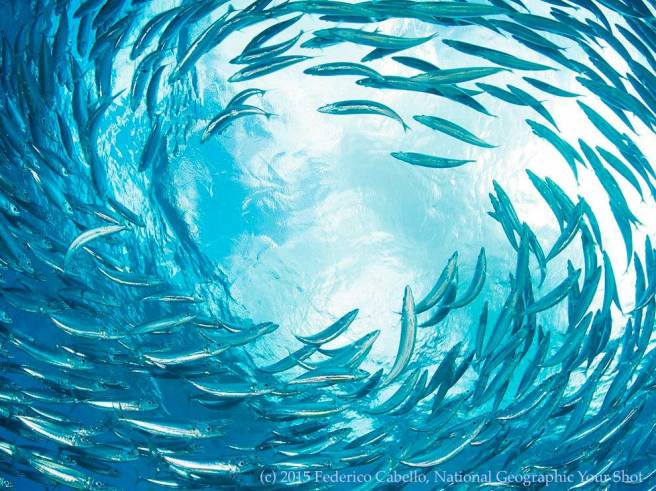
Shoal of Sardines, Photograph by Federico Cabello, National Geographic Your Shot
The mass of unenlightened spiritual seekers,
trying to figure it all out,
trying to see their True Natures,
like the proverbial fish looking for water,
or the lady looking everywhere for her necklace,
only to find it on her neck.
The trying-to-figure-it-all-out is the suffering.
A horde of egos,
trying to be happy,
struggling to attain Bliss and Peace,
like someone using a bloodied towel to wipe up blood,
like a person in quicksand sinking ever deeper with each attempt to be free.
The trying-to-be-happy is the suffering.
Why bother?
Why argue with what is?
What’s wrong with right here, right now?
(It is the mind that tells you otherwise)
Stop:
Water is here all you around you, dear fish!
My lady, you look stunning in your necklace!
The splattered blood is perfect, right where I wanted it to be!
When you stop moving, look, the quicksand disappears!
‘No, don’t stop’ says the mind ‘There’s more, just around the corner your prize awaits.’
‘Just go that one bit further and you’ll have it figured out.’
‘Peace and Bliss are yours. You are much more than just this.‘
The mind believes the mind,
thought believes its thinking.
The mind thinks it is the doer,
and so thinks it can do something about this.
But what can be done? And who/what can do it?
This cannot be figured out (by the ego/doer/mind).
How can the ego realise it does not exist?
What can you do to realise there is no doer?
There is nobody here!
So how can there be anything to do?
Look:
Actions happen by themselves,
according to the nature of things:
planets orbit the sun,
the wind blows,
rivers flow,
seeds sprout,
plants grow,
babies are born,
hearts beat,
lungs breathe,
minds think,
bodies act…
Nobody doing any of it,
all of it happening anyway,
all of it choicelessly accepted,
by the all-embracing awareness,
that is none other than our ordinary everyday experience:
spontaneously present,
spontaneously aware.
Did we ask to be aware?
Did we create awareness?
Did we create our experiences?
Or did our awareness spontaneously arise?
Or did experience and experiences spontaneously appear?
Seeing this,
it is seen.
Did you chose to be a seeker?
Did you chose to take yourself to be a doer?
See, you are not in control,
for there is no evidence of a controller.
Why believe in that for which there is no evidence?
Look:
There is no mass of unenlightened seekers at all,
The horde of egos is but an imagined illusion.
No unenlightened people,
no enlightened people,
Just what is.
All there is is life,
a uni-versal process,
a vast interconnected web,
spanning from celestial bodies to nervous systems,
one system operating…
“The differences are the result of the sense of doership.
The fruits will be destroyed if the root is destroyed.
So relinquish the sense of doership.
The differences will vanish and the essential reality will reveal itself.
In order to give up the sense of doership one must seek to find out who the doer is.
Inquire within. The sense of doership will vanish.
Vichara (inquiry) is the method.”
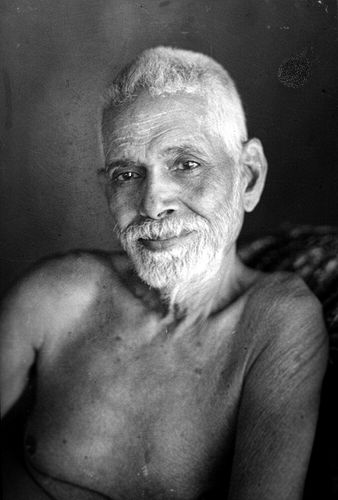
Taken from Talks with Sri Ramana Maharshi, talk no. 429
Tom’s comments:
The root of suffering is the sense of doership, the sense that there is a doer-entity, the sense that you are a doer. The root is the notion ‘I am a doer’, the fruit is suffering and duality.
Let go of this sense of doership, either by simply relaxing and letting go, or, as suggested above, look and find out what the doer is. Look at your own direct experience: can you see the doer? Can you feel the doer? What does the doer look and feel like exactly? Where does the doer begin and end? How big is the doer? Where is the doer located?
When you look, as you keep on noticing, you may start to realise/see that there is no actual experience of a doer at all. All there are are sensations, feelings and thoughts. Specifically there may be the thought ‘I am the doer’ or ‘this is the doer’, but no actual doer is seen/experienced apart from the thought. The doer is seen to be an imagined entity. The doer (ie. ego) is revealed to be a fiction.
Ramana uses the word ‘reality’ above. What is reality? It’s just what’s left over when the sense of doership is seen through. It’s just what’s left over when false illusions are seen for what they are: false.
 Everything is happening,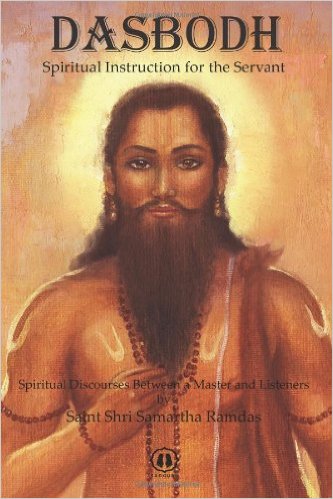


 Tom Das