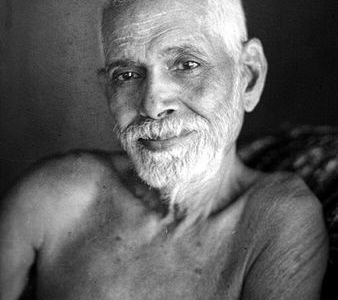
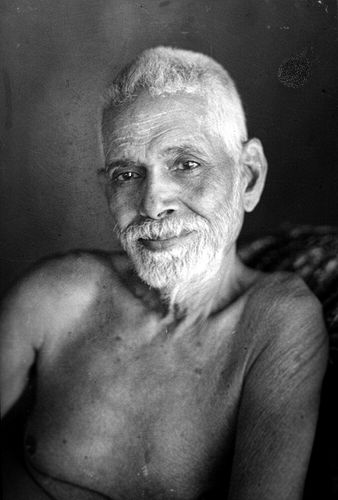
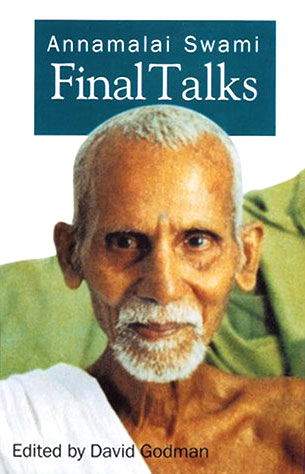
The following excerpt is from the wonderful book Annamalai Swami FINAL TALKS, Chapter 1:
Annamalai Swami: Mind is just a shadow. Attempts to catch it and control it are futile. They are just shadows chasing shadows. You can’t control or eliminate a shadow by chasing it or by putting a shadow hand on it. These are just children’s games.
Ram Tirtha once told a story about a small boy who ran down the street, trying to catch up with the head of his shadow. He never managed because no matter how fast he ran, the shadow of his head was always a few feet ahead of him.
His mother, who was watching him and laughing, called out, ‘Put your hand on your head!’
When the boy followed this instruction, the shadow hand caught up with the shadow head. This was enough to satisfy the boy.
This kind of advice may be enough to keep children happy, but it won’t produce satisfactory results in the realm of sadhana and meditation. Don’t chase your shadow thoughts and your shadow mind with mind-control techniques because these techniques are also shadows. Instead, go back to the source of the shadow-mind and stay there. When you abide in that place, you will be happy, and the desire to go chasing after shadow thoughts will no longer be there.
Bhagavan often told the story of a man who tried to get rid of his shadow by burying it in a pit. This man dug a hole and then stood on the edge of it in such a way that his shadow was cast on the bottom of the hole he had just made. After lining it up in this way, he started throwing soil on the shadow in an attempt to bury it. Of course, no matter how much soil he put in the hole, the shadow still remained on top of it.
Your mind is an insubstantial shadow that will follow you around wherever you go. Attempts to eliminate or control it cannot succeed while there is still a belief that the mind is real, and that it is something that can be controlled by physical or mental activity.
Question: But this shadow mind must still be eliminated by some means.
Annamalai Swami: When self-realisation happens, mind is no longer there. However, you do not get self-realisation by getting rid of the mind. It happens when you understand and know that the mind never existed. It is the recognition of what is real and true, and the abandonment of mistaken ideas about the reality and substantiality of this ephemeral shadow you call the mind.
This is why Bhagavan and many other teachers kept bringing up the analogy of the snake and the rope. If you mistake a rope on the ground for a snake, the snake only exists as an idea in your mind. That idea might cause you a lot of worry and anxiety, and you may waste a lot of mental energy wondering how to avoid the snake or kill it, but this fact remains: there is no snake outside your imagination. When you see the rope, the substratum upon which your false idea of a snake is superimposed, the idea that there is a snake, and that it is real, instantly vanishes. It is not a real snake that has disappeared. The only thing that has disappeared is an erroneous idea.
The substratum upon which the false idea of the mind has been superimposed is the Self. When you see the mind, the Self, the underlying substratum, is not seen. It is hidden by a false but persistent idea. And conversely, when the Self is seen, there is no mind.
Question: But how to give up this false idea that the mind is real?
Annamalai Swami: The same way that you give up any wrong idea. You simply stop believing in it. If this does not happen spontaneously when you hear the truth from a teacher, keep telling yourself, “I am not the mind; I am not the mind. There is no mind; there is no mind. Consciousness alone exists.” If you have a firm conviction that this is the truth, one day this firm conviction will mature to the point where it becomes your direct experience.
Consciousness alone exists. If you generate a firm conviction that this is the truth, eventually this firm conviction will become your own direct experience. Consciousness alone exists. That is to say, whatever exists is consciousness alone. Keep this in mind and don’t allow yourself to regard anything else as being real. If you fail and give even a little reality to the mind, it will become your own false reality. Once this initial wrong identification – ‘I am the mind, the mind is real’ – has happened, problems and suffering will follow.
Don’t be afraid of the mind. It’s a false tiger, not a real one. Something that is not real cannot harm you. Fear and anxiety may come to you if you believe that there is a real tiger in your vicinity. Someone may be making tiger noises as a joke to make you afraid, but when he reveals himself, all your fears go because you suddenly understand that there never was a tiger outside your imagination.
Question: One can have a temporary experience of the Self, the underlying reality, but then it goes away. Can you offer any guidance on how to stabilise in that state?
Annamalai Swami: A lamp that is lit may blow out if the wind is strong. If you want to see it again, you have to relight it. But Self is not like this. It is not a flame that can be blown out by the passing winds of thoughts and desires. It is always bright, always shining, always there. If you are not aware of it, it means that you have put a curtain or a veil in front of it that blocks your view. Self does not hide itself behind a curtain. You are the one who puts the curtain there by believing in ideas that are not true. If the curtain parts and then closes again, it means that you are still believing in wrong ideas. If you have eradicated them completely, they will not reappear. While these ideas are covering up the Self, you still need to do constant sadhana.
So, going back to your question, the Self does not need to stabilise itself. It is full and complete in itself. The mind can be stabilised or destabilised, but not the Self.
Question: By constant sadhana, do you mean self-enquiry?
Annamalai Swami: Yes. By strength of practice, by doing this sadhana, this veil will be removed completely. There will be no further hindrances. You can go to the top of Arunachala, but if you are not alert, if you are not paying attention, you may slip and end up at Easanya Math (a Hindu institution at the base of the hill).
You have to make an enormous effort to realise the Self. It is very easy to stop on the way and fall back into ignorance. At any moment you can fall back. You have to make a strong determined effort to remain on the peak when you first reach it, but eventually a time will come when you are fully established in the Self. When that happens, you cannot fall. You have reached your destination and no further efforts are required. Until that moment comes, constant sadhana is required.
Question: Is it important to have a Guru at this stage, this period when constant effort is required?
Annamalai Swami: Yes. The Guru guides you and tells you that what you have done is not enough. If you are filling a bucket with water, you can always add more if there is still space. But when it is completely full, full to overflowing, it is pointless to add even a single drop. You may think that you have done enough, and you may believe that your bucket is full, but the Guru is in a better position to see that there is still a space, and that more water needs to be added. Don’t rely on your own judgement in this matter. The state you have reached may seem to be complete and final, but if the Guru says, “You need more sadhana,” trust him and carry on with your efforts.
Bhagavan often used to say, ‘The physical Guru is outside, telling you what to do and pushing you into the Self. The inner Guru, the Self within, simultaneously pulls you towards itself.’
Once you have become established in the inner Guru, the Self, the distinction between Guru and disciple disappears. In that state you no longer need the help of any Guru. You are That, the Self.
Until the river reaches the ocean it is obliged to keep on flowing, but when it arrives at the ocean, it becomes ocean and the flow stops. The water of the river originally came from the ocean. As it flows, it is merely making its way back to its source. When you meditate or dosadhana, you are flowing back to the source from which you came. After you have reached that source, you discover that everything that exists – world, Guru, mind – is one. No differences or distinctions arise there.
Non-duality is jnana; duality is samsara. If you can give up duality, Brahman alone remains, and you know yourself to be that Brahman, but to make this discovery continuous meditation is required. Don’t allocate periods of time for this. Don’t regard it as something that you do when you sit with your eyes closed. This meditation has to be continuous. Do it while you are eating, walking, and even talking. It has to be continued all the time.
 Stop thinking, and end your problems.
 Everything is happening,