The four types of Liberated Sage (Jnani) | Advaita Vedanta |Kaivalya Navaneeta

Kaivalya Navaneeta front cover ramana

In the text Kaivalya Navaneeta (The Cream of Liberation; a 16th century traditional advaita text that was often recommended by Sri Ramana Maharshi), four types of liberated sages are described starting at verse 94.

Understanding these descriptions can help explain and reconcile the different views of liberation one may come across, such as whether or not the body and world appear after liberation, what type of lifestyle a liberated sage would exhibit and whether or not they would experience any kind of afflictive or suffering-causing emotions at all. My comments are in italicised red:


94. The wise, remaining like ether and liberated even here, are of four classes, namely Brahmavid (i.e. a knower of Brahman), vara, varya, and varishta, in order of merit.

Tom: The four types of liberated sage are called Brahmavid, Vara, Varya and Varishta. First we will discuss the Brahmavid or or ‘knower or Brahman’ (Vidya is Sanskrit for knowledge). The phrase ‘remaining like ether’ refers to the previous verse 93 and means the wise sage abides as consciousness, fully liberated.

95. The Brahmavids who by steadfast practice have gained clear realization of Brahman, continue to perform even the hard duties of their caste and stage in life, exactly as prescribed by the shastras for the benefit of others, without themselves swerving from their supreme state.

96. Should passions rise up they disappear instantly and cannot taint the mind of the Brahmavids who live in society detached like water on a lotus leaf. They look ignorant, not showing forth their knowledge, and remain mute owing to intensity of inward Bliss.

Tom: the first type of liberated sage is called the Brahmavid. They continue to be fully engaged in society and the world whilst simultaneously being liberated. Occasionally afflictive emotions and passions arise but they are short lived and do not affect the Brahmavid. They may seem like an ordinary person with nothing particularly special about them, but they are often outwardly quiet.

97. Prarabdha, i.e., karma which is now bearing fruit, differs according to the actions in past incarnations. Therefore the present pursuits also differ among jnanis, who are all, however, liberated even here. They may perform holy tapas; or engage in trade and commerce; or rule a kingdom; or wander about as mendicants.

Tom: Prarabdha essentially refers to the destiny of the particular body-mind based on its previous actions, ie. its karma . This verse states that the actions of the (body of the) jnani  or sage (jnani literally means ‘knower’, ie. ‘knower of truth’ or ‘knower of Self’) varies depending on what the activities the body did prior to realisation. So the sage may, for example, perform holy penance, or engage in the world, or be a ruler, or a wandering monk. Basically there is no fixed description of what a sage would do in daily life in terms of their ‘occupation’.

98. They would not think of the past or future; would partake of what comes unsolicited; would not wonder, even if the sun turned into the moon, or at any other marvel, whether the sky were to spread its shoots down like a banyan tree or a corpse were to be revived; nor would they distinguish good and bad, for they always remain as the unchanging Witness of all.

Tom: the last point on the Brahmavid is that they are unaffected by whatever appears to happen, no matter how marvelous, calamitous or ridiculous. Why? Because they are liberated, ‘fixed’ as the Self, remaining as the ever-unchanging ‘Witness of all’.

Now let us look at the other three classes of Jnani or Liberated Sage:

99. Among the other three classes, the vara and the varya remain settled in samadhi. The vara feels concern for the maintenance of the body; the varya is reminded of it by others; the varishta never becomes aware of the body, either by himself or through others.

Tom: Here the vara and varya are both aware of the body at times whilst the fourth type of Jnani, the varishta, is not even ever aware of the body at all, even though others may perceive him or her as a body. The vara has a desire to maintain the body, whilst the varya occasionally becomes aware of their body if someone else prompts them.

So which of these types of liberation is best? Let us see…

100. Although there are distinguishing characteristics in the lives of the different Sages, who are themselves very rare in the world, yet there is absolutely no difference in the experience of Liberation. What can be the use of the hard-won samadhi? The Brahmavid, who is outwardly active, seems sometimes to feel the misery of calamities, whereas the others remain in unbroken Bliss.

Tom: Here it is made clear: all of these four types of sage are rare, and all are the same in that they are all fully liberated. They all in themselves have the same essential experience of Liberation, the differences being only superficial and present from the point of view of other non-liberated people, ie. from the point of view of ignorance.

However a point is raised that is dealt with in the next verse. The Brahmavid may appear to suffer and stress like the unliberated, whereas the other three categories of liberated sage are lost in eternal Peace and Bliss. How can this be? How can the Brahmavid be said to be truly liberated?

101. Now if the Brahmavids live like the ignorant, how are they free from the cycle of births, and how is their ignorance gone? The all-pervading ether remains untainted by anything; the other four elements are tainted by contact with objects. So it is with the Brahmavid and the ignorant.

Tom: The answer given is that, as Consciousness, the Brahmavid remains unaffected and untouched by whatever seems to happen in the world of objects that we ordinarily call life.


Tom’s summary: So we can see there are various types of liberated sage that are all fully and totally liberated, but appear different to each other only from the point of view of ignorance or the ‘unliberated’. Some jnanis are active in the world and appear to stress and suffer, some are immersed in constant experiential bliss, some are totally unaware of their body or only aware of it to some degree, and others seem to have a need to look after their body. Some appear to be holy sages, other just ordinary mundane people int he world.  However, all of this does not matter from the point of view of Liberation – Liberation is only One. Know Thy Self!

Ramana Maharshi on the two types of liberation: (1) liberation in this life (Jivanmukti) and (2) liberation after death (Videhamukti)


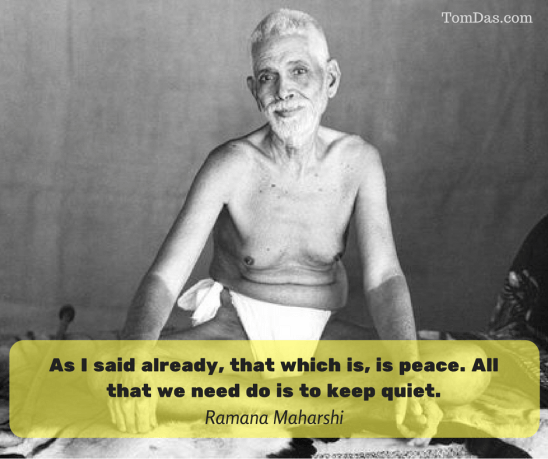
ramana all that we need do is to keep quiet

The following dialogue is taken from Talks with Sri Ramana Maharshi, Talk number 265, my additions are in red:

Questioner: There are said to be sadeha mukta (liberated in body) and videha mukta (liberated without body).

Sri Ramana Maharshi: There is no liberation, and where are muktas [the liberated ones]?

Questioner: Do not Hindu sastras [scriptures] speak of mukti [liberation]?

Sri Ramana Maharshi: Mukti is synonymous with the Self. Jivan mukti (liberation while alive) and videha mukti (liberation after the body falls) are all for the ignorant. The Jnani  [liberated one] is not conscious of mukti or bandha (bondage).

Bondage, liberation and orders of mukti are all said for an ajnani [ignorant or unliberated one] in order that ignorance might be shaken off.

There is only mukti and nothing else.


The following is the taken from Vichara Shangraham, a text attributed to Sri Ramana Maharshi. Vichara Sangraham is often translated simply as ‘Self Enquiry’ and literally means ‘A compendium of (Self) Enquiry’. This excerpt is very the last section of the text:

Question: What are the characteristics of the jivan-mukta (the liberated in life) and the videha-mukta (the liberated at death)?

Sri Ramana Maharshi: ‘I am not the body; I am Brahman which is manifest as the Self. In me who am the plenary [absolute] Reality, the world consisting of bodies etc, are mere appearance, like the blue of the sky’. He who has realized the truth thus is a jivan-mukta.

Yet so long as his mind has not been resolved, there may arise some misery for him because of relation to objects on account of prarabdha (karma which has begun to fructify and whose result is the present body) [ie. due to destiny], and as the movement of mind has not ceased there will not be also the experience of bliss.

The experience of Self is possible only for the mind that has become subtle and unmoving as a result of prolonged meditation. He who is thus endowed with a mind that has become subtle, and who has the experience of the Self is called a jivan-mukta. It is the state of jivan-mukti that is referred to as the attributeless Brahman and as the Turiya.

When even the subtle mind gets resolved, and experience of self ceases, and when one is immersed in the ocean of bliss and has become one with it without any differentiated existence, one is called a videha-mukta. It is the state of videha-mukti that is referred to as the transcendent attributeless Brahman and as the transcendent Turiya. This is the final goal.

Because of the grades in misery and happiness, the released ones, the jivan-muktas and videha- muktas, may be spoken of as belonging to four categories — Brahmavid, vara, variyan and varishtha. But these distinctions are from the standpoint of the others who look at them; in reality, however, there are no distinctions in release [liberation] gained through jnana [self-knowledge].

My Love. Faith & Jnana.

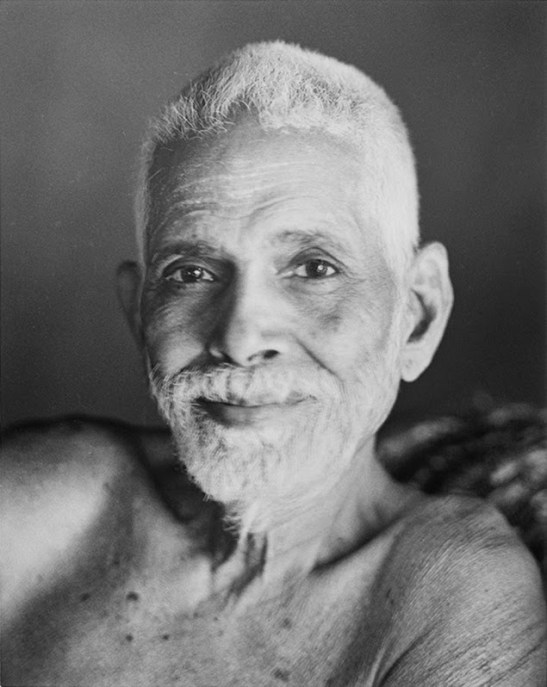
ramana-maharshi face
Sri Ramana Maharshi

Perfection of Faith in God/Guru/Self is the same as Jnana (spiritual ‘knowledge’ or ‘enlightenment’).

You could say that one leads to another – faith and surrender leads to knowledge, or knowledge leads to surrender and faith – and these are both true on one level, but ultimately they are one and the same – where is the difference apart from on the conceptual level?

For me Faith in the Guru, my Beloved, Bhagavan Sri Ramana Maharshi, overcame me quite spontaneously, without my asking, and clinging to Him and Faith in his Word and dwelling in His Presence became the Way and the Law and my Self.

For me, whilst I like to learn a bit about Ramana’s life and I enjoy reading his teachings, gazing at His Image and feeling His Presence has often been more powerful than all the written teachings and all my efforts put together.

Someone recently approached me at the end of one of my Satsangs/meetings and asked me which book would I recommend as being the best one to understand Ramana’s teachings. I told him that Talks with Sri Ramana Maharshi and Be As You Are are two wonderful books, but when you open the book, the most important page is the one which has a photograph of Ramana on it (most of Ramana’s books contain a photograph of him in the first few pages).

Instead of reading all the teachings and trying to figure it all out, just look at His Image, feel His Presence!

We can read and listen to the teachings as much as we like, but I have found there is power in something else, something intangible – the Guru’s grace, the eyes of the Guru, His Divine Grace…

So, cling to the Guru, cling to His Teachings. For me, that means Sri Ramana Maharshi. If it suits you, if you are drawn to Him, Ramana, take Him up as your Guru. Look at His Image, give yourself to Him, if it feels right for you. Of if you have another Guru/God you are drawn to, do the same with him/her. Or if you cannot relate to a Guru or God, try relating to Life or the Universe or Universal Energy or something similar. See what happens and feel free to let me know too!

Ramana said that life often brings us to have faith in God, then God brings us a Guru, and the Guru then directs us back to our Self and we realise all is One. Of course, we do not really realise, rather the ‘we’ or the ‘me’ that is seeking Union disappears or ‘merges into Him’. There was only ever Him/Self/Guru/God/Oneness…use any word that suits you.

Ramana also said that if we are lucky enough to be blessed with faith in something, that is a blessing to us and we should seize that faith and lean on it with loving devotion, and not to allow it to wither away.

So I encourage you to look at His Image, surrender to Him, and let me know how it goes!

‘Perfection of Faith in God/Guru/Self is the same as Jnana’

With love and best wishes

Tom

🙏🙏🙏

Ramana Maharshi on those who claim to have surpassed the traditional notion of enlightenment

Last month I wrote a post titled Q. Some teachers (eg. Bentinho Massaro, Anadi, Adi Da Samraj) claim to have surpassed the traditional notion of enlightenment and say co-creation is the next evolutionary step…any thoughts?.

There have always been spiritual teachers who claim to have gone beyond the traditional notions of enlightenment and who claim that they have had a special enlightenment that is somehow unique to them. Often their teachings, in my view, leave much to be desired and wreak of egotism, and those seekers who know what to look for sense this fairly quickly. Their teachings often rehash a mixture of traditional and non-traditional methods, which is fine in itself as far as I am concerned, but then they mix in a good helping of old fashioned ego and narcissism: ‘I am the best, follow me’. The teachings are often presented in a more glamorous way which is ultimately less effective at best and very damaging at worst.

It may interest you to know that Ramana Maharshi was also asked about these types of teachers who claim something more that ‘traditional realisation’ and something special for themselves, and in this post I will give you an example of what Ramana said in response to this.

The following excerpt is from Talks with Sri Ramana Maharshi, Talk 201, and Ramana is initially asked about Sri Aurobindo who apparently stated that Self-Realisation was only the beginning of the journey and not the end:


They further asked for Maharshi’s opinion of Sri Aurobindo’s Yoga, and his claim to have probed beyond the experiences of the Vedic rishis and the Mother’s opinion of the fitness of her disciples to begin with the realisation of the Upanishadic rishis.

Tom’s comment: ‘The Mother’ or Mirra Alfassa was a westerner from Paris who taught alongside Sri Aurobindo and set up Sri Aurobindo’s Ashram

M.: Aurobindo advises complete surrender. Let us do that first and await results, and discuss further, if need be afterwards and not now. There is no use discussing transcendental experiences by those whose limitations are not divested. Learn what surrender is. It is to merge in the source of the ego. The ego is surrendered to the Self. Everything is dear to us because of love of the Self.

Tom’s comments: you can see how Ramana Maharshi’s first response is not to criticise another teacher or teaching but to find some common ground and focus upon this. This would presumably be of most benefit for the seeker, which is Ramana’s primary concern, rather than engaging in some intellectual debate or trying to prove his teaching style to be superior

The Self is that to which we surrender our ego and let the Supreme Power, i.e., the Self, do what it pleases. The ego is already the Self’s. We have no rights over the ego, even as it is. However, supposing we had, we must surrender them.

D.: What about bringing down divine consciousness from above?

Tom’s comments: this presumably was another of Sri Aurobindo’s teachings, namely that divine consciousness should descend onto us from above. Here Ramana responds by quoting various scriptures:

M.: As if the same is not already in the Heart? “O Arjuna, I am in the expanse of the Heart,” says Sri Krishna “He who is in the sun, is also in this man”, says a mantra in the Upanishads. “The Kingdom of God is within”, says the Bible. All are thus agreed that God is within. What is to be brought down? From where? Who is to bring what, and why?

Realisation is only the removal of obstacles to the recognition of the eternal, immanent Reality. Reality is. It need not be taken from place to place.

D.: What about Aurobindo’s claim to start from Self-Realisation and develop further?

M.: Let us first realise and then see.

Tom’s comments: Again, Ramana’s instinct is to sidestep any intellectual argument and instead encourage the seeking in practical terms. Ramana now considers other theories on enlightenment and liberation, and again gives a practical response:

Then Maharshi began to speak of similar theories: The Visishtadvaitins say that the Self is first realised and the realised individual soul is surrendered to the universal soul. Only then is it complete. The part is given up to the whole. That is liberation and sayujya union. Simple Self-Realisation stops at isolating the pure Self, says Visishtadvaita.

The siddhas say that the one who leaves his body behind as a corpse cannot attain mukti [liberation]. They are reborn. Only those whose bodies dissolve in space, in light or away from sight, attain liberation. The Advaitins of Sankara’s school stop short at Self-Realisation and this is not the end, the siddhas say.

There are also others who extol their own pet theories as the best, e.g., late Venkaswami Rao of Kumbakonam, Brahmananda Yogi of Cuddappah, etc.

The fact is: There is Reality. It is not affected by any discussions. Let us abide as Reality and not engage in futile discussions as to its nature, etc.

The fact is: There is Reality.

It is not affected by any discussions.

Let us abide as Reality and not engage in futile discussions as to its nature, etc.

ramana umbrella


Q: During deep meditation peace is there all the time. But otherwise it comes and goes…I want to have the direct experience of the peace that never comes and goes | Annamalai Swami


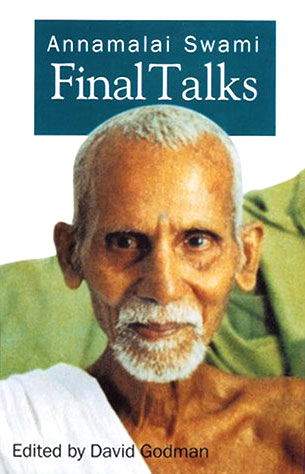
annamalai swami final talks

Question: During deep meditation peace is there all the time. But there is still a feeling that peace is something that can come and go. I know that this is just an idea, but I want to eliminate this idea and have the direct experience of the peace that never comes and goes.

Bhagavan says, ‘You are always the Self. It is just your notion that you are not the Self that has to be got rid of.’ How does this happen?

Annamalai Swami: The Self is peace and happiness. Realizing peace and happiness within you is the true realization of the Self. You cannot distinguish between peace, happiness and the Self. They are not separate aspects. You have this idea that peace and happiness is within you, so you make some effort to find it there, but at the moment it is still only an idea for you.

The Self is peace and happiness...You cannot distinguish between peace, happiness and the Self.

So, ask yourself, ‘To whom does this idea come? Who has this idea?’

You must pursue this line if you want to have the idea replaced by the experience. Peace is not an idea, nor is it something that comes and goes. We are always That. So, remain as That. You have no birth and no death, no bondage and no freedom. It is perpetual peace, and it is free from all ideas.

The ‘I am the body” idea is what is concealing it. This is what has to go.

The ‘I am the body” idea is what is concealing it. This is what has to go.

Question: So the notion of being the body and the mind comes back and covers the experience?

Annamalai Swami: Yes, yes. This idea, ‘I am the body’ is not there during sleep. Everyone enjoys sleeping, and the reason we enjoy it is because there are no thoughts there. It is the thoughts that arise that cause us all our trouble. There is no separate entity during sleep because no thought has arisen to create the image of one.

When waking comes, this first rising thought, ‘I am the body,’ brings separation, doubts, and confusion. If you can be without it in the waking state there will be the knowledge, ‘I am Ramana, I am Arunachala. Everything is myself.’

…this first rising thought, ‘I am the body,’ brings separation, doubts, and confusion. If you can be without it in the waking state there will be the knowledge…

Rama, Krishna, etc., are all you. It is just this limiting ‘I am the body’ thought that keeps this knowledge, this awareness from you.

In the waking state, the jnani has no limiting thoughts, no ego that identifies with a name and a form. His state is crystal clear. Ramana Bhagavan had no ego, no limiting thoughts, which is why he knew himself to be this peace, this happiness.

Ramana Bhagavan had no ego, no limiting thoughts, which is why he knew himself to be this peace, this happiness

The above excerpt is taken from Annamalai Swami Final Talks, Chapter 14

Shankara & Ramana Maharshi: First Know Thyself, then Be Still

Shankara bondage is a mirage

In the traditional path of Knowledge or Jnana, first we are to know our True Self (Atman) and know this to be the same as the Absolute (Brahman). Then we are to be still and renounce all desires.

This spiritual knowledge (Jnana) of ‘I am Brahman’ (Aham Brahmasmi) allows the mind to become still and desireless. Note this does not mean that the body becomes totally inert – no – rather it continues to function naturally according to its destiny (Prarabdha Karma) until the body dies.

Shankara states this multiple times, eg, in Vivekachudamani, and also in his many commentaries, eg. in his commentary upon the Kena Upanishad – in his introduction to the Kena Upanishad Shankara writes:

And [the Self] being eternal, it is not to be secured by any means other than the cessation of ignorance. Hence the only duty is to renounce all desires after the realisation of the unity of the indwelling Self and Brahman.

This is akin to Self-Surrender, as spoken by Sri Ramana Maharshi:

There is no destiny. Surrender, and all will be well. Throw all the responsibility on God. Do not bear the burden yourself. What can destiny do to you then?”
(Talks 244)

and again here:

Question: Surrender is said to be Bhakti [the path of devotional love]. But Sri Bhagavan [Ramana Maharshi] is known to favour enquiry [ie. the path of Knowledge or Jnana] for the Self. There is thus confusion in the hearer.
Ramana Maharshi: Surrender can take effect only when done with full knowledge. Such knowledge comes after enquiry. It ends in surrender.
(Talks 462)
This above post was an excerpt from The ‘ultimate means’ to liberation

Annamalai Swami – How to abide as the Self and perform Self-Inquiry (Atma Vichara)

annamalai swami final talks

Annamalai Swami spent nearly 10 years of his life attending to Bhagavan Sri Ramana Maharshi, listening to Ramana’s teachings and bathing in Ramana’s Silent Presence. He himself attained self-realisation and we in turn are blessed to receive these teachings from him.

I present these excepts for the benefit of all who are earnestly seeking and highly recommend you buy this text to support the editor who enabled these teachings to be shared with us all.

Annamalai Swami Ch 18 1Annamalai Swami Ch 18 2Annamalai Swami Ch 18 3Annamalai Swami Ch 18 4Annamalai Swami Ch 18 5Annamalai Swami Ch 18 6Annamalai Swami Ch 18 7Annamalai Swami Ch 18 8

Devotional Love – The Sure Path of Bhakti Yoga

Ramana Maharshi downward gaze

In Guru Vachaka Kovai, Bhagavan Sri Ramana Maharshi tells us:

734. Those who have one-pointed devotion towards God, like the magnetic needle [of a ship’s compass] which always stands facing towards the north, will never be perplexed and go astray in the ocean of attachment of this world.

735. Those who live in the world, clinging whole-heartedly to God, are like children who whirl round and round a pillar holding it firmly. Since they have a strong and unshakeable hold on God, they are devoid of ego [anava] and therefore will never fall a prey to the delusion of the world.

736. If one fixes one’s mind firmly on that pure Supreme Reality which pervades all activities, one will not be affected by any number of activities that are done.

Jnana vs Bhakti (The path of Knowledge vs Devotional Love)

Ramana Maharshi downward gaze

Bhagavan Sri Ramana Maharshi states in Guru Vachaka Kovai:

722. On scrutiny, supreme devotion [parabhakti] and Jnana are in nature one and the same. To say that one of these two is a means to the other is due to not knowing the nature of either of them.

731. Know that the path of Jnana and the path of Bhakti are inter-related. Follow these inseparable two paths without dividing one from the other.

B13. Attending to Self is devotion to the supreme Lord, because the Lord exists as Self.

What is the relationship between Desire and Realisation?

ramana escape the tricks of maya

Bhagavan Sri Ramana Maharshi states in his text ‘Who am I?’:

Question 26. What is the relation between desirelessness (nirasa) and wisdom (jnana)?
Sri Ramana Maharshi: Desirelessness is wisdom. The two are not different; they are the same. Desirelessness is refraining from turning the mind towards any object. Wisdom means the appearance of no object. In other words, not seeking what is other than the Self is detachment or desirelessness; not leaving the Self is wisdom.

The above was taken from the question and answer version of ‘Who am I?’. Note that the Sanskrit word Jnana, literally meaning knowledge or wisdom, is a synonym for Self-Realisation when used in spiritual texts. In the alternate essay version of ‘Who am I?’, which is the version Ramana wrote himself, the same essential teachings are given but phrased slightly differently. Here is this particular teaching from the essay version:

Not attending to what-is-other (anya, that is, to any second or third person object) is non-attachment (vairagya) or desirelessness (nirasa); not leaving Self is knowledge (jnana). In truth, these two (desirelessness and knowledge) are one and the same.

In Talks with Sri Ramana Maharshi, talk number 502, Ramana states the following:

There is room for kama (desire) so long as there is an object apart from the subject (i.e., duality). There can be no desire if there is no object. The state of no-desire is moksha.

In Guru Vachaka Kovai, verse 149, Ramana States:

149. The non-dual experience will only be attained by those who have completely given up desires. For those with desires, it is far, far away. Hence it is proper for those with desires to direct their desires towards God, who is desireless, so that through desire for God the desires that arise through the delusion that objects exist and are different from oneself will become extinct.

In verses 378-9 Ramana states:

378. Except for the one who has completely cut the tie of desires, the false appearance [that he is a suffering jiva] will not cease. Therefore, without any hesitation, one should cut even the desire for the great Divine Happiness.
379. O foolish mind who is suffering due to the desire for the petty pleasures of this world and of the next, if you remain quiet [i.e. without desire] you will certainly attain that State of Bliss which surely transcends the pleasures of these two.

As always, Ramana’s teachings are in line with the traditional Vedanta texts such as the writing of Shankara and the Upanishads. I have written some other posts that demonstrate this point, see below:

DESIRE, DISPASSION & LIBERATION with quotes from The Upanishads

Shankara: How to Meditate for Self-Realisation| Vivekachuhdamani

Does stillness of mind lead to liberation?