advaita
Manonasa – what is it? And doesn’t ‘destruction of the mind’ sound dangerous and unhealthy?
What is manonasa?
In the traditional scriptures, Manonasa, literally meaning desctruction of the mind, is a synonym for liberation of self-realisation.
Doesn’t ‘extinction of the mind’ sound dangerous?
Deep sleep is Brahman – the three states according to the Birhadaranyaka Upanishad with commentary by Shankara

Please see the end of the article for a summary of the main points or jump ahead to verses 4.31 and 4.32 for the part where the Brihadaranyaka Upanishad equates Deep Sleep with Brahman.
Also see:
Deep Sleep and Self-Realisation
Ramana Maharshi: the method of wakeful sleep (Jagrat Sushupti) to attain liberation
(I’ve just typed this up quite quickly so, as usual, apologies for any spelling or grammatical mistakes)
The teaching of the three states (ie. the waking, dream and deep sleep states) is a staple Vedanta teaching and often the source for this teaching is cited as being the Mandukya Upanishad. However, the three states are presented and analysed in the earlier-written Brihadaranyaka Upanishad, especially in section 4.3.
Dry Upanishadic Humour
Section 3 of the Brihadarankaya Upanishad consists of a conversation between King Janaka and the Sage Yajnavalkya. Now for those of you who have not encountered Sage Yajnavalkya, he is quite a character at times, demonstrating the dry humour present in many of the Upanishads. Here is an example from Section 3.1 of the Brihadaranyaka Upanishad:
3.1.1: Om. Janaka, Emperor of Videha, performed a sacrifice in which gifts were freely distributed among the priests. Brahmin scholars from the countries of Kuru and Panchala were assembled there. Emperor Tanaka of Videha wished to know which of these brahmins was the most erudite Vedic scholar. So he confined a thousand cows in a pen and fastened on the horns of each ten padas of gold.
3.1.2: He said to them: “Venerable brahmins, let him among you who is the best Vedic scholar drive these cows home.” None of the brahmins dared. Then Yajnavalkya said to one of his pupils: “Dear Samsrava, drive these cows home.” He drove them away. The brahmins were furious and said: “How does he dare to call himself the best Vedic scholar among us?” Now among them there was Asvala, the hotri priest of Emperor Janaka of Videha. He asked Yajnavalkya: “Are you indeed the best Vedic scholar among us, O Yajnavalkya?” He replied: “I bow to the best Vedic scholar, but I just wish to have these cows.” Thereupon the Hotri Asvala determined to question him.
Here we have a scenario in which King Janaka effectively sets up a challenge to see who the best Vedic Scholar is, with the prize being one thousand cows. However before the challenge has even begun, Sage Yajnavalkya simply asks one of his students to take the cows. When challenged by the other scholars to see if he is really the most knowledgeable in the Vedas, Yajnavalkya dryly replies that irrespective of who the best scholar is, he just wants the cows! For me this demonstrates the humour, irony and rebellious spirit that is present throughout many of the Upanishads, but this humourous aspect of the teaching is often missed when the approach becomes overly intellectual and analytical.
The Guru wants to get paid!
Anyway, back to the three states and section 4 of the Brihadaranyaka Upanishad. In section 4.3 Yajnavalkya goes to King Janaka with the intent of not speaking, but because he had previously made a promise to King Janaka that he will answer any questions King Janaka asks, we obtain the dialogue of section 4.3 which pertains to the three states. In Shankara’s commentary on these verses he explains that the real reason Yajnavalkya visits King Janaka is to gain more wealth and cattle from the King, and throughout the following dialogue King Janaka keeps on gifting increasing numbers of cattle to Sage Yajnavalkya.
4.3.1 Yajnavalkya called on Janaka, Emperor of Videha. He said to himself: “I will not say anything.” But once upon a time Janaka, Emperor of Videha and Yajnavalkya had had a talk about the Agnihotra sacrifice and Yajnavalkya had offered him a boon. Janaka had chosen the right to ask him any questions he wished and Yajnavalkya had granted him the boon. So it was the Emperor who first questioned him.
Shankara’s commentary on the above verse reads as follows:
‘Yajnavalkya went to Janaka, Emperor of Videha. While going, he thought he would not say anything to the Emperor. The object of the visit was to get more wealth and maintain that already possessed….’
Note how this is contrary to how many nowadays state that a true teacher would not accept money or material objects for their teaching. In this, the oldest, longest and perhaps the most authoritative of Upanishads, we have the reverse situation! Again, such is the often dry humour of the Upanishads!
No immediate answers…
In the next verses, verses 4.3.2 to 4.3.6 Yajnavalkya reveals that the Self is the Ultimate Reality upon which all stands. You can see that Yajnavalkya does not give the ultimate answer straight away, but only when pressed by King Janaka does he eventually reveal the Self as the true answer he is looking for. My reading of this is that Sage Yajnavalkya only wants to give the teaching to those who are truly intererested, who are truly enquiring, and not to those who merely accept the first answer given to them:
4.3.2. “Yajnavalkya, what serves as light for a man?” “The light of the sun, O Emperor,” said Yajnavalkya, “for with the sun as light he sits, goes out, works and returns.” “Just so, Yajnavalkya.”
4.3.3. “When the sun has set, Yajnavalkya, what serves as light for a man?” “The moon serves as his light, for with the moon as light he sits, goes out, works and returns.” “Just so, Yajnavalkya.”
4.3.4. “When the sun has set and the moon has set, Yajnavalkya, what serves as light for a man?” “Fire serves as his light, for with fire as light he sits, goes out, works and returns.” “Just so, Yajnavalkya.”
4.3.5. “When the sun has set, Yajnavalkya and the moon has set and the fire has gone out, what serves as light for a man?” “Speech (sound) serves as his light, for with speech as light he sits, goes out, works and returns. Therefore, Your Majesty, when one cannot see even one’s own hand, yet when a sound is uttered, one can go there.” “Just so, Yajnavalkya.”
4.3.6. “When the sun has set, Yajnavalkya and the moon has set and the fire has gone out and speech has stopped, what serves as light for a man?” “The self, indeed, is his light, for with the self as light he sits, goes out, works and returns.”
4.3.7 “What is this Self”….
The three states…
…waking and dream
In the next few verses Yajnavalkya teachings that the Self floats between two states, the dream state and waking state, but remains unaffected by theses states, returning to the state of deep sleep when not in dream or waking. All this time Yajnavalkya receives more and more cattle from King Janaka for his teachings! Here is a description of the dream state by Yajnavalkya, in which he explains the dream is a mere unreal projection:
4.3.9 and 4.3.10 ….”And when he dreams, he takes away a little of the impressions of this all-embracing world (the waking state), himself makes the body unconscious and creates a dream body in its place, revealing his own brightness by his own light-and he dreams. In this state the person becomes self-illumined. There are no real chariots in that state, nor animals to be yoked to them, nor roads there, but he creates the chariots, animals and roads. There are no pleasures in that state, no joys, no rejoicings, but he creates the pleasures, joys and rejoicings. There are no pools in that state, no reservoirs, no rivers, but he creates the pools, reservoirs and rivers. He indeed is the agent.
Similarly in verse 13:
4.3.13. ‘In the dream world, the luminous one attains higher and lower states and creates many forms – now, as it were, enjoying himself in the company of women, now laughing, now even beholding frightful sights.
Next Yajnavalkya describes how the Self, referred here by the term Purusha, which literally means ‘supreme being’ or ‘supreme person’ (think ‘higher-self’), floats between two states, the dream state and waking state, but remains unaffected by theses states, returning to the state of deep sleep when not in dream or waking. He receives cattle for his teachings here:
15. Yajnavalkya said: “The entity (purusha), after enjoying himself and raoming in the dream state and merely witnessing the results of good and evil, remains in a state of profound sleep and then hastens back in the reverse way to his former condition, the dream state. He remains unaffected by whatever he sees in that dream state, for this infinite being is unattached.” Janaka said: “Just so, Yajnavalkya. I give you, Sir, a thousand cows. Please instruct me further about Liberation itself.
16. “Yajnavalkya said: “That entity (purusha), after enjoying himself and roaming in the dream state and merely witnessing the results of good and evil, hastens back in the reverse way to his former condition, the waking state. He remains unaffected by whatever he sees in that state, for this infinite being is unattached.” Janaka said: “Just so, Yajnavalkya. I give you, Sir, a thousand cows. Please instruct me further about Liberation itself.”
…and deep sleep
17. Yajnavalkya said: “That entity (purusha), after enjoying himself and roaming in the waking state and merely witnessing the results of good and evil, hastens back in the reverse way to its former condition, the dream state or that of dreamless sleep.
18. “As a large fish swims alternately to both banks of a river – the east and the west – so does the infinite being move to both these states: dreaming and waking.
19. “As a hawk or a falcon roaming in the sky becomes tired, folds its wings and makes for its nest, so does this infinite entity (purusha) hasten for this state, where, falling asleep, he cherishes no more desires and dreams no more dreams.
The Self…
…no objects present in the Self
So we can see in the above verses Yajnavalkya has described the three states and how the Self remains unaffected by the two states of waking or dreaming. Now Yajnavalkya proceeds to teach more about the Self. Using a series of metaphors he explains how no objects are present in the Self. Initially he compares it to the ecstacy of sexual orgasm in which one loses all knowledge of the body mind and world, one loses all sense of fear and misery, and one feels completely and totally fulfilled, not desiring anything more and with no trace of suffering:
21. “That indeed is his form-free from desires, free from evils, free from fear. As a man fully embraced by his beloved wife knows nothing that is without, nothing that is within, so does this infinite being (the self), when fully embraced by the Supreme Self, know nothing that is without, nothing that is within. That indeed is his form, in which all his desires are fulfilled, in which all desires become the self and which is free from desires and devoid of grief.”
Yajnavalkya then goes on to say that with realisation of the Self, everything is no longer what it appeared to be, and the Self is untouched by karma – good deeds and bad deeds – and also untouched by any suffering:
22. “In this state a father is no father, a mother is no mother, the worlds are no worlds, the gods are no gods, the Vedas are no the Vedas. In this state a thief is no thief, the killer of a noble brahmin is no killer, a chandala is no chandala, a paulkasa is no paulkasa, a monk is no monk, an ascetic is no ascetic. This form of his is untouched by good deeds and untouched by evil deeds, for he is then beyond all the woes of his heart.”
He then states that even in deep sleep the Self exists as pure consciousness, not conscious of any object, for there are no objects in deep sleep, but conscious somehow nonetheless, for its nature is imperishable eternal consciousness:
23. “And when it appears that in deep sleep it does not see, yet it is seeing though it does not see; for there is no cessation of the vision of the seer, because the seer is imperishable. There is then, however, no second thing separate from the seer that it could see.
The above verse is essentially repeated for all the senses and mind, but then culminates at verses 31 and 32. I have here included the full sanskrit and Shankara’s commentary for these important verses. The verses state that when objective phenomena appear, ie. in the dream or waking states, it appears as if we can see something separate from us or perceive something separate from us. This apparent perception is due to ignorance or illusion. However, when we return to deep sleep, that is the Self:
Verse 4.3.31:
यत्र वा अन्यदिव स्यात्, तत्रान्योऽन्यत्पश्येत्, अन्योऽन्यज्जिघ्रेत्, अन्योऽन्यद्रसयेत्, अन्योऽन्यद्वदेत्, अन्योऽन्यच्छृणुयात्, अन्योऽन्यन्मन्वीत, अन्योऽन्यत्स्पृशेत्, अन्योऽन्यद्विजानीयात् ॥ ३१ ॥
yatra vā anyadiva syāt, tatrānyo’nyatpaśyet, anyo’nyajjighret, anyo’nyadrasayet, anyo’nyadvadet, anyo’nyacchṛṇuyāt, anyo’nyanmanvīta, anyo’nyatspṛśet, anyo’nyadvijānīyāt || 31 “||
31. In the waking and dream states, when there is something else, as it were, then one can see something, one can smell some-thing, one can taste something, one can speak something, one can hear something, one can think something, one can touch something, or one can know something.
Shankara’s commentary on 4.3.31:
It has been said that in the state of profound sleep there is not, as in the waking and dream states, that second thing [ie. objects] differentiated from the self which it can know; hence it knows no particulars [ie. objects] in profound sleep. Here it is objected: If this is its nature, why does it give up that nature and have particular knowledge [of objects]? If, on the other hand, it is its nature to have this kind of knowledge, why does it not know particulars [ie. objects] in the state of profound sleep? The answer is this: When, in the waking or dream state, there is something else besides the self, as it were, presented by ignorance, then one, thinking of oneself as different from that something—although there is nothing different from the self, nor is there any self different from it—can see something. This has been shown by a referrence to one’s experience in the dream state in the passage, ‘As if he were being killed, or overpowered’(IV. iii. 20). Similarly one can smell, taste, speak, hear, think, touch and know something.
Verse 4.3.32:
सलिल एको द्रष्टाद्वैतो भवति, एष ब्रह्मलोकः सम्राडिति हैनमनुशशास याज्ञवल्क्यः, एषास्य परमा गतिः, एषास्य परमा संपत्, एषोऽस्य परमो लोकः, एषोऽस्य परम आनन्दः; एतस्यैवानन्दस्यान्यानि भूतानि मात्रामुपजीवन्ति ॥ ३२ ॥
salila eko draṣṭādvaito bhavati, eṣa brahmalokaḥ samrāḍiti hainamanuśaśāsa yājñavalkyaḥ, eṣāsya paramā gatiḥ, eṣāsya paramā saṃpat, eṣo’sya paramo lokaḥ, eṣo’sya parama ānandaḥ; etasyaivānandasyānyāni bhūtāni mātrāmupajīvanti || 32 ||
32. In the deep sleep state, it becomes (transparent) like water, one, the witness, and without a second. This is the world (state) of Brahman, O Emperor. Thus did Yājñavalkya instruct Janaka: This is its supreme attainment, this is its supreme glory, this is its highest world, this is its supreme bliss. On a particle of this very bliss other beings live.
Shankara’s commentary on 4.3.32:
When, however, that ignorance which presents things other than the self is at rest, in that state of profound sleep, there being nothing separated from the self by ignorance, what should one see, smell, or know, and through what? Therefore, being fully embraced by his own self-luminous Supreme Self, the Jīva becomes infinite, perfectly serene, with all his objects of desire attained, and the self the only object of his desire, transparent like water, one, because there is no second: It is ignorance which separates a second entity, and that is at rest in the state of profound sleep; hence ‘one.’ The witness, because the vision that is identical with the light of the self is never lost. And without a second, for there is no second entity different from the self to be seen. This is immortal and fearless. This is the world of Brahman, the world that is Brahman: In deep sleep the self, bereft of its limiting adjuncts, the body and organs, remains in its own supreme light of the Ātman [the Self], free from all relations, O Emperor. Thus did Yājñavalkya instruct Janaka. This is spoken by the Śruti.
How did he instruct him? This is its supreme attainment, the attainment of the individual self.
The other attainments, characterised by the taking of a body, from the state of Hiraṇyagarbha down to that of a clump of grass, are created by ignorance [Tom: ie. all objects of the universe are creations of Ignorance; we can see Shankara is equating ignorance with Maya here, as Maya is traditionally said to be the cause of the phenomenal universe] and therefore inferior to this, being within the sphere of ignorance. But this identification with all, in which one sees nothing else, hears nothing else, knows nothing olse, is the highest of all attainments such‘as identity with the gods, that are achieved through meditation and rites. This too is its supreme glory, the highest of all its splendours, being natural to it; other glories are artificial. Likewise this is its highest world; the other worlds, which are the result of its past work, are inferior to it; this, however, is not attainable by any action, being natural; hence ‘this is its highest world.’ Similarly this is its supreme bliss, in comparison with the bther joys that are due to the contact of the organs with their objects, since it is eternal; for another Śruti says, ‘That which is infinite is bliss’ (Ch. VII. xxiii. 1). ‘That in which one sees something. . . . knows something, is puny,’ mortal, secondary joy. But this is the opposite of that hence ‘this is its supreme bliss.’ On a particle of this very bliss, put forward by ignorance, and perceived only during the contact of the organs with their objects, other beings live. Who are they? Those that have been separated from that bliss by ignorance, and are considered different from Brahman. Being thus different, they subsist on a fraction of that bliss which is perceived through the contact of the organs with their objects.
Tom’s concluding remarks:
We can see that in the above two verses Shankara and Yajnavalkya are stating that:
–The Self cannot be attain by various karmas or works, for these are relating to objective phenomena only which occur only in the dream and waking states. ie. works or practices can only occur in the waking or dream states.
-However, the Self already is, it is already our True Actual Nature, naturally unattached and unaffected by it all, naturally beyond desire and suffering, its nature being happiness or bliss and oneness in which there is no sense of other.
– In deep sleep, when there are no adjuncts, ie. no objective phenomena such as body, world or mind, then there is only the Self. Shankara states ‘this is spoken by shruti’, shruti referring to the revealed scriptures that are the vedas and upanishads, meaning that this teaching comes from the highest authority.
This same teaching is given by Sri Ramana Maharshi here. Note that it is only from the point of view of ignorance (in the waking state) that deep sleep is considered to be a third state (and not the Pure Self) and it is inferred (ignorantly in the waking state) that a seed of ignorance remains in this deep sleep state in order to account for the ‘fact’ that we are not liberated through sleep.
– All else, ie. all objective phenomena, are created and presented to us by ignorance (ie. ignorance and maya are one), and so we are separated from the Bliss of Brahman by our seeing of objects ‘outside of us’.
The Upanishad tells us Thus did Yājñavalkya instruct Janaka
Note that a clear and direct method for realisation is not given in this section of the Upanishad, although it is hinted at. For more on this see here which is where the instruction on the method on how to attain liberation is given in the Brihadaranyaka Upanishad by our friend, Sage Yajnavalkya.
Note that this above section of the Brihadaranyaka Upanishad also tallies with and is indirectly explained further by Sri Ramana Maharshi’s method of wakeful-sleep, a wonderful and simple explanation of the path to liberation.
Also see:
Let me discover what I am and BE DONE WITH THIS
Your faith will lead you to REALISATION
The evolution of Tony Parsons 2 – Was Tony reading Sri Nisargadatta Maharaj? | Neo-Advaita | Radical Non-duality| Traditional Advaita Vedanta
‘I am that. I am the source of all that is, and so are you’
Tony Parsons, from Invitation to Awaken, page 117.
Generally speaking I do not comment much on other teachers as everyone has their own path and different teachings can be helpful at different times (apparently!). If you have found a teaching or communication useful, who am I to say otherwise? I am not interested in trying to take you away from something you resonate with, enjoy or agree with – quite the contrary in fact. However occasionally I find myself writing posts such as these in order to shine some light and clarity on aspects of certain teachings (or ‘non-teachings’!) and give my view for those who are interested.
Last year I wrote a post called ‘The evolution of Tony Parsons’ in which I noted how Tony’s expression has changed over time, becoming more and more radical or ‘neo-advaitic’ and less traditional as the years have progressed. Conversely, in previous years gone by his expression was much more in line with the traditional type teachings that he now states are dualistic, confusing and misleading. I also noted how in my view some important absences in the teaching limit its effectiveness, and how the evolution of his teaching is actually in line with the teaching methodology of traditional Advaita.
Nowadays all references to ‘I am That’ or ‘awaken to your true nature’ and references to awareness are all dismissed as being incorrect, ‘dualistic’ and ‘for the me’ by Tony Parsons, but several years ago he was speaking in this very way that he now says is dualistic.
Since writing ‘The Evolution of Tony Parsons’, I was encouraged to read another another book of Tony Parsons published in 2004, which is no longer on sale, called ‘Invitation to Awaken’. As his first book ‘The Open Secret’ was published in 1995, this represents at least the first 9 years of him sharing these teachings. I obtained a copy about six months ago but for some reason today I was moved to actually pick it up, take a look at it, and write this post. Having flicked through it, I can only presume that it is no longer on sale as it contains teachings which now Tony Parsons says are dualistic and inaccurate. In fact I would guess that most of the following quotes would now likely be thought of as being incorrect and dualistic by those who advocate radical non-duality (or neo-advaita) style communications.
The subheading ‘Embracing Our Natural State of Presence’ is exactly the type of teaching language that is now refuted by so-called radical non-duality, so it is particularly interesting that this was the phrase chosen to be put on to the book cover:
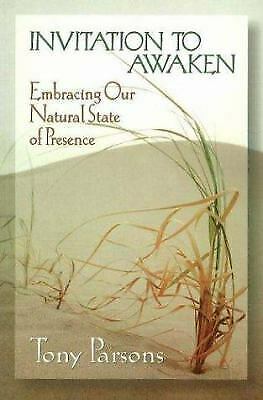
In this book called ‘Invitation to Awaken’, what I would call the savikalpa aspect of the traditional teaching is unfolded by Tony Parsons in a manner very similar to Sri Nisargadatta Maharaj’s teachings. This savikalpa (literally meaning ‘with objects’ or with arising phenomena present) teaching illumines the oneness between all arising phenomena and the space-like consciousness that we are, but by itself rarely leads to permanent end of (apparent) duality and suffering.
Please take the time to watch this video where I explain this important teaching, as it is the nirvikalpa aspect of the teaching that is actually liberating and ends suffering:
However, unlike Nisargadatta Maharaj’s teachings, in Tony’s teachings the nirvikalpa aspect of the Vedanta teaching is notably absent. This nirvikalpa (literally, without objects or arising phenomena) aspect of the teachings, in which one naturally turns away from objective phenomena towards the Subject/Self, is the actual part of the teaching which is liberating.
It is this aspect of the teaching that many never take up, for the ego doesn’t want to go there, and it is this part of the teaching that (for most) leads to liberation. It is this nirvikalpa aspect of the teaching which removes the habitual energetic tendency (vasana) to identify with the body-mind. eg. Nisargadatta Maharaj teaches the method of staying with the ‘I AM’, which leads one to this liberating nirvikalpa aspect of the teaching, but Tony Parsons advocates no such thing – in fact he even detracts from this kind of sadhana/practice, so allowing the ego-mind and duality to remain intact.
Please note that most of the quotes below are probably now refuted by those who have an affinity with radical non-duality, including Tony Parsons himself. Please also note that I have selectively taken quotes to highlight the similarity with more traditional vedanta expositions, at least the savikalpa aspect of the teachings. In the book there are still many neo-advaita style teachings present.
Please also note that I am not trying to criticise any teachings or teachers/speakers but my interest is only to share how these teachings may have evolved into their present form and I hope this article is useful to those seekers who are faced with an abundance of teachings and are trying to find their way through it all.
‘A meeting with Tony Parsons can be an invitation to rediscover your true nature. Reading a book like this may help you recognize your own doubts, hope and questions until they no longer come to the surface’
Quote from back cover of ‘Invitation to Awaken’ by Tony Parsons
‘Totally radical and uncompromising expression of absolute Non-dualism’
The preface to the 2004 book ‘Invitatation to Awaken’ by Tony Parsons states that:
‘this book is a totally radical and uncompromising expression of absolute Non-dualism’.
Tony Parsons also states in the same preface:
‘I am surprised at the number of teachings that are presented or thought of as nondualistic or Advaita teachings when they are anything but. As far as I can see, the radical, clear, and uncompromising expression of absoute nonduaism is still very rarely communicated’
Let us see some of these ‘totally radical and uncompromising expressions’ in this post.
Awareness and Consciousness
When reading this book, there are several phrases that seem reminiscent of the language used in Nisargadatta Maharaj’s book ‘I am That’. Tony here even speaks of the distinction between ‘awareness’ and ‘consciousness’, which is a fairly peculiar distinction made in the specific Advaita Vedanta teaching lineage from which Nisargadatta Maharaj comes from. In fact I have never heard of this kind of distinction made by anyone else in quite this way:
‘Anger, sadness and thoughts can still be present, but they all arise in what I am, which is awareness.’
Tony Parsons, from Invitation to Awaken, page 3
‘Awareness is the source of all. As the matrix of everything, it is completely still, silent and impersonal. It has no relationship with anything; it’s the singularity from which everything emanates. Consciousness for me is the soup, which contains everything that apparently happens, including the sense of separation….Awareness simply is and requires nothing; consciousness can only arise in awareness.’
Tony Parsons, from Invitation to Awaken, page 3
‘…you are That. That is it – simple awareness. Just know this awareness, which is watching the game of consciousness. You have always been That.’
Tony Parsons, from Invitation to Awaken, page 4
‘You are simply awareness, seeing whatever arises. It’s absolutely simple, and it’s absolutely what you are. Just let awareness see what arises. ‘
Tony Parsons, from Invitation to Awaken, page 21
Tony Parsons and Nisargadatta Maharaj
So when I read the above on the first few pages, I thought that this must have been a time during which Tony was reading Nisargadatta Maharaj. The influence of Nisargadatta seems to be fairly strong. But was Tony even aware of Nisargadatta Maharaj? I would find it difficult to believe that this distinction between ‘awareness’ and ‘consciousness’ would arise otherwise, as practically no other teacher uses this terminological difference as far as I am aware. Well, I found my answer on page 37 when Tony mentions Nisargadatta by name:
‘When Nisargadatta said ‘Nothing is happening’, this’s what he meant. Actually, nothing ever happens’
Tony Parsons, from Invitation to Awaken, page 37
Here we have Tony Parsons interpreting Nisargadatta Maharaj! For those familiar with radical non-duality/ neo-advaita as well as more traditional expositions, perhaps there is some humour in this!
Love and wisdom
Nisargadatta famously said in I Am That:
‘Love says ‘I am everything.’ Wisdom says ‘I am nothing.’ Between the two, my life flows.’
Nisargadatta Maharaj, I Am That
Here we have Tony saying something very similar on page 43:
‘Deep wisdom is knowing ‘I am awareness, I am nothing’, but unconditional love is knowing that ‘I am everything’.
Tony Parsons, from Invitation to Awaken, page 43
Later in the book Tony quotes Nisargadatta Maharaj, seemingly approving of this style of expression:
‘In the words of Sri Nisargadatta Maharaj, while absolute wisdom sees that ‘I am nothing’, absolute love sees that ‘I am everything’. Everything is generated from unconditional love’
Tony Parsons, from Invitation to Awaken, page 60
‘Neo-Advaita’
Contrast this with what Tony says nowadays, namely that the notion of awareness is itself dualistic and perpetuates the ego. The following quotes are taken from This Freedom by Tony Parsons, published in 2015:
‘Awareness is the fuel of separation…Awareness is that which helps to construct a subject-object world. It is the accomplice of separation. A subject is aware of an object.’
Tony Parsons, This Freedom, page 48
‘But awareness is a function that needs something apart for it to be aware of.’
Tony Parsons, This Freedom, page 9
‘Awareness simply feeds separation, and a state of detachment can arise and be mistaken for enlightenment.’
Tony Parsons, This Freedom, page 9
‘Consciousness, knowing and awareness are similar apparent functions within wholeness. Awareness is the function through which the apparently contracted energy of a separate identity arises. The function of awareness re-establishes and maintains the illusory sense of a self’
Tony Parsons, This Freedom, page 50
However, previously Tony said something quite different, namely he emphasised the subject, similar to traditional vedanta and Nisargadatta Maharaj’s teachings:
‘Some people teach that awakening is seeing that there is no ‘doer’, that consciousness is all there is. But there’s something that knows that consciousness is all there is. It is the lover, the ultimate, what you are.’
Tony Parsons, from Invitation to Awaken, page 61
I am that
Let us see again how Tony used to talk about non-dualty – all italics are present in the original text:
‘I am that. I am the source of all that is, and so are you’
Tony Parsons, from Invitation to Awaken, page 117.
‘You are That’
Tony Parsons, from Invitation to Awaken, page 111.
‘I don’t need to still my mind because I am stillness itself…I am the stillness, and the mind arises within it’
Tony Parsons, from Invitation to Awaken, page 122.
‘You are absolute awareness, and without absolute awareness nothing can be’
Tony Parsons, from Invitation to Awaken, page 94.
‘[talking about the Buddha] he ultimately gave it up and saw ‘I am That”
Tony Parsons, from Invitation to Awaken, page 96.
‘…the nearest I can get to is is absolute Being. When the state of unconditional love is total, it leads to the fnial realisation ‘I am absolute Being’ or ‘There’s just absolute Being.’
Tony Parsons, from Invitation to Awaken, page 43
‘While your perception of ‘I am That, I am the absolute, I am awareness, I am the light just as everyone else is’ remains constant, in certain circumstances you can still contract back into identification. This means that at times you can still be in relationship…’
Tony Parsons, from Invitation to Awaken, page 49
‘Let’s close our eyes and be open to the possibility that there’s no one there, that there’s simply awareness – silent, still, impersonal awareness – and whatever seem to be happening is arising in that. Just be the watcher…you are the stillness; you are the silence in which everything arises. Embrace that which never moves and is totally still’
Tony Parsons, from Invitation to Awaken, page 53
The ‘I Am’
Another phrase Nisargadatta Maharaj uses is ‘the I Am’. Here in this same book we have Tony using the same phrase:
‘You are the I Am, and so am I’
Tony Parsons, from Invitation to Awaken, page 58
The Subject
These days Tony states there is no subject, the subject being an illusion that perpetuates duality. Here is an example of this:
‘Question: But is there a perception of ‘what is’?
Tony: No, there is just ‘what is’…there is no perceiver that is real’
Tony Parsons, This Freedom, page 49
However previously Tony emphasised the subject – italics in the following quotes are not added by myself but are present in the book. The first quote is presumable referring to Ramesh Balsekar who used to teach the ‘no doer, all is consciousness’ teaching at that time:
‘Some people teach that awakening is seeing that there is no ‘doer’, that consciousness is all there is. But there’s something that knows that consciusness is all there is. It is the lover, the ultimate, what you are.’
Tony Parsons, from Invitation to Awaken, page 61
Here is another example of Tony emphasing the subject, again italics are present in the original text:
‘Question: How does one drop it [the veil], then?
Tony: One doesn’t drop it. It’s dropped by seeing that there is no individual, but only space in which things apparently happen. You get a sense of moving ‘behind’ the person that’s always been at the forefront of things. Just behind that apparent person is the one that knows the person standing there looking at me’
Tony Parsons, from Invitation to Awaken, page 64.
Integration after awakening
Imagine my suprise to hear Tony discussing the need for integration after awakening! Here is what he says:
‘After awakening, people need to integrate what’s happened to them. Very often they rush out and say ‘I’m giving Satsang on Friday’, even though there’s been no integration.’
Tony Parsons, from Invitation to Awaken, page 70
‘Although I experienced great clarity walking across the park, it took some time to integrate the vast seeing that ‘this is all there is’…a lot of people start teaching thinking that they can help others attain what they have, but if they haven’t integrated their awakening, their teachings may create some confusion.’
Tony Parsons, from Invitation to Awaken, page 71
Perhaps it is these kinds of statements which explains why this book is no longer being published?
Is this just linguistics or semantics?
But isn’t this just linguistics? The ‘old Tony’ and the ‘new Tony’ – are they not just saying the same thing using different words? I don’t think so. Our true nature, consciousness, is often traditionally said to know itself, just like Nisargadatta Maharaj’s teachings. Here is a questioner trying to get to this point, taken from the 2015 publication This Freedom, page 51:
Questioner: But surely the no thing that is and isn’t, knows itself?
Tony: It’s doesn’t need to know it is and is not. It is an illusion that consciousness knows consciousness…Where would it go to stand apart and know itself?
Questioner: I am not talking about a consciousness that is apart, I am talking about a consciousness that is in it.
Tony: So consciousness is another word for knowing or awareness, and these are all transient functions…they are in movement. They are actions that apparently happen within wholeness. Consciousness of a tree, consciousness of self, knowing the sky, knowing I am, awareness of a thought; it is wholeness appearing to be a separate knower.’
Tony Parsons, This Freedom, page 51
And again on page 52:
‘So as consciousness is an inconstant function within the everything, how can it be the everything?’
On page 61:
‘Awareness is the accomplice of separation. Awareness is a function which requires something for it to be aware of. When awareness arises there is a subject aware of an object. That is awareness.’
However, what did Tony say back in 2004?
‘…you are That. That is it – simple awareness. Just know this awareness, which is watching the game of consciousness. You have always been That.’
Tony Parsons, from Invitation to Awaken, page 4
‘I am that. I am the source of all that is, and so are you’
Tony Parsons, from Invitation to Awaken, page 117.
OK, that’s all from me on this for now. I hope you enjoyed reading the above and found it interesting and perhaps even useful. Again, the idea of this post is not to criticise or condemn, but to share and give insight into how such teachings can change and evolve over (apparent) time. Please feel free to check out Tony Parsons’s current teachings on YouTube and see what you think for yourself!
Namaste
Tom
The Role of Grace
Ultimately, it is all just due to Grace. Hearing the teaching, being interested in it, meeting a teacher… It is all due to Grace. Just be open and receptive to it.
Attend to the Subject
Direct and Indirect Knowledge (Paroksha and Aparoksha Jnana) | Advaita Vedanta
First we hear the teachings (sravana), then we think about the teachings (manana), then we realise what they are pointing to (*paroksha jnana or understanding primarily on the level of the mind, ie. indirect knowledge;).
This naturally leads to abiding as the Self (nididhyasana), which leads to deeper and deeper silence (mouna or samadhi).
Eventually all of the egoic tendencies (vasanas) are removed (vasana kshaya) resulting in destruction of ignorance (manonasa or destruction of egoic mind) which is the same as liberation (moksha) or direct knowledge (*aparoksha jnana – direct knowledge) or self-realisation (atma sakshatkara)
This entire path is then seen to have been illusory (maya)!
Where is there to go? Who/what entity is there to go anywhere? What is there to do?
In the meantime suffering will continue until the Self is realised as your own very Being, and it is Abidance in that Being as that Being that fructifies as Moksha.


*Think of ‘paroksha’ as meaning ‘mediated’, so paroksha jnana means knowledge that is mediated by something, ie. it is indirect knowledge. Conversely think of aparoksha as meaning unmediated, so aporoksha jnana refers to unmediated or direct knowledge.
Why faith IS required for liberation | Advaita Vedanta
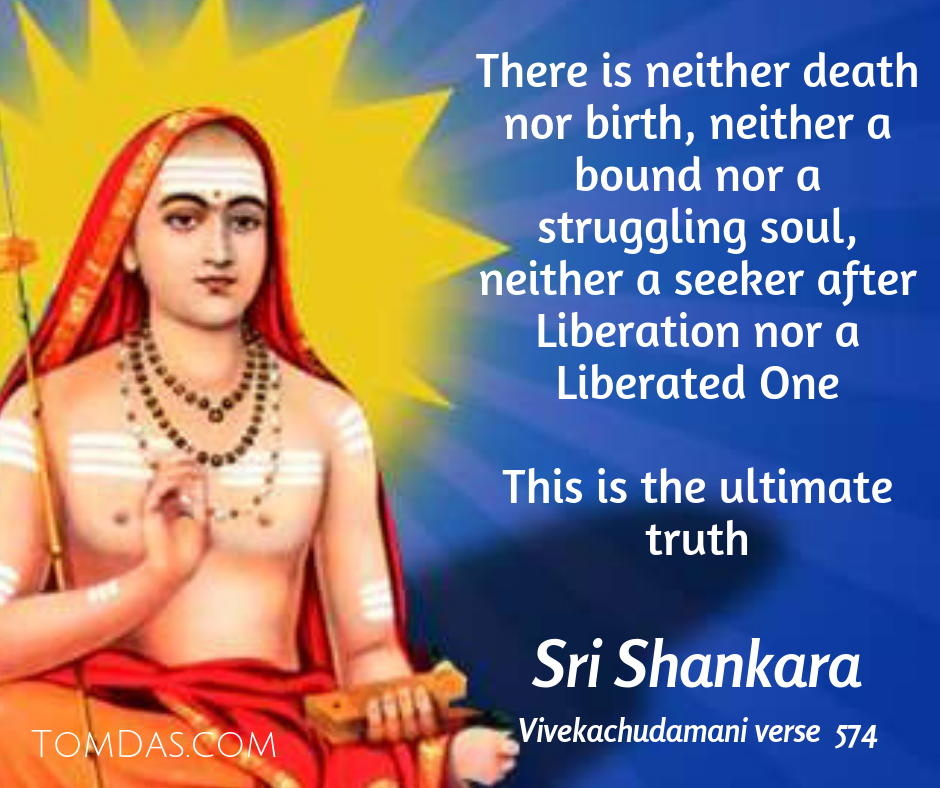
I have heard some Advaita Vedanta teachers say that there is no need for faith in Vedanta. However, what do the Advaita scriptures say? Is faith simply blind belief? Is faith based on logic and conceptual knowledge? Or is faith something else?
Here we shall look at some selected quotes from Shankara and the Bhagavad Gita below which state both the importance and necessity of faith on the Path to Liberation, and explore why this is the case.
WHY IS FAITH IMPORTANT?
Why is faith important? Simply put, because without sufficient faith one will not have the dedication, love and perseverance to continue with self-enquiry (vichara), until liberation is attained. And Self-Enquiry, as taught by the Upanishads, by Shankara and by Sri Ramana Maharshi, is the only practice that ultimately leads to Moksha.
SOME TEACHERS SAY FAITH IS NOT REQUIRED
There are some teachers that say faith is not required for Vedanta as one can discover this all for oneself like a scientist can discover the various laws of nature.
Whilst this truth needs to be discovered for oneself and realised for oneself, I have noticed these teachings that push out the need for faith tend to be the teachings that predominately stay on the level of the mind. They tend to teach that prolonged meditation on the Self/Self-Enquiry is not required for liberation, and that essentially one can come to liberation through qualities such as having a keen intellect combined with exploring the nature of our present experience only.
This being the case, these teachings alone do not lead to the end of individuality, duality and suffering – ie. they do not actually lead to Moksha (liberation) at all, and the ego-separation remains.

‘FAITH PENDING RESULTS’?
Some say that Shraddha, the Sankrit word for faith, does not refer to blind faith or mere belief, but to a ‘faith pending results’, similar to the ‘faith’ required for a science student to follow a scientific experiment in order to discover the truth it yields.
Whilst there is some truth in this, it is not the whole truth, and also note that the scriptures do not define faith in this way (see the quotes section below). It is true that faith, as spoken of in the Advaita scriptures, is not the end goal in itself, meaning one doesn’t simply believe in God or in a dogma or creed of some kind and leave it at that, which would be rather superficial and on the level of the intellect predominantly. Rather faith is a ferry to take us to the shore of liberation, and this liberation is the goal, and this goal of liberation or God must be ‘experienced’ or ‘realised’ or ‘known’ for oneself, for want of a better phrase.
However, the faith spoken of in the Vedanta scriptures is much deeper than what has been described above. It is not just a mere willingness to try something until you see the results, like a scientist, or even a simple trust that the teachings will show you the way, but something that throbs in our very core, a deep conviction, in our very heart, in our Being. It is a deep resonance, a magnetic pull, intertwined with an intuitive knowing.
This faith cannot be taught, but is something that at some point in our journey springs into our very Being and takes us Home to Liberation. Perhaps it comes to us having listened to and studied the Advaita (or similar) teachings for some time, or perhaps faith dawns after having experienced the various ups and downs of life, or perhaps it comes to us unasked for, as Divine a Gift from God, a Gift of His Grace.
This true faith is inextricably linked with Bhakti, or devotional love of the Divine, which culminates in love to be with Self as Self, otherwise known as Self-Enquiry or Dhyana (meditation).
For me this Faith arose through the Presence and Teachings of Sri Ramana Maharshi, and for that I am forever grateful. His Presence and His Teachings unfailingly guide Homeward those who have come under His Spell and Grace. He is the Lord, He is the very Self, he resides within your very Heart – turn inwards and dis-cover (ie. uncover and reveal) your identity with Him.
QUOTES FROM THE VEDANTA SCRIPTURES
Let us see what kind of person, according to Vedanta, attains Jnana, or ‘divine knowledge’, otherwise known as liberation:
Bhagavan Lord Krishna states in the Gita Chapter 4, verse 39: ‘Those whose faith is deep and who have practiced controlling their mind and senses attain divine knowledge.’
But what if this faith is not present?
Lord Krishna also states in the Gita in the next verse, chapter 4, verse 40: ‘But persons who possess neither faith nor knowledge, and who are of a doubting nature, suffer a downfall. For the skeptical souls, there is no happiness either in this world or the next.’
In Chapter 5, Krishna further states in verse 17: ‘Those whose intellect is fixed in God, who are wholly absorbed in God, with firm faith in Him as the supreme goal, such persons quickly reach the state from which there is no return, their sins having been dispelled by the light of knowledge.’
What is the definition of faith?
Shankara defines faith and states it is necessary for realisation in Vivekachudamani: ‘Acceptance by firm judgment as true of what the Scriptures and the Guru instruct, is called by sages Shraddha or faith, by means of which the Reality is perceived‘
Shankara also writes in Aparokshanubhuti that Shraddha is required for liberation and defines Shraddha as follows: ‘Implicit faith in the words of the Vedas and the teachers (who interpret them) is known as Shraddha‘
Lets leave the last quote of this post to Bhagavan Sri Krishna, this time from the last verse of Chapter 6 of the Bhagavad Gita where he states: ‘Of all yogis, those whose minds are always absorbed in me, and who engage in devotion to me with great faith, them I consider to be the highest of all.’
 Tom Das