atma vichara
Q. Doesn’t the notion of ‘turning within’ to find yourself create an artificial duality? All is already one! | Self-Enquiry | Atma Vichara

Q. Don’t these traditional Vedanta teachings create an artificial duality where there actually is none? Why turn away from the world towards an apparent ‘True Self’? Why create this duality in the first place? All is already one!
Tom: For most, the ego-mind keeps on habitually coming back, causing suffering and perpetuating the illusion of duality until one finally turns to Self-Enquiry and Abides as the Self. You can say ‘all is one’, or ‘this is it already’, or ‘there is no duality’, but usually it is just the ego-mind saying that (ie. it is only on the level of concepts and belief) and so suffering and the illusion of duality continue. The infinite-love-bliss of the Self is not ‘experienced’ or ‘known’.
How to remove the illusion of separation, so it, and the resultant suffering never returns? The only way I know is to abide as the pure consciousness within. This is the teaching of the Vedanta scriptures and of all effective and true spiritual teachings that I have come across.
For most, unless this is done, suffering and peace alternate, which is itself suffering.
The purpose of Satsang/teachers/teachings is only for you to turn within and Be what You already Are. Other than that, no teacher or teaching is required.
‘The seat of Realisation is within and the seeker cannot find it as an object outside him. That seat is bliss and is the core of all beings. Hence it is called the Heart. The only useful purpose of the present birth is to turn within and realise it. There is nothing else to do.’
Sri Ramana Maharshi, Talks with Sri Ramana Maharshi, Talk no. 219
Turn Within? Really? Isn’t this dualistic and doesn’t this just strengthen the ego? | Self-Enquiry | Atma Vichara | Awareness Watching Awareness
The symbol Om represents the Self, the eternal Truth Within
Also see:
IN BRIEF: HOW TO ATTAIN LIBERATION (MOKSHA)
HOW TO END EGO-SUFFERING (and why other spiritual paths tend not to ultimately work)
‘Do not reject this teaching saying – ‘all is already one’, or ‘what is needed to be yourself?’ or ‘This is It, already – what practice is required and for who?’ or ‘There is no ego already’. This is the ego’s way of avoiding its own destruction.’
Some people, when they hear of the true teachings of Self-Enquiry, they attend to it straight away and realise the Self, the eternal happiness and bliss that is devoid of misery and suffering, the Kingdom of Heaven that is found within.
Others spend time roaming and suffering in the arid desert of other ways (or ‘non-ways’) and teachings first, teachings that pertain to gross and subtle objects (ie body, mind and world, thoughts, feelings, experiences, knowledge, etc). Only later do they realise that despite all their knowledge and insights and experiences, despite their proclamations of oneness, etc, their suffering still continues, and maybe they then find the motivation to try something else and turn within.
OBJECTION: WHY TURN WITHIN? ISN’T THAT DUALISTIC?
Q .But if all is one or non-dual, why turn within at all? Is this not creating an artificial duality between the inner and the outer, and do not all practices strengthen the ego?
A. Because only then is suffering removed and the bliss of the self realised. Without this practice of turning within, suffering continues. See this for yourself in your own experience – has your suffering ended? If not, turn within and abide as the Self. Suffering is the hallmark of ego/ignorance.
WHY IS THIS THE CASE?
Q.Why is it so?
A. Because without this specific practice, objects are continually attended to, and this nurtures the notion ‘I am a body-mind entity living in a world’. Or rather it doesn’t attack or destroy this ignorance, which is deep rooted, habitual and strong (seemingly). The habitual ignorance ‘I am the separate body-mind entity’ continues to intermittently rise and cause suffering. Out of habit, ignorance continues, and with it suffering too.
‘The ego-thief pretends to be the policeman who catches the thief’.
Without this practice of attending to the Self or pure consciousness within, ignorance and suffering both continue, in spite of superficial proclamations such as ‘all is one’ or ‘nothing needs to change’. Similarly, other practices which involve attending to gross or subtle objects also do not sever this ignorance, although they may weaken it (or strengthen it).
OBJECTION: DOES THIS PRACTICE NOT STRENGTHEN THE EGO?
A. This is the only practice that does not strengthen the ego. All practices, except Self-Enquiry or Self-Attention, need the identity ‘I am the body-mind’, ie. the ego, to practice them. In Self-Enquiry it is not accepted that you are the body-mind from the outset.
The mind, when attending to gross and subtle objects, is called the mind. When this same mind attends to the Subject, itself, it is no longer the mind but is simply Consciousness or Awareness Being Consciousness or Awareness, ie. Self Being Self. (Ramana Maharshi states In Day by Day with Bhagavan: ‘The mind turned inwards is the Self; turned outwards, it becomes the ego and all the world’. The traditional Advaita text Yoga Vasishta states: ‘Consciousness, which is undivided, imagines to itself desirable objects and runs after them. It is then known as the mind.’ )
This practice, unlike all others, is not a doing (ie. not an act by the body-mind entity), but BEING SELF.
It is only through BEING SELF and not through attending to various gross and subtle objects that the egoic vasanas/ignorance can be rooted out and suffering ended at its source. See for yourself how suffering continues otherwise, how without this practice the ego continues itself.
A TRUE TEACHING
This is why Sri Ramana Maharshi taught this teaching. This is why Shankara taught this teaching. This is why Buddha taught this teaching. This is why Krishna and Vasishta taught this teaching. This is why Shiva taught this teaching. Why else has this teaching been taught for millennia?
Hence this is the true teaching of Vedanta that has been handed down, generation to generation, for millennia, and it is the true teaching of all genuine and effective spiritual paths.
My gratitude to Sri Ramana Maharshi for revitalising this ancient teaching, purifying it of all dross and superstition and making it easily accessible for all.
DO NOT ALLOW THOUGHT/THE EGO TO PHILOSOPHISE THIS TEACHING AWAY
Discover this yourself, not with intellectualising or philosophising, but by trying and seeing for yourself. Do not reject this teaching saying – ‘all is already one’, or ‘what is needed to be yourself?’ or ‘This is It, already – what practice is required and for who?’ or ‘There is no ego already’. This is the ego’s way of avoiding its own destruction. You will know this is the case as suffering is the sign of the ego. Are you still suffering? If so, attend to the Self, the pure consciousness, the subject, within. If you do not, suffering will continue until you do.
Sri Ramana Maharshi states:
‘The seat of Realisation is within and the seeker cannot find it as an object outside him. That seat is bliss and is the core of all beings. Hence it is called the Heart. The only useful purpose of the present birth is to turn within and realise it. There is nothing else to do.’ (Talks 219)
JUST A LITTLE PRACTICE MAKES A DIFFERENCE
Whilst practice gradually increases over time an infiltrates into your entire being and all of the three states (waking, dreaming, deep sleep), even a small amount of practice, even when NOT performed with great skill, leads to immense reduction in suffering and egotism. What may take years through mental philosophising is cut through quickly with devoted practice. This will build your faith in the teachings and take you home.
So start small and allow the momentum to gradually build, like a snowflake becoming an avalanche.
THE METHOD
Also see: IN BRIEF: HOW TO ATTAIN LIBERATION (MOKSHA)
Another quote from Sri Ramana Maharshi, this time from the Sri Ramana Gita, a small text that outlines the entire teaching of Ramana in concise form:
Q. What in brief is the means to know one’s own real nature? What is the effort that can bring about the sublime inner vision?
Sri Ramana Maharshi: Strenuously withdrawing all thoughts from sense objects, one should remain fixed in steady, non-objective [ie. subjective] enquiry. This, in brief, is the means of knowing one’s own real nature; this effort alone bring about the sublime inner vision.
Sri Ramana Gita, Chapter 3, verses 4-6
Here are some other quotes for you:


🕉Om Guru Ramana 🕉
🙏🙏🙏
The entire path explained: the Path of Sri Ramana (Parts 1 and 2; PDF downloads)
This is one of a series of introductory articles – please see the homepage of tomdas.com for more introductory articles.

See also:
IN BRIEF: HOW TO ATTAIN LIBERATION (MOKSHA)
Recommended Reading: books for Liberation & Self-Realisation
‘The path of Sri Ramana is meant for anyone who craves for happiness…’
These texts, written by Sri Sadhu Om, himself a direct devotee of Sri Ramana Maharshi, clearly, unambiguously and thoroughly explain the path to Self-Realisation, which is the extinguishment of suffering, as taught by Sri Ramana Maharshi.
- Part one focuses on Self-Enquiry (the path of knowledge or Jnana), which is the principal path for liberation/Moksha.
- Part two focuses on Self-Surrender (the path of Bhakti or love/ devotion).
Together these texts summarise the entire Vedanta path, and are consistent with the Vedanta scriptures, but the teachings are arranged practically for those with a genuine yearning for liberation and not just philosophical study.
There is also a text which is considered to be ‘Part three’ called Sadhanai Saram, which means ‘The Essence of Spiritual Practice’, and this text further explains what is given in parts one and two, and goes into more detail about the nature of liberation itself as well as various other topics. Click on the link above to download this as a PDF file.
Sri Sadhu Om (1922-1985), sometimes known as Sri Sadhu Om Swamigal, spent 4 years with Sri Ramana Maharshi from 1946 until Ramana’s death in 1950. He was regarded by many other direct devotees as both Self-Realised and an authority on Ramana Maharshi’s teachings. Sri Muruganar, one of the few devotees of Sri Ramana Maharshi who Sri Ramana openly conceded to be Self-Realised, considered Sri Sadhu Om to be one of the few people who truly understood Sri Ramana Maharshi’s teachings.
We are indeed fortunate to have these clear and precise teachings to hand!
All we have to do is understand them and put them into practice!
Click on the links below to download these precious texts, and then put them into practice:
The Path of Sri Ramana Part One (PDF file)
The Path of Sri Ramana Part Two (PDF file)
UPDATE 2023: a new revised translation in a single volume is now available to purchase, eg. on Amazon, called ‘The Path of Sri Ramana’. There are 60 pages of new additional previously untranslated material, part 2 is now called the supplement, and the biographical section has been removed. Personally I find the older version, available as a PDF on this website, easier to read, however several people who attend satsang meetings with me have informed me they prefer the newer translation which they feel is more precise and more accurate.
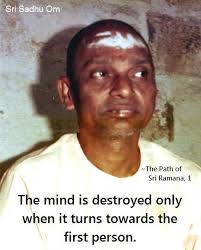
“We should not run after the world; we should not look outwards at the world, we should look inwards at Self. Those sannyasis who run after the world achieve neither the world nor Self (God). If we try to chase after our shadow, we will never catch it; but if we go towards the sun, our shadow will automatically come running behind us.
Those sannyasis who are always attending to the world with the aim of teaching the world became spoilt in the end. . . No Sage (jnani) who ever came on earth was the product of an ashramam, math or any such institution. Each one of them stood alone and realized the Truth by himself.
There is no rule that a man can attain true knowledge (jnana) only by becoming an inmate of a religious institution. Therefore, in the name of service to the world, let no one cheat himself and retard his spiritual progress by forming foundations and associations and by preaching, shouting slogans and running magazines”
~ Sri Sadhu Om
The entire path is also explained in more concise form in Ramana Maharshi’s text ‘Who Am I?’ (Nar Yar?). However I have found that many people actually miss the key teachings in ‘Who Am I?’ even though they are plainly written due to the ego’s distortion in interpreting what it hears/reads. After reading ‘The Path of Sri Ramana’, the teachings in ‘Who Am I?’ become crystal clear.
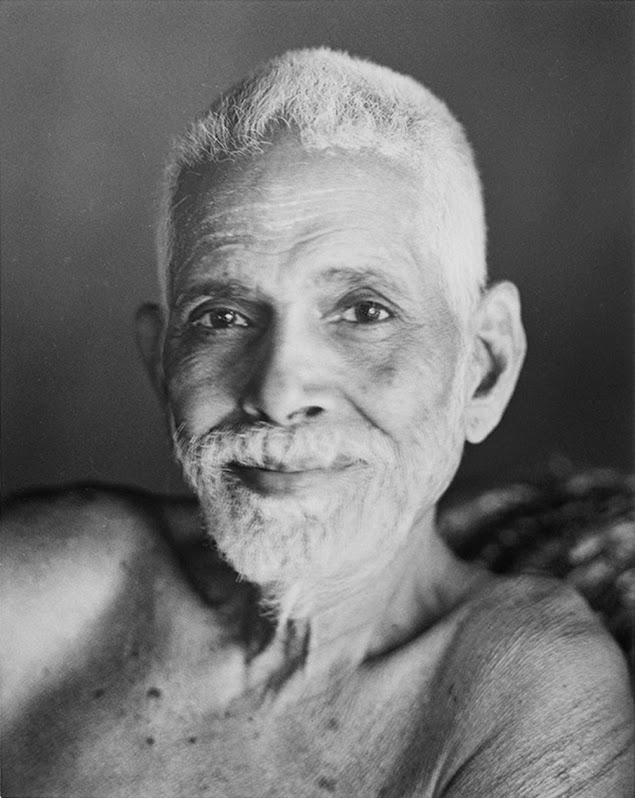
Guru Vachaka Kovai (Garland of Guru’s Sayings) PDF download – Ramana Maharshi: Know the Knower
Also see: Recommended Reading: Books for Enlightenment, Liberation and Self-Realisation
It is widely accepted that the text Guru Vachaka Kovai (Garland of Guru’s Sayings) presents the most precise, systematic and authoritative exposition of Sri Ramana Maharshi’s teachings; Here is what Ramana Ashram states about the Guru Vachaka Kovai in the foreword of their publication of it:
‘[Guru Vachaka Kovai] provides the most precise, systematic and authoritative exposition of Sri Bhagavan’s teaching, explaining step by step the theory, the practice and the experience of jnana, the Truth supreme which is Being as Life Eternal, Pure Awareness, Perfect Bliss. Thus, the most comprehensive collection of the Maharshi’s sayings is Guru Vachaka Kovai.’
Download Guru Vachaka Kovai (Garland of Guru’s Sayings) as a PDF file here
Here is another version of Guru Vachaka Kovai (PDF) with commentary by Sri Sadhu Om
Following my previous post, here are some more verses for you:
132.
Why do people call me learned?
What is the mark of real learning?
Learning that all garnered knowledge
Of things is empty ignorance
And that true knowledge is the search
For the Knower.
133.
He, who by questing inward for
The Knower, has destroyed the ego
And transcended so-called knowledge,
Abides as the Self. He alone
Is a true knower, not one who has
Not seen the Self and therefore has
An ego still.
134.
Those who, learning to forget
Completely all objective knowledge,
Turn inward firmly and see clearly
The Truth, abide serene. Those who
Try to recall forgotten things
Pine bewildered, fretting over
False phenomena.
Ramana Maharshi: True Wisdom
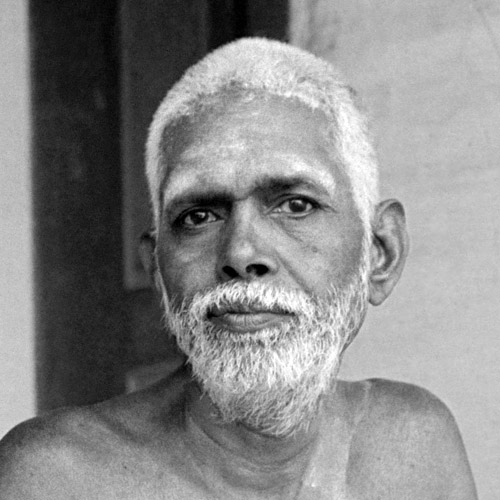
The following are sayings of Sri Ramana Maharshi, taken from the text Guru Vachaka Kovai which is widely accepted as the most precise, systematic and authoritative exposition of Sri Ramana Maharshi’s teachings:
Download Guru Vachaka Kovai as a PDF file here
536.
O worldly folk who long for and run after
An endless series of unenduring things
’Tis wisdom true to seek and know
That one thing, on knowing which
All other things will cease to be.
537.
For those who see with insight keen
The subtle Truth, what is there to gain
From knowledge of gross material things?
What the imperishable inner sense
Perceives surpasses far the sight
Seen by the corporeal eye.
538.
Knowing aright the nature of the Self
And abandoning the non-self as void,
Unreal, is wisdom true.
All other knowledge is ignorance,
And not wisdom.
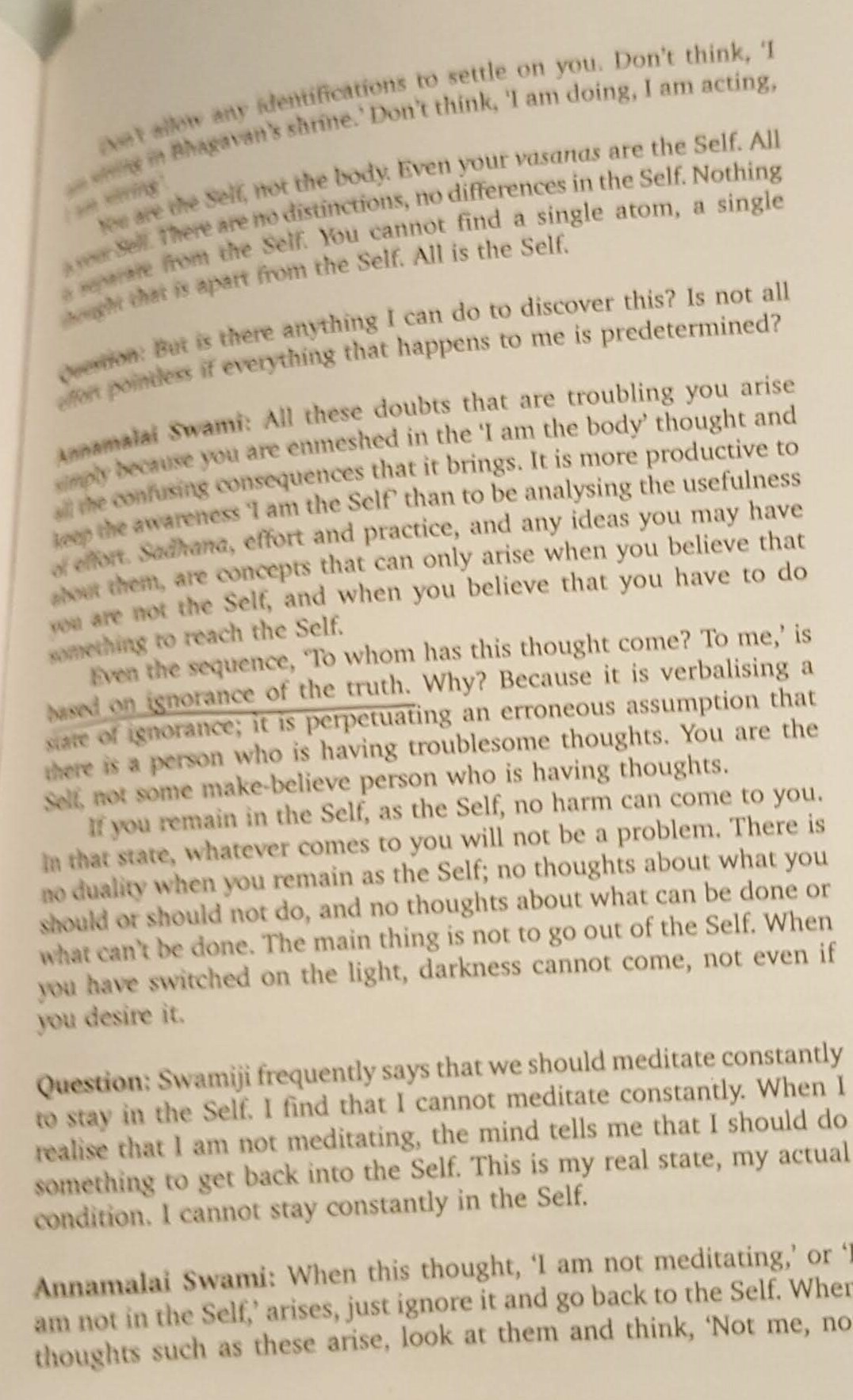
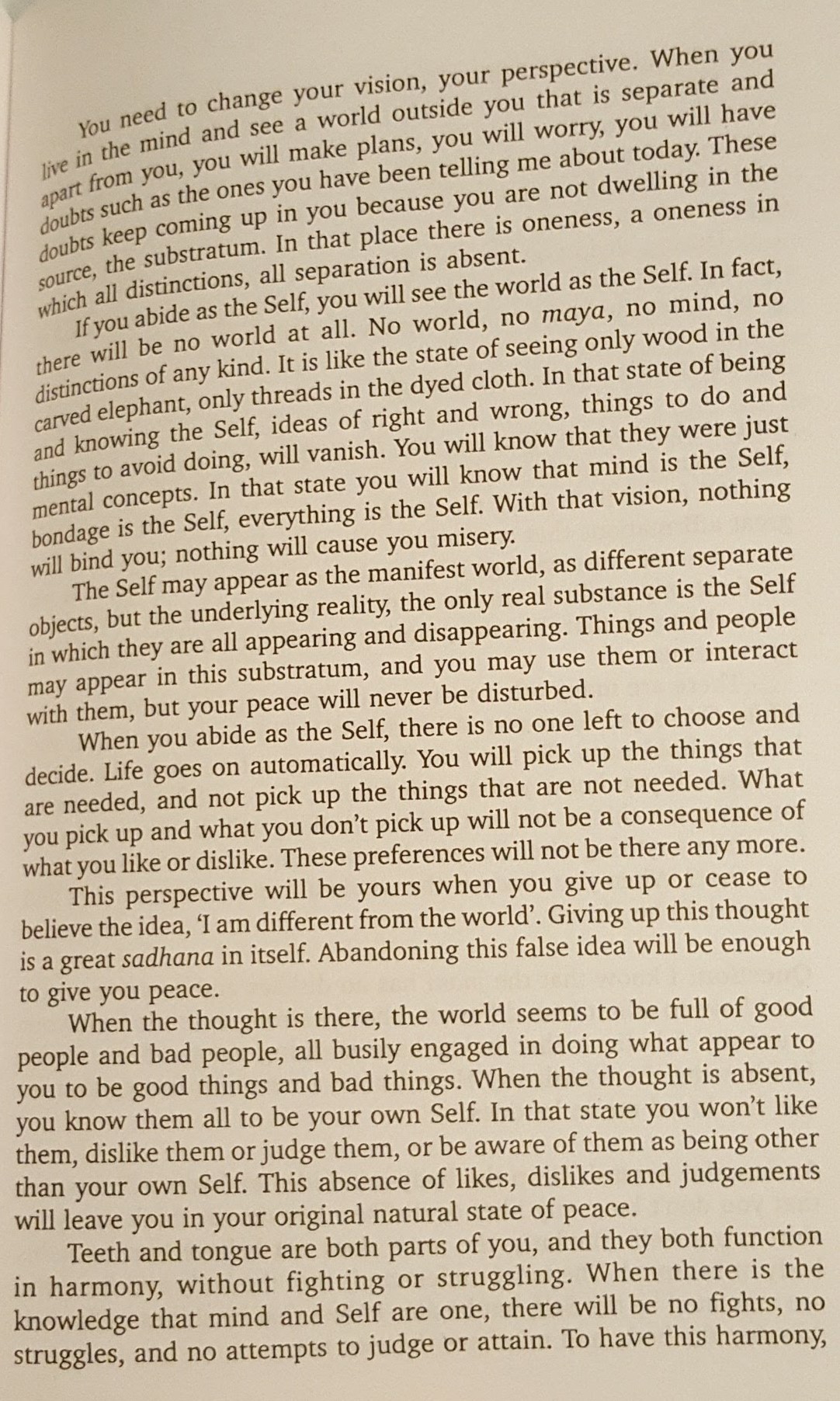
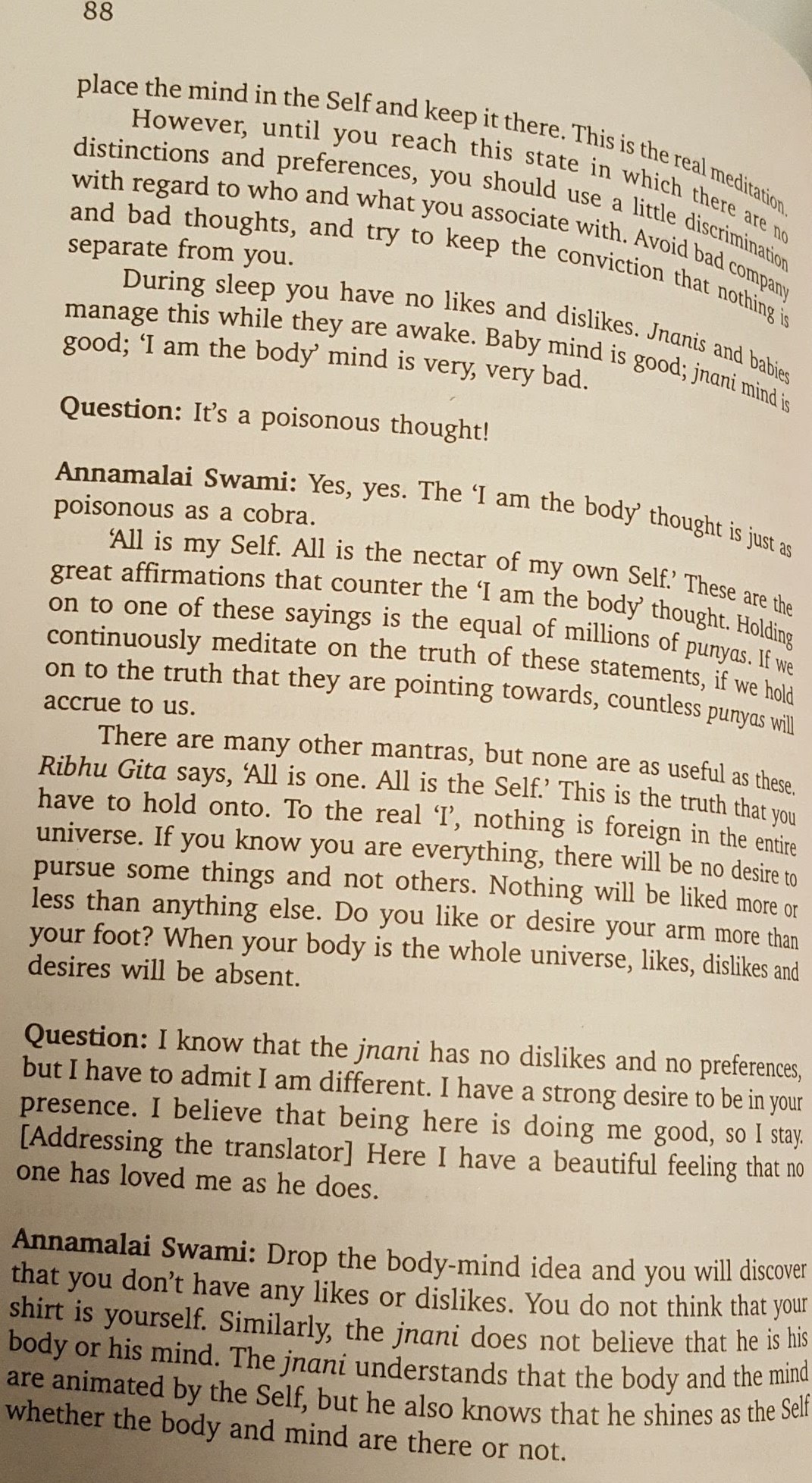
Annamalai Swami – How to abide as the Self and perform Self-Inquiry (Atma Vichara)

Annamalai Swami spent nearly 10 years of his life attending to Bhagavan Sri Ramana Maharshi, listening to Ramana’s teachings and bathing in Ramana’s Silent Presence. He himself attained self-realisation and we in turn are blessed to receive these teachings from him.
I present these excepts for the benefit of all who are earnestly seeking and highly recommend you buy this text to support the editor who enabled these teachings to be shared with us all.




In Ramana Maharshi’s own words: How to do Self Enquiry | Self Enquiry in daily life| Atma Vichara |
I have taken and arranged the following quotes from Ramana Maharshi’s two works Who Am I? (Nan Yar?) and Self Enquiry (Vichara Sangraham) with a focus on Self Enquiry and how to actually put the method into practice.
In order to do this, we will also look at some of the underpinning theory and also some practical points as to how this can be put into practice in daily life. Bold type and headings have been added by myself
Best wishes
Tom
Enquiry is the way
Ramana Maharshi: As all living beings desire to be happy always, without misery, as in the case of everyone there is observed supreme love for one’s self, and as happiness alone is the cause for love, in order to gain that happiness which is one’s nature and which is experienced in the state of deep sleep where there is no mind, one should know one’s self. For that, the path of knowledge, the inquiry of the form ‘Who am I?’, is the principal means.
Disciple: Master! What is the means to gain the state of eternal bliss, ever devoid of misery?
Ramana Maharshi: Apart from the statement in the Veda that wherever there is body there is misery, this is also the direct experience of all people; therefore, one should enquire into one’s true nature which is ever bodiless, and one should remain as such. This is the means to gaining that state.
Disciple: What is meant by saying that one should enquire into one’s true nature and understand it?
Ramana Maharshi: Experiences such as “I went; I came; I was; I did” come naturally to everyone. From these experiences, does it not appear that the consciousness ‘I’ is the subject of those various acts? Enquiry into the true nature of that consciousness, and remaining as oneself is the way to understand, through enquiry, one’s true nature
How to perform Self-Enquiry – The Theory
Disciple: How is one to enquire: ‘Who am I?’
Ramana Maharshi: Actions such as ‘going’ and ‘coming’ belong only to the body. And so, when one says “I went, I came”, it amounts to saying that the body is ‘I’.
But, can the body be said to be the consciousness ‘I’, since the body was not before it was born, is made up of the five elements, is non-existent in the state of deep sleep, and becomes a corpse when dead? Can this body which is inert like a log of wood be said to shine as ‘I-I’? Therefore, the ‘I’ consciousness which at first arises in respect of the body is referred to variously as self-conceit (tarbodham), egoity (ahankara), nescience (avidya), maya, impurity (mala), and individual soul (jiva) .
Can we remain without enquiring into this? Is it not for our redemption through enquiry that all the scriptures declare that the destruction of ‘self-conceit’ is release (mukti)?
Disciple. Who am I ?
Ramana Maharshi: The gross body which is composed of the seven humours (dhatus), I am not; the five cognitive sense organs, viz. the senses of hearing, touch, sight, taste, and smell, which apprehend their respective objects, viz. sound, touch, colour, taste, and odour, I am not; the five cognitive senseorgans, viz. the organs of speech, locomotion, grasping, excretion, and procreation, which have as their respective functions speaking, moving, grasping, excreting, and enjoying, I am not; the five vital airs, prana, etc., which perform respectively the five functions of in-breathing, etc., I am not; even the mind which thinks, I am not; the nescience too, which is endowed only with the residual impressions of objects, and in which there are no objects and no functioning’s, I am not.
Disciple. If I am none of these, then who am I?
Ramana Maharshi: After negating all of the above-mentioned as ‘not this’, ‘not this’, that Awareness which alone remains – that I am
Disciple: What is the nature of the Self?
Ramana Maharshi: What exists in truth is the Self alone. The world, the individual soul, and God are appearances in it. like silver in mother-of-pearl, these three appear at the same time, and disappear at the same time. The Self is that where there is absolutely no ‘I’ thought. That is called ‘Silence’ The Self itself is the world; the Self itself is ‘I’; the Self itself is God; all is Siva, the Self.
Disciple: Is it not possible for God and the Guru to effect the release of a soul?
Ramana Maharshi: God and the Guru will only show the way to release; they will not by themselves take the soul to the state of release.
Disciple: Is it any use reading books for those who long for release?
Ramana Maharshi: All the texts say that in order to gain release one should render the mind quiescent; therefore their conclusive teaching is that the mind should be rendered quiescent; once this has been understood there is no need for endless reading.
In order to quieten the mind one has only to inquire within oneself what one’s Self is; how could this search be done in books? One should know one’s Self with one’s own eye of wisdom. The Self is within the five sheaths; but books are outside them. Since the Self has to be inquired into by discarding the five sheaths, it is futile to search for it in books. There will come a time when one will have to forget all that one has learned.
How to perform Self-Enquiry – The Method
Therefore, making the corpse-body remain as a corpse, and not even uttering the word ‘I’, one should enquire keenly thus: ‘Now, what is it that rises as ‘I’’. Then, there would shine in the Heart a kind of wordless illumination of the form ‘I’ ‘I’. That is, there would shine of its own accord the pure consciousness which is unlimited and one, the limited and the many thoughts having disappeared. If one remains quiescent without abandoning that (experience), the egoity, the individual sense, of the form ‘I am the body’ will be totally destroyed, and at the end the final thought, viz. the ‘I’-form also will be quenched like the fire that burns camphor [ie. without leaving any sediment]. The great sages and scriptures declare that this alone is release.
Disciple: How will the mind become quiescent?
Ramana Maharshi: By the inquiry ‘Who am I?’. The thought ‘who am I?’ will destroy all other thoughts, and like the stick used for stirring the burning pyre, it will itself in the end get destroyed. Then, there will arise Self-realization.
Disciple What is the means for constantly holding on to the thought ‘Who am I?’
Ramana Maharshi: When other thoughts arise, one should not pursue them, but should inquire: ‘To whom do they arise?’ It does not matter how many thoughts arise. As each thought arises, one should inquire with diligence, ‘To whom has this thought arisen?’. The answer that would emerge would be ‘To me’. Thereupon if one inquires ‘Who am I?’, the mind will go back to its source; and the thought that arose will become quiescent.
With repeated practice in this manner, the mind will develop the skill to stay in its source.
When the mind that is subtle goes out through the brain and the sense-organs, the gross names and forms appear; when it stays in the heart, the names and forms disappear. Not letting the mind go out, but retaining it in the Heart is what is called ‘inwardness’ (antarmukha). Letting the mind go out of the Heart is known as ‘externalisation’ (bahir-mukha).
Thus, when the mind stays in the Heart, the ‘I’ which is the source of all thoughts will go, and the Self which ever exists will shine.
Whatever one does, one should do without the egoity ‘I’. If one acts in that way, all will appear as of the nature of Siva (God).
Even if one thinks constantly ‘I’ ‘I’, one will be led to that place.
The mind should not be allowed to wander towards worldly objects and what concerns other people.
The world should be considered like a dream.
Disciple: How long should inquiry be practised?
Ramana Maharshi: As long as there are impressions of objects in the mind, so long the inquiry ‘Who am I?’ is required.
As thoughts arise they should be destroyed then and there in the very place of their origin, through inquiry.
If one resorts to contemplation of the Self unintermittently, until the Self is gained, that alone would do. As long as there are enemies within the fortress, they will continue to sally forth; if they are destroyed as they emerge, the fortress will fall into our hands.
But thoughts still arise…
Disciple: When one enquires into the root of ‘self conceit’ which is of the form ‘I’, all sorts of different thoughts without number seem to rise; and not any separate ‘I’ thought.
Ramana Maharshi: …Whatever thoughts arise as obstacles to one’s sadhana (spiritual discipline) – the mind should not be allowed to go in their direction, but should be made to rest in one’s self which is the Atman; one should remain as witness to whatever happens, adopting the attitude ‘Let whatever strange things happen, happen; let us see!’ This should be one’s practice. In other words, one should not identify oneself with appearances; one should never relinquish one’s self.
This is the proper means for destruction of the mind (manonasa) which is of the nature of seeing the body as self, and which is the cause of all the aforesaid obstacles.
This method which easily destroys egoity deserves to be called devotion (bhakti), meditation (dhyana), concentration (yoga), and knowledge (jnana).
Disciple: The residual impressions (thoughts) of objects appear wending like the waves of an ocean. When will all of them get destroyed?
Ramana Maharshi: As the meditation on the Self rises higher and higher, the thoughts will get destroyed.
Disciple: Is it possible for the residual impressions of objects that come from beginningless time, as it were, to be resolved, and for one to remain as the pure Self?
Ramana Maharshi: Without yielding to the doubt “Is it possible, or not?”, one should persistently hold on to the meditation on the Self. Even if one be a great sinner, one should not worry and weep “O! I am a sinner, how can I be saved?”; one should completely renounce the thought “I am a sinner”; and concentrate keenly on meditation on the Self; then, one would surely succeed.
Disciple: Are there no other means for making the mind quiescent?
Ramana Maharshi: Other than inquiry, there are no adequate means. If through other means it is sought to control the mind, the mind will appear to be controlled, but will again go forth. Through the control of breath also, the mind will become quiescent; but it will be quiescent only so long as the breath remains controlled, and when the breath resumes the mind also will again start moving and will wander as impelled by residual impressions.
Can we do enquiry in daily life in the world?
Disciple: Is the aforesaid Self-experience possible, even in the state of empirical existence, for the mind which has to perform functions in accordance with its prarabdha (the past karma which has begun to fructify)?
Ramana Maharshi: A Brahmin may play various parts in a drama; yet the thought that he is a Brahmin does not leave his mind. Similarly, when one is engaged in various empirical acts there should be the firm conviction “I am the Self”, without allowing the false idea “I am the body, etc.” to rise.
If the mind should stray away from its state, then immediately one should enquire, “Oh! Oh! We are not the body etc.! Who are we?” and thus one should reinstate the mind in that (pure) state. The enquiry ‘Who am I?’ is the principal means to the removal of all misery and the attainment of the supreme bliss. When in this manner the mind becomes quiescent in its own state, Self-experience arises of its own accord, without any hindrance. Thereafter sensory pleasures and pains will not affect the mind. All (phenomena) will appear then, without attachment, like a dream. Never forgetting one’s plenary Self-experience is real bhakti (devotion), yoga (mind-control), jnana (knowledge) and all other austerities. Thus say the sages.
Disciple: When there is activity in regard to works, we are neither the agents of those works nor their enjoyers. The activity is of the three instruments (i.e., the mind, speech, and body). Could we remain (unattached) thinking thus?
Ramana Maharshi: After the mind has been made to stay in the Self which is its Deity, and has been rendered indifferent to empirical matters because it does not stray away from the Self, how can the mind think as mentioned above? Do not such thoughts constitute bondage? When such thoughts arise due to residual impressions (vasanas), one should restrain the mind from flowing that way, endeavour to retain it in the Self-state, and make it turn indifferent to empirical matters. One should not give room in the mind for such thoughts as: “Is this good? Or, is that good? Can this be done? Or, can that be done?” One should be vigilant even before such thoughts arise and make the mind stay in its native state. If any little room is given, such a (disturbed) mind will do harm to us while posing as our friend; like the foe appearing to be a friend, it will topple us down.
Is it not because one forgets one’s Self that such thoughts arise and cause more and more evil? While it is true that to think through discrimination, “I do not do anything; all actions are performed by the instruments”, is a means to prevent the mind from flowing along thought vasanas, does it not also follow that only if the mind flows along thought vasanas that it must be restrained through discrimination as stated before?
Can the mind that remains in the Self-state think as ‘I’ and as ‘I behave empirically thus and thus’? In all manner of ways possible one should endeavour gradually not to forget one’s (true) Self that is God. If that is accomplished, all will be accomplished. The mind should not be directed to any other matter. Even though one may perform, like a mad person, the actions that are the result of prarabdha-karma, one should retain the mind in the Self-state without letting the thought ‘I do’ arise. Have not countless bhaktas (devotees) performed their numerous empirical functions with an attitude of indifference?
Is there any way of adoring the Supreme which is all,
except by abiding firmly as that!
Om Tat Sat
The Essential Teachings of Sri Ramana Maharshi & How to abide as the Self | The world is not real | Attend to yourself

This is one of a series of introductory articles found on the homepage of tomdas.com. Please also see the recommended reading list here.
This post authoritatively summarises the essential liberating teachings of Sri Ramana Maharshi in relatively concise form. Please take the time to read and study this material in order to gain benefit from it.
The text ‘Guru Vachaka Kovai’, also known as ‘The Garland of Guru’s sayings’, is widely considered to be the most authoritative, reliable and comprehensive collection of the verbal teachings of Sri Ramana Maharshi. Here is what Ramana Ashram states about Guru Vachaka Kovai in the foreword of their publication of it:
‘[Guru Vachaka Kovai] provides the most precise, systematic and authoritative exposition of Sri Bhagavan’s teaching, explaining step by step the theory, the practice and the experience of jnana, the Truth supreme which is Being as Life Eternal, Pure Awareness, Perfect Bliss. Thus, the most comprehensive collection of the Maharshi’s sayings is Guru Vachaka Kovai.’
I have selected the following verses, as recorded by Sri Muruganar, using the version translated by Michael James.
Bold text has been added by myself for emphasis, and I have included a few comments from Sri Sadhu Om when further explanation may be helpful. As usual my own comments are added in italicised red – I hope they are of benefit.
May these verses illuminate the path for earnest seekers of realisation!
I prostrate to Bhagavan Sri Ramana Maharshi, from whose lips these teachings graciously fell, and also to Dearest Muruganar who faithfully recorded these jewels
I bow to Sri Ramana, the Lord Himself, whose Grace is ever-present everywhere
I give myself unto dear Bhagavan, whose light shines as the Self within our Heart, whose true form is Pure Consciousness, Silence, the Sadguru (True Teacher) within and without
! Om Namo Bhagavate Sri Ramayana Om !
Introduction
The Self is ever-attained:
8. The benefit of this Light of Supreme Truth is the understanding that there is not the least thing such as ‘attainment’, since the Supreme Self is the Ever-Attained One Whole. Thus the mental wanderings caused by striving towards Dharma, Artha, and Kama are also removed.
Sri Sadhu Om: Up till now the shastras [scriptures] have prescribed, as the rightful goals of human life, the following four aims:
-Dharma: the practice of righteous social duties.
-Artha: the acquisition of wealth through righteous means.
-Kama: the satisfaction of desires within righteous limits.
-Moksha: liberation, the natural state of abiding as Self.
This work, The Light of Supreme Truth shows us now that the first three worldly aims are futile and transitory, and thus it removes our wandering mental efforts to attain them. We may however still think, “Is not mental effort at least needed to obtain Moksha?” but again this Light shows us the meaninglessness of striving to ‘attain’ Self, which is ever-attained, and instead it recommends the cessation of all mental activity, thereby fixing us in the eternal, motionless and ever-attained State of Self.
The unreality of the world
The world does not exist:
23. The Realised who do not know anything as being other than Self, which is absolute Consciousness, will not say that the world, which has no existence in the view of the Supreme Brahman, is real.
28. O aspirants who hide yourselves away fearing this world, nothing such as a world exists! Fearing this false world which appears to exist, is like fearing the false snake which appears in a rope.
87. Self appearing as the world is just like a rope seeing itself as a snake; just as the snake is, on scrutiny, found to be ever non-existent, so is the world found to be ever non-existent, even as an appearance.
The world only appears to exist due to ignorance/maya/mind:
34. The deceptive I-am-the-body idea alone makes the world, which is an appearance of names and forms, seem real, and thereby it at once binds itself with desires [for the world].
35. Since this world of dyads and triads appears only in the mind, like the illusory ring of fire formed [in darkness] by whirling the single point of a glowing rope-end, it is false, and it does not exist in the clear sight of Self.
‘Dyads’ refers to seer/seen or perceiver/perceived or knower/known, ie. subject/object; ‘triads’ refers to seer/seeing/seen or perceiver/perceiving/perceived or knower/knowing/known, ie. subject/verb/object. Ramana is stating that this division of the world into dyads or triads only appears due to ‘the mind’, ie. ignorance.
Another way of stating the above is that the world/ego/ignorance only exists due to a lack of self-enquiry/self-attention:
156. The reason for our mistake of seeing a world of objects in front of us is that we have risen as a separate ‘I’, the seer, due to our failure to attend to the vast perfection of Self-Consciousness, which is our Reality.
36. O worldly-minded man who is unable to understand the wise reasoning and the teachings of Sages about the Supreme Knowledge, if properly scrutinised, this big universe of delusion is seen to be nothing but the illusive play of the vasanas [mental tendencies] within you.
ie. like a dream, the world is merely a projection of the mind and is unreal, also see below:
84. All that is perceived by the mind was already within the heart. Know that all perceptions are a reproduction of past tendencies now being projected outside [through the five senses].
40. How does this false and villainous vast world, that cheats and ravages the minds of all people [except the wise], come into existence? Because of no reason other than our own mistake in falling away from, instead of clinging to, Self-attention.
ie. the world is created through ignorance, ie. it is maya, see below:
55. The appearance of this world, like the illusory appearance of a dream, is merely mental and its truth [therefore] can be known correctly only by the Supreme Consciousness that transcends Maya, the mind.
Ignorance is not real and never existed:
86. Do not ask, “Why does Self, as if confused, not know the Truth that It is Itself which is seen as the world?” If instead you enquire, “To whom does this confusion occur?”, it will be discovered that no such confusion ever existed for Self!
87. Self appearing as the world is just like a rope seeing itself as a snake; just as the snake is, on scrutiny, found to be ever non-existent, so is the world found to be ever non-existent, even as an appearance.
100. Although Guru Ramana taught various doctrines according to the level of understanding of those who came to Him, we heard from Him that ‘Ajata’ alone is truly His own experience. Thus should you know.
Sri Sadhu Om: ‘Ajata’ is the knowledge that nothing – neither the world, soul nor God – ever comes into existence, and that ‘That Which Is’ ever exists as IT is.
The body
The body, being part of the world, is also a non-existent illusion:
97. The body exists only in the view of the mind, which is deluded and drawn outwards by the power of Maya. In the clear view of Self, which is a single vast Space of Consciousness, there is no body at all and it is therefore wrong to call Self ‘Dehi’ or ‘Kshetrajna’ [the owner or knower of the body]
Kshetra means ‘field’ and ‘jna’ is the root of the verb ‘to know’, so kshetrajna means ‘knower of the field’. These terms were used by Sri Krishna in Chapter 13 of the Bhagavad Gita when he explains to Arjuna that the body is the ‘kshetra’ or field but what we really are is the knower of the body/field, kshetrajna. Here Bhagavan Ramana Maharshi goes one step further by stating that the idea of kshetra and kshetrajna or deha (body) and dehi (owner of the body) are too just dualistic ideas of the mind. Whilst they are useful teachings at one level, these dualistic notions are ultimately more ignorance.
B1. Give up thinking that the loathsome body is ‘I’. Know Self, which is eternal Bliss. Cherishing the ephemeral body as well as trying to know Self is just like using a crocodile as a raft to cross a river.
[Tom – compare to: ‘Whoever seeks to realise the Self by devoting himself to the nourishment of the body, proceeds to cross a river by catching hold of a crocodile, mistaking it for a log.’ Shankara, Vivekachudamani, verse 84]
126. Instead of attending to Sat-Chit-Ananda, the subtlest, which is beyond the reach of speech or mind, to spend one’s life attending merely to the welfare of the gross body is just like drawing water with great difficulty from a well in order to water some useless grass [instead of paddy].
127. Those who take to the petty life, mistaking the body as ‘I’, have lost, so to speak, the great life of unlimited Bliss in the Heart, which is ever waiting to be experienced by them.
The ego
The ego is another illusory phenomena, a ‘picture on the screen’:
159. The life of the filthy ego, which mistakes a body both as ‘I’ and as ‘my place’, is merely a false imagination seen as a dream in the pure, real, Supreme Self.
160. This fictitious jiva, who lives as ‘I [am the body]’, is also one of the pictures on the screen.
Happiness is not in the world
We all want to be happy; the easy way is to attend to the Self, ie. self-attention, which is the noble path of self-enquiry; the difficult way (that doesn’t work) is to attend to the world, ‘the field of the five senses’:
72. Longing for a tiny grain of pleasure, people toil so hard using the mind to plough the field of the five senses, but they never wish for the flood of Bliss which is the fruit that comes by ploughing the Heart, the Source of the mind, with [simple] Self-attention. Ah, what a wonder!
Do not seek happiness in the world – you will ‘drown’ in maya:
128. Not knowing that the world in front of them brings only great harm, those who take it to be real and a source of happiness will drown in the ocean of birth and death, like one who takes hold of a floating bear as a raft.
74. Only when the world’s allurement is lost will true Liberation be possible [and its allurement cannot be lost unless it is found to be unreal]. Hence, to try to foist reality upon this world is to be just like an infatuated lover who tries to foist chastity upon a prostitute.
Note, the above notion that we have to lose our allurement with the world may seem difficult, but by merely attending to the Self, as outlined below, dispassion (vairagya) towards the world and love for Self/Bhagavan will naturally develop:
The only true practice/teaching
The only true way is to attend to the Self. This means to turn within, away from phenomenal objects and towards the Subject-Self. This is Jnana (knowledge), this is Dhyana (meditation), this is Bhakti (devotion/love):
175. The only worthy occupation is to thoroughly absorb the ego by turning Selfward and, without allowing it to rise, to thus abide quietly, like a waveless ocean, in Self-Knowledge, having annihilated the delusive mind-ghost, which had been wandering about unobstructed.
Do not attend to objects – attend to the subject!
186. O miserable and extroverted people, failing to see the seer, you see only the seen! To dissolve duality by turning inwards instead of outwards is alone Blissful.
Do not attend to objects – how? By attending to the Subject-Self!
187. O mind, it is not wise for you to come out [in the form of thoughts]; it is best to go within. Hide yourself deep within the Heart and escape from the tricks of Maya, who tries to upset you by drawing you outwards.
189. Since it is only the notion of duality that spoils Bliss and causes misery, to avoid yielding to the attractions of that notion and to thus arrest all chitta vrittis is alone worthwhile.
‘Chitta’ means mind or consciousness and ‘vritti’ means ‘wave’. Chitta vrittis are therefore the various waves or modulation of our consciousness such as thoughts and perceptions. The famous phrase ‘yoga chitta vritti nirodha’ occurs in Verse 2 of Chapter 1 of Patanjali’s Yoga Sutras. Here Patanjali, the so-called Father of Yoga defines what yoga is. It roughly translates as ‘Yoga means stilling the modulations of consciousness’ or ‘Yoga means to still the mind’
190. O people, not knowing that Shiva is dwelling within you, you fly about like birds from one holy place to another [seeking His Darshan]. Consciousness, when abiding still in the Heart, is the Supreme Shiva.
This above verse refers to those spiritual seekers who, not realising that the True Teacher, Shiva, is within us, go from one teacher to another, from one holy place to another, instead of simply Being Still/Being What You Are/Attending to the Self.
Now Ramana will tell us how we can protect ourselves from the clutches of Maya:
191. The ship would be destroyed by the storm if its sails were spread outside, but it is safe when its anchor is sunk deep into the sea. Similarly, if the mind were sunk deep in the Heart instead of being spread outside, that would be Jnana.
What is true heroism?
192. To arrest the mind – which tries to rush outwards – securely within, is the truly heroic act of the ripe aspirant who wants to see the Supreme Lord in the Heart.
In the above verse ‘securely within’ implies that the mind has turned within towards the Self and is made to rest ‘securely’ there. This is further made clear in the next verse:
193. When the mind [ie. the ego’s attention] which wanders outside, knowing only other objects [2nd and 3rd persons] – begins to attend to its own nature, all other objects will disappear, and then, by experiencing its own true nature [ie. Self], the pseudo-‘I’ will also die.
The above verses described the path using the language of the path of Knowledge (Jnana). Below we will see this is also the path of devotion and love (Bhakti):
204. A peaceful attitude, together with a ‘silent-flow’ of mind towards undeviating abidance in Self, Sat-Chit, is the best worship of Shiva.
205. Saint Markandeya survived death by conquering even Yama, and lived beyond his destined time. Know, therefore, that death can be overcome by worshipping Shiva, the death-killer.
The message here that in worshipping Shiva we can overcome our karma and destiny just as Saint Markandeya overcame Yama, the Lord of Time and Death
291. If one wants to be saved, one is given the following true and essential advice: just as the tortoise draws all its five limbs within its shell, so one should draw the five senses within and turn one’s mind Selfward. This alone is happiness.
Compare with Bhagavad Gita 2.58: ‘One who is able to fully withdraw the senses from their objects, just as a tortoise withdraws its limbs into its shell, is established in Divine Knowledge’.
Here, once again, the method to attain Self-Realisation, which is perfect infinite eternal Happiness, is made clear:
293. Having known for certain that everything which is seen, without the least exception, is merely a dream, and that it [the seen] does not exist without the seer, turn only towards Self – Sat-Chit-Ananda – without attending to the world of names and forms, which is only a mental conception.
The ‘only raft’, meaning the only way:
294. Attention to one’s own Self, which is ever shining as ‘I’, the one undivided and pure Reality, is the only raft with which the jiva, who is deluded by thinking “I am the body”, can cross the ocean of unending births.
297. Do not wander outside, eating the scorching sand of worldly pleasures, which are non-Self; come home to the Heart where Peace is shining as a vast, everlasting, cool shade, and enjoy the feast of the Bliss of Self.
Pay homage to the Guru, to Bhagavan Ramana! How? Let us see:
319. One’s merging into the Heart – through the enquiry into the nature of the ego, which is a delusion in the form of mind – is the right worship of the Lotus-Feet of the supreme Mouna-Guru, who is beyond the mind.
Here the path of enquiry and devotion are shown to be the same One Path
Conduct in the world
The advice given is to live your life as a normal and ethical person in the society you find yourself in:
82. It is not right for the Wise One to behave improperly, even though He has known all that is to be known and attained all that is to be attained. Therefore, observe the code of conduct which is befitting to your outward mode of life.
Self-Realisation
296. Having annihilated the delusive mind which always dwells upon worldly things, having killed the restless ego, and having completely erased the worldly vasanas, shine as Shiva, the pure Consciousness Itself.
In Self-realisation there is no sense of being a separate individual:
122. Whatever high and wonderful state of tapas one may have attained, if one still identifies oneself with an individuality, one cannot be a Sahaja-Jnani [i.e. One in the State of Effortlessness]; one is only an aspirant of, perhaps, an advanced stage.
Duality, or ‘the world’, which is ignorance and maya, disappears upon realisation of the Self:
114. When the limited light [which is used to project pictures on the cinema screen] is dissolved in the bright sunlight [which enters the cinema], the pictures also will disappear instantaneously. Similarly, when the limited consciousness [chittam] of the mind is dissolved in supreme Consciousness [Chit], the picture show of these three prime entities [God, world and soul] will also disappear.
If the above is true, why do religions talk of these three (ie. God, the world and the individual soul)?
115. Thus, since the Truth of the Source is One, why do all religions [and sometimes even Sages] start their teachings by at first conceding that these three prime entities are real? Because the mind, which is tossed about by objective knowledge, would not agree to believe in the One unless the Sages condescended to teach It as three.
True Knowledge vs intellectual knowledge
133. Enquiring, “Who is this ‘I’ that has learnt all these arts and sciences?”, and thereby reaching the Heart, the ego vanishes along with all its learning. He who knows the remaining Self-Consciousness is the true Pandit; how can others who have not realised It be Pandits?
Pandit is a word often used to describe a scholar who is well versed in all of the scriptures and in interpreting them in a logical way, but who does not necessarily Know the Self. Here Ramana redifined the word Pandit to be only he who Abides as the Self.
134. Those who have learnt to forget all that was learnt, and to abide within, are alone the Truth-Knowers. Others, who remember everything, will suffer with anxiety, being deluded by the false samsara.
141. After knowing that the purport at the heart of all scripture is that the mind should be subdued in order to gain Liberation, what is the use in continuously studying them? Who am I?
144. To be freed from ignorance by mere studies is as impossible as the horns of a horse, unless by some means the mind is killed and the tendencies are thus completely erased by the blossoming of Self-Knowledge.
145. For the jiva’s weak and unsteady mind, which is ever wavering like the wind, there is no place to enjoy bliss except the Heart, its Source; the study of scriptures is, for it, like a noisy shandai [a cattle fair].
Desire and security
149. The experience of Vedanta is possible only for those who have completely given up all desires. For the desirous it is far away, and they should therefore try to rid themselves of all other desires by the desire for God, who is free from desires.
150. The Wise, who know that all worldly experiences are formed by prarabdha alone, never worry about their life’s requirements. Know that all one’s requirements will be thrust upon one by prarabdha, whether one wills them or not.
Prarabdha refers to one’s destiny, which Ramana says will play out regardless of what one wills. Therefore worry not.
Summary verses
293. Having known for certain that everything which is seen, without the least exception, is merely a dream, and that it [the seen] does not exist without the seer, turn only towards Self – Sat-Chit-Ananda – without attending to the world of names and forms, which is only a mental conception.
294. Attention to one’s own Self, which is ever shining as ‘I’, the one undivided and pure Reality, is the only raft with which the jiva, who is deluded by thinking “I am the body”, can cross the ocean of unending births.
297. Do not wander outside, eating the scorching sand of worldly pleasures, which are non-Self; come home to the Heart where Peace is shining as a vast, everlasting, cool shade, and enjoy the feast of the Bliss of Self.
296. Having annihilated the delusive mind which always dwells upon worldly things, having killed the restless ego, and having completely erased the worldly vasanas, shine as Shiva, the pure Consciousness Itself.
! Om Namo Bhagavate Sri Ramayana Om !
This article does not go in depth into the nature of liberation. For more on this please see the introductory articles on tomdas.com
Also see:
The 2 Key Mistakes to avoid on the path to liberation
How to actually do Self-Inquiry/Self-Enquiry/Atma Vichara
How to actually do self-enquiry:
Here is a video detailing the theory and practice:
Here is a guided self-inquiry – short version:
 Tom Das