The Sage or Guru is the form of Ultimate Reality

“Those who say that the reality has no form are those who do not know the reality. For the form of the Sage [sahaja nishta] who correctly knows and abides in the reality, Self, the nature of which is like the [all- pervading] nature of space, is verily the form of the reality. Know this.”

Sri Ramana Maharshi, Guru Vachaka Kovai verse 656


Commentary by Sri Muruganar:

Through this verse, Sri Bhagavan disproves the saying, ‘The reality has no form’. How? Since the Sage [sahaja nishtha] who has known the reality as it is, is none other than the reality, He Himself is the very form of that reality. This is what is meant by saying, ‘Jnani Himself is Self’. Sri Muruganar here refers to the Bhagavad Gita, chapter 7, verse 18, in which Sri Krishna says that the Jnani is Atma.

For those attached to the world, the world is considered to be a divine manifestation. For the advanced seeker, the world is considered to be an illusion | Advaita Vedanta | Sri Ramana Maharshi | Ajata Vada

For those seekers who are attached to the world, the world is considered to be a divine manifestation. For the more advanced seeker, the world is considered to be an illusion. Many teachers teach this the wrong way around – this, of course, is itself due to their attachment to the world, ie. this wrong teaching is due to ignorance.

This is why Sri Ramana says, right at the start in the beginning few verses of The Garland of Gurus Sayings (Guru Vachaka Kovai), in verse 21:

21. For those who take the world appearance as real and enjoy it, it is the Lord’s creation. But for those who, free from fear, have known the Truth, the undeluded Self, it is no more than a mere mental image projected by desire.

For those who are fearful of the world, Sri Ramana gives the following even more radical advice in the same text, verse 28:

28. Ye who in fear shrink from the world, know that the place has no existence. Fear of this phenomenal world is like being frightened by a rope mistaken by you for a snake.

In verse 35 he uses the same analogy as Gaudapada (in his commentary on Mandukya Upanishad, Mandukya Karika), of a glowing flame whirled in a circle:

35. The empirical world of jostling names and forms is false and has no real existence in bright, full Awareness. Like a ring of fire formed in the dark when one whirls fast a glowing joss-stick, ’tis an illusion, mind-created.

The idea here is that in the dark (ie. in ignorance), a whirling flame appears as a world (that is a body, a mind and a world), but in the light (ie. in self-knowledge or self-realisation, also known as liberation), it is not seen at all.

Sri Ramana explains this in page 193 of Day by Day with Bhagavan when he states:

‘In reality, saying ‘We must see Brahman in everything and everywhere’ is also not quite correct. Only that state is final, where there is no seeing, where there is no time or space. There will be no seer, seeing and an object to see. What exists then is only the infinite eye.’

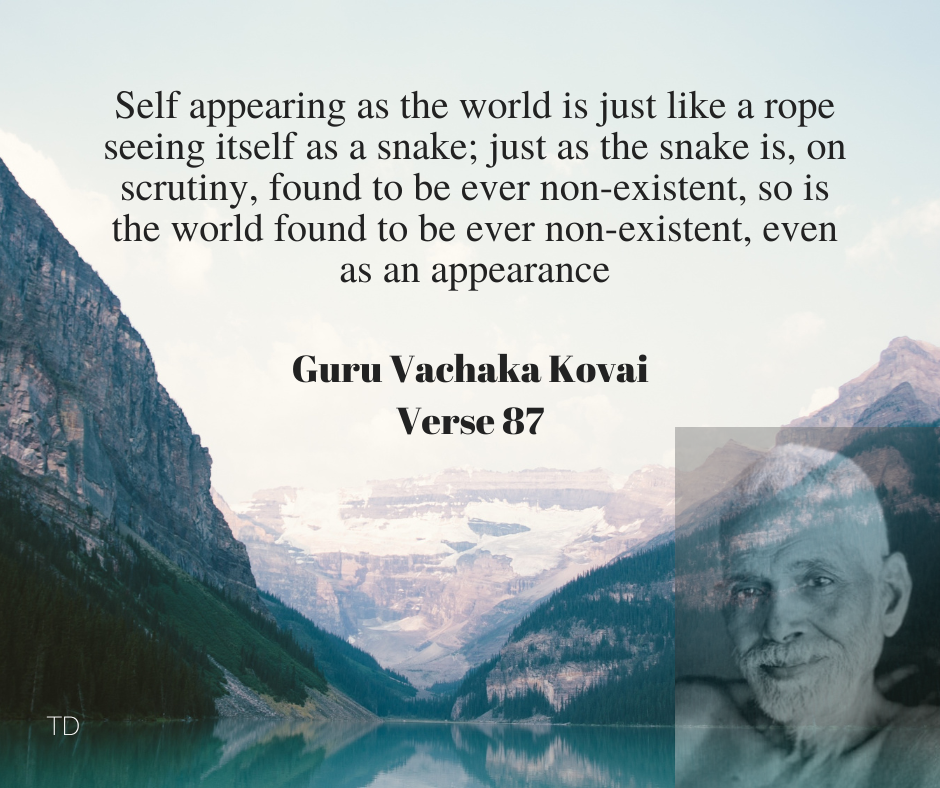
Similarly, Sri Ramana says in Guru Vachaka Kovai, verse 87:

‘…just as the snake is, on scrutiny, found to be ever non-existent, so is the world found to be ever non-existent, even as an appearance

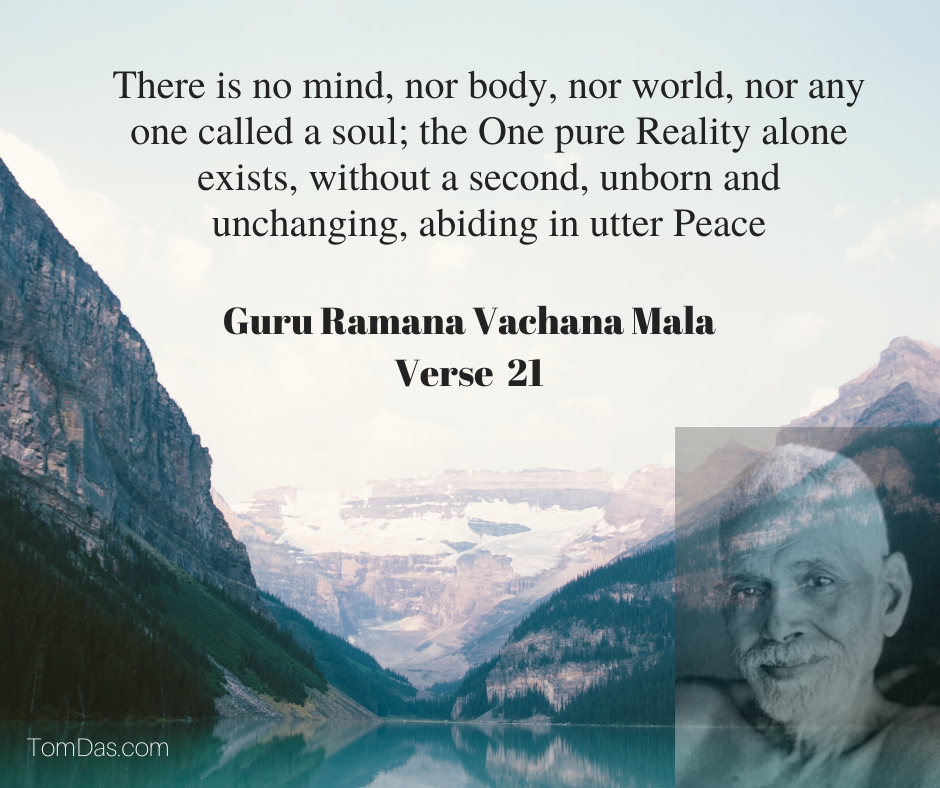
And in Guru Ramana Vachana Mala, verse 21, Sri Ramana gives us the Ajata teaching, that no-thing ever really came into existence at all:

There is no mind, nor body, nor world, nor anyone called a soul; the One pure Reality alone exists, without a second, unborn and unchanging, abiding in utter Peace’

For more on this teaching see here and here

Namaste

Shakara did not teach ‘The world is an illusion, only Brahman is real, the world is Brahman’

As far as I’m aware Shankara never actually taught ‘The world is an illusion, only Brahman is real, the world is Brahman.’ – this appears to be a misquote.

The actual teaching is ‘Brahma satyam, jagat mithya, jivo brahmaiva naparah’

..which means:

‘Brahman is Truth/Reality, the world is illusion, the Jiva (individual Self or ‘I’ or ‘I Am’) [when enquired into] is nothing but Brahman’

Buddhism vs Vedanta | Self vs no-self | Nirvana vs Self-Realisation | The Unborn | The Deathless

This is one of a series of introductory articles – please see the homepage of tomdas.com for more introductory articles.

Here in this article we will explore the Buddhist teachings and contrast them to Vedanta or ‘Hindu-style’ teachings. We will look at notions of self and no-self, nirvana and self-realisation, and look at the earliest complete Buddhist teachings ie. as recorded in the Pali Suttas (Sutta is a Pali word meaning ‘thread’ and refers to a ‘string of verses’, ie. a text; Sutra is the equivalent word in Sanskrit)

Also see: Ramana Maharshi: was the Buddha self-realised?

Q. Arahant vs Bodhisattva – which is best? | Buddhism

Self-enquiry and Buddhism/ the Jhanas and Ramana Maharshi

Some people think that the teachings of the Buddha point in some fundamental way to something different to teachings of ‘Hinduism’ (Sanatana Dharma) and Vedanta. Most of these people are either only approaching the teachings in an intellectual way or are attached to a particular conceptual view; or perhaps they have not made a deep study of the teachings, or perhaps they have not developed a deeper insight into the teachings for themselves.

Let us see why this is the case, as if one reads the early recorded teachings of the Buddha for oneself, clarity on this issue arises:

The Unborn, the Unmanifest, the Uncreated, the Unconditioned

A closer reading of the Buddhist texts reveals that the Buddha did actually acknowledge in many places the existence of what in Vedanta would be called ‘The Self’ (Sanskrit: Atman) and what others may even call God. Here is just one example from the Nibbana Sutta verse 3 (Udana 8.3), which is from the Pali Canon:

There is, bhikkhus [monks], that which is unborn, that which is unmanifest [or has not come into being], that which is not fabricated/created, that which is unconditioned.

If there were not, bhikhus, that which is unborn, that which is unmanifest, that which is not fabricated/created, that which is unconditioned, there would not be escape from that which is born, from that which is manifest, from that which is fabricated/created, from that which is conditioned – that therefore would not have been clearly known/experienced/seen.

But because, bhikhus, there is indeed that which is unborn, that which is unmanifest, that which is not fabricated/created, that which is unconditioned, therefore escape from that which is born, from that which is manifest, from that which is fabricated, from that which is conditioned, is [or can be] clearly known/experienced/seen.

We can clearly see that the Buddha is categorically stating that there is something that is beyond birth and creation, beyond manifestation and that which is conditioned (ie. all objects).

He then goes on to sate that only because there is such a thing as this Unborn is it possible for liberation to occur. The Buddha even states that without the existence of ‘that which is unborn’ liberation would not be possible.

Negating vs affirming language

Note that the Buddha characteristically uses negating language – ie. NOT born, NOT manifest, NOT created, etc, rather than the combination of both negating and affirming language often used in the vedic literature.

I hope you will see that this is clearly analogous to descriptions of the Self in Vedic literature which is described as being that which is Unborn, Unmanifest, Unconditioned, etc.

Please note that the above verse and following verses are taken from the Pali canon which represents the earliest complete recorded teachings of the Buddha (rather that the writings of later schools).

Nirvana

Please also note that the word Nibbana is the Pali equivalent of the Sanskrit word Nirvana (sometimes spelt Nirbana), which is a word that is also used in pre-Buddhist Vedic texts such as the Bhagavad Gita as a synonym for liberation. This means that the Buddha chose to use the same word for liberation that the Vedic texts also used.

‘No Self’ means no ego or no Jiva, NOT no Brahman/Unborn principle

So what does the word ‘Nirvana’ mean? It literally means extinguishment or annihilation or ‘blown out’ (like extinguishing or blowing out a flame).

Why is this word used in both ‘Hinduism’ and Buddhism (and Jainism too) as a synonym for liberation? It is because in all these traditions, it is accepted that liberation is simply destruction or extinguishment of the ego-self, which is illusory or unreal. So when ‘no-self’ is proclaimed in Buddhism, it is only the denial of the Jiva (apparently separate self) or ego-illusion.

In Vedanta this is also known as manonasa or destruction (extinguishment) of mind (manas = mind; nasa = destruction or anihiliation). We will see later that the Buddha also conceived of liberation in the same way – ie. destruction of the thinking and desiring mind.

Anatman (Anatta in pali) vs Atman

The Sanskrit word atman means self, and anatman means not-self or no-self. The Pali equivalent of anatman is anatta.

The Buddha points to various phenomenal arisings and points out that in none of these can a self be found and that all of these phenomenal arisings are anatman or ‘not-self’. An example of this is the Buddhist teaching of the five skandas, which is clearly analogous to the Vedic teaching of the five koshas. In both these teachings it is pointed out that these five skandas or five koshas are not-self, meaning no self can be found in them.

It should be clear that he Buddha is not saying there is no Unborn Principle (quite the opposite as we can see from the Nibbana Sutta verse 3 above), but that the phenomenal appearance of a separate self (Jiva in Sanskrit) or ego is illusory and that only by coming into the Unborn we can attain liberation – see the next section for more on this as well as how to do this for oneself.

The Deathless – how to attain Nirvana & Sri Ramana Maharshi’s teachings

Earlier we saw how the Buddha referred to what called the Unborn, the Unmanifest, the Unfabricated. Elsewhere he referred to the same Unborn as ‘the Deathless’. See here for an example of this – in this post I also go more into the actual methodology of liberation as proposed by the Buddha and show how it is essentially the same method taught by Bhagavan Sri Ramana Maharshi.

The Unmanifest or Nirguna Brahman

In Vedanta teachings, two forms of Ultimate Reality or Brahman are spoken of: the manifest or saguna Brahman and the unmanifest or nirguna Brahman (sa = with; nir = without; guna = qualities).

According to Vedanta, in truth there is only one form of Brahman – the unmanifest or Nirguna Brahman, but is spoken of as being two purely for purposes of teaching. This Nirguna Brahman, which has no qualities that can be described in words and has no qualities that can be perceived by the senses, this nirguna Brahman is the only True Reality, and realisation of this Truth is tantamount to liberation.

The manifest or Saguna Brahman refers to the apparent world of phenomenal appearances and according to Vedanta these do not actually exist and are illusory. The Vedanta teachings encourage us to turn away from objective phenomena towards the Subject-Self which is then revealed to be Nirguna Brahman.

Unsurprisingly we see exactly the same teaching in the Buddhist Pali Suttas time and time again.

Extinguishing the Fire of Egotism

For example in the Fire Sermon, which was said to be the third sermon the Buddha gave, the Buddha explains that everything that we can perceive and imagine is just egotism which he likens to a flame or fire. It then makes sense that Nirvana is extinguishment of this flame or fire of egotism. He encourages us to ‘become disgusted’ with the various phenomenal arisings and turn away from them, and it is in this way liberation or nirvana, which is the end of egotism and suffering, occurs.

In Nirvana there is the cessation of all phenomenal appearances

How does the Buddha describe Nibbana? Where better to look than the Nibbana Sutta that was quoted above? Here is verse 1 (Udana 8.1):

There is, bhikkhus, that Base where there is no earth, no water, no fire, no air…neither this world nor another world nor both; neither sun nor moon. Here, bhikkhus, I say there is no coming, no going, no staying, no deceasing, no uprising. Not fixed, not movable, it has no support. Just this is the end of suffering.

We can see from the last phrase ‘just this is the end of suffering’ that the Buddha is describing Nirvana (which he defines as the end of suffering, and which is generally defined as the end of suffering) or what is Vedanta would be called The Self (Atman).

In his description the Buddha is also explaining that in Nirvana ‘there is no earth, no water, no fire, no air…‘, ie. by negating the appearance of the four classical elements he is stating that in nirvana there are no phenomenal arisings whatsoever. He continues this theme by stating ‘there is neither this world, not another world…neither sun nor moon… no coming, no going…

See the PDF file here to see this same process of cessation of all phenomenal arisings being described in Vedanta.

The ‘Unmoving’, that which requires ‘no support’, the ‘Unaffected’

The Buddha then goes on to describe what in Vedanta would be called the Self – the Buddha states it is ‘…not moveable, it has no support‘. In Vedanta it would be said to be immovable or unchanging (that which moves can change, that which doesn’t move does not change) and self-shining, meaning it supports itself. In Vedanta, the word ‘ananda’ which means happiness or bliss means the cessation of suffering. Hopefully it is fairly clear that the teachings are pointing to the same basic thing!

In verse two of the same Nibbana Sutta (Udana 8.2) The Buddha speaks of ‘the Unaffected‘, which is clearly another name for the Vedic notion of Self, by which craving and all phenomenal appearance (Maya in vedanta) is ended. Every phenomenal appearance is within the realm of ‘the affected’, so what is this ‘unaffected’ but the True Self?:

It’s hard to see the Unaffected,
for the Truth isn’t easily seen.
Craving is pierced
in one who knows;
For one who sees,
there is nothing.

In liberation there are no thoughts or desires

As we have already quoted from verse 3 at the top of the post, let us proceed to verse 4. In verse 4 of the Nibbana Sutta the Buddha explains that one who has not found the ‘Unaffected’ (ie. the True Self) remains dependent (on phenomenal objects) and so ‘wavers’. This wavering refers to the movements of the mind, ie. what we would call thoughts and desires. Here is verse 4 (Udana 8.4):

One who is dependent has wavering. One who is independent has no wavering. There being no wavering, there is calm. There being calm, there is no desire. There being no desire, there is no coming or going. There being no coming or going, there is no passing away or arising. There being no passing away or arising, there is neither a here nor a there nor a between-the-two. This, just this, is the end of suffering.

See how Sri Ramana Maharshi explains this here.

Cessation of time and space in Liberation

In the above verse 4 the reference to ‘there being no passing away or arising’ not only indicates no arising phenomena in liberation, but also the cessation of time itself. Similarly the reference to ‘there is neither a here nor a there nor a between-the-two’ refers to the cessation of perception of space.

We can see that the teachings are referring to what in Vedanta is known as ‘non-duality’, or advaita, Oneness beyond the illusions of ego, separation, time and space

See this described here in Vedanta teachings.

The ‘Stainless’, the ‘Sorrowless’, the ‘Blissful’

In verse 5, the final verse of this Nibbana Sutta, the Buddha states the following, continuing the theme of the need to efface all desires, wants and cravings. Note how he refers to ‘stainless’ and ‘sorrowless’ and ‘blissful’ – could be be referring to what in Vedanta would be called the Self? I think so!:

The sorrows, lamentations,
the many kinds of suffering in the world,
exist dependent on something dear.
They don’t exist
when there’s nothing dear.
And thus blissful & sorrowless
are those for whom nothing
in the world is dear anywhere.
So one who aspires
to be stainless & sorrowless
shouldn’t make anything
in the world dear
anywhere.

See how Sri Ramana Maharshi similarly describes the way to liberation here.

Some concluding remarks

I have only touched upon one Sutta here in any detail. If you read the Pali canon for yourself you will find countless references like these, eg. to the Unborn and the Deathless, again and again. You will also see references to the need to turn away from objective phenomena towards that which is unborn. You will also see references to the cessation of all arising phenomena. Again and again these references are made.

Surely the Buddha and Vedanta teachings are pointing to the same thing in their own way?

I hope you found this post of use. I have written it rather hastily in one quick sitting so apologies for any spelling or grammatical or other errors.

Namaste and best wishes!
Isn’t Brahma-Jnanam (Knowledge of Brahman) also Adhyasa (a superimposition or false appearance)?

Questioner: Isn’t Brahma-Jnanam (Knowledge of Brahman) also adhyasa* (superimposition or false appearance)?

Tom: It depends what you mean by ‘Knowledge of Brahman’. If you mean knowledge in the mind, then this too is certainly maya/illusion/adhyasa.

However True ‘Knowledge of Brahman’ just means the Self devoid of all objective phenomena. It is also called Silence or Samadhi and is also what is meant by Yoga. This ‘knowledge’ is just the Pure Self-Shining Reality (and so it is not adhyasa and not the result of any action/karma or teaching/dharma).

It is only this ‘knowledge’ (the Self) that removes ignorance.

(*Tom: Note that adhyasa is a Sanskrit word that means superimposition, false attribution or false appearance. It essentially refers to any object that appears, such as the body, mind and world and includes thoughts, feelings, imaginings, states of consciousness, teachings, teachers, tables, chairs, the sun, the sky, etc. The idea is that these objects are falsely ‘superimposed’ onto pure consciousness like the movie is superimposed onto the cinema screen. According to the Upanishads and Advaita Vedanta, all these superimposed appearances/objects may appear to be real to us out of ignorance, but they are actually totally false or unreal, like a dream may appear to be real, but is actually not real at all – rg. was that four-headed dinosaur you dreamt of real? Put simply, adhyasa is another word for maya (cosmic illusion) or ignorance or duality, all of which are also synonyms.)

NOT ‘THIS’, ONLY ‘THAT’

Some say that all is One already, All is Divine, so no need to give anything up, no need to do anything. Whilst there is a truth in this, and whilst this type of teaching can provide us some limited time-bound relief (which is good as a start), it is almost always an ego-preservation strategy: the thinking mischief-causing mind is allowed to continue with its ideas and concepts and beliefs about ‘this’, and the genuine thought-free Blissful Realisation of That Which Always Is, is postponed yet again. Suffering and duality continue, apparently, and we remain stuck in illusion, apparently.

Why ‘apparently’? Because in Reality there was never any ignorance, any delusion, any duality or any suffering. Only Blissful Being ever really is.

‘This’ never was (referring to objective phenomena/maya).

There is only That (Divine Formless Spirit)…
…and That Thou Art.

To realise this is very simple: (1) Surrender all to the Him (or Her or It), (2) allow the mind to become first happy, then very calm and still, and then (3) enquire into yourself as per instructions of Bhagavan Guru Sri Ramana Maharshi

Bhagavan Ramana summarises the teachings using the Biblical phrase ‘Be Still and Know I Am God’

Om Tat Sat
🕉

Shankara: The Self or Brahman cannot be known!

A definition of Jnana by Shankara

The Brihadaranyaka Upanishad, verse 4.4.20, states the following:

20. It [Brahman] should be realised in one form only, (for) It is unknowable and eternal. The Self is taintless, beyond the (subtle) ether, birthless, infinite and constant.

Here we can see that the Upanishad is stating that Brahman is unknowable. So what of Self-Knowledge or knowledge of Brahman that is so often spoken about? Shankara explains this contradiction in his commentary on this verse:

The knowledge of Brahman too means only the cessation of the identification with extraneous things (such as the body). The relation of identity with It [Brahman] has not to be directly established, for it is already there. Everybody always has that identity with It, but it appears to be related to something else. Therefore the scriptures do not enjoin that identity with Brahman should be established, but that the false identification with things other than That should stop. When the identification with other things is gone, that identity with one’s own Self which is natural, becomes isolated; this is expressed by the statement that the Self is known. In Itself It is unknowable – not comprehended through any means. Hence both statements are consistent.

We can see that Shankara is stating that Brahman is indeed unknowable, and that Jnana, or knowledge, only signifies the cessation of identification with extraneous things, ie. loss of identification with objects, specifically the body-mind. Jnana is not of the mind and is not for the jiva or individual.

We do not need to affirm our identity as Brahman, as we already are and always have been and always will be Brahman. Any affirmation of Brahman would simply be on the level of thought or concepts, and so it would be Maya, or more ignorance. But once the false identification has been removed, then the Self naturally shines as itself, and this lack of wrong-knowledge, or lack of wrongly identifying as the body-mind, is what is called ‘Jnana’ or ‘knowledge’.

In Ulladu Narpadu verse 12, Sri Ramana Maharshi writes:

True Knowledge is being devoid of knowledge as well as ignorance of objects. Knowledge of objects is not true knowledge. Since the Self shines self-luminous, with nothing else for It to know, with nothing else to know It, the Self is Knowledge. Nescience It is not.

In Upadesa Saram verse 27, Sri Ramana Maharshi writes:

That is true knowledge which transcends
Both knowledge and ignorance,
For in pure knowledge
Is no object to be known.

The above is an excerpt from the following post which further explores this topic: What exactly is Jnana (knowledge) according to Shankara and Gaudapada and the scriptures?

Deep Sleep and Self-Realisation | Falling asleep during Self-Enquiry

Also see:

Deep sleep is Brahman – the three states according to the Birhadaranyaka Upanishad with commentary by Shankara

Ramana Maharshi: the method of wakeful sleep (Jagrat Sushupti) to attain liberation

Tom: In the following quotes Sri Ramana Maharshi gives us a teaching on the correct relationship between Deep Sleep & Self-Realisation or Jnana:

Questioner: Sushupti [deep sleep] is often characterised as the state of ignorance.

Sri Ramana Maharshi: No, it is the pure state. There is full awareness in it [deep sleep] and total ignorance in the waking state. It is said to be ajnana [ignorance] only in relation to the false jnana prevalent in jagrat [the waking state].

Really speaking jagrat [the waking state] is ajnana [ignorance] and sushupti [the sleep state] prajnana [wisdom]. If sushupti is not the real state where does the intense peace come from to the sleeper?

It is everybody’s experience that nothing in jagrat can compare with the bliss and well-being derived from deep sleep, when the mind and the senses are absent. What does it all mean? It means that bliss comes only from inside ourselves and that it is most intense when we are free from thoughts and perceptions, which create the world and the body, that is, when we are in our pure being, which is Brahman, the Self. In other words, the being alone is bliss and the mental superimpositions are ignorance and, therefore, the cause of misery. That is why samadhi is also described as sushupti in jagrat [sleep in the waking state]; the blissful pure being which prevails in deep sleep is experienced in jagrat, when the mind and the senses are fully alert but inactive.

~ Guru Ramana, pp. 112-13

Tom: Here are some verses from Sri Ramana Maharshi taken from Guru Vachaka Kovai that make similar points, namely that deep sleep is not actually ignorance at all but actually the Self. It is only our belief that the waking state is Reality (and that we are the body-mind) that makes us feel that Deep Sleep is a state of total ignorance. It is actually Pure Knowedge:

455.

Having experienced fully the great bliss of the sublime state of sleep where no other object exists, it is sheer ignorance not to value that state and to regard it as one’s salvation, but instead to desire something else, imagining it to be one’s defence against the misery one experiences.

457.

The ignorance of forgetfulness which makes you say that the waking state is a state of illumination makes you [also] declare that sleep is a sheath [kosa] of ignorance. If the belief that the waking state is the illustrious and unique state of truth goes, then sleep will become, and shine as, pure non-duality.

461.

Only in an intellect that has developed a desire for the waking state will the eminent state of deep sleep, which is all bliss, be classified as a state of ignorance: ‘I did not know anything during sleep.’ By failing to enquire into and realise the true experience that exists and shines in the same way forever, one becomes deluded and thinks, ‘I am the one who woke up’. If that powerful sheath of the intellect, the ignorance that is experienced in the waking state, is destroyed by the sword of vichara [that leads to the knowledge] ‘I am not the one who woke up’, then the eminent state of sleep will shine, remaining as pure bliss, its ignorance destroyed.

Tom: We see the same teaching in Talks with Sri Ramana Maharshi. The following is from talk number 314:

Again, sleep is said to be ajnana [ignorance]. That is only in relation to the wrong jnana prevalent in the wakeful state. The waking state is really ajnana [ignorance] and the sleep state is prajnana [full knowledge].

Tom: Here Bhagavan Ramana explains that the waking and dream states are mere projections of the minds habitual tendencies (vasanas), and when these are removed, only Deep Sleep remains, and this Deep Sleep is nothing but the Self (here called Turiya, the ‘forth’ state.):

460.

If the beginningless, impure vasanas that remain as the cause for waking and dream leave and perish, the state of sleep [previously perceived as] void-like and dull, and which led us into a state of ignorance and suffering, will become the transcendent state of turiya.

Tom: What about if we fall asleep during Self-Inquiry, what then? Bhagavan Ramana reassures us as follows:

462.

If the illumination that is awareness of your being exists so firmly that it remains unshaken until sleep overpowers you, then there will be no need to feel jaded and disheartened, lamenting, ‘Oh, the forgetfulness of nescient sleep has come and unsettled me!’

Tom: Note that the word nescience in the above verse is just a synonym for ignorance, the root meanings of the words being the same, ie. not-knowing. Ignorance negates the Greek word ‘gnosis’, which means knowledge, and nescience negates the Latin word ‘scientia’ which also means knowledge.

The above verses allow us to more fully understand the somewhat cryptic but important verse in the Bhagavad Gita Chapter 2, verse 69. It also reveals to us the depth of knowledge present in the Bhagavad Gita:

What all [ignorant] beings consider as night, is the day for the wise,

And what all [ignorant] beings see as day, is the night for the sage.

Tom: We can see that the above verse from the Bhagavad Gita is saying that most people consider deep sleep as being total darkness and ignorance, whilst the Sage considers this to be Knowledge, ie The Self. Conversely, what most people consider to be the ‘waking state’ is actually considered by the Sage to be a state of pure ignorance and delusion.

The waking state is considered by most to be a state in which we know things (other objects) and in which we ‘live our life’ as a human being – this is the meaning of ‘day’ for most people. The sage considers this ‘day time’ or ‘waking state to be pure illusion and delusion, or ‘maya’.

Because most people identify as being the body-mind in the waking state, and because most people consider the waking state to be a worthy state in which we experience ‘real life’ and gain ‘worthy life-experiences’, they therefore consider deep dreamless sleep as being a dull dark state full of ignorance. However the sage, who has lost the ego-identification as body-mind, sees Deep Dreamless Sleep only as the Pure Self in which there is only Perfect Love-Being-Bliss devoid of space, time, creation, body, mind, thoughts and concepts.

This same teaching that Bhagavan Ramana has made so clear to us above is also given in the Brihadaranyaka Upanishad, see here for details

Also see: Ramana Maharshi: the method of wakeful sleep (Jagrat Sushupti) to attain liberation

Let us give thanks and gratitude to Bhagavan Ramana Maharshi for his wonderfully clarifying teachings!

!Om Namo Bhagavate Sri Ramanaya Om!