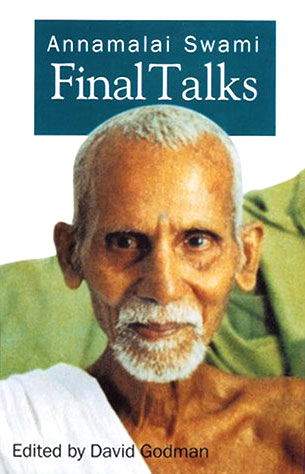
The following excerpt is from Chapter 7 of the above book:
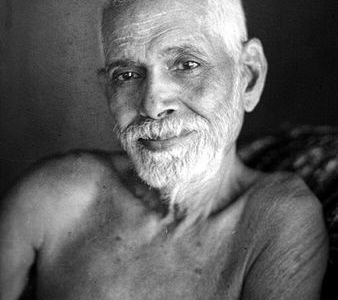
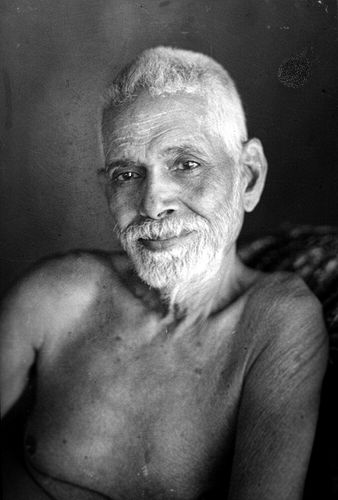
Annamalai Swami: Enquire ‘Who am I?’ or ‘What is my real nature?’ The nature of the Self is nothing but peace. If you are not aware of that peace, it means that you are identifying with something that is not the Self. As long as you hear, taste and smell things, you identify with the body. When the perceptions and the perceiver of them vanish, you become aware of the peace that is there all the time.
If you are not aware of that peace, it means that you are identifying with something that is not the Self.
Q: I hear the sound. Then I ask myself who is hearing the sound, and the answer is ‘I’. What happens next depends on where I am. If I am in Swami’s presence or in the meditation hall at Sri Ramanasramam, I feel the presence of the Self and the bliss of peace, but when I am away from Swami, it is not easy.
AS: You need not hold on to That because you are That all the time. That is enough. You are That. How can you hold on to That, or feel separate from it, or try to get it back, or lose it? If That is your real nature, how can you pretend that you are nearer to it in two places and separate from it when you are somewhere else?
How can you hold on to That, or feel separate from it, or try to get it back, or lose it?
Q: I have the experience of That with Swami, but I don’t have the same experience when I am away from him. This is definitely my experience, so I don’t really understand what you are telling me.
AS: Your understanding or your lack of it does not affect the truth of what I am saying. You are That. See who you are and there will be nothing obstructing the experience of this fact.
Q: I still say I see who I am when I am near Swami. When I am away from him, I can remember it as a fact, but it is not my direct experience.
AS: This is because you identify with your body and your mind. Your mind is making you believe that a certain experience can only happen when you are in a particular place. Give up this identification and you will find that the Self is everywhere. You will see it, know it and be it wherever you go. Everything is Swami including you yourself.
Question: How do I give up identification with the body, particularly when I am not in front of Swami? I keep practicing, but I don’t have that experience.
AS: Meditate ‘I am the Self’. If you do this, the idea that you are the body will go. ‘I am the Self’ is still an idea, and as such, it belongs in maya, along with all other ideas. But you can begin to conquer maya by giving up utterly wrong ideas that bind you and cause you trouble. How to do this? Replace them with ideas that are a better reflection of the truth, and which are helpful in leading you towards that truth. If you want to cut iron, you use another piece of iron.
But you can begin to conquer maya by giving up utterly wrong ideas that bind you and cause you trouble. How to do this? Replace them with ideas that are a better reflection of the truth…
In battle, if someone shoots an arrow at you, you shoot one back. In maya, if the arrow of a bad idea comes speeding towards you, dodge it. Don’t let it stick to you of you will end up in pain. Then, in retaliation, fire back the arrow of ‘I am the Self’ at the place where the wrong idea came from.
Sadhana is a battlefield. You have to be vigilant. Don’t take delivery of wrong beliefs and don’t identify with the incoming thoughts that will give you pain and suffering. But if these things start happening to you, fight back by affirming, ‘I am the Self; I am the Self; I am the Self’. These affirmations will lessen the power of the ‘I am the body’ arrows and eventually they will armour-plate you so successfully, the ‘I am the body’ thoughts that come your way will no longer have the power to touch you, affect you or make you suffer.
Don’t take delivery of wrong beliefs and don’t identify with the incoming thoughts that will give you pain and suffering…fight back by affirming, ‘I am the Self; I am the Self; I am the Self’.
This fight all takes place within maya because in reality you are peace and peace alone. But while you are suffering in maya you can use these thoughts as a means of ultimately conquering it.
The following excerpt is from the wonderful book Annamalai Swami FINAL TALKS, Chapter 1:
Annamalai Swami: Mind is just a shadow. Attempts to catch it and control it are futile. They are just shadows chasing shadows. You can’t control or eliminate a shadow by chasing it or by putting a shadow hand on it. These are just children’s games.
Ram Tirtha once told a story about a small boy who ran down the street, trying to catch up with the head of his shadow. He never managed because no matter how fast he ran, the shadow of his head was always a few feet ahead of him.
His mother, who was watching him and laughing, called out, ‘Put your hand on your head!’
When the boy followed this instruction, the shadow hand caught up with the shadow head. This was enough to satisfy the boy.
This kind of advice may be enough to keep children happy, but it won’t produce satisfactory results in the realm of sadhana and meditation. Don’t chase your shadow thoughts and your shadow mind with mind-control techniques because these techniques are also shadows. Instead, go back to the source of the shadow-mind and stay there. When you abide in that place, you will be happy, and the desire to go chasing after shadow thoughts will no longer be there.
Bhagavan often told the story of a man who tried to get rid of his shadow by burying it in a pit. This man dug a hole and then stood on the edge of it in such a way that his shadow was cast on the bottom of the hole he had just made. After lining it up in this way, he started throwing soil on the shadow in an attempt to bury it. Of course, no matter how much soil he put in the hole, the shadow still remained on top of it.
Your mind is an insubstantial shadow that will follow you around wherever you go. Attempts to eliminate or control it cannot succeed while there is still a belief that the mind is real, and that it is something that can be controlled by physical or mental activity.
Question: But this shadow mind must still be eliminated by some means.
Annamalai Swami: When self-realisation happens, mind is no longer there. However, you do not get self-realisation by getting rid of the mind. It happens when you understand and know that the mind never existed. It is the recognition of what is real and true, and the abandonment of mistaken ideas about the reality and substantiality of this ephemeral shadow you call the mind.
This is why Bhagavan and many other teachers kept bringing up the analogy of the snake and the rope. If you mistake a rope on the ground for a snake, the snake only exists as an idea in your mind. That idea might cause you a lot of worry and anxiety, and you may waste a lot of mental energy wondering how to avoid the snake or kill it, but this fact remains: there is no snake outside your imagination. When you see the rope, the substratum upon which your false idea of a snake is superimposed, the idea that there is a snake, and that it is real, instantly vanishes. It is not a real snake that has disappeared. The only thing that has disappeared is an erroneous idea.
The substratum upon which the false idea of the mind has been superimposed is the Self. When you see the mind, the Self, the underlying substratum, is not seen. It is hidden by a false but persistent idea. And conversely, when the Self is seen, there is no mind.
Question: But how to give up this false idea that the mind is real?
Annamalai Swami: The same way that you give up any wrong idea. You simply stop believing in it. If this does not happen spontaneously when you hear the truth from a teacher, keep telling yourself, “I am not the mind; I am not the mind. There is no mind; there is no mind. Consciousness alone exists.” If you have a firm conviction that this is the truth, one day this firm conviction will mature to the point where it becomes your direct experience.
Consciousness alone exists. If you generate a firm conviction that this is the truth, eventually this firm conviction will become your own direct experience. Consciousness alone exists. That is to say, whatever exists is consciousness alone. Keep this in mind and don’t allow yourself to regard anything else as being real. If you fail and give even a little reality to the mind, it will become your own false reality. Once this initial wrong identification – ‘I am the mind, the mind is real’ – has happened, problems and suffering will follow.
Don’t be afraid of the mind. It’s a false tiger, not a real one. Something that is not real cannot harm you. Fear and anxiety may come to you if you believe that there is a real tiger in your vicinity. Someone may be making tiger noises as a joke to make you afraid, but when he reveals himself, all your fears go because you suddenly understand that there never was a tiger outside your imagination.
Question: One can have a temporary experience of the Self, the underlying reality, but then it goes away. Can you offer any guidance on how to stabilise in that state?
Annamalai Swami: A lamp that is lit may blow out if the wind is strong. If you want to see it again, you have to relight it. But Self is not like this. It is not a flame that can be blown out by the passing winds of thoughts and desires. It is always bright, always shining, always there. If you are not aware of it, it means that you have put a curtain or a veil in front of it that blocks your view. Self does not hide itself behind a curtain. You are the one who puts the curtain there by believing in ideas that are not true. If the curtain parts and then closes again, it means that you are still believing in wrong ideas. If you have eradicated them completely, they will not reappear. While these ideas are covering up the Self, you still need to do constant sadhana.
So, going back to your question, the Self does not need to stabilise itself. It is full and complete in itself. The mind can be stabilised or destabilised, but not the Self.
Question: By constant sadhana, do you mean self-enquiry?
Annamalai Swami: Yes. By strength of practice, by doing this sadhana, this veil will be removed completely. There will be no further hindrances. You can go to the top of Arunachala, but if you are not alert, if you are not paying attention, you may slip and end up at Easanya Math (a Hindu institution at the base of the hill).
You have to make an enormous effort to realise the Self. It is very easy to stop on the way and fall back into ignorance. At any moment you can fall back. You have to make a strong determined effort to remain on the peak when you first reach it, but eventually a time will come when you are fully established in the Self. When that happens, you cannot fall. You have reached your destination and no further efforts are required. Until that moment comes, constant sadhana is required.
Question: Is it important to have a Guru at this stage, this period when constant effort is required?
Annamalai Swami: Yes. The Guru guides you and tells you that what you have done is not enough. If you are filling a bucket with water, you can always add more if there is still space. But when it is completely full, full to overflowing, it is pointless to add even a single drop. You may think that you have done enough, and you may believe that your bucket is full, but the Guru is in a better position to see that there is still a space, and that more water needs to be added. Don’t rely on your own judgement in this matter. The state you have reached may seem to be complete and final, but if the Guru says, “You need more sadhana,” trust him and carry on with your efforts.
Bhagavan often used to say, ‘The physical Guru is outside, telling you what to do and pushing you into the Self. The inner Guru, the Self within, simultaneously pulls you towards itself.’
Once you have become established in the inner Guru, the Self, the distinction between Guru and disciple disappears. In that state you no longer need the help of any Guru. You are That, the Self.
Until the river reaches the ocean it is obliged to keep on flowing, but when it arrives at the ocean, it becomes ocean and the flow stops. The water of the river originally came from the ocean. As it flows, it is merely making its way back to its source. When you meditate or dosadhana, you are flowing back to the source from which you came. After you have reached that source, you discover that everything that exists – world, Guru, mind – is one. No differences or distinctions arise there.
Non-duality is jnana; duality is samsara. If you can give up duality, Brahman alone remains, and you know yourself to be that Brahman, but to make this discovery continuous meditation is required. Don’t allocate periods of time for this. Don’t regard it as something that you do when you sit with your eyes closed. This meditation has to be continuous. Do it while you are eating, walking, and even talking. It has to be continued all the time.
Dasbodh, written by Sri Samartha Ramdas in 1654, has been long used as a source text for seekers of enlightenment within the Advaita Vedanta tradition. Nisargadatta Maharaj’s lineage, the Inchegarei Sampradaya, were hugely inspired by this text and Nisargadatta used to regularly read from it.
Here Samartha Ramdas is pointing us to something very profound, yet very simple once realised. For more, compare this verse with that of Zen master Han-Shan here.
“The differences are the result of the sense of doership.
The fruits will be destroyed if the root is destroyed.
So relinquish the sense of doership.
The differences will vanish and the essential reality will reveal itself.
In order to give up the sense of doership one must seek to find out who the doer is.
Inquire within. The sense of doership will vanish.
Vichara (inquiry) is the method.”
Taken from Talks with Sri Ramana Maharshi, talk no. 429
Tom’s comments:
The root of suffering is the sense of doership, the sense that there is a doer-entity, the sense that you are a doer. The root is the notion ‘I am a doer’, the fruit is suffering and duality.
Let go of this sense of doership, either by simply relaxing and letting go, or, as suggested above, look and find out what the doer is. Look at your own direct experience: can you see the doer? Can you feel the doer? What does the doer look and feel like exactly? Where does the doer begin and end? How big is the doer? Where is the doer located?
When you look, as you keep on noticing, you may start to realise/see that there is no actual experience of a doer at all. All there are are sensations, feelings and thoughts. Specifically there may be the thought ‘I am the doer’ or ‘this is the doer’, but no actual doer is seen/experienced apart from the thought. The doer is seen to be an imagined entity. The doer (ie. ego) is revealed to be a fiction.
Ramana uses the word ‘reality’ above. What is reality? It’s just what’s left over when the sense of doership is seen through. It’s just what’s left over when false illusions are seen for what they are: false.
This aware principle,
Is already always aware.
Without lifting a finger,
It is effortlessly present.
Within this awareness,
A multitude of phenomena spontaneously arise and fall.
Conceptually we say ‘multitude of phenomena’,
But in reality there is just One Seamless Experience.
Whatever phenomena awareness is aware of,
We can call ‘objects’.
No object is this aware principle,
No object is awareness.
There are no actual separate objects,
Just the appearance of separate objects.
The mind, using concepts like a sword,
Carves up our Seamless Experience into apparent parts.
Let us examine this awareness,
Which is not separate from the objects it observes.
Where does it come from?
What is its nature?
Observe, no particular object of awareness is awareness itself:
An object itself cannot be aware,
The perceived cannot perceive.
Therefore awareness is not an object.
There is no knowledge of awareness:
Awareness cannot be seen, touched, smelt, heard or tasted.
In this sense it cannot be known,
But awareness’s existence is self-evident.
What is this awareness?
– I don’t know!
But I know awareness exists. How?
– Because I am aware!
Observe, there is no awareness of awareness itself,
Only awareness of objects,
(Or in Deep Sleep or Samadhi,
the awareness of the absence of objects),
The existence of awareness,
Is inferred from the presence (or absence) of objects.
So what is awareness but an idea,
Based on the assumption of a subject, a seer?
Awareness is a merely a concept,
Indistinguishable from the objects it is aware of.
Objects are awareness,
Awareness is simply the presence of objects
(or the presence of an absence of objects,
as in Deep Sleep or Samadhi).
‘Objects’ and ‘awareness’ are two names for our One Total Seamless Experience.
See this at once!
All these words,
Simply trying to describe,
What is already our direct experience of life,
Right now.
Words simply point,
To the simplicity of this, This which is so simple:
It is just our direct experience.
Truly,
What we conceive to be awareness.
Is nothing other than our everyday experience of objects, This.
Truly,
What is conceived to be the Absolute (ie. the Subject)
Is none other than the relative (ie. objects), This.
In this,
There is no object or subject,
No relative or absolute,
Just this, beyond words, beyond opposites.
There is only this,
Completely obvious,
Self evident,
Alive,
And elusive of conceptualisation.
Listen and read the Song of Ribhu. Let the words wash over you. These words are not to be analysed and contemplated; they are to sink into your bones and marrow and stir that Ancient Knowing that is already there within you.
Read, chant, have faith (let go into presence) and be free!
1. Ribhu: Listen again the the supreme knowledge that confers liberation immediately. All is Brahman alone, always. All is tranquility – there is no doubt.
 Everything is happening,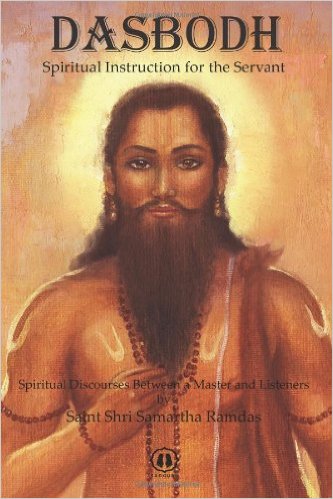


 Tom Das