‘It is wrong to call Self the Witness’ – Sri Ramana Maharshi

The following is an excerpt from this post: Is the Self a witness? Or is it everything? Or both?
Sri Ramana Maharshi has taught us in Guru Vachaka Kovai verse 98 (Guru Vachaka Kovai is the most authoritative record of Sri Ramana Maharshi’s verbal teachings according to Sri Ramana Ashram):

98. Unless the body is taken to be ‘I’, otherness – the world of moving and unmoving objects – cannot be seen. Hence, because otherness – the creatures and their Creator – does not exist, it is wrong to call Self the Witness.

Sri Sadhu Om, a direct devotee of Sri Ramana Maharshi, writes in his commentary on this verse:

Descriptions of self as the ‘witness of the individual soul’ (jiva sakshi) or the ‘witness of everything’ (sarva sakshi), which can be found in some sacred texts, are not true but are only figurative (upacara), because only when other things are known would the one who knows them be a ‘witness’ of them. Since self does not know anything in the state of absolute oneness, which is devoid of any other thing, to what can it be a witness? Therefore describing self as a ‘witness’ is incorrect.

What both Sri Ramana Maharshi and Sri Sadhu Om are saying is that objects only appear when the ego/ignorance is present. In Self-realisation, there are no objects, only the Self, so in truth the Self cannot be said to be a witness.

In verse 869 of Guru Vachaka Kovai Sri Ramana teaches us:

869. ’Tis a foolish fancy to ascribe the role of ‘witness’ to the Self, the luminous Sun, the mighty sky of Pure Awareness. In the Self Immutable there is no room for maya’s darkness void. The Self is one sole whole without a second.

Here is an alternative translation of the same verse, with Sri Sadhu Om’s commentary, which essentially states in truth, ie. in realisation, there is no Maya in the Self. It is only for ajnani’s, ie. the ignorant, that consider the Self to be a witness of phenomena/maya:

869. The role [dharma] of seeing is ascribed to Self – the space of consciousness, the sun – only in the imagination of ajnanis, [because] maya, the empty ignorance [of seeing otherness], never exists in Self, the support [sthanu], [and also because] Self is without a second.

Sri Sadhu Om’s comments: Since Self is in truth that which transcends all roles and all qualities, and since It exists as one without a second, to glorify It as the ‘witness of all’ [sarva-sakshi] or as the ‘knower of all’ [sarvajna] is merely the folly of ignorant people.

Also see: The practice of witnessing thoughts and events was never even in the least recommended by Sri Ramana Maharshi

For those attached to the world, the world is considered to be a divine manifestation. For the advanced seeker, the world is considered to be an illusion | Advaita Vedanta | Sri Ramana Maharshi | Ajata Vada

For those seekers who are attached to the world, the world is considered to be a divine manifestation. For the more advanced seeker, the world is considered to be an illusion. Many teachers teach this the wrong way around – this, of course, is itself due to their attachment to the world, ie. this wrong teaching is due to ignorance.

This is why Sri Ramana says, right at the start in the beginning few verses of The Garland of Gurus Sayings (Guru Vachaka Kovai), in verse 21:

21. For those who take the world appearance as real and enjoy it, it is the Lord’s creation. But for those who, free from fear, have known the Truth, the undeluded Self, it is no more than a mere mental image projected by desire.

For those who are fearful of the world, Sri Ramana gives the following even more radical advice in the same text, verse 28:

28. Ye who in fear shrink from the world, know that the place has no existence. Fear of this phenomenal world is like being frightened by a rope mistaken by you for a snake.

In verse 35 he uses the same analogy as Gaudapada (in his commentary on Mandukya Upanishad, Mandukya Karika), of a glowing flame whirled in a circle:

35. The empirical world of jostling names and forms is false and has no real existence in bright, full Awareness. Like a ring of fire formed in the dark when one whirls fast a glowing joss-stick, ’tis an illusion, mind-created.

The idea here is that in the dark (ie. in ignorance), a whirling flame appears as a world (that is a body, a mind and a world), but in the light (ie. in self-knowledge or self-realisation, also known as liberation), it is not seen at all.

Sri Ramana explains this in page 193 of Day by Day with Bhagavan when he states:

‘In reality, saying ‘We must see Brahman in everything and everywhere’ is also not quite correct. Only that state is final, where there is no seeing, where there is no time or space. There will be no seer, seeing and an object to see. What exists then is only the infinite eye.’

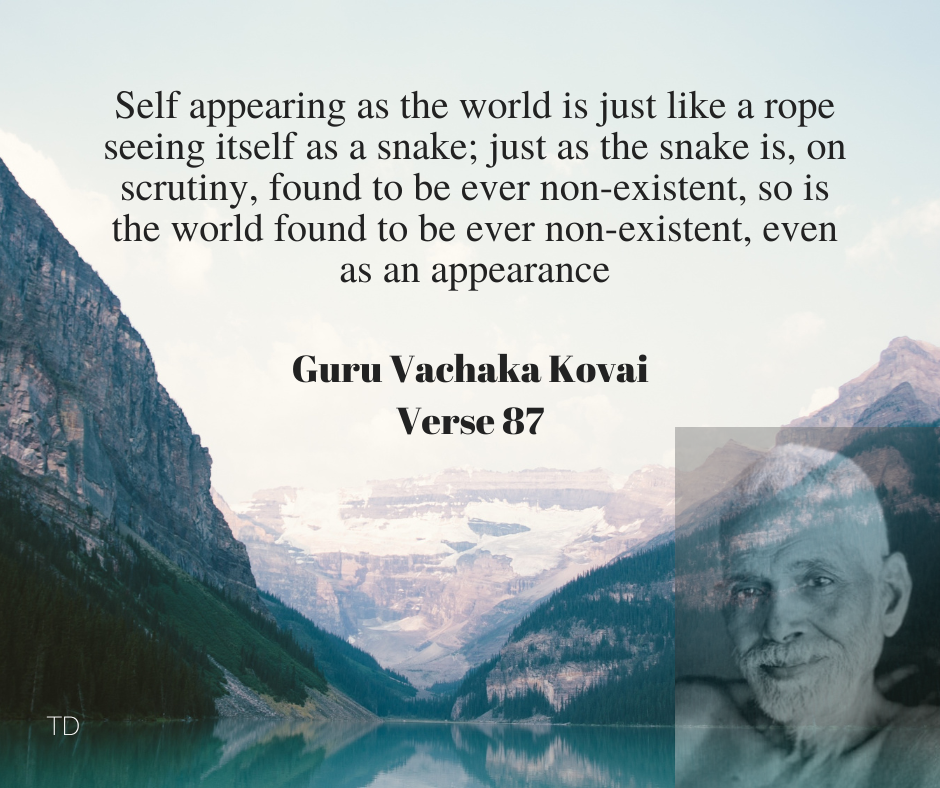
Similarly, Sri Ramana says in Guru Vachaka Kovai, verse 87:

‘…just as the snake is, on scrutiny, found to be ever non-existent, so is the world found to be ever non-existent, even as an appearance

And in Guru Ramana Vachana Mala, verse 21, Sri Ramana gives us the Ajata teaching, that no-thing ever really came into existence at all:

There is no mind, nor body, nor world, nor anyone called a soul; the One pure Reality alone exists, without a second, unborn and unchanging, abiding in utter Peace’

For more on this teaching see here and here

Namaste

There is no Duality in Non-duality | Self-knowledge

[Sri Ramana Maharshi writes in] Upadesa Undiyar verse 26, “Being Self is itself knowing Self, because Self is that which is devoid of duality…“.

Therefore it follows that the very nature of Self is itself knowledge, though it is a knowledge which is devoid of the act of knowing.

That is why Sri Bhagavan says in verse 12 of Ulladu Narpadu, “ … That which knows cannot be [true] knowledge … “.

The same truth is also expressed by Sri Muruganar in verse 831 of Mey Tava Vilakkam, where he says, “The real ‘I’ is such a knowledge which knows neither other things nor itself”.

Since Self-knowledge is non-dual, it is a knowledge which shines without the triad [triputi] – the knower, the act of knowing and the object known – and hence it is quite different from other kinds of knowledge, all of which involve the act of knowing.

~ Sri Sadhu Om, commentary on Guru Vachaka Kovai verse 1038

Conscious sleep (Jagrat Sushupti) is Self-knowledge | Sri Ramana Maharshi | Guru Vachaka Kovai

959. O men who, caught by the dangerous snares of the world and struck by the sharp arrows of cruel miseries, are suffering greatly and are wandering in search of the attainment of supreme bliss, the sleep in which there is no loss of consciousness [i.e. wakeful sleep or jagrat-sushupti] alone is the imperishable happiness.

~Sri Ramana Maharshi, Guru Vachaka Kovai

Commentary by Sri Sadhu Om:

The sleep in which there is no loss of consciousness’ [arivu-azhiya tukkam] means only the state of Self-knowledge.

‘Here consciousness [arivu] means prajna or the knowledge of one’s own existence, and not the knowledge of other things.

That which knows other things is not true knowledge [see Ulladu Narpadu verse 12]. The state we call sleep is the state in which we know no other things, not even the body.

‘The state we call waking is the state in which, along with the knowledge of one’s own existence [‘I am’], there is also knowledge of other things.

‘The state in which we remain conscious merely of our own existence, like in waking, but in which the mind [the knower of other things] does not rise, like in sleep, is called the state of conscious sleep or wakeful sleep.

‘Since no other thing is known in this state, it is a sleep; and since one’s own existence is shining clearly there, it is a state of consciousness or waking.’

960. Those who are sleeping, having given up the habit of [going out through] the deceitful senses and having become established in the heart-lotus, are those who are awake in the abode of real knowledge [mey-jnana]. Others are those who are asleep, being immersed in the dense darkness of this unreal world [poy-jnala].

~Sri Ramana Maharshi, Guru Vachaka Kovai

The Purpose behind the Various and Diverse Theories of Creation in the Vedas | Advaita Vedanta | Sri Ramana Maharshi

Why do the different portions of the Vedas describe creation in different ways? Their sole intention is not to proclaim a correct theory of creation, but to make the aspirant enquire into the Truth which is the Source of creation.

~ Sri Ramana Maharshi, Guru Vachaka Kovai, Verse 102

Here, in one of the earliest texts Sri Ramana authored he wrote the following in response to the following question:

Question: If the entire universe is of the form of mind, then does it not follow that the universe is an illusion? If that be the case, why is the creation of the universe mentioned in the Veda?

Sri Ramana Maharshi: There is no doubt whatsoever that the universe is the merest illusion. The principal purport of the Veda is to make known the true Brahman, after showing the apparent universe to be false. It is for this purpose that the Vedas admit the creation of the world and not for any other reason.

Moreover, for the less qualified persons creation is taught, that is the phased evolution of prakriti (primal nature), mahat-tattva (the great intellect), tanmatras (the subtle essences), bhutas (the gross elements), the world, the body, etc., from Brahman: while for the more qualified simultaneous creation is taught, that is, that this world arose like a dream on account of one’s own thoughts induced by the defect of not knowing oneself as the Self. Thus, from the fact that the creation of the world has been described in different ways it is clear that the purport of the Vedas rests only in teaching the true nature of Brahman after showing somehow or other the illusory nature of the universe.

That the world is illusory, every one can directly know in the state of realization which is in the form of experience of one’s bliss-nature.

~ Sri Ramana Maharshi, Self Enquiry (Vichara Sangraham)

Sri Sadhu Om also wrote a commentary on the above verse of Guru Vachaka Kovai (verse 102), as follows:

‘If creation were true, the scriptures would describe it in only one manner, but their diverse theories make it clear that creation is not the truth. To enable ripe aspirants to discover the falsity of the notion of creation, the Vedas purposely teach contradictory theories. However, such contradictions are found only in the descriptions of creation, they never occur when the Vedas attempt to describe the nature of Self, the Supreme. Concerning Self, they all agree and speak in one voice, saying ‘Self is One, Perfect, Whole, Immortal, Unchanging, Self-shining etc., etc.’ From this we should understand that the deep intention behind such conflicting theories of creation is to indirectly show aspirants the necessity of enquiring into Self, which is the Source of all ideas of creation.’

Who can conceive of the state of the Jnani? Sri Sadhu Om | The true nature of the Jnani. The true nature of Jnana | Advaita Vedanta | Sri Ramana Maharshi

The following verse is taken from Guru Vachaka Kovai verse 1105 followed by commentary by Sri Sadhu Om, a direct devotee of Sri Ramana Maharshi’s who spent several years with him. Guru Vachaka Kovai is recognised as being the most authoritative exposition of Sri Ramana Maharshi’s verbal teachings, and can be downloaded in full here. For this particular verse, Sri Ramana Maharshi has also re-written the verse so we have 2 forms of the same verse:

1105. The Jnani, the unchanging one, who is sleeping naturally within the body, does not know His activities [vyavahara] in the world, His absorption [nishtha] and His sleep, just as one who is sleeping in the cart does not know the moving of the cart, its standing still and its lying [with the bullocks unyoked].

The above verse was rewritten by Bhagavan Sri Ramana Maharshi in the form of the following verse, which is also included in Ulladu Narpadu – Anubandham (Supplement to 40 verses on reality) as verse 31:

B21. To the knower of the reality [mey-jnani], who is asleep within the fleshy body, which is [like] a cart, His activities [in waking and in dream], His absorption [nishtha] and His sleep are similar to the moving of the cart, its standing still and the cart being unyoked, to one who is sleeping in the cart

Commentary by Sri Sadhu Om: The bodily life of a Jnani appears to be real only from the perspective of others. So ignorant people [ajnanis] think, “This Jnani is performing activities here in the waking state.”

But since the Jnani is verily bodiless, He does not know those activities; to Him the body and its activities are completely non-existent.

Just as the traveler who is sleeping in a bullock cart does not know the movement of the cart, and just as a sleeping child does not know that he is taking food, so also the Jnani does not know the state in which the body, the senses and the mind are active.

When the body, the senses and the mind of a Jnani remain without activities, people think, “This Jnani is in samadhi.” This is similar to the state where the oxen remain yoked to the cart but are motionless. Even this state of samadhi or nishtha is not known to the Jnani; for Him it is completely non-existent. When people think, “This Jnani is sleeping,” this state of apparent deep sleep in which his body, his senses and his mind seem to be unconscious, is similar to the cart that is with the unyoked oxen.

Just as the fact that the car is undone is not known to the traveler who sleeps in the car, so also the state of deep sleep is not known to the Jnani; for him this state it is completely non-existent.

Therefore, these three different states in the life of a Jnani seem to exist only under the erroneous perspective of the ajnanis, who see the bodiless Jnani as a body.

For the Jnani, the state of activity [wakefulness and sleep], the state of samadhi and the state of deep sleep do not really exist.

That is why Sri Bhagavan says in verse 31 of Ulladu Narpadu:

Who can conceive and how what his [the Jnani’s] state is?

~ above text is by Sri Sadhu Om in his commentary on Guru Vachaka Kovai verses 1105 and B21

For more on the same topic, please also see here:

For those attached to the world, the world is considered to be a divine manifestation. For the advanced seeker, the world is considered to be an illusion

What exactly is Jnana (self-knowledge) according to Shankara and Gaudapada and the scriptures?

How can the Jnani (sage) function with NO THOUGHTS? Sri Ramana Maharshi

Ramana Maharshi: how to abide as the Self, the world is not real, attend to yourself

Does the Sage (Jnani) see the world? Does the world appearance exist after liberation?

Multiplicity, plurality and polarity ARE duality | Non-duality | Sri Ramana Maharshi

The nature of liberation | Manonasa by Michael Langford | Ramana Maharshi | PDF download

Does the liberated Jnani or Sage see the body, the mind, the world or the 3 states of deep sleep, waking and dream according to Sri Ramana Maharshi and Sri Adi Shankara?

Does Jnana (or Self-Enquiry) lead to Bhakti (or Self-Surrender) or the other way round? Sri Ramana Maharshi

This is one of a series of introductory articles – please see the homepage of tomdas.com for more introductory articles.

Some say that self-enquiry eventually culminates in surrender, and others say the opposite. Which is true? By the way, Self-Enquiry can also be referred to the path of Jnana (Knowledge or Wisdom) and Self-Surrender is also known as the path of Bhakti (love or devotion).

Ramana Maharshi has sometimes said it one way, and other times another, and other times said they are the same path. Again, which of these is true?

Let us see definitively what Sri Ramana says about this (surrender = Bhakti; Self-enquiry = jnana) in Guru Vachaka Kovai*, a text that is widely considered to be the most authoritative, reliable and comprehensive collection of the verbal teachings of Sri Ramana Maharshi:

722. When scanned, bhakti supreme and jnana
Shine as in their essence one.
Saying that one of them is but
A means to the other is only due
To understanding neither
.

723. Even those who know may sometimes seem
To honour this saying and so prefer
One or the other of these paths.
This is in order to prevent
Some seeker half-way on one path
From giving it up and choosing the other
.

724. When one adopting self-enquiry
Reaches the journey’s end and gains
Samadhi’s bliss, it is solely due
To the grace of God
, one’s inmost Self,
Life of one’s life.

725. Unless the Self, the God within,
By power of grace pulls in the mind
,
Who has the strength through his own effort
To stop the rogue mind’s outward drift
And merge it in the Heart and so
Gain peace?

728 To tell the truth, God’s grace supreme
And the keen quest “Who am I?”,
Which means abidance in the Heart,
Will work together as mutual aids
And bring one to the state of oneness
With the Self supreme.

729 This maya world-dream will not end
Unless the Self within speaks out.
The enquiry, “Who is the dreamer
Of this dream?” is prayer addressed
To Him
to speak and wake us up.

730. It is said that meditation
On one’s own being [Tom: ie. Self-enquiry] is supreme
Devotion to all-transcending God,
Because, though spoken of as two,
They are in substance one
.

731. The way of knowledge and the way of love
Are interwoven close. Don’t tear
Asunder these inseparables
.
But practise both together holding
In the heart the two as one.

Meditation on the Self
Is devotion to the Lord

Supreme, since He abides as this,
Our very Self.
– SRI BHAGAVAN 13

*Guru Vachaka Kovai, or The Garland of Guru’s sayings, is widely considered to be the most authoritative, reliable and comprehensive collection of the verbal teachings of Sri Ramana Maharshi. Here is what Ramana Ashram states about the Guru Vachaka Kovai in the foreword of their publication of it:

‘[Guru Vachaka Kovai] provides the most precise, systematic and authoritative exposition of Sri Bhagavan’s teaching, explaining step by step the theory, the practice and the experience of jnana, the Truth supreme which is Being as Life Eternal, Pure Awareness, Perfect Bliss. Thus, the most comprehensive collection of the Maharshi’s sayings is Guru Vachaka Kovai.’

The paths of knowledge and love are more fully explained in the text The Path of Sri Ramana which you can download for free here. This is one of the few texts that goes into detail into both the paths of knowledge and love.

Also see:

Non-dual devotion, worship and prayer

Ramana Maharshi on those who ridicule idol-worship or image-worship

The paths of Devotion and Knowledge – Bhakti vs Jnana | Advaita Vedanta

Bhakti Yoga as a complete path to Final Liberation

Sri Ramana Maharshi: the necessity of Meditation

Authentic living, authentic spirituality – teachings by Sri Ramana Maharshi

The following teaching verses on how to live a truly authentic life are taken from the text Guru Vachaka Kovai (The Garland of Guru’s sayings, you can download the entire text here). According to Sri Ramana Ashram, as explained in the foreward of the book ‘…[Guru Vachaka Kovai] provides the most precise, systematic and authoritative exposition of Sri Bhagavan’s teaching, explaining step by step the theory, the practice and the experience of jnana, the Truth supreme which is Being as Life Eternal, Pure Awareness, Perfect Bliss. Thus, the most comprehensive collection of the Maharshi’s sayings is Guru Vachaka Kovai…’

Chapter 40: Authentic Living

1089 Life you desire. But how to live
You know not. Thinking that this sinking
Deep in this void, vain, illusive
Waking-dream is ‘life’, you proudly
Claim you ‘live’. Pierce this illusion,
Go, grasp the Truth, eternal life.

Tom: Bhagavan Sri Ramana gives a radical interpretation as to what true authentic living actually is. Thinking this world to be real and living in it in this way is not authentic living at all. People who proudly strut about the world proclaiming how authentic their life is are merely dabbling in ego and illusion, so says the Ever-Living-Sage. What is authentic living then? Let us see what Bhagavan says in the following verses:

1090 Shun anger and desire; destroy
Illusions false that cause confusion,
Behave at all times with detachment
Calm. This is authentic living.
To this hold fast.

Tom: What should we hold fast to? Let us see:

1091 Abiding as Self-being, living
A life that is a steady flow
Unhindered of true love welling up
In the heart, this is the bright, joyous
Sivahood, which ends forever
The inveterate, false, deceitful ego.

Tom: we should know by now that all of Bhagavan Ramana’s teaching point to turning within to attain Self-Knowledge, to discover that which we truly are, which is the same as being that which you truly are. Here we are specifically advised to shun anger and desire, be calm and detached, and turn within to discover our true radiant being as Being, Self, Love. The discovery of what we truly are ends this false deceitful ego as well as the ‘void and illusive’ waking-dream.

1092 The seers who have placed at Siva’s Feet
All their life’s burdens and now live
Lives sublime of calm detachment
And shine in radiant purity,
They alone possess true beauty,
They alone enjoy true bliss.

Tom: Surrender life’s burdens to Shiva, the Self Supreme

1093 That Heart which truly knows the Self
Is full of love whence Bliss supreme
Wells up forever. There desire,
And its shadow, sorrow, have no place.
Such a life whose nature pure,
From Being flows serenely calm.

Tom: with self-knowledge, desire and sorrow naturally fall away, there being no ‘place’ for them to sustain themselves and exist. Here is the next verse Sri Ramana makes the teaching especially clear. What is authentic living? It is simply to Be or Abide As the Self.

1094 The only goal worth seeking is
The bliss supreme of Self-Awareness
.
Constant remembering and abiding
As That within the heart amounts
To plenitude of life.

Tom: Sri Ramana drives the point home that living a worldly life in the waking dream, which is a false illusion, is not at all the truly authentic life at all. Rather it is maya, illusion, with all its suffering and seeming-separation.

1095 Such a life of Grace alone
Is life lived in full, real Being.
This worldly life of false phenomena
Full of fear is sinking deeper
In illusion, not authentic living.

Tom: In the next verse that which was previously implied but not stated is now stated: the senses are turned within, no longer seeing the world, no longer interested in that which is not at all real or existent.

1096 Those whose five senses turn no longer
Towards the world which once seemed real,
Those who have learned to live without
Their minds being moved by the illusive
Universe of forms, they need
Perform no penance.

Tom: Revelling only in the Self Supreme, total Bliss, Love and Peace. This is the only authentic life – eternal life.

!Om Namo Bhagavate Sri Ramanaya Om!