Sri Nisargadatta Maharaj: in self-realisation there is no perception of a body, mind or world | Ajata | Advaita Vedanta | Maya and illusion

The following quotes are all from Sri Nisargadatta Maharaj (NM), taken from the book ‘I Am That’ by Sri Nisargadatta Maharaj.

NM gave many different teachings, depending on the level of the seeker and the context. The ego-mind often clings to the lower teachings for safety and security – here only the higher teachings are included, so please only read the following if you have a deep and sincere interest in liberation.

If you read carefully, you will see the following themes stated and expounded by NM:

  1. The self-realised jnani has no consciousness of having a body.
  2. The self-realised jnani has no consciousness of a world or phenomena arising.
  3. The apparent consciousness of the world is only due to ignorance, also known as the ‘I thought’ or the ‘I am the body sense’. This ignorance is also known as ‘imagination’, ‘illusion’, ‘ego’ or ‘the mind’.
  4. Ignorance of what you truly are projects the (false) appearance of a world, which includes the appearance of the body-mind and world. These do not appear to a jnani.
  5. All conversation, teachings, words and thoughts are in illusion only, as are all teachers. Similarly, birth and death only (appear to) exist for the ignorant.

These are of course the Ajata teachings, and you can read about them here in this article and also in the introductory articles on the tomdas.com homepage.

Some may say that this notion of liberation is not appealing at all (for the ego-mind), but of course it is actually everything you are looking for and more. It is the treasure found within, this is the ‘kingdom of God’ within us. Anything less and the seeking, the doubts and the sense of ego will not end, and so suffering and duality will continue; hence the value of these teachings in reminding us to continue to go further with our sadhana until all objective phenomena have dissolved rather than stop prematurely.

Many of these quotes below are also found in the wonderful book The Seven Steps to Awakening, one of the best books ever written on self-realisation and liberation. This book goes much further than this article and clearly describes other aspects of the teaching including the method by which self-realisation can be attained.

Here are the quotes from Sri Nisargadatta Maharaj:


The body and mind are only symptoms of ignorance, of misapprehension.

——-

He who knows the state in which there is neither the world nor the thought of it, he is the Supreme Teacher.

——-

What do you know of me, when even my talk with you is in your world only?

——-

NM: The body appears in your mind; in my mind nothing is.
Q: Do you mean to say you are quite unconscious of having a body?
NM: On the contrary, I am conscious of not having a body.
Q: I see you smoking!
NM: Exactly so. You see me smoking. Find out for yourself how did you come to see me smoking, and you will easily realize that it is your ‘I am the body’ state of mind that is responsible for this ‘I see you smoking’ idea.

——-

Nothing dies. The body is just imagined. There is no such thing.

——-

In my world nothing happens

——-

Without imagination there is no world.

——-

If you seek real happiness, unassailable and unchangeable, you must leave the world with its pains and pleasures behind you.

——-

You are neither the body nor in the body – there is no such thing as body

——-

NM: My world is real, while yours is made of dreams
Q: Yet we are talking.
NM: The talk is in your world. In mine – there is eternal silence. My silence sings, my emptiness is full, I lack nothing. You cannot know my world until you are there.

——-

It is not at all as you imagine and I am not bound by your imaginings.

——-

Q. If all that passes has no being, then the universe has no being either
NM: Who ever denies it? Of course the universe has no being.

——-

In reality, nothing ever happens.

——-

No doubt imagination is richly creative. Universe within universe are built on it. Yet they are all in space and time, past and future, which just do not exist.

——-

In pure consciousness nothing ever happens

——-

The moment you allow your imagination to spin, it at once spins out a universe.

——-

There is no body, nor a world to contain it; there is only a mental condition, a dreamlike state, easy to dispel by questioning its reality.

——-

All experience is born of imagination; I do not imagine, so no birth or death happens to me.

——-

To take appearance for reality is a grievous sin and the cause of all calamities

——-

It is by your consent that the world exists. Withdraw your belief in its reality and it will dissolve like a dream.

——-

What is real is nameless and formless.

——-

Do understand that what you think to be the world is your own mind

——-

I take my stand where no difference exists, where things are not, nor the minds that create them. There I am at home.

——-

All thinking is in duality. In identity [Tom: ie. self realisation] no thought surives

——-

Now go within, into a state in which you may compare to a state of waking sleep, in which you are aware of yourself, but not of the world. In that state you will know, without the least trace of doubt, that at the root of your being you are free and happy.

——-

To know yourself, turn your attention away from the world and turn it within.

——-

The world appears to you so overwhelmingly real, because you think of it all the time; cease thinking of it and it will dissolve into thin mist.

——-

To see what Sri Ramana Maharshi thought of the same Ajata teachings please see this article here.

This article here also goes into what Shankara wrote on these Ajata teachings.

Tom, please can you explain verse 32 of Ulladu Narpadu (40 verses on Reality, a text written by Sri Ramana Maharshi)? The vedas have declared ‘Thou art That’ | Self-Enquiry | Tat Tvam Asi

Questioner: Hi Tom, can you please explain verse 32 of Ulladu Narpadu (40 verses on Reality, a text written by Sri Ramana Maharshi)?

When the Vedas have declared, ‘Thou art That’ – not to seek and find the nature of the Self and abide in It, but to think ‘I am That, not This’ is want of strength. Because, That abides forever as the Self.

Sri Ramana Maharshi, Ulladu Narpadu, Verse 32

Tom: The idea is that we should turn within and discover what we truly are by inwardly and intuitively going towards the sense of ‘I’. When we go within in this way (this is also called self-enquiry) our mind becomes increasingly withdrawn and we start to discover, and eventually do discover, what we actually are: the formless, eternal, birthless, deathless Spirit that is devoid of objectivity, multiplicity, ego and suffering.

If instead of discovering what we truly are, we remain extroverted, sensing and perceiving objects and multiplicity, and merely repeat or think to ourselves ‘I am that’ or ‘all is already one’ or something like this, then we are fooling and deceiving ourselves, and we are weak and uncourageous, for we are not applying ourselves and developing true bravery or strength, which is turning within, away from the world, to discover our actual nature.

🙏

Shankara teaches two methods to ‘attain liberation’ (Self-Knowledge or Atma-Jnana) | Swami Satchidanandendra Saraswati (SSS) | Advaita Vedanta

Swami Satchidanandendra Saraswati (SSS) was a great Sanskrit scholar who made an extensive study of Shankara’s writings and commentaries and subsequently wrote many books on Advaita Vedanta. According to SSS, there are essentially 2 methods to ‘attain liberation’ outlined by Sri Shankara:

1. Firstly, in those who are ripe, merely hearing (sravana) a teaching equating oneself with Brahman, will result in liberation. For some who are slighlty less ripe, some repeated contemplation (manana) upon this teaching will be required too. (Tom’s addition: A ripe mind may be a mind that is rendered extremely pure and subtle by long and sustained spiritual practice, or a mind may be ripe due to other more mysterious factors including ‘God’s Grace’.)

2. Secondly, for those who are not able to ‘attain liberation’ merely by hearing +/- contemplating a teaching such as ‘you are that’, one must also undergo prolonged meditation (nididyasana) which will directly result in liberation.

We can see that Bhagavan Sri Ramana Maharshi broadly states the same here.

SSS in his text the Theory of Vedanta writes on p. 153:

‘In addition to Karma and Upasana, there is a kind of concentrated contemplation called the Adhyatma-Yoga which leads to immediate intuition [of Brahman, ie. Self Realisation]’

You can see that SSS is stating that this Adhyatma-Yoga is not classified as ‘karma’ or action, and is also not classed as Upasana (meditation on objects), but is something else that is a direct means of knowledge or liberation.

SSS writes in ‘The Method of Vedanta’ p. 147:

‘The aim of the one practising sustained meditation (nididhyasana) is different [to Upasana, defined here as meditation on forms/objects]. He tries to attain direct vision of reality (here in this very world) by turning his mind away from all else [ie. all objects]. And there is the difference — as against upasana — that after the rise of knowledge nothing further remains to be done. It is this sustained meditation that is referred to at Kathha Upanishad I.ii.12 by the name ‘Adhyatma Yoga’. In the Gita it is sometimes called ’Dhyana Yoga’ (e.g. XVI11.52). In the Mandukya Karikas it is called ’restraint of the mind’ (G.K.III.41, etc.). Its nature is described there in that latter work. Everywhere its result is described in the same way as right metaphysical knowledge, and from this comes immediate liberation (sadyo-mukti).’

You can see that SSS defines Upasana as meditation upon objects, and that this is considered to be action or karma (and so will not directly lead to realisation), whereas nididhyasana is a special type of meditation which involves turning away from objects, and this type of meditation is not considered to be ‘karma’ or action, but a direct means to knowledge (as karma pertains to objects only, not to the actionless subject).

Here again this is stated more clearly in the introduction to the text Adhyatma Yoga:

‘The subject dealt with here viz. Adhyatma Yoga, also known as Dhyana Yoga, Mano-nigraha Yoga, Samadhi Yoga and Nidhidhyasana, is treated these days as a Kartru Tantra Sadana. But in the Shankara Bhashya throughout, this Adhyatma Yogi or Dhyana Yoga is treated as a Vastu Tantra Sadhana’

Kartru Tantra Sadana means action, which being limited, will therefore not lead to something unlimited (ie. liberation or the Self). Vastu Tantra Sadhana means something that will lead directly to the Supreme Truth (Vastu), ie. that which is a means of Knowledge or Liberation.

In summary, SSS writes on p 143 of The Method of Vedanta’:

‘the highest kind of candidate is able to acquire immediate intuitive vision that his Self is the Absolute from merely hearing the relevant upanishadic texts once. These people who realize the goal by merely hearing the texts once have nothing further to do…

‘…But those who are not able to acquire intuitive knowledge of the meaning of the texts in their own direct experience have to go on hearing the texts and reflecting over them to remove the doubts that prevent their meaning being understood, and they have to continue with this until intuitive knowledge arises. For we see that those of dull understanding acquire knowledge through diligent repetition…

‘…But those who cannot acquire intuitive knowledge of reality by hearing and reflection alone have to resort to sustained meditation also. In any case, the general rule is that hearing and the rest have to be continued until there is intuitive knowledge of reality. For attainment of intuitive knowledge of reality is their purpose’

To see how SSS and Shankara define meditation or nididhyasana, see here: What is Vedantic Meditation?

To see how Sri Ramana gives the same teaching, see here: Sravana alone can result in Self-Realisation! Sri Ramana Maharshi on Sravana, Manana and Nididhyasana

THERE IS NO RESTING IN THE I AM

‘Rest in the I Am’

Objection:

There is no resting in the ‘I Am’

Tom:

Resting is the nature of I Am.

I suspect you mean that the ego, which is of the nature of ‘doing’ cannot ‘do resting’ as the I Am.

The resolution of this conundrum is that when the ego turns towards the I Am or the Self, it disappears.

A common objection is that anything the ego does, such as ‘trying to rest as the I AM’ just perpetuates the ego.

However, this is just a logical supposition, ie. it is a belief, based on logic, and is not actually the way it is.

In practice, when the ego-I turns inwards, it disappears. Ego is only of the nature of movement, or doing, and when it turns inwards, towards the I Am, which is of the nature of being (ie. no movement, not doing), the ego-I becomes still and disappears.

Being an illusion, it, the ego-I, never really was.

Namaste

Nisargadatta Maharaj: the essence of his teachings in four simple quotes

Here are four quotes of Sri Nisargadatta Maharaj that conveys the essence of his teachings. They are all taken from the book I Am That. Read them several times, contemplate what he is trying to convey, and put the teachings into practice.

Best wishes!

See Also:

Nisarga Yoga explained (Nisargadatta Maharaj’s teachings summarised)
How Nisargadatta Maharaj attained self-realisation
How to know God. How to see God
IN BRIEF: HOW TO ATTAIN LIBERATION (MOKSHA)

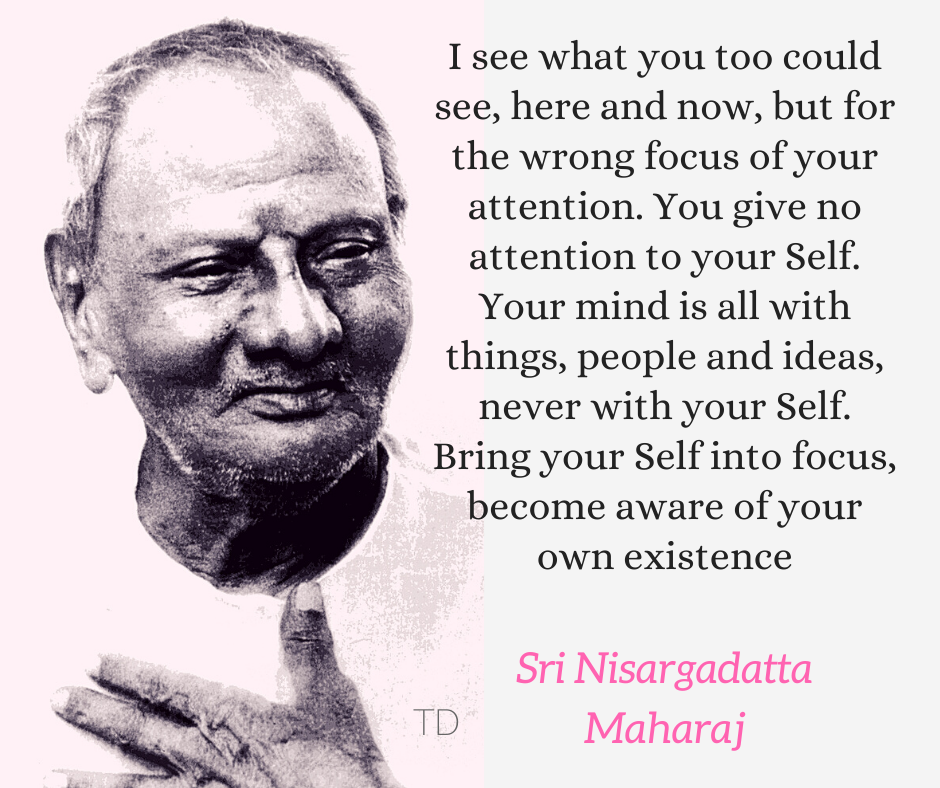
Nisargadatta focus on your Self

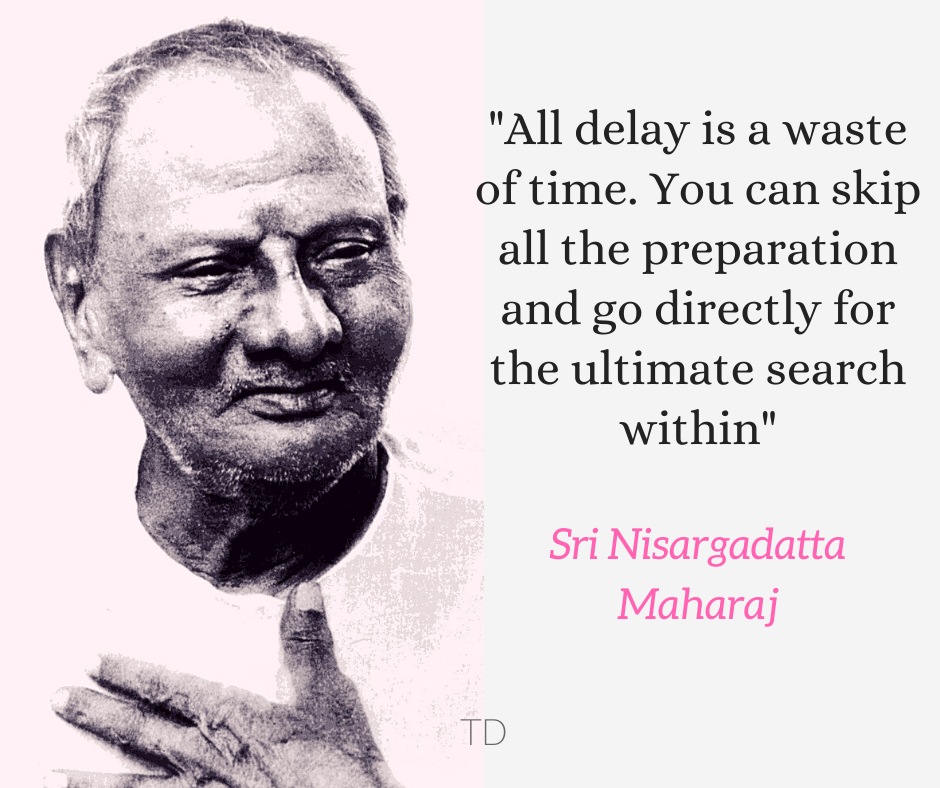
Nisargadatta all delay is a waste of time

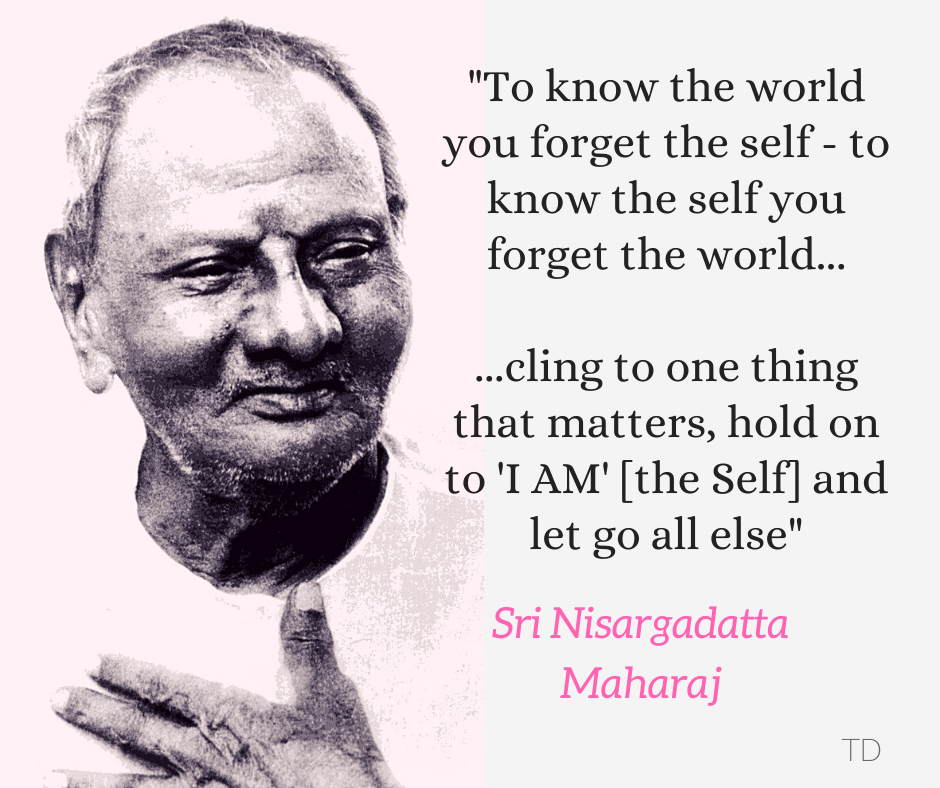
Nisargadatta cling to one thing that matters

Nisargadatta the only way is practice

False Gurus & Finding the True Teacher – Nisargadatta Maharaj

The following are quotes from Nisargadatta Maharaj, taken from the book ‘I Am That’. The subheadings are my own additions; I have also added bold type where I felt emphasis would be useful:

I Am That

False gurus

Questioner: You were telling us that there are many self-styled Gurus, but a real Guru is very rare. There are many jnanis who imagine themselves realised, but all they have is book knowledge and a high opinion of themselves. Sometimes they impress, even fascinate, attract disciples and make them waste their time in useless practices. After some years, when the disciple takes stock of himself, he finds no change. When he complains to his teacher, he gets the usual rebuke that he did not try hard enough. The blame is on the lack of faith and love in the heart of the disciple, while in reality the blame is on the Guru, who had no business in accepting disciples and raising their hopes. How to protect oneself from such Gurus?

Maharaj: Why be so concerned with others? Whoever may be the Guru, if he is pure of heart and acts in good faith, he will do his disciples no harm. If there is no progress, the fault lies with the disciples, their laziness and lack of self-control.

On the other hand, if the disciple is earnest and applies himself intelligently and with zest to his sadhana, he is bound to meet a more qualified teacher, who will take him further.

Your question flows from three false assumptions: that one needs concern oneself with others; that one can evaluate another and that the progress of the disciple is the task and responsibility of his Guru. In reality, the Guru’s role is only to instruct and encourage; the disciple is totally responsible for himself.


On surrender to a guru

Q: We are told that total surrender to the Guru is enough, that the Guru will do the rest.

M: Of course, when there is total surrender, complete relinquishment of all concern with one’s past, presents and future, with one’s physical and spiritual security and standing, a new life dawns, full of love and beauty; then the Guru is not important, for the disciple has broken the shell of self-defence. Complete self-surrender by itself is liberation.


What if both guru and seeker are inadequate?

Q: When both the disciple and his teacher are inadequate, what will happen?

M: In the long run all will be well. After all, the real Self of both is not affected by the comedy they play for a time. They will sober up and ripen and shift to a higher level of relationship.

Q: Or, they may separate.

M: Yes, they may separate. After all, no relationship is forever. Duality is a temporary state.


Is meeting a guru a chance occurrence?

Q: Is it by accident that I met you and by another accident shall we separate never to meet again? Or is my meeting you a part of some cosmic pattern, a fragment in the great drama of our lives?

M: The real is meaningful and the meaningful relates to reality. If our relationship is meaningful to you and me, it cannot be accidental. The future affects the present as much, as the past.


How can I determine a True Guru?

Q: How can I make out who is a real saint and who is not?

M: You cannot, unless you have a clear insight into the heart of man. Appearances are deceptive. To see clearly, your mind must be pure and unattached. Unless you know yourself well, how can you know another? And when you know yourself – you are the other.

Leave others alone for some time and examine yourself. There are so many things you do not know about yourself – what are you, who are you, how did you come to be born, what are you doing now and why, where are you going, what is the meaning and purpose of your life, your death, your future? Have you a past, have you a future? How did you come to live in turmoil and sorrow, while your entire being strives for happiness and peace? These are weighty matters and have to be attended to first. You have no need, nor time for finding who is a jnani and who is not?

Tom: ie. knowing yourself is the chief aim, and this should be the focus of your attention, not concerning yourself about who is a real jnani/guru and who isn’t.

Q: I must select my guru rightly.

M: Be the right man and the right Guru will surely find you.

Nisarga Yoga explained (Nisargadatta Maharaj’s teachings summarised)

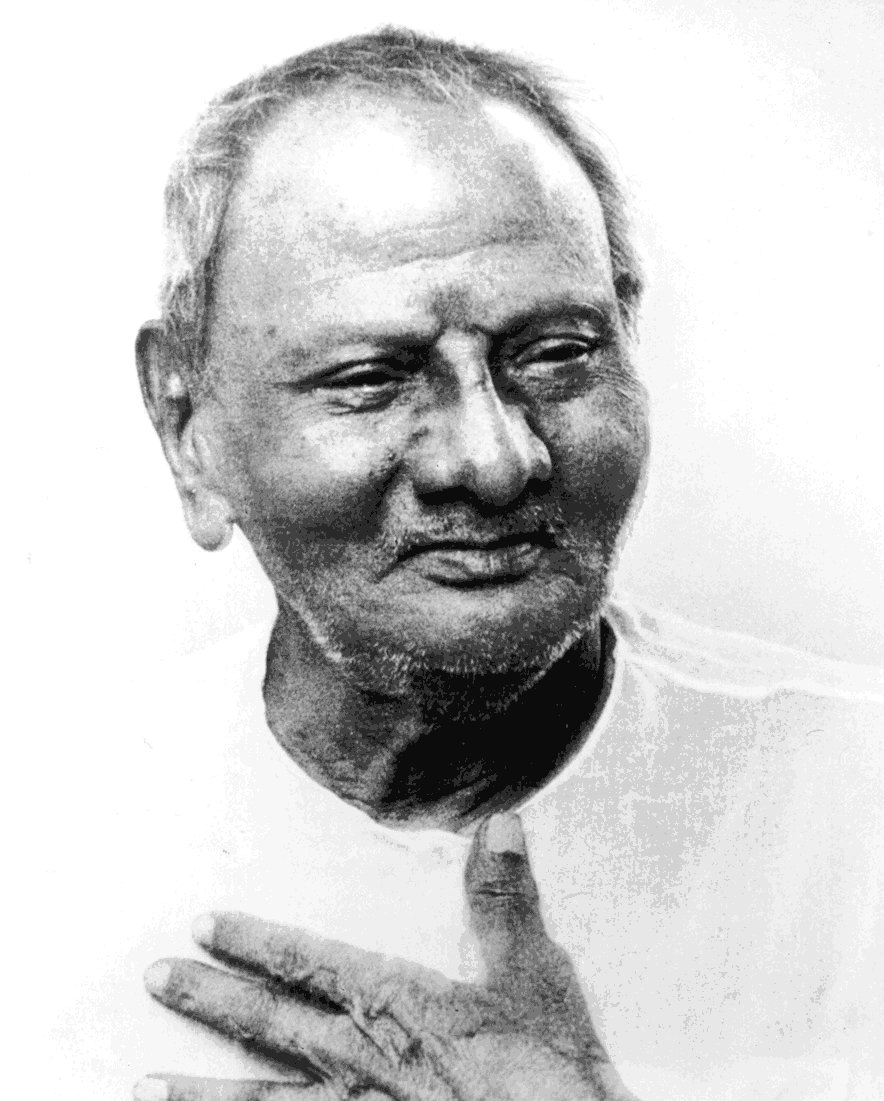
Nisargadatta Maharaj

The following text is a summary of Nisargadatta Maharaj’s teaching and was written by Maurice Frydman, the translator and editor of ‘I Am That’, Nisargadatta’s most widely read work. The text was entitled ‘Nisarga Yoga’ which, as Maurice Frydman explains below, means ‘the easy or natural yoga’, and it was originally published as an appendix to ‘I Am That’.

The text below is essentially the same as how it was originally published except for my addition of bold type for emphasis of what I felt were key points for a seeker of liberation.

I have also made a compilation of direct quotes from Nisargadatta Maharaj which fully explains his method for the discerning reader.

Wishing you peace and realisation

Tom


In the humble abode of Sri Nisargadatta Maharaj, but for the electric lights and the noises of the street traffic, one would not know in which period of human history one dwells. There is an atmosphere of timelessness about his tiny room; the subjects discussed are timeless – valid for all times; the way they are expounded and examined is also timeless; the centuries, millennia and yugas fall off and one deals with matters immensely ancient and eternally new.

The discussions held and teachings given would have been the same ten thousand years ago and will be the same ten thousand years hence. There will always be conscious beings wondering about the fact of their being conscious and enquiring into its cause and aim. Whence am I? Who am I? Whither am I? Such questions have no beginning and no end. And it is crucial to know the answers, for without a full understanding of oneself, both in time and in timelessness, life is but a dream, imposed on us by powers we do not know, for purposes we cannot grasp.

Maharaj is not a learned. There is no erudition behind his homely Marathi; authorities he does not quote, scriptures are rarely mentioned; the astonishingly rich spiritual heritage of India is implicit in him rather than explicit. No rich Ashram was ever built around him and most of his followers are humble working people cherishing the opportunity of spending an hour with him from time to time.

Simplicity and humility are the keynotes of his life and teachings; physically and inwardly he never takes the higher seat; the essence of being on which he talks, he sees in others as clearly as he sees it in himself. He admits that while he is aware of it, others are not yet, but this difference is temporary and of little importance, except to the mind and its ever-changing content. When asked about his Yoga, he says he has none to offer, no system to propound, no theology, cosmology, psychology or philosophy. He knows the real nature – his own and his listeners’ – and he points it out. The listener cannot see it because he cannot see the obvious, simply and directly. All he knows, he knows with his mind, stimulated with the senses. That the mind is a sense in itself, he does not even suspect.

The Nisarga Yoga, the ‘natural’ Yoga of Maharaj, is disconcertingly simple – the mind, which is all becoming, must recognise and penetrate its own being, not as being this or that, here or there, then or now, but just as timeless being.

This timeless being is the source of both life and consciousness. In terms of time, space and causation it is all-powerful, being the causeless cause; all-pervading, eternal, in the sense of being beginningless, endless and ever-present. Uncaused, it is free; all-pervading, it knows; undivided, it is happy. It lives, it loves, and it has endless fun, shaping and re-shaping the universe. Every man has it, every man is it, but not all know themselves as they are, and therefore identify themselves with the name and shape of their bodies and the contents of their consciousness.

To rectify this misunderstanding of one’s reality, the only way is to take full cognisance of the ways of one’s mind and to turn it into an instrument of self-discovery. The mind was originally a tool in the struggle for biological survival. It had to learn the laws and ways of Nature working hand-in-hand can raise life to a higher level. But, in the process the mind acquired the art of symbolic thinking and communication, the art and skill of language. Words became important. Ideas and abstractions acquired an appearance of reality, the conceptual replaced the real, with the result that man now lives in a verbal world, crowded with words and dominated by words.

Obviously, for dealing with things and people words are exceedingly useful. But they make us live in a world totally symbolic and, therefore, unreal. To break out from this prison of the verbal mind into reality, one must be able to shift one’s focus from the word to what it refers to, the thing itself.

The most commonly used word and most pregnant with feelings, and ideas is the word ‘I’. Mind tends to include in it anything and everything, the body as well as the Absolute. In practice it stands as a pointer to an experience which is direct, immediate and immensely significant. To be, and to know that one is, is most important. And to be of interest, a thing must be related to one’s conscious existence, which is the focal point of every desire and fear. For, the ultimate aim of every desire is to enhance and intensify this sense of existence, while all fear is, in its essence, the fear of self-extinction.

To delve into the sense of ‘I’ – so real and vital – in order to reach its source is the core of Nisarga Yoga. Not being continuous, the sense of ‘I’ must have a source from which it flows and to which it returns. This timeless source of conscious being is what Maharaj calls the self-nature, self-being, swarupa.

As to the methods of realising one’s supreme identity with self-being, Maharaj is peculiarly non-committal. He says that each has his own way to reality, and that there can be no general rule. But, for all the gateway to reality, by whatever road one arrives to it, is the sense of ‘I am’. It is through grasping the full import of the ‘I am’, and going beyond it to its source, that one can realise the supreme state, which is also the primordial and the ultimate. The difference between the beginning and the end lies only in the mind. When the mind is dark or turbulent, the source is not perceived. When it is clear and luminous, it becomes a faithful reflection of the source. The source is always the same – beyond darkness and light, beyond life and death, beyond the conscious and the unconscious.

This dwelling on the sense ‘I am’ is the simple, easy and natural Yoga, the Nisarga Yoga. There is no secrecy in it and no dependence; no preparation is required and no initiation. Whoever is puzzled by his very existence as a conscious being and earnestly wants to find his own source, can grasp the ever-present sense of ‘I am’ and dwell on it assiduously and patiently, till the clouds obscuring the mind dissolve and the heart of being is seen in all its glory.

The Nisarga Yoga, when persevered in and brought to its fruition, results in one becoming conscious and active in what one always was unconsciously and passively. There is no difference in kind – only in manner – the difference between a lump of gold and a glorious ornament shaped out of it. Life goes on, but it is spontaneous and free, meaningful and happy.

Maharaj most lucidly describes this natural, spontaneous state, but as the man born blind cannot visualise light and colours, so is the unenlightened mind unable to give meaning to such descriptions. Expressions like dispassionate happiness, affectionate detachment, timelessness and causelessness of things and being – they all sound strange and cause no response. Intuitively we feel they have a deep meaning, and they even create in us a strange longing for the ineffable, a forerunner of things to come, but that is all. As Maharaj puts it: words are pointers, they show the direction but they will not come along with us. Truth is the fruit of earnest action, words merely point the way.

Maurice Frydman