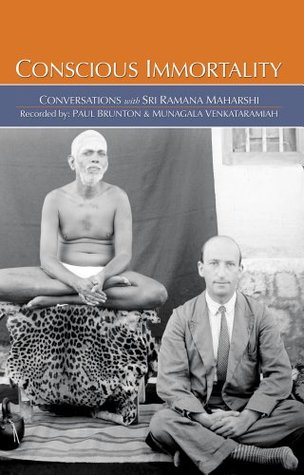
Ramana Maharshi: a quick and simple method to self-realisation

ramana umbrella

In the deep sleep state we lay down our ego [ahankara],
our thoughts and our desires.

If we could only do all this while we are conscious,
we would realise the Self.

(excerpted from Conscious Immortality, Chapter 13)

For more on this topic see the following links:

Ramana Maharshi: the method of wakeful sleep (Jagrat Sushupti) to attain liberation
Ramana Maharshi: Conscious Immortality
Ramana Maharshi – limitation is only in the mind

Ramana Maharshi: Conscious Immortality

Conscious Immortality Ramana Maharshi

The following is taken from Chapter 14 of Conscious Immortality and is instructive about the path to complete liberation. As often is the case with Ramana’s writings, there is much packed into each phrase. My comments have been interspersed in blue italics, and I pray you find these to be of assistance. If they are not, please feel free to ignore them:

“The Self is like a powerful hidden magnet within us. It draws us gradually to itself, though we imagine we are going to it of our own accord.

Tom: we imagine that we are seeking, whereas actually we are being moved by the Self, as is everything else likewise being orchestrated by Oneness. Next the basic teaching is given in concise form:

“When we are near enough, it puts an end to our other activities, makes us still, and then swallows up our own personal current, thus killing our personality. It overwhelms the intellect and over floods the whole being.

Tom: the teaching goes like this: first we naturally drop and turn away from outer (egoic) activities as we realise that we no longer need them. Then we become still. Lastly after having been still for some time, our personhood is ‘swallowed up’ by the self. Then all that remains is fullness, the Self. That’s all there ever was.

“We think we are meditating upon it and developing towards it, whereas the truth is that we are as iron filings and it is the Atman-magnet that is pulling us towards itself. Thus the process of finding Self is a form of Divine Magnetism.

Tom: again the notion of personal doership is being undercut here – we are all but puppets of the Lord. We take ourselves to be the orchestrator of our actions, whereas we are His instruments playing His song. So does this mean that we do not have to practice?

It is necessary to practise meditation frequently and regularly until the condition induced becomes habitual and permanent throughout the day. Therefore meditate.

You lost sight of the bliss because your meditative attitude had not become natural and because of the recurrence of vasanas. When you become habitually reflective, the enjoyment of spiritual beatitude becomes a matter of natural experience.

Tom: Ramana instructs us to practice meditation regularly, so that the meditative attitude becomes the predominant habitual way of being. How to meditate? This will be explained below:

“It is not by a single realisation that “I am not the body but the Atman” that the goal is reached. Do we become high in position by once seeing a king? One must constantly enter into samadhi and realise one’s Self, and completely blot out the old vasanas and the mind, before it becomes the Self.

Tom: here Ramana makes a central point. It is often mistakenly thought that realising who you are is a one time affair. However here Ramana emphasises that this realisation alone is insufficient for true liberation to dawn. One must time and time again sink into Samadhi and remove the habitual tendencies (vasanas) that cause us to identify as a finite body-mind entity. This simple but essential teaching is often side-stepped by those who would like the fruits of liberation without the need to actually practice and drive out the vasanas/habitual ignorance.

The example that one cannot become a king simply by seeing a king is cited by Ramana. This example is reminiscent of that given in Chapter 7 of Advaita Bodha Deepika, one of Ramana’s favourite texts, where it is repeatedly told that mere knowledge of the king by a beggar does not transform the beggar into a king. Similarly, the jiva is not so easily transformed into the Self, so to speak, by simply knowing of the Self. So, how can the jiva be ‘transformed into the Self’? Ramana will enlighten us:

“If you keep to the thought of the Self, and be intently watching for it then even that one thought which is used as a focus in concentration will disappear and you will BE, the true Self. Meditation on Self is our natural state.

Only because we find it hard do we imagine it to be an arbitrary and extraordinary state. We are all unnatural.

The mind resting in the Self is its natural condition, but instead of that our minds are resting in outward objects. After the expulsion of name and form (nama-rupa) which compose the external world, and by dwelling on existence-knowledge-bliss (sat-chit-ananda), take care to prevent the re-entry into the mind of the expelled name and form.

Tom: here the essence of spiritual practice is given: we are to rest as the self. How to do that? We are to not rest in outward objects, we are to pay no attention to name and form (nama-rupa) and instead dwell on awareness-consciousness-Being-Bliss, which is our own true nature. This is simply Self abiding as Self, or Being being Being.

We are to take care not to allow the mind to again shoot outwards into the world and dwell on the forms (that it itself projects).

We are to cultivate thought of this Self, and eventually this thought too will disappear and all that will be left is Self without any trace of jiva or the idea that I am a limited body-mind entity.

We can see that this is the same teaching that is given in the Upanishads and by Sri Shankara in Vivekachudamani and in Shankara’s Commentaries.

Roger Castillo and Tom Das: a Joint Satsang 2018

Please join us for Satsang this week:

A Joint Satsang with Roger Castillo and Tom Das
Thursday 16th August, 7pm
The Druids’s Head Pub, Kingston Upon Thames, UK

For more details see link below. Please RSVP if you would like to attend so we can get an idea of numbers:

https://www.meetup.com/Non-duality-Kingston-London/events/brwqlpyxlbvb/

Ramana Maharshi: How to bring spiritual practice (sadhana) into daily life

41k1lywu0sl

Many people find it difficult to engage in spiritual practices (sadhanas) during the ups and downs of daily life. In the following dialogue recounted by Devaraja Mudaliar, a questioner asks Ramana Maharshi 5 questions related to this:

Mr. Joshi put five questions. I give below the questions and Sri Bhagavan’s answers:

Question 1: Should I go on asking ‘who am I?’ without answering? Who asks whom? Which bhavana (attitude) should be in the mind at the time of inquiry? What is ‘I’, the Self or the ego?

Answer: In the inquiry Who am I? ‘I’ is the ego. The question really means, ‘what is the source or origin of this ego?’ You need not have any bhavana in the mind. All that is required is, you must give up any bhavana that you are the body, of such and such description, with such and such a name, etc., There is no need to have a bhavana about your real nature. It exists as it always does. It is real and no bhavana.

Question 2: I cannot be always engaged in this inquiry, for I have got other work to do, and when I do such work, I forget this quest.

Answer: When you do other work, do you cease to exist? You always exist. Do you not?

Question 3: Without the sense of doership, – the sense ‘I am of doing’ – work cannot be done.

Answer: It can be done. Work without attachment. Work will go on even better than when you worked with the sense that you were the doer.

Question 4: I don’t understand what work I should do and what not.

Answer: Don’t bother. What is destined as work to be done by you in this life, will be done by you, whether you like it or not.

Question 5: Why should I try to realize? I will emerge from this state, as I wake up from a dream. We do not make an attempt to get out of a dream during sleep.

Answer: In a dream, you have no inkling that it is a dream and so you don’t have the duty of trying to get out of it by your own effort. But in this life, you have some intuition, by your sleep experience, by reading and hearing, that this life is something like a dream, and hence the duty is cast on you to make an effort and get out of it. However, who wants you realize the Self if you don’t want it? If you prefer to be in the dream, stay as you are.

With reference to question 4, Mrs. P.C. Desai quoting the Bhagavad Gita asked Bhagavan: If (as Arjuna was told) there is a certain work destined to be done by each and we shall eventually do it however much we do not wish to do it or refuse to do it, is there any freewill?

Bhagavan said: ‘It is true that the work meant to be done by us will be done by us. But it is open to us to be free from the joys and pains, pleasant and unpleasant consequences of the work, not identifying ourselves with the body or that which does the work. If you realize your true nature, and know that it is not you, that does any work, you will be unaffected by the consequences of whatever work the body may be engaged in according to destiny or past karma or divine plan, however you may call it. You are always free and there is no limitation of that freedom.’

(The above excerpt is from Day by Day with Bhagavan, pages 88-90) 

Tom’s Comments:

Here we can distil several key points:

1. You always exist, regardless of whether you are thinking about it or not, regardless of what you are doing.

2. The issue is that you take yourself to be the body-mind and therefore you take yourself to be a doer who has to choose what actions to do and suffer the consequences thereof. Instead relinquish the idea that you are the body-mind, and don’t take yourself to be the doer of any actions or receiver of pleasure/pain. You do not need to cultivate a specific bhavana (attitude or feeling).

3. When you don’t take yourself to be the body-mind-doer-receiver, life still continues and the body-mind appearance still is able to fulfil its responsibilities – in fact it becomes more efficient in doing so.

4. Whatever is destined to happen will happen regardless of your desires about this.

5. Effort must be made to cast off the ignorance ‘I am the body-mind-doer-receiver’. However there is no obligation for you to do this. If you wish to remain in ignorance, in the dream in which you believe yourself to be a separate body-mind, that is fine.

6. You are, in truth, always ever free. You are the Self. Know this and remain naturally unaffected by the life-appearance. In this way sadhana (spiritual practice) is in no way opposed to daily life.

Om Guru Ramana!

Q. Does liberation even exist? If it’s here and now, why don’t I experience it?

Q. Hey Tom. I had one question to ask, if you don’t mind. Is Mukti (liberation) even there? Is there something called Liberation? If it’s there here and now, why don’t I feel it? And when it should be the most obvious thing, that is my own existence, why don’t I experience it, or rather recognize it? And what is the purpose of the world if it exists but doesn’t exist. A complete paradox, isn’t it?

Tom: Liberation just means removal of wrong ideas/what is false. Nothing is gained, mistakes are lost. Make sense?

Q. Yes. I’m on the same page. But if it’s so evident, why am I missing it?

Tom: Who says you are missing it? The mind?

Q. Yes

Tom. Why believe the mind? Be still my friend ❤

Q. So belief is the reason for all misery, isn’t it?

Tom: Bondage is an illusion of the mind only. Bondage = suffering.

Q. Be still and know that I’m God. But I know this well, I experience it, sometimes. But when problems arise, I’m carried away with it. How to recollect the Self always?

Tom: Practice.

Q. What is the best way of practicing this? Apart from Self-enquiry?

Tom: See here:

https://tomdas.com/2018/06/24/spiritual-liberation-some-essential-instructions/

Or here:

https://tomdas.com/2018/06/13/letting-go-of-liberation/

Or here:

https://tomdas.com/2018/05/05/the-natural-path-to-the-natural-state/

Q. Okay. I will read it. But liberation itself is an idea that I have to let go to completely enjoy bliss, isn’t it?

Tom: Have a read 🙂

<Sometime later>

Q. Thanks. It was a great read. 🙂🙏🏻


Spiritual Liberation – Some Basic Practice Instructions

still waters.jpg

Take your time with each of these, really take your time with them…

1. Do not get involved with life. Allow the body-mind to look after itself. Allow everything to come and go.

2. Relax and be still.

3. Do not take yourself to be a person, a body-mind. Here the questions ‘Who am I?’ and ‘From where does ‘I’ arise?’ can be useful initially, as can the assertions ‘I am not the body-mind-world’ and ‘I am That’. Relaxation and stillness are also useful here.

4. To rest in that state where one is aware but no ‘I’ thought arises is stillness. In time resting here will lead to realisation, but there must be no thought of realisation as this itself is a disturbance, a distortion.

5. Know that all is nothing,
Everything is nothing,
Nothing is here…
There is only That…

…not even That.