Stop thinking, and end your problems.
What difference between yes and no?
What difference between success and failure?
Must you value what others value, avoid what others avoid?
How ridiculous!
Tao Te Ching, verse 20
Tom’s comments:
Free of thoughts, where are your problems?
We do not need to shun thought in its entirety, just not buy into the suffering it creates through comparison and moral judgement.
We can see through the values, ideals and standards that other people and society dictate to us. We can see through the received wisdom of the day.
We can let go and be real, discover who we truly are – we can discover what it is to be human for ourselves and not simply force ourselves to fit into an ideological mould, no matter how reasonable it sounds. We can be who we are.
And who are we? Are we separate from the world that gave birth to us? Are we separate from the environment that shaped and influences us? Are we wholly good or bad? 0r can good come from bad and vice versa? Can failure lead to success?
I put it to you: all things are interdependent, and no things exist by themselves.
just for the purpose of breaking through obsessions, doubts,
intellectual interpretations & egocentric ideas
Yuanwu (1063-1135)
Tom’s comments:
If there was ever a dogma in Zen Buddhism* (and there is no dogma by the way) it is that there is no fixed Zen teaching. In Yuanwu’s letters, from which this quote was taken, Yuanwu gives us a no frills introduction and foray into the heart of Zen.
And so we hear of zen teachings ranging from reading the scriptures to simply hearing the sound of a ringing bell; from seeing an object drop to the ground to the admittedly extreme physical blows that are often dished out (and received) by zen masters as a form of teaching – not a method I would advocate, I hasten to add.
So the teaching methods and expressions of truth may vary from person to person and from time and place, forged out of the cultures and characters of the moment. This is why the teaching reinvents itself from generation to generation, and varies from teacher to teacher, even when the core teaching and core ‘realisation’ is the same.
*Yuanwu was actually Chinese, so strictly speaking he is a Chan Master. When Chan Buddhism spread to Japan it became known as Zen, Zen simply being the Japanese word for Chan.
If you try to figure it out, if you try to look for it, you have already missed it, for you have presupposed incompleteness, you have assumed the presence of lack.
Where is the lack? In what way are you incomplete?
It is the mind that tells you you need something else, the mind that ‘says this is not enough’.
There is no need to believe the mind and the stories (lies) it spews forth: it is already here, ‘LACKING NOTHING AT ALL’, and you are it.
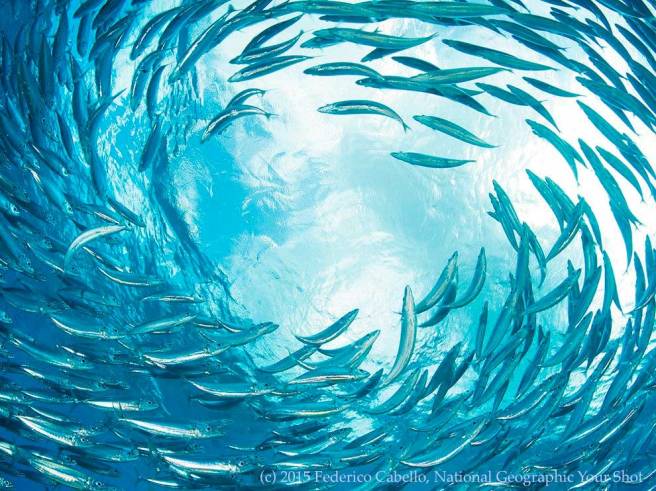
Shoal of Sardines, Photograph by Federico Cabello, National Geographic Your Shot
The mass of unenlightened spiritual seekers,
trying to figure it all out,
trying to see their True Natures,
like the proverbial fish looking for water,
or the lady looking everywhere for her necklace,
only to find it on her neck.
The trying-to-figure-it-all-out is the suffering.
A horde of egos,
trying to be happy,
struggling to attain Bliss and Peace,
like someone using a bloodied towel to wipe up blood,
like a person in quicksand sinking ever deeper with each attempt to be free.
The trying-to-be-happy is the suffering.
Why bother?
Why argue with what is?
What’s wrong with right here, right now?
(It is the mind that tells you otherwise)
Stop:
Water is here all you around you, dear fish!
My lady, you look stunning in your necklace!
The splattered blood is perfect, right where I wanted it to be!
When you stop moving, look, the quicksand disappears!
‘No, don’t stop’ says the mind ‘There’s more, just around the corner your prize awaits.’
‘Just go that one bit further and you’ll have it figured out.’
‘Peace and Bliss are yours. You are much more than just this.‘
The mind believes the mind,
thought believes its thinking.
The mind thinks it is the doer,
and so thinks it can do something about this.
But what can be done? And who/what can do it?
This cannot be figured out (by the ego/doer/mind).
How can the ego realise it does not exist?
What can you do to realise there is no doer?
There is nobody here!
So how can there be anything to do?
Look:
Actions happen by themselves,
according to the nature of things:
planets orbit the sun,
the wind blows,
rivers flow,
seeds sprout,
plants grow,
babies are born,
hearts beat,
lungs breathe,
minds think,
bodies act…
Nobody doing any of it,
all of it happening anyway,
all of it choicelessly accepted,
by the all-embracing awareness,
that is none other than our ordinary everyday experience:
spontaneously present,
spontaneously aware.
Did we ask to be aware?
Did we create awareness?
Did we create our experiences?
Or did our awareness spontaneously arise?
Or did experience and experiences spontaneously appear?
Seeing this,
it is seen.
Did you chose to be a seeker?
Did you chose to take yourself to be a doer?
See, you are not in control,
for there is no evidence of a controller.
Why believe in that for which there is no evidence?
Look:
There is no mass of unenlightened seekers at all,
The horde of egos is but an imagined illusion.
No unenlightened people,
no enlightened people,
Just what is.
All there is is life,
a uni-versal process,
a vast interconnected web,
spanning from celestial bodies to nervous systems,
one system operating…
The following is an excerpt from the book Zen Mind, Beginner’s Mind by Shunryu Suzuki:
If you want to obtain perfect calmness in your zazen, you should not be bothered by the various images you find in your mind. Let them come, and let them go. Then they will be under control. But this policy is not so easy. It sounds easy, but it requires some special effort. How to make this kind of effort is the secret of practice.
Suppose you are sitting under some extraordinary circumstances. If you try to calm your mind you will be unable to sit, and if you try not to be disturbed, your effort will not be the right effort. The only effort that will help you is to count your breathing, or to concentrate on your inhaling and exhaling. We say concentration, but to concentrate your mind on something is not the true purpose of Zen. The true purpose is to see things as they are, to observe things as they are, and to let everything go as it goes. This is to put everything under control in its widest sense.
The true purpose is to see things as they are, to observe things as they are, and to let everything go as it goes.
Zen practice is to open up our small mind. So concentrating is just an aid to help you realise ‘big mind’, or the mind that is everything.
If you want to discover the true meaning of Zen in your everyday life, you have to understand the meaning of keeping your mind on your breathing and your body in the right posture in zazen.
You should follow the rules of practice and your study should become more subtle and careful. Only in this way can you experience the vital freedom of Zen.
Meditation is never the control of the body. There is no actual division between the organism and the mind. The brain, the nervous system and the thing we call the mind are one, indivisible. It is the natural act of meditation that brings about the harmonious movement of the whole. To divide the body from the mind and to control the body with intellectual decisions is to bring about contradiction, from which arise various forms of struggle, conflict and resistance.
Every decision to control only breeds resistance, even the determination to be aware. Meditation is the understanding of the division brought about by decision. Freedom is not the act of decision but the act of perception. The seeing is the doing. It is not a determination to see and then to act. After all, will is desire with all it’s contradictions. When one desire assumes authority over another, that desire becomes will. In this there is inevitable division. And meditation is the understanding of desire, not the overcoming of one desire by another. Desire is the movement of sensation, which becomes pleasure and fear. This is sustained by the constant dwelling of thought upon one or the other.
And meditation is the understanding of desire, not the overcoming of one desire by another.
Meditation really is a complete emptying of the mind. Then there is only functioning of the body; there is only the activity of the organism and nothing else; then thought functions without identification as the me and the non-me. Thought is mechanical, as is the organism.
Meditation really is a complete emptying of the mind. Then there is only functioning of the body
What creates conflict is thought identifying itself with one of its parts which becomes the me, the self and the various divisions in that self. There is no need for the self at any time. There is nothing but the body, and freedom of the mind can only happen when thought is not breeding the me.
What creates conflict is thought identifying itself with one of its parts which becomes the me…
There is no self to understand but only the thought which creates the self. When there is only the organism without the self , perception, both visual and non-visual can never be distorted. There is only seeing ‘what is’ and that very perception goes beyond what is. The emptying of the mind is not an activity of thought or an intellectual process. The continuous seeing of what is without any kind of distortion naturally empties the mind of all thought and yet that very mind can use thought when it is necessary. Thought is mechanical and meditation is not.
There is only seeing ‘what is’ and that very perception goes beyond what is.
Excerpt taken from J. Krishnamurti, ‘The Beginnings of Learning’
My awakening experience whilst reading Krishnamurti:
 Stop thinking, and end your problems.
 Everything is happening,




 Being,


