The following excerpt is taken from the book “How to see yourself as you really are” by the Dalai Lama:
What makes all this trouble in the world? Our own counterproductive emotions. Once they are generated, they harm us both superficially and deeply. These afflictive emotions accomplish nothing but trouble from beginning to end. If we tried to counteract each and every one individually, we would find ourselves in an endless struggle. So what is the root cause of afflictive emotions that we can address more fruitfully? Continue reading →
No sadhanas are required
No sadhana (spiritual practice) can lead to self realisation. No map can take you to where you already are, and no practice can transform you into that which you always have been.
All sadhanas such as meditation, mindfulness, mantra, puja, selfless service and devotion – all sadhanas are for the illusory individual. They are an extension of greed/egotism. It is this web of illusion, all hinged upon the idea of being a person with a body and mind, that prevents the obvious from being ‘seen’. Continue reading →
I recall walking in the gardens of a local convent in Autumn last year. After meandering around for a while I found my self standing by a tree. I looked up to see a dark angular leaf-less branch silhouetted against a luminous evening blue sky. There was complete stillness and a sense of vastness. The universe was functioning, but “I” was not there. Everything was happening by itself, seemingly magical and uncaused. The silence was deafening, as they say. The universe was, as ever, mysterious, strange and peaceful. It was both familiar and unfamiliar at the same time. Continue reading →
I was reading a passage from J. Krishnamurti’s slim book called meditations which reminded me of a passage from The Gospel According to Matthew. The language they use is strikingly similar. I’ll start with the biblical passage as it’s shorter:
But when you pray, go into your room, close the door and pray to your Father, who is unseen. Then your Father, who sees what is done in secret, will reward you.
Matthew 6:6
The heart of the teachings are just this. Here is the most excellent of sadhanas (spiritual practices). Gotta love Swami Chinmayananda for keeping it real. I especially like the way he says “I am not insulting you”:
The following is an excerpt from a talk by Jiddu Krishnamurti:
….Surely, it is only by understanding ourselves patiently, quietly, unobtrusively, that we begin to discover, experience something which is not of our own creation; and it is that which brings about help, which begins to clear the field of our vision.
But you cannot ask for that help; it must come to you darkly, uninvited.Continue reading →
Questioner: As a child fairly often I experienced states of complete happiness, verging on ecstasy: later, they ceased, but since I came to India they reappeared, particularly after I met you. Yet these states, however wonderful, are not lasting. They come and go and there is no knowing when they will come back.
Nisargadatta Maharaj: How can anything be steady in a mind which itself is not steady?
Q: How can I make my mind steady?
M: How can an unsteady mind make itself steady? Of course it cannot. It is the nature of the mind to roam about. All you can do is to shift the focus of consciousness beyond the mind.
Q: How is it done?
M: Refuse all thoughts except one: the thought ‘I am’. The mind will rebel in the beginning, but with patience and perseverance it will yield and keep quiet. Once you are quiet, things will begin to happen spontaneously and quite naturally without any interference on your part.
Q: Can I avoid this protracted battle with my mind?
M: Yes, you can. Just live your life as it comes, but alertly, watchfully, allowing everything to happen as it happens, doing the natural things the natural way, suffering, rejoicing — as life brings. This also is a way.
Q: Well, then I can as well marry, have children, run a business… be happy.
M: Sure. You may or may not be happy, take it in your stride.
Q: Yet I want happiness.
M: True happiness cannot be found in things that change and pass away. Pleasure and pain alternate inexorably. Happiness comes from the self and can be found in the self only. Find your real self (swarupa) and all else will come with it.
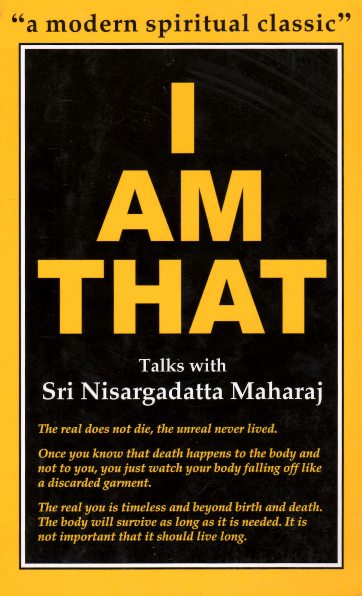
The above excerpt is from I Am That by Nisargadatta Maharaj
Tom’s comments:
There are so many gems in just this short passage! First Maharaj points out the mind need not be directly controlled and that the very nature of the mind is to roam, ruminate and be unsteady. Instead focus on something else: the sense ‘I AM’. Then the goal of a quiet mind will naturally arise.
Maharaj then gives us more: if we are not drawn to this sadhana (spiritual practice), then we can try an alternative. Instead we can surrender to whatever happens, keeping a watchfulness about ourselves whilst we do so. This, rather like the ‘I AM’ sadhana, also has the effect of quietening the mind and prevents the ego having room to manoevure. The ‘I’ which is always trying to meddle in things is cut off, restricted. There is much more to how these methods work and how they can be practised – I have written an article hereexplaining more on this.
Lastly Maharaj gives us a final nugget: ‘True happiness cannot be found in things that change and pass away.’
Experience, knowledge, insight and consciousness all come and go – so where does this leave us? Where can we seek if we do not seek in this world of impermanent things? Here we pass from the domain of the mind to that which is beyond words. Call it ‘true self’ (swarupa) or ‘no-self’, words do not apply.
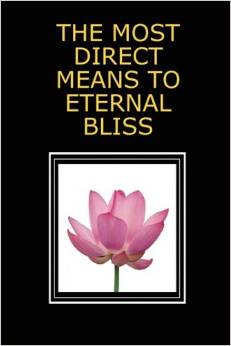
The following is an excerpt from a book rather modestly titled ‘The Most Direct Means To Eternal Bliss’.
Despite some tendency towards grandiosity, this book is actually pretty amazing in my opinion. I think it was written as a labour of love and has been uploaded to the internet for free viewing by the author here. You can also buy a hard copy here which contains a single extra chapter (which was written later).
Be warned, this book and its tone may not be for everyone. It is radical, focused, in some ways quite narrow, and not at all modest. However the advice dispensed is actually very good in the context in which it was written and the teachings are made extremely clear. The initial chapters alone are worth the purchase price in my opinion (plus it’s free online anyway)
“As you walked on the beach the waves were enormous and they were breaking with magnificent curve and force. You walked against the wind, and suddenly you felt there was nothing between you and the sky, and this openness was heaven.
To be so completely open, vulnerable – to the hills, to the sea, and to man – is the very essence of meditation. To have no resistance, to have no barriers inwardly towards anything, to be really free, completely, from all the minor urges, compulsions, and demands, with all their little conflicts and hypocrisies, is to walk in life with open arms.
And that evening, walking there on that wet sand, with the sea gulls around you, you felt the extraordinary sense of open freedom and the great beauty of love which was not in you or outside you – but everywhere.”
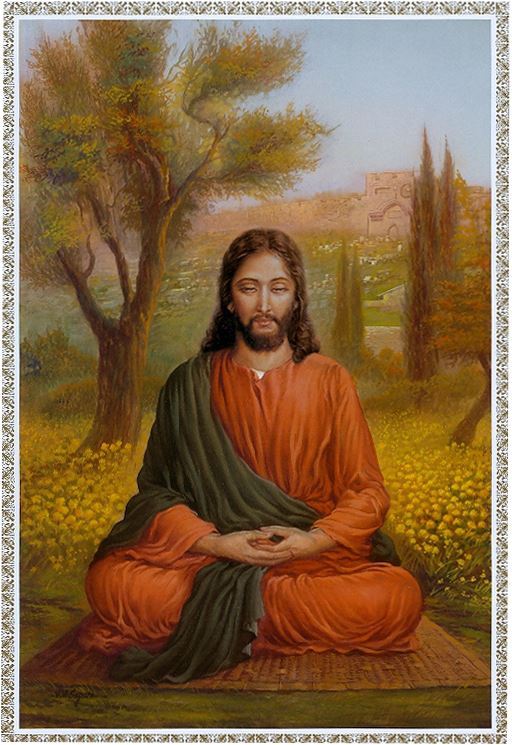
For me, the answer is he probably did. Let me preface this by stating the obvious: I don’t actually know for sure what Jesus did. I don’t even want to get into the ‘did Jesus exist’ debate in this post. But if we take the New Testament at face-value (I don’t want to get into this debate either) it seems to me that he did meditate, or at least engage in contemplative-meditative practices. Continue reading →



 Tom Das