Ramana Maharshi – limitation is only in the mind

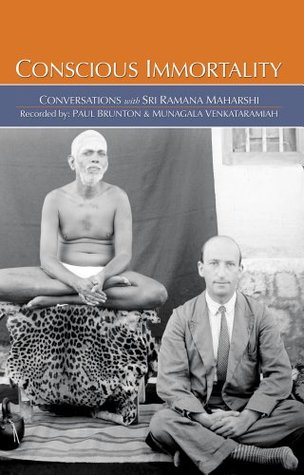
Conscious Immortality Ramana Maharshi

In sleep, in trance, in absent-mindedness there is no differentiation. What is that which was then but is absent now? The difference is due to mind.

The mind is sometimes present and at other times absent; there is no change in the Reality.

The same person who was in sleep is now too, in waking. The Self is the same all through.

Limitation is only in the mind.

The same Self is here and now, in the wakeful state, as in deep sleep when no limitation is felt. There was no mind in sleep whereas it is now active. The Self exists in the absence of mind also.

The above excerpt has been taken from Conscious Immortality, Chapter 13 (bold type added by me for emphasis).

The Natural Path to the Natural State

Lake calm new zealand meditation nonduality

Through the mind being increasingly more still, all is revealed, naturally and directly, non-verbally and non-conceptually, beyond any set of words or stock-phrases.

We don’t need to wrestle with ideas and questions such as:
– Is there a separate self?
– Is the world an illusion?
– Is everything really me?
– Do I survive after death?
– Am I really not the body?
– Is there free will?
– Are all these teachings actually just ramblings of self-deluded people? (It’s not impossible!)

All of the above is just ego-play, the mind perpetuating itself.

Through being still, as the thoughts lessen and lessen, the distorting veil of the ego lessens and its illusions are naturally seen through. Insight pours in all by itself, insight simply being the recognition of illusion for what it is, and the falling away of illusion.

All practices eventually take us to this stillness, so do what you need to do to be still. Often uplifting, blissfull, loving, positive and invigotating practices and techniques are needed first to root out negative tendencies (tamasic vasanas), and soothing calming practices are needed to calm passionate activated energies (rajasic vasanas) prior to allowing yourself to be still. Do what you need to do to allow stillness into your life.

Any teachings that have given you lasting benefit just bring you to this stillness, even if just momentarily. Through repeated prolongued immersion in stillness, the tendency to identify with the body-mind reduces then, after much time, eventually disappears, and with that the belief in the solidity of the world and other people also disappears, as does the notion of subject-object and time. This just happens by itself.

No need to take my word for it. Just be still and find out for yourself. Let go of belief in the ‘me’, the body, the world, the future, the past, etc, allow all thoughts to gently settle down and let go of all thinking. No need to push anything away or supress anything, just allow yourself (the ego-mind) to die…all will naturally work itself out.

Of course you will not find discover anything new or realise anything: the ego-illusion, the centre that is seeking – that will simply end. This is not about gaining new special knowledge or a new insight into reality, so if you are not getting special experiences/understanding or don’t appear to be ‘making progress’ through being still, don’t worry, that’s perfect. This is about the end of the ‘me’ that is seeking all of that.

Also, don’t underestimate the tenaciousness, endurance and pervasiveness of the ego. Even when thoughts do not appear to be consciously present, the ego is still fully there, dormant and in seed form, ready to sprout, just like in deep sleep. Therefore the stillness, even when thoughts appear not to be present, still needs to be be further deepened and the sadhana (spiritual practice) still needs to be continued until there is no individuality-duality left. A superficial absense of thoughts will not do. If this seems too difficult or daunting, don’t worry – just start, just start! What at first appears difficult or even impossible becomes easy with repeated attempts and practice. Take the example of a child learning to walk, ride a bike, swim or speak a language.

What remains when the ego/’me’ is gone can’t be put into words, and cannot be understood by the ego/mind. Thinking that this can be put into words such as ‘all is one’, or ‘Atman is Brahman’ or ‘there’s nobody here’ or any other set of words is seen to be false and just more toys for the ego. At the same time, it can be seen what these words may be trying (and failing) to point to.

So, no need to figure any of this out – that is more ego – instead be still. No need to cling to insights or words or knowledge or experiences – that too is more ego – instead be still.

Do not try to be still – that is just more activity, more ego. Seeing this, just allow everything to be as it is, not in order to get something, as that too is more ego.

Seeing the ego is always trying to gain, and intuitively non-verbally seeing this is just an unnecessary waste of energy, the ego can spontaneouly be let go of, for no reason, and not supressed, but just allowed, and in that the egoic drive has been removed, and this is being still. You need to try it and experiment to find this out for yourself.

Just like unplugging an electric fan, the blades of the ego-fan may appear to turn for a while, a good while, but no need to try to stop the blades rotating – that is more ego-effort and causes more issues – just be still and the ego-thoughts will naturally slow down when it is ready, just like the electric fan blades eventually stop by themselves when the power is taken away.

The other thing is don’t get stuck in a trance, a static feel-good state of mind. That is also another play of the mind looking for escape and pleasure. Stillness is not a trance, it’s much gentler than that – it’s the natural state. Try, experiment and practice and you will find the way, not by sitting on the sidelines thinking about it, but by actually doing it.

In summary: be still, all will be revealed.

Which means nothing will really be revealed, just the illusion/illusory seeker will die. The illusion-free state, the egoless state, the non-dual state, which of course is not a state, is the natural state.

If this is confusing, don’t worry. The words are never it. Instead just be still. Actually do it. Again and again forget everything, let go of your thoughts and thinking, bring yourself back to stillness, become nothing, let go of it all, be still.

This is the natural path to the natural state.

Wishing you peace.

The mind, no doer and action

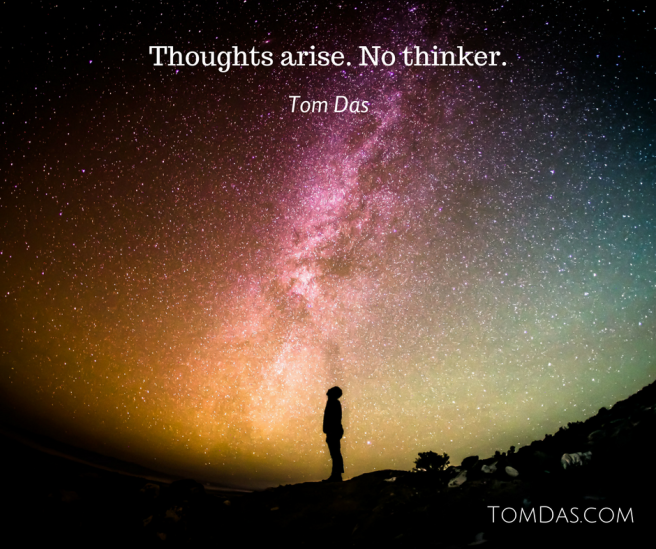
no-thinker

The key way the teaching works is upon the mind by removing the belief in the notion of doership. This belief is the key source of suffering, and when this belief is seen through then the suffering which is dependent on it dissolves away.

Often there is a process by which the habitual tendencies that cause suffering gradually fall away over time as the understanding of ‘no-doer’ infiltrates and has its effect on the mind’s conditioning.

Note that the notion of a doer is a false belief – there is no evidence for a doer being present, just as there is no evidence for a volcano god that erupts volcanos or a sea god that ravages the seas. The lack of belief in a doer does not mean there is no action, just as lack of belief in the above mentioned gods does not render the volcano or seas impotent.

Action and movement continues as they have always done. They happen seemingly by themselves, spontaneously you could say. Live goes on, and it feels much the same, the whole range of feelings and emotions continue, just without the suffering.


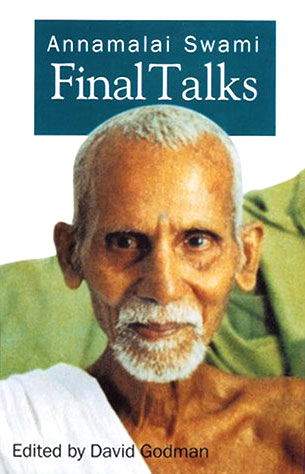
Annamalai Swami: ‘Don’t sit and meditate’

Annamalai Swami: Bhagavan watched me very closely in the years that I served him in the ashram. One time I went to the Mother’s temple where many people were talking about worldly matters.

Bhagavan called me back, saying, ‘Why should you go to that crowd? Don’t go to crowded places. If you move with the crowd, their vasanas will infect you.’

annamalai swami final talks

Bhagavan always encouraged me to live a solitary life and not mix with other people. That was the path he picked for me. Other people got different advice that was equally good for them.

But while he actively discouraged me from socialising, he also discouraged me from sitting quietly and meditating during the years that I was working in the ashram. In this period of my life, if Bhagavan saw me sitting with my eyes closed he would call out to me and give me some work to do.

On one of these occasions he told me,

‘Don’t sit and meditate. It will be enough if you don’t forget that you are the Self. Keep this in your mind all the time while you are working. This sadhana will be enough for you. The real sadhana is not to forget the Self. It is not sitting quietly with one’s eyes closed. You are always the Self. Just don’t forget it.’

Bhagavan’s way does not create a war between the mind and the body. He does not make people sit down and fight the mind with closed eyes. Usually, when you sit in meditation, you are struggling to achieve something, fighting to gain control over the mind. Bhagavan did not advise us to engage in this kind of fight. He told us that there is no need to engage in a war against the mind, because mind does not have any real, fundamental existence. This mind, he said, is nothing but a shadow. He advised me to be continuously aware of the Self while I did the ordinary things of everyday life, and in my case, this was enough.

The above is an excerpt taken from Final Talks by Annamalai Swami, p. 67

Problems with utilising conceptual tools

Continued from 2 previous posts:

  1. Why seeing/understanding alone may not be enough
  2. Integrating the understanding of no-doer

Problems with utilising conceptual tools

Generally speaking, the more you believe in the concept, the better it works, but conversely the harder it is to throw it away once the task at hand (rooting out the ego/’I am the body’ notion) has been completed.

Other problems with believing in the concepts is that it sets you against other traditions and teachings that either utilise other concepts, thus breeding division and sectarianism, and also it can lead to some unintended consequences, some of which can be quite unpleasant.

These include spiritual bypassing, which is where emotional and psychological issues are not dealt with properly as ‘I am not the body-mind so I have no issues’ or where the body is neglected and not properly respected as it is deemed to be ‘insentient, inert and not me’.

Another problem with utilising concepts is that the ego is perpetuated and can even be strengthened during this part of the teaching. Eventually it can be seen that all teachings are also subtle ways of continuing/perpetuating the egoic process which is itself based on the illusion of being a separate doer-entity. Until then, these conceptual teachings and practices based upon these concepts may be useful, but eventually we see that all teachings are potential obstacles. Why? Because Freedom is already fully present, and on a subtle level all teachings assume that Freedom is not already here and reinforce the notion that this moment is deficient in some way.

You can probably think of other negatives of this approach yourself, and perhaps have seen spiritual seekers on this journey fall into one of these traps.

To be continued in a future post: Practicing knowledge

Ramana Maharshi: just ‘lose’ the ego

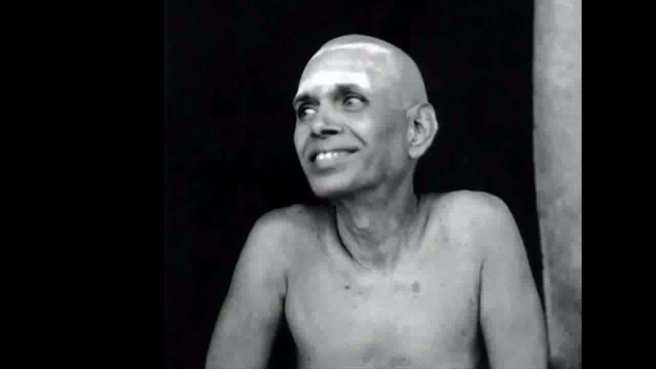
Ramana smiling

Be what you are…All that is needful is to lose the ego, That what is, is always there. Even now you are That…
…The thought ‘I have not seen’, the expectation to see and the desire of getting something, are all the working of the ego.
You have fallen into the snares of the ego. The ego says all these and not you. Be yourself and nothing more!

Talks with Sri Ramana Maharshi
Talk 183

See also:
Ramana Maharshi on non-doership and self-realisation
Ramana Maharshi: Self-inquiry (atma vichara) and doership

Nisargadatta Maharaj: Ignore your thoughts

Nisargadatta_Maharaj

“It is the mind that tells you that the mind is there. Don’t be deceived. All the endless arguments about the mind are produced by the mind itself, for its own protection, continuation and expansion. It is the blank refusal to consider the convolutions and convulsions of the mind that can take you beyond it.”

Nisargadatta Maharaj, I Am That

My comments:

The word ‘mind’ in the above quote is synonymous with the false sense of individual separate self. This self, this ‘I’, is just a notion, an idea reinforced by the mind. The ‘I’ is a thought, and it is reinforced by thoughts.

Trying to figure this all out (ie. more thought) is a function of the same mind that is ultimately false, imaginary: it is a fruitless endeavour.

A particularly effective sadhana (spiritual practice) is to ignore the content of thoughts as they appear within our consciousness. The energy of the sense of ‘I’ then begins to loosen and its mechanics are exposed and revealed. We can then start to see things as they actually are.

There are broadly two ways this can be done:

1) by concentrating on something else such as a mantra, the breath, or by chanting, etc – ie. a distraction from thoughts;

2) by allowing thoughts to wash past you like clouds in the sky, and in so doing not paying attention to the content of thoughts, eg. a surrender, acceptance, gratitude or mindfulness practice.

When looking for a sadhana, you will naturally be able to find the one that works for you by looking to see which one gives you greatest sense of peace and relief, and by seeing which practice you are naturally inclined towards.

For more about spiritual practices and how they work click here