Responsibility: if there is no doer and no-self, and if there no nobody here doing anything, then what about responsibility?

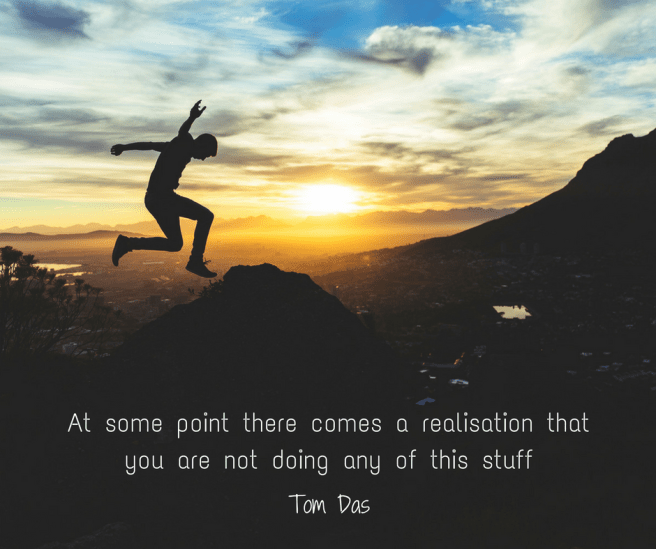
at-some-point-there-comes-a-realisation

Question: If there is no doer, then how does the notion of responsibility fit into this? If there is nobody here, then surely there can’t be anyone responsible?

Tom: This teaching is not an excuse to act irresponsibly or unethically. Responsibility is an important part of being human, and it is a phenomena that arises by itself from time to time, like any other phenomena we experience.

By responsibility I mean a natural sense of caring, affection, consideration, thoughtfulness and desire to take care of the people, animals and world around us.

As far as I can see, when we free ourselves from illusions of a separate doer/self, the energies in the human organism naturally tend to balance out. This is because the distorting centripetal factor of egotism (I define ego as the belief in being a separate doer-entity who creates thoughts and actions) is no longer at play. And when the energies in the body are harmonious and in balance, the body-mind naturally tends to become responsible, kind and loving.

It’s just what tends to happen, and it takes time, depending on your conditioning which in turn depends on the culture, environment, genetics, etc.

And it’s not just responsibility, it’s true for a whole load of so-called positive qualities such as love, sensitivity, kindness, thoughtfulness, empathy, openness, being non-judgmental. These just tend to arise, by themselves, when the doer/ego is seen to be non-existent.

Q: So there is no doer, but these things happen by themselves?

Tom: Yes, exactly. Of course it doesn’t have to be like that. Perhaps the energies in the body don’t balance out and the heart doesn’t open and these loving qualities do not express themselves. In Freedom it doesn’t really matter. There is no attempt to be more loving or to be more responsible – that would just be the ego striving for an ideal. Freedom doesn’t care for these artificial ideals and does not try to conform to imaginary notions. But precisely because there is no self-motive, these qualities naturally tend to arise.

And if these qualities don’t arise that’s ok too. This is Freedom: whatever happens is whatever happens, no judgement, no motive, total forgiveness, and nobody doing any of it.


Q: OK, you mentioned total forgiveness? That’s confused me. Why do you say that? 

Q: You mentioned earlier that the heart opens? That sounds rather fluffy and vague to me – what does it mean?

Q. But I think there’s another type of responsibility, not just the sense of responsibility for others and caring for those around you, not just being responsible for the people and word, but a sense ‘I am responsible for my thoughts and actions’. And if you do something wrong, then you are ‘responsible’ and accountable for that. What about that? Does that exist if there is no doer? (To be continued in a future post)
Jiddu Krishnamurti: We are talking of something entirely different

‘We are talking of something entirely different, not of self-improvement, but of the cessation of the self’
Jiddu Krishnamurti

Tom’s Comments:

Seeing there is no self (ie. no doer, no independent entity that is the author of thoughts and actions) is ‘cessation of the self’.

It is not something you have to do – that would be more self-improvement.

With this insight suffering falls away by itself, as a side-effect. Not that it matters, for there is no choice, just spontaneous happening.

Ramana Maharshi: remaining quiet and aware is the state of mind to aim at

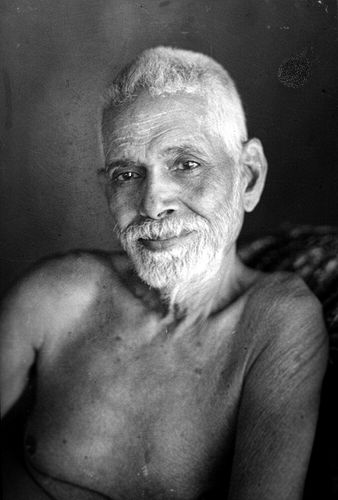
Ramana Maharshi sitting

Questioner:  There are times when persons and things take a vague, almost transparent form, as in a dream. One ceases to observe them as outside, but passively conscious of their existence, while not actively conscious of any kind of selfhood.  There is a deep quietness in the mind.

Is it at such times that one is ready to dive into the Self? Or is this condition unhealthy, the result of self hypnotism? Should it be encouraged as yielding temporary peace?

Ramana Maharshi:  There is Consciousness along with quietness in the mind.  This is exactly to be aimed at.  The fact that the question has formed on this point, without realizing that it is the Self, shows that the state is not steady but casual.

The word ‘diving’ is appropriate when there are outgoing tendencies, and when, therefore, the mind has to be directed and turned within, there is a dip below the surface of externalities.  But when quietness prevails without obstructing the Consciousness, where is the need to dive?

Taken from Talks with Ramana Maharshi, Talk 348


Tom’s comments:

The sadhana (spiritual practice) that Bhagawan recommends above is to simply remain quiet (in mind and thought) and also to remain aware.

This is self-knowledge. This is the Self.

When thoughts can come and go without disturbing this essential quality of mind, there is no need to ‘dive’ using the tools of Self Inquiry (ie. the question ‘Who am I?’). With time it may be seen that nothing ever disturbs this ‘peace that passeth all understanding’, and that nothing ever did.

It was always here, fully manifest, right under our noses.

Here is the gateway to Self-knowledge or liberation.

Zen Master Huang Po: how to remove our illusions

Q: Illusion can hide from us our own mind, but up to now you have not taught us how to get rid of illusion.

zen circle

A: The arising and the elimination of illusion are both illusory. Illusion is not something rooted in Reality; it exists because of your dualistic thinking.

If you will only cease to indulge in opposed concepts such as ‘ordinary’ and ‘Enlightened’, illusion will cease of itself. And then if you still want to destroy it wherever it may be, you will find that there is not a hairsbreadth left of anything on which to lay hold.

This is the meaning of: ‘I will let go with both hands, for then I shall certainly discover the Buddha in my mind’.

The arising and the elimination of illusion are both illusory…If you will only cease to indulge in opposed concepts such as “ordinary” and “Enlightened,” illusion will cease of itself.

Q: If there is nothing on which to lay hold, how is the Dharma [The Teaching, Enlightenment] to be transmitted?

A: It is a transmission of Mind with Mind [Tom – note that the Chinese word for ‘mind’ can also be translated as ‘heart’, so this could be ‘heart to heart’ transmission].

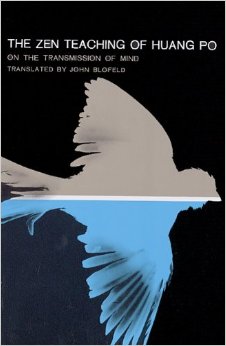
Huang Po Zen Teachings

Q: If Mind is used for transmission, why do you say that Mind too does not exist?

A: Obtaining no Dharma whatever is called Mind transmission. The understanding of this implies no Mind and no Dharma.

Q: If there is no Mind and no Dharma, what is meant by transmission?

A: You hear people speak of Mind transmission and then you talk of something to be received. So Bodhidharma [the first Zen patriarch, the ‘founder of zen’] said:

The nature of the Mind when understood,
No human speech can compass or disclose.
Enlightenment is naught to be attained,
And he that gains it does not say he knows.

If I were to make this clear to you, I doubt if you could stand up to it.

Taken from The Zen Teaching of Huang Po (Chun Chou record no. 32)

Zen Master Huang Po: the true teaching

Huang Po Zen Teachings.jpg

Q: Up to now, you have refuted everything which has been said. You have done nothing to point out the true Dharma [the true teaching, the true way] to us.

Huang Po: In the true Dharma there is no confusion, but you produce confusion by such questions. What sort of ‘true Dharma’ can you go seeking for?

Q: Since the confusion arises from my questions, what – will Your Reverence’s answer be?

Huang Po: Observe things as they are and don’t pay attention to other people. There are some people just like mad dogs barking at everything that moves, even barking when the wind stirs among the grass and leaves.’

Taken from The Zen Teaching of Huang Po (Chun Chou record no. 28)


Tom’s comments:

The questioner appears frustrated at not being able to obtain anything tangible from Huang Po. ‘What is the true teaching? What is The Way?’, he asks.

The master replies: you yourself create the confusion, the questions being evidence of this. Is there even a ‘true Dharma’ to be sought?

The answer? Just be with what is, see things as they are, don’t worry about the words and ideas of others caught up in their own illusions and fears.


Tao Te Ching: Before you learnt to smile

mountain river

…Other people are joyous,
as though they were at a spring festival.
I alone am unconcerned and expressionless,
like an infant before it has learned to smile.

Other people have more than they need;
I alone seem to possess nothing.
I am lost and drift about with no place to go.
I am like a fool, my mind is in chaos.

Ordinary people are bright;
I alone am dark.
Ordinary people are clever;
I alone am dull.
Ordinary people seem discriminating;
I alone am muddled and confused.

I drift on the waves on the ocean,
blown at the mercy of the wind.
Other people have their goals,
I alone am dull and uncouth.

I am different from ordinary people.
I nurse from the Great Mother’s breasts.

Tao Te Ching, verse 20

Tom’s comments:

This is one of my favourite verses of this wonderful text. I remember when I first read it as a university student in the 90s, I was particularly struck by the phrase ‘like an infant before it has learned to smile’. We can be free of needing to be happy, to smile, to conform, and we can simply be true to ourselves.

This world can seem so confusing. It can feel like everyone else seems to know what they want and where they are going. Of course, it’s such an illusion! How can anyone know what this is all about? If you think you know, you have surely missed the mark!

The Sage sees through all illusions, she sees through the faux-intelligence, goals and make-believe of people around her. The Sage knows he is but Nature expressing herself: he is dependent on her, as a child is on his mother’s breast milk, and he is also Her.

He sees the inherent unfathomable mystery at the heart of life and lovingly pities those who think ‘they understand’.

Tao Te Ching: How ridiculous!

lotus leaf waterStop thinking, and end your problems.
What difference between yes and no?
What difference between success and failure?
Must you value what others value, avoid what others avoid?
How ridiculous!

Tao Te Ching, verse 20

Tom’s comments:

Free of thoughts, where are your problems?

We do not need to shun thought in its entirety, just not buy into the suffering it creates through comparison and moral judgement.

We can see through the values, ideals and standards that other people and society dictate to us. We can see through the received wisdom of the day.

We can let go and be real, discover who we truly are – we can discover what it is to be human for ourselves and not simply force ourselves to fit into an ideological mould, no matter how reasonable it sounds. We can be who we are.

And who are we? Are we separate from the world that gave birth to us? Are we separate from the environment that shaped and influences us? Are we wholly good or bad? 0r can good come from bad and vice versa? Can failure lead to success?

I put it to you: all things are interdependent, and no things exist by themselves.

Onwards, children of God, onwards! 🙂


Ramana Maharshi: Self-inquiry (atma vichara) and doership

Ramana Maharshi sitting

“The differences are the result of the sense of doership.

The fruits will be destroyed if the root is destroyed.

So relinquish the sense of doership.

The differences will vanish and the essential reality will reveal itself.

In order to give up the sense of doership one must seek to find out who the doer is.

Inquire within. The sense of doership will vanish.

Vichara (inquiry) is the method.”

Taken from Talks with Sri Ramana Maharshi, talk no. 429

Tom’s comments:

The root of suffering is the sense of doership, the sense that there is a doer-entity, the sense that you are a doer. The root is the notion ‘I am a doer’, the fruit is suffering and duality.

Let go of this sense of doership, either by simply relaxing and letting go, or, as suggested above, look and find out what the doer is. Look at your own direct experience: can you see the doer? Can you feel the doer? What does the doer look and feel like exactly? Where does the doer begin and end? How big is the doer? Where is the doer located?

When you look, as you keep on noticing, you may start to realise/see that there is no actual experience of a doer at all. All there are are sensations, feelings and thoughts. Specifically there may be the thought ‘I am the doer’ or ‘this is the doer’, but no actual doer is seen/experienced apart from the thought. The doer is seen to be an imagined entity. The doer (ie. ego) is revealed to be a fiction.

Ramana uses the word ‘reality’ above. What is reality? It’s just what’s left over when the sense of doership is seen through. It’s just what’s left over when false illusions are seen for what they are: false.

Shunryu Suzuki: How to achieve perfect calm

blue mountains.png

The following is an excerpt from the book Zen Mind, Beginner’s Mind by Shunryu Suzuki:

If you want to obtain perfect calmness in your zazen, you should not be bothered by the various images you find in your mind. Let them come, and let them go. Then they will be under control. But this policy is not so easy. It sounds easy, but it requires some special effort. How to make this kind of effort is the secret of practice.

Suppose you are sitting under some extraordinary circumstances. If you try to calm your mind you will be unable to sit, and if you try not to be disturbed, your effort will not be the right effort. The only effort that will help you is to count your breathing, or to concentrate on your inhaling and exhaling. We say concentration, but to concentrate your mind on something is not the true purpose of Zen. The true purpose is to see things as they are, to observe things as they are, and to let everything go as it goes. This is to put everything under control in its widest sense.

The true purpose is to see things as they are, to observe things as they are, and to let everything go as it goes.

Zen practice is to open up our small mind. So concentrating is just an aid to help you realise ‘big mind’, or the mind that is everything.

If you want to discover the true meaning of Zen in your everyday life, you have to understand the meaning of keeping your mind on your breathing and your body in the right posture in zazen.

You should follow the rules of practice and your study should become more subtle and careful. Only in this way can you experience the vital freedom of Zen.