Ramana Maharshi: Self-Realisation is simply being one’s self

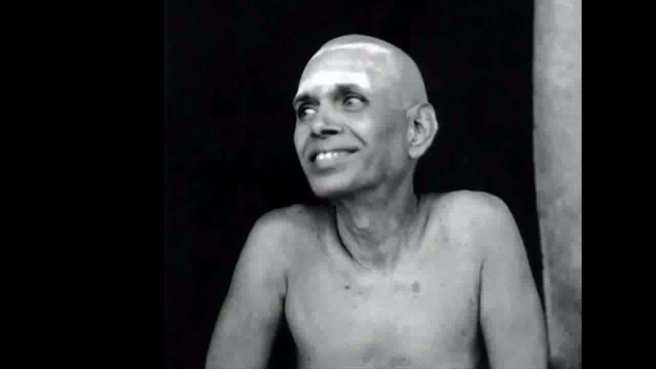
Ramana smiling

The state we call Realisation is simply being one’s self, not knowing anything or becoming anything.

If one has realised, one is that which alone is and which alone has always been. One cannot describe that state, but only be That.

Of course, we talk loosely of Self-Realisation for want of a better term.

Ramana Maharshi
(taken from the book Day by Day with Bhagavan, p. 296)

Tom’s comments:

Notice that the search for ‘understanding’ and the search for becoming ‘enlightened’ or ‘self-realised’ are both pursuits of the ego. The ego is looking for security and pleasure and has projected/created these fantasies which it tries to attain.

Instead of trying to attain a projected fantasy, why not instead look at what is actually happening? Look at yourself, look at the ego, the ‘I’. Ask yourself ‘what is this ego? Who am I?’ Investigate for yourself repeatedly and you will see that the ego, the ‘you’ is illusory – it’s just a bundle of thoughts that occur by themselves, spontaneously. ‘Your thoughts’ are not yours at all: note how you cannot chose to stop thinking, stop worrying, stop your addictions. You cannot chose to believe something you don’t. You cannot chose to not believe something you do believe. You cannot stop your ‘bad thoughts’. In fact you probably do not even know what exactly you will be thinking in 5 minutes time let alone tomorrow or 5 days from now.

Another point: if you happen to think you are a dinosaur, it doesn’t necessarily make you one. Similarly if you think that you are an ego (a doer, a thinker, an agent who has authorship over his/her actions), it doesn’t make it true. Yes, the idea of being a doer is just that: it is an idea, a belief that has been tacitly repeated to us and drummed into us since childhood. An oft-repeated lie is then (mistakenly) taken to be true.

In seeing this first-hand, there is no specific intellectual understanding or state of mind gained. It’s just that an illusion has been seen through, like seeing that a frightening snake is in fact just a harmless rope in poor light (or like realising that you are not in fact a dinosaur after all!).

No dogmas, no metaphysics, no complex body-twisting acrobatics, no beliefs and no rituals are necessary (although they may be a part of the apparent journey).

Then all there is is ‘what’s happening’, and what you thought was you is actually just a part of that happening. Or as Bhagavan puts it, all there is is ‘simply being one’s self’.
Free webstream talk: ‘Freedom from Suffering’

Do you want to watch me talk about this stuff? This Thursday I’ll be doing a live (and free) webstream with Conscious 2, find out more below:

http://www.conscious2.com/freedom-from-suffering/

http://www.conscious2.com/teachers/tom-das/

TomDasFreedomFromSufferingLIVEstream.jpg


Tibetan Buddhism: The Mind Instructions of Khenpo Gangshar

image

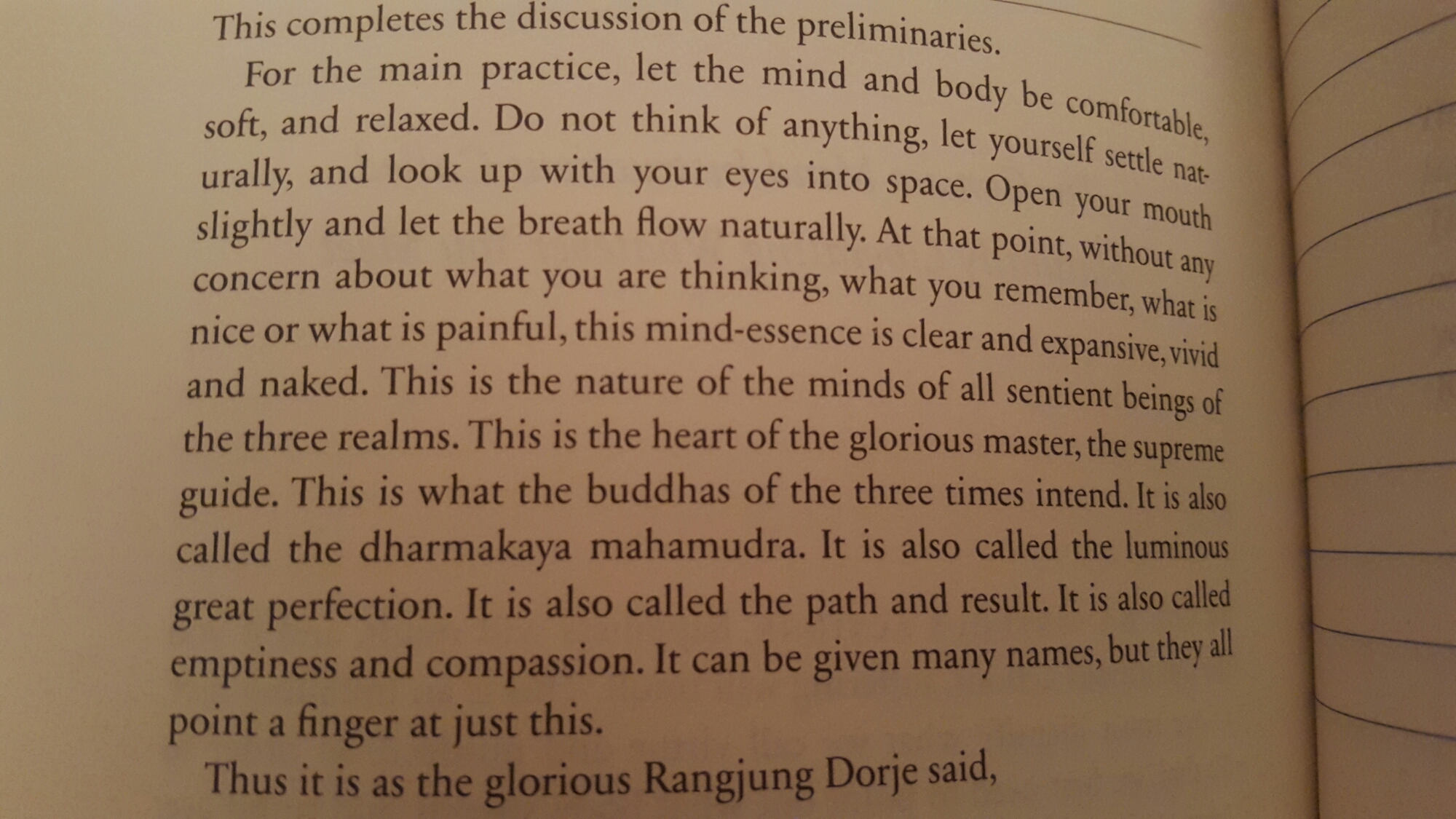
Above is an excerpt from a text called ‘The Concise Mind Instructions Called Naturally Liberating Whatever You Meet’ by Khenpo Gangshar, as found in the book Vivid Awareness by Khenchen Thrangu.

In this short text Khenpo Gangshar goes on to say:

Directly, whatever arises, do not change it – rest naturally. This fulfils the essence of all creation stages, completion stages, mantra recitations, and meditations.

This is the heart of the highest Tibetan Buddhist teachings: to rest naturally and be vividly aware. Just be. I would add that in this no sense of self is being created, and this is the practice. To simply be, and not to take yourself as being a ‘self’ or ‘doer’. To use a commonly used phrase in vedanta: do not take yourself to be ‘this or that’.

Khenpo Gangshar goes on to give advice on how to deal with difficulties along the way:

You must take sickness as the path, afflictions as the path, the bardo as the path, and delusion as the path. The heart of all these applications is to rest naturally in the essence.

This advice is very much in line with most of traditional Tibetan Buddhist teachings, but here it is stated in very concise form. When difficulties come along, just rest in your natural being. Don’t identify as being ‘this or that’, don’t start to create or believe in the concept of being a doer. This is the false concept that is rooted out and seen through in this practice.

When life throws us a challenge, don’t simply fall back into your old habits of self-identification. It is from this creation of an imaginary doer/self that all other afflictions and suffering follows. Instead, just rest, just be. Let your awareness shine, let it shine brightly. If the thought ‘I’ arises, let it, notice it, notice that it is empty and does not describe or pertain to any reality. There is no ‘I’, there is no self. Only the bright expanse of phenomena.

One final thought from me, a question:
Does any of this have anything to do with Freedom? Does Freedom depend on any practice? Does Freedom depend on any of this?

How spiritual teachings work

Raft.jpg

This is one of a series of introductory articles – please see the homepage of tomdas.com for more introductory articles.

Buddha’s raft

The Buddha likened his teachings to a raft that takes you from the shore of suffering (samsara) across the river to the shore of enlightenment (nirvana). When you get to the land on the other side, you do not carry the raft around with you – the raft would actually be an impediment on land.

The teachings are therefore provisional constructs and concepts and are not true in themselves. Ultimately we can let go of attachment both to the teaching and teacher once it has done its work.

If we fall in love with the teaching or teacher, this is not necessarily a bad thing. It can serve as a useful and positive motivation force, keeping our search and inquiry strong through both good and bad times, and may well continue after a genuine enlightenment. However I have often seen how the attachment to (and belief in) a teaching or teacher can impede a genuine realisation, as it can restrict our ability to freely inquire and see things as they really are.

‘Use a thorn to remove a thorn, then throw them both away’

In this Hindu saying, a thorn represents a concept that gives rise to suffering when it pierces our skin. The teachings are another concept/thorn that you can use to remove the first thorn from your body. However you must throw the teaching away too when it’s work is done, otherwise it simply becomes a thorn in your side that binds you.

Ramana Maharshi used to speak of his teachings as being like a wooden stick used to prod the burning carcass in the funeral pyre. Once the teaching has done its job of ‘burning the ego (sense of being a separate doer)’, the stick is also pushed into the fire and it too burns away.

‘Eventually, all that one has learnt will have to be forgotten’
Sri Ramana Maharshi
Kill the Buddha
There is a famous Zen teaching: “If you see Buddha on the path, kill him”. Don’t even let Buddhism and Buddha’s teachings get in the way. Let go of all concepts and liberation is there as it always has been.
This idea is similarly indicated in Hindu teachings such as in the Yoga Vasistha:
‘When you realise that which is indicated by the words, then naturally you will abandon the jugglery of words’
Yoga Vasistha
Expedient Means
In Mahayana Buddhism the term ‘expedient means’ (Sanskrit: upaya) is used to signify that the best teaching is the one that produces the result – ie. enlightenment. What is good for one aspirant may not be good for another, depending on where they each are. This is also why various teachings can appear contradictory and may not be true in themselves. The point is that the teachings are not necessarily true, but as long as they work that’s what matters.
 
Some of my analogies and thoughts on how teachings work
  • The teachings are not themselves ultimately true. They are just words. But like a finger pointing to the moon, they  point to something greater than themselves. 
  • Teachings use words and concepts to point to or indicate that which is beyond all words and concepts.
  • The teachings are like a virus. Once you have heard them, they get to work within you, chipping away at false beliefs and in doing so the Truth is revealed.
  • Like when matter and anti-matter collide, the teachings destroy false notions and then when its work is done, the teaching also self-destructs.
  • We think we chose to read or hear the teachings and apply them. When we understand the teachings more fully, we realised that the teachings came to us, they were a gift to us, that they chose us, and they work their magic on us.
  • If you cling to words of the teachings, it is a sure indicator you have not understood what they are pointing to. Eventually you have to go beyond the teachings. Excessive clinging to notions such as Absolute Consciousness or ‘You are the Witness’ or overly complicated metaphysics is a sure sign of not seeing the essence of what is being pointed to.
  • The teachings are like a recipe – you follow the instructions and get the results. Until the food is made, you treasure the recipe for it is the gateway to your meal. Note that the cooked meal looks nothing like the recipe and you can throw away the recipe once you have mastered the cooking and are eating the meal. However, please don’t worship the recipe, please don’t (just) discuss recipes endlessly with your friends,  and please don’t forget to do what it says!

Don’t accept a lie

masks.jpg

Don’t accept a lie.
If you see there is no evidence for there being a separate ‘you’,
Then whenever this thought or notion ‘you’ turns up in daily life,
See through it.
Deny it.
Not out of a belief,
Not as a formula to be repeated,
But as something that is clearly seen.

Bodhidharma’s Zen: the Perfect Way, the Ultimate Truth

Bodhidharma.jpg
Bodhidharma, founder of Zen Buddhism

The following are excepts I’ve compiled from the Zen Teaching of Bodhidharma (the founder of Zen Buddhism) as translated by Red Pine. What do you think?

————–

The way is basically perfect. It doesn’t require perfecting.

The way has no form or sound. It’s subtle and hard to perceive.

It’s like when you drink water: you know how hot or cold it is but you can’t tell others.

————–

The ultimate Truth is beyond words.

Doctrines are words. They are not the Way.

The Way is wordless.

————–

If you see your nature, you don’t need to read sutras or invoke Buddhas.

Erudition and Knowledge are not only useless but also cloud your awareness.

Doctrines are only for pointing to the mind. Once you see your mind, why pay attention to doctrines?

————–

People, though, are deluded. They’re unaware that their own mind is the Buddha. Otherwise they wouldn’t look for a Buddha outside the mind.

Buddhas don’t ferry Buddhas to the shore of liberation. If you use your mind to look for a Buddha, you won’t see the Buddha.

As long as you seek Buddhas outwards, you’ll never see that your own Heart is the Buddha.

————–

To find a Buddha, you have to see your nature. Whoever sees his nature is a Buddha.

————–

If you don’t see your nature and run outwards to seek for external objects, you’ll never find a buddha.

The truth is there’s nothing to find.

————–

If you attain anything at all, it’s conditional.

————–

Defilement and attachment, subject and object don’t exist.

————–

All phenomena are empty. They contain nothing worth desiring.

————–

A buddha is free of karma, free of cause and effect.

————–

To attain enlightenment you have to see your nature.

————–

It has never lived or died, appeared or disappeared, increased or decreased. It’s not pure or impure, good or evil, past or future. It’s not true or false. It’s not male or female. It doesn’t appear as a monk or a layman, an elder or a novice, a sage or a fool, a buddha or a mortal. It strives for no realisation and suffers no karma. It has no strength or form. It’s like space. You can’t possess it and you can’t lose it. Its movements can’t be blocked by mountains, rivers, or rock walls….No karma can restrain this real body. But this mind is subtle and hard to see. It’s not the same as the sensual mind.

————–

Everything that has a form is an illusion.

————–

Those who hold onto appearances are devils. They fall from the Path.

————–

All appearances are illusions.

————–

That which is free of all form is the Buddha.

————–

Wherever you find delight, you find bondage. 

————–

I only talk about seeing your nature. I don’t talk about creating karma.

————–

The buddha is your real body, your original mind. This mind has no form or characteristics, no cause or effect, no tendons or bones.

————–

Detachment is enlightenment because it negates appearances.

————–

The appearance of appearance as no appearance can’t be seen visually, but can only be known by means of wisdom.

————–

All practices are impermanent.

————–

The sutras say, “Go beyond language. Go beyond thought.”

————–

Basically, seeing, hearing, and knowing are completely empty.

————–

Your anger, joy, or pain is like that of puppet.

————–

Trying to find a Buddha or enlightenment is like trying to grab space. Space has a name but no form.

It’s not something you can pick up or put down. And you certainly can’t grab it.

————–

Whoever realizes that the six senses aren’t real, that the five aggregates are fictions, that no such things can be located anywhere in the body, understands the language of buddhas.

————–

Not thinking about anything is Zen.

Don’t believe the hype

street grafitti.jpg

Public Enemy were onto something. They really were. Their song title ‘Don’t believe the hype’ has profound ramifications when applied to our own beliefs. We have consumed so many ideas of what will fulfill us, so much propaganda.

The mind churns out all sorts of formulas for what will make us happy. Don’t believe any of it. It’s all rubbish. All of it.

I’m not talking of practical issues of survival or health, etc. I’m talking about wanting more than that. I’m talking about dukkha, that insatiable existential itch that always comes back no matter how many times you scratch it.

The mind comes up with endless and repetitive ways of scratching that itch. But everything you think will make you happy – none of it will fill that deep dark hole inside you. Yes, it may give you some temporary pleasure, perhaps even some longer lasting pleasure too, but that void inside of you that tugs and tugs away at your insides returns saying “I want more, I want more…“:

I want a girlfriend/boyfriend
I want a degree/job/skill/to be able to dance better
I want to get drunk/get high/fall asleep
I want a bigger/new/better/faster ____.
I want a house/car/other object
I want to look better/bigger/thinner
I want curly/straight/blonde/brown hair

It’s even worse when people are involved. Then the “If onlys” start:

If only he did it this way
If only she shut up a bit
If only he was more considerate
If only she did not complain so much
If only he talked less
If only she talked more

Worse still are the “shoulds“:

I should have done ‘x’
He shouldn’t have done ‘y’
I can’t believe ‘z’ happened. ‘z’ so shouldn’t have happened

When it comes to spiritual matters, it’s just as bad, more hype:

I want to feel good forever and ever and ever
I want God to protect me and make me feel good (forever)…
I want to pray/meditate/go to church/satsang more…
I want to be able to do those yoga poses
I want to know all those scriptures and read all those books
I want the ultimate Understanding
I want Enlightenment

See, it’s all bogus. Phoney. Whatever you attain can be lost. I’ll repeat that – whatever you attain can be lost.

Any conceptual understanding gained is a concept that can be doubted or questioned. Eternal Happiness is right here and now. It is ever-present, just waiting to be noticed. And how do you notice it? Just by noticing the truth that you have believed the hype and created your misery.

Don’t believe the hype – then the misery and nagging itch inside that longs for more – that all disappears. And ‘you’ disappear along with it all, for all ‘you’ are is a bundle of thoughts. And what is left when ‘you’ disappear? Ahh, the sweetness of it all…indescribable

So next time you want something really bad, next time you think you know what will make you happy, take my advice: think again. What are you looking for? Will that really make you happy? As I said, it’s all rubbish. See through it all. Remember: don’t believe the hype.

Zen: How should one approach enlightenment?

lake reflection2.jpg
Can you smooth out this lake using your hand please?

Two great Chan (Zen) masters speak:

Zhaozhou: How should one approach enlightenment?
Nanquan: If you try to head for it, you immediately turn away from it.

Tom’s comments:
So, what to do?


The root concept

Cirrus clouds fox.jpg
Is anybody here? Is anybody doing this?

It is the concept of a subject,
That gives rise to the concept of an object.
Or put another way,
The concept of ‘me’,
That gives rise to ‘not me’.

But look at your experience for yourself:

What was thought to be the subject
Is actually also an object.

The experiencing entity that we take ourselves to be,
Is actually something we are aware of,
and not the subject at all.

The person looking at and experiencing life,
Is just a part of life,
Totally inseparable from life.

The body,
thoughts,
emotions,
inner sensations,
intuitions,
visions,
dreams.
– all these are objects.
– all these are sensations.
– none of these are ‘me’.
– none of these are ‘mine’.

Sensations cannot themselves sense.
The perceived cannot perceive.

In fact, looking at our own experience,
Where is the subject at all?

Look!
-There are only sensations.
-There are only objects.
-There is only experience.
-There is never the experience of the subject.

Look!
Experience is a seamless whole,
One seamless happening,
And the so-called experiencer, the ‘me’,
Is simply part of that happening.

So what are we left with?
Just this.

Life simply happening,
All by itself.