Ramana Maharshi: Laugh and cry!

ramana umbrella.jpg

The realized person weeps with the weeping,

laughs with the laughing,

plays with the playful,
sings with those who sing,
keeping time to the song.

What does he lose?

Tom’s comments:

Many truth seekers suppose that the ‘fully self-realised guru’ would act in a certain way:

speak, walk, dress in certain ways,
never angry, always kind,
never unhappy, ever-blissful
pure and faultless

What a prison!
Freedom does not care for that!

In Freedom our humanity naturally shines

Also see All exist in me

Tao Te Ching: Before you learnt to smile

mountain river

…Other people are joyous,
as though they were at a spring festival.
I alone am unconcerned and expressionless,
like an infant before it has learned to smile.

Other people have more than they need;
I alone seem to possess nothing.
I am lost and drift about with no place to go.
I am like a fool, my mind is in chaos.

Ordinary people are bright;
I alone am dark.
Ordinary people are clever;
I alone am dull.
Ordinary people seem discriminating;
I alone am muddled and confused.

I drift on the waves on the ocean,
blown at the mercy of the wind.
Other people have their goals,
I alone am dull and uncouth.

I am different from ordinary people.
I nurse from the Great Mother’s breasts.

Tao Te Ching, verse 20

Tom’s comments:

This is one of my favourite verses of this wonderful text. I remember when I first read it as a university student in the 90s, I was particularly struck by the phrase ‘like an infant before it has learned to smile’. We can be free of needing to be happy, to smile, to conform, and we can simply be true to ourselves.

This world can seem so confusing. It can feel like everyone else seems to know what they want and where they are going. Of course, it’s such an illusion! How can anyone know what this is all about? If you think you know, you have surely missed the mark!

The Sage sees through all illusions, she sees through the faux-intelligence, goals and make-believe of people around her. The Sage knows he is but Nature expressing herself: he is dependent on her, as a child is on his mother’s breast milk, and he is also Her.

He sees the inherent unfathomable mystery at the heart of life and lovingly pities those who think ‘they understand’.

Tao Te Ching: How ridiculous!

lotus leaf waterStop thinking, and end your problems.
What difference between yes and no?
What difference between success and failure?
Must you value what others value, avoid what others avoid?
How ridiculous!

Tao Te Ching, verse 20

Tom’s comments:

Free of thoughts, where are your problems?

We do not need to shun thought in its entirety, just not buy into the suffering it creates through comparison and moral judgement.

We can see through the values, ideals and standards that other people and society dictate to us. We can see through the received wisdom of the day.

We can let go and be real, discover who we truly are – we can discover what it is to be human for ourselves and not simply force ourselves to fit into an ideological mould, no matter how reasonable it sounds. We can be who we are.

And who are we? Are we separate from the world that gave birth to us? Are we separate from the environment that shaped and influences us? Are we wholly good or bad? 0r can good come from bad and vice versa? Can failure lead to success?

I put it to you: all things are interdependent, and no things exist by themselves.

Onwards, children of God, onwards! 🙂


Zen (Chan) master Yuanwu: No fixed teaching

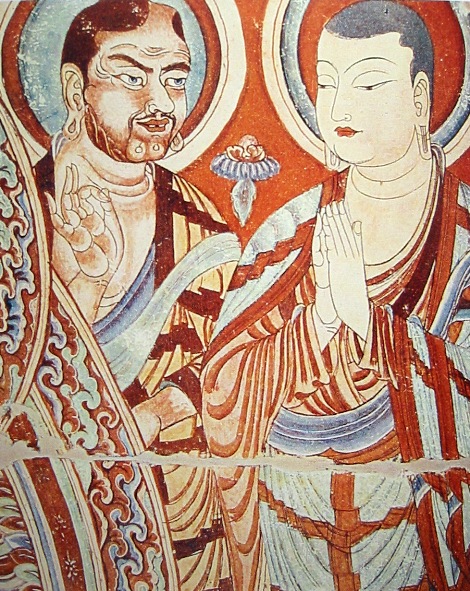
Central_Asian_Buddhist_Monks
A fresco from the Bezeklik Thousand Buddha Caves

All teachings are expedients

just for the purpose of breaking through obsessions, doubts,

intellectual interpretations & egocentric ideas

Yuanwu (1063-1135)

Tom’s comments:

If there was ever a dogma in Zen Buddhism* (and there is no dogma by the way) it is that there is no fixed Zen teaching. In Yuanwu’s letters, from which this quote was taken, Yuanwu gives us a no frills introduction and foray into the heart of Zen.

In this quote he gets straight to telling us how the Buddhist teachings work: the teachings are not necessarily  100% true in themselves, but are devices used to set us free. What is the correct teaching? It’s simply the teaching that works. This is what the word ‘expedient’ means: whatever works is the ‘correct teaching’.

And so we hear of zen teachings ranging from reading the scriptures to simply hearing the sound of a ringing bell; from seeing an object drop to the ground to the admittedly extreme physical blows that are often dished out (and received) by zen masters as a form of teaching – not a method I would advocate, I hasten to add.

So the teaching methods and expressions of truth may vary from person to person and from time and place, forged out of the cultures and characters of the moment. This is why the teaching reinvents itself from generation to generation, and varies from teacher to teacher, even when the core teaching and core ‘realisation’ is the same.

*Yuanwu was actually Chinese, so strictly speaking he is a Chan Master. When Chan Buddhism spread to Japan it became known as Zen, Zen simply being the Japanese word for Chan.

I AM

bright lightsEverything is happening,
in every nook and cranny,
everything shining,
saying ‘I AM’

Sights, sounds, visions and sensations,
flurrying and flitting,
dancing for us,
each saying ‘I AM’

The auditory landscape whooshing through,
ceaselessly onwards,
speaking to me,
constantly saying ‘I AM’

The energy of life,
abundant and obvious,
Zip! Zap! Zoom!
right in our faces, everything:
‘I AM’

Something is watching you

leopards eyes

While the mind chatters endlessly
and the body does its thing,
have you ever noticed,
a Presence watching over you?

You’ve been
trying to do this, trying to do that,
and all the time,
feel it: Something watches over you.

Consumed by thoughts,
dramas and life,
Something stands still
– can you sense it, silently watching you?

Wherever you go,
whatever you do,
incessantly following you,
observing all, watching you.

You have gone around your life,
doing this, doing that,
and all the while,
a presence is here, everywhere, watching you.

Zen Master Han-Shan: It is originally inherent in everyone

Han Shan

It is originally inherent in

EVERYONE,

Actually complete in each individual,

LACKING NOTHING

at all

Han-shan

Tom’s comments:

What more is there to say?

If you try to figure it out, if you try to look for it, you have already missed it, for you have presupposed incompleteness, you have assumed the presence of lack.

Where is the lack? In what way are you incomplete?

It is the mind that tells you you need something else, the mind that ‘says this is not enough’.

There is no need to believe the mind and the stories (lies) it spews forth: it is already here, ‘LACKING NOTHING AT ALL’, and you are it.