Vivekachudamani by Sri Shankara: Resources and PDF downloads | Translation by Sri Ramana Maharshi | Advaita Vedanta | Crest Jewel of Discrimination

Here are some resources and links relating to this superb traditional Advaita Vedanta text that gives us a step-by-step method for Self-Realisation and Liberation.

Attributed to Sri Shankara, written approximately 1400 years ago, Vivekachudamani (‘The Crest Jewel of Discrimination’ or the ‘The Highest Treasure of Wisdom’) was also recommended by Sri Ramana Maharshi who said this text explains ‘…in detail the points that have to be grasped by those who seek liberation, and thereby directing them to the true and direct path‘:

Shankara’s Vivekachudamani as translated by Sri Ramana Maharshi: https://tomdas.com/2019/03/04/vivekachudamani-as-translated-by-sri-ramana-maharshi/

Sri Ramana’s introduction to Vivekachudamani where he summarises the entire path to liberation: https://tomdas.com/2019/02/25/ramana-maharshis-introduction-to-shankaras-crest-jewel-of-discrimination-vivekachudamani-and-summary-of-its-teachings/

The 10 most important verses of Vivekachudamani as selected by Sri Ramana Maharshi: https://tomdas.com/2020/05/14/the-ten-most-important-verses-of-shankaras-vivekachudamani-according-to-sri-ramana-maharshi/

Is Vivekachudamani sexist? https://youtu.be/VPZw6cgczLw

A more traditional verse by verse translation of Vivekachudamani by Swami Madhavananda: https://tomdas.com/2018/10/01/vivekachudamani-crest-jewel-of-discrimination-by-shankara/

A more accurate verse by verse translation of Vivekachudamani with word for word transliteration and translation by Achyarya Pranipata Chaitanya:

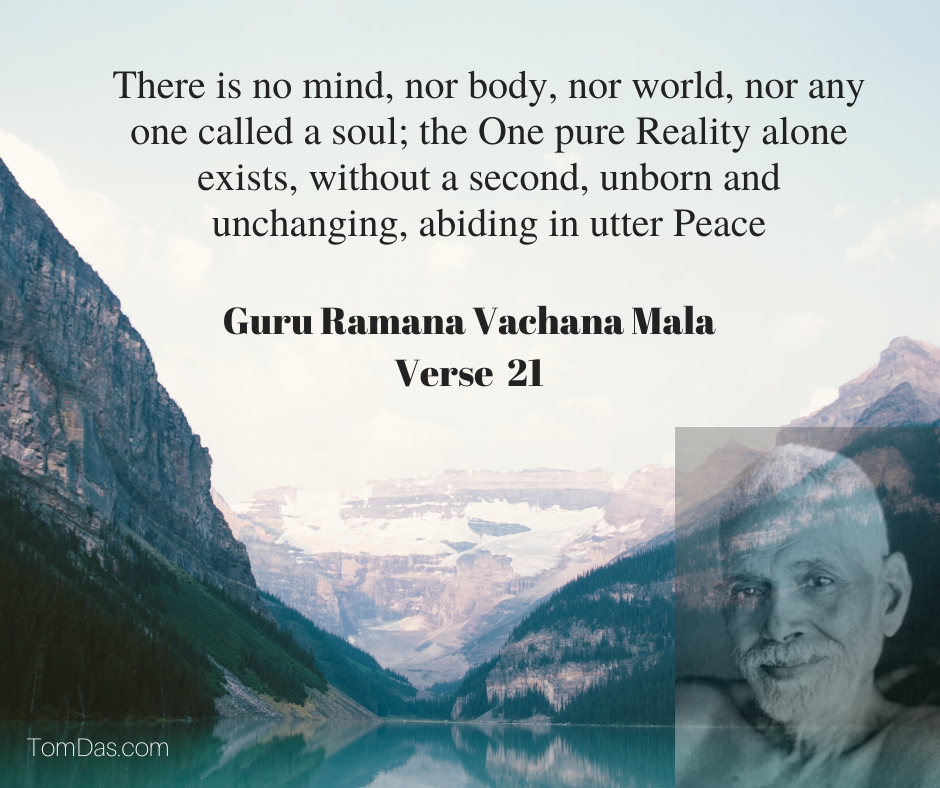
No body, no mind, no world

All that which is seen or perceived is an utter illusion. In reality there is no body, no mind and no world. There is only the One Formless Blissful Reality and You Are That. This must be discovered for oneself. The Reality, That which you ARE, which is unseen, is often overlooked, ignored.

When this is pointed out, those overly-attached to their individuality – ie. those overly attached to the notion of being a particular body-mind and their worldly life – they may cite this as being an offensive, impractical or life-denying teaching. In doing this they miss the Eternal Life of Unending Bliss!

But do not concern yourself with all of this: of course, this is all part of the illusion, the dream…Have faith in Bhagavan Sri Ramana and His Teachings and His Grace…press on with your Sadhana!

Shankara teaches two methods to ‘attain liberation’ (Self-Knowledge or Atma-Jnana) | Swami Satchidanandendra Saraswati (SSS) | Advaita Vedanta

Swami Satchidanandendra Saraswati (SSS) was a great Sanskrit scholar who made an extensive study of Shankara’s writings and commentaries and subsequently wrote many books on Advaita Vedanta. According to SSS, there are essentially 2 methods to ‘attain liberation’ outlined by Sri Shankara:

1. Firstly, in those who are ripe, merely hearing (sravana) a teaching equating oneself with Brahman, will result in liberation. For some who are slighlty less ripe, some repeated contemplation (manana) upon this teaching will be required too. (Tom’s addition: A ripe mind may be a mind that is rendered extremely pure and subtle by long and sustained spiritual practice, or a mind may be ripe due to other more mysterious factors including ‘God’s Grace’.)

2. Secondly, for those who are not able to ‘attain liberation’ merely by hearing +/- contemplating a teaching such as ‘you are that’, one must also undergo prolonged meditation (nididyasana) which will directly result in liberation.

We can see that Bhagavan Sri Ramana Maharshi broadly states the same here.

SSS in his text the Theory of Vedanta writes on p. 153:

‘In addition to Karma and Upasana, there is a kind of concentrated contemplation called the Adhyatma-Yoga which leads to immediate intuition [of Brahman, ie. Self Realisation]’

You can see that SSS is stating that this Adhyatma-Yoga is not classified as ‘karma’ or action, and is also not classed as Upasana (meditation on objects), but is something else that is a direct means of knowledge or liberation.

SSS writes in ‘The Method of Vedanta’ p. 147:

‘The aim of the one practising sustained meditation (nididhyasana) is different [to Upasana, defined here as meditation on forms/objects]. He tries to attain direct vision of reality (here in this very world) by turning his mind away from all else [ie. all objects]. And there is the difference — as against upasana — that after the rise of knowledge nothing further remains to be done. It is this sustained meditation that is referred to at Kathha Upanishad I.ii.12 by the name ‘Adhyatma Yoga’. In the Gita it is sometimes called ’Dhyana Yoga’ (e.g. XVI11.52). In the Mandukya Karikas it is called ’restraint of the mind’ (G.K.III.41, etc.). Its nature is described there in that latter work. Everywhere its result is described in the same way as right metaphysical knowledge, and from this comes immediate liberation (sadyo-mukti).’

You can see that SSS defines Upasana as meditation upon objects, and that this is considered to be action or karma (and so will not directly lead to realisation), whereas nididhyasana is a special type of meditation which involves turning away from objects, and this type of meditation is not considered to be ‘karma’ or action, but a direct means to knowledge (as karma pertains to objects only, not to the actionless subject).

Here again this is stated more clearly in the introduction to the text Adhyatma Yoga:

‘The subject dealt with here viz. Adhyatma Yoga, also known as Dhyana Yoga, Mano-nigraha Yoga, Samadhi Yoga and Nidhidhyasana, is treated these days as a Kartru Tantra Sadana. But in the Shankara Bhashya throughout, this Adhyatma Yogi or Dhyana Yoga is treated as a Vastu Tantra Sadhana’

Kartru Tantra Sadana means action, which being limited, will therefore not lead to something unlimited (ie. liberation or the Self). Vastu Tantra Sadhana means something that will lead directly to the Supreme Truth (Vastu), ie. that which is a means of Knowledge or Liberation.

In summary, SSS writes on p 143 of The Method of Vedanta’:

‘the highest kind of candidate is able to acquire immediate intuitive vision that his Self is the Absolute from merely hearing the relevant upanishadic texts once. These people who realize the goal by merely hearing the texts once have nothing further to do…

‘…But those who are not able to acquire intuitive knowledge of the meaning of the texts in their own direct experience have to go on hearing the texts and reflecting over them to remove the doubts that prevent their meaning being understood, and they have to continue with this until intuitive knowledge arises. For we see that those of dull understanding acquire knowledge through diligent repetition…

‘…But those who cannot acquire intuitive knowledge of reality by hearing and reflection alone have to resort to sustained meditation also. In any case, the general rule is that hearing and the rest have to be continued until there is intuitive knowledge of reality. For attainment of intuitive knowledge of reality is their purpose’

To see how SSS and Shankara define meditation or nididhyasana, see here: What is Vedantic Meditation?

To see how Sri Ramana gives the same teaching, see here: Sravana alone can result in Self-Realisation! Sri Ramana Maharshi on Sravana, Manana and Nididhyasana

A Message for the New Year (Ramana Maharshi’s teachings summarised)

Some consider Bhagavan Sri Ramana Maharshi’s text ‘Ulladu Narpadu’ or ’40 verses on Reality’ to be the most profound teachings of Bhagavan Sri Ramana.

Here in the first invocatory verse of Ulladu Narpadu, Bhagavan Sri Ramana summarises the path of knowledge:

1. Unless Reality exists, can thought of it arise? Since, devoid of thought, Reality exists within as Heart, how to know the Reality we term the Heart? To know That is merely to be That in the Heart.

In the second invocatory verse he summarises the path of Love or Bhakti:

2. When those who are in dread of death seek refuge at the feet of the deathless, birthless Lord Supreme, their ego and attachments die; and they, now deathless, think no more of death.

Therefore, in just these two verses, the entire teaching is summarised. Let us contemplate upon them, meditate upon them and realise their essential teaching!

Wishing you all a wonderful 2022!

Happy New Year!

🙏🙏🙏

Except by the Lord’s Grace (Sri Ramana Maharshi | Tips for Self-Enquiry | Guru Vachaka Kovai)

‘Except by the Lord’s Grace, which begins to function when one surrenders oneself completely to His Feet with sincere devotion, It [The Reality] cannot be cognised merely by the skill of the mind of the jiva [the apparently individual person]. So subtle is the reality.’

~Sri Ramana Maharshi (Guru Vachaka Kovai, Verse 648, translated by Sri Sadhu Om and Michael James)


Here is the same verse 648 translated by T.V. Venkatasubramanian, Robert Butler and David Godman:

‘Know that reality is so extremely subtle, it cannot be known and realised through the exertions of the jiva‘s intellect, but only through the Grace of God, which manifests when you offer yourself up with love at His Feet’


Here is the next verse, verse 649 translated by T.V. Venkatasubramanian, Robert Butler and David Godman:

‘Do not wander and search, having failed to find the Abiding State in spite of receiving tuition in all the arts and sciences, and thoroughly mastering them. The Supreme State is to abide wholly as the Reality that remains enshrined as the form of Love’

The Law of Attraction Teachings – Are they helpful for spiritual enlightenment or liberation? What does Advaita Vedanta say about Law of Attraction Teachings? Tripura Rahasya

Did you know that many Vedanta and Vedic texts contain what are now often called ‘Law of Attraction’ Teachings? Including the text Tripura Rahasya, a text recommended by Sri Ramana Maharshi?

Just through Being Still

Be still.

Just be still.

Gently,

Without force,

Allow all thoughts to subside,

In their own time,

So that only Stillness (Subject-Self-Consciousness) remains.


All doubts, confusions and questions

Will gently fade away effortlessly,

By themselves,

Just through Being Still.


Have faith in your Self-Nature

(Or Guru or God),

Know you are One and All,

And armed with this Knowing-Faith-Intuition,

Surrender,

And Be Still


Once one starts to gain experience in Being Still/turning within,

All teachings that do not encourage stillness or turning within

To discover the Pure Subject-Self/Divine Essence,

Are seen to be utterly superficial, egoic

And of the nature of delusion.


The Simple Being

That is your own True Self or True Nature

(Also known by more grandiose terms

Such as ‘Ultimate Truth’ or ‘Thoughtless Reality’ or ‘God’)

Will be revealed as simply your own Being

Or Isness

Devoid of objective arisings,

Just through Being Still.


‘You’ will discover your own True Self,

which is naturally devoid of arising objective phenomena,

just through Being Still.


Suffering will slips away of its own accord,

there being nowhere for it to attach itself to,

just through Being Still.


Bliss overflows
Infinity Dawns,
Eternity Rises,
Consuming all:
One is thrust into Eternal Life-Joy-Bliss,
One with Source (‘The Father’)

Just through Being Still


All duality is destroyed,
And with it suffering and egoity also disappear,
As the many waters of duality,
Flow into the Ocean of Unity,
(That is my Beloved Guru Bhagavan Sri Ramana,
Who is Grace,
Oneness itself)

Just through Being Still


Without Being Still,
(Also known as Self-Enquiry, Self-Surrender, Abiding as Self,
Being with God, Being with Guru, Residing in The Heart,
Turning Within, Awareness Watching Awareness, Self-Attention,
Parabhakti, Samadhi, Meditation,
Yoga, Devotion, Loving Self/God
Nididhyasana, Silence, Just Being),
Without this Sadhana (Spiritual Practice),
Know that ego-duality-confusion-suffering-samsara will continue potentially forever until the practice is undertaken.

Therefore,
Be Still.


For those who find themselves unable to practice thus,

Contemplate deeply upon this:

What will bring Eternal Joy-Peace-Happiness-Bliss?

Attending to/paying attention to that which changes (ie. various objects that arise and fall)

Or paying attention to that which never changes (the Subject-Consciousness-Self)?

Contemplating thus,

Know that attending to objects/maya simply leads to more objects/maya,

And thus more ego & suffering.

Contemplate this deeply.

Contemplating deeply, and knowing thus,
Discover what You Are:
Abide as the Self,
And Be Still.


Therefore

Be still.

Just be still.

Gently,

Without force,

Allow all thoughts to subside,

In their own time,

So that only Stillness (Subject-Self-Consciousness) remains.

❤️🙏❤️

Unity amidst diversity? No! This is not true! (Sri Ramana Maharshi refuting the view of Bheda-Abedha)

Also see:

How can the sage function with NO THOUGHTS? Sri Ramana Maharshi

Ramana Maharshi Quotes: Nobody here/ the jnani is not a person

Does the Sage (Jnani) see the world? Does the world appearance exist after liberation?

In verse 931 of Guru Vachaka Kovai, Sri Ramana Maharshi says:

931. “The mukta [‘liberated sage’] like the rest of us perceives the world in all its vast variety and yet he sees non-difference in it”, so people say. This is not true.

Tom: the idea that the liberated sage still perceives differences ‘like the rest of us’ but perceives an underlying unity despite various objects being seen is here being refuted. Let us see Sri Sadhu Om’s commentary on Guru Vachaka Kovai verse 931:

Sri Sadhu Om: People have many wrong conceptions about the state of a Jnani or Jivanmukta, and one such misconception is refuted here. “What people see as water, the Jivanmukta also sees as water, and what they see as food, He also sees as food. Therefore, in His experience of sense-objects, the Jivanmukta is the same as other people. But even while the Jivanmukta thus sees these differences, He sees the non-difference in them” – are there not many pandits and lecturers who talk and write thus, even though they themselves have no experience of Advaita but have only read about it in books?

But who is the proper authority to say what is the actual experience of a Jivanmukta? Only a real Jivanmukta! Thus Bhagavan Sri Ramana, who has actually experienced the reality and who is the true Loka Maha Guru, declares in this verse that such statements are wrong, and in the next verse He explains how and why they are wrong.’

~Sri Sadhu Om

Tom: Let us see the next verse:

932. Those who mistakenly perceive the variegated universe believe the mukta [‘liberated sage’] too is a perceiver like them. But he is not the perceiver.

Tom: ie. Taking yourself, in ignorance, to be a perceiver and doer, one also, in ignorance, takes the sage to be a perceiver and doer. The sage is not a perceiver! The sage is not a doer! It is just a projection of ignorance that views ‘a sage’ in this way, as a human being or individual person. Again let us see Sri Sadhu Om’s comments:

Sri Sadhu Om: Verse 119 of this work should again be read here. So long as one sees oneself as an individual who sees the world of differences, one cannot but see the Jnani likewise as an individual who sees differences. But since the jnani is in fact nothing but the bodiless and individuality-less Jnana Itself [Tom: ie. in reality we not a human being or body-mind entity at all – we are in fact Spirit, or the Bodiless Atman-Brahman], to see Him as a seer and to believe that even He is seeing differences like oneself, is true only in the outlook of ajnanis.

The absolute truth, however, is that the Jnani is not a seer and that He never sees any differences, for as Sri Bhagavan says in verse 13 of Ulladu Narpadu, “Knowledge of multiplicity is only ignorance [ajnana]”. Thus in the above two verses Sri Bhagavan clearly refutes the wrong idea expressed in the note at the end of the introduction to Sat-Darshana-Bhashya, 6th ed. pp. 35 to 38, namely the idea that a Jnani or liberated soul retains His individuality in spite of the destruction of the ego, and that He “perceives diversity in unity and experiences unity in diversity”.

Regarding this erroneous theory of bheda-abheda or unity in diversity, Sri Bhagavan used to say that if the least difference or diversity is perceived, it means that the ego or individuality is there, so if difference is experienced, non-difference or unity would merely be a theoretical proposition and not an actual experience.

~ Sri Sadhu Om