Spiritual knowledge cannot be learnt

green sloping hills.jpg
“There will come a time when one will have to forget all that one has learned.” 
from ‘Who am I’ by Ramana Maharshi

Ultimate truth is simply that which never changes. It is here, now, everywhere and always already in its full glory. It is not separate from whatever is happening or from what is currently being experienced. Ultimate truth does not require you to believe in it or even do anything for it. Just drop all wrong thoughts and whatever remains is It. It cannot be caught in concepts.

The main role of the spiritual path is not to learn about ultimate truth, as it cannot be accumulated, but to discard falsehood. Seeing through false assumptions is what is called ‘spiritual knowledge’. It is not knowledge in the conventional sense at all really.

Conventionally speaking, learning is about accumulation of knowledge, but spiritual learning is more like pruning a hedge or chipping away at a block of stone to reveal a beautiful sculpture beneath. Put simply, spiritual learning is unlearning. Spiritual knowledge is seeing through false ideas.

“The state of Self-realisation, as we call it, is not attaining something new or reaching some goal which is far away, but simply being that which you always are and which you always have been. All that is needed is that you give up your realisation of the not-true as true.”
Ramana Maharshi

Anything that is learnt as being true is in the realm of relative knowledge. Anything that is learnt can also be forgotten whereas the Ultimate neither comes nor goes. Any statement posited as being true can be questioned and doubted leaving with it the bitter taste of uncertainty.

The Ultimate cannot be conceptualised. Conceptualisation itself relies on the Ultimate for its existence. All statements of truth rely on supporting structures and logic, eg. underpinning scientific or philosophical reasoning. The Ultimate truth stands by itself without needing outside support. It is none other than what you truly are. Look and you shall see.

Humility and realisation

humility flower.jpg

An important part of the teaching is to realise the limits of our ability to know or understand things. Often we think we know or understand things only to later find that we were deluding ourselves. The very ideas we think we know to be true are the same ones that keep us trapped and prevent realisation occurring.

The very ideas we think we know to be true are the same ones that keep us trapped and prevent realisation occurring.

Remember that realisation does not mean arriving at a new understanding: it is actually the realisation that the beliefs we held about ourself, specifically the ‘I am the doer’ belief, do not have the evidence required to support them. If we just follow the evidence, we will not make claims that are unjustified, and we preserve our humility and integrity. Any understanding we subsequently develop will have strong foundations.

Being humble just means not pretending to know something that you don’t. Similarly if you think you know something but are not completely sure, it means admitting that uncertainty. In that space of doubt, there is room for something true to emerge and be seen. In acknowledging the limitations and assumptions of our thought processes we are entering into what is actual and true.

In that space of doubt, there is room for something true to emerge and be seen.

To put it differently, humility is a form of honesty, and it is this being completely honest with ourselves that forms a firm foundation from which this teaching can take root, grow and thrive.


Spiritual Materialism

diamond.png

So many spiritual seekers start off on the wrong footing, so many spiritual teachings pander to the ego. If your main aim on the spiritual path is to gain super-powers, be permanently in a state of heightened bliss or to be the next great spiritual teacher, then you are primarily interested in accumulation and possession and perhaps not as deeply interested in truth as you may think. You should know this is the ego’s desire and the spiritual path you walk is not a genuine one.

So, first ask yourself honestly – do you want truth or pleasure? You may want both, but which one do you want more? If your perception is distorted by ego and desire, then the spiritual path you are attracted to will be similarly distorted. We get the spiritual teachings we deserve.

We get the spiritual teachings we deserve.

There is nothing wrong with seeking happiness of course. It is through suffering and seeking an end to suffering that most of us become spiritually inclined in the first place. But if we are clouded by our desires and insecurities then we become susceptible to false beliefs, magical thinking, exploitation and corrupt spiritual teachings. This ‘spirituality’ is in fact another form of materialism or hedonism in a different guise: the ego is still at play.

If you can see all of this, then you already know that you are apart from it. What is it that sees? Who are you at your innermost core? All that you have accumulated will pass away: pleasure, pain, psychic powers, fame, charisma and transcendental experiences. All are finite and transient. None of them are the Eternal.

The Eternal already is. Nothing is not It.


Annamalai Swami: maya, the body and self-enquiry

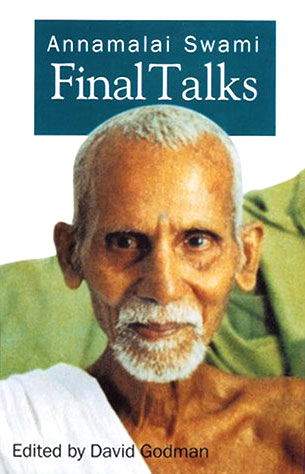
annamalai swami final talks

(The following is an excerpt from the above book and comprises most of Chapter 3):

A devotee who came to Annamalai Swami had so much pain in one of his legs, he found it very difficult to sit comfortably  on the floor. Observing his difficulties, Annamalai Swami (AS) made the following remarks:

AS: Though the body is needed for Sadhana, one should not identify with it. We should make good use of it and look after it well,but we should not pay too much attention to it.

There are so many thoughts in the mind. Thought after thought after thought. They never stop.  But there is one thought that is continuous, though it is mostly subconscious.  ‘I am the body’ – this is one string on which all other thoughts are threaded. Once we identify  ourselves with the body by thinking this thought, Maya follows. It also follows that if we cease to identify ourselves with the body, Maya will not affect us anymore.

‘I am the body’ – this is one string on which all other thoughts are threaded.  Once we identify  ourselves with the body by thinking this thought, Maya follows.

Maya is fundamentally non existent. Bhagavan said that Maya literally means ‘that which is not.’ It is unreal because everything that Maya produces is an outgrowth of a wrong idea. It is a consequence of taking something to be true that is not really true. How can something that is not real produce something that is real? If a barren woman says that she has beaten by her son, or that she has been injured by the horns of a hare, we would rightly take her to be deluded. Something that does not exist cannot be the cause of suffering or of anything else.

Maya is fundamentally non existent.

How to get rid of this ‘I am the body’ feeling and of the Maya that is produced by it?  It goes when there is ‘saman bhava’  the equanimity  or equality of outlook that leaves one unaffected by the extreme opposites such has happiness and unhappiness, pleasure and pain. When ‘saman bhava’ is attained, the idea ‘I am the body’ is no longer present and Maya is transcended.

Question:  Is the body to be regarded as unreal, as ‘not me’? What attitude should I have towards this body and all the sensory information it provides me with?

AS:  By itself, this body is jada, inert and lifeless. Without the mind, the body cannot function. And how does the mind  function? Through the five senses that the body provides.

Mind and body are like the tongue and teeth in the mouth. They have to work in harmony with each other. The teeth do not fight with tongue and bite it. Mind and body should combine in the same harmonious way.

However, if we want to go beyond the body, beyond the mind, we have to understand and fully accept that all the information the senses provide is not real. Like the mirage that produces an illusory oasis in the desert, the senses create information that there is a real world in front of us that is being perceived by the mind. The apparent reality of the world is an illusion. It is merely a misperception. When the mind perceives a snake where in reality there is only a rope, this is clearly a case of the senses projecting an imaginary image onto a real substratum. This, on a large scale, is how the unreal appearance of the world is projected by the mind and the senses onto the underlying reality of the Self….

…Self Inquiry is the  process by which attention is put on the substratum instead of on names and forms that are habitually imposed on it. Self is the substratum out of which all things appear to manifest, and the Jnani is the one who is continually aware of the real substratum. He is never deluded into believing that the names and forms that are perceived by the senses have any  real existence.

Self Inquiry is the  process by which attention is put on the substratum instead of on names and forms that are habitually imposed on it.

Whatever we see in this room, for example, that picture of Bhagavan over there, is unreal. It has no more reality than objects we perceive in our dreams. We think we live in a real, materially substantial world, and that our minds and bodies are real entities that move around in it. When the Self is seen and known, all these ideas fade away and one is left with the knowledge: Self alone exists.

Question: If I regard all the people that I see and meet as unreal projections, what do I base my moral sense on? I can go around killing then or robbing them without feeling guilty because i would know that they are just characters in my dream.

AS: Everything that we perceive is maya, an unreal dream,  but one should not then think, “Since everything is unreal, I can do what I like”. There are dream consequences for the bad acts committed in the dream, and while you still take the dream to be the reality, you will suffer the consequences of your bad behaviour. Do no evil and have no hate. Have equanimity towards everything.


New Online (Skype) Meetings: Non-Duality & Spirituality Meetings, London, UK

Since starting to hold regular non-duality and spirituality meetings in London, it has been truly wonderful to meet many of you in person and share this message with you. I’d like to take this opportunity to express my thanks and gratitude for your presence and support.

It’s also been fascinating for me to see how this simple yet dynamic teaching has the potential to alleviate suffering and liberate those who come in to contact with it, and often in a relatively short space of time.

I’ve also been amazed at how many people are thirsting for this message and are really serious about finding true answers, true resolution, not just on the level of concepts and mere explanations, but on a much deeper ‘experiential’ level.

However there are some people who find it difficult to attend the twice monthly meetings in person at the Druids Head, London, so I have now scheduled online meetings via Skype. These will be in addition to the regular meetings in person in Kingston, London. Details of how to join us can be found here or here. Dates of forthcoming meetings can be found here.

I hope this allows more people to be able to hear these wonderful teachings.

For further information on other ways you can meet with me click here.

So perhaps I will see you soon, in person or via Skype.

Wishing you peace, happiness and wisdom

Tom

Ramana Maharshi: Self-Realisation is simply being one’s self

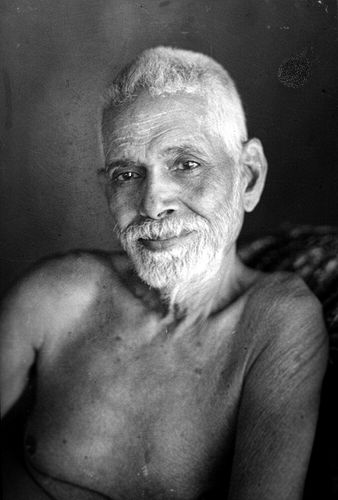
Ramana smiling

The state we call Realisation is simply being one’s self, not knowing anything or becoming anything.

If one has realised, one is that which alone is and which alone has always been. One cannot describe that state, but only be That.

Of course, we talk loosely of Self-Realisation for want of a better term.

Ramana Maharshi
(taken from the book Day by Day with Bhagavan, p. 296)

Tom’s comments:

Notice that the search for ‘understanding’ and the search for becoming ‘enlightened’ or ‘self-realised’ are both pursuits of the ego. The ego is looking for security and pleasure and has projected/created these fantasies which it tries to attain.

Instead of trying to attain a projected fantasy, why not instead look at what is actually happening? Look at yourself, look at the ego, the ‘I’. Ask yourself ‘what is this ego? Who am I?’ Investigate for yourself repeatedly and you will see that the ego, the ‘you’ is illusory – it’s just a bundle of thoughts that occur by themselves, spontaneously. ‘Your thoughts’ are not yours at all: note how you cannot chose to stop thinking, stop worrying, stop your addictions. You cannot chose to believe something you don’t. You cannot chose to not believe something you do believe. You cannot stop your ‘bad thoughts’. In fact you probably do not even know what exactly you will be thinking in 5 minutes time let alone tomorrow or 5 days from now.

Another point: if you happen to think you are a dinosaur, it doesn’t necessarily make you one. Similarly if you think that you are an ego (a doer, a thinker, an agent who has authorship over his/her actions), it doesn’t make it true. Yes, the idea of being a doer is just that: it is an idea, a belief that has been tacitly repeated to us and drummed into us since childhood. An oft-repeated lie is then (mistakenly) taken to be true.

In seeing this first-hand, there is no specific intellectual understanding or state of mind gained. It’s just that an illusion has been seen through, like seeing that a frightening snake is in fact just a harmless rope in poor light (or like realising that you are not in fact a dinosaur after all!).

No dogmas, no metaphysics, no complex body-twisting acrobatics, no beliefs and no rituals are necessary (although they may be a part of the apparent journey).

Then all there is is ‘what’s happening’, and what you thought was you is actually just a part of that happening. Or as Bhagavan puts it, all there is is ‘simply being one’s self’.

Don’t accept a lie

masks.jpg

Don’t accept a lie.
If you see there is no evidence for there being a separate ‘you’,
Then whenever this thought or notion ‘you’ turns up in daily life,
See through it.
Deny it.
Not out of a belief,
Not as a formula to be repeated,
But as something that is clearly seen.

We don’t have to define reality

Leopard

We don’t have to define reality
We don’t even need to see things as they are.
We don’t need to do anything.
Just this.
That’s it.

Naturally,
We already see things as they are,
Effortlessly,
It’s our natural intelligence,
(It’s not ‘ours’)
And wrong concepts are naturally dropped,
(Or maybe they are not).

Reality shines through all of this.
How could it not?