Self-Attention is the key. Powerful teachings quotes of Sri Ramana Maharshi arranged for deep contemplation here in this video below. Each quote is initially repeated twice to drive the teachings home and later on more time is given between the quotes to enable one to dive deeper into the Silence-Self within.
For a full transcript of the featured quotes together with source text from which they are obtained, please see the final ‘Summary Verses’ section on this link.
For more videos like this see the playlist ‘Guided Meditations’ here.
Question: Ramana Maharshi said that to do the Self Enquiry, one already must have a clear, calm mind. Otherwise he said to follow other paths first – am I right? Like Karma yoga and Bhakti yoga. But I think the Work of Byron Katie also helps to see through the beliefs we ended up with after trauma. Do you know if it’s true that, even if you inquire into the beliefs, there will always be, for example, fear stored in your subconciuousness or store consciousness? So even If you keep inquiring into the beliefs after trauma there will always be pain stored in the body and that this can only be dealt with by energetic bodywork or Eye Movement Desenzatition and Reprocessing (EMDR)? And keep on doing Self Enquiry of course.
Tom: the key trauma is the ego, ie. the idea ‘I am a limited entitiy (ie. the body-mind)’. This only goes with self-enquiry. Self-enquiry cuts the trunk of the tree of suffering. Other remedies attack the leaves and branches. Both are valid: one alleviates suffering, the other cures it once and for all. Theoretically, one can go straight for self-enquiry, but for many I come across, it seems that trimming the leaves and branches need to be done first (I often help people with this too) to quieten, de-traumatise and purify the mind. This is not actually the case, but it seems that way due to the distorting effect of the ego.
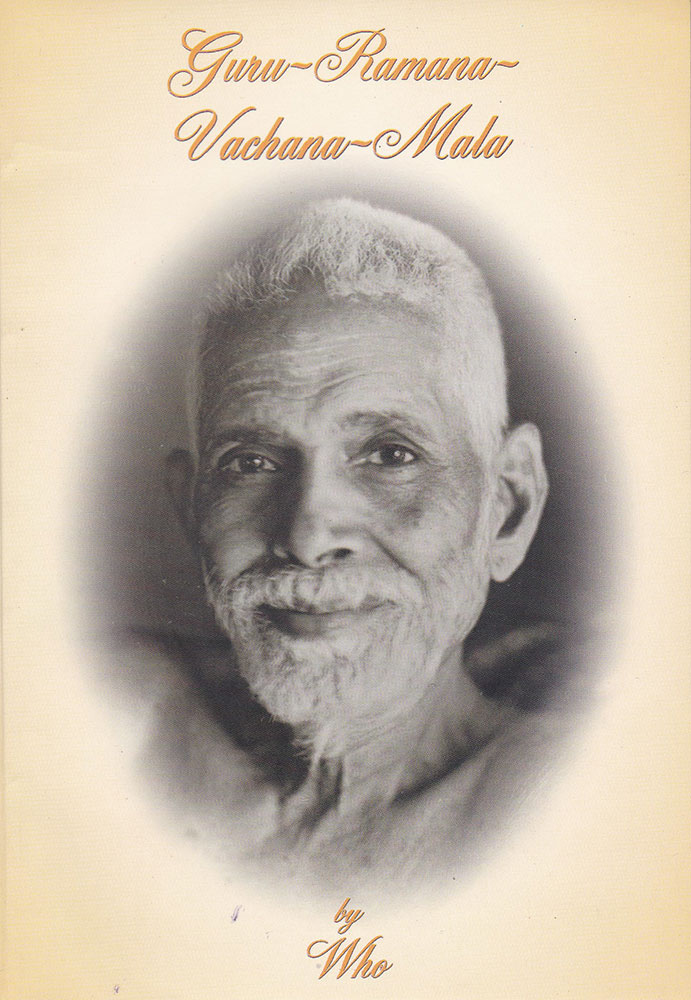
Guru Ramana Vachana Mala (‘A stringing together (mala) of Guru Ramana’s sayings (verbal teachings)’) is a small but wonderful text that concisely and accurately summarises the teachings of Sri Ramana Maharshi. It was compiled with the help of both Sri Ramana Maharshi and Sri Muruganar and clarifies areas of the teaching that may not be otherwise clear for the seeker. It also summarises the essential Vedanta teachings, as per verse 3 of the text.
Click here to download Guru Ramana Vachana Mala in PDF format
Update 2024: Ramana Ashram have asked me to remove the PDF download of Guru Ramana Vachana Mala
The text consists of 349 selected verses compiled together by Sri K. Lakshmana Sarma (who wrote under the pseudonym ‘Who?’), who was not only intimate with Sri Ramana’s teachings, but also a scholar in Vedantic studies and also fluent in the Tamil, Sanskrit and English languages – these verses are translated into English by Lakshmana Sarma himself, so we can be confident the translation is accurate with regards to both the accuracy and intention of the teaching. The verses are helpfully organised by topic and about 300 of these verses are taken from the text Guru Vachaka Kovai which is widely accepted as being the most authoritative text on Sri Ramana Maharshi’s verbal teachings.
Whilst the verses in Guru Ramana Vachana Mala do not go into great detail on the method of Self-Enquiry compared to other recommended texts, they are very illuminating nonetheless and give great clarity on areas of the teaching that may otherwise not be clear for the seeker. I therefore highly recommend this book, but I also recommend that you read this together another of the recommended texts pertaining to Sri Ramana, such as The Path of Sri Ramana which explains the process of Self-Enquiry in greater detail.
Sri Lakshmana Sarma was in close contact with Sri Ramana Maharshi for over 20 years and was also good friends with Sri Muruganar (who wrote Guru Vachaka Kovai). He was also one of only two people who received private tuition by Sri Ramana Maharshi on the true/deeper meaning of the teachings (the other person was Sri Muruganar), this private tuition extending over a period of many years, and he was known for constantly checking his understanding of the teachings with Sri Ramana to ensure that his understanding was accurate.
For example, Sri Ramana said that Lakshmana Sarma’s commentary on Ulladu Narpadu (40 verses on reality) was the best commentary available, which is unsurprising given that Sri Ramana himself taught Lakshmana Sarma the meaining of each verse in this text over a period of several years.
As stated above, Guru Ramana Vachana Mala was composed with the help of both Sri Ramana Maharshi and Sri Muruganar, as T.N. Venkataraman (the then president of Sri Ramana Ashram) writes in the preface to the 8th edition of Maha yoga:
‘Just as Lakshmana Sarma had composed Sri Ramana Hridayam with the help and guidance of Sri Bhagavan, he composed Guru Ramana Vachana Mala with the help of both Sri Bhagavan and Sri Muruganar, and in doing so he had a further opportunity to study Sri Bhagavan’s teachings deeply and to receive pertinent instructions from Him.’
These above factors, together with the fact that this text was first published during Sri Ramana’s lifetime means we can be confident that the teachings presented here are a true representation of Sri Ramana’s teachings.
The teacher who is going to deliver you from bondage, from suffering to liberation, where is this teacher? Where is Guru? Where are you? Is there another outside you who is going to liberate you? And what is satsang really?
This video was recorded live during a Satsang meeting with Tom Das and put together by volunteers.
Self-enquiry is diving into the Self, Self-surrender is letting go of body, mind and world. Both these ways lead to Self-abidance and Liberation/ Self-Realisation.
This video was recorded live during an online meeting and put together by volunteers;
‘The mind is by nature restless. Begin liberating it from its restlessness; give it peace; make it free from distractions; train it to look inward; make this a habit. This is done by ignoring the external world and removing the obstacles to peace of mind’
~Sri Ramana Maharshi, Talks with Sri Ramana Maharshi, talk no. 26
Objection: I have a slightly different view then Ramana perhaps did on ignoring the external world. It seems to me that the external world is the reflection of the inner. Becoming conscious of the beauty in nature resonates with the inner. This is perhaps a more indigenous view and is much older then even Vedanta and goes back even to the time when humans were Neanderthals as well as Homo sapiens when everything in nature was animating in presence.
Tom: Yes, being with nature is one of many things that can bring us in tune with the Self and bring us genuine peace and genuine insight, but ultimately for realisation to occur (and thus for suffering to end) one must turn within and all thoughts must cease. Otherwise the illusion of time and space are not seen through and suffering (and duality) continue, even if in a subtle way.
This is why Sri Ramana Maharshi writes in Who Am I?:
Q. When will the realization of the Self be gained? Sri Ramana: When the world which is what-is-seen [ie. objects] has been removed, there will be realization of the Self which is the seer. Q. Will there not be realization of the Self even while the world is there? Sri Ramana: There will not be.
~ Sri Ramana Maharshi, Who Am I?
Tom: What we call the world (ie. space and time and people) is actually a projection of mind/thought. Put simply, the world, space and time are simply thoughts. Again, this cannot be known unless we turn within, away from the world, towards the Self, and thoughts competely cease. From Sri Ramana Maharshi:
‘When the mind, which is the cause of all cognition’s and of all actions, becomes quiescent, the world will disappear…All the texts say that in order to gain release one should render the mind quiescent; therefore teaching is that the mind should be rendered quiescent.’
~ Sri Ramana Maharshi, Who Am I?
Tom: When thoughts completely cease, time and space disappear. If time and space are still appearing, it is because thought (namely the ‘I-thought’, which is the notion or thought or belief that ‘I am a body-mind’) still persists.
Therefore, when the world appears, the Self does not appear; and when the Self appears the world does not appear.
~ Sri Ramana Maharshi, Who Am I?
When the mind comes out of the Self, the world appears.
What you are is what you are. It can never be known by the mind. The thinking mind can never discover what you are. This is knowledge, supreme knowledge, supreme realisation as opposed to mundane or worldly knowledge. This knowledge is your Being. It is known by being what you are. So when this question is asked, ‘Who am I? What am I?’ The answer is not the words ‘I am’, the answer is what those words signify.
This video was recorded live during a Satsang meeting with Tom Das and put together by volunteers.
Now it is true that Sri Ramana often said that we should ‘be still’ [in Tamil – ‘Summa Irru’ which means ‘be still’ or ‘just be’] and that this is the practice, but what did he mean by ‘be still’? If we read and examine Sri Ramana’s written work ‘Who Am I?’, we will see what Sri Ramana means when he says ‘be still’ or ‘keep quiet’. Note that we can trust the teachings in ‘Who Am I?’ as an authentic rendition of Sri Ramana’s teachings as they were written by Sri Ramana himself.
Let us see: the first time we come across the notion of quieting the mind in ‘Who Am I?’ is as follows:
‘When the mind, which is the cause of all cognition’s and of all actions, becomes quiescent, the world will disappear.’
Now on the face of it this is quite a strange statement for Sri Ramana to make: that the world will disappear when the mind is still. Clearly, when Sri Ramana states that the mind is to be quiet, he is perhaps using these words in a different way to how they are normally used. How can it be that when the mind becomes quiet the world disappears?
Well earlier in ‘Who Am I?’ Sri Ramana explains that it is the mind is a power that creates or projects the entire body, mind and world*, so to ‘be quiet’ means not just to still the ordinary thinking mind, but to still this world-projecting power, ie. to remove all of Maya. Ramana repeats this, see here, also from ‘Who Am I?’:
Question: When will the realization of the Self be gained?
Sri Ramana Maharshi: When the world which is what-is-seen has been removed, there will be realization of the Self which is the seer
Question: Will there not be realization of the Self even while the world is there?
Sri Ramana Maharshi: There will not be.
I have a video here which explains the importance of this teaching. It fundamentally explains why some teachings are liberating and others are not:
Whilst some teachings may encourage us to still the mind, Sri Ramana is emphasising removing the entire body-mind-world from our consciousness. We can see that Sri Ramana’s teaching is far more extreme than many others – it is this extreme teaching that is needed to remove ignorance and realise the Self.
Sri Ramana emphasises Self-Enquiry as the only sadhana that will lead us to Liberation. Again, Sri Ramana’s teaching is more narrow and prescriptive in this way, as he maintains that Self-Enquiry is the only way. Let us see what else Sri Ramana writes in ‘Who Am I?’:
Question: Are there no other means for making the mind quiescent?
Sri Ramana Maharshi: Other than inquiry [Vichara; Self-Enquiry], there are no adequate means.
We can see that Sri Ramana is stating that sadhana or self-enquiry is essential to make the mind quiet, so that when Sri Ramana is asking us to ‘be still’ or ‘keep quiet’, he is actually asking us to do Self-Enquiry.
*What is called mind (manam) is a wondrous power existing in Self (atma-swarupam). It projects all thoughts…Other than thoughts, there is no such thing as the world….Just as the spider spins out the thread from within itself and again withdraws it into itself, so the mind projects the world from within itself and again absorbs it into itself. ~ from Who Am I? by Sri Ramana Maharshi

 Tom Das