Here are some quotes I have arranged by theme: they are all taken from Ramana Maharshi’s masterpiece Who Am I? (Nan Yar? in Tamil).
It is a short text and should ideally be read in full. You can find a version on this website here which is truer to the original Ramana himself wrote and where I have also introduced the text more fully, and you can find another version from Ramanashramam here, from where the quotes below were taken.
Throughout you can see that the emphasis is on stilling the mind to bring about Self-Realisation. The method for doing this is Self-Enquiry. See if you can see all the different ways that Ramana points to making the mind still in each of his answers. The Bold Type Headings are my own additions and my comments are in italicised red.
See here for an audio version of the text below:
How can I attain realisation? By removing the world and making the mind still.
Q. When will the realization of the Self be gained?
A. When the world which is what-is-seen has been removed, there will be realization of the Self which is the seer.
Q. Will there not be realization of the Self even while the world is there?
A. There will not be.
Q. When will the world which is the object seen be removed?
A. When the mind, which is the cause of all cognition’s and of all actions, becomes quiescent, the world will disappear.
Tom: Ramana is stating that realisation appears when the mind is still. Many people avoid these kinds of teachings which advocate turning away from the world, and give various seemingly logical reasons for this philosophical stance (note that it is a philosophical stance for the most part, based on logical reasoning, belief and a certain ideology), but for most people, without prolonged stillness of mind, egotism finds a way to perpetuate itself and suffering, separation and ignorance also continue.
Breath control, mantra, devotional practice are aids but are not the true practice.
Like the practice of breath-control, meditation on the forms of God, repetition of mantras, restriction on food, etc., are but aids for rendering the mind quiescent.
Through meditation on the forms of God and through repetition of mantras, the mind becomes one-pointed.
Just as when a chain is given to an elephant to hold in its trunk it will go along grasping the chain and nothing else, so also when the mind is occupied with a name or form it will grasp that alone.
Why make the mind one-pointed?
When the mind expands in the form of countless thoughts, each thought becomes weak; but as thoughts get resolved the mind becomes one-pointed and strong; for such a mind Self-inquiry will become easy.
Tom: Note that here Ramana defines a strong and weak mind: a strong mind is one that is one-pointed, a weak mind is one that is not one-pointed, ie. a scattered mind. It is a strong one-pointed mind that can undergo self-enquiry effectively for most. Therefore the practices above such as breath control, devotion and mantra practice can form a spiritual foundation for those who are not able to effectively perform self-enquiry straight away.
But thoughts keep on coming. Will thoughts ever end?
Q. The residual impressions (thoughts) of objects appear unending like the waves of an ocean. When will all of them get destroyed?
A. As the meditation on the Self rises higher and higher, the thoughts will get destroyed.
Q. Is it possible for the residual impressions of objects that come from beginningless time, as it were, to be resolved, and for one to remain as the pure Self?
A. Without yielding to the doubt “Is it possible, or not?”, one should persistently hold on to the meditation on the Self. Even if one be a great sinner, one should not worry and weep “O! I am a sinner, how can I be saved?”; one should completely renounce the thought “I am a sinner”; and concentrate keenly on meditation on the Self; then, one would surely succeed.
Tom: To worry about whether or not thoughts can end is itself a thought and so is moving away from stillness of mind. See how tricky the mind is?
What about my worldly problems and other people?
The mind should not be allowed to wander towards worldly objects and what concerns other people.
However bad other people may be, one should bear no hatred for them.
Tom: Again, the above teachings are all about the mind becoming still.
What about desire and hatred?
Both desire and hatred should be eschewed.
Tom: Hatred and desire are more agitations of the mind.
How can I stop worrying about worldly affairs?
Whatever burdens are thrown on God, He bears them. Since the supreme power of God makes all things move, why should we, without submitting ourselves to it, constantly worry ourselves with thoughts as to what should be done and how, and what should not be done and how not? We know that the train carries all loads, so after getting on it why should we carry our small luggage on our head to our discomfort, instead of putting it down in the train and feeling at ease?
Tom: One solution for an agitated mind is to have faith in the Supreme God, for the mind that trusts and has faith in God naturally becomes still. This is made clearer in the next quote.
Is there room for devotion and surrender on this path?
He who gives himself up to the Self that is God is the most excellent devotee. Giving one’s self up to God means remaining constantly in the Self without giving room for the rise of any thoughts other than that of the Self.
Tom: ie. be still. If you do have thoughts, they should only be about the Self, meaning the mind is strong and one-pointed, as referenced in an earlier quote above.
Maybe I should find a guru who will help me? Perhaps I need their grace or transmission?
God and the Guru will only show the way to release; they will not by themselves take the soul to the state of release.
Each one should by his own effort pursue the path shown by God or Guru and gain release.
Tom: The Guru only tells you to be still. Seeking a Guru is entering more delusion/illusion/ignorance and merely perpetuates ignorance and mental agitation/movement. See how skilfully Ramana steers us away from this mistake? This same teaching is also given at the start of Shankara’s Vivekachudamani (verses 51-55).
Which scriptures and books will help me on this path?
All the texts say that in order to gain release one should render the mind quiescent; therefore their conclusive teaching is that the mind should be rendered quiescent; once this has been understood there is no need for endless reading.
Where in the world can I find lasting happiness and fulfillment?
There is no happiness in any object of the world. We imagine through our ignorance that we derive happiness from objects. When the mind goes out, it experiences misery. In truth, when its desires are fulfilled, it returns to its own place and enjoys the happiness that is the Self.
Tom: Seeking happiness in the world or in objects is more mental agitation. Ceasing to do this is making the mind still. This is elaborated upon and emphasised in the next two quotes.
How does a wise one act?
Under the tree the shade is pleasant; out in the open the heat is scorching. A person who has been going about in the sun feels cool when he reaches the shade. Someone who keeps on going from the shade into the sun and then back into the shade is a fool. A wise man stays permanently in the shade. Similarly, the mind of the one who knows the truth does not leave Brahman. The mind of the ignorant, on the contrary, revolves in the world, feeling miserable, and for a little time returns to Brahman to experience happiness. In fact, what is called the world is only thought. When the world disappears, i.e. when there is no thought, the mind experiences happiness; and when the world appears, it goes through misery.
What about Spiritual Knowledge (Jnana) or Wisdom?
Q. What is wisdom-insight (jnana-drsti)?
A. Remaining quiet is what is called wisdom-insight.
Q. What is the relation between desirelessness and wisdom?
A. Desirelessness is wisdom. The two are not different; they are the same. Desirelessness is refraining from turning the mind towards any object. Wisdom means the appearance of no object.
SOME CONCLUDING WORDS:
Tom: Gratitude to Sri Ramana for his teachings that skilfully and in numerous ways tell us to still the mind. Bhagavan Ramana writes:
‘All the texts say that in order to gain release one should render the mind quiescent; therefore their conclusive teaching is that the mind should be rendered quiescent; once this has been understood there is no need for endless reading.’
If you are not able to take up self-enquiry and still the mind, take up the auxiliary practices at once and devote yourself fully to them. Bhagavan Ramana writes:
‘Through meditation on the forms of God and through repetition of mantras, the mind becomes one-pointed…the mind becomes one-pointed and strong; for such a mind Self-inquiry will become easy.’
So devote yourself to God, devote yourself to Sri Ramana, chant the mantra with unceasing and unending devotion, and then go deep deep into stillness wielding the question ‘Who am I?’ as your weapon of choice, eventually letting go of this weapon too, drowning in Effulgent Grace in the formless form of Realisation. Bhagavan Ramana writes:
‘By the inquiry ‘Who am I?’. The thought ‘who am I?’ will destroy all other thoughts, and like the stick used for stirring the burning pyre, it will itself in the end get destroyed. Then, there will arise Self-realization.’
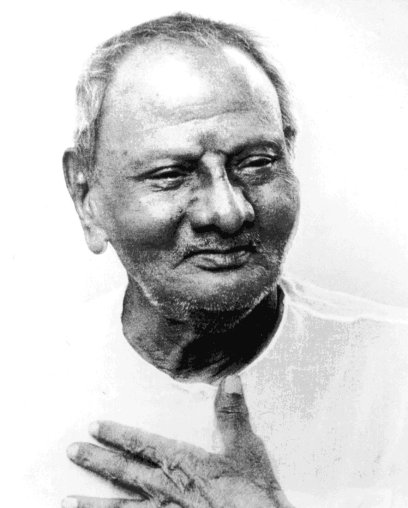
Nisargadatta Maharaj often spoke about his own spiritual journey and practice, and how his guru’s teachings led him to his own eventual self-realisation. In his most widely read book, ‘I Am That’, Nisargadatta speaks many times of his practice and the profound effect his own guru had upon him. The following are direct quotes from I Am That focusing on what Nisargadatta spoke of his own sadhana (spiritual practice) and the teachings of his own Guru.
I have not added any commentary as I think the excerpts speak for themselves, but I have added bold text to emphasize specific points I thought would be of use for seekers in terms of making the sadhana practical.
I hope you find the following quotes both instructive and inspiring for your own sadhana,
Best wishes
Tom
It so happened that I trusted my Guru. He told me I am nothing but my self and I believed him. Trusting him, I behaved accordingly and ceased caring for what was not me, nor mine.
Questioner: Kindly tell us how you realised.
Maharaj: I met my Guru when I was 34 and realised by 37.
Questioner: What happened? What was the change?
Maharaj: Pleasure and pain lost their sway over me. I was free from desire and fear. I found myself full, needing nothing. I saw that in the ocean of pure awareness, on the surface of the universal consciousness, the numberless waves of the phenomenal worlds arise and subside beginninglessly and endlessly. As consciousness, they are all me. As events they are all mine. There is a mysterious power that looks after them. That power is awareness, Self, Life, God, whatever name you give it. It is the foundation, the ultimate support of all that is, just like gold is the basis for all gold jewellery. And it is so intimately ours! Abstract the name and shape from the jewellery and the gold becomes obvious. Be free of name and form and of the desires and fears they create, then what remains?
Q: Nothingness.
M: Yes, the void remains. But the void is full to the brim.
Q: Please tell me which road to self-realisation is the shortest.
M: No way is short or long, but some people are more in earnest and some are less. I can tell you about myself. I was a simple man, but I trusted my Guru. What he told me to do, I did. He told me to concentrate on ‘I am’ – I did. He told me that I am beyond all perceivables and conceivables — I believed.
I gave him my heart and soul, my entire attention and the whole of my spare time (I had to work to keep my family alive). As a result of faith and earnest application, I realised my self (swarupa) within three years. You may choose any way that suits you; your earnestness will determine the rate of progress.
Q: No hint for me?
M: Establish yourself firmly in the awareness of ‘I am’. This is the beginning and also the end of all endeavour.
Q: How did you come to it?
M: By my trust in my Guru. He told me ‘You alone are’ and I did not doubt him.
…my Guru too taught me to doubt — everything and absolutely. He said: ‘deny existence to everything except your self.’ Through desire you have created the world with its pains and pleasures.
Put in all and you will get all. I was doing it. All my time I was giving to my Guru and to what he told me.
Q: Still, you have a body and you depend on it.
M: Again you assume that your point of view is the only correct one. I repeat: I was not, am not, shall not be a body. To me this is a fact. I too was under the illusion of having been born, but my Guru made me see that birth and death are mere ideas — birth is merely the idea: ‘I have a body’. And death — ‘I have lost my body’. Now, when I know I am not a body, the body may be there or may not — what difference does it make? The body-mind is like a room. It is there, but I need not live in it all the time.
I trusted my Guru and he proved right. Trust me, if you can. Keep in mind what I tell you: desire nothing, for you lack nothing. The very seeking prevents you from finding.
‘One can give food, clothes, shelter, knowledge, affection, but the highest gift is the gospel of enlightenment‘, my Guru used to say. You are right, enlightenment is the highest good. Once you have it, nobody can take it away from you.
I am now 74 years old. And yet I feel that I am an infant. I feel clearly that in spite of all the changes I am a child. My Guru told me: that child, which is you even now, is your real self (swarupa). Go back to that state of pure being, where the ‘I am’ is still in its purity before it got contaminated with ‘this I am’ or ‘that I am’. Your burden is of false self-identifications — abandon them all.
My Guru told me — ‘Trust me. I tell you; you are divine. Take it as the absolute truth. Your joy is divine, your suffering is divine too. All comes from God. Remember it always. You are God, your will alone is done’.
I did believe him and soon realised how wonderfully true and accurate were his words. I did not condition my mind by thinking: ‘I am God, I am wonderful, I am beyond’. I simply followed his instruction which was to focus the mind on pure being ‘I am’, and stay in it. I used to sit for hours together, with, nothing but the ‘I am’ in my mind and soon peace and joy and a deep all-embracing love became my normal state. In it all disappeared — myself, my Guru, the life I lived, the world around me. Only peace remained and unfathomable silence.
When I met my Guru, he told me: ‘You are not what you take yourself to be. Find out what you are. Watch the sense ‘I am’, find your real self’. I obeyed him, because I trusted him. I did as he told me. All my spare time I would spend looking at myself in silence. And what a difference it made, and how soon! It took me only three years to realise my true nature. My Guru died soon after I met him, but it made no difference. I remembered what he told me and persevered.
Q: The mind is so absolutely restless. For quieting it what is the way?
M: Trust the teacher. Take my own case. My Guru ordered me to attend to the sense ‘I am’ and to give attention to nothing else. I just obeyed. I did not follow any particular course of breathing, or meditation, or study of scriptures. Whatever happened, I would turn away my attention from it and remain with the sense ‘I am’, it may look too simple, even crude. My only reason for doing it was that my Guru told me so. Yet it worked! Obedience is a powerful solvent of all desires and fears.
Just turn away from all that occupies the mind; do whatever work you have to complete, but avoid new obligations; keep empty, keep available, resist not what comes uninvited.
In the end you reach a state of non-grasping, of joyful non-attachment, of inner ease and freedom indescribable, yet wonderfully real.
My Guru, before he died, told me: Believe me, you are the Supreme Reality. Don’t doubt my words, don’t disbelieve me. I am telling you the truth – act on it. I could not forget his words and by not forgetting – I have realised.
I lived my life, plied my trade, looked after my family, and every free moment I would spend just remembering my Guru and his words. He died soon after and I had only the memory to fall back on. It was enough.
Q: How did you get it?
M: I found it all in the holy presence of my Guru — I did nothing on my own. He told me to be quiet – and I did it – as much as I could.
Q: You made no efforts whatsoever?
M: None. Believe it or not, I was not even anxious to realise. He only told me that I am the Supreme and then died. I just could not disbelieve him. The rest happened by itself. I found myself changing — that is all. As a matter of fact, I was astonished. But a desire arose in me to verify his words. I was so sure that he, could not possibly have told a lie, that I felt I shall either realise the full meaning of his words or die. I was feeling quite determined, but did not know what to do. I would spend hours thinking of him and his assurance, not arguing, but just remembering what he told me.
Q: What happened to you then? How did you know that you are the Supreme?
M: Nobody came to tell me. Nor was I told so inwardly. In fact, it was only in the beginning when I was making efforts, that I was passing through some strange experiences; seeing lights, hearing voices, meeting gods and goddesses and conversing with them. Once the Guru told me: ‘You are the Supreme Reality’, I ceased having visions and trances and became very quiet and simple. I found myself desiring and knowing less and less, until I could say in utter astonishment: ‘I know nothing, I want nothing.’
I am That,
That Awareness,
That unchanging eternal Consciousness,
That which is intrinsically different to and untouched by the myriad phenomena of body-mind-and-world,
That which does nothing, but in whose presence all is done,
That which is beyond the grasp of the fickle mind,
That which is beyond all experiences of bliss and suffering,
That which can never be known,
But always IS.
Yet all this is Me,
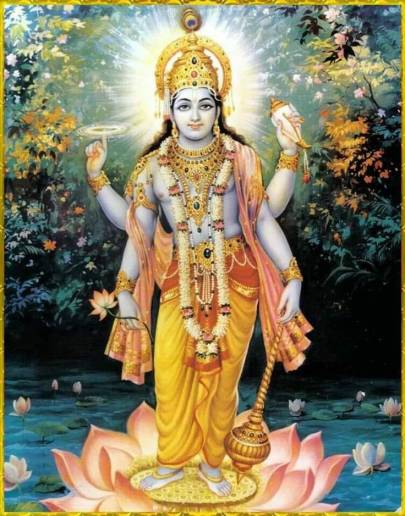
The all-pervading Vishnu,
Benevolently smiling,
Radiant with Blissful Love,
Protecting all,
Loving all and everything,
Encompassing all,
One with all phenomena,
Clear,
Pure,
The nature of Love,
Beauty itself,
Worthy of Ceaseless Devotion and Gratitude,
Self-shining,
Bright and ever-whole,
Ever-pristine and peaceful,
Always intuitively known by simply BEING,
Effortlessly present and ever-free.
This is one of a series of introductory articles found on the homepage of tomdas.com. Please also see the recommended reading list here.
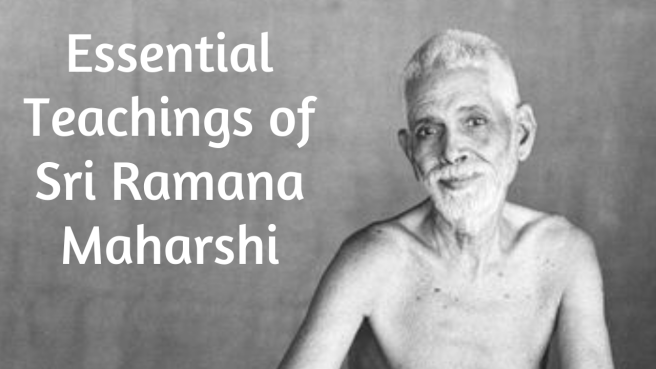
This post authoritatively summarises the essential liberating teachings of Sri Ramana Maharshi in relatively concise form. Please take the time to read and study this material in order to gain benefit from it.
The text ‘Guru Vachaka Kovai’, also known as ‘The Garland of Guru’s sayings’, is widely considered to be the most authoritative, reliable and comprehensive collection of the verbal teachings of Sri Ramana Maharshi. Here is what Ramana Ashram states about Guru Vachaka Kovai in the foreword of their publication of it:
‘[Guru Vachaka Kovai] provides the most precise, systematic and authoritative exposition of Sri Bhagavan’s teaching, explaining step by step the theory, the practice and the experience of jnana, the Truth supreme which is Being as Life Eternal, Pure Awareness, Perfect Bliss. Thus, the most comprehensive collection of the Maharshi’s sayings is Guru Vachaka Kovai.’
Bold text has been added by myself for emphasis, and I have included a few comments from Sri Sadhu Om when further explanation may be helpful. As usual my own comments are added in italicised red – I hope they are of benefit.
May these verses illuminate the path for earnest seekers of realisation!
I prostrate to Bhagavan Sri Ramana Maharshi, from whose lips these teachings graciously fell, and also to Dearest Muruganar who faithfully recorded these jewels
I bow to Sri Ramana, the Lord Himself, whose Grace is ever-present everywhere
I give myself unto dear Bhagavan, whose light shines as the Self within our Heart, whose true form is Pure Consciousness, Silence, the Sadguru (True Teacher) within and without
! Om Namo Bhagavate Sri Ramayana Om !
Introduction
The Self is ever-attained:
8. The benefit of this Light of Supreme Truth is the understanding that there is not the least thing such as ‘attainment’, since the Supreme Self is the Ever-Attained One Whole. Thus the mental wanderings caused by striving towards Dharma, Artha, and Kama are also removed.
Sri Sadhu Om: Up till now the shastras [scriptures] have prescribed, as the rightful goals of human life, the following four aims:
-Dharma: the practice of righteous social duties. -Artha: the acquisition of wealth through righteous means. -Kama: the satisfaction of desires within righteous limits. -Moksha: liberation, the natural state of abiding as Self.
This work, The Light of Supreme Truth shows us now that the first three worldly aims are futile and transitory, and thus it removes our wandering mental efforts to attain them. We may however still think, “Is not mental effort at least needed to obtain Moksha?” but again this Light shows us the meaninglessness of striving to ‘attain’ Self, which is ever-attained, and instead it recommends the cessation of all mental activity, thereby fixing us in the eternal, motionless and ever-attained State of Self.
The unreality of the world
The world does not exist:
23. The Realised who do not know anything as being other than Self, which is absolute Consciousness, will not say that the world, which has no existence in the view of the Supreme Brahman, is real.
28. O aspirants who hide yourselves away fearing this world, nothing such as a world exists! Fearing this false world which appears to exist, is like fearing the false snake which appears in a rope.
87. Self appearing as the world is just like a rope seeing itself as a snake; just as the snake is, on scrutiny, found to be ever non-existent, so is the world found to be ever non-existent, even as an appearance.
The world only appears to exist due to ignorance/maya/mind:
34. The deceptive I-am-the-body idea alone makes the world, which is an appearance of names and forms, seem real, and thereby it at once binds itself with desires [for the world].
35. Since this world of dyads and triads appears only in the mind, like the illusory ring of fire formed [in darkness] by whirling the single point of a glowing rope-end, it is false, and it does not exist in the clear sight of Self.
‘Dyads’ refers to seer/seen or perceiver/perceived or knower/known, ie. subject/object; ‘triads’ refers to seer/seeing/seen or perceiver/perceiving/perceived or knower/knowing/known, ie. subject/verb/object. Ramana is stating that this division of the world into dyads or triads only appears due to ‘the mind’, ie. ignorance. Another way of stating the above is that the world/ego/ignorance only exists due to a lack of self-enquiry/self-attention:
156. The reason for our mistake of seeing a world of objects in front of us is that we have risen as a separate ‘I’, the seer, due to our failure to attend to the vast perfection of Self-Consciousness, which is our Reality.
36. O worldly-minded man who is unable to understand the wise reasoning and the teachings of Sages about the Supreme Knowledge, if properly scrutinised, this big universe of delusion is seen to be nothing but the illusive play of the vasanas [mental tendencies] within you.
ie. like a dream, the world is merely a projection of the mind and is unreal, also see below:
84. All that is perceived by the mind was already within the heart. Know that all perceptions are a reproduction of past tendencies now being projected outside [through the five senses].
40. How does this false and villainous vast world, that cheats and ravages the minds of all people [except the wise], come into existence? Because of no reason other than our own mistake in falling away from, instead of clinging to, Self-attention.
ie. the world is created through ignorance, ie. it is maya, see below:
55. The appearance of this world, like the illusory appearance of a dream, is merely mental and its truth [therefore] can be known correctly only by the Supreme Consciousness that transcends Maya, the mind.
Ignorance is not real and never existed:
86. Do not ask, “Why does Self, as if confused, not know the Truth that It is Itself which is seen as the world?” If instead you enquire, “To whom does this confusion occur?”, it will be discovered that no such confusion ever existed for Self!
87. Self appearing as the world is just like a rope seeing itself as a snake; just as the snake is, on scrutiny, found to be ever non-existent, so is the world found to be ever non-existent, even as an appearance.
100. Although Guru Ramana taught various doctrines according to the level of understanding of those who came to Him, we heard from Him that ‘Ajata’ alone is truly His own experience. Thus should you know.
Sri Sadhu Om: ‘Ajata’ is the knowledge that nothing – neither the world, soul nor God – ever comes into existence, and that ‘That Which Is’ ever exists as IT is.
The body
The body, being part of the world, is also a non-existent illusion:
97. The body exists only in the view of the mind, which is deluded and drawn outwards by the power of Maya. In the clear view of Self, which is a single vast Space of Consciousness, there is no body at all and it is therefore wrong to call Self ‘Dehi’ or ‘Kshetrajna’ [the owner or knower of the body]
Kshetra means ‘field’ and ‘jna’ is the root of the verb ‘to know’, so kshetrajna means ‘knower of the field’. These terms were used by Sri Krishna in Chapter 13 of the Bhagavad Gita when he explains to Arjuna that the body is the ‘kshetra’ or field but what we really are is the knower of the body/field, kshetrajna. Here Bhagavan Ramana Maharshi goes one step further by stating that the idea of kshetra and kshetrajna or deha (body) and dehi (owner of the body) are too just dualistic ideas of the mind. Whilst they are useful teachings at one level, these dualistic notions are ultimately more ignorance.
B1. Give up thinking that the loathsome body is ‘I’. Know Self, which is eternal Bliss. Cherishing the ephemeral body as well as trying to know Self is just like using a crocodile as a raft to cross a river.
[Tom – compare to: ‘Whoever seeks to realise the Self by devoting himself to the nourishment of the body, proceeds to cross a river by catching hold of a crocodile, mistaking it for a log.’ Shankara, Vivekachudamani, verse 84]
126. Instead of attending to Sat-Chit-Ananda, the subtlest, which is beyond the reach of speech or mind, to spend one’s life attending merely to the welfare of the gross body is just like drawing water with great difficulty from a well in order to water some useless grass [instead of paddy].
127. Those who take to the petty life, mistaking the body as ‘I’, have lost, so to speak, the great life of unlimited Bliss in the Heart, which is ever waiting to be experienced by them.
The ego
The ego is another illusory phenomena, a ‘picture on the screen’:
159. The life of the filthy ego, which mistakes a body both as ‘I’ and as ‘my place’, is merely a false imagination seen as a dream in the pure, real, Supreme Self.
160. This fictitious jiva, who lives as ‘I [am the body]’, is also one of the pictures on the screen.
Happiness is not in the world
We all want to be happy; the easy way is to attend to the Self, ie. self-attention, which is the noble path of self-enquiry; the difficult way (that doesn’t work) is to attend to the world, ‘the field of the five senses’:
72. Longing for a tiny grain of pleasure, people toil so hard using the mind to plough the field of the five senses, but they never wish for the flood of Bliss which is the fruit that comes by ploughing the Heart, the Source of the mind, with [simple] Self-attention. Ah, what a wonder!
Do not seek happiness in the world – you will ‘drown’ in maya:
128. Not knowing that the world in front of them brings only great harm, those who take it to be real and a source of happiness will drown in the ocean of birth and death, like one who takes hold of a floating bear as a raft.
74. Only when the world’s allurement is lost will true Liberation be possible [and its allurement cannot be lost unless it is found to be unreal]. Hence, to try to foist reality upon this world is to be just like an infatuated lover who tries to foist chastity upon a prostitute.
Note, the above notion that we have to lose our allurement with the world may seem difficult, but by merely attending to the Self, as outlined below, dispassion (vairagya) towards the world and love for Self/Bhagavan will naturally develop:
The only true practice/teaching
The only true way is to attend to the Self. This means to turn within, away from phenomenal objects and towards the Subject-Self. This is Jnana (knowledge), this is Dhyana (meditation), this is Bhakti (devotion/love):
175. The only worthy occupation is to thoroughly absorb the ego by turning Selfward and, without allowing it to rise, to thus abide quietly, like a waveless ocean, in Self-Knowledge, having annihilated the delusive mind-ghost, which had been wandering about unobstructed.
Do not attend to objects – attend to the subject!
186. O miserable and extroverted people, failing to see the seer, you see only the seen! To dissolve duality by turning inwards instead of outwards is alone Blissful.
Do not attend to objects – how? By attending to the Subject-Self!
187. O mind, it is not wise for you to come out [in the form of thoughts]; it is best to go within. Hide yourself deep within the Heart and escape from the tricks of Maya, who tries to upset you by drawing you outwards.
189. Since it is only the notion of duality that spoils Bliss and causes misery, to avoid yielding to the attractions of that notion and to thus arrest all chitta vrittis is alone worthwhile.
‘Chitta’ means mind or consciousness and ‘vritti’ means ‘wave’. Chitta vrittis are therefore the various waves or modulation of our consciousness such as thoughts and perceptions. The famous phrase ‘yoga chitta vritti nirodha’ occurs in Verse 2 of Chapter 1 of Patanjali’s Yoga Sutras. Here Patanjali, the so-called Father of Yoga defines what yoga is. It roughly translates as ‘Yoga means stilling the modulations of consciousness’ or ‘Yoga means to still the mind’
190. O people, not knowing that Shiva is dwelling within you, you fly about like birds from one holy place to another [seeking His Darshan]. Consciousness, when abiding still in the Heart, is the Supreme Shiva.
This above verse refers to those spiritual seekers who, not realising that the True Teacher, Shiva, is within us, go from one teacher to another, from one holy place to another, instead of simply Being Still/Being What You Are/Attending to the Self.
Now Ramana will tell us how we can protect ourselves from the clutches of Maya:
191. The ship would be destroyed by the storm if its sails were spread outside, but it is safe when its anchor is sunk deep into the sea. Similarly, if the mind were sunk deep in the Heart instead of being spread outside, that would be Jnana.
What is true heroism?
192. To arrest the mind – which tries to rush outwards – securely within, is the truly heroic act of the ripe aspirant who wants to see the Supreme Lord in the Heart.
In the above verse ‘securely within’ implies that the mind has turned within towards the Self and is made to rest ‘securely’ there. This is further made clear in the next verse:
193. When the mind [ie. the ego’s attention] which wanders outside, knowing only other objects [2nd and 3rd persons] – begins to attend to its own nature, all other objects will disappear, and then, by experiencing its own true nature [ie. Self], the pseudo-‘I’ will also die.
The above verses described the path using the language of the path of Knowledge (Jnana). Below we will see this is also the path of devotion and love (Bhakti):
204. A peaceful attitude, together with a ‘silent-flow’ of mind towards undeviating abidance in Self, Sat-Chit, is the best worship of Shiva.
205. Saint Markandeya survived death by conquering even Yama, and lived beyond his destined time. Know, therefore, that death can be overcome by worshipping Shiva, the death-killer.
The message here that in worshipping Shiva we can overcome our karma and destiny just as Saint Markandeya overcame Yama, the Lord of Time and Death
291. If one wants to be saved, one is given the following true and essential advice: just as the tortoise draws all its five limbs within its shell, so one should draw the five senses within and turn one’s mind Selfward. This alone is happiness.
Compare with Bhagavad Gita 2.58: ‘One who is able to fully withdraw the senses from their objects, just as a tortoise withdraws its limbs into its shell, is established in Divine Knowledge’.
Here, once again, the method to attain Self-Realisation, which is perfect infinite eternal Happiness, is made clear:
293. Having known for certain that everything which is seen, without the least exception, is merely a dream, and that it [the seen] does not exist without the seer, turn only towards Self – Sat-Chit-Ananda – without attending to the world of names and forms, which is only a mental conception.
The ‘only raft’, meaning the only way:
294. Attention to one’s own Self, which is ever shining as ‘I’, the one undivided and pure Reality, is the onlyraft with which the jiva, who is deluded by thinking “I am the body”, can cross the ocean of unending births.
297. Do not wander outside, eating the scorching sand of worldly pleasures, which are non-Self; come home to the Heart where Peace is shining as a vast, everlasting, cool shade, and enjoy the feast of the Bliss of Self.
Pay homage to the Guru, to Bhagavan Ramana! How? Let us see:
319. One’s merging into the Heart – through the enquiry into the nature of the ego, which is a delusion in the form of mind – is the right worship of the Lotus-Feet of the supreme Mouna-Guru, who is beyond the mind.
Here the path of enquiry and devotion are shown to be the same One Path
Conduct in the world
The advice given is to live your life as a normal and ethical person in the society you find yourself in:
82. It is not right for the Wise One to behave improperly, even though He has known all that is to be known and attained all that is to be attained. Therefore, observe the code of conduct which is befitting to your outward mode of life.
Self-Realisation
296. Having annihilated the delusive mind which always dwells upon worldly things, having killed the restless ego, and having completely erased the worldly vasanas, shine as Shiva, the pure Consciousness Itself. In Self-realisation there is no sense of being a separate individual:
122. Whatever high and wonderful state of tapas one may have attained, if one still identifies oneself with an individuality, one cannot be a Sahaja-Jnani [i.e. One in the State of Effortlessness]; one is only an aspirant of, perhaps, an advanced stage.
Duality, or ‘the world’, which is ignorance and maya, disappears upon realisation of the Self:
114. When the limited light [which is used to project pictures on the cinema screen] is dissolved in the bright sunlight [which enters the cinema], the pictures also will disappear instantaneously. Similarly, when the limited consciousness [chittam] of the mind is dissolved in supreme Consciousness [Chit], the picture show of these three prime entities [God, world and soul] will also disappear.
If the above is true, why do religions talk of these three (ie. God, the world and the individual soul)?
115. Thus, since the Truth of the Source is One, why do all religions [and sometimes even Sages] start their teachings by at first conceding that these three prime entities are real? Because the mind, which is tossed about by objective knowledge, would not agree to believe in the One unless the Sages condescended to teach It as three.
True Knowledge vs intellectual knowledge
133. Enquiring, “Who is this ‘I’ that has learnt all these arts and sciences?”, and thereby reaching the Heart, the ego vanishes along with all its learning. He who knows the remaining Self-Consciousness is the true Pandit; how can others who have not realised It be Pandits?
Pandit is a word often used to describe a scholar who is well versed in all of the scriptures and in interpreting them in a logical way, but who does not necessarily Know the Self. Here Ramana redifined the word Pandit to be only he who Abides as the Self.
134. Those who have learnt to forget all that was learnt, and to abide within, are alone the Truth-Knowers. Others, who remember everything, will suffer with anxiety, being deluded by the false samsara.
141. After knowing that the purport at the heart of all scripture is that the mind should be subdued in order to gain Liberation, what is the use in continuously studying them? Who am I?
144. To be freed from ignorance by mere studies is as impossible as the horns of a horse, unless by some means the mind is killed and the tendencies are thus completely erased by the blossoming of Self-Knowledge.
145. For the jiva’s weak and unsteady mind, which is ever wavering like the wind, there is no place to enjoy bliss except the Heart, its Source; the study of scriptures is, for it, like a noisy shandai [a cattle fair].
Desire and security
149. The experience of Vedanta is possible only for those who have completely given up all desires. For the desirous it is far away, and they should therefore try to rid themselves of all other desires by the desire for God, who is free from desires.
150. The Wise, who know that all worldly experiences are formed by prarabdha alone, never worry about their life’s requirements. Know that all one’s requirements will be thrust upon one by prarabdha, whether one wills them or not.
Prarabdha refers to one’s destiny, which Ramana says will play out regardless of what one wills. Therefore worry not.
Summary verses
293. Having known for certain that everything which is seen, without the least exception, is merely a dream, and that it [the seen] does not exist without the seer, turn only towards Self – Sat-Chit-Ananda – without attending to the world of names and forms, which is only a mental conception.
294. Attention to one’s own Self, which is ever shining as ‘I’, the one undivided and pure Reality, is the onlyraft with which the jiva, who is deluded by thinking “I am the body”, can cross the ocean of unending births.
297. Do not wander outside, eating the scorching sand of worldly pleasures, which are non-Self; come home to the Heart where Peace is shining as a vast, everlasting, cool shade, and enjoy the feast of the Bliss of Self.
296. Having annihilated the delusive mind which always dwells upon worldly things, having killed the restless ego, and having completely erased the worldly vasanas, shine as Shiva, the pure Consciousness Itself.
! Om Namo Bhagavate Sri Ramayana Om !
This article does not go in depth into the nature of liberation. For more on this please see the introductory articles on tomdas.com
I have taken the following teaching statements of Sri Ramana Maharshi from the wonderful text Guru Vachaka Kovai. My advice is to stick to Sri Ramana’s teachings to keep your path straight:
To hear these quotes read out loud see this video here:
🙏❤️🙏
175. The only worthy occupation is to thoroughly absorb the ego by turning Selfward and, without allowing it to rise, to thus abide quietly, like a waveless ocean, in Self-Knowledge, having annihilated the delusive mind-ghost, which had been wandering about unobstructed.
186. O miserable and extroverted people, failing to see the seer, you see only the seen! To dissolve duality by turning inwards instead of outwards is alone Blissful.
187. O mind, it is not wise for you to come out [in the form of thoughts]; it is best to go within. Hide yourself deep within the Heart and escape from the tricks of Maya, who tries to upset you by drawing you outwards.
189. Since it is only the notion of duality that spoils Bliss and causes misery, to avoid yielding to the attractions of that notion and to thus arrest all chitta vrittis is alone worthwhile.
190. O people, not knowing that Shiva is dwelling within you, you fly about like birds from one holy place to another [seeking His Darshan]. Consciousness, when abiding still in the Heart, is the Supreme Shiva.
191. The ship would be destroyed by the storm if its sails were spread outside, but it is safe when its anchor is sunk deep into the sea. Similarly, if the mind were sunk deep in the Heart instead of being spread outside, that would be Jnana.
192. To arrest the mind – which tries to rush outwards – securely within, is the truly heroic act of the ripe aspirant who wants to see the Supreme Lord in the Heart.
193. When the mind [i.e., the ego’s attention] which wanders outside, knowing only other objects [2nd and 3rd persons] – begins to attend to its own nature, all other objects will disappear, and then, by experiencing it’s own true nature [i.e. Self], the pseudo-‘I’ will also die.
204. A peaceful attitude, together with a ‘silent-flow’ of mind towards undeviating abidance in Self, Sat-Chit, is the best worship of Shiva.
205. Saint Markandeya survived death by conquering even Yama, and lived beyond his destined time. Know, therefore, that death can be overcome by worshipping Shiva, the death-killer.
291. If one wants to be saved, one is given the following true and essential advice: just as the tortoise draws all its five limbs within its shell, so one should draw the five senses within and turn one’s mind Selfward. This alone is happiness.
293. Having known for certain that everything which is seen, without the least exception, is merely a dream, and that it [the seen] does not exist without the seer, turn only towards Self – Sat-Chit-Ananda – without attending to the world of names and forms, which is only a mental conception.
294. Attention to one’s own Self, which is ever shining as ‘I’, the one undivided and pure Reality, is the only raft with which the jiva, who is deluded by thinking “I am the body”, can cross the ocean of unending births.
296. Having annihilated the delusive mind which always dwells upon worldly things, having killed the restless ego, and having completely erased the worldly vasanas, shine as Shiva, the pure Consciousness Itself.
297. Do not wander outside, eating the scorching sand of worldly pleasures, which are non-Self; come home to the Heart where Peace is shining as a vast, everlasting, cool shade, and enjoy the feast of the Bliss of Self.
319. One’s merging into the Heart – through the enquiry into the nature of the ego, which is a delusion in the form of mind – is the right worship of the Lotus-Feet of the supreme Mouna-Guru, who is beyond the mind.
Everyone and everything will eventually let you down. Make no mistake about this – it’s just a matter of time. Be sure to understand this.
This is not pessimism but reality. You can then enter into life knowlingly. We can enter into love and engage with life out of understanding rather than ignorance.
Know that everything will eventually let you down. You cannot rely on anyone or anything to give you lasting happiness, so dont expect that from people or things. Anything else leads to suffering.
The only exception is the ever-present Self, which of course is no particular object, yet is non-separate from everything. It is all there is. It is the essence of who you are. It is you.
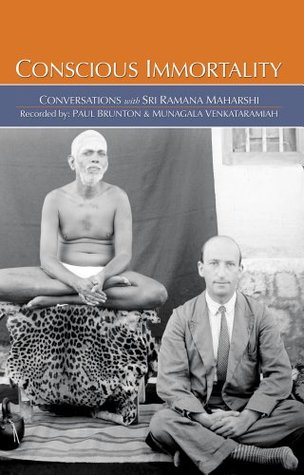
The following is taken from Chapter 14 of Conscious Immortality and is instructive about the path to complete liberation. As often is the case with Ramana’s writings, there is much packed into each phrase. My comments have been interspersed in blue italics, and I pray you find these to be of assistance. If they are not, please feel free to ignore them:
“The Self is like a powerful hidden magnet within us. It draws us gradually to itself, though we imagine we are going to it of our own accord.
Tom: we imagine that we are seeking, whereas actually we are being moved by the Self, as is everything else likewise being orchestrated by Oneness. Next the basic teaching is given in concise form:
“When we are near enough, it puts an end to our other activities, makes us still, and then swallows up our own personal current, thus killing our personality. It overwhelms the intellect and over floods the whole being.
Tom: the teaching goes like this: first we naturally drop and turn away from outer (egoic) activities as we realise that we no longer need them. Then we become still. Lastly after having been still for some time, our personhood is ‘swallowed up’ by the self. Then all that remains is fullness, the Self. That’s all there ever was.
“We think we are meditating upon it and developing towards it, whereas the truth is that we are as iron filings and it is the Atman-magnet that is pulling us towards itself. Thus the process of finding Self is a form of Divine Magnetism.
Tom: again the notion of personal doership is being undercut here – we are all but puppets of the Lord. We take ourselves to be the orchestrator of our actions, whereas we are His instruments playing His song. So does this mean that we do not have to practice?
“It is necessary to practise meditation frequently and regularly until the condition induced becomes habitual and permanent throughout the day. Therefore meditate.
You lost sight of the bliss because your meditative attitude had not become natural and because of the recurrence of vasanas. When you become habitually reflective, the enjoyment of spiritual beatitude becomes a matter of natural experience.
Tom: Ramana instructs us to practice meditation regularly, so that the meditative attitude becomes the predominant habitual way of being. How to meditate? This will be explained below:
“It is not by a single realisation that “I am not the body but the Atman” that the goal is reached. Do we become high in position by once seeing a king? One must constantly enter into samadhi and realise one’s Self, and completely blot out the old vasanas and the mind, before it becomes the Self.
Tom: here Ramana makes a central point. It is often mistakenly thought that realising who you are is a one time affair. However here Ramana emphasises that this realisation alone is insufficient for true liberation to dawn. One must time and time again sink into Samadhi and remove the habitual tendencies (vasanas) that cause us to identify as a finite body-mind entity. This simple but essential teaching is often side-stepped by those who would like the fruits of liberation without the need to actually practice and drive out the vasanas/habitual ignorance.
The example that one cannot become a king simply by seeing a king is cited by Ramana. This example is reminiscent of that given in Chapter 7 of Advaita Bodha Deepika, one of Ramana’s favourite texts, where it is repeatedly told that mere knowledge of the king by a beggar does not transform the beggar into a king. Similarly, the jiva is not so easily transformed into the Self, so to speak, by simply knowing of the Self. So, how can the jiva be ‘transformed into the Self’? Ramana will enlighten us:
“If you keep to the thought of the Self, and be intently watching for it then even that one thought which is used as a focus in concentration will disappear and you will BE, the true Self. Meditation on Self is our natural state.
Only because we find it hard do we imagine it to be an arbitrary and extraordinary state. We are all unnatural.
The mind resting in the Self is its natural condition, but instead of that our minds are resting in outward objects. After the expulsion of name and form (nama-rupa) which compose the external world, and by dwelling on existence-knowledge-bliss (sat-chit-ananda), take care to prevent the re-entry into the mind of the expelled name and form.
Tom: here the essence of spiritual practice is given: we are to rest as the self. How to do that? We are to not rest in outward objects, we are to pay no attention to name and form (nama-rupa) and instead dwell on awareness-consciousness-Being-Bliss, which is our own true nature. This is simply Self abiding as Self, or Being being Being.
We are to take care not to allow the mind to again shoot outwards into the world and dwell on the forms (that it itself projects).
We are to cultivate thought of this Self, and eventually this thought too will disappear and all that will be left is Self without any trace of jiva or the idea that I am a limited body-mind entity.




 Tom Das