Ramana Maharshi: some gems from Who Am I? (Nan Yar) | Be still | Silence

Here are some quotes I have arranged by theme: they are all taken from Ramana Maharshi’s masterpiece Who Am I? (Nan Yar? in Tamil).

It is a short text and should ideally be read in full. You can find a version on this website here which is truer to the original Ramana himself wrote and where I have also introduced the text more fully, and you can find another version from Ramanashramam here, from where the quotes below were taken.

Throughout you can see that the emphasis is on stilling the mind to bring about Self-Realisation. The method for doing this is Self-Enquiry. See if you can see all the different ways that Ramana points to making the mind still in each of his answers. The Bold Type Headings are my own additions and my comments are in italicised red.

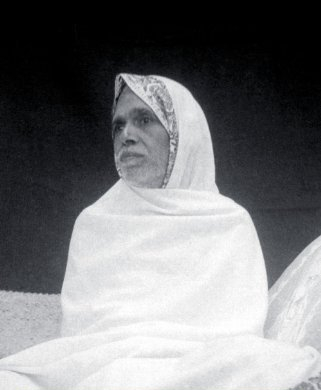
42-reclining-on-the-sofa-h-563x400

See here for an audio version of the text below:

How can I attain realisation? By removing the world and making the mind still.

Q. When will the realization of the Self be gained?
A. When the world which is what-is-seen has been removed, there will be realization of the Self which is the seer.

Q. Will there not be realization of the Self even while the world is there?
A. There will not be.

Q. When will the world which is the object seen be removed?
A. When the mind, which is the cause of all cognition’s and of all actions, becomes quiescent, the world will disappear.

Tom: Ramana is stating that realisation appears when the mind is still. Many people avoid these kinds of teachings which advocate turning away from the world, and give various seemingly logical reasons for this philosophical stance (note that it is a philosophical stance for the most part, based on logical reasoning, belief and a certain ideology), but for most people, without prolonged stillness of mind, egotism finds a way to perpetuate itself and suffering, separation and ignorance also continue.

Breath control, mantra, devotional practice are aids but are not the true practice.

Like the practice of breath-control, meditation on the forms of God, repetition of mantras, restriction on food, etc., are but aids for rendering the mind quiescent.

Through meditation on the forms of God and through repetition of mantras, the mind becomes one-pointed.

Just as when a chain is given to an elephant to hold in its trunk it will go along grasping the chain and nothing else, so also when the mind is occupied with a name or form it will grasp that alone.

Why make the mind one-pointed?

When the mind expands in the form of countless thoughts, each thought becomes weak; but as thoughts get resolved the mind becomes one-pointed and strong; for such a mind Self-inquiry will become easy.

Tom: Note that here Ramana defines a strong and weak mind: a strong mind is one that is one-pointed, a weak mind is one that is not one-pointed, ie. a scattered mind. It is a strong one-pointed mind that can undergo self-enquiry effectively for most. Therefore the practices above such as breath control, devotion and mantra practice can form a spiritual foundation for those who are not able to effectively perform self-enquiry straight away.

But thoughts keep on coming. Will thoughts ever end? 

Q. The residual impressions (thoughts) of objects appear unending like the waves of an ocean. When will all of them get destroyed?
A. As the meditation on the Self rises higher and higher, the thoughts will get destroyed.

Q. Is it possible for the residual impressions of objects that come from beginningless time, as it were, to be resolved, and for one to remain as the pure Self?
A. Without yielding to the doubt “Is it possible, or not?”, one should persistently hold on to the meditation on the Self. Even if one be a great sinner, one should not worry and weep “O! I am a sinner, how can I be saved?”; one should completely renounce the thought “I am a sinner”; and concentrate keenly on meditation on the Self; then, one would surely succeed.

Tom: To worry about whether or not thoughts can end is itself a thought and so is moving away from stillness of mind. See how tricky the mind is?

What about my worldly problems and other people?

The mind should not be allowed to wander towards worldly objects and what concerns other people.

However bad other people may be, one should bear no hatred for them.

Tom: Again, the above teachings are all about the mind becoming still.

What about desire and hatred?

Both desire and hatred should be eschewed.

Tom: Hatred and desire are more agitations of the mind.

How can I stop worrying about worldly affairs? 

Whatever burdens are thrown on God, He bears them. Since the supreme power of God makes all things move, why should we, without submitting ourselves to it, constantly worry ourselves with thoughts as to what should be done and how, and what should not be done and how not? We know that the train carries all loads, so after getting on it why should we carry our small luggage on our head to our discomfort, instead of putting it down in the train and feeling at ease?

Tom: One solution for an agitated mind is to have faith in the Supreme God, for the mind that trusts and has faith in God naturally becomes still. This is made clearer in the next quote.

Is there room for devotion and surrender on this path?

He who gives himself up to the Self that is God is the most excellent devotee. Giving one’s self up to God means remaining constantly in the Self without giving room for the rise of any thoughts other than that of the Self.

Tom: ie. be still. If you do have thoughts, they should only be about the Self, meaning the mind is strong and one-pointed, as referenced in an earlier quote above.

Maybe I should find a guru who will help me? Perhaps I need their grace or transmission?

God and the Guru will only show the way to release; they will not by themselves take the soul to the state of release.

Each one should by his own effort pursue the path shown by God or Guru and gain release.

Tom: The Guru only tells you to be still. Seeking a Guru is entering more delusion/illusion/ignorance and merely perpetuates ignorance and mental agitation/movement. See how skilfully Ramana steers us away from this mistake? This same teaching is also given at the start of Shankara’s Vivekachudamani (verses 51-55).

Which scriptures and books will help me on this path?

All the texts say that in order to gain release one should render the mind quiescent; therefore their conclusive teaching is that the mind should be rendered quiescent; once this has been understood there is no need for endless reading.

Where in the world can I find lasting happiness and fulfillment?

There is no happiness in any object of the world. We imagine through our ignorance that we derive happiness from objects. When the mind goes out, it experiences misery. In truth, when its desires are fulfilled, it returns to its own place and enjoys the happiness that is the Self.

Tom: Seeking happiness in the world or in objects is more mental agitation. Ceasing to do this is making the mind still. This is elaborated upon and emphasised in the next two quotes.

How does a wise one act?

Under the tree the shade is pleasant; out in the open the heat is scorching. A person who has been going about in the sun feels cool when he reaches the shade. Someone who keeps on going from the shade into the sun and then back into the shade is a fool. A wise man stays permanently in the shade. Similarly, the mind of the one who knows the truth does not leave Brahman. The mind of the ignorant, on the contrary, revolves in the world, feeling miserable, and for a little time returns to Brahman to experience happiness. In fact, what is called the world is only thought. When the world disappears, i.e. when there is no thought, the mind experiences happiness; and when the world appears, it goes through misery.

What about Spiritual Knowledge (Jnana) or Wisdom?

Q. What is wisdom-insight (jnana-drsti)?
A. Remaining quiet is what is called wisdom-insight.

Q. What is the relation between desirelessness and wisdom?
A. Desirelessness is wisdom. The two are not different; they are the same. Desirelessness is refraining from turning the mind towards any object. Wisdom means the appearance of no object.


SOME CONCLUDING WORDS:

Tom: Gratitude to Sri Ramana for his teachings that skilfully and in numerous ways tell us to still the mind. Bhagavan Ramana writes:

‘All the texts say that in order to gain release one should render the mind quiescent; therefore their conclusive teaching is that the mind should be rendered quiescent; once this has been understood there is no need for endless reading.’

If you are not able to take up self-enquiry and still the mind, take up the auxiliary practices at once and devote yourself fully to them. Bhagavan Ramana writes:

‘Through meditation on the forms of God and through repetition of mantras, the mind becomes one-pointed…the mind becomes one-pointed and strong; for such a mind Self-inquiry will become easy.’

So devote yourself to God, devote yourself to Sri Ramana, chant the mantra with unceasing and unending devotion, and then go deep deep into stillness wielding the question ‘Who am I?’ as your weapon of choice, eventually letting go of this weapon too, drowning in Effulgent Grace in the formless form of Realisation. Bhagavan Ramana writes:

‘By the inquiry ‘Who am I?’. The thought ‘who am I?’ will destroy all other thoughts, and like the stick used for stirring the burning pyre, it will itself in the end get destroyed. Then, there will arise Self-realization.’

Om Tat Sat

Om on emojidex 1.0.34

HOW CAN I ATTAIN REALISATION?

42-reclining-on-the-sofa-h-563x400

Q: When will the realization of the Self be gained?
Ramana Maharshi: When the world which is what-is-seen has been removed, there will be realization of the Self which is the seer.

Q: Will there not be realization of the Self even while the world is there?
Ramana Maharshi: There will not be.

Q: When will the world which is the object seen be removed?
Ramana Maharshi: When the mind, which is the cause of all cognition’s and of all actions, becomes quiescent, the world will disappear.

TOM’S COMMENTS:

Many people avoid these kinds of teachings which advocate turning away from the world and stilling the mind, and give various seemingly logical reasons for this philosophical stance (note that it is a philosophical stance for the most part, based on logical reasoning, belief and a certain ideology), but for most people, without prolonged stillness of mind, egotism finds a way to perpetuate itself and suffering, separation and ignorance also continue. Don’t just take my word for it. Step outside of your mind, look into your heart and know this to be true for yourself  

Bhagavad Gita – how to advance in Yoga

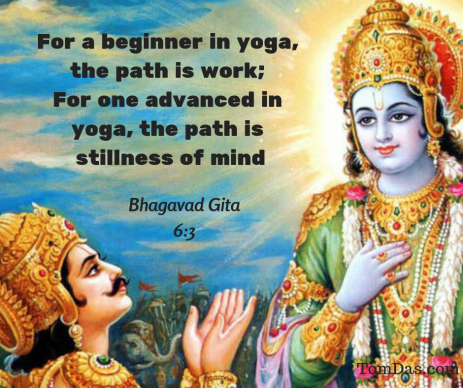
Gita the path is stillness.png

In the original Sanskrit, the word translated here as ‘work’ is ‘karma’. In the the preceding chapters Krishna has taught Arjuna about spiritual practice during activities, ie. karma yoga, in which the mind is made calm during activities by various means.

Now, in Chapter 6, Krishna teaches Arjuna that eventually the path of work leads to the path of stillness, and it is through stillness of mind that one advances in yoga. The rest of Chapter 6 explains in more details how this is to be done.

Be still and abide as the Self

Gita step by step he should become still.png

Whilst everything is nothing but the Self and nothing is ever apart from the Self, the Vedanta texts often speak of abiding as the Self.

This means to still the mind so that it is undisturbed and lose any notion of being a separate ‘I’ or ‘me’. Here we just abide as pure consciousness or pure knowingness, devoid of thoughts and phenomena, devoid of egotism.

This is pure ‘knowledge’ beyond knowledge, direct ‘experience’ beyond experiences, the ‘peace’ that passeth all understanding, Silence, beyond words and chatter.

❤️🙏

You cannot ‘be still’/ how to be still

full-moon

‘Be still’ (ie. Nididhyasana) or natural stillness (ie. Samadhi), and the eternal peace of mind/end of suffering that seemingly emerge from that (ie. Moksha) – these are not something you do or create, or necessarily need to strive to practice. They can be a natural outcome of insight into the experiential truths of ‘no-doer’ (both in ‘yourself’ and in ‘others’) and ‘nothing else needed’ or ‘nothing to get’.

Similarly, insight is not something you have to do or achieve or create. It is a natural outcome of listening to the teachings (ie. Sravana) and contemplating them in a (relatively) clear and quiet mind (ie. Manana).

Therefore listen to the teachings, remember them, relax, and let the mind contemplate them unhurriedly. The teachings need time and space to blossom and bloom. 🌿🌼🌷

Seeking out teachings to listen to, actually listening to them and subsequently contemplating them is not something you do or chose to do or ever did. It is a natural outcome of a desire to end suffering (ie. Mumukshutva) together with having heard the notion or possibility that suffering can end (ie. Hearing about the concept of enlightenment or liberation). These factors naturally and automatically lead to seeking a teaching/teacher.

The desire to end suffering is not something you have created or ever ‘done’. It is the natural consequence of and intelligent response to suffering.

This is all spontaneous action and response. No doer entity or separate entity doing, authoring or creating anything.

Suffering is not something you chose to happen, or something you have created/caused. It is a natural consequence of living life with concepts of ignorance deeply rooted into the body-mind.

Hearing about the notion or possibility that suffering can end is not something you chose to hear. It is a consequence of God’s Grace.

Ignorance was not something you chose. It too was and is God’s Grace.

All this, one could say, is God’s Grace, unfolding beautifully. It is the way it is. What is is what is.

Does stillness of mind lead to liberation?

51m5pnpvk0l

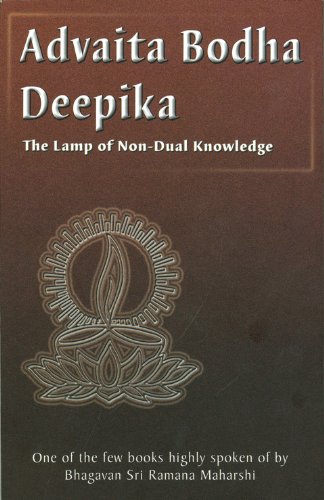
Advaita Bodha Deepika is a traditional text and a masterpiece, summarising the methods and techniques of advaita vedanta. It was a favourite text of Sri Ramana Maharshi and was often recommended by him. Here is what it says about how to attain liberation, the following is from Chapter 3:

17…Master: With complete stillness of mind, samsara will disappear root and branch. Otherwise there will be no end to samsara, even in millions of aeons (Kalpakotikala).
18. Disciple: Cannot samsara be got rid of by any means other than making the mind still?
M: Absolutely by no other means; neither the Vedas, nor the shastras nor austerities, nor karma, nor vows, nor gifts, nor recital of scriptures of mystic formulae (mantras), nor worship, nor anything else, can undo the samsara. Only stillness of mind can accomplish the end and nothing else.
19. D: The scriptures declare that only Knowledge can do it. How then do you say that stillness of the mind puts an end to samsara?
M: What is variously described as Knowledge, Liberation, etc., in the scriptures, is but stillness of mind.
D: Has any one said so before?
20 M: Sri Vasishta had said…

41k1lywu0sl

Beloved Ramana Maharshi says the same in Guru Vachaka Kovai, verse 141:

All the jnana* scriptures that teach the way to redemption proclaim in unison that restraining and stilling the mind is the best means for liberation. This is also emphasised by jnanis*. If, after a certain amount of study, one knows this to be the inner purport of the scriptures, one should then direct ones whole effort towards that [practice]. What is the use of continuously studying more and more scriptures without doing this?

*Jnana, literally meaning knowledge, refers to the teachings of spiritual liberation, whereas jnani, literally ‘knower’, refers to the spiritually liberated sage.


In Ramana’s ‘Who am I?’, the question as to the nature of Jnana arises and is simply answered:

Questioner: What is wisdom-insight (jnana-drsti)?
Ramana Maharshi: Remaining quiet is what is called wisdom-insight.


The Katha Upanishad states the same, in verse 2.3.10:

When the five organs of perception become still, together with the mind, and the intellect ceases to be active: that is called the Supreme State [Brahma-Vidya or Self Knowledge].

Shankara’s commentary on this above verse (Katha Upanishad, verse 2.3.10) states the following:

‘At the time when the five senses…, together with the mind…, which is now no longer functioning and thinking, are at rest in the Self alone, after turning away from objects, and with the intellect…no longer engaging with its functioning, that they call the highest state [Brahma-Vidya or Self-Knowledge].’

Earlier in the Katha Upanishad we see the following verse:

The Lord created the senses out-going: therefore, one sees outside and not the Self within. Some intelligent man, with his senses turned away (from their objects), desirous of immortality, sees the Self within.
~ Katha Upanishad 2.1.1

In his commentary on this above verse (Katha Upanishad 2.1.1), Shankara writes:

‘…the perceiver sees the external objects which are not-Self/not the Atman, such as sound, etc., and not the Self within. Though this is the nature of the world, some (rare) discerning man, like turning back/ reversing the current of a river, sees the Self within…The group of sense organs, beginning with the ear, should be turned away from all sense-objects. Such a one, who is purified thus, sees the indwelling self. For it is not possible for the same person to be engaged in the thought of sense-objects and to have the vision of the Self as well.

In his commentary on Katha Upanishad verse 1.2.20 Sri Shankara writes:

‘…One whose intellect has been withdrawn from all objects, gross and subtle, when this takes place, this is known as ‘inactivity of the sense organs’. Though this ‘inactivity of the sense organs’ one sees that glory of the Self. ‘Sees’ means he directly realises the Self as ‘I am the Self’ as thereby becomes free from suffering’


The Amritabindu Upanishad equates the controlled/stilled mind with Jnana (knowledge) and liberation:

2. It is indeed the mind that is the cause of men’s bondage and liberation. The mind that is attached to sense-objects leads to bondage, when unattached from sense-objects it tends to lead to liberation. So they [the sages] say.
3. Since liberation is based on the mind devoid of desire for sense objects, therefore, the mind should always be made free of such desire, by the seeker after liberation.
4. When the mind, with its attachment for sense-objects annihilated, is fully controlled within the heart and thus realises its own essence, then that is the Supreme State (Brahma-Vidya or Self-Knowledge is gained).
5. The mind should be controlled [made still] so that it becomes merged in the heart. This is Jnana (knowledge) and this is Dhyana (meditation). All else is argumentation and verbiage.

The Advaitic giant, Sri Gaudapada, (Shankara’s guru’s guru) writes in his Mandukya Karika:

The controlled mind is verily the fearless Brahman’ Chapter 3, verse 35

And in verse 37 of the same chapter he writes:

[Atman is] beyond all expression by words and beyond all acts of mind; It is all peace, eternal effulgence free from activity and fear and attainable by samadhi’ Chapter 3, verse 37

In the wonderfully authoritative Advaita Vedanta text Yoga Vasistha it is written:

The rock-like state in which all thoughts are still and which is different from the waking and dream states, is one’s supreme state [Brahma-Vidya or Self-Knowledge].

And elsewhere in the same Yoga Vasistha it is said:

Just as the great ocean of milk became still when the Mandara Mountain (with which it was churned by the Devas and the Asuras) became still, even so the illusion of samsara comes to an end when the mind is stilled.

And again from Yoga Vasistha…

He who casts away from his mind all objects ofperception and, attaining perfect quiescence, remains still as space, unaffected by sorrow, is a liberated man; he is the Supreme Lord.


Shankara states the same multiple times, eg, in Vivekachudamani, and also in his many commentaries, eg. in his commentary upon the Kena Upanishad – in his introduction to the Kena Upanishad Shankara writes:

And [the Self] being eternal, it is not to be secured by any means other than the cessation of ignorance. Hence the only duty is to renounce all desires after the realisation of the unity of the indwelling Self and Brahman.

Also see:

The key to nonduality and yoga

In brief: How to attain liberation

The ‘ultimate means’ to liberation

Shankara on Samadhi (stillness of mind)

Ramana Maharshi: be still

Ramana Maharshi: a quick and simple method to self-realisation

False enlightenment

Q. Does liberation even exist? If it’s here and now, why don’t I experience it?

Q. Hey Tom. I had one question to ask, if you don’t mind. Is Mukti (liberation) even there? Is there something called Liberation? If it’s there here and now, why don’t I feel it? And when it should be the most obvious thing, that is my own existence, why don’t I experience it, or rather recognize it? And what is the purpose of the world if it exists but doesn’t exist. A complete paradox, isn’t it?

Tom: Liberation just means removal of wrong ideas/what is false. Nothing is gained, mistakes are lost. Make sense?

Q. Yes. I’m on the same page. But if it’s so evident, why am I missing it?

Tom: Who says you are missing it? The mind?

Q. Yes

Tom. Why believe the mind? Be still my friend ❤

Q. So belief is the reason for all misery, isn’t it?

Tom: Bondage is an illusion of the mind only. Bondage = suffering.

Q. Be still and know that I’m God. But I know this well, I experience it, sometimes. But when problems arise, I’m carried away with it. How to recollect the Self always?

Tom: Practice.

Q. What is the best way of practicing this? Apart from Self-enquiry?

Tom: See here:

https://tomdas.com/2018/06/24/spiritual-liberation-some-essential-instructions/

Or here:

https://tomdas.com/2018/06/13/letting-go-of-liberation/

Or here:

https://tomdas.com/2018/05/05/the-natural-path-to-the-natural-state/

Q. Okay. I will read it. But liberation itself is an idea that I have to let go to completely enjoy bliss, isn’t it?

Tom: Have a read 🙂

<Sometime later>

Q. Thanks. It was a great read. 🙂🙏🏻