Know well that even performing tapas (spiritual practice) and yoga with the intention ‘I should become an instrument in the hands of the Lord Siva’ is a blemish to complete self-surrender, which is the highest form of being in His service. (Guru Vachaka Kovai, verse 471)
Sri Sadhu Om’s Comments:
Since even the thought ‘I am an instrument in the Lord’s hand’ is a means by which the ego retains its individuality, it is directly opposed to the spirit of complete self-surrender, the ‘I’-lessness. Are there not many good-natured people who engage themselves in prayers, worship, yoga and such virtuous acts with the aim of achieving power from God and doing good to the world as one divinely commissioned? It is exposed here that even such endeavours are egotistical and hence contrary to self-surrender.
The key way the teaching works is upon the mind by removing the belief in the notion of doership. This belief is the key source of suffering, and when this belief is seen through then the suffering which is dependent on it dissolves away.
Often there is a process by which the habitual tendencies that cause suffering gradually fall away over time as the understanding of ‘no-doer’ infiltrates and has its effect on the mind’s conditioning.
Note that the notion of a doer is a false belief – there is no evidence for a doer being present, just as there is no evidence for a volcano god that erupts volcanos or a sea god that ravages the seas. The lack of belief in a doer does not mean there is no action, just as lack of belief in the above mentioned gods does not render the volcano or seas impotent.
Action and movement continues as they have always done. They happen seemingly by themselves, spontaneously you could say. Live goes on, and it feels much the same, the whole range of feelings and emotions continue, just without the suffering.
Annamalai Swami: Bhagavan watched me very closely in the years that I served him in the ashram. One time I went to the Mother’s temple where many people were talking about worldly matters.
Bhagavan called me back, saying, ‘Why should you go to that crowd? Don’t go to crowded places. If you move with the crowd, their vasanas will infect you.’
Bhagavan always encouraged me to live a solitary life and not mix with other people. That was the path he picked for me. Other people got different advice that was equally good for them.
But while he actively discouraged me from socialising, he also discouraged me from sitting quietly and meditating during the years that I was working in the ashram. In this period of my life, if Bhagavan saw me sitting with my eyes closed he would call out to me and give me some work to do.
On one of these occasions he told me,
‘Don’t sit and meditate. It will be enough if you don’t forget that you are the Self. Keep this in your mind all the time while you are working. This sadhana will be enough for you. The real sadhana is not to forget the Self. It is not sitting quietly with one’s eyes closed. You are always the Self. Just don’t forget it.’
Bhagavan’s way does not create a war between the mind and the body. He does not make people sit down and fight the mind with closed eyes. Usually, when you sit in meditation, you are struggling to achieve something, fighting to gain control over the mind. Bhagavan did not advise us to engage in this kind of fight. He told us that there is no need to engage in a war against the mind, because mind does not have any real, fundamental existence. This mind, he said, is nothing but a shadow. He advised me to be continuously aware of the Self while I did the ordinary things of everyday life, and in my case, this was enough.
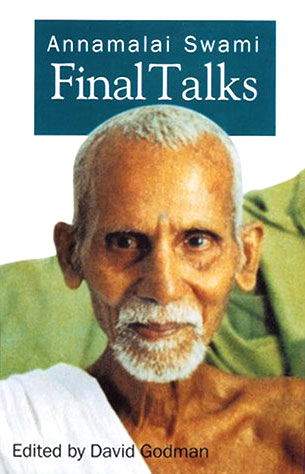
The above is an excerpt taken from Final Talks by Annamalai Swami, p. 67
I have often seen people talk and write about various levels of reality. Typically, they talk of the level of the absolute and the level of the relative. On the level of the absolute, everything is one, so they say. Whereas on the relative level, the level of being a person different rules apply. On the relative level differentiation exists, we talk to each other, we love one another, we get annoyed and irritated, we buy fast-food from time to time, and yet ultimately, at the highest and truest level we are told this is all oneness.
Well let me start off by saying that I reject the notion of levels of reality. I think reality has various aspects, but not levels per se. Now this may seem like a minor difference, a play of semantics if you will, but let me explain the difference.
Talking about the same thing in different ways
When I say reality has various aspects, all I really mean is that there are various ways you can talk about reality – actually there are various ways you can talk about anything. That doesn’t mean there are different levels of reality.
Lets take a simple example: lets take a human body. You can talk about a human body in different ways. You can talk about it in terms of its size: you can say it is big, small, medium. You can talk about its age: is it a young or older body. You can talk about it in terms of organ systems such as the cardiovascular system or digestive system and how they function and describe the body that way, or you can talk about its anatomy and how various parts of it fit together. You can talk about the body’s name and culture – eg. maybe it is called John and it comes from the United Kingdom, you can talk about its occupation. You could talk about its fashion sense, its muscularity…
…ok ok, hopefully you get the idea: there are different ways you can talk about things. There are different conceptual frameworks from where we can view the body. And this is true for anything. We can talk about a pebble in terms of its age, size, geology or how good it would be to skim on a lake’s surface. We can talk about a lake in terms of its scenic beauty, how choppy its water are, its phosphorus content, or remark how it is all made up (mainly) of water.
Now, how many levels does a body or a pebble have? It doesn’t actually have any levels at all – there is only one body or stone (in the above examples) – it’s just that we can talk about them in various ways. In the same way there are no levels in reality, just different ways of talking about it.
No particular conceptual framework is intrinsically higher than another
Also note that no particular way of talking about the body or a pebble is intrinsically better that any other way. It just depends on what you want the conceptual framework to achieve. For example, if you want to skim a stone on the surface of a lake, then it’s less useful to talk about the geology of the stone, and more useful to look at it in terms of its shape and size with respect to achieving your goal (skimming it across the lake). You can’t legitimately claim that one way of viewing something is intrinsically higher and another way is lower, which is something you often hear when talking about ‘ultimate reality’ or the ‘highest level’. It just depends on how well the way you are conceptualising and viewing the object(s) in question fits in with your goal.
It depends on what you want to achieve
Similarly, it is not necessarily better to talk about the body in terms on physiology or organ systems compared to it’s occupation or fashion sense. As previously stated, it just depends on what you want to achieve. If the body has a disease, then understanding the physiology and how to correct any imbalance or defect in this is useful. Conversely if you are going out on a first date, then perhaps a degree of fashion sense would be useful.
No paradoxes, no contradictions
Also there in no contradiction in talking about a single object in different ways depending on the context. There is no paradox that a stone has both an age and a shape, or that a river is a single system made up of a variety of different things, all of which are in motion. There is a consistent underlying reality that underpins the various ways we talk about it. No contradiction or paradox at all.
Different ways of talking about the same experience
Remember, what we are talking about here is our experience of reality. Our reality is our experience – that’s all we know. We can talk about how everything we perceive is non-different to our consciousness, and we can also talk of how things interact within this consciousness, and the rules and consequences thereof. These are just different ways of talking about our experience and our experiences. No particular way is higher or lower, and there are no actual ‘levels’ that exist apart from our conceptualisations.
The description is not the described
We can chose how to conceptually carve up and talk about our experiential reality in order to achieve certain specific aims. To that end these conceptual maps are useful and often necessary. However we must not mistake any particular conceptual map of (our experience of) reality for reality, just as no particular way of describing the body is the body itself.
Meditation is never the control of the body. There is no actual division between the organism and the mind. The brain, the nervous system and the thing we call the mind are one, indivisible. It is the natural act of meditation that brings about the harmonious movement of the whole. To divide the body from the mind and to control the body with intellectual decisions is to bring about contradiction, from which arise various forms of struggle, conflict and resistance.
Every decision to control only breeds resistance, even the determination to be aware. Meditation is the understanding of the division brought about by decision. Freedom is not the act of decision but the act of perception. The seeing is the doing. It is not a determination to see and then to act. After all, will is desire with all it’s contradictions. When one desire assumes authority over another, that desire becomes will. In this there is inevitable division. And meditation is the understanding of desire, not the overcoming of one desire by another. Desire is the movement of sensation, which becomes pleasure and fear. This is sustained by the constant dwelling of thought upon one or the other.
And meditation is the understanding of desire, not the overcoming of one desire by another.
Meditation really is a complete emptying of the mind. Then there is only functioning of the body; there is only the activity of the organism and nothing else; then thought functions without identification as the me and the non-me. Thought is mechanical, as is the organism.
Meditation really is a complete emptying of the mind. Then there is only functioning of the body
What creates conflict is thought identifying itself with one of its parts which becomes the me, the self and the various divisions in that self. There is no need for the self at any time. There is nothing but the body, and freedom of the mind can only happen when thought is not breeding the me.
What creates conflict is thought identifying itself with one of its parts which becomes the me…
There is no self to understand but only the thought which creates the self. When there is only the organism without the self , perception, both visual and non-visual can never be distorted. There is only seeing ‘what is’ and that very perception goes beyond what is. The emptying of the mind is not an activity of thought or an intellectual process. The continuous seeing of what is without any kind of distortion naturally empties the mind of all thought and yet that very mind can use thought when it is necessary. Thought is mechanical and meditation is not.
There is only seeing ‘what is’ and that very perception goes beyond what is.
Excerpt taken from J. Krishnamurti, ‘The Beginnings of Learning’
My awakening experience whilst reading Krishnamurti:





 Tom Das