vedanta
Online Satsang with Tom Das | Advaita with loving devotion to Sri Ramana Maharshi | Online Non-duality meetings | Advaita Vedanta

See here for more details
Please join us – all are welcome and no prior knowledge is required.
We meet ONLINE twice every week (every Thursday 8pm and Sunday 3pm UK time).
We meet IN-PERSON on the first Sunday of every month at 2pm UK time and this meeting is also livestreamed on Zoom.
Meetings often start with some Silence followed by some readings, a talk and some questions. The initial silence is a wonderful opportunity for stillness and to put the teachings into practice.
After the meeting there is an opportunity to stay and connect with other people attending the meeting.
To join or find out more please see this link.
The real meaning of Omniscience | Advaita Vedanta
See here for a PDF download of Upadesa Saram (The Essence of the Teachings written by Sri Ramana Maharshi) with brief explanatory notes:
https://tomdas.com/2019/03/25/ramana-maharshi-upadesa-saram-the-essence-of-the-teachings/
This video was recorded live during a Satsang meeting with Tom Das and put together by volunteers.
To attend satsang, see here:
https://tomdas.com/events
For guided meditations see the ‘guided meditation’ playlist here: https://www.youtube.com/c/TomDasNonduality/playlists
For recommended reading for liberation see here: https://tomdas.com/2020/10/19/recommended-reading-books-for-enlightenment-liberation-and-self-realisation/
To book a 1 to 1 session with Tom see here: https://tomdas.com/nondual-spiritual-counsellor
Understanding Turiya (the 4th state) and Turiyatita (the state beyond the 4th state)
Question: I get confused between the idea of Turiya, the so-called 4th state, which is the Self, and the idea of Turiyatita or beyond the 4th state. How can there be something beyond the Absolute Self, the ‘4th’?
Tom: Turiya means the Self. That is the only reality – there is no real ‘beyond turiya’ (turiyatita). First see how Turiya is defined in the Mandukya Upanishad in verse 7 here.
Then note what Bhagavan Sri Ramana says in Guru Vachaka Kovai verse 567:
567. The difference between the first three dense states and the fourth and fifth states are only for those who are not able to immerse and abide firmly in turiya, which shines piercing through the dark ignorance of sleep.
Sadhu Om’s commentary: The import of this verse is that advanced aspirants should know that all states other than turiya which are mentioned in scriptures [i.e. sleep, waking, dream and turiyatita] are unreal.
Tom: Now see further verses from Guru Vachaka Kovai which explain Sri Ramana Maharshi’s teaching on this subject further:
- In Jnanis, who have destroyed the ego, the three states [waking, dream and sleep], which were seen previously, will disappear, and the noble state of turiya [the ‘fourth’] will itself shine gloriously in them as turiyatita [the state transcending the ‘fourth’].
Tom’s comments: ie. the forth state (Turiya) is in fact Turiyatita – they are one and the same. This is stated more explicitly in the next 2 verses:
- The state of turiya, which is Self, pure sat-chit, is itself the non-dual turiyatita. Know the three states are mere [false] appearances, and that Self is the supporting base for them [i.e. the base on which they appear and disappear].
- Is it not only if the other three states [waking, dream and sleep] were real that wakeful sleep [jagrat-sushupti], the pure Jnana, would be the fourth? Since those three states are [found to be] unreal in front of turiya, that [turiya] is the only state; know [therefore] that it [turiya] is itself turiyatita.
Using much simpler language, I also explain this type of teaching in a slightly different way that you may find helpful here in this video:
‘We must see Brahman in everything and everywhere’ is also not quite correct | Sri Ramana Maharshi | Advaita Vedanta

See here for the full quote: Remove Nama-Rupa (Name & Form) to reveal Sat-Chit-Ananda (the Self)
Buddhism vs Vedanta | Self vs no-self | Nirvana vs Self-Realisation | The Unborn | The Deathless
This is one of a series of introductory articles – please see the homepage of tomdas.com for more introductory articles.
Here in this article we will explore the Buddhist teachings and contrast them to Vedanta or ‘Hindu-style’ teachings. We will look at notions of self and no-self, nirvana and self-realisation, and look at the earliest complete Buddhist teachings ie. as recorded in the Pali Suttas (Sutta is a Pali word meaning ‘thread’ and refers to a ‘string of verses’, ie. a text; Sutra is the equivalent word in Sanskrit)
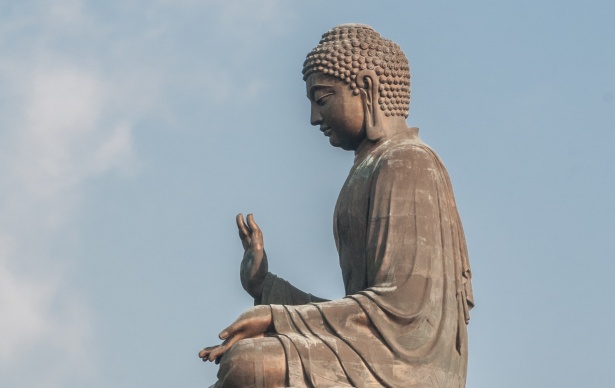
Also see: Ramana Maharshi: was the Buddha self-realised?
Q. Arahant vs Bodhisattva – which is best? | Buddhism
Self-enquiry and Buddhism/ the Jhanas and Ramana Maharshi
Some people think that the teachings of the Buddha point in some fundamental way to something different to teachings of ‘Hinduism’ (Sanatana Dharma) and Vedanta. Most of these people are either only approaching the teachings in an intellectual way or are attached to a particular conceptual view; or perhaps they have not made a deep study of the teachings, or perhaps they have not developed a deeper insight into the teachings for themselves.
Let us see why this is the case, as if one reads the early recorded teachings of the Buddha for oneself, clarity on this issue arises:
The Unborn, the Unmanifest, the Uncreated, the Unconditioned
A closer reading of the Buddhist texts reveals that the Buddha did actually acknowledge in many places the existence of what in Vedanta would be called ‘The Self’ (Sanskrit: Atman) and what others may even call God. Here is just one example from the Nibbana Sutta verse 3 (Udana 8.3), which is from the Pali Canon:
There is, bhikkhus [monks], that which is unborn, that which is unmanifest [or has not come into being], that which is not fabricated/created, that which is unconditioned.
If there were not, bhikhus, that which is unborn, that which is unmanifest, that which is not fabricated/created, that which is unconditioned, there would not be escape from that which is born, from that which is manifest, from that which is fabricated/created, from that which is conditioned – that therefore would not have been clearly known/experienced/seen.
But because, bhikhus, there is indeed that which is unborn, that which is unmanifest, that which is not fabricated/created, that which is unconditioned, therefore escape from that which is born, from that which is manifest, from that which is fabricated, from that which is conditioned, is [or can be] clearly known/experienced/seen.
We can clearly see that the Buddha is categorically stating that there is something that is beyond birth and creation, beyond manifestation and that which is conditioned (ie. all objects).
He then goes on to sate that only because there is such a thing as this Unborn is it possible for liberation to occur. The Buddha even states that without the existence of ‘that which is unborn’ liberation would not be possible.
Negating vs affirming language
Note that the Buddha characteristically uses negating language – ie. NOT born, NOT manifest, NOT created, etc, rather than the combination of both negating and affirming language often used in the vedic literature.
I hope you will see that this is clearly analogous to descriptions of the Self in Vedic literature which is described as being that which is Unborn, Unmanifest, Unconditioned, etc.
Please note that the above verse and following verses are taken from the Pali canon which represents the earliest complete recorded teachings of the Buddha (rather that the writings of later schools).
Nirvana
Please also note that the word Nibbana is the Pali equivalent of the Sanskrit word Nirvana (sometimes spelt Nirbana), which is a word that is also used in pre-Buddhist Vedic texts such as the Bhagavad Gita as a synonym for liberation. This means that the Buddha chose to use the same word for liberation that the Vedic texts also used.
‘No Self’ means no ego or no Jiva, NOT no Brahman/Unborn principle
So what does the word ‘Nirvana’ mean? It literally means extinguishment or annihilation or ‘blown out’ (like extinguishing or blowing out a flame).
Why is this word used in both ‘Hinduism’ and Buddhism (and Jainism too) as a synonym for liberation? It is because in all these traditions, it is accepted that liberation is simply destruction or extinguishment of the ego-self, which is illusory or unreal. So when ‘no-self’ is proclaimed in Buddhism, it is only the denial of the Jiva (apparently separate self) or ego-illusion.
In Vedanta this is also known as manonasa or destruction (extinguishment) of mind (manas = mind; nasa = destruction or anihiliation). We will see later that the Buddha also conceived of liberation in the same way – ie. destruction of the thinking and desiring mind.
Anatman (Anatta in pali) vs Atman
The Sanskrit word atman means self, and anatman means not-self or no-self. The Pali equivalent of anatman is anatta.
The Buddha points to various phenomenal arisings and points out that in none of these can a self be found and that all of these phenomenal arisings are anatman or ‘not-self’. An example of this is the Buddhist teaching of the five skandas, which is clearly analogous to the Vedic teaching of the five koshas. In both these teachings it is pointed out that these five skandas or five koshas are not-self, meaning no self can be found in them.
It should be clear that he Buddha is not saying there is no Unborn Principle (quite the opposite as we can see from the Nibbana Sutta verse 3 above), but that the phenomenal appearance of a separate self (Jiva in Sanskrit) or ego is illusory and that only by coming into the Unborn we can attain liberation – see the next section for more on this as well as how to do this for oneself.
The Deathless – how to attain Nirvana & Sri Ramana Maharshi’s teachings
Earlier we saw how the Buddha referred to what called the Unborn, the Unmanifest, the Unfabricated. Elsewhere he referred to the same Unborn as ‘the Deathless’. See here for an example of this – in this post I also go more into the actual methodology of liberation as proposed by the Buddha and show how it is essentially the same method taught by Bhagavan Sri Ramana Maharshi.
The Unmanifest or Nirguna Brahman
In Vedanta teachings, two forms of Ultimate Reality or Brahman are spoken of: the manifest or saguna Brahman and the unmanifest or nirguna Brahman (sa = with; nir = without; guna = qualities).
According to Vedanta, in truth there is only one form of Brahman – the unmanifest or Nirguna Brahman, but is spoken of as being two purely for purposes of teaching. This Nirguna Brahman, which has no qualities that can be described in words and has no qualities that can be perceived by the senses, this nirguna Brahman is the only True Reality, and realisation of this Truth is tantamount to liberation.
The manifest or Saguna Brahman refers to the apparent world of phenomenal appearances and according to Vedanta these do not actually exist and are illusory. The Vedanta teachings encourage us to turn away from objective phenomena towards the Subject-Self which is then revealed to be Nirguna Brahman.
Unsurprisingly we see exactly the same teaching in the Buddhist Pali Suttas time and time again.
Extinguishing the Fire of Egotism
For example in the Fire Sermon, which was said to be the third sermon the Buddha gave, the Buddha explains that everything that we can perceive and imagine is just egotism which he likens to a flame or fire. It then makes sense that Nirvana is extinguishment of this flame or fire of egotism. He encourages us to ‘become disgusted’ with the various phenomenal arisings and turn away from them, and it is in this way liberation or nirvana, which is the end of egotism and suffering, occurs.
In Nirvana there is the cessation of all phenomenal appearances
How does the Buddha describe Nibbana? Where better to look than the Nibbana Sutta that was quoted above? Here is verse 1 (Udana 8.1):
There is, bhikkhus, that Base where there is no earth, no water, no fire, no air…neither this world nor another world nor both; neither sun nor moon. Here, bhikkhus, I say there is no coming, no going, no staying, no deceasing, no uprising. Not fixed, not movable, it has no support. Just this is the end of suffering.
We can see from the last phrase ‘just this is the end of suffering’ that the Buddha is describing Nirvana (which he defines as the end of suffering, and which is generally defined as the end of suffering) or what is Vedanta would be called The Self (Atman).
In his description the Buddha is also explaining that in Nirvana ‘there is no earth, no water, no fire, no air…‘, ie. by negating the appearance of the four classical elements he is stating that in nirvana there are no phenomenal arisings whatsoever. He continues this theme by stating ‘there is neither this world, not another world…neither sun nor moon… no coming, no going…‘
The ‘Unmoving’, that which requires ‘no support’, the ‘Unaffected’
The Buddha then goes on to describe what in Vedanta would be called the Self – the Buddha states it is ‘…not moveable, it has no support‘. In Vedanta it would be said to be immovable or unchanging (that which moves can change, that which doesn’t move does not change) and self-shining, meaning it supports itself. In Vedanta, the word ‘ananda’ which means happiness or bliss means the cessation of suffering. Hopefully it is fairly clear that the teachings are pointing to the same basic thing!
In verse two of the same Nibbana Sutta (Udana 8.2) The Buddha speaks of ‘the Unaffected‘, which is clearly another name for the Vedic notion of Self, by which craving and all phenomenal appearance (Maya in vedanta) is ended. Every phenomenal appearance is within the realm of ‘the affected’, so what is this ‘unaffected’ but the True Self?:
It’s hard to see the Unaffected,
for the Truth isn’t easily seen.
Craving is pierced
in one who knows;
For one who sees,
there is nothing.
In liberation there are no thoughts or desires
As we have already quoted from verse 3 at the top of the post, let us proceed to verse 4. In verse 4 of the Nibbana Sutta the Buddha explains that one who has not found the ‘Unaffected’ (ie. the True Self) remains dependent (on phenomenal objects) and so ‘wavers’. This wavering refers to the movements of the mind, ie. what we would call thoughts and desires. Here is verse 4 (Udana 8.4):
One who is dependent has wavering. One who is independent has no wavering. There being no wavering, there is calm. There being calm, there is no desire. There being no desire, there is no coming or going. There being no coming or going, there is no passing away or arising. There being no passing away or arising, there is neither a here nor a there nor a between-the-two. This, just this, is the end of suffering.
See how Sri Ramana Maharshi explains this here.
Cessation of time and space in Liberation
In the above verse 4 the reference to ‘there being no passing away or arising’ not only indicates no arising phenomena in liberation, but also the cessation of time itself. Similarly the reference to ‘there is neither a here nor a there nor a between-the-two’ refers to the cessation of perception of space.
We can see that the teachings are referring to what in Vedanta is known as ‘non-duality’, or advaita, Oneness beyond the illusions of ego, separation, time and space
See this described here in Vedanta teachings.
The ‘Stainless’, the ‘Sorrowless’, the ‘Blissful’
In verse 5, the final verse of this Nibbana Sutta, the Buddha states the following, continuing the theme of the need to efface all desires, wants and cravings. Note how he refers to ‘stainless’ and ‘sorrowless’ and ‘blissful’ – could be be referring to what in Vedanta would be called the Self? I think so!:
The sorrows, lamentations,
the many kinds of suffering in the world,
exist dependent on something dear.
They don’t exist
when there’s nothing dear.
And thus blissful & sorrowless
are those for whom nothing
in the world is dear anywhere.
So one who aspires
to be stainless & sorrowless
shouldn’t make anything
in the world dear
anywhere.
See how Sri Ramana Maharshi similarly describes the way to liberation here.
Some concluding remarks
I have only touched upon one Sutta here in any detail. If you read the Pali canon for yourself you will find countless references like these, eg. to the Unborn and the Deathless, again and again. You will also see references to the need to turn away from objective phenomena towards that which is unborn. You will also see references to the cessation of all arising phenomena. Again and again these references are made.
Surely the Buddha and Vedanta teachings are pointing to the same thing in their own way?
I hope you found this post of use. I have written it rather hastily in one quick sitting so apologies for any spelling or grammatical or other errors.
Namaste and best wishes!
Q. Why does Vedanta insist on there being a Self? No-self makes more sense to me | the I AM|
Qestioner: Why do you say that non-duality means ‘there is only you’? For me it makes more sense to say ‘there is no you’?
Tom: Yes, many people say it the way you do, but there is a specific reason why it is said in the traditional scriptures that ‘only I exist ‘ or ‘only you exist’ as opposed to ‘there is no I’ or ‘there is no you’.
The ‘I’ or ‘I AM’ is being pointed out as indicating the reality.
Why is this?
It is because only when we turn towards the ‘I Am’ or the Subject can the non-dual reality be intuited. Otherwise, as you say, the knowledge remains only on the conceptual level for the ego-mind. This is more fully explained in Chapter 8 of The Path of Sri Ramana.
I also explain this more here.
Arunachala is the Self, Arunachala is Ramana Maharshi
Sri Ramana Maharshi: the necessity of Meditation | Upasana | The Natural State | Sri Ramana Gita

The following verses are teachings of Sri Ramana Maharshi taken from Sri Ramana Gita, Chapter 1 ‘The Importance of Upasana’. Let us start at verse 12:
- The seeker of knowledge does not achieve his end merely by a study of the scriptures. Without upasana [meditation] there cannot be attainment for him; this is definite.
Tom: But what is this Upasana? The next verse explains:
- Experiencing the natural state, during spiritual practice, is called upasana and when that state becomes firm and permanent that itself is called jnana [knowledge].
Tom: But what is this Natural State? Again, the next verse explains
- When discarding sense-objects, one abides in one’s own true nature as a flame of jnana, this state of being is termed sahaja sthiti [the natural state].
Tom: so we can see here that the teaching is to discard sense-objects, and abide in one’s own nature. This is called Jnana or Sahaja Sthiti. Remaining in this state is the principle sadhana (spiritual practice) – this is Upasana (meditation) and this leads to liberation, not just mere study of the scriptures.
You intuitively already know this in your heart | Self-Knowledge | Advaita Vedanta | Non-duality
This knowledge is already fully within you
All the Spiritual Knowledge you ever need is already within you (it actually is you). What is this Spiritual Knowledge? It is knowledge of what you truly are, namely Pure Ever-Blissful Ever-Full Eternal Formless Spirit.
You already fully know this
You already know this. You have always eternally known this. This knowledge has always been within you, intuitively, meaning non-verbally ie. NOT knowledge in the mind and NOT knowledge known by a person. It is innate inborn knowledge that cannot be lost, ever, and does not need to be gained ever.
If you look within, take the time to really feel, then perhaps you will intuit that you have always known that you are infinite, formless and divine, beyond time and space.
Intuitively you have always known that you are not merely flesh and bone, you are not this mere body and mind.
You do not need any new knowledge or understanding in the mind for this path.
So, what’s the problem?
Well, in truth there is no problem, and there never has been, and never will be (no problems are real, and time such as past and future are also not actually real)…and you already intuitively and deeply know that there is no problem…but…
…But so long as you believe the limiting ideas thrown out by the mind – and all the mind’s ideas are limiting – then you will consider yourself to be limited. You will consider yourself to have name and form, you will consider yourself to be flesh and blood, and to be subject to birth, disease, suffering and death. You will consider the world to be real and you will consider problems to be real.
In Truth you are Spirit Divine, Eternal, Lumonious, Blissfull, devoid of time, space, individuality, devoid of one iota of suffering, devoid of one iota of multiplicity or duality, ever whole, pure, pristine Beauty and Love.
This ‘knowledge’ is not in the mind – no body or mind is required for this ‘knowledge
As I said, you know this already – ‘in your heart’ – meaning intuitively this is known, ie. this is not known and can never be known with the mind or with concepts/thoughts, but it is always known in your Heart or Being.
Your True Nature always knows itself to be Divine, fully. This knowledge does not require and body or mind, both of which, together with the world, are non-existent and unreal.
In truth there is no you and me. There is only ONE, THAT. And ‘we’ are THAT ONE.
The only ‘issue’ (not that there really is any issue) is that we take on wrong concepts, believing ourselves to be a body-mind entity living in a world when actually these are all false and non-existent In Truth.
‘Ignorance’
All ‘we have to do’ to realise this is lose the wrong concepts, lose the wrong beliefs, which means to stop attending to them, to stop paying attention to the body + mind + world, especially our thoughts and concepts. All we have to do is have faith in our own innate unborn non-mental non-conceptual knowledge of what we are, and attend to and nurture that intuitive-faith-knowingness-self.
Then, as ignorance slips away, all will eventually be seen to be One and Yourself, Shining as Pure Consciousness, initially with Objects Present (Savikalpa, with forms or with objects) and then in its pure Divine Form devoid of objective phenomena (Nirvikalpa, without form or without objects).
‘Self-Knowledge’
This is Self-Knowledge devoid of a shred ignorance, this is what already IS, this is what you already are, this is what is already and eternally intuitively known ‘in the heart’, meaning never with the mind.
The Self always fully knows itself to be Divine and Full, without words, without a body and without a mind – ignorance never really ever was.
If anything is needed, all we have to do is to nurture and attend to this intuitive self-knowledge. It is the guru, it will teach us, it will reveal itself to us.
‘The Teaching’
Therefore the teaching is simply: KNOW THYSELF or BE THYSELF or ATTEND TO THYSELF or HAVE FAITH IN AND NURTURE YOUR OWN INNATE INTUITIVE KNOWING/KNOWLEDGE
Ignore body/mind/world and see/intuit only consciousness-beingness-love-bliss. Attend to your beingness-knowingness, which is Self-Knowledge. Nurture, stoke and tend to this intuitive knowing – it will grow and consume everything. This is what you truly are.
And of course, you know all of this already
Namaste
❤️🕉
 Tom Das