yoga
No doer / fear of non-existence / Killing Santa Claus 😯
Shankara – Vasanas and the nature of liberation
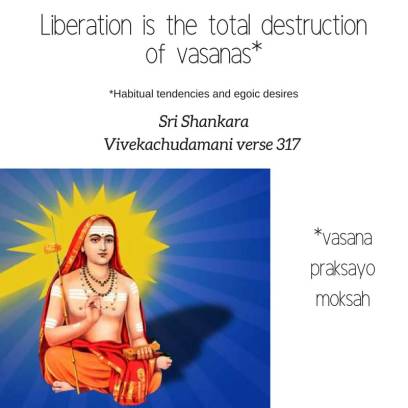
Tom: Liberation is total destruction of habitual egoic desires or vasanas. Only then does suffering end and ethical behaviour naturally arise. Only then do the vedic teachings come to fruition.
Vasanas naturally start to fall away once the illusion of a separate limited ‘me’ is seen through, and life becomes correspondingly easier as the freedom of no-self is seen, but just that seeing alone is not the full liberation until the vasanas have completely dropped off. Until then suffering and egoic behaviour will continue despite the realisation of freedom.

Even after the ‘Truth has been realised’, remain as the Self to root out ignorance and vasanas.
The Truth About the Spiritual Journey
What does ‘there is no person’ actually mean? (The doer-perceiver split)
Roger Castillo and Tom Das: a Joint Satsang 2018
Please join us for Satsang this week:
A Joint Satsang with Roger Castillo and Tom Das
Thursday 16th August, 7pm
The Druids’s Head Pub, Kingston Upon Thames, UK
For more details see link below. Please RSVP if you would like to attend so we can get an idea of numbers:
https://www.meetup.com/Non-duality-Kingston-London/events/brwqlpyxlbvb/
The Chandogya Upanishad: Tat Tvam Asi (You Are That)
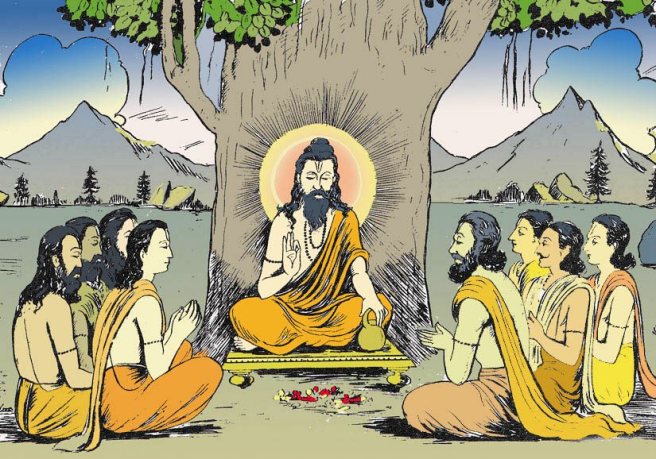
Tat Tvam Asi is one of the most famous phrases from the ancient upanishadic texts. But what does it mean?
Tat = that
Tvam = thou or you
Asi = art or are
Tat Tvam Asi = That thou art, or thou art that, or you are that
‘That’ refers to the Absolute. ‘You’ normally refers to the limited separate body-mind identity known in advaita vedanta as the jiva, but in this aphorism from the Upanishads it is implicitly declared, via the word ‘asi’, that you are not the jiva but the Absolute. Why does this matter? Well, when you know yourself as one with the Absolute, suffering ends.
This phrase, Tat Tvam Asi, is repeatedly uttered by Uddalaka to his son Shvetaketu as recorded in the Chandogya Upanishad, and is considered one of the four Mahavakyas (great utterances) of the Upanishads. Below are just two of the teaching exampes it occurs in, taken from sections twelve and thirteen of the Chandogya Upanishad:
Uddalaka: “Bring me a fruit from the banyan tree.”
Shvetaketu: “Here is one, Father.”
Uddalaka: “Break it open.”
Shvetaketu: “It is broken, Father.”
Uddalaka: “What do you see there?”
Shvetaketu: “These tiny seeds.”
Uddalaka: “Now break one of them open.”
Shvetaketu: “It is broken, Father.”
Uddalaka: “What do you see there?”
Shvetaketu: “Nothing, Father.”
Uddalaka: “My son, you know there is a subtle essence which you do not perceive, but through that essence the truly immense banyan tree exists. Believe it, my son. Everything that exists has its self in that subtle essence. It is Truth. It is the Self, and you, Shvetaketu, are that.”
Shvetaketu: “Please, Father, teach me more.”
Uddalaka: “I will, my son,”
——-
Uddalaka: “Place this salt in water, and come back to me in the morning.”
The son did as he was told.
Uddalaka (in the morning): “Bring me the salt you put in the water last night.”
Shvetaketu (after looking): “Father, I cannot find it.”
Uddalaka: “Of course not; it has dissolved. Now taste the water from the surface. How does it taste?”
Shvetaketu: “It’s salty.”
Uddalaka: “Taste the water from the middle of the bowl. How does it taste?”
Shvetaketu: “It’s salty.”
Uddalaka: “Now taste the water from the bottom. How does it taste?”
Shvetaketu: “It’s salty.”
Uddalaka: “Go, throw it away and come back to me.”
He did so, and returned.
Shvetaketu: “But, father, although I have thrown it away, the salt remains.”
Uddalaka: “Likewise, though you cannot hear or perceive or know the subtle essence, it is here. Everything that exists has its self in that subtle essence. It is Truth. It is the Self, and you, Shvetaketu, are that.”
Shvetaketu: “Please, Father, teach me more.”
Uddalaka: “I will, my son.”
Spiritual enlightenment: Do you need a quiet mind?
Ramana Maharshi: How to bring spiritual practice (sadhana) into daily life

Many people find it difficult to engage in spiritual practices (sadhanas) during the ups and downs of daily life. In the following dialogue recounted by Devaraja Mudaliar, a questioner asks Ramana Maharshi 5 questions related to this:
Mr. Joshi put five questions. I give below the questions and Sri Bhagavan’s answers:
Question 1: Should I go on asking ‘who am I?’ without answering? Who asks whom? Which bhavana (attitude) should be in the mind at the time of inquiry? What is ‘I’, the Self or the ego?
Answer: In the inquiry Who am I? ‘I’ is the ego. The question really means, ‘what is the source or origin of this ego?’ You need not have any bhavana in the mind. All that is required is, you must give up any bhavana that you are the body, of such and such description, with such and such a name, etc., There is no need to have a bhavana about your real nature. It exists as it always does. It is real and no bhavana.
Question 2: I cannot be always engaged in this inquiry, for I have got other work to do, and when I do such work, I forget this quest.
Answer: When you do other work, do you cease to exist? You always exist. Do you not?
Question 3: Without the sense of doership, – the sense ‘I am of doing’ – work cannot be done.
Answer: It can be done. Work without attachment. Work will go on even better than when you worked with the sense that you were the doer.
Question 4: I don’t understand what work I should do and what not.
Answer: Don’t bother. What is destined as work to be done by you in this life, will be done by you, whether you like it or not.
Question 5: Why should I try to realize? I will emerge from this state, as I wake up from a dream. We do not make an attempt to get out of a dream during sleep.
Answer: In a dream, you have no inkling that it is a dream and so you don’t have the duty of trying to get out of it by your own effort. But in this life, you have some intuition, by your sleep experience, by reading and hearing, that this life is something like a dream, and hence the duty is cast on you to make an effort and get out of it. However, who wants you realize the Self if you don’t want it? If you prefer to be in the dream, stay as you are.
With reference to question 4, Mrs. P.C. Desai quoting the Bhagavad Gita asked Bhagavan: If (as Arjuna was told) there is a certain work destined to be done by each and we shall eventually do it however much we do not wish to do it or refuse to do it, is there any freewill?
Bhagavan said: ‘It is true that the work meant to be done by us will be done by us. But it is open to us to be free from the joys and pains, pleasant and unpleasant consequences of the work, not identifying ourselves with the body or that which does the work. If you realize your true nature, and know that it is not you, that does any work, you will be unaffected by the consequences of whatever work the body may be engaged in according to destiny or past karma or divine plan, however you may call it. You are always free and there is no limitation of that freedom.’
(The above excerpt is from Day by Day with Bhagavan, pages 88-90)
Tom’s Comments:
Here we can distil several key points:
1. You always exist, regardless of whether you are thinking about it or not, regardless of what you are doing.
2. The issue is that you take yourself to be the body-mind and therefore you take yourself to be a doer who has to choose what actions to do and suffer the consequences thereof. Instead relinquish the idea that you are the body-mind, and don’t take yourself to be the doer of any actions or receiver of pleasure/pain. You do not need to cultivate a specific bhavana (attitude or feeling).
3. When you don’t take yourself to be the body-mind-doer-receiver, life still continues and the body-mind appearance still is able to fulfil its responsibilities – in fact it becomes more efficient in doing so.
4. Whatever is destined to happen will happen regardless of your desires about this.
5. Effort must be made to cast off the ignorance ‘I am the body-mind-doer-receiver’. However there is no obligation for you to do this. If you wish to remain in ignorance, in the dream in which you believe yourself to be a separate body-mind, that is fine.
6. You are, in truth, always ever free. You are the Self. Know this and remain naturally unaffected by the life-appearance. In this way sadhana (spiritual practice) is in no way opposed to daily life.
 Tom Das