This article is an excerpt from a much longer article which you can view here, that gives further quotes from others including Sri Ramana Maharshi, more quotes from Shankara, Suresvara (Shankara’s main student), Yoga Vasistha and Ribhu Gita on this same topic.
There was a particular conceptual world-view that great sages such as Sri Ramana Maharshi encouraged us to take on, if we are able to, in order to facilitate our spritual practice and thereby attain self-realisation or liberation.
For lower seekers of liberation, meaning for those whose minds were unable to be open to the higher teachings, Sri Ramana Maharshi and the great sages often did not give the teachings we will outline below, but for those whose minds were ready and ripe, he would often encourage this following view of creation and the world, as it is this conceptual view that most readily allows the seeker’s mind to properly do self-enquiry and thereby realise the Self.
However, rest assured, that regardless of how one conceives of the world, meaning that even if you do NOT agree with the teachings below, if one makes an earnest attempt to understand and carry out Self-Enquiry, liberation will be assured irrespective of your conceptual view on liberation and the world. Then you will discover the truth for yourself.
A warning/disclaimer
The teachings that are given below, whilst they are open to anyone, they are very radical in their nature. It is not recommended that you read them if you are not an earnest seeker of liberation or if your mind is likely to be destabilised by a more radical notion of the nature of the universe or what liberation looks like.
We will see that these same exact teachings have been given for many centuries, but traditionally these teachings would only be given to a prepared mind, a mind prepared by devotion, faith and loving surrender. This infuses the mind and heart with an energy of peace, calm and loving kindness and happiness. It is this stable peaceful mind that is most able to receive these teachings, although it is possible there can be some exceptions to this.
Some people can find these teachings quite distressing and destablising and the author of this post takes no responsibility for providing this information to you that has been traditionally written about and taught for many centuries and is already in the public domain.
Be open minded to receive these teachings
Similarly, the ego-mind will often reject these teachings when it first hears them. Often a person’s ego will only be able to come to these teachings once it has suffered enough. The more insight the ego has into suffering, and the more it is able to contemplate the causes of suffering, then the more likely it is able to appreciate the truth of these teachings.
Usually only a sharp intellect is usually able to discern these teachings. Many people read these types of spiritual teachings and immediately project their own preconceived ideas onto them, and so distort the teachings from the very beginning. If we keep an open mind and read the range of quotes given, we will inevitably see what they are truly pointing too. If we cling to our own preconceived notions then we are less likely to receive these teachings in the way they were intended.
These teachings are rare and often misunderstood
Many prominent spiritual teachers, including prominent teachers of advaita and non-duality, give out distorted versions of these teaching, so it is important to be able to temporarily put aside all you have learnt whilst reading or listening to these teachings if you really want to understand what the intended communication actually is.
It is also important to not assume that all spiritual teachers are teaching their own versions of the Same One Teaching, and be open to the fact that they may be teaching very different things; just because a teaching is helpful, doesn’t mean it is liberating; and just because a teaching isn’t liberating, it doesn’t mean it will not be helpful to you.
The Jnani does not see the world
Sri Ramana often said that the Jnani (self-realised or liberate Sage) is totally unaware of the body, the mind and the world, and that the liberated sage also has no awareness of the 3 states of dream, deep sleep or waking, all of which are a projection of ignorance (aka the mind). We will see below that Sri Shankara says the same, as does his guru’s guru, Sri Gaudapada, as well as his student, Sri Suresvara.
For a clear definition of what Ajata vada is, please see this article here.
Sri Gaudapada’s Mandukya Karira and Shankara’s commentary on this
Gaudapada, who was the guru of Shankara’s guru, also makes these teachings (ie. that the body mind and world no longer appear in liberation, ie. Ajata Vada) very clear repeatedly throughout his writings, and Shankara makes these same points in several of his other commentaries too. If you read discerningly you can see Gaudapada makes the following points in the quotes below (as Shankara has already made these points above), and that Shankara brings these very points out in his own commentary on Gaudapada’s verses:
- The term ‘duality’ refers to the appearance of objects
- Similarly the term ‘non-duality’ refers to that which remains when no objects whatsoever arise
- In non-duality there is no duality whatsoever, not even as an appearance (some people are of the impression that the non-dual acts as a ‘container’ for the apparently dual)
- The entire world (of phenomenal arisings), which is duality, is projected or created by ignorance and is also known as ‘the effects of ignorance’.
- Ignorance is also known as the mind, and every thing (object) we perceive, from the subtle to the gross, is actually a manifestion of thought or mind
- When the mind stops, that is the cessation of ignorance; then there are no thoughts, no duality and therefore no effects of ignorance (ie. no appearance of body, thoughts/feelings or the world) as their cause (ignorance) has been removed.
- This is akin to the rope and the snake, wherein the snake disappears when the truth of the rope is seen; similarly the arising phenomena, which are illusory like the rope, all cease when the truth of Self is realised.
- It is spoken as if there are two levels or aspects of reality – (1) conventional or relative reality consisting of the body mind and world ie. all objects or duality, and (2) the Ultimate or the Absolute, which is the non-dual Brahman/Atman. However, although it is spoken of as two levels, in truth, only one of these actually exists, and in self-realisation it is seen that the relative never existed at all, not even as an appearance. The notion of there being two aspects of reality is a fictional concesession merely used as a teaching device for the ignorant who are presently unable to fathom the unreality and non-existence of the phenomenal world. See here for more.
If we read discerningly and carefully, we will see that several other notions or theories are refuted by the quotes below and therefore not compatible with them:
- the notion that in self-realisation all phenomena continue to arise but are seen as illusion (for it is only the ego or ignorance that sees phenomena or could know phenomena as being real or illusory)
- the notion that in self-realisation all phenomena continue to arise but are seen as one with Self (for to admit to phenomena arising would be to admit to multiplicity or duality as somehow existing or apparently existing in the self, and this is not permissable according to the scriptures)
- the notion that for the realised sage the body-mind continues according to its remaining (prarabdha) karma – this is a lower teaching for those who are unable to accept the radical ajata teachings explained above.
- the notion that when Gaudapada or Shankara deny objects, they are not really denying the objects, but just the notion they are separate from the Self. It is important to note in the quotes below that (1) this view is denied by Shankara and (2) nowhere in the scriptures is this view given, apart from as a lower view.
- because the world is an illusion, there is no need to do a practice or have a teacher, as these too are part of the illusion. No, rather the teaching and teacher, whilst ultimately being part of the illusion, they are part of the illusion that help us get out of the illusion, like dreaming of a lion that scares us and wakes us up from that dream. There is a specific teaching and practice that is necessary to undergo whilst the illusion/ignorance appears to exist, and whilst we consider ourself to be a person living in a world and thereby suffering accordingly.
Before we get to verses from Gaudapada, let us read Shankara’s introduction to his commentary on Mandukya Upanishad and Karika, where he explains the purpose of the text:
‘What is the aim of the text? Let me explain: just as a healthy person afflicted by disease will seek a cure for the disease in order to regain the natural state of health, the natural state of being the Self, when afflicted by suffering, will be returned to its ‘natural state of health’ through the cessation of the phenomenal universe of duality.
The aim therefore is the realisation of non-duality. Since the phenomenal world of duality is a creation of ignorance, it can be eradicated through knowledge.’
~ Sri Shankara, introduction to his commentary on Mandukya Upanishad and Mandukya Karika
We can see right that the outset Sri Shankara is summarising the teachings. Let us now see what Gaudapda says in his writings. If we read carefully and discerningly, we will see he is giving a very clear teaching. As usual, unless we read with a clear and discerning mind, the true teaching may ellude us:
‘This duality, which consists of the moving [ie. living beings/creatures] and the unmoving [ie. inert or non-living things], is a projection seen by the mind. Indeed, when there is the state of no-mind, this duality is not perceived/experienced at all.’
(manodṛśyam idaṃ dvaitaṃ yat kiṃcit sacarācaram
manaso hy amanībhāve dvaitaṃ naivopalabhyate)
~ Sri Gaudapada, Mandukya Karika 3.31
Gaudapada states that duality, which consists of all living and non-living things – ie. all objects – is merely a projection of the mind, and when the mind no longer exists (later it will be explained the mind no longer appears or exists in self-realisation), this duality is not experienced/perceived at all. Note how Guadapada specifically refers to and thereby defines duality as the objective realm of living and non-living things, and note how Gaudapada is clear there is no duality in non-duality. Shankara, in his commentary on this verse, states the following:
This duality as a whole, that is perceived by the mind, is nothing but the mind, which itself is imagined – this is the proposition. For duality endures so long as the mind does, and disappears with the disappearance of the mind.
~ Sri Shankara, commentary on Mandukya Karika 3.31
See here how Shankara repeats that duality is a projection of the mind, which itself is a projection/imagination – ie. the mind itself is not a real entity. Note how Shankara also asserts that all phenomenal arising are themselves nothing but mind, and they all disappear when the mind disappears (it will be explained later that the mind disappears in self-realisation).
Shankara also writes the same in his wonderful masterpiece of a text, Vivekachudamani, in many verses, some of which I have included below. Verse 170 in particular was highlighted by Sri Ramana Maharshi as containing a most essential teaching of Vedanta – (see here for verses Sri Ramana Maharshi thought were most important in Vivekachudamani, and see here for more verses like these from Vivekachudamani, as there are many more – this last link also explains the method by which liberation is attained which is not explored so much in this post, and is perhaps the more important topic!):
169. There is no Ignorance (Avidya) outside the mind. The mind alone is Avidya, the cause of the bondage of transmigration. When that is destroyed, all else is destroyed, and when it is manifested, everything else is manifested.
170. In dreams, when there is no actual contact with the external world, the mind alone creates the whole universe consisting of the experiencer etc. Similarly in the waking state also; there is no difference. Therefore all this (phenomenal universe) is the projection of the mind.
179. Man’s transmigration is due to the evil of superimposition, and the bondage of superimposition is created by the mind alone.
180. Hence sages who have fathomed its secret have designated the mind as Avidya or ignorance, by which alone the universe is moved to and fro, like masses of clouds by the wind.
407. This apparent universe has its root in the mind, and never persists after the mind is annihilated. Therefore dissolve the mind by concentrating it on the Supreme Self, which is thy inmost Essence.
~ Sri Shankara, Vivekachudamani
See also how Shankara insists duality ends when the mind ends and equates duality with the appearance of objects or phenomenal arisings. You can also see Shankara is equating ignorance with maya (the power the projects the illusory world) repeatedly. Shankara goes on to say the following in his commentary on the same verse:
For, when the mind ceases to be mind, like the disappearance of the illusory snake in the rope, the mind’s activity stops through the practice of wisdom and detachment, or when the mind gets absorbed in the state of deep sleep, duality is not perceived.
~ Sri Shankara, commentary on Mandukya Karika 3.31
Shankara is likening the illusory projection of objects onto the self to the illusory projection of the snake onto the rope: just like the snake disappears when the truth of the rope is seen, the objects disappear when the truth of the Self is seen/known/realised. Sri Ramana Maharshi explains this same exact teaching in his text ‘Who Am I?’ as follows:
If the mind, which is the cause of all [objective] knowledge and all action, subsides, the perception of the world (jagat-drishti) will cease. Just as the knowledge of the rope, which is the base, will not be obtained unless the knowledge of the snake, the superimposition, goes, so the realization of Self, which is the base, will not be obtained unless the perception of the world which is a superimposition, ceases.
~ Sri Ramana Maharshi, ‘Who Am I?’
Note that Shankara states that objects cease to appear both in deep sleep (when no objects are perceived) and in Self-realisation, making clearer the intended meaning that ‘duality’ refers to the presence or perception or appearance of objects, and that these are absent in self-realisation. Shankara in his commentary then asks how to attain this state of ‘no-mind’ and says this will be explained in Gaudapada’s next verse. In the next verse Gaudapada explains that this no-mind state is attained through self-realisation, and that the mind no longer exists in Self-realisation due to there being no thoughts present:
‘The mind ceases to think as a consequence of the realisation of the Truth that is the Self (Atmasatya), then the mind attains the state of no-mind; in the absence of objects to be perceived, it ceases that perception (of objects).’
Ātma-satya-anubodhenā na saṅkalpayate yadā |
Amanastāṃ tadā yāti grāhy-ābhāve tad-grahaṃ
~ Sri Gaudapada, Mandukya Karika 3.32
We can see here in verse 3.32 Gaudapada is stating that in Self-Realisation, all thoughts cease, and when all thoughts cease, there is no mind. Verse 3.31 has already stated that the mind is the cause of the appearance of all objects, the implication is therefore that when the mind ceases to think, it ceases to project any phenomena or objects, and therefore no arising phenomena or objects are perceived in the self. In 3.32 Gaudapada states in the state of no-mind, there are no objects to be perceived and therefore no perception of objects remains. Shankara write the following in his commentary on this verse:
The mind does not think, as fire does not burn in the absense of fuel, then at that time it attains the state of no-mind. In the absense of objects to be perceived, that mind becomes free from the entire illusion of perception.
~ Sri Shankara, commentary on Mandukya Karika 3.32
Notice how Shankara is comparing the mind to fire and objects to fuel – he is saying just as there can be no fire without fuel, there can be no mind without objects appearing/being present. This is the state of no-mind, or self-realisation, in which freedom from all of Maya or phenomenal arising occurs. Again we see the same teaching from Sri Ramana Maharshi in his text ‘Who Am I?’:
What is called mind (manam) is a wondrous power existing in Self. It projects all thoughts. If we set aside all thoughts and see, there will be no such thing as mind remaining separate; therefore, thought itself is the nature (or form) of the mind. Other than thoughts, there is no such thing as the world. In deep sleep there are no thoughts, (and hence) there is no world; in waking and dream there are thoughts, (and hence) there is the world also, Just as the spider spins out the thread from within itself and again withdraws it into itself, so the mind projects the world from within itself and again absorbs it into itself. When the mind comes out (rises) from Self, the world appears. Therefore, when the world appears, Self will not appear; and when Self appears (shines), the world will not appear…The mind can exist only by always depending upon something gross [ie. objects]; by itself it cannot stand’
~ Sri Ramana Maharshi, ‘Who Am I?’
We can see how Sri Ramana also concurs with Shankara and Gaudapada stating that the entire world is merely a projection of the mind, comparing this to a spider projecting a web (a traditional metaphor also used by Shankara in his commentaries) – an apt comparison before the days of computer simulation and wide use of projecting devices. Sri Ramana also states that when the world appears, the Self will not be realised and vice verse – when the Self is realised, the world will not appear. This is made even clearer in the question and answer version of ‘Who Am I?’:
Question 4. When will the realisation of the Self be gained?
Sri Ramana: When the world, which is what-is-seen, has been removed, there will be realisation of the Self, which is the seer
Question 5. Will there not be realisation of the Self even while the world is there?
Sri Ramana: There will not be
~ Sri Ramana Maharshi, ‘Who Am I?’
(Question and Answer version)
Also note how Sri Ramana uses an analogy similar to Shankara’s fuel/fire analogy when he writes ‘The mind can exist only by always depending upon something gross [ie. objects]; by itself it cannot stand‘, meaning that devoid of objects, the mind cannot survive, just as fire cannot survive without fuel.
Shankara and Ramana are both stating that in self realisation, objects or duality no longer exist or even appear to exist, and therefore, as the mind mind cannot exist without objects, it too can no longer exist. This causality can also be stated the other way round, as causality itself is an illusion, so we can also say that as objects (all living and non-living things as Gaudapada and Shankara put it) are projection of the mind, when the mind becomes no-mind, ie. when there are no thoughts and when therefore there is no mind, the objects can no longer appear. Shankara makes this point repeatedly in his commentaries on other Upanishads and in his various other writings such as Upadesa Saharsri, eg:
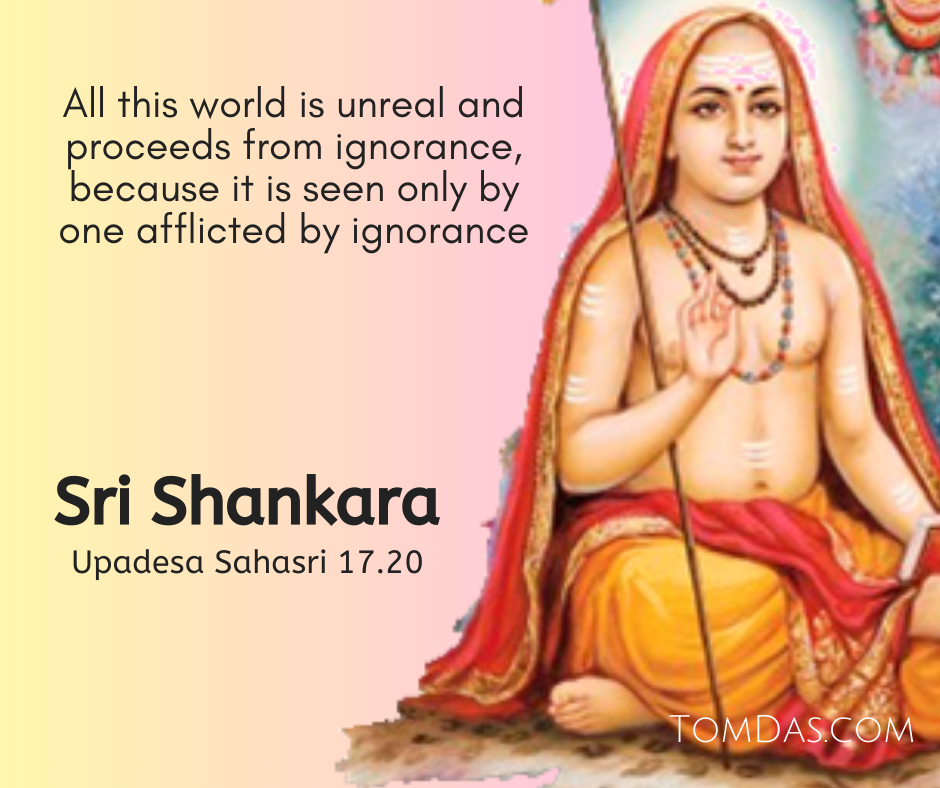
All this world is unreal and proceeds from ignorance, because it is seen only by one afflicted by ignorance
~ Sri Shankara, Upadesa Sahasri 17.20
‘For it is not possible for the same person to be engaged in thoughts of sense-objects and to have the vision of the Self as well.’
~Sri Shankara, commentary on Katha Upanishad 2.1.1
‘The highest truth is that in Brahman, which is Truth by nature, nothing whatsoever, not even a jot or a tittle, is born [ie. no phenomenal appearances arise whatsoever]‘
~ Sri Shankara, commentary on Mandukya Karika 3.48
Shankara makes it clear that in Self-Realisation objects do not even arise as an appearance
These teachings are usually only discernable by people of sharp intellect (or intuitively by those who dive deep within and realise the Self or who experience revelation through Grace of God). Despite the above verses, which make the teachings very clear, some people say that Shankara and Gaudapada are not really saying there are no objects that appear in the Self, but they instead are saying that objects do appear and arise in the Self but are either seen to be the Self, or they are seen to be unreal/illusory arisings and in this sense they do not exist: objects arise and appear, but they are not real, like a dream may arise and appear, but is ultimately not real. This view is known as Dristi-Sristi Vada (DSV), and this view is different from Ajata Vada as expounded by Shankara and Gaudapada – see this article here where this is more clearly explained.
Both Shankara and Gaudapada in various places explicity refute this notion of DSV. Towards the end of Chapter 4 of his Mandukya Karika, Gaudapada makes this very point. He states that in order to explain for purposes of teaching we talk about 2 levels of reality:
1) Vyavaharika – firstly there is the vyvaharika or realm of objects, also called conventional reality, transactional reality (because you can transact objects here), the empirical outlook, the phenomenal realm, the relative world of (living and non-living) things, or maya. We can see from the earlier verses cited above that this is also known as duality or the mind.
2) Paramarthika – and secondly there is paramartikha or the ultimate truth, also known as the Self/Atman, the Absolute reality, Brahman. This is no-mind or non-duality where no duality whatsoever is present.
Both Shankara and Gaudapada state that for purposes of teaching usually these 2 levels are acknowledged, but in reality only one of them, Atman, truly exists, and the first one appears to exist only due to maya or ignorance or the mind. This is akin to saying that for teaching purposes we temporarily or provisionally admit of duality or ignorance as actually existing: we talk as if objects, people and things are real and existent, but in truth these things do not exist whatsoever, not even as an appearance, ie. there is no duality in non-duality, or put differently, there are no objects that arise (or are ‘born’) in the self, nothing ever happened and ignorance or maya never existed at all in any way shape or form. This is the meaning of ajata vada, as explained by Shankara and Gaudapada.
Logically, it should be obvious that there cannot really be two points of view if reality is truly non-dual, for two points of view denotes duality.
This teaching comes to a crescendo in Chapter 4 of Gaudapada’s Karika and Shankara makes clear and highlights this teaching even further. For example starting in verse 4.61 through to 4.70 Gaudapada and Shankara explain the (lower and ultimately false) teaching of Dristi-Sristi Vada, namely that all objects arise in consciousness as consciousness and all objective arisings are one with that consciousness. In verse 4.68 Gaudapda states this conventional reality of objects appearing is like a dream, in which all dream phenomena are a projection of mind and one with the mind-consciousness in which they appear, and in verses 4.69 and 4.70 they state it could also be likened to an illusion created by a magician (4.69) or a hallucination created by drugs, etc (4.70). In both these cases the objects come and go, but the consciousness onto which they are projected or superimposed is constant and unchanging.
But then in verse 4.71 Gaudapada states in the highest truth, ie. in self-realisation, no living being is ever born, as there is no source or cause for it (the cause or source for birth would be ignorance, also known as maya, ego or mind):
‘No creature whatsoever has birth, there is no source for it. This is the highest truth where nothing whatsoever is born’
~ Sri Gaudapada, Mandukya Karika 4.71
Shankara then makes this teaching even clearer in his commentary on this verse:
‘It has been said that birth, death, etc of creatures within the range of empirical existence are like those of the creatures in a dream etc, but the highest truth is that where no creature undergoes birth. The remaining portion was explained before [in his commentary on verse 3.48 cited above]’
~ Sri Shankara, commentary on Mandukya Karika 4.71
We can see in this commentary Shankara is clearly refuting the idea that objects continue to appear, like in a dream, in Self-realisation, as in actuality no objects appear (no objects are ‘born’). Shankara refers to his previous comments on verse 3.48 where he writes ‘The highest truth is that in Brahman, which is Truth by nature, nothing whatsoever, not even a jot or a tittle, is born [ie. no phenomenal appearances arise whatsoever]‘.
In the next verse the same teaching is given in a different way: here it is said that objects arise from a vibration of the self, which is the mind or ignorance:
‘The duality of the perceiver and the perceived is the vibration or movement of consciousness or mind (citta-spandikam); yet consciousness itself is always without an object, eternal, and unattached — therefore, it is so described or proclaimed.
cittaspandikamevedaṃ grāhyagrāhakavaddvayam
cittaṃ nirviṣayaṃ nityamasaṃgaṃ tena kīrtitam
~ Sri Gaudapada, Mandukya Karika 4.72
Shankara writes in his commentary on this verse:
All duality, which consists of a subject and object, is a vibration of mind/consciousness. But from the Ultimate point of view, consciousness is nothing but the Self, and accordingly it is nirvasayam, without objects…as consciousness is without objects, it is unattached, this is the meaning [of the verse].
~ Sri Shankara, commentary on Mandukya Karika 4.72
We can see that Shankara is clearly stating that unlike a dream or magic show or a drug-induced or otherwise-induced hallucination, in (Ultimate) Reality, appearances or objects no longer arise. In the next verse Gaudapada makes this even clearer:
‘That which exists because of a fancied empirical (relative) outlook, does not do so from the standpoint of the absolute Reality. Anything that may exist on the strength of the empirical outlook, taught by various other schools of thought, does not really exist‘
yo’sti kalpitasaṃvṛtyā paramārthena nāstyasau
paratantrābhisaṃvṛtyā syānnāsti paramārthataḥ
~ Sri Gaudapada, Mandukya Karika 4.73
Gaudapada is clearly stating that that which appears to exist from a relative point of view is actually non-existent in self-realisation. In his commentary on this verse Shankara emphasises this same point stating that the empirical outlook is an imagined illusion that certainly has no actual existence.
All of this has already been stated earlier in Chapter 2 of the same Mandukya Karika, eg. 2.17:
As a rope whose nature has not been well ascertained is imagined in the dark to be various things like a snake, a line of water, etc, so also is the Self imagined variously
~ Sri Gaudapada, Mandukya Karika 2.17
On his commentary on this verse Shankara states the following:
‘..this is the illustration – similarly the Self is imagined to be such countless diverse objects as an individual creature or the vital force, etc, just because It has not been ascertained in its true nature to be pure intelligence, existence and non-duality, and different from such evils as cause and effects that are characteristics of the world. This is the conclusion of all Upanishads’
~ Sri Shankara, commentary on Mandukya Karika 2.17
Some may argue that unlike the rope and snake in which the snake disappears when the rope is seen, when the Highest Truth (of Self) is seen the appearance of the world does not disappear but it continues, but Gaudapada and Shankara both refute this view in the next verse:
‘As illusion (eg. of the snake) ceases and the rope alone remains when the rope is ascertained to be nothing but the rope, so also is the ascertainment about the Self’
~Sri Gaudapada, Mandukya Karika 2.18
Shankara makes it explicitly clear what exactly this means in his commentary on this verse:
‘As on certainly realising that the rope is nothing but a rope all imaginations disappear and there remains rope alone without anything else, so also from the scriptural text ‘neti, neti’ [Brihadaranyaka Upanishad 4.4.22] establishing the Self as devoid of all wordly attributes, there dawn, as a result of the light of the sun of realisation certainty about the Self.’
~ Sri Shankara, commentary on Mandukya Karika 2.18
We can clearly see the analogy between the rope and the imaginary appearance of the illusory snake, is analogous to the Self and the imaginary appearance of objects, and Shankara is clearly stating that the appearances no longer arise in self-realisation. We have already seen that Sri Ramana wrote the same in his text ‘Who am I?’:
If the mind, which is the cause of all [objective] knowledge and all action, subsides, the perception of the world (jagat-drishti) will cease. Just as the knowledge of the rope, which is the base, will not be obtained unless the knowledge of the snake, the superimposition, goes, so the realization of Self, which is the base, will not be obtained unless the perception of the world which is a superimposition, ceases.
~ Sri Ramana Maharshi, ‘Who Am I?’
But perhaps Shankara says it best in his own introduction to the Mandukya Upanishad where he writes:
‘Since the phenomenal world of duality is a creation of ignorance, it can be eradicated through knowledge, and hence this book is begun in order to reveal the knowledge of Brahman’
~ Shankara, introduction to his commentary on Mandukya Upanishad and Gaudapada’s Karika
Shankara also makes the following remark in his introduction, this time summarising chapter 2 of Mandukya Karika:
‘The second chapter is concerned with rationally proving the unreality of the phenomenal world of duality, on the cessation of which is attained non-duality, just as the reality of the rope is know on the elimination of the illusion of the snake etc imagined upon it’
~ Shankara, introduction to his commentary on Mandukya Upanishad and Gaudapada’s Karika
Lastly I will leave you with a verse from Chandogya Upanishad and Shankara’s commentary on this:
‘The infinite is that where one does not see anything else, does not hear anything else, and does not understand anything else. Hence, the finite is that where one sees something else, hears something else, and understands something else. That which indeed is the Infinite is immortal. On the other hand, that which is finite is mortal’
~ Chandogya Upanishad 7.24.1
Shankara writes the following in his commentary on this verse – note he is making a statement about the entire text. Hopefully given all of the above the meaning is clear without my having to comment any further:
‘Therefore the meaning of the whole text is that phenomenal dealing does not exist in the Infinite…the idea is that this [phenomenal dealing] exists during the period of ignorance. It is like a thing seen in a dream, which only exists in that period, before waking’
~ Shankara’s commentary on Chandogya Upanishad 7.24.1
There are so many more quotes, both from Gaudapada and Shankara, on this same topic that give the same teaching. If we explore Shankara’s other commentaries we see these same teachings given again and again. For example, see this post here on Chapter 1 of Gaudapada’s Karika which explains many things including:
- the True Self (Atman) is also known as Turiya
- there are no phenomenal arisings in Turiya/Atman
- no cause or effect or karma exists in Turiya/Atman
- in Turiya/Atman there is no consciousness of the waking, dream or deep sleep state
- in truth we cannot even say the the phenomenal world disappears in liberation, as when truth (self) is realised, it is ‘known’ that the phenomenal world never even arose or appeared in the first place (ie. the radical ajata doctrine is being ellucidated here)
And I haven’t even included this most famous verse from Gaudapa which expounds the highest truth in Vedanta teachings – I hope that after reading the above, you can hopefully understand exactly what the verse does and does not mean!
See here for the rest of this article which provides extensive quotes from Sri Ramana Maharshi, more quotes from Shankara, and other quotes from Yoga Vasistha and Ribhu Gita on this same topic of Ajata Vada
 Tom Das
One thought on “Gaudapada and Shankara explain Ajata Vada: No body,mind or world appear in Self-Realisation or Liberation | Advaita Vedanta”