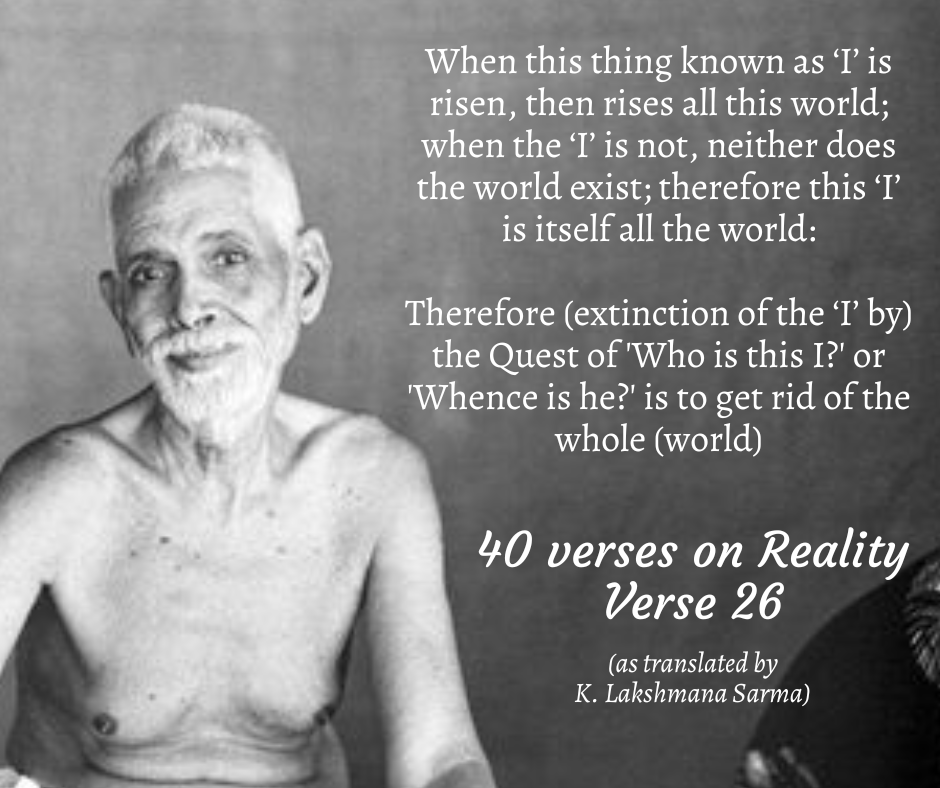
If God is everywhere, why do we have to turn within? Why can’t we see God in the World? How is God to be seen? Sri Ramana Maharshi
Also see:
Ramana Maharshi: how to abide as the Self
The need to turn within according to Advaita Vedanta
‘We must see Brahman in everything and everywhere’ is also not quite correct
The following is from Talks with Sri Ramana Maharshi, Talk no. 244:
Question: How is God to be seen?
Sri Ramana Maharshi: Within. If the mind is turned inward God manifests as inner consciousness.
Tom: here Bhagavan Sri Ramana gives us the essential teaching – God is to be found within – not outside, meaning not in the body, mind or world, but within, meaning in the non-conceptual Self that is the Subject. As Ramana himself wrote in the text ‘Who Am I?’:
Question: When will the realization of the Self be gained?
Answer: When the world which is what-is-seen has been removed, there will be realization of the Self which is the seer.
And in the same text, Who Am I?, in the answer to question 16 it is written:
‘the Self itself is God’
However, the questioner poses a seemingly logical question, namely that if God is everywhere, why cannot be see God everywhere? Why the need to look within when we can just as easily look outside at ‘God’s creation’, through our senses and see God there? Let us see:
Q: God is in all – in all the objects we see around us. They say we should see God in all of them.
Sri Ramana Maharshi: God is in all and in the seer. Where else can God be seen? He cannot be found outside. He should be felt within. To see the objects, mind is necessary. To conceive God in them is a mental operation. But that is not real. The consciousness within, purged of the mind, is felt as God.
Tom: here Sri Ramana is stating that to see God outside is merely to see a projection of the mind, for according to Sri Ramana, as we shall see shortly, all objective phenomena are mere thoughts, or projections of the mind, much like a dream objects are projection of the mind. An alternative explanation is that to see God in objective phenomena is actually a subtle act of the mind, a conceptual framework we are overlaying onto objects.
However, the questioner persists in pursuing their line of enquiry by challening Sri Ramana – are not various objects beautiful? Are not colours lovely to look at? Can we not see God in these objects too? Let us see:
Q: There are, say, beautiful colours. It is a pleasure to watch them. We can see God in them.
Sri Ramana Maharshi: They are all mental conceptions.
Q: There are more than colours. I mentioned colours only as an example.
Sri Ramana Maharshi: They are also similarly mental.
Tom: the questioner states that we can see God in objects and through the senses, but Sri Ramana dismisses this as mere concepts. The questioner, having raised objective qualities such as colour, then having raised other senses, not just colour now goes onto the body and the mind:
Q: There is the body also – the senses and the mind. The soul makes use of all these for knowing things.
Sri Ramana Maharshi: The objects or feelings or thoughts are all mental conceptions. The mind rises after the rise of the I-thought or the ego. Wherefrom does the ego rise? From the abstract consciousness or Pure intelligence.
Tom: Here Sri Ramana again states that the body, senses and mind are all mental conceptions (or mental projections), as are all objects, feelings and thoughts.
He then goes on to give a teaching given in the aforementioned text ‘Who Am I?’, that the first though is the ‘I-thought’ also known as the ego, and only once this has risen can other thoughts or objective phenomena arise such as the body, the mind and the world. In this way Bhagavan Sri Ramana is repeating his teaching, a teaching also taught in the Upanishads and by Sri Shankara, that the body-mind-world is actually a projection of ego or ignorance.
What is the source of this ego or I-thought? It is the Self, or Pure Consciousness as he refers to it here. The word ‘pure’ denotes the absence of arisising objective phenomena, which is consistent with the teaching explained in my above paragraph.

Later in the same dialogue (Talk 244) Sri Ramana explains that the ego or ‘I-thought’ gives rise to (or projects out) the mind, and the mind then projects out a body:
Sri Ramana Maharshi: The sense of body is a thought; the thought is of the mind, the mind rises after the ‘I-thought’, the ‘I-thought’ is the root thought. If that is held, the other thoughts will disappear. There will then be no body, no mind, not even the ego.
Q: What will remain then?
Sri Ramana Maharshi: The Self in its purity.
Tom: We can see that Sri Ramana is re-iterating that the body and mind are both projections of thought, and that their root is the ego, also known as the I-thought. When this ego-root (ie. ignorance) is cut down, by self-enquiry, all thoughts cease and the Self remains in its purity. As the body, mind and ego are all thoughts, Bhagavan Sri Ramana here explicitly states that in Self-Realisation there is no body, mind or ego. All that remains is the pure Self, again ‘pure’ denoting the lack of objective phenomena such as body, mind, world, feelings, sensations, etc.
As always, please do not simply accept teachings at face value. It is always good to read teachings in their proper context, so I encourage you to not just accept my commentary above, but to read the full talk for yourself so you can see it in its context. You will find many other valuable teachings in this talk too, such as Sri Ramana’s exposition of the three states and how he equates deep sleep with the Self, how he says that the world is a mere dream, his insistence that Self-Enquiry is the easiest path, and that Happiness or Pleasure or God can only truly be found Within.
Shankara: The Self or Brahman cannot be known!
The unknowable Self

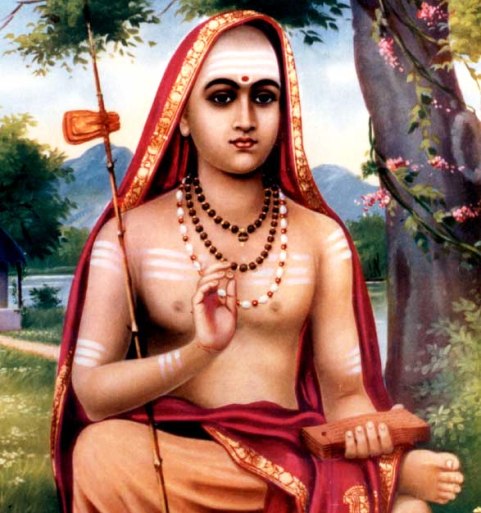
A definition of Jnana by Shankara
The Brihadaranyaka Upanishad, verse 4.4.20, states the following:
20. It [Brahman] should be realised in one form only, (for) It is unknowable and eternal. The Self is taintless, beyond the (subtle) ether, birthless, infinite and constant.
Here we can see that the Upanishad is stating that Brahman is unknowable. So what of Self-Knowledge or knowledge of Brahman that is so often spoken about? Shankara explains this contradiction in his commentary on this verse:
The knowledge of Brahman too means only the cessation of the identification with extraneous things (such as the body). The relation of identity with It [Brahman] has not to be directly established, for it is already there. Everybody always has that identity with It, but it appears to be related to something else. Therefore the scriptures do not enjoin that identity with Brahman should be established, but that the false identification…
View original post 297 more words
Q. Tom, do you experience any mental contractions?
What’s the best way to help other people on the spiritual path?
“I’m Very Grateful for These Teachings!” | The Path of Sri Ramana | Sri Sadhu Om | Sri Ramana Maharshi
Seven Steps to Awakening | PDF download | Michael Langford | Sri Ramana Maharshi | Nisargadatta Maharaj | Shankara | Yoga Vasistha

One of the best books ever written for spiritual liberation/self-realisation is the Seven Steps to Awakening, compiled by Michael Langford, incorporating teachings from Sri Ramana Maharshi, Sri Muruganar, Sri Sadhu Om, Sri Vasistha and Sri Shankara to name a few.
It is one of my recommended books for liberation. Of particular interest is the introduction to the text which is very instructive. As with other books by Michael Langford, all of which are highly recommended, the style may not suit everyone, but serious seekers of liberation will hopefully find the content to be of great benefit and overlook any perceived stylistic deficits.
I am therefore sharing the full text here as a PDF (see below), but I highly recommend you buy a paper copy of the book for yourself to support the author.
It is best read together with The Most Direct Means to Eternal Bliss, another book also by Michael Langford.
Again, please do read the introduction, reflect upon the teachings therein and follow the suggestions given.
Namaste and best wishes!
You can download the entire text as a PDF here
Gaining a deeper understanding of Sri Ramana Maharshi’s teachings: Sri Muruganar, Sri Sadhu Om & Lakshmana Sarma
To my knowledge, the only living human being who was said by Sri Ramana Maharshi to have attained Self-Realisation was Sri Muruganar, a devotee of Sri Ramana’s for over 25 years.
Muruganar also was one of 2 people who had personal one-to-one tuition from Sri Ramana on the actual deeper meaning of the teachings (the other person was K. Lakshmana Sarma).
Muruganar recorded Sri Ramana’s teaching in the text Guru Vachaka Kovai, which is said by Sri Ramana Ashram to be ‘the most precise, systematic and authoritative exposition of Sri Bhagavan’s teaching, explaining step by step the theory, the practice and the experience of jnana, the Truth supreme which is Being as Life Eternal, Pure Awareness, Perfect Bliss. Thus, the most comprehensive collection of the Maharshi’s sayings is Guru Vachaka Kovai…’
Sri Sadhu Om spent many years with Sri Ramana Maharshi and after Sri Ramana’s death he spent many years with Muruganar. Muruganar said that Sri Sadhu Om was the only person who really understood Sri Ramana’s teachings. Sri Sadhu Om wrote several books on Sri Ramana’s teachings such as The Path of Sri Ramana and Sadhanai Saram (the essence of spiritual practice) and translated them into English himself.
K. Lakshmana Sarma, another long time devotee of Sri Ramana’s, was the only other person (other than Sri Muruganar) to have 1 to 1 tuition on the true meaning of Sri Ramana’s teachings; this tuition lasted several years. Lakshmana Sarma was often unhappy to see people misinterpreting and misunderstanding Sri Ramana’s teachings and he wrote several books such as Maha Yoga and a commentary on 40 verses on reality to explain Sri Ramana’s true teachings, and he translated them into English himself.
Most people, when they hear the teachings, their ego-mind immediately distorts the teaching, and this often converts a liberating teaching into a non-liberating teaching. So the person recording the teaching is of utmost importance if we want to understand the true teaching that will lead to liberation.
I therefore recommend you read the above texts if you want to discover a truly liberating teaching, free from distortion, that will quickly and effectively lead to liberation, which is eternal bliss and the cessation of suffering.
We also have the texts that Sri Ramana Maharshi himself wrote.
You may be pleased to know that I have compiled all of the above (and some more), which you can download for free, on my Recommended Reading List.
The above text has also been added as an appendix to the recommended reading list
The deeper meaning of the story of Mary and Martha (from the New Testament of the Bible) | Jesus
Q. What about other books on Sri Ramana Maharshi’s teachings not mentioned in your recommended reading list?
I have updated the recommended reading list with the following 2 questions:
Q. Why is my favourite spiritual book not on your list of books?
It may be that I haven’t read it, or it may be that it doesn’t in my view fulfil the criteria I have outlined at the top of the post.
If a well-known teacher is not mentioned in the above list, the chances are that I do not recommend them.
Q. What about other books on Sri Ramana Maharshi’s teachings not mentioned in your recommended reading list? What about books
A. It is very easy for the teachings to be distorted and misunderstood by the ego-mind. Apart from the above books listed, I do not generally recommend other books on Sri Ramana Maharshi’s teachings. I have found almost all other books on Sri Ramana Maharshi’s teachings that I have come across contain a level of distortion and misinterpretation. I have found that this often leads seekers away from liberation, even if the author or editor is well-meaning and well-intentioned.

