This is a very important verse from Shankara. Most people concentrate on the point being made about samadhi when reading this verse, but note how it states that manana is ‘one hundred times’ superior to sravana.
Yesterday in Satsang, we were talking about manana and how we can do this more effectively, and how this naturally will lead to nididhyasana and then samadhi and then full realisation. You will start to find that the motivation to do practice will increase.
Thinking about the teachings, seeing the tricks the ego keeps on playing on you to perpetuate itself, seeing the very nature of the ego for yourself, writing this all down and reflecting upon it means the ego has less room to manoevure. Write down all your thoughts, write down all your insights, get it all on paper.
At this point in the teaching it is helpful to do this as the mind, being very fickle and forgetful will quickly forget the insights you have previously made, thus perpetuating itself.
As you engage with this aspect of the teaching, you will see how just powerful it indeed is, how the ego has less and less room to move in, how the ego weakens naturally, and how peace and love more and more come into you, merging with your very Being.
Tom: I highly recommend this version of Shankara’s Vivekachudamani, which is complete with detailed commentary by Swami Chinmayananda on every verse in case there is any doubt of the meaning of the text. You can download a copy of the text here but I recommend you buy a print copy:
Talks on Vivekachoodamani
[Edit May 2023: I have asked to remove the PDF of this work by Chinmayamission]
Shankara’s Vivekachudamani, verse 366:
By nirvikalpa samadhi the true nature of Brahman is clearly and definitely manifest, never otherwise, for then, the mind being unsteady, is apt to be mixed with other perceptions.
Swami Chinmayananda’s Commentary:
In the condition of nirvikalpa samadhi alone can this great Reality be apprehended with certainty. With cent per cent certainty you apprehend the Truth when all the waves and ripples in your mind have ended. Sankara is positive and declares, ‘Never by any other method’; bringing the mind to quietude is the only method.
To quieten the mind there are many methods. You may quieten your mind through devotion, or through knowledge, or through karma-yoga or through pranayama. Whether standing on the head or sitting down, whether by going to the Himalayas or by living in your own home – you have the freedom to choose these – but your mind you must quieten.
The mind’s nature is to be constantly active. ‘Thought flow’, it is called. Therefore, it is impossible to realise the changeless Self with the mind, which, by its very nature is unstable. Whenever you try to grasp anything through the mind and intellect, the object of knowledge gets entangled in your own thought patterns. Pure Self can never be understood [Tom: Brihadaranyaka Upanishad states that Brahman is unknowlable, see ‘Another definition of Jnana’ herefor more], so all that you understand about the Atman through the mind and intellect is Saguna Brahman and not Nirguna Brahman.
The unconditioned Absolute is never understood; you just become It when the mind ends [Tom: also compare with Ulladu Narpadu – invocation verse 1 and verses 8, 12 and 21which essentially state the same]. As long as you look at It through the mind. It is only the conditioned, the limited (Saguna) version of the eternal absolute Self.
Here are several other articles explaining the need for Nirvikalpa Samadhi according to Advaita Vedanta for liberation:
The following is taken from The Sutra of Hui Neng (also known as the Platform Sutra), Chapter 2 entitled ‘On Prajna’. My comments are interspersed in italicised red:
The wisdom of Buddhas, past, present and future, as well as the teachings of the twelve sections of the canon are immanent in the mind, but in case we fail to enlighten ourselves, we have to seek the guidance of the pious and learned.
Tom: the essential teaching is within ourselves or ‘immanent in the mind’. Only if we do not enlighten ourselves with our own inner wisdom do we need the external teacher (‘the pious and the learned’)
On the other hand those who enlighten themselves need no extraneous help. It is wrong to insist upon the idea that we cannot obtain liberation without the assistance of the pious and learned. It is by our innate wisdom that we enlighten ourselves, and even the extraneous help and instruction of a pious and learned friend would be of no use so long as one is deluded by false doctrines and erroneous views.
Tom: ie. it is possible for illumination to occur without an outer teacher as the true wisdom of enlightenment is our very nature. How can this be done? All we have to do is realise our true nature, what Hui Neng here calls ‘Essence of Mind’, and we will certainly and immediately be Buddhas, let us see:
As we introspect our minds with Prajñā, all erroneous views will disappear of themselves, and just as soon as we realise Essence of Mind we will immediately arrive at the Buddha stage.
Tom: Hui Neng states that if we look within at our true nature or ‘minds’ with Prajna, all erroneous views or ignorance will disappear spontaneously, and this is realisation of Essence of Mind or True Nature, and this is also the same a Buddhahood or enlightenment. So, how ‘introspect with prajna’? Hui Neng will explain. Prajna means wisdom or insight:
When we use Prajñā for introspection we are illuminated within and without and are in position to know our own nature. To realise our own nature is to obtain fundamental liberation. To obtain liberation is to attain the Samadhi of Prajñā, which is ‘thoughtlessness’.
Tom: Hui Neng explains that realising our true nature is liberation. This is also known as ‘thoughtlessness’. What is this ‘thoughtlessness’? Let us see:
What is ‘thoughtlessness? ‘Thoughtlessness’ is to see and to realise all dharmas (things) with a mind free from attachment. In action Prajñā is everywhere present yet it “sticks” nowhere. What we have to do is to so purify the mind that the six vijnanas (aspects of consciousness sight, sound, smell, taste, touch, mentation) in passing through their six sense-gates will neither be defiled by nor attached to their six sense-objects. When our mind works freely without any hindrance and is at liberty “to come” or “to go, “then we have attained the intuitive insight of Prajñā, which is emancipation. To enable one to attain such a mental state of freedom is the function of intuitive insight.
Tom: In summary Hui Neng is stating that when the mind functions free from attachment to both gross and subtle objects, that is liberation. This non-attachment is also known as ‘thoughtlessness’. We can see this is in keeping with the Buddha’s more classical teachings which essentially state the same. We can also see this is in keeping with the Vedanta teachings in which lack of identification with and attachment to the body, mind and world is the same as Self-Realisation.
Sri Ramana Maharshi states the following in Maharshi’s Gospel, Chapter 3 entitled ‘Mind Control‘:
Questioner: Does Bhagavan condemn dvaita Philosophy?
Sri Ramana Maharshi :Dvaita can subsist only when you identify the Self with the not-Self. Advaita is non-identification.
Now Hui Neng will tell us what not to do:
To refrain from thinking of anything, in the sense that all mental activity is suppressed, is to be Dharma-ridden; this is an extremely erroneous view. (Discriminative thought which leads to desire and attachment, or to aversion and defilement, is to be controlled in the interests of intuitive thought which leads to self-realisation and freedom.)
Those who understand the way of ‘thoughtlessness’ will know everything; they will have the experience that all the Buddhas have had, and they will attain Buddhahood.
Tom: later on in the same chapter Hui Neng quotes a long verse that he composed himself for the benefit of those listening to him – here are a couple of excerpts I have chosen to quote here:
To illumine our gloomy tabernacle, which is stained by defilement,
We should constantly set up the Light of Wisdom.
Erroneous views keep us in defilement
While right views remove us from it,
But when we are in a position to discard both of them
Question: Are yogic exercises helpful in any way to human beings?
Jiddu Krishnamurti: I think one must go into this question fairly deeply. Apparently in Europe, as well as in India, there is this idea that by doing yogic exercises, practising virtue, being good, participating in social work, reading sacred books, following a teacher – that by doing something of this kind, you are going to achieve salvation or enlightenment. I am afraid you are not. On the contrary, you are going to be caught in the things you are practising, and therefore you will always be held a prisoner and your vision will be everlastingly limited.
Yogic exercises are all right, probably, for the body. Any kind of exercise – walking, jumping, climbing mountains, swimming, or whatever you do – is on the same level. But to suppose that certain exercises will lead you to salvation, to understanding, to God, truth, wisdom – this I think is sheer nonsense, even though all the yogis in India say otherwise. If once you see that anything that you practise, that you accept, that you develop, always has behind it the element of greed – wanting to get something, wanting to reach something, wanting to break a record – , then you will leave it alone. A mind that is merely concerned with the `how’, with doing yogic exercises, this or that, will only develop a sense of achievement through time, and such a mind can never comprehend that which is timeless.
After all, you practise yogic exercises in the hope of reaching something, gaining something; you hope to achieve happiness, bliss, or whatever is offered. Do you think bliss is so easily realized? Do you think it is something to be gained by doing certain exercises, or developing concentration? Must not the mind be altogether free of this self-centred activity? Surely a man who practises yoga in order to reach enlightenment, is concerned about himself, about his own growth; he is full of his own importance. So it is a tremendous art – an art which can be approached only through self-knowledge, not through any practice – to understand this whole process of self-centred activity in the name of God, in the name of truth, in the name of peace, or whatever it be – to understand and be free of it.
Now, to be free does not demand time, and I think this is our difficulty. We say “I am envious, and to get rid of envy I must control, I must suppress, I must sacrifice, I must do penance, I must practise yoga”, and all the rest of it – all of which indicates the continuance of self-centred activity, only transferred to a different level. If one sees this, if one really understands it, then one no longer thinks in terms of getting rid of envy in a certain period of time. Then the problem is, can one get rid of envy immediately? It is like a hungry man – he does not want a promise of food tomorrow, he wants to be fed now, and in that sense he is free of time. But we are indolent, and what we want is a method to lead us to something which will ultimately give us pleasure.
Hamburg, Germany 4th Public Talk 14th September 1956
Question: A well-known author has written a great deal about the use of certain drugs which enable man to arrive at some visionary experience of union with the divine ground. Are those experiences helpful in finding that state of which you speak?
Jiddu Krishnamurti: You can learn tricks, or take drugs, or get drunk, and you will have intense experiences of one kind or another, depressing or exciting. Obviously the physiological condition does affect the psychological state of the mind; but drugs and practices of various kinds do not in any way bring about that state of which we are talking. All such things lead only to a variety, intensity and diversity of experience – which we all want and hunger after, because we are fed up with this world. We have had two world wars, with appalling misery and everlasting strife on every side; and our own minds are so petty, personal, limited. We want to escape from all this, either through psychology, philosophy, so-called religion, or through some exercise or drug – they are all on the same level.
The mind is seeking a sensation; you want to experience what you call reality, or God, something immense, great, vital. You want to have visions; and if you take some kind of drug, or are sufficiently conditioned in a certain religion, you will have visions. The man who is everlastingly thinking about Christ, or Buddha, or what not, will sooner or later have experiences, visions; but that is not truth, it has nothing whatever to do with reality. Those are all self-projections; they are the result of your demand for experience. Your own conditioning is projecting what you want to see.
To find out what is real, the mind must cease to demand any experience. So long as you are craving experience, you will have it, but it will not be real – real in the sense of the timeless, the immeasurable; it will not have the perfume of reality. It will all be an illusion, the product of a mind that is frustrated, that is seeking a thrill, an emotion, a feeling of vitality. That is why you follow leaders. They are always promising something new, a Utopia, always sacrificing the present for the future; and you foolishly follow them, because it is exciting. You have had that experience in this country, and you ought to know better than anyone else the miseries, the brutality of it all. Most of us demand the same kind of experience, the same kind of sensation, only at another level. That is why we take various drugs, or perform ceremonies, or practise some exercise that acts as a stimulant. These things all have significance in the sense that their use indicates that one is still craving experience; therefore the mind is everlastingly agitated. And the mind that is agitated, that is craving experience, can never find out what is true.
Truth is always new, totally unknown and unknowable. The mind must come to it without any demand, without any knowledge, without any wish; it must be empty, completely naked. Then only truth may happen. But you cannot invite it.
Hamburg, Germany 4th Public Talk 14th September 1956
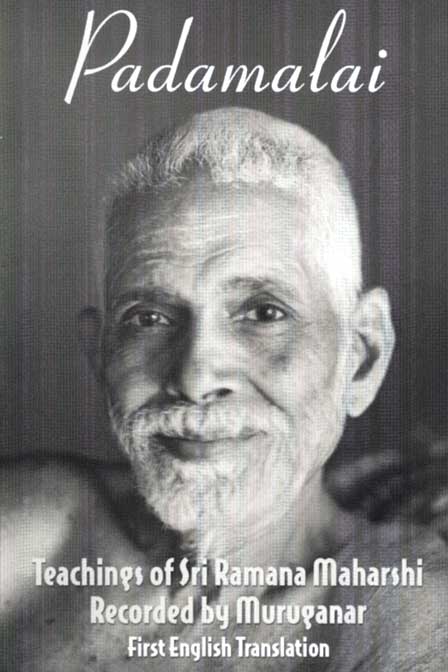
The following verses are taken from Padamalai, a record of teaching statements from Ramana Maharshi which were taken down by one of his foremost devotees, Muruganar. This version I am quoting from is translated by Dr T. V. Venkatasubramanian, Robert Butler and David Godman – my deep appreciation to them in making this wonderful and instructive work more widely available.
In their translation they have changed the order of the verses and grouped them thematically. The following verses are taken from the chapter entitled ‘The Self’.
My comments are interspersed in italics in grey.
Self-knowledge
5. True jnana* is only the removal of wrong knowledge. Only this is useful for liberation.
*Jnana is a Sanskrit word that means knowledge. It is etymologically related to the words gnosis and knowledge. In a spiritual context it implies the height of spiritual knowledge. In an Advaita/non-dual context it is synonymous with self-realisation, liberation/freedom…
In Advaita Vedanta it is said that the Ultimate Truth is that Maya never existed, and that there never was a world (Jagat), individual person (Jiva), or a God (Isvara). This is known as Ajata Vada – see here for an example of this teaching. Here in Guru Vachaka Kovai we have Sri Muruganar stating the same:
‘…I have known that in truth there is never in the least any attainment of bondage, liberation, and so on, which are fabricated when one imagines one is separate from reality’ Guru Vachaka Kovai, verse 1241
Someone recently made a comment to me that this sounds remarkably like Neo-Advaita, to which my response was as follows:
They sound remarkably similar because on the verbal level both traditional and neo-Advaita talk about Ajata Vada (the view that there is no maya, no objects truly exist, and therefore no true meaning, no seeker, no teaching, no teacher, etc) as being the ultimate truth, but traditional advaita also talks about teachings from vivarta vada (world is a projected illusion) and shristi dristi vada (world is real) viewpoints and prescribes self-enquiry as a (paradoxically) valid method for this to be realised on these latter 2 levels for those who cannot fathom ajata vada. Upon this realisation it is ‘realised’ there was never a seeker and no real realisation either. Sri Ramana Maharshi explains it more fully hereif you are interested.