Direct pointing in 3 mins!
My mind is sometimes restless, sometimes peaceful, what should I do? (Ramana Maharshi)

A man from Cocanada [Kakinada] asked:
‘My mind remains clear for two or three days and turns dull for the next two or three days; and so it alternates. What is it due to?’
Sri Ramana Maharshi:
It is quite natural; it is the play of brightness (sattva), activity (rajas) and darkness (tamas) alternating. Do not regret the tamas; but when sattva [peace] comes into play, hold on to it fast and make the best of it.
Taken from Talks with Sri Ramana Maharshi, Talk number 52
Tom: here the advice is clear; when you are peaceful, take advantage of this peace and make the most of it – abide in this peace and know yourself to be beyond all.
Prolonged stillness removes the vasanas
The four types of Liberated Sage (Jnani) | Advaita Vedanta |Kaivalya Navaneeta

In the text Kaivalya Navaneeta (The Cream of Liberation; a 16th century traditional advaita text that was often recommended by Sri Ramana Maharshi), four types of liberated sages are described starting at verse 94.
Understanding these descriptions can help explain and reconcile the different views of liberation one may come across, such as whether or not the body and world appear after liberation, what type of lifestyle a liberated sage would exhibit and whether or not they would experience any kind of afflictive or suffering-causing emotions at all. My comments are in italicised red:
94. The wise, remaining like ether and liberated even here, are of four classes, namely Brahmavid (i.e. a knower of Brahman), vara, varya, and varishta, in order of merit.
Tom: The four types of liberated sage are called Brahmavid, Vara, Varya and Varishta. First we will discuss the Brahmavid or or ‘knower or Brahman’ (Vidya is Sanskrit for knowledge). The phrase ‘remaining like ether’ refers to the previous verse 93 and means the wise sage abides as consciousness, fully liberated.
95. The Brahmavids who by steadfast practice have gained clear realization of Brahman, continue to perform even the hard duties of their caste and stage in life, exactly as prescribed by the shastras for the benefit of others, without themselves swerving from their supreme state.
96. Should passions rise up they disappear instantly and cannot taint the mind of the Brahmavids who live in society detached like water on a lotus leaf. They look ignorant, not showing forth their knowledge, and remain mute owing to intensity of inward Bliss.
Tom: the first type of liberated sage is called the Brahmavid. They continue to be fully engaged in society and the world whilst simultaneously being liberated. Occasionally afflictive emotions and passions arise but they are short lived and do not affect the Brahmavid. They may seem like an ordinary person with nothing particularly special about them, but they are often outwardly quiet.
97. Prarabdha, i.e., karma which is now bearing fruit, differs according to the actions in past incarnations. Therefore the present pursuits also differ among jnanis, who are all, however, liberated even here. They may perform holy tapas; or engage in trade and commerce; or rule a kingdom; or wander about as mendicants.
Tom: Prarabdha essentially refers to the destiny of the particular body-mind based on its previous actions, ie. its karma . This verse states that the actions of the (body of the) jnani or sage (jnani literally means ‘knower’, ie. ‘knower of truth’ or ‘knower of Self’) varies depending on what the activities the body did prior to realisation. So the sage may, for example, perform holy penance, or engage in the world, or be a ruler, or a wandering monk. Basically there is no fixed description of what a sage would do in daily life in terms of their ‘occupation’.
98. They would not think of the past or future; would partake of what comes unsolicited; would not wonder, even if the sun turned into the moon, or at any other marvel, whether the sky were to spread its shoots down like a banyan tree or a corpse were to be revived; nor would they distinguish good and bad, for they always remain as the unchanging Witness of all.
Tom: the last point on the Brahmavid is that they are unaffected by whatever appears to happen, no matter how marvelous, calamitous or ridiculous. Why? Because they are liberated, ‘fixed’ as the Self, remaining as the ever-unchanging ‘Witness of all’.
Now let us look at the other three classes of Jnani or Liberated Sage:
99. Among the other three classes, the vara and the varya remain settled in samadhi. The vara feels concern for the maintenance of the body; the varya is reminded of it by others; the varishta never becomes aware of the body, either by himself or through others.
Tom: Here the vara and varya are both aware of the body at times whilst the fourth type of Jnani, the varishta, is not even ever aware of the body at all, even though others may perceive him or her as a body. The vara has a desire to maintain the body, whilst the varya occasionally becomes aware of their body if someone else prompts them.
So which of these types of liberation is best? Let us see…
100. Although there are distinguishing characteristics in the lives of the different Sages, who are themselves very rare in the world, yet there is absolutely no difference in the experience of Liberation. What can be the use of the hard-won samadhi? The Brahmavid, who is outwardly active, seems sometimes to feel the misery of calamities, whereas the others remain in unbroken Bliss.
Tom: Here it is made clear: all of these four types of sage are rare, and all are the same in that they are all fully liberated. They all in themselves have the same essential experience of Liberation, the differences being only superficial and present from the point of view of other non-liberated people, ie. from the point of view of ignorance.
However a point is raised that is dealt with in the next verse. The Brahmavid may appear to suffer and stress like the unliberated, whereas the other three categories of liberated sage are lost in eternal Peace and Bliss. How can this be? How can the Brahmavid be said to be truly liberated?
101. Now if the Brahmavids live like the ignorant, how are they free from the cycle of births, and how is their ignorance gone? The all-pervading ether remains untainted by anything; the other four elements are tainted by contact with objects. So it is with the Brahmavid and the ignorant.
Tom: The answer given is that, as Consciousness, the Brahmavid remains unaffected and untouched by whatever seems to happen in the world of objects that we ordinarily call life.
Tom’s summary: So we can see there are various types of liberated sage that are all fully and totally liberated, but appear different to each other only from the point of view of ignorance or the ‘unliberated’. Some jnanis are active in the world and appear to stress and suffer, some are immersed in constant experiential bliss, some are totally unaware of their body or only aware of it to some degree, and others seem to have a need to look after their body. Some appear to be holy sages, other just ordinary mundane people int he world. However, all of this does not matter from the point of view of Liberation – Liberation is only One. Know Thy Self!
You are the Thoughtless Reality

This Thursday ONLINE Satsang/Meeting with Tom Das | Liberation and Non-Duality | Advaita
All are welcome to join me in an ONLINE satsang this Thursday 8pm GMT (UK time). See the link below for details and how to join.
We meet ONLINE on the 1st and 3rd Thursday of every month.
Best wishes to you all
Tom
https://www.meetup.com/Non-duality-Kingston-London/events/jllxkrybcfbhb/
Ramana Maharshi on the two types of liberation: (1) liberation in this life (Jivanmukti) and (2) liberation after death (Videhamukti)
The following dialogue is taken from Talks with Sri Ramana Maharshi, Talk number 265, my additions are in red:
Questioner: There are said to be sadeha mukta (liberated in body) and videha mukta (liberated without body).
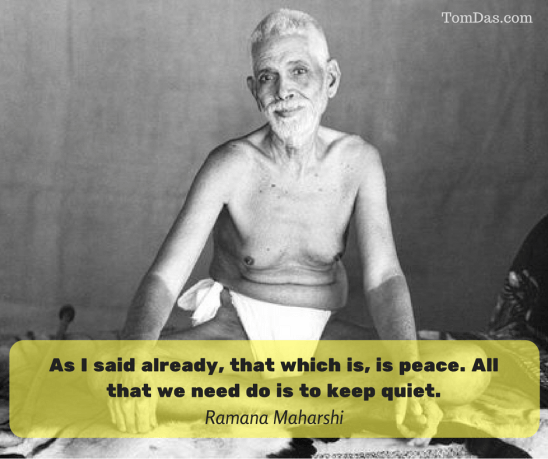
Sri Ramana Maharshi: There is no liberation, and where are muktas [the liberated ones]?
Questioner: Do not Hindu sastras [scriptures] speak of mukti [liberation]?
Sri Ramana Maharshi: Mukti is synonymous with the Self. Jivan mukti (liberation while alive) and videha mukti (liberation after the body falls) are all for the ignorant. The Jnani [liberated one] is not conscious of mukti or bandha (bondage).
Bondage, liberation and orders of mukti are all said for an ajnani [ignorant or unliberated one] in order that ignorance might be shaken off.
There is only mukti and nothing else.
The following is the taken from Vichara Shangraham, a text attributed to Sri Ramana Maharshi. Vichara Sangraham is often translated simply as ‘Self Enquiry’ and literally means ‘A compendium of (Self) Enquiry’. This excerpt is very the last section of the text:
Question: What are the characteristics of the jivan-mukta (the liberated in life) and the videha-mukta (the liberated at death)?
Sri Ramana Maharshi: ‘I am not the body; I am Brahman which is manifest as the Self. In me who am the plenary [absolute] Reality, the world consisting of bodies etc, are mere appearance, like the blue of the sky’. He who has realized the truth thus is a jivan-mukta.
Yet so long as his mind has not been resolved, there may arise some misery for him because of relation to objects on account of prarabdha (karma which has begun to fructify and whose result is the present body) [ie. due to destiny], and as the movement of mind has not ceased there will not be also the experience of bliss.
The experience of Self is possible only for the mind that has become subtle and unmoving as a result of prolonged meditation. He who is thus endowed with a mind that has become subtle, and who has the experience of the Self is called a jivan-mukta. It is the state of jivan-mukti that is referred to as the attributeless Brahman and as the Turiya.
When even the subtle mind gets resolved, and experience of self ceases, and when one is immersed in the ocean of bliss and has become one with it without any differentiated existence, one is called a videha-mukta. It is the state of videha-mukti that is referred to as the transcendent attributeless Brahman and as the transcendent Turiya. This is the final goal.
Because of the grades in misery and happiness, the released ones, the jivan-muktas and videha- muktas, may be spoken of as belonging to four categories — Brahmavid, vara, variyan and varishtha. But these distinctions are from the standpoint of the others who look at them; in reality, however, there are no distinctions in release [liberation] gained through jnana [self-knowledge].
Are practices required for self-realisation?
The simple way to Liberation (Moksha)

The simple way to Liberation or Moksha is to (1) allow the mind be still and (2) not take yourself to be the body-mind.
That’s it

However, if you still want to know more about this kind of approach, I wrote an article about it here that goes into more detail.
Shankara: the world or universe is a projection of the mind
From Shankara’s Vivekachudamani:
170. In dreams, when there is no actual contact with the external world, the mind alone creates the whole universe consisting of the experiencer etc. Similarly in the waking state also; there is no difference. Therefore all this (phenomenal universe) is the projection of the mind.
171. In dreamless sleep, when the mind is reduced to its causal state, there exists nothing (for the person asleep), as is evident from universal experience. Hence man’s relative existence is simply the creation of his mind, and has no objective reality.

