Q. Can you briefly define Jnana Yoga vs Bhakti Yoga and how they relate to Advaita and Vedanta?
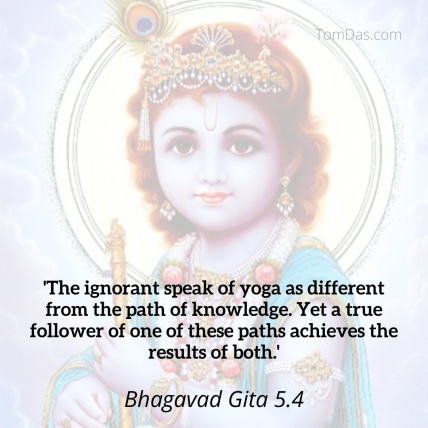
Tom: Jnana yoga usually refers to the use of (intellectual) knowledge in the mind used to remove ignorance, a thorn to remove a thorn, and then the thorn of ‘knowledge’ is itself allowed to fall away; Bhakti yoga is faith, love and devotion from the heart to Self/Guru/God. These 2 yogas seem different at first, but then they quickly merge together to remove ignorance and end suffering, which is what the word ‘yoga’ means of course. Both of the above are part and parcel of Advaita Vedanta as per the Upanishads, Gita, etc.
Q. What about Advaita vs. Jnana?
Tom: Advaita Vedanta, as a traditional teaching is the general term used to refer to the teachings of the Upanishads, Bhagavad Gita, Brahma Sutras and a few other traditional texts. Jnana yoga refers to one part of the teachings of Advaita Vedanta. Other aspects of Advaita Vedanta include Bhakti Yoga, Raja Yoga and several other teachings found in the above aforementioned texts.
Advaita, literally means not-two. Jnana means knowledge. Jnana can either mean relative knowledge in the mind, which is the means of jnana yoga, or it can refer to the Absolute, which is not really knowledge per se as it is beyond ideas/conceptualisation, but the word Jnana is sometimes used nonetheless. This ‘absolute Jnana’ is synonymous with Advaita and points to that which is beyond both Advaita and Jnana, ie. God or True Self! It is also known as Parabhakti (divine love), Aparokshanubhuti (direct experience), Moksha (freedom) and various other terms, none of which fully capture what is spoken of!
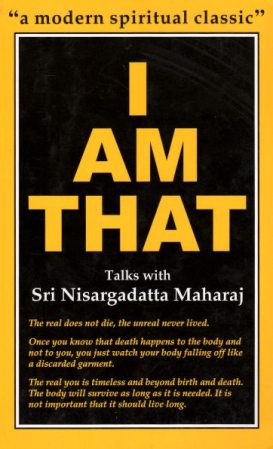
Nisargadatta Maharaj: Why not change? Gurus are like milestones? It is natural to move on from one to another. Each tells you the direction and the distance, while the sadguru, the eternal Guru, is the road itself. Once you realise that the road is the goal and that you are always on the road, not to reach a goal, but to enjoy its beauty and its wisdom, life ceases to be a task and becomes natural and simple, in itself an ecstasy.
Questioner: So, there is no need to worship, to pray, to practice Yoga?
Nisargadatta Maharaj: A little of daily sweeping, washing and bathing can do no harm. Self-awareness tells you at every step what needs be done. When all is done, the mind remains quiet.
The following verses are read on this video here (a couple of the verses are in a slightly different order):
Sage Ashtavakra, the young boy with contorted limbs, teaches King Janaka, and the result is the Song of Ashtavakra, or Ashtavakra Gita. Here are some selected verses, enjoy:
2.1. Oh, I am spotless, tranquil, Pure Consciousness, and beyond Nature. All this time I have been mocked by illusion.
Tom – Now the triad of knower/knowing/known are said not to exist. Note that this triad essentially encompasses all arising or objective phenomena:
2.15. Knowledge, knower and the known –these three do not exist in reality. I am that stainless Self in which this triad appears through ignorance.
Tom – here the remedy is prescribed:
2.16. Oh, the root of misery is duality. There is no other remedy for it except the realisation of the unreality of all objects of experience and that I am One, Pure Consciousness, and Bliss.
2.18. I am neither bound nor free. My illusion has ended. The world, though appearing to exist in me, has in reality no existence.
2.19. My conviction is that the Universe and the body have no reality. The Self is Consciousness alone. How can the world be imagined in it?
2.20. I am the Self, and my nature is pure Consciousness. The body, heaven, hell, bondage, freedom, and fear are merely imagined, and I have no relationship with them.
3.13. Knowing the object of perception to be naught by nature, that steady-minded one neither accepts this nor rejects that.
5.3. Though the Universe is perceptible by the senses, it has no factual existence, like the snake in the rope. Therefore, enter into Laya, the state of dissolution.
Tom – Again the essential teaching is dispensed:
11.8. He who is convinced that this manifold and wonderful Universe has no real existence, becomes free from desire, is pure Consiousness, and finds peace in the Knowledge that nothing is real.
15.16. The world is the result of ignorance of your own nature. In reality, you alone exist. There is neither jiva (the individual person) nor Ishvara (God), nothing other than thyself.
15.17. He who has fully realised that the Universe is a pure illusion, becomes desireless and Consciousness Itself – such a one abides in peace.
16.11. Even though Shiva, Vishnu, or Brahma instruct you, unless you regard the world as unreal, and dismiss all sense of egotism, you will not become established in your own nature (the Self).
17.19. Devoid of the feeling of ‘This is mine’ and ‘This I am’ and knowing for certain that nothing objective exists in reality, the knower of Truth is at peace within himself, his desires have subsided. Though appearing to act, in fact he does not engage in action.
18.14. Where is delusion, where is the universe, where is renunciation, moreover where is liberation for the great-souled one who rests beyond the world of desires?
Tom – the implication in verse 18.14 above is that all the items listed – namely ignorance, the universe, renunciation and liberation – all of these are illusion.
18.28. That man of peace, beyond distraction and contemplation, is neither an aspirant for liberation, nor is he bound. Knowing the Universe to be an illusion, though perceiving it, he remains in the absolute state.
18.70. The pure one knows for certain that this universe is nothing but the product of illusion and that nothing exists. The Imperceptible Self is revealed to him, and he naturally enjoys peace.
Tom – As if the above verses were not enough, here, in the last chapter, chapter 20, the point is driven home again. Everything in the phenomenal world is negated as being mere dream-like illusion, a product of imagination, from the scriptures, to the seeker, from the teacher to the teaching. Even notions of liberation, bondage, knowledge, ignorance, time and space and lastly even duality and non-duality – all these are said to be mere illusion.
20.1. In my Perfect Self (Atman), neither the elements, nor the body, nor the sense-organs, nor the mind, nor the void, nor despair, exist.
20.2. Where are the scriptures, where is Self-Knowledge, where is the mind not attached to sense-objects, where is contentment, and where is desirelessness for me who am ever devoid of the sense of duality?
Tom – ie. scriptures, self-knowledge, the unattached mind, happiness and desirelessness are all illusory
20.3. Where is knowledge and where is ignorance; where is ‘I’, where is ‘this’, and where is ‘mine’; where is bondage and where is liberation? Where is an attribute to the nature of my self?
Tom – ie. knowledge, ignorance, bondage, liberation, subject and object are all illusory. And so the verses continue in the same fashion:
20.6. Where is the world and where is the seeker of liberation; where is the Yogi and where is the Jnani; where is bondage and where is liberation for me who am non-dual by nature?
20.7. Where are creation and destruction; where is the end and where the means; where is the seeker and success for me abiding in my non-dual nature?
20.8. Where is the knower, the means to knowledge, the object of knowledge or knowledge itself; where is anything, and where is nothing for me who am ever pure?
20.9. Where is distraction, where is concentration; where is knowledge, where is delusion; where is joy and where is sorrow for me who am ever actionless?
20.13. Where are instruction and scriptural injunction, where is the disciple and where is the guru; where, indeed, is the object of life for me who am absolute good and free from limitation?
20.14. Where is existence, where is non-existence; where is unity, where is duality? What need is there to say more? Nothing emanates from me.
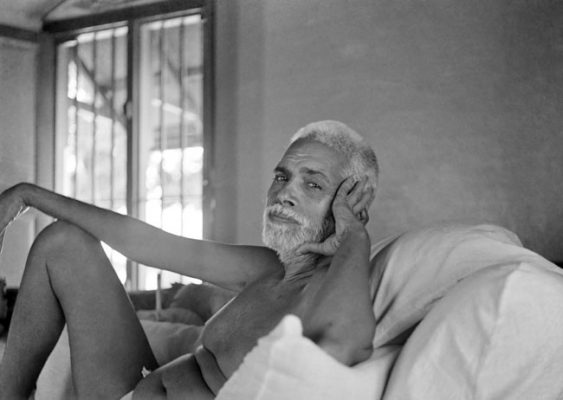
Here, in the Sri Ramana Gita, Bhagavan Sri Ramana Maharshi speaks of Bhakti (devotion towards God or Guru or Self) as a complete path to the Divine and a complete path to Spiritual Liberation.
May we have gratitude to Sri Ramana for his teachings!
May we love Sri Ramana for His Presence in Our Hearts!
All praise to Ramana!
All praise to Him who is God!
All praise to Him in our Hearts!
SRI RAMANA GITA
CHAPTER 16: ON BHAKTI
1. Then, questioned regarding Bhakti, the best of men, the highly auspicious Bhagavan Ramana Maharshi, spoke thus:
2. The Self is dear to all. Nothing else is as dear. Love, unbroken like a stream of oil, is termed Bhakti.
3. Through Love the Sage knows that God is none other than his own Self. Though the devotee, on the other hand, regards Him as different from himself, yet he too merges and abides in the Self alone.
4. The Love which flows (unbroken) like a stream of oil, towards the Supreme Lord, leads the mind infallibly into pure Being, even without one’s desiring it.
5 & 6. When the devotee, regarding himself as a separate, limited individual of poor understanding, and desirous of deliverance from suffering, takes the omnipresent Supreme Reality to be some deity and worships it, even then he attains in the end That (alone).
7. Oh best of men, one who attributes names and forms to the deity, through those very names and forms, transcends all name and form.
8. When Bhakti has grown perfect, then hearing once (about Reality) is enough, for it confers perfect Knowledge.
9. Bhakti not continuous like a stream is called intermittent Bhakti. Even this is bound to result in supreme Bhakti.
10. One who practises Bhakti for a desired end finds no fulfillment on attaining it and then again worships God for the sake of eternal happiness.
11. Bhakti, even when accompanied by desire, does not cease with the achievement of the desire. Faith in the Supreme Person develops and goes on increasing.
12. Growing thus, Bhakti in course of time becomes perfect.
By means of this perfect and supreme Bhakti, even as by jnana, one crosses (the ocean of) Becoming.
This is the sixteenth chapter entitled ‘ON BHAKTI’ in Sri Ramana Gita, the Science of Brahman, and the Scripture of Yoga composed by Ramana’s disciple Vasishta Ganapati.
Tom:
May we praise Sri Ramana for his words!
May we have gratitude to Sri Ramana for his teachings!
May we love Sri Ramana for His Presence in Our Hearts!
The external guru that appears as an external form is a dream-guru
The world is simply thought; the universe is made up of thought
The guru does not need to teach others or ‘spread the word’
The false ideas ‘I do not want liberation’ and ‘Let all others be liberated before me first’ are discussed
Other people do not need to be saved, ie. the focus should be on your own realisation
There is only one jiva (seperate ego-self) – ie. eka jiva vada
The Dream
Here is an essential instruction from Ramana Maharshi:
‘The world should be considered like a dream’ Who Am I?
The following are supportive quotes:
Waking is long and a dream short; other than this there is no difference Who Am I?
The present waking state is no more than a dream Talks 244
The so-called waking state is itself an illusion Talks 199
The Dream Guru
In the following two quotes we see that Ramana is describing the Guru or Teacher or Teaching as a mere dream-guru or dream-teaching, a part of the illusion. There is no real teaching, no real teacher, no real seeker, no real liberation. These are all illusion. The example given is that we dream the guru up, rather like dreaming of a tiger that then causes us to awake from the dream:
A man dreams of a tiger, takes fright and wakes up Talks 473
It is said that awaking from ignorance is like awaking from a fearful dream of a beast Talks 627
In the following dialogue this is also made clear:
A Swami asked: I feel toothache. Is it only a thought? Ramana Maharshi: Yes.
Questioner: Why can I not think that there is no toothache and thus cure myself?
Ramana Maharshi: When engrossed in other thoughts one does not feel the toothache. When one sleeps toothache is not felt.
Questioner: But toothache remains all the same.
Ramana Maharshi: Such is the firm conviction of the reality of the world that it is not easily shaken off. The world does not become, for that reason, any more real than the individual himself.
Questioner: Now there is the Sino-Japanese war. If it is only in imagination, can or will Sri Bhagavan imagine the contrary and put an end to the war?
Ramana Maharshi: The Bhagavan of the questioner [ie. Sri Ramana Maharshi] is as much a thought as the Sino Japanese war. (Laughter.)
Talks 451
The Guru does not need to teach others
In the following excerpt Ramana points some flawed reasoning. Firstly why does a liberated sage not need to go out and preach to the world?
People often say that a mukta purusha[ie. liberated person; mukta = liberated, purusha = person] should go out and preach his message to the people. They argue, how can anyone be a mukta so long as there is misery by his side?
True. But who is a mukta? Does he see misery beside him? They want to determine the state of a mukta without themselves realising the state.
From the standpoint of the mukta their contention amounts to this: a man dreams a dream in which he finds several persons. On waking up, he asks, ‘Have the dream individuals also wakened?’ It is ridiculous.
Talks 498
Two false teachings
Secondly, the flawed thinking in those who say to themselves:
a) ‘I don’t mind if I don’t get mukti’ or
b) ‘Let me be the last person to be liberated and instead help all others become liberated first’. (ie. what in Mahayana Buddhism is known as the Bodhisattva ideal)
Again, a good man says, “It does not matter even if I do not get mukti. Or let me be the last man to get it so that I shall help all others to be muktas before I am one.” It is all very good. Imagine a dreamer saying, “May all these wake up before I do”. The dreamer is no more absurd than the amiable philosopher aforesaid.
Talks 498
Others do not need to be saved
Does a man who sees many individuals in his dream persist in believing them to be real and enquire after them when he wakes up? Talks 571
There are not many jivas/egos/people
Here a questioner asks are there not many jivas? Ramana informs the questioner there is only one jiva:
A question was asked why it was wrong to say that there is a multiplicity of jivas. Jivas are certainly many. For a jiva is only the ego and forms the reflected light of the Self. Multiplicity of selves may be wrong but not of jivas.
M.: Jiva is called so because he sees the world. A dreamer sees many jivas in a dream but all of them are not real. The dreamer alone exists and he sees all. So it is with the individual and the world.
There is the creed of only one Self which is also called the creed of only one jiva*. It says that the jiva is only one who sees the whole world and the jivas therein.
Talks 571
*This is called the doctrine of eka jiva vada (the view there is only a single jiva/ego/person). Our own body-mind, and the body-mind of apparent others are all projections of the Self. Like a dream, it appears we are many, but actually this entire dream world is an illusion, and there is only the Dreamer, the Self, the Consciousness from which all is projected. Tat Tvam Asi, You are That.
Ramana Maharshi:
‘The world should be considered like a dream’
Waking is long and a dream short; other than this there is no difference. Who Am I?
The present waking state is no more than a dream. Talks 244
The so-called waking state is itself an illusion Talks 199
Yoga Vasishta clearly defines Liberation as the abandonment of the false and remaining as Being. Talks 442
A man dreams of a tiger [the guru], takes fright and wakes up Talks 473
It is said that awaking from ignorance is like awaking from a fearful dream of a beast. Talks 627
A Swami asked: I feel toothache. Is it only a thought?
Ramana Maharshi: Yes. Talks 451
The Bhagavan of the questioner [ie. Sri Ramana Maharshi] is as much a thought as the Sino Japanese war. Talks 451
Does a man who sees many individuals in his dream persist in believing them to be real and enquire after them when he wakes up? Talks 571
Jiva is called so because he sees the world. A dreamer sees many jivas in a dream but all of them are not real. The dreamer alone exists and he sees all. So it is with the individual and the world. Talks 571
There is the creed of only one Self which is also called the creed of only one jiva. It says that the jiva is only one who sees the whole world and the jivas therein. Talks 571
Remember, no teaching has a monopoly on truth. No teaching is totally true, as what is being shared is beyond words and cannot be captured in words. Rather the teaching is a method of removing ignorance, that it all…it is a thorn to remove a thorn. The teaching is also false, a thorn, a new form of ignorance that if clung to will cause suffering
The primary ignorance is the belief in a limited ‘me’ entity, or the notion ‘I am the body mind’, or I am a subject living in a world of objects (subject-object duality).
The teaching is there to remove that false belief.
We do not need to replace this with a new belief such as ‘all is illusion’, but the teaching may take many forms such as ‘all is illusion’.
Ultimately we do away will all teachings.
The best teachings are those that self-destruct once their work has been done!
The following summarises the spiritual method advised by Sri Gaudapada, the great-guru of the more famous Sri Shankara. It is taken from Chapter 3 of Gaudapada’s Karika (Gaudapada’s commentary on the Mandukya Upanishad), one of the earliest, most authoritative and most-influential of Advaita Vedanta Scriptures.
42. The mind distracted by desires and enjoyments should be brought under control by proper means; so also the mind enjoying pleasure in inactivity (laya). For the state of inactivity is as harmful as the state of desires.
43. Turn back the mind from the enjoyment of desires, remembering that they beget only misery. Do not see the created objects, remembering that all this is the unborn Atman.
44. If the mind becomes inactive, arouse it from laya [inactivity]; if distracted, make it tranquil. Understand the nature of the mind when it contains the seed of attachment. When the mind has attained sameness, do not disturb it again.
45. The yogi must not taste the happiness arising from samadhi; he should detach himself from it by the exercise of discrimination. If his mind, after attaining steadiness, again seeks external objects, he should make it one with Atman through great effort.
46. When the mind does not lapse into inactivity [laya] and is not distracted by desires, that is to say, when it remains unshakable and does not give rise to appearances, it verily becomes Brahman.
The true meaning of Jnana (Self-Knowledge) is revealed by Sage Vasistha, taken from the wonderful and highly authoritative traditional Advaita text, the Yoga Vasistha.
At Rama’s request, VASISTHA narrated the following story:
Once upon a time there was a king named Bhagiratha who was devoted to dharma. He gave liberal gifts to the pious and holy ones and he was terror to the evildoers. He worked tirelessly to eradicate the very causes of poverty. When he was in the company of the holy ones his heart melted in devotion.
Bhagiratha brought the holy river Ganga from the heavens down to the earth. In this he had to encounter great difficulties and propitiate the gods Brahma and Siva and also the sage Jahnu. In all this he suffered frequent frustrations and disappointments.
He, too, was endowed with discrimination and dispassion even at an early age, O Rama. One day while remaining alone he reflected thus: “This worldly life is really essenceless and stupid. Day and night chase each other. People repeat the same meaningless actions again and again. I regard only that as proper action which leads to the attainment beyond which there is nothing to be gained; the rest is repeated foul excretion (as in cholera).” He approached his guru Tritala and prayed, “Lord, how can one put an end to this sorrow and to old age, death and delusion which contribute to repeated birth here?”
Tom – here below the first teaching will be dispensed. The teaching says that suffering will end when the self is known. How to know the self? One has to abide as the Self for a long time:
TRITALA said: Sorrow ceases, all the bondages are rent asunder and doubts are dispelled when one is fully established in the equanimity of the self for a long time, when the perception of division has ceased and when there is the experience of fullness through the knowledge of that which is to be known. What is to be known? It is the self which is pure and which is of the nature of pure consciousness which is omnipresent and eternal.
BHAGIRATHA asked: I know that the self alone is real and the body, etc., are not real. But how is it that it is not perfectly clear to me?
Tom – how often we have heard the teaching, we have heard the words, we may know the theory, but still we do not know! Let us listen to Tritala’s response, in which he will tell us the true nature of Knolwedge and the means to it:
TRITALA said: Such intellectual knowledge is not knowledge! Unattachment to wife, son and house, equanimity in pleasure and pain, love of solitude, being firmly established in self-knowledge—this is knowledge, all else is ignorance! Only when the ego-sense is thinned out does this self-knowledge arise.
BHAGIRATHA asked: Since this ego-sense is firmly established in this body, how can it be uprooted?
TRITALA replied: By self-effort and by resolutely turning away from the pursuit of pleasure. And by the resolute breaking down of the prison-house of shame (false dignity), etc. If you abandon all this and remain firm, the ego-sense will vanish and you will realise that you are the supreme being!
VASISTHA continued: Having heard the teachings of his teacher, Bhagiratha decided to perform a religious rite as a prelude to total renunciation of the world. In three days he had given away everything to the priests and to his own relatives, whether they were endowed with good nature or not. His own kingdom he handed over to his enemies living across the borders. Clad in a small piece of loin-cloth, he left the kingdom and roamed in countries and forests where he was totally unknown.
Very soon, he had attained the state of supreme peace within himself. Accidentally and unknowingly Bhagiratha entered his own previous kingdom and solicited alms from the citizens there. They recognised him, worshipped him and prayed that he should be their king. But he accepted from them nothing but food. They bewailed, “This is king Bhagiratha, what a sad plight, what an unfortunate turn of events!” After a few days he left the kingdom again.
Tom – in the following paragraphs we will see some hints, in bold type, as to how life is for the apparently self-realised sage:
Bhagiratha once again met his teacher and the two of them roamed the country all the time engaged in spiritual dialogue: “Why do we still carry the burden of this physical body? On the other hand, why should it be discarded? Let it be as long as it will be!” They were devoid of sorrow and of rejoicing, nor could they be said to adhere to the middle path. Even if the gods and sages offered them wealth and psychic powers, they spurned them as blades of dry grass.
In a certain kingdom the king had died without an heir and the ministers were in search of a suitable ruler. Bhagiratha, clad in a loincloth, happened to be in that kingdom. The ministers decided that he was the person fit to ascend the throne, and surrounded him. Bhagiratha mounted the royal elephant. Soon he was crowned king.
While he was ruling that kingdom, the people of his previous kingdom approached him once again and prayed that he should rule that kingdom also. Bhagiratha accepted. Thus he became the emperor of the whole world. Remaining at peace within himself, with his mind silenced, free from desires and jealousy, he engaged himself in doing appropriate action in circumstances as they arose.
Once he heard that the only way to please the souls of his departed ancestors was to offer libation with the waters of the Ganga. In order to bring the heavenly Ganga down to earth, he repaired to the forest to perform austerities, having entrusted the empire to his ministers. There he propitiated the gods and the sages and achieved the most difficult task of bringing the Ganga down to earth so that all the people for all time to come might offer libations to their ancestors with the waters of the holy Ganga. It is only from that time that this sacred Ganga which adorned the crown of lord Siva’s head began to flow on the earth.
Tom – traditionally the river Ganges, here called the Ganga, its Sanskrit name, springs from the head of Lord Shiva. In the picture below we can see the out-shoot of water from the crown of his head which is the source of the Ganga:
VASISTHA continued: Even so, Rama, remain in a state of equanimity like king Bhagiratha. And, like Sikhidhvaja, having renounced everything, remain unmoved. I shall narrate to you the story of Sikhidhvaja. Pray, listen. Once there were two lovers who were reborn in a later age on account of their divine love for each other…[and so the wonderful Yoga Vasistha continues with its interweaving stories all explaining in different ways to paths to Realisation…]
Just a reminder that there will be an ONLINE SATSANG tonight at 8pm GMT (UK time). This is instead of the usual Kingston meeting. Due to the current coronavirus situation all face-to-face or in-person meetings are being cancelled and we will be meeting online on Thursdays until further notice.