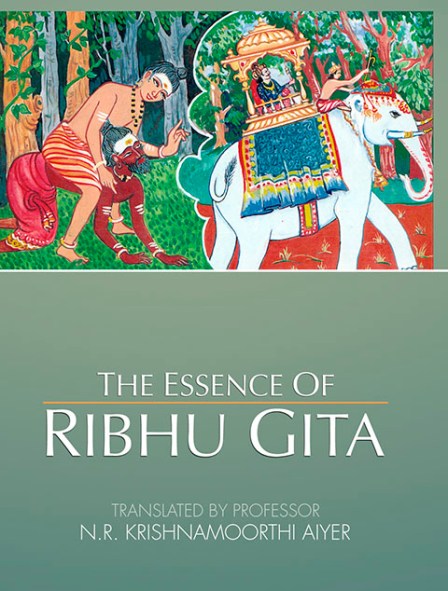
The Essence of the Ribhu Gita

essence_of_ribhu_gita_1071

Tom: This wonderful text provides a hard-hitting summary of essential Advaita Vedanta teachings. Blessings to you who have found these teachings and put them into practice.

Also see Ribhu Gita – Chapter 26 which Sri Ramana Maharshi reportedly specifically recommended recitation of for attainment of Self-Realisation.

PREFACE

The Ribhu Gita forms the sixth section of the Sanskrit work known as Siva Rahasya. It is the teachings of Lord Siva in Mount Kailas to His devotee Ribhu, from whom the Gita derives its name.

The Tamil version is a free translation of the original Sanskrit text, consisting of 1,924 verses of such scintillating brilliance that Bhagavan Sri Ramana Maharshi recommended its recital as a strong support for spiritual sadhana. He used to say that the recital itself leads to spontaneous abidance in the Self.

The book presented herewith consists of 122 verses from the original Tamil work, being a free translation into English prose, conveying the essence of the original, rather than a mere mechanical word for word translation.

Benedictory verses

To Siva

1. Salutations to the Supreme Lord Siva, the pure Awareness in the sky of consciousness in the Heart, by meditation on whom, Ganesa, Guha, Mother-Sakti who is the embodiment of Siva’s Grace, and myriads of Devas, saints and devotees have attained their cherished goals. (Chapter 1, Verse 1).

To Nataraja

2. From the sky of consciousness of the Heart springs forth the dancer Nataraja with his blissful consort Freedom, to the delectation of his devotees who are thus liberated forever. Unto that Ananda Natesa do we render our devout salutations. (Ch.1, v.2)

To Ardhanareeswara

3. Unto that Form whose left half is the Mother of all manifestation and whose right half is the Father of the same, the jingle of the gems enclosed within the hollow golden anklet of whose foot is the source of all scriptures, and whose three eyes (Fire, Sun and Moon) are the illuminants of the universe, to that Form be our devout salutations. May that divine Form ever be our protection. (Ch.1, v.3)

To Siva, Sakti, Vinayaka and Shanmukha

4. Salutations to Siva, the Lord of the universe of infinite power, to Sat-Chit-Ananda-Sakti, the Mother of the universe, to Vinayaka the dispeller of all impediments to freedom, and to Shanmukha the Sat-Guru, who dispenses to his worthy devotees the divine wisdom of Siva-Self leading to salvation. (Ch.1, v.4)

THE ESSENCE OF THE RIBHU GITA

The following verses constitute the teachings of Siva to Ribhu, who in turn transmits those teachings to his disciple Nidhaga Rishi. The treatise goes by the name Ribhu Gita.

5. The universe was neither born, nor maintained, nor dissolved; this is the plain truth. The basic screen of pure Being-Awareness-Stillness devoid of all the moving shadow pictures of name and form of the universe is the sole, eternal Existence. (Ch.2, v.33)

6. Some may argue that this universe of duality (multiple existences) is a factual second reality, clearly seen by the senses operated by the mind. But then, are the senses anything apart from the mind? Can they function without the support of the mind in which they are imbedded? What is this mind except a bundle of thoughts? What are thoughts except evanescent ripples in the still, limitless ocean of pure Being-Awareness-Self, which is the sole Existence without a second? (Ch. 2, v.34)

7. The existence of the illusion of silver in mother of pearl is not a reality apart from the reality of mother of pearl, which is the basic reality. The illusion of the universe is based on the mind, which again is an illusion based on the still Awareness-Being-Self. (Ch.2, v.35)

8. In the unitary, undifferentiated still ocean of Existence-Awareness-Self, body, senses, mind, intellect and jivas (embodied souls) are nothing but evanescent ripples not apart from that sole Self. (Ch.4, v.6)

9. The universe of name and form, the embodied creatures and their creator, mind, desire, Karma (action), misery and everything other than the Self, are merely thought formations projected by the powers of the Self on its screen — Self. (Ch.5, v.25)

10. The state of firm abidance in that thought-free alert Awareness-Self, constitutes integral perfection, yoga, wisdom, Moksha, Sahaja Samadhi, the state of Siva and the state of Atman-Self, which scriptures proclaim by the title of Brahman. (Ch.5, v.26)

11. There never was a mind nor any of its countless forms like world, jivas, etc. There isn’t the least doubt that all these are the form of the eternally undifferentiable Supreme Brahman-Self. This is the Truth. The one who hears this great secret diligently and understands completely, abides as Brahman-Self (Ch.5, v.28)

Greatness of Videha Mukta

12. With all objective knowledge banished, with no trace of thought or nescience, with all the three states of waking, dream and sleep wiped out, with all thought of death and birth abolished, and ever established in the spontaneous blissful state of Brahman-Self, the condition of the Videha Mukta cannot be conceived, and much less expressed in words. (Ch.5, v.39)

13. The continued repetition of ‘I am Self-Brahman’ constitutes the sole mantra-japa leading to Mukti (Liberation). All other mantra-japas connected with diverse gods should be firmly eschewed, as they aim at mundane objectives other than the Self. All other mantra-japas always entangle one inextricably in the bondage of worldly enjoyments. (Ch.6, v.37)

Sat-Chit-Ananda-Self Siva and His worship

14. On the eternal and infinite screen of Sat-Chit-Ananda-Self Siva, by His own power, Sakti is projected as the moving shadow picture of the universe in manifestation and into that again it is absorbed in dissolution.

All luminaries like the sun, moon, fire, stars and lightning derive their luminosity as a gracious gift from the Sakti inherent in that screen of Self-Siva only. Though bright in themselves, they can only obscure and cannot reveal the Siva-Screen which they cover up.

Out of fear of that Siva, their creator, Devas and Asuras (gods and demons) are ever alertly engaged in their ordained duties.

That Siva must be meditated upon and realised to be the Self, by making the restless mind stay still and alert after it has been adequately restrained, and completely prevented from the pursuit of sense objects, namely, the shadow pictures on the screen of the Self. All shadow pictures removed, what remains is pure Awareness, the spotlessly effulgent screen. Thus, Siva reveals Himself spontaneously as the sole eternal Sat-Chit-Ananda-Self, the very essence of the nature of the worshipper. (Ch.7, v.35)

The Jivan Mukta

15. The Jivan Mukta is a person liberated during his lifetime, who continues to have consciousness of the body and the world (as Brahman) along with his firm abidance in his Siva-Self. He ever abides in the blissful peace of Sat-Chit-Ananda. He is poised rock-firm in the conviction that he is not the body, and that his Being is the sole existence, the sole alert-awareness-bliss of Siva-Self Supreme. (Ch.8, v.1)

16. The Jivan Mukta has his consciousness completely dissolved beyond recognition in his Brahman-Self. Eternally alone in his Self, he is ever lost in the enjoyment of the bliss of his Brahman-Self. (Ch.8, v.25).

The Videha Mukta

17. The Videha Mukta [The term literally means the ‘disembodied-liberated person’] is free from the least trace of thought; he abides all alone in his effulgent pure-Awareness-. He is the matured adept, who at the moment of death, abides as the pure Sat-Chit-Ananda-Self. Figuratively the term means mature liberated being who, while still alive, abides as the pure Sat-Chit-Ananda-Self without awareness of body and the world around him. Self in intense unbroken bliss, totally oblivious of limited forms, in a state of Maha-Mounam (stillness of body, speech and mind). (Ch.9, v.1)

18. He is the pure embodiment of Sat-Chit-Ananda, all pervasive as ether, infinite as the sky, all alert with Awareness, spontaneously abiding as the perfect Brahman-Self in a state of still, unbroken, peaceful bliss. (Ch.9, v.15)

19. There is not an atom apart from the Self, which is the integral undifferentiated perfection of whole Being. Soul, world and Creator are inseparable from the Self. The reality of these is the reality of the Self only. (Ch.10, v.34)

20. All ignorance and illusion, all objects inert and living, all beings and non-beings, all the five elements, all the diverse worlds, all bodies and the lives that arise in them, not being apart from Brahman-Self, are Brahman-Self only. Existence alone is, for even non-existence acquires meaning only in Existence. Simply put, everything exists always as Brahman-Self only. (Ch.12, v.2)

21. All objective knowledge, all thought forms, all visible objects, all things heard, all questions and answers, all the food consumed and all other illusions, not being apart from the Self, should be regarded as Brahman-Self only. (Ch.13, v.2)

22. Therefore one should practise the habit of regarding everything as Brahman-Self only; until all thought of things other than the Self is lost. This condition once achieved, one should not give room for any thought and should ever abide in Maha-Mounam (peace of total stillness). (Ch.14, v.38)

23. Anything seen as other than Brahman-Self is bound to cause fear and trouble. Therefore, it behoves one to stick to the single attitude that everything sensed is Brahman-Self alone. In due course even this one thought must be given up, in order to abide firmly in the free undisturbed blissful state of the sole Brahman-Self. (Ch.15, v.5)

24. The total discarding of the mind is alone victory, achievement, bliss, yoga, wisdom and liberation. The sacrifice of the mind is, in fact, the totality of all sacred sacrifices. (Ch.15, v.7)

25. The firm denial of the existence of the mind and the firm belief in the existence of Brahman-Self, is the sure way to the conquest of mind, leading to the experience of the sole effulgent Self. (Ch.15, v.11)

26. If one gives the slightest room for the thought that the mind exists, pure Awareness itself will vibrate as the ruffled mind, which is the parent of all trouble and illusions. Therefore, one should ever abide in the conviction that there is no mind, and that the pure Awareness-Self is the sole Existence. This is the easy way to conquer the mind with all its vagaries. (Ch.15, v.12)

27. There is no such thing as the troublesome mind, no world of names and forms, not the least bit of ego. All these are nothing but the perfect Brahman-Self, which I am. In this conviction one should abide firmly, until one achieves the state of sleepless-sleep which is alert-peace-eternal. (Ch.16, v.7)

The True Samadhi

28. To hold on to the conviction born of Self-enquiry that “I am no doubt the Screen — Brahman-Self, and the world picture thereon, though evanescent, is no doubt ‘I am Self’ only”, and to abide still and blissful in that conviction is the acme of all sadhanas, like divine worship, charitable gifts, spiritual austerities, mantra-japa and samadhi as well. (Ch.16, v.41)

29. The Self alone is the spontaneous self effulgent Awareness; that alone is eternal bliss; that alone is Existence everlasting; that alone is all embracing perfection, the sole Godhead without a rival and the sole primordial stuff of the Universe. In the conviction born of this experience, one should ever abide, as the sole I AM, the Supreme Self. (Ch.17, v.29)

Sahaja Samadhi

30. Remaining alertly aware and thought-free, with a still mind devoid of differentiation of Self and non-Self even while being engaged in the activities of worldly life, is called the state of Sahaja Nirvikalpa Samadhi (the natural state of abidance in the Self when all differentiation has ceased). This is called Akhandakara vritti, the ‘I’ of infinite perfection as contrasted with the ‘I am the body’ notion of those who have not realised the Self. (Ch.18, v.40)

Maturing of Sahaja Samadhi

31. Abidance in Sahaja Samadhi is the hallmark of a Jivan Mukta. With progressive development towards this state, an intensity of blissful peace is attained, leading on to the four successive stages of perfection in samadhi. Nothing short of this Sahaja Samadhi will be of any avail in destroying the fearsome cycle of births and deaths. (Ch.18, v.41)

32. That realised person who abides in the Brahman-Self, and has lost all feelings of differentiation of self and non-self, is the Jnani or Mukta Purusha. Such a Jnani is rare to find even by searching among millions of people. If one has the lucky opportunity of getting his darshan (personal view and contact) one attains purification from all his sins, and what is more, such a person’s ego gets liquidated at once. (Ch.19, v.10)

33. Darshan of the matured Jnani constitutes the acme of purification of baths taken in sacred waters, divine worship, mantra-japa, spiritual austerities, charitable acts and devotional worship of Lord Siva Himself. To find and to gain access to the sacred presence of such a Jnani is the luckiest of opportunities that one could ever obtain in this world. (Ch.19, v.11)

34. Worshipful service rendered unto such a Jnani-SatGuru quickens one’s spiritual wisdom to attain the bliss of jivan mukti. If continued further, it bestows on the disciple even the status of videha mukti. Therefore, if one is keen on being released from bondage into the freedom of mukti, the one infallible means of achieving that aim is the loving and worshipful service of the Jnani-Sat-Guru. (Ch.19, v.13)

35. Firmly established in the Self, undisturbed by the least ripple of thought, as still as an idol of stone or wood, dissolved completely in Brahman-Self, even as water is in milk, with awareness devoid of all impurities of thought and drowsiness, standing clear as the pure sky, the grandeur of the Jnani’s nishta (firm stance in the Self) defies thought and expression. (Ch.19, v.21)

The sine qua non of Mukti is Siva’s grace

36. That in which the whole universe is born and into which it is absorbed in dissolution, is the Siva-Self. Devoted worship of and meditation on that Siva-Self of pure Consciousness alone will attract Siva’s Grace, which is indispensable for liberation. (Ch.19, v.60)

37. Those engaged in the pursuit of knowledge of the Brahman-Self, happening to get involved in the mundane pleasures of sex, should regard such pleasures as merely faint shadows of the bliss of the Self. They should never even dream of worldly pleasures. (Ch.20, v.45)

38. As the Self is Sat, meditative contact with the Self is the true Sat Sanga (association with sadhus who abide in the Self). As Brahman-Self is the highest, association with the Self is Mahat Sanga (highest association). (Ch.21, v.28)

39. The sadhaka practising meditation on the Self, should always think firmly that all diversities of soul, world and creator are the undifferentiated Brahman-Self only. By practice, his consciousness is freed from thoughts, after which he should give up the above thought also and abide always in the thought-free state of the Self (Ch.21, v.39)

40. Abidance in the state of thought-free alert Awareness, is the state of mukti beyond thought and expression. The emergence of thought is the bondage of untold suffering. Abidance in the Self is the true non-dual samadhi, and that alone leads one to the eternal bliss of mukti. (Ch.21, v.41)

41. The great illusions: maya (associated with God Iswara), avidya (associated with individual souls), mind and jivas (souls), world and its creator, all names and forms, and all mental conceptions are nothing but the Self. One should ever abide in this conviction. (Ch.22, v.23)

42. All worlds and creatures are only thought forms. They are nothing but the mind, which is a bundle of thoughts, which again are nothing more than ripples in the still ocean of Awareness-Self, and certainly nothing apart from that Self. Therefore, one should abide in the firm conviction that all objects are only I Am Self-Brahman. (Ch.22, v.24)

43. There are no such things as achieved objectives and the efforts leading to them, association with the wise or the ignorant, efforts of learning and knowledge acquired, acts of enquiry and practice, the learner or the learned, and any goals achieved. What exists is only Brahman, the effulgent Awareness-Self. (Ch.23, v.10)

44. One should be firm in the conviction that there are no charitable acts, sacred waters and kshetras (pilgrim centres), no loss or gain and no loser or gainer, no karma, bhakti and wisdom, and no knower or known. All these thought-forms are bound to be dissolved and lost in the Brahman-Self, which is the sole existence. (Ch.23, v.11)

45. The bhavana* ‘I-am-Brahman-Self’ swiftly takes one to mukti. As the continued reading of the texts generating that bhavana, takes the aspirant unerringly to the goal, he should always dwell on the written words dealing with the Brahman-Self. (Ch.24, v.27)

46. The illusion that one is the body and that the world is the basic reality has remained soaked over a long, long time, and cannot be got rid of by the casual reading and mere understanding of the truth. The basic illusion can be effaced only by a long and unremitting practice of the bhavana that all this is ‘I-am-Brahman-Self’. (Ch.24, v.28)

47. Everything is only a concoction of time, space and energy. All else is the trite talk of people who dislike the effort of sadhana which takes them to the Self. This talk is based on their dense ignorance of the Self. Only by persistent practice and experience of sadhana, can one arrive at the truth that all concepts of souls, world, and the cause thereof are just evanescent shadows on the screen of Siva-Self-Brahman. (Ch.24, v.31)

48. There is never such a thing as conception of names and forms, no such thing as the conceiving mind, no such thing as a person lost in samsara, and no such things as the world and its creator. Everything that is seen to exist must be realised to be no other than the sole, pure Awareness-Being-Brahman-Self. (Ch.25, v.8)

Everything is Sat-Chit-Ananda-Self only

49. Whatever is found to exist is Sat (Existence) only. Whatever is pleasurable is Ananda (Bliss) only. One should ever abide in the bedrock bhavana of Sat-Chit-Ananda. Never for once should one slip, even inadvertently, into the disastrous bhavana that one is the body and that the world is real. (Ch.25, v.12)

50. One should abide in the rock-firm bhavana that ‘Everything is only Brahman-Self and I am that Brahman-Self’. By this bhavana all thought movements and nescience will disappear, resulting in the eternal abidance in the sole Sat-Chit-Ananda-Self. (Ch.25, v.14)

Verses 51 to 60 herein deal with practice of ‘Abedha Nishta or Atma Nishta’ — non-dual state or abidance in the Self

51.By abiding in the Self, the wandering mind is reduced to perfect stillness after being freed from all nescience and thought currents. It gets lost in the Sat-Chit-Ananda-Self in the same way that water is lost when mixed with milk. This unitary state of abidance in the Self is called Atma Nishta by the wise who have attained perfection. (Ch.26, v.2)

‘Sahaja Nishta’ or The Natural State

52. Having realised that the world picture on the screen-Self is evanescent and essentially non-existent, one should ever remain still and blissful in the firm conviction of ever being the sole Brahman-Self only. This conviction should be maintained even while functioning as an individual in the world of name and form. This matured state of abidance in the Self is called Sahaja Nishta (the Natural State). (Ch.26, v.3)

53. In that blissful Self wherein there is no action of body, speech and mind, no virtuous or sinful karma (action) and the fruits thereof, one should remain still, eschewing the least trace of thought. (Ch.26, v.7)

54. In that Self wherein there is neither conceiver nor conception of the world of names and forms, one should remain blissfully still, eschewing the least trace of thought. (Ch.26, v.8)

55. In that Self wherein desire, anger, covetousness, confusion, bigotry and envy are all absent; in that Self wherein there is no thought of bondage or release, one should abide blissfully still, eschewing the least ripple of thought. (Ch.26, v.13)

56. Firmly abiding in the Self one acquires the totality of all knowledge and achieves the successful completion of all endeavours and duties. In that state one should abide blissful and still, eschewing the least ripple of thought. (Ch.26, v.25).

57. Mind merged completely in the Self, one becomes a lord without rival-steeped in bliss beyond compare. In that state one should abide still, free from the least trace of thought. (Ch.26, v.28)

58. I am that Self which is integral existence-awareness-bliss, the sole impartite Brahman-Self. Firm in the conviction born of this experience, one should abide still, free from the least trace of thought. (Ch.26, v.29)

59. In the conviction that ‘I am the Self’ in which no thought, ego, desire, mind or confusion can exist one should abide still, free from trace of thought. (Ch.26, v.31)

60. The firm faith of being the Self is sufficient to dispel all thought and establish one in Brahman-Self. In due course of this practice, even the thought involved in that faith fades away leading to the spontaneous effulgence of the Self. If a person hearkens to this teaching and practises the faith, even if he is a great sinner, he is washed clean of all his sins and is established in Brahman-Self. (Ch.26, v.42)

61. There is certainly no such thing as mind with its constituents of thought and thought forms of objects. In this conviction one should ever abide still and at peace, in the state of thought-free alert Awareness-Self which endures after all sadhanas and its rigours have exhausted themselves in Brahman-Self. (Ch.27, v.29)

62. Having gained the experience that there is no creator, no maya, no duality, and no objects at all, and that pure Awareness-Self alone exists, one should ever remain still and peaceful in that state of Selfhood. (Ch.27, v.34)

63. If a person gives heed to these teachings he would certainly gain the grace of Lord Siva and attain the state of Selfhood even though he is immersed in the dense darkness of nescience which could not be banished by the glare of a million suns. (Ch.27, v.43)

64. Why waste words? This is the truth in a nutshell. Only those who have earned the Grace of our Lord Siva by long devotional worship will get the rare opportunity of reading this scriptural text which leads to the bliss of peace everlasting in Brahman-Self. (Ch.27, v.44)

65. Only that Jnani who teaches ‘Thou art the thoughtfree, alertly aware, absolutely still, ever blissful, intensely peaceful, unqualified Brahman-Self’, is the true Sat Guru, and others are not. (Ch.28, v.28)

66. Unbroken abidance in the state of alert awareness, unruffled by thoughts, is Self-realization. That is at once the spotless jivan mukti and the magnificent videha mukti. This state is easily attainable only for those who have earned the divine Grace of Siva by deep devotion to Him, and not for others. What is stated here is the import in a nutshell of the message of that charming crest jewel of the Vedas known as the Upanishads. (Ch.29, v.37)

67. Those who give heed to this message and abide in accordance with it will forthwith attain mukti (liberation). They will not suffer from the least particle of affliction; they will enjoy a bliss far greater than the bliss attained from this and all other worlds; they and their environments will be filled with the plenitude of auspicious events. Totally free from all trace of fear, they will never again enter the cycle of births and deaths. They will become the immutable Brahman-Self. All this we swear is the truth beyond doubt. By our Lord Siva, again and again we swear that this is the fundamental truth. (Ch.29, v.40)

68. That state of still, pure, effulgent awareness is moksha, the state beyond compare. Those who maintain an unbroken abidance in that supreme state will never more be touched by suffering or confusion, and will be absolved from all duties. Such duties if any will somehow be completed without any volition on their part. They will eternally abide as the sole supreme Self. (Ch.30, v.31)

In all the 13 verses of Chapter 32, the term bhavana is to be understood as faith or firm belief in ‘Aham Brahmam’ (I am the Self)

69. By the persistent and continued bhavana of ‘I am the Brahman-Self’ all thoughts and feelings of differentiation of Self and non-Self will drop off and permanent abidance in Brahman-Self will be achieved. This bhavana is possible only for those with a keen inquiring mind intent on knowing the Self and not for those who are indifferent about Self-knowledge. (Ch.32, v.18)

70. Ignorance and indifference in regard to the enquiry of the truth about one-self is the store house of nescience and trouble, blocking the view of the Self, and creating in a split second all sorts of illusions and harassment of mental worry. Non-enquiry renders bhavana impossible. (Ch.32, v.19)

71. In short, non-enquiry will steep one for ever in the ocean of samsara (earthly suffering). There is no greater enemy for one than non-enquiry. Therefore, this habit must be overcome in order to fix the mind in the bhavana which leads to abidance in the Self. (Ch.32, v.20)

72. Enquiry should be made this wise: With the kind help of the Sat Guru one should enquire ‘Who am I? what is this world? what is the reality behind all these?’ (Ch.32, v.21)

73. Staying in the company of sadhus (those engaged in the pursuit and enjoyment of the bliss of the Sat-Self) and respectfully questioning the Sat-Guru-Jnani, one should first make oneself clear about the objective to be obtained. This is an important aspect of the enquiry. After thus making sure of the objective, one must firmly abide in that objective of sole Brahman-Self until the Self is unmistakably experienced. (Ch.32, v.22)

74. The conscious introspective concentration of Self enquiry (‘Who am I’?) kills all thoughts and destroys the dense darkness of nescience; it effaces all worry; it illuminates the intellect with the radiance of pure awareness; it wipes out all conceptual confusions; it fixes one in Siva-Self; it transforms a host of impending disasters into auspicious events; and lastly, it destroys the ego-mind utterly with all its afflictions. (Ch.32, v.24)

75. Only by those strong willed persons who make earnest and persistent Self-enquiry will the turbulent mind be controlled and fixed still in the practice of firm bhavana. In due course all thoughts and nescience will disappear, yielding place to the effulgent Awareness-Self of mukti. (Ch.32, v.26)

76. One should relentlessly pursue Self-enquiry until all conceptual forms of creature, world and creator merge and disappear in the pure thought-free, alert Awareness-Self, enabling one to abide in that bhavana of the experience, ‘I am the Brahman-Self’. (Ch.32, v.27)

77. It is only the mind which appear as the world and bondage; there is no world other than the mind. On enquiry this mind turns out to be nothing more than a group of ripples (thoughts) in the still ocean of pure Awareness-Siva-Self. I am that Siva-Self only and there is nothing apart from me, one should ever abide in the conviction born of this experience. (Ch.32, v.33)

78. There is no world apart from the mind. What appears as the world is only the mind. If this mind is investigated, it turns out to be nothing more than a bundle of thoughts based on the primary thought of ‘I am the body’ called the ego. If this ego — I is enquired into and its identity searched, it gets swallowed up without a trace in the pure Awareness-Being-Siva-Self. One should maintain this firm bhavana ‘I am Self-Siva’ until that state of being the Siva-Self — becomes the spontaneous experience free from the effort of bhavana. (Ch.32, v.34)

79. In me, the pure Awareness-Self, the universe is born, maintained and dissolved as the mind. Therefore, there are no mind and thought forms of objects apart from me the Self. In this firm experience one should ever abide. (Ch.32, v.35)

80. One should ever abide as pure Siva-Self by the firm experience that there are no thought forms of creature, world and creator apart from the mind which is just an array of ripples in me the still ocean of pure Awareness-Self and therefore I am the sole Being Siva-Self only. (Ch.32, v.36)

81. Even as the world, seen in my dream, is not apart from me but only my creation, even so, the world of the waking state is only a creation made by me and seen by me in the medium of my pure Awareness-Self. In this experience one should firmly abide. (Ch.32, v.37)

82. The rock-firm conviction of ‘I am the Self ‘ is the sure mark of firm abidance in the Self. Abidance in that conviction under all conditions is, true divine worship, meditation on God, incantation of mantras, practice of right conduct in life, contemplation, integral yoga, wisdom of the Self and moksha as well. (Ch.33, v.16)

83. Whatever appears as maya, creator, creature, mind, world, names and forms are the pure Brahman-Self only and not apart from that Self. (Ch.34, v.15)

84. Steady abidance in the rock-firm conviction born of the experience of ‘I am the Self’, is the greatest yoga, total dissolution of the mind, true renunciation, true wisdom, and jivan mukti as well. (Ch.34, v.46)

85. Whatever names and forms are seen by me in my dream are not anything apart from me. Even so, this world seen by me in my waking state is not anything apart from me, the Awareness-Self that I am. The wise one should give up all differentiation of Self and non-Self, and abide as pure Self only. (Ch.35, v.23)

86. If this world of the waking state is not evanescent in its nature, whatever is seen in the waking state must be seen during sleep also. Since I as pure Self exist alone and always, there is no room for thought of non-Self-world. I-Self-Brahman is the sole Existence. (Ch.35, v.24)

87. No world exists during the absence of the mind, and there is no mind apart from my awareness. So, mind and world are nothing apart from the Self, and I am ever that sole Existence-Awareness-Brahman-Self. The wise one should abolish all thought of differentiation of self and non-Self. (Ch.35, v.25)

88. I see neither mind nor world during my sleep. In my dream there is mind with its creation, the dream world. The dream world is falsified in my waking state. But I-Self exist always. Arguing thus, one must give up all differentiation of self and non-Self, and ever abide firmly as the thought-free alert Awareness-Self-Brahman. (Ch.35, v.26)

89. All diversities of world, mind, maya (confusing power of Brahman), wakefulness, dream, sleep, talk of you and me are evanescent, and yet, not apart from the Self. Thus wise one should give up all thought of Self and non-Self and abide as Self only. (Ch.35, v.27)

90. In dim light the illusion of a serpent is seen in a rope, and this serpent is nothing but the rope. Even so all illusion of non-Self exists in the Self only. Thus wise one should give up all thought of Self and non-Self and ever abide firmly in the peace of the Self. (Ch.35, v.28)

91. In the wisdom of integral experience, I am the nondual, transcendental, motionless, peaceful, bondagefreedom-notion-free, sky of pure consciousness only. With this experience one should reject all differentiation of Self and non-Self and ever abide firmly in the peace of Brahman-Self. (Ch.35, v.33)

92. One should give up all hatha yogic practices like breath control, all religious dogmas and their diverse sadhanas 19 and be ever satisfied in simple abidance as the Self only. (Ch.35, v.38)

93. Only those who contemplate on Lord Siva-Self, the pure supporting screen of all manifestation, gain the pure experience of sahaja nirvikalpa samadhi. Apart from this devotion to Lord Siva (the Pure-Alert-Awareness-Self ) there are no other means leading to liberation. (Ch.35, v.44)

94. The non-dual sole being existing in deep sleep conjures up a world in the dream state. Even so, the shadow world conjured up in the waking state is the work of the power, inherent in one’s own Brahman-Self. Abiding firmly in the experience of pure Brahman-Self, one finds that the mind and all its confabulations are lost forever. (Ch.36, v.25)

95. One should remain firm in the conviction ‘I am the Self’ and reject all thoughts like ‘I am this body’ and ‘This world is real’. If one maintains this habit unremittingly, this false belief will drop away even as a flower held in the hand slips away when one falls into deep slumber. (Ch.37, v.33)

96. One is solely responsible for one’s own liberation or bondage, since the choice of destroying the restless mind or allowing it to roam at large rests with that one only. Therefore, one should conquer the restless mind by steady abidance in the pure thought-free Alert-Awareness-Self only. This steady abidance is moksha. (Ch.38, v.7)

97. You are the sole supreme Godhead, the Self. There is nothing apart from you. This, we declare to be the ultimate truth after a complete analysis of all the scriptures. By the holy feet of Siva, we swear this to be the truth beyond all doubt. By the feet of the Sat Guru, we swear again that this is the truth declared by the Upanishads. (Ch.38, v.9)

98. All charitable gifts, all pilgrimages to sacred places, all sorts of mantra-japa and worship of diverse gods must be firmly given up in favour of steady practice of the teachings of this book only. (Ch.38, v.24)

99. All yogic practices, all philosophic pursuits, all devotional exercises, and all faiths and beliefs should be abandoned. One should confine oneself to practice of the teachings of this book only. (Ch.38, v.25)

100. By the sole practice of the teachings of this book, all confusion and ignorance will be destroyed. Firm abidance in the Self will be the positive result. With the fusion of the wisdom and peaceful bliss in the Self, mukti will be attained. (Ch.38, v.29)

101. Only when all sins are washed off by the practice of virtues running through many lives, one gets the rare opportunity of securing this treatise and practising its tenets. By the feet of Lord Siva we declare that only those whose cycle of births and deaths has come to an end with this life will ever get this treatise in their hands and practise its teachings. (Ch.38, v.40)

Verses 102 to 121

These 20 verses contain the declarations of the disciple Nidaga before his teacher Ribhu, expressing the spiritual achievements secured by him by the grace of his teacher, and expressions of his gratitude to his teacher, Ribhu.

102. O My Lord Sat Guru! By thy grace I have, in a split second, shed all sense of differentiation of Self and non-Self; I have attained the certainty that all is Brahman and I am that Brahman-Self; I have become settled in the eternal bliss of Brahman-Self. (Ch.39, v.7)

103. I am verily the Sat-Chit-Ananda-Brahman-Self. I am the eternal undisturbed peace devoid of name and form. I am the flawless integral whole of all existence. Firmly I am settled in my sole Brahman-Self. (Ch.40, v.10)

104. Oh! I have become Brahma, Vishnu, Rudra, Mahesa, Sadasiva, Parameswara and his spouse Parvati, Vinayaka, Subrahmanya, cohorts of sides hosts (Siva ganas) and devotees of Lord Siva, all rolled into one! (Ch.41, v.-15)

105. I am myself all the devas (celestials beings) and asuras (denizens of the nether world), Indra the Chief of the devas, the Lord of the eight cardinal directions, the community of sages, the swarm of rakshasas (demons), and in fact, the denizens of this and all other worlds. (Ch.41, v.16)

106. I have become the five elements, multitudinous worlds scattered in the skies, all existing things and their histories, all the Vedas, and all the diversities of name and form. (Ch.41, v.17)

107. At one stroke I have become the bodies, senses, and souls owning them, the mind, intellect, intuition, ego, the primal nescience and the restless commotion of spirit, and in short all that is seen and known. (Ch.41, v.19)

108. That gracious person who gives these teachings is no doubt the embodiment of Lord Parameswara, His Devi Parvati, Vinayaka and God Shanmukha all rolled into one. (Ch.4, v.5)

109. He is again, Nandikeswara, Dattatreya, Dakshinamurti, and in short, the Supreme Lord Siva Himself (Ch.42, v.6)

110. After being duly initiated into these teachings by the Sat Guru, the disciple must, as long as life lasts in him, provide his teacher liberally with money, food, clothing and shelter and loving devotion. This is the sine qua non for the disciple’s mukti. (Ch.43, v.11)

111. Further, he should adorn his forehead and body with vibhuti (sacred ash) in the prescribed manner, as this use of vibhuti alone will entitle him to Lord Siva’s grace which removes all impediments to salvation. (Ch.43 v.12)

112. The habitual smearing of the body with vibhuti is called pasupatha vratham (austerity in devotion to Siva). This practice quickens the attainment of Self-knowledge. O Lord Sat Guru! By this practice I earned the merit for arriving at thy holy feet which have led me to salvation. (Ch.43, v.13)

113. I am ever the eternal, pure, all knowing, free, unshakeable, non-dual, integral Self. This is the firm conviction of the experience of the jivan mukta in the Self. (Ch.43, v.28)

114. That mature Jnani who is lost in the maha mounam (total stillness) of the pure effulgent Awareness-Brahman-Self, devoid of the least trace of nescience, totally devoid of all consciousness of the body and its three states of waking, dream and sleep, devoid of all distinctions of name and form and devoid of any thought of bondage or freedom is a videha mukta. (Ch.43, v.29)

115. Thou hast, O Lord Sat Guru, taken me across the boundless ocean of samsara in the boat of Self-knowledge. To me, floundering in the misery of the belief that ‘I am the body’ thou hast taught that ‘I am the Brahman-Self’ and vouchsafed to me the bliss of all embracing Awareness-Being. To thee, I render these devout salutations. (Ch.44, v.16)

116. Salutations to thee, my Lord Sat Guru! Thou hast destroyed my illusion that I am the body and that the world is apart from me and is real. Thou hast given me the experience of my own Brahman-Self. Thou hast destroyed my wrong belief that karma (action) is the road to salvation, and showing that knowledge alone could make one free. Thou hast given me my salvation in the Self (Ch.44, v.17)

117. To that divine Grace-embodied, to that Omnipresence beyond compare, to that Siva-Self Sat Guru, I render devout salutation. (Ch.44, v.18)

118. To that Sat Guru who is the core of my Self, who destroyed my nescience by the gift of Awareness-Self, to that embodiment of Self-knowledge, do I offer these salutations. (Ch.44, v.19)

119. Salutations to the Sat Guru who is the embodiment of undisturbed peace, without attributes, eternal purity, all 23 pervasive infinite sky of consciousness and integral perfection (Ch.44, v.20)

Note:-The following verses 120 and 121 contain Ribhu’s exhortation to Nidaga.

120. In reply to the words of Nidaga, Ribhu replies thus: O my son! You are now no doubt firmly settled in the bliss of Brahman-Self, having been freed from all illusion and nescience. All the same, as abundant precaution, until you attain videha mukti you must assiduously practise continued abidance in the Self. (Ch.44, v.22)

121. Aspirants of Self-knowledge will find their success accelerated by practical bodily worship of Siva. Living in a Siva kshetra (neighbourhood of Siva Temple) they should offer worship to Siva Maha Lingam, wearing the sacred vibhuthi and rudraksha (garland of a specified sort of beads), and repeating the name of Siva with loving devotion. (Ch.44, v.39)

122. Benedictory Verse offering salutations to Siva-Self.

Salutations to Sat-Chit-Ananda-Siva-Self!
Salutations to that Peace undisturbed, the Self!
Salutations to that integral Perfection, the Self!
Salutations to that Effulgent-Awareness, the Self!
Salutations to that blemish-free Self without attributes!
Salutations to that indivisible Unity, the Self!
Salutations to that pure sky of consciousness, the Self!
Salutations to that supreme integral Existence, the Self!
(Ch.44, v.51)
DESIRE, DISPASSION, LIBERATION & THE ABSOLUTE with quotes from The Upanishads and Sri Ramana Maharshi

2000px-om_symbol-svg

One learns more and more that no number of objects we experience (this includes worldly objects, people, thoughts, feelings, experiences, praise, adoration, etc) will ever bring lasting satisfaction. These objects (which includes all experiences), each being temporary and limited, will bring only temporary and limited pleasures at best. This pleasure will inevitably end which results in stress and suffering as we try to prevent the ending of our association with the desired objects. So seeking fulfillment in objects results in the perpetuation of suffering, and this is learnt over and over again ever more deeply over the course of time.

Simultaneously, we realise that lasting fulfillment only comes from not-seeking, ie. when we are resting as our-Self in the Natural Condition. Again, this insight-realisation deepens and our conviction that this is true grows stronger over time, as we psychologically and spiritually mature.

How quickly we learn this depends on our ability to observe, listen, discern and learn the lessons life is teaching us (this is called Viveka in Sanskrit, often translated as discrimination or discernment, but also can be translated as wisdom).

This natural turning away from gross and subtle objects and dropping away of desire for them is known as dispassion or vairagya in Sanskrit, and this vairagya naturally occurs to spiritual seekers (ie. the ego) as they spiritually mature and internalise these above lessons.

When vairagya becomes fully mature there is just constant abiding as Self. Self is satisfied as Self, not needing pleasure or good feelings from ‘outside’ limited objects. The seeking mind (which is the egoic mind or the functioning of the separate ‘I’ concept), then never emerges and is eventually destroyed through sustained inactivity.

This total Vairagya is where the separate ‘I concept’ never rises and is essentially dead. This is known as destruction of the Mind (Manonasa) or extinction of the vasanas (the habitual egoic tendencies, the extinction of which is called Vasana Kshaya). It is also known as Self-Realisation (Atma Sakshatkara) or Self-Knowledge (Atma Jnana). It is not realisation or knowledge in the traditional sense, as there is not necessarily any knowledge in the mind. Rather it is the non-emergence of egotism (egotism is also known as ignorance or separation, so knowledge is simple the lack of ignorance or the lack of separation). It is also known as Silence (Mauna) or the Absolute (Brahman).

Bhagavan Sri Ramana Maharshi gives us a practical definition of Silence here when he states:

‘The Self is that where there is absolutely no “I”-thought. That is called silence [mauna]’ and again he states ‘That state in which the “I”-thought does not rise even in the least is silence [mauna].’

In the same vein Advaita Bodha Deepika states:

‘What is variously described as Knowledge [Jnana], Liberation [Moksha], etc., in the scriptures, is but stillness of mind.’

In the Amritabindu Upanishad it is written:

‘When the mind, with its attachment for sense-objects annihilated, is fully controlled within the heart and thus realises its own essence, then that is the Supreme State (Brahman is gained)’

The Advaitic giant, Sri Gaudapada, (Shankara’s guru’s guru) writes in his Mandukya Karika:

‘The controlled mind is verily the fearless Brahman’ (Chapter 3, verse 35)

Regarding Vairagya and Jnana, in the text ‘Who am I?’, Bhagavan Ramana Maharshi writes:

‘Not to desire anything extraneous to oneself constitutes vairagya (dispassion) or nirasa (desirelessness). Not to give up one’s hold on the Self constitutes jnana (knowledge). But really vairagya and jnana are one and the same.’

Later in the same text, ‘Who am I?’, he writes:

‘It is pleasant under the shade of a tree, and scorching in the heat of the sun outside. A person toiling in the sun seeks the cool shade of the tree and is happy under it. After staying there for a while, he moves out again but, unable to bear the merciless heat of the sun, he again seeks the shade. In this way he keeps on moving from shade to sun and sun to shade.

It is an unwise person who acts thus, whereas the wise man never leaves the shade: in the same way the mind of the Enlightened Sage (Jnani) never exists apart from Brahman, the Absolute. The mind of the ignorant, on the other hand, entering into the phenomenal world, suffers pain and anguish; and then, turning for a short while towards Brahman, it experiences happiness. Such is the mind of the ignorant.’


May these teachings, through repeated hearing and contemplation, grow in your hearts and mind and give rise to stillness of mind and eventually Mauna, that is Self-Realisation itself.

May vairagya and viveka grow and blossom into timeless Jnana!

Tat Tvam Asi!

🕉

Om Shanti Shanti Shanti

🕉

🙏🙏🙏
❤️❤️❤️

Also see: What is the relationship between Desire and Realisation?

Shankara: the highest truth

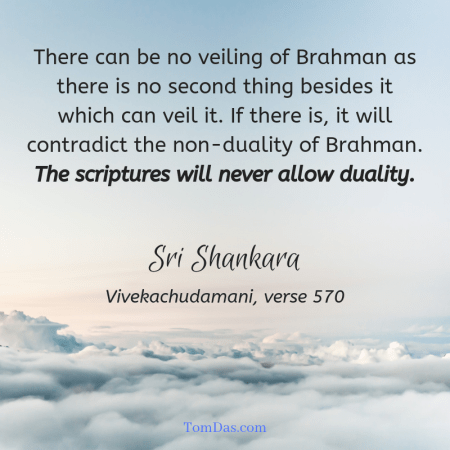
Right at the end of his masterpiece entitled Vivekachudamani (which essentially means ‘The Highest or Supreme Wisdom’), Shankara makes a series of radical and emphatic non-dual declarations which he states is the highest or ultimate truth.

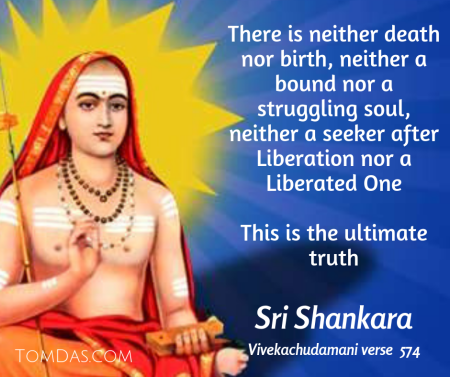
In his usual style, he reinforces the point he wishes to make in successive verses, building up to a crescendo which culminates in verse 574, the most famous of these verses.

This well-known verse was actually copied by Shankara from The Upanishads and is also found in the works of Sri Gaudapada, Shankara’s guru’s guru.

Om and blessings!

🕉

Shankara the scriptures will never allow duality

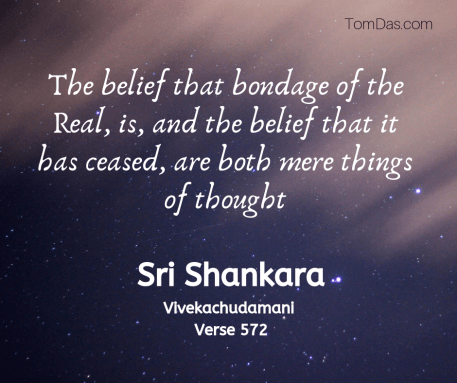
Shankara bondage is mere thought

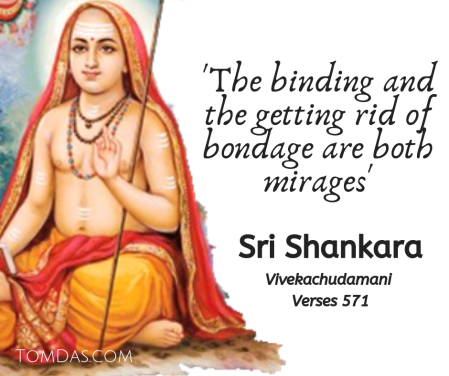
Shankara bondage is a mirage

Shankara no seeker no liberation

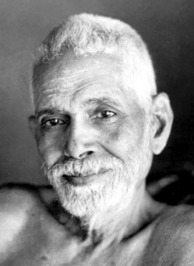
Ramana Maharshi: ‘Man considers himself limited and there arises the trouble’

In the following excerpt from Talks with Sri Ramana Maharshi, Ramana concisely outlines the problem (suffering), its cause (ignorance) and its remedy (self-knowledge). First Ramana says that the fact that one considers oneself to be limited is the essential problem. This arising of the notion of ‘I’ is a notion of limitation, and it is to this limited notion that ‘the world’ appears. It is this limited entity ‘I’ (ego) that then seeks various things, including self-realisation, and so suffers more.I have added bold type for emphasis and my comments are italicised in red:

201908

The fact is that the man considers himself limited and there arises the trouble. The idea is wrong. He can see it for himself. In sleep there was no world, no ego (no limited self), and no trouble. Something wakes up from that happy state and says ‘I’. To that ego the world appears. Being a speck in the world he wants more and gets into trouble. How happy he was before the rising of the ego!

Now Ramana prescribed the remedy, after restating that it is this limited ‘ego’ that is the cause of the ‘trouble’, ie. suffering:

Only the rise of the ego is the cause of the present trouble. Let him trace the ego to its source and he will reach that undifferentiated happy state which is sleepless sleep. The Self remains ever the same, here and now. There is nothing more to be gained. Because the limitations have wrongly been assumed there is the need to transcend them.

To illustrate the point that there is nothing to be gained, that we are already essentially whole, and that the problem is simply one of ignorance or ‘wrong assumptions’, Ramana narrates two traditional stories – ‘the tenth man’ and ‘the woman wearing a necklace’:

It is like the ten ignorant fools who forded a stream and on reaching the other shore counted themselves to be nine only. They grew anxious and grieved over the loss of the unknown tenth man. A wayfarer, on ascertaining the cause of their grief, counted them all and found them to be ten. But each one of them had counted the others leaving himself out. The wayfarer gave each in succession a blow telling them to count the blows. They counted ten and were satisfied. The moral is that the tenth man was not got anew. He was all along there, but ignorance caused grief to all of them.

Again, a woman wore a necklace round her neck but forgot it. She began to search for it and made enquiries. A friend of hers, finding out what she was looking for, pointed out the necklace round the seeker’s neck. She felt it with her hands and was happy. Did she get the necklace anew? Here again ignorance caused grief and knowledge happiness.

Similarly also with the man and the Self. There is nothing to be gained anew. Ignorance of the Self is the cause of the present misery; knowledge of the Self brings about happiness.

Ramana now provides the seeking mind/ego with some elementary logic to underpin his case. If liberation were something to be gained, it could also be lost. How so? Because logically if something can be attained, it can also be lost. Therefore something gained cannot be permanent. Liberation, or ‘salvation’ as it is written below, is permanent only because it is already totally and fully here – already! Ramana continues writing that it only seems that ‘Wisdom’ seems to be attained once the ignorance is removed, but really wisdom was already ‘ever present’:

Moreover, if anything is to be got anew it implies its previous absence. What remained once absent might vanish again. So there would be no permanency in salvation. Salvation is permanent because the Self is here and now and eternal. Thus the man’s efforts are directed towards the removal of ignorance. Wisdom seems to dawn, though it is natural and ever present.

The visitor, while taking leave, saluted the master, and said, “It is said that the victim in the tiger’s mouth is gone for ever.” The reference is to a passage in Who am I? where it is stated that a disciple can never revert to the world after he has once fallen into the field of the Guru’s gracious look as surely as the prey in the tiger’s jaws cannot escape.

Excerpt from Talks with Sri Ramana Maharshi, Talk 63

Oh yes! Once we have felt the Guru’s gracious look, once we have felt the Presence of the Maharshi, we are already in the Tiger’s Mouth. We are already in His Clutches. There is no going back! The Self will surely reel us in and chew us (the ego or ignorance) up!

!Om Namo Bhagavate Sri Ramanaya Om!

Ramana Maharshi – three theories of reality of the world (shristi-dristi vada, dristi-shristi vada/vivarta vada, ajata vada) – the 3 levels of the teaching

This is one of a series of introductory articles – please see the homepage of tomdas.com for more introductory articles. Also see: For those attached to the world, the world is considered to be a divine manifestation. For the advanced seeker, the world is considered to be an illusion

And The Suprising Meaning of ‘Real’ and ‘Unreal’ in Advaita Vedanta

In classical Advaita (Non-Dual) Vedanta, there are three main theories or viewpoints of reality, called shristi-dristi vada, dristi-shristi vada and lastly ajata vada. Whilst these Sanskrit words may appear complex, the idea is actually very simple, and Bhagavan Sri Ramana Maharshi explains the meaning of these terms below.

It may be helpful to note that ‘vada’ means ‘theory’ or ‘viewpoint’, ‘shristi’ means ‘the world’ or ‘creation’, ‘dristi’ literally means ‘sight’ but in this context refers to consciousness, and ‘jata’ means ‘birth’ (or creation). Adding ‘a’ as a prefix to ‘jata’ negates the meaning so that ‘ajata’ means ‘unborn’ or ‘no creation’.

Therefore:

1) Shristi-dristi vada is the view that the world is primary and gives rise to consciousness, which is the most commonplace model of the universe, ie. that first there was a universe in which life gradually evolved on planet Earth and eventually human life and human consciousness evolved. In Western philosophy this is known as the Realist view of reality. This view also broadly corresponds to the waking state and to the Dvaita (dualistic) world view.

2) Dristi-shristi vada is the view that consciousness is primary and gives rise to the world appearance, ie. like in a dream, consciousness exists first and then this consciousness manifests the apparent dream-world and dream-subject/object duality. In Western philosophy this is known as the Idealist view of reality. This view broadly corresponds to the dream state and the view of Vasistadvaita (qualified non-duality or partial non-duality as I like to call it). This view is also known as, or at least is very similar to vivarta vada, which is the view that the world and individual are both projected illusions that simultaneously appear, and that the world and individual appear to appear but do not actually appear, rather like a dream. Vivarta vada could therefore be considered to be a sub-type of Drist-Shristi-Vada.

and

3) Ajata vada is the radical view that there never was any creation at all, and that there is only The Absolute, and that there never has even been the appearance of creation. This view broadly corersponds to the deep sleep state and also to Turiya, the ‘fourth’ state. This is the true Advaita (non-duality). In Vivarta-vada, it is said that Maya (the entire phenomenal appearance) appears to exist, but actually doesn’t, but in ajata vada it is almost imcomprehensibly stated that Maya never even came into existence, not even as an appearance. Hence the difference between Vivarta Vada and Ajata Vada. Vivarta vada states the snake appears to exist in the dimly lit rope, but that it isn’t real, whereas ajata vada states that the snake never even appeared to exist at ‘any time’ (‘any time’ is in quotes as the notion of time and space are also ‘seen’ to never have existed).

Note that whilst (1) and (2) can be understood conceptually with the mind, Ajata vada is an advanced and highly radical teaching that is very difficult to comprehend and it makes little sense to the mind. This is why liberation is said to be unfathomable. Ajata Vada is usually associated with Gaudapada’s commentary on the Mandukya Upanishad but also features in several other scriptures such as Ribhu Gita, Yoga Vasishtha, the final few verses of Shankara’s Vivekachudamani, the Ashtavakra Gita and Avadhuta Gita to name a few. Shankara’s commentaries on the Upanishads also commonly point to the radical ajata teachings.

Vedanta teachings often start by working in a Realist framework, which is the default conceptual framework of reality for most seekers especially at the start of their journey. Then the Idealist conceptual framework is introduced, and later the Ajata or no-creation viewpoint is brought in when the seeker is ready, in step-wise progression depending on how the seeker is progressing with the teachings. The nature and content of teachings differ depending on what framework of reality is being used. Note the purpose of the teachings is not that they are true, but the view is to be adopted in order to remove ignorance and reveal THAT which cannot be taught, explained or expressed in words – THAT which you – THAT which is all there is – beyond words.

Note that the stronger the ego (ie. the identification with being a body-mind), the stronger the attachment to the belief-concept that the world is real, and this means that the higher teachings are more likely to be rejected by the ego-mind. Conversely, the weaker the attachment to body-mind, the weaker the attachment to the belief in the world being real, and the more likely the higher teachings are to be accepted. This in turn facilitates Self-Enquiry and ‘attainment’ of Moksha (liberation).

Similarly, whenever we come across a teaching, it can be very helpful to see which of the 3 levels the teaching belongs to – this can be very helpful to avoid unnecessary confusion in what can otherwise seem to be contradictory teachings.

To explain further, here is an excerpt from Day by Day with Bhagavan from 15th March, 1946:

201908

[Ramana Maharshi:] I do not teach only the ajata doctrine. I approve of all schools. The same truth has to be expressed in different ways to suit the capacity of the hearer. The ajata doctrine says, “Nothing exists except the one reality. There is no birth or death, no projection or drawing in [of the world], no sadhaka [no seeker], no mumukshu [no one seeking liberation], no mukta [no liberated person], no bondage, no liberation. The one unity alone exists ever.”

‘To such as find it difficult to grasp this truth and who ask. “How can we ignore this solid world we see all around us?” the dream experience is pointed out and they are told, “All that you see depends on the seer. Apart from the seer, there is no seen.”

Tom: Note here how Sri Ramana is distinguishing and differentiating vivarta vada/drist-sristi vada from ajata vada. Many people erroneously think that ajata vada states that world appears as a dream and non-creation means that the world is merely a dream-like appearance (as a dream appears, but is not real, and in that sense has not been created) – ie. many people erroneously equate ajata vada with vivarta vada/dristi-sristi vada. However here in the section above, if we read carefully, we can see that Sri Ramana is stating the Ajata vada is actually different to the idea that ‘all appears as the Self’. See here and here for more on this.
In Sri Ramana Paravidyopanishad we also see this same teaching in verses 147 and 330:

147. Creation is not other than seeing; seeing and creating are one and the same process. Annihilation is only the cessation of seeing and nothing else, for the world comes to an end by the right awareness of oneself.

330. There is no creation apart from seeing; seeing and creation are one and the same. And because that seeing is due to ignorance, to cease seeing is the truth of the dissolution (of the world).

‘This is called the drishti-srishti vada, or the argument that one first creates out of his mind and then sees what his mind itself has created.

‘To such as cannot grasp even this and who further argue, “The dream experience is so short, while the world always exists. The dream experience was limited to me. But the world is felt and seen not only by me, but by so many, and we cannot call such a world non-existent,” the argument called srishti-drishti vada is addressed and they are told, “God first created such and such a thing, out of such and such an element and then something else, and so forth.” That alone will satisfy this class. Their mind is otherwise not satisfied and they ask themselves, “How can all geography, all maps, all sciences, stars, planets and the rules governing or relating to them and all knowledge be totally untrue?” To such it is best to say, “Yes. God created all this and so you see it.”’

Dr. M. said, ‘But all these cannot be true; only one doctrine can be true.’

Bhagavan said, ‘All these are only to suit the capacity of the learner. The absolute can only be one.’


In Guru Vackaka Kovai (Garland of Guru’s Sayings), Ramana says the following (with a comment by Sri Sadhu Om):

100. Although Guru Ramana taught various doctrines according to the level of understanding of those who came to Him, we heard from Him that ‘Ajata’ alone is truly His own experience. Thus should you know.

Sri Sadhu Om’s comments: ‘Ajata’ is the knowledge that nothing – neither the world, soul nor God – ever comes into existence, and that ‘That Which Is’ ever exists as IT is.

Tom: here in Sri Sadhu Om, we have a close and direct devotee of Sri Ramana’s clearing stating what Ajata Vada actually is.

114. When the limited light [which is used to project pictures on the cinema screen] is dissolved in the bright sunlight [which enters the cinema], the pictures also will disappear instantaneously. Similarly, when the limited consciousness [chittam] of the mind is dissolved in supreme Consciousness [Chit], the picture show of these three prime entities [God, world and soul] will also disappear.

Here Sri Ramana explains why the teachings may initially concede the existence of the three primal entities (the individual or jiva, the world or jagat, and God the ordainer or Isvara):

115. Thus, since the Truth of the Source is One, why do all religions [and sometimes even Sages] start their teachings by at first conceding that these three prime entities are real? Because the mind, which is tossed about by objective knowledge, would not agree to believe in the One unless the Sages condescended to teach It as three.

122. Whatever high and wonderful state of tapas one may have attained, if one still identifies oneself with an individuality, one cannot be a Sahaja-Jnani [i.e. One in the State of Effortlessness]; one is only an aspirant of, perhaps, an advanced stage.

Here it is explained that for the teaching to ‘condescend’ to vivartha vada is the most practical method for seekers:

83. From his condescending opening words, “Because we see the world”, it is to be understood that the Great Master, Bhagavan Sri Ramana, who gives the most practical assistance to aspirants, sets aside all other doctrines and teaches that only the ‘Doctrine ofVivartha’is suitable to be taken as true.

Sri Sadhu Om’s comments: Though His experience of the Truth can only be adequately expressed by the ‘Doctrine of Ajata’, Bhagavan Sri Ramana uses only the ‘Doctrine of Vivartha’ for His Teachings…The ‘Doctrine of Vivartha’ is recommended to explain the standpoint of Advaita, ie. to explain how the world-appearance, its seer, and the seer’s knowledge of the appearance all come into existence simultaneously, unconditioned by cause and effect. However, since this accepts the appearance of the world, souls and God, it is only a working hypothesis to help aspirants. The‘Doctrine of Ajata’, on the other hand, never accepts even the appearance of this trinity, but proclaims that the One Self-shining Reality alone exists eternally and without modification; Ajata is therefore the highest of all doctrines and it is only suitable for the fully-ripened aspirants. Bhagavan Sri Ramana therefore comes down condescendingly and, setting aside ‘Ajata’ and the two lower doctrines He advocates through His Forty Verses on Reality the ‘Doctrine of Vivartha’ which is suitable for the ripe aspirants who have no faith in the lower doctrines, yet do not have the maturity to grasp the highest, ‘Ajata’.

Also see Ramana Maharshi: how to abide as the Self, the world is not real, attend to yourself

and How spiritual teachings work and Ramana Maharshi on those who claim to have surpassed the traditional notion of enlightenment

and Manonasa and The nature of Liberation | Ramana Maharshi | PDF download

Ajata Vada as taught in the Bhagavad Gita

The True Nature of Turiya

Nisarga Yoga explained (Nisargadatta Maharaj’s teachings summarised)

Nisargadatta Maharaj

The following text is a summary of Nisargadatta Maharaj’s teaching and was written by Maurice Frydman, the translator and editor of ‘I Am That’, Nisargadatta’s most widely read work. The text was entitled ‘Nisarga Yoga’ which, as Maurice Frydman explains below, means ‘the easy or natural yoga’, and it was originally published as an appendix to ‘I Am That’.

The text below is essentially the same as how it was originally published except for my addition of bold type for emphasis of what I felt were key points for a seeker of liberation.

I have also made a compilation of direct quotes from Nisargadatta Maharaj which fully explains his method for the discerning reader.

Wishing you peace and realisation

Tom


In the humble abode of Sri Nisargadatta Maharaj, but for the electric lights and the noises of the street traffic, one would not know in which period of human history one dwells. There is an atmosphere of timelessness about his tiny room; the subjects discussed are timeless – valid for all times; the way they are expounded and examined is also timeless; the centuries, millennia and yugas fall off and one deals with matters immensely ancient and eternally new.

The discussions held and teachings given would have been the same ten thousand years ago and will be the same ten thousand years hence. There will always be conscious beings wondering about the fact of their being conscious and enquiring into its cause and aim. Whence am I? Who am I? Whither am I? Such questions have no beginning and no end. And it is crucial to know the answers, for without a full understanding of oneself, both in time and in timelessness, life is but a dream, imposed on us by powers we do not know, for purposes we cannot grasp.

Maharaj is not a learned. There is no erudition behind his homely Marathi; authorities he does not quote, scriptures are rarely mentioned; the astonishingly rich spiritual heritage of India is implicit in him rather than explicit. No rich Ashram was ever built around him and most of his followers are humble working people cherishing the opportunity of spending an hour with him from time to time.

Simplicity and humility are the keynotes of his life and teachings; physically and inwardly he never takes the higher seat; the essence of being on which he talks, he sees in others as clearly as he sees it in himself. He admits that while he is aware of it, others are not yet, but this difference is temporary and of little importance, except to the mind and its ever-changing content. When asked about his Yoga, he says he has none to offer, no system to propound, no theology, cosmology, psychology or philosophy. He knows the real nature – his own and his listeners’ – and he points it out. The listener cannot see it because he cannot see the obvious, simply and directly. All he knows, he knows with his mind, stimulated with the senses. That the mind is a sense in itself, he does not even suspect.

The Nisarga Yoga, the ‘natural’ Yoga of Maharaj, is disconcertingly simple – the mind, which is all becoming, must recognise and penetrate its own being, not as being this or that, here or there, then or now, but just as timeless being.

This timeless being is the source of both life and consciousness. In terms of time, space and causation it is all-powerful, being the causeless cause; all-pervading, eternal, in the sense of being beginningless, endless and ever-present. Uncaused, it is free; all-pervading, it knows; undivided, it is happy. It lives, it loves, and it has endless fun, shaping and re-shaping the universe. Every man has it, every man is it, but not all know themselves as they are, and therefore identify themselves with the name and shape of their bodies and the contents of their consciousness.

To rectify this misunderstanding of one’s reality, the only way is to take full cognisance of the ways of one’s mind and to turn it into an instrument of self-discovery. The mind was originally a tool in the struggle for biological survival. It had to learn the laws and ways of Nature working hand-in-hand can raise life to a higher level. But, in the process the mind acquired the art of symbolic thinking and communication, the art and skill of language. Words became important. Ideas and abstractions acquired an appearance of reality, the conceptual replaced the real, with the result that man now lives in a verbal world, crowded with words and dominated by words.

Obviously, for dealing with things and people words are exceedingly useful. But they make us live in a world totally symbolic and, therefore, unreal. To break out from this prison of the verbal mind into reality, one must be able to shift one’s focus from the word to what it refers to, the thing itself.

The most commonly used word and most pregnant with feelings, and ideas is the word ‘I’. Mind tends to include in it anything and everything, the body as well as the Absolute. In practice it stands as a pointer to an experience which is direct, immediate and immensely significant. To be, and to know that one is, is most important. And to be of interest, a thing must be related to one’s conscious existence, which is the focal point of every desire and fear. For, the ultimate aim of every desire is to enhance and intensify this sense of existence, while all fear is, in its essence, the fear of self-extinction.

To delve into the sense of ‘I’ – so real and vital – in order to reach its source is the core of Nisarga Yoga. Not being continuous, the sense of ‘I’ must have a source from which it flows and to which it returns. This timeless source of conscious being is what Maharaj calls the self-nature, self-being, swarupa.

As to the methods of realising one’s supreme identity with self-being, Maharaj is peculiarly non-committal. He says that each has his own way to reality, and that there can be no general rule. But, for all the gateway to reality, by whatever road one arrives to it, is the sense of ‘I am’. It is through grasping the full import of the ‘I am’, and going beyond it to its source, that one can realise the supreme state, which is also the primordial and the ultimate. The difference between the beginning and the end lies only in the mind. When the mind is dark or turbulent, the source is not perceived. When it is clear and luminous, it becomes a faithful reflection of the source. The source is always the same – beyond darkness and light, beyond life and death, beyond the conscious and the unconscious.

This dwelling on the sense ‘I am’ is the simple, easy and natural Yoga, the Nisarga Yoga. There is no secrecy in it and no dependence; no preparation is required and no initiation. Whoever is puzzled by his very existence as a conscious being and earnestly wants to find his own source, can grasp the ever-present sense of ‘I am’ and dwell on it assiduously and patiently, till the clouds obscuring the mind dissolve and the heart of being is seen in all its glory.

The Nisarga Yoga, when persevered in and brought to its fruition, results in one becoming conscious and active in what one always was unconsciously and passively. There is no difference in kind – only in manner – the difference between a lump of gold and a glorious ornament shaped out of it. Life goes on, but it is spontaneous and free, meaningful and happy.

Maharaj most lucidly describes this natural, spontaneous state, but as the man born blind cannot visualise light and colours, so is the unenlightened mind unable to give meaning to such descriptions. Expressions like dispassionate happiness, affectionate detachment, timelessness and causelessness of things and being – they all sound strange and cause no response. Intuitively we feel they have a deep meaning, and they even create in us a strange longing for the ineffable, a forerunner of things to come, but that is all. As Maharaj puts it: words are pointers, they show the direction but they will not come along with us. Truth is the fruit of earnest action, words merely point the way.

Maurice Frydman


How Nisargadatta Maharaj attained self-realisation: Nisargadatta’s method and his Guru’s instructions to him

nisargadatta_maharaj

Nisargadatta Maharaj often spoke about his own spiritual journey and practice, and how his guru’s teachings led him to his own eventual self-realisation. In his most widely read book, ‘I Am That’, Nisargadatta speaks many times of his practice and the profound effect his own guru had upon him. The following are direct quotes from I Am That focusing on what Nisargadatta spoke of his own sadhana (spiritual practice) and the teachings of his own Guru.

I have not added any commentary as I think the excerpts speak for themselves, but I have added bold text to emphasize specific points I thought would be of use for seekers in terms of making the sadhana practical.

I hope you find the following quotes both instructive and inspiring for your own sadhana,

Best wishes 

Tom


It so happened that I trusted my Guru. He told me I am nothing but my self and I believed him. Trusting him, I behaved accordingly and ceased caring for what was not me, nor mine.


Questioner: Kindly tell us how you realised.

Maharaj: I met my Guru when I was 34 and realised by 37.

Questioner: What happened? What was the change?

Maharaj: Pleasure and pain lost their sway over me. I was free from desire and fear. I found myself full, needing nothing. I saw that in the ocean of pure awareness, on the surface of the universal consciousness, the numberless waves of the phenomenal worlds arise and subside beginninglessly and endlessly. As consciousness, they are all me. As events they are all mine. There is a mysterious power that looks after them. That power is awareness, Self, Life, God, whatever name you give it. It is the foundation, the ultimate support of all that is, just like gold is the basis for all gold jewellery. And it is so intimately ours! Abstract the name and shape from the jewellery and the gold becomes obvious. Be free of name and form and of the desires and fears they create, then what remains?

Q: Nothingness.

M: Yes, the void remains. But the void is full to the brim.


Q: Please tell me which road to self-realisation is the shortest.

M: No way is short or long, but some people are more in earnest and some are less. I can tell you about myself. I was a simple man, but I trusted my Guru. What he told me to do, I did. He told me to concentrate on ‘I am’ – I did. He told me that I am beyond all perceivables and conceivables — I believed.

I gave him my heart and soul, my entire attention and the whole of my spare time (I had to work to keep my family alive). As a result of faith and earnest application, I realised my self (swarupa) within three years. You may choose any way that suits you; your earnestness will determine the rate of progress.

Q: No hint for me?

M: Establish yourself firmly in the awareness of ‘I am’. This is the beginning and also the end of all endeavour.


Q: How did you come to it?

M: By my trust in my Guru. He told me ‘You alone are’ and I did not doubt him.


…my Guru too taught me to doubt — everything and absolutely. He said: ‘deny existence to everything except your self.’ Through desire you have created the world with its pains and pleasures.


Put in all and you will get all. I was doing it. All my time I was giving to my Guru and to what he told me.


Q: Still, you have a body and you depend on it.

M: Again you assume that your point of view is the only correct one. I repeat: I was not, am not, shall not be a body. To me this is a fact. I too was under the illusion of having been born, but my Guru made me see that birth and death are mere ideas — birth is merely the idea: ‘I have a body’. And death — ‘I have lost my body’. Now, when I know I am not a body, the body may be there or may not — what difference does it make? The body-mind is like a room. It is there, but I need not live in it all the time.


I trusted my Guru and he proved right. Trust me, if you can. Keep in mind what I tell you: desire nothing, for you lack nothing. The very seeking prevents you from finding.


‘One can give food, clothes, shelter, knowledge, affection, but the highest gift is the gospel of enlightenment‘, my Guru used to say. You are right, enlightenment is the highest good. Once you have it, nobody can take it away from you.


I am now 74 years old. And yet I feel that I am an infant. I feel clearly that in spite of all the changes I am a child. My Guru told me: that child, which is you even now, is your real self (swarupa). Go back to that state of pure being, where the ‘I am’ is still in its purity before it got contaminated with ‘this I am’ or ‘that I am’. Your burden is of false self-identifications — abandon them all.

My Guru told me — ‘Trust me. I tell you; you are divine. Take it as the absolute truth. Your joy is divine, your suffering is divine too. All comes from God. Remember it always. You are God, your will alone is done’.

I did believe him and soon realised how wonderfully true and accurate were his words. I did not condition my mind by thinking: ‘I am God, I am wonderful, I am beyond’. I simply followed his instruction which was to focus the mind on pure being ‘I am’, and stay in it. I used to sit for hours together, with, nothing but the ‘I am’ in my mind and soon peace and joy and a deep all-embracing love became my normal state. In it all disappeared — myself, my Guru, the life I lived, the world around me. Only peace remained and unfathomable silence.


When I met my Guru, he told me: ‘You are not what you take yourself to be. Find out what you are. Watch the sense ‘I am’, find your real self’. I obeyed him, because I trusted him. I did as he told me. All my spare time I would spend looking at myself in silence. And what a difference it made, and how soon! It took me only three years to realise my true nature. My Guru died soon after I met him, but it made no difference. I remembered what he told me and persevered.


Q: The mind is so absolutely restless. For quieting it what is the way?

M: Trust the teacher. Take my own case. My Guru ordered me to attend to the sense ‘I am’ and to give attention to nothing else. I just obeyed. I did not follow any particular course of breathing, or meditation, or study of scriptures. Whatever happened, I would turn away my attention from it and remain with the sense ‘I am’, it may look too simple, even crude. My only reason for doing it was that my Guru told me so. Yet it worked! Obedience is a powerful solvent of all desires and fears.

Just turn away from all that occupies the mind; do whatever work you have to complete, but avoid new obligations; keep empty, keep available, resist not what comes uninvited.

In the end you reach a state of non-grasping, of joyful non-attachment, of inner ease and freedom indescribable, yet wonderfully real.


My Guru, before he died, told me: Believe me, you are the Supreme Reality. Don’t doubt my words, don’t disbelieve me. I am telling you the truth – act on it. I could not forget his words and by not forgetting – I have realised.


I lived my life, plied my trade, looked after my family, and every free moment I would spend just remembering my Guru and his words. He died soon after and I had only the memory to fall back on. It was enough.


Q: How did you get it?

M: I found it all in the holy presence of my Guru — I did nothing on my own. He told me to be quiet – and I did it – as much as I could.


Q: You made no efforts whatsoever?

M: None. Believe it or not, I was not even anxious to realise. He only told me that I am the Supreme and then died. I just could not disbelieve him. The rest happened by itself. I found myself changing — that is all. As a matter of fact, I was astonished. But a desire arose in me to verify his words. I was so sure that he, could not possibly have told a lie, that I felt I shall either realise the full meaning of his words or die. I was feeling quite determined, but did not know what to do. I would spend hours thinking of him and his assurance, not arguing, but just remembering what he told me.

Q: What happened to you then? How did you know that you are the Supreme?

M: Nobody came to tell me. Nor was I told so inwardly. In fact, it was only in the beginning when I was making efforts, that I was passing through some strange experiences; seeing lights, hearing voices, meeting gods and goddesses and conversing with them. Once the Guru told me: ‘You are the Supreme Reality’, I ceased having visions and trances and became very quiet and simple. I found myself desiring and knowing less and less, until I could say in utter astonishment: ‘I know nothing, I want nothing.’


The path to Liberation – Sublime Teachings from the Yoga Vasistha

Behold the wondrous teachings of the Yoga Vasistha, one of the pre-eminent texts of Advaita (non-duality). Usually it is an incarnation of God that teaches mere mortals in such scriptures, but here we have a rare and sublime teaching in which a Sage is teaching God! In this case the young Lord Rama, incarnation of Lord Vishnu, is being taught the eternal teaching by the Holy Sage Vasistha.

The following teachings are taken from Chapter 3 of the Yoga Vasistha, where Sage Vasistha tells the Story of Lavana. After he has told the story to Lord Rama, he gives  the following teachings.

Note that the headings in bold are my own additions, and I have also put some text in bold type for emphasis of what I thought were some key points.

With love and well wishes

Tom

See also:

Yoga Vasishta Sara (The essence of the Yoga Vasishta)

Yoga Vasistha: HOW CAN IGNORANCE AND EGOTISM ARISE IN THE SELF?

Rama Vasistha yoga

Turn away from the senses (Dispassion or Vairagya)

He who does not allow his mind to roam in objects of pleasure is able to master it. Even as one who is bound to a pillar does not move, the mind of a noble man does not move from the reality: he alone is a human being, the others are worms. He attains to the supreme being by constant meditation.

Victory over this goblin known as mind is gained when, with the aid of one’s own self-effort, one attains self-knowledge and abandons the craving for what the mind desires as pleasure. This can easily be achieved without any effort at all (even as a child’s attention can be easily diverted) by the cultivation of the proper attitude. Woe unto him who is unable to give up cravings, for this is the sole means to one’s ultimate good. By intense self-effort it is possible to gain victory over the mind; then without the least effort the individualised consciousness is absorbed in infinite consciousness, when its individuality is broken through. This is easy and is easily accomplished: they who are unable to do this are indeed vultures in human form.

Let the mind become still

Abandon your reliance on fate or gods created by dull witted people, and by self-effort and self-knowledge make the mind no-mind. Let the infinite consciousness swallow, as it were, the finite mind, and then go beyond everything. With your intelligence united with the supreme, hold on to the self, which is imperishable.

When the mind is thus conquered by remaining completely unagitated, you will consider even the conquest of the three worlds worthless. This does not involve studying the scriptures, or rising or falling – nothing but self-knowledge. Why do you consider it difficult? If this is found difficult by someone, how does he even live in this world without self-knowledge?

Self-Knowledge

One who knows the deathless nature of the self is not afraid of death. Nor is he affected by separation from friends and relations. The feelings ‘This is I’ and ‘This is mine’ are the mind; when they are removed, the mind ceases to be. Then one becomes fearless. Weapons like swords generate fear; the weapon (wisdom) that destroys egotism generates fearlessness.

Mind and Liberation defined

Towards whichever object the mind flows with intensity, in that it sees the fulfilment of its craving. Of course, there is no mind without restlessness; restlessness is the very nature of the mind. It is the work of this restlessness of the mind based on the infinite consciousness that appears as this world, O Rama, that indeed is the power of the mind. But, when the mind is deprived of its restlessness, it is referred to as the dead mind; and that itself is penance (tapas) as also the verification of the scriptures and liberation.

O Rama, mind constantly swings like a pendulum between the reality and the appearance, between consciousness and inertness. When the mind contemplates the inert objects for a considerable time, it assumes the characteristics of such inertness. When the same mind is devoted to inquiry and wisdom, it shakes off all conditioning and returns to its original nature as pure consciousness.

The psychological tendency (or mental disposition or mental conditioning) is unreal, yet it does arise in the mind. The product of ignorance is real only to the ignorant person; to the wise, it is just a verbal expression (just as one speaks of the barren woman’s son). Do not remain ignorant, O Rama, but strive to be wise by renouncing mental conditioning.

Non-doership

You are not the doer of any action here, O Rama, so why do you assume doership? When one alone exists, who does what and how? Do not become inactive, either, for what is gained by doing nothing? What has to be done has to be done. Therefore rest in the self. Even while doing all the actions natural to you if you are unattached to those actions you are truly the non-doer; if you are doing nothing and are attached to that non-doership (then you are doing nothing) you become the doer! When all this world is like the juggler’s trick, what is to be given up and what is to be sought?

The trickery of Ignorance/Mind

The seed of this world appearance is ignorance. This ignorance or mental conditioning is acquired by man effortlessly and it seems to promote pleasure, but in truth it is the giver of grief. It creates a delusion of pleasure only by the total veiling of self-knowledge. Thus it was able to make the king Lavana experience less than an hour as if it were of several years’ duration.

This ignorance or mental conditioning has but a momentary existence, yet since it flows on, it seems to be permanent like a river. Because it is able to veil the reality, it seems to be real, but when you try to grasp it, you discover it is nothing. Yet, again, it acquires strength and firmness on account of these qualities in the world-appearance, even as a flimsy fibre when rolled into a rope acquires great strength. This conditioning seems to grow, but in fact it does not. For when you try to grasp it, it vanishes like the tip of a flame. Yet, again, even as the sky appears to be blue, this conditioning also seems to have some kind of real appearance! It is born as the second moon in diplopia, it exists like the dream-objects and it creates confusion, even as people sitting in a moving boat see the shore moving. When it is active, it creates a delusion of the long dream of world-appearance. It perverts all relationships and experiences. It is this ignorance or mental conditioning throws up an endless stream of creation and perception of duality, and of division and the consequent confusion of perception and experience.

Overcoming Ignorance – Turn towards the Self

When this ignorance or mental conditioning is mastered by becoming aware of its unreality, mind ceases to be – even as when the water ceases to flow, the river dries up.

O Rama, even as darkness disappears as you turn towards light, ignorance disappears if you turn towards the light of the self. As long as there does not arise a natural yearning for self-knowledge, so long ignorance or mental conditioning throws up an endless stream of world-appearance. Even as a shadow vanishes when it turns to see the light, this ignorance perishes when it turns towards self-knowledge.

The Self

O Rama, from Brahma the creator down to the blade of grass, all this is nothing but the self; ignorance is non-existent unreality. There is no second thing here known as the mind. In that self itself, the veil (that is also of itself) floats, creating the polarisation of subject – object; and infinite consciousness itself is then known as the mind. This veil is an idea, an intention or a thought in that infinite consciousness. Mind is born of this idea or thought, and mind has to vanish with the help of an idea or thought i.e., by the coming to an end of the idea or thought.

‘All is Brahman’

The firm conviction that ‘I am not the absolute Brahman’ binds the mind; the mind is liberated by the firm conviction ‘everything is the absolute Brahman’. Ideas and thoughts are bondage, and their coming to an end is liberation. Therefore, be free of them and do whatever has to be done spontaneously. Even as thought or idea ‘sees’ blueness in the sky, the mind sees the world as real.

He who does not let his mind dwell on such thoughts and ideas, by striving to be conscious of the self, enjoys peace. That which was not in the beginning does not exist even now! That which was and therefore is now, is the absolute Brahman – contemplation of this bestows peace, for that Brahman is peace. One should not contemplate anything else at any time and in any manner anywhere. One should uproot the very hope of enjoyment with one’s utmost strength, and using one’s utmost intelligence. Hopes and attachments seem to ramify on account of mental conditioning, which is ignorance. In this empty physical body, where is it that is called ‘I’? In truth, O Rama, ‘I’, ‘mine’, etc. have no existence at all; the one self alone is the truth at all times.

Why does illusion appear so real?

Is it not a great wonder, O Rama, that people forget the truth that the absolute Brahman alone is, and are convinced of the existence of the unreal and non-existent ignorance? Rama, do not let the foolish idea of the existence of ignorance take root in you; for if the consciousness is thus polluted, it invites endless suffering. Though it is unreal, it can cause real suffering! It is on account of ignorance that illusions like a mirage exist, and that one sees various visions and hallucinations (like flying in the air and flying in space) and one experiences heaven and hell. Therefore, O Rama, give up mental conditioning which alone is responsible for the perception of duality, and remain totally unconditioned. Then, you will attain incomparable preeminence over all!

Rama asked: Holy sage! It is indeed incredible that this nonexistent nescience creates such an illusion that this non-existent world appears to be very real: pray explain to me further how this is possible…

Vasistha: O Rama, it is not really true that consciousness is in any way related to this body. The body has only been fancied by the consciousness as if in a dream. When consciousness, clothed as it were, by its own energy, limits itself and considers itself jiva, that jiva, endowed with this restless energy, is involved in this world-appearance.

The embodied being who enjoys or suffers the fruits of past actions and who dons a variety of bodies is known as egotism, mind and also jiva. Neither the body nor the enlightened being undergoes suffering: it is only the ignorant mind that suffers. It is only in a state of ignorance (like sleep) that the mind dreams of the world-appearance, not when it is awake or enlightened. Hence the embodied being that undergoes suffering here is variously known as the mind, ignorance, jiva and mental conditioning, as also the individualised consciousness.

The body is inert and hence can neither enjoy nor suffer. Nescience gives rise to heedlessness and unwisdom; hence it is nescience alone that enjoys or suffers. It is indeed the mind alone that is born, weeps, kills, goes, abuses others, etc., not the body. In all the experiences of happiness and unhappiness, as also in all the hallucinations and imaginations, it is mind that does everything and it is mind that experiences all this: mind is man.

The seven steps to perfection

Vasistha: Equipped with wisdom, he who gradually ascends the seven steps to perfection in yoga attains liberation from these.

Rama: Holy sir, what are the seven steps you have referred to?

Vasistha: O Rama, there are seven descending steps of ignorance, and there are seven ascending steps of wisdom. I shall now describe them to you. To remain established in self-knowledge is liberation; when this is disturbed, there arise egotism and bondage. The state of self-knowledge is that in which there is no mental agitation, neither distraction nor dullness of mind, neither egotism nor perception of diversity.

The delusion that veils this self-knowledge is sevenfold: seed state of wakefulness, wakefulness, great wakefulness, wakeful dream, dream, dream wakefulness and sleep. In pure consciousness, when mind and jiva exist only in name, it is the seed state of wakefulness. When notions of ‘I’ and ‘this’ arise, it is known as wakefulness. When these notions get strengthened by the memory of previous incarnations, it is great wakefulness. When the mind is fully awake to its own fancies and is filled with them, it is wakeful dream. The false notions of experiences during sleep, which yet appear to be real, are dreams. In the dream wakeful state one recalls past experiences as if they are real now. When these are abandoned in favour of total inert dullness, it is sleep. These seven have their own innumerable subdivisions.

I shall now describe to you, O Rama, the seven states or planes of wisdom. Knowing them you will not be caught in delusion. Pure wish or intention is the first, inquiry is the second, the third is when the mind becomes subtle, establishment in truth is the fourth, total freedom from attachment or bondage is the fifth, the sixth is cessation of objectivity, and the seventh is beyond all these.

Tom: note here Sage Vasishta has described in brief the entire path:

  1. The desire for liberation, which leads eventually to…
  2. Self-Enquiry, which means turning away from objects towards the Self
  3. The mind, through self-enquiry, becomes more subtle, that is less disturbed and more peaceful
  4. Establishment in Truth, Truth meaning the Self
  5. This in turn roots out attachments and vasanas (habitual egoic tendencies)
  6. This then leads to the cessation of the projection of objects/the objective world which is a result of ignorance
  7. Self-Realisation

Vasishta continues, explaining the path further:

Why do I continue to be a fool? I shall seek holy men and scriptures, having cultivated dispassion’ – such a wish is the first state. Thereupon one engages in the practice of inquiry (direct observation). With all these, there arises non-attachment, and the mind becomes subtle and transparent: this is the third state. When these three are practised, there arises in the seeker a natural turning away from sense-pleasures and there is natural dwelling in truth: this is the fourth state.

When all these are well practised, there is total non-attachment and at the same time a conviction in the nature of truth: this is the fifth state. Then one rejoices in one’s own self, the perception of duality and diversity both within oneself and outside oneself ceases, and the efforts that one made at the inspiration of others bear fruition in direct spiritual experience.

After this there is no other support, no division, no diversity, and self-knowledge is spontaneous, natural and therefore unbroken: this is the seventh, transcendental state. This is the state of one who is liberated while living here. Beyond this is the state of one who has transcended even the body (turiyatita).

Rama, all these great ones who ascend these seven planes of wisdom are holy men. They are liberated and they do not fall into the mire of happiness and unhappiness. They may or may not work or be active. They rejoice in the self and do not stand in need of others to make them happy.

The highest state of consciousness can be attained by all, even by animals and by primitive men, by those who have a body and even by disembodied beings, for it involves only the rise of wisdom.

They who have reached the highest planes of consciousness are indeed great men. They are adorable; even an emperor is like a worthless blade of grass compared to them, for they are liberated here and now.

How can ignorance and egotism arise in the self?

Vasistha: The self ignorantly imagines an egotistic existence, even as if gold, forgetting its goldness, might think it is a ring and weep and wail “Alas, I have lost my goldness”.

Rama: Holy sir, how can this ignorance and egotism arise in the self?

Vasistha: Rama, one should ask questions concerning the reality only, not concerning the unreal. Neither goldless ringness nor limited egotism exists in truth. When the goldsmith sells the ring, he weighs out the gold, for it is gold. If one were to discuss the existence of the ringness in the ring, and the finite form in the infinite consciousness, then one has to compare it with the barren woman’s son. The existence of the unreal is unreal: it arises in ignorance and vanishes when inquired into. In ignorance one sees silver in the mother-of-pearl, but it cannot serve as silver even for a moment! As long as the truth that it is mother-of-pearl is not seen, the ignorance lasts. Even as one cannot extract oil from sand and even as one can obtain only gold from the ring, there are no two things here in this universe: the one infinite consciousness alone shines in all names and forms.

Egotism or ignorance/nescience does not really exist

Such indeed is the nature of this utter ignorance, this delusion and this world-process: without real existence there is this illusory notion of egotism. This egotism does not exist in the infinite self. In the infinite self there is no creator, no creation, no worlds, no heaven, no humans, no demons, no bodies, no elements, no time, no existence and no destruction, no ‘you’, no ‘I’, no self, no that, no truth, no falsehood (none of these), no notion of diversity, no contemplation and no enjoyment.

Whatever is, and is known as the universe, is that supreme peace. There is no beginning, no middle and no end: all is all at all times, beyond the comprehension of the mind and speech. There is no creation. The infinite has never abandoned its infinity. That has never become this.

It is like the ocean, but without ocean’s movement. It is self-luminous like the sun, but without activity. In ignorance, the supreme being is viewed as the object, as the world. Even as space exists in space, one with space, even so what appears to be the creation is Brahman existing in Brahman, as Brahman. The notions of far and near, of diversity, of here and there are as valid as the distance between two objects in a mirror in which a whole city is reflected.

O Rama, all this is ignorance! The notions of far and near, a moment and eternity, are all hallucinations. In ignorance the real appears to be unreal, and the unreal seems to be real. The individualised consciousness perceives what it thinks it perceives, on account of its conditioning.

On account of ignorance, when the notion of egotism arises, at that very moment the delusion of a beginning, a middle and an end also arises. One who is thus deluded thinks that he is an animal and experiences this. All this happens on account of accidental coincidence: just as a crow flies towards a coconut palm and as it alights on the tree, a fruit falls down as if the crow dislodged it – though, in fact, the crow did not! Similarly, by pure coincidence and in ignorance, the unreal seems to be real…

Nescience is not a real entity, even as oil in sand is not a real entity. Nescience and the self cannot have any relationship, for there can be relationship only between same or similar entities – this is obvious in everyone’s experience. Thus, it is only because consciousness is infinite that everything in the universe becomes knowable. It is not as if the subject illumines the object, which has no luminosity of its own, but since consciousness is all this, everything is self-luminous,without requiring a perceiving intelligence. It is by the action of consciousness becoming aware of itself that intelligence manifests itself, not when consciousness apprehends an inert object.

It is not correct to say that there is a mixture in this universe of the sentient and the inert, for they do not mix. All things are full of consciousness and when this consciousness comprehends itself there is knowledge.

Relationship between things

One may see a relationship between a tree and a rock, though they appear to be inert: such relationship exists in their fundamental constituents which have undergone a certain kind of change to become a tree and a rock. This is also seen in the sense of taste: the taste-buds in the tongue respond to the taste in the food, because of their similarity in constitution.

All relationship is therefore the realisation of the already existing unity: it is regarded as relationship only because of the previous false and deluded assumption of a division into subject and object.

In the middle between the sight and the seen, there is a relationship which is known as the seer. When the division between the seer, the sight and the seen is abolished, that is the supreme. When the mind travels from one country to another, between them is cosmic intelligence. Be that always. Even as you do not busy yourself with the affairs of a future village, do not get tangled with the moods of your mind, but be established in truth. Regard the mind as a foreigner or a piece of wood or stone. There is no mind in infinite consciousness; that which is done by this non-existent mind is also unreal. Be established in this realisation. I have investigated the truth concerning the mind for a very long time, O Rama, and have found none: only infinite consciousness exists.

The company of holy ones (Satsang)

This seemingly endless stream of ignorance can be crossed over only by the constant company of holy ones. From such company there arises wisdom concerning what is worth seeking and what is to be avoided. Then there arises the pure wish to attain liberation. This leads to serious inquiry. Then the mind becomes subtle, because this inquiry thins out the mental conditioning. As a result of the rising of pure wisdom, one’s consciousness moves in the reality. Then the mental conditioning vanishes and there is non-attachment. Bondage to actions and their fruits ceases. The vision is firmly established in truth and the apprehension of the unreal is weakened. Even while living and functioning in this world, he who has this unconditioned vision does what has to be done as if he is asleep, without thinking of the world and its pleasures. After some years of living like this, one is fully liberated and transcends all these states: he is liberated while living.

Overcoming Maya

When mental conditioning is overcome and the mind is made perfectly tranquil, the illusion that deludes the ignorant comes to an end. It is only as long as this illusion (Maya) is not clearly understood that it generates this great delusion; once it is clearly understood, it is seen as the infinite, and it becomes the source of happiness and the realisation of the absolute Brahman. It is only for the sake of scriptural instruction that one speaks of the self, Brahman, etc., but in truth one alone is. It is pure consciousness, not embodied being. It is, whether one knows or not, whether one is embodied or without a body. All the unhappiness you see in this world belongs to the body; the self which is not grasped by the senses is not touched by sorrow. In the self there is no desire: the world appears in it without any wish or intention on its part. Thus,

Sage Vasistha’s concluding remarks to Lord Rama

O Rama, through my precepts the false notion of a creation and its existence has been dispelled. Your consciousness has become pure, devoid of duality.

Yoga Vasishta Sara (The essence of the Yoga Vasishta)

One of the most amazing scriptures of Advaita (non-duality) is the Yoga Vasishta. It is, as far as I am aware, the longest Advaitic treatise in the Vedanta/Hindu scriptures, and one of the oldest and most authentic scriptures too. The text has been highly revered by all the great Advaita sages through the centuries and speaks authoritatively on all matters relating to Vedanta and Liberation.

(Eg. Vidyaranya Swami (1296-1386), Shankaracharya (head monk) of Sringeri Math, wrote a text called Jivanmukti Viveka in which he extensively quotes from Yoga Vasishta to establish for his readers what the true path to liberation in this life is.)

The Yoga Vasishta in its earliest form likely predates or is at least contemporary with Sri Shankara’s writing (neither Shankara not any of his works are mentioned a single time in any of the 32,000 couplet verses), but is consistent with it in terms of the major themes of how an apparent individual can attain enlightenment. There are very few texts that clearly explain in detail what traditional Vedanta teachings were like prior to Shankara. In Yoga Vasishta we surely have such a text, and not just any text, but an incredibly long and rich work that explains everything the seeker needs to know in detail and with such poetic ease. It clearly directs us to the True Vedanta teachings and away from falsehoods.

To my mind the Yoga Vasishta is the singular traditional scripture that is also closest to Sri Ramana Maharshi’s teaching. Indeed in Ramana’s Supplement to his 40 verses on reality, Ramana took several verses from Yoga Vasishta verbatim and simply included them unaltered into his work. High praise indeed. Many of Sri Ramana’s answers to questions in his various talks could easily have been chapter excerpts lifted from Yoga Vasishta.

One unusual thing about Yoga Vasishta is that the teacher, Sage Vasishta, is teaching none other than Rama, God-incarnate and avatar of Vishnu. (Usually it is God who dispenses the teaching, but here God is being taught!) How lucky we are to receive these teachings! While it is a very large text, it is also very accessible, with all the aspects of Vedanta clearly explained in a systematic and easy-to-understand way, with use of wonderful imagery and narrative throughout.

Here below we have a distillation of the text for the serious seeker, Yoga Vasishta Sara. May it help you on your way.

Blessings and best wishes

Tom

Also see:

The path to Liberation – Sublime Teachings from the Yoga Vasistha

The Seven Steps to Liberation (Yoga Vasistha)

What is True Self-Knowledge (Atma-Jnana)? Yoga Vasistha and the source of the River Ganges

19124021

Download PDF Version Here

YOGA VASISHTA SARA

(THE ESSENCE OF YOGA VASISHTA)

INTRODUCTION TO THE SRI RAMANASRAMAM PUBLICATION OF THE TEXT

The Brihat (the great) Yoga Vasishta or Yoga Vasishta Maha Ramayana as it is also called, is a work of about 32,000 Sanskrit couplets, traditionally attributed to Valmiki, the author of Srimad Ramayana. It is a dialogue between Sage Vasishta and Sri Rama, during which Advaita (the doctrine of non-duality) in its pure form of ajatavada (theory of non-origination) is expounded, with illustrative stories in between. This vast work was abridged some centuries ago by Abhinanda Pandita, a Kashmiri scholar, into 6,000 couplets, which go by the name of Laghu Yoga Vasishta. This is a masterpiece in itself, like the original Brihat. Bhagavan Sri Ramana Maharshi used to refer to Yoga Vasishta frequently and has even incorporated six couplets from it in His Supplement to Forty Verses (verses 21 to 27). A further condensation of this work was made long ago, by an unknown author, into about 230 couplets, divided into ten chapters, as Yoga Vasishta Sara (Essence of Yoga Vasishta), of which this translation is presented for the first time. By making this condensation the author has rendered a great service to all sadhaks. This is indeed a goldmine fit for repeated reading and meditation.

CHAPTER ONE – DISPASSION

1. Salutations to that calm effulgence which is endless and unlimited by space, time etc., the pure consciousness which can be known by experience only.

2. Neither one who is totally ignorant nor one who knows it (i.e. Truth) is eligible to study this book. Only he who thinks ‘I am bound; I must become free’ is entitled to study it.

3. Until one is definitely blessed by the Supreme Lord he will not find either a proper Guru or the right scripture.

4. Just as a steady boat, O Rama, is obtained from a boatman, so also the method of crossing the ocean of samsara is learnt by associating with great souls.

5. The great remedy for the long-lasting disease of samsara is the enquiry, ‘Who am I?, to whom does this samsara belong?,’ which entirely cures it.

6. Not a day should be spent in a place which does not possess the tree of a wise knower of Truth with its good fruit and cool shade.

7. The sages are to be approached even if they do not teach. Even their talks in a light vein contain wisdom.

8. The company of sages converts emptiness into fullness, death into immortality and adversity into prosperity.

9. If sages were concerned solely with their own happiness with whom could those tormented by the sorrows of samsara seek refuge?

10. That which is imparted, O good soul, to a worthy disciple who has become dispassionate, is the real wisdom; it is the real purport of the sacred texts and is also the comprehensive wisdom.

11. Following the customary method of teaching is only for preserving the tradition. Pure awareness results solely from the clarity of the disciple’s understanding.

12. The Lord cannot be seen with the help of the sacred texts or the Guru. The self is seen by the Self alone with the pure intellect.

13. All the arts acquired by men are lost by lack of practice, but this art of wisdom grows steadily once it rises.

14. Just as an ornament worn round the neck is considered lost through forgetfulness and is gained when the mistake is realized, so also the Self is attained (when the delusion is removed) by the words of the Guru.

15. He is indeed an unfortunate person who, not knowing his own Self, takes pleasure in sense-objects, like one who realizes too late that the food eaten by him was poisonous.

16. That perverted man who, even after knowing that worldly objects are deceptive, still thinks of them, is an ass not a man.

17. Even the slightest thought immerses a man in sorrow; when devoid of all thoughts he enjoys imperishable bliss.

18. Just as we experience the delusion of hundreds of years in a dream lasting an hour, so also we experience the sport of maya in our waking state.

19. He is a happy man whose mind is inwardly cool and free from attachment and hatred and who looks upon this (world) like a mere spectator.

20. He who has understood well how to abandon all ideas of acceptance and rejection and who has realized the consciousness which is within the innermost heart -his life is illustrious.

21. On the dissolution of the body, the ether (consciousness) limited by the heart (hridayam) alone ceases to exist. People lament needlessly that the Self is extinct.

22. When pots, etc. are broken the space within them becomes unlimited. So also when bodies cease to exist the Self remains eternal and unattached.

23. Nothing whatever is born or dies anywhere at any time. It is Brahman alone appearing illusorily in the form of the world.

24. The Self is more extensive than space; it is pure, subtle, undecaying and auspicious. As such how could it be born and how can it die?

25. All this is the tranquil, One without beginning, middle or end, which cannot be said to be existent or non-existent. Know this and be happy.

26. O Rama, it is indeed nobler to wander begging about the streets of the outcasts (chandalas), an earthen bowl in hand, than to live a life steeped in ignorance.

27. Neither disease nor poison nor adversity nor any other thing in the world causes more suffering to men than such stupidity engendered in their bodies.

CHAPTER TWO – UNREALITY OF THE WORLD

1. Just as the great ocean of milk became still when the Mandara Mountain (with which it was churned by the Devas and the Asuras) became still, even so the illusion of samsara comes to an end when the mind is stilled.

2. Samsara rises when the mind becomes active and ceases when it is still. Still the mind, therefore, by controlling the breath and the latent desires (vasanas).

3. This worthless (lit. burnt out) samsara is born of one’s imagination and vanishes in the absence of imagination. It is certain that it is absolutely unsubstantial.

4. The idea of a (live) snake in a picture of a snake ceases to be entertained when the truth is known. Similarly samsara ceases to exist (when the Truth is realized), even if it continues to appear.

5. This long-living ghost of a samsara which is the creation of the deluded mind of man and the cause of his sufferings disappears when one ponders over it.

6. O Rama, maya is such that it brings delight through its own destruction; its nature is inscrutable; it ceases to exist even while it is being observed.

7. Dear boy, wonderful indeed is this maya which deludes the entire world. It is on account of it that the Self is not perceived even though it pervades all the limbs of the body.

8. Whatever is seen does not truly exist. It is like the mythical city of Gandharvas (fata morgana) or a mirage.

9. That which is not seen, though within us, is called the eternal and indestructible Self.

10. Just as the trees on the bank of a lake are reflected in the water, so also all these varied objects are reflected in the vast mirror of our consciousness.

11. This creation, which is a mere play of consciousness, rises up, like the delusion of a snake in a rope (when there is ignorance) and comes to an end when there is right knowledge.

12. Even though bondage does not really exist, it becomes strong through desire for worldly enjoyments; when this desire subsides bondage becomes weak.

13. Like waves rising up from the ocean the unstable mind rises out of the vast and stable expanse of the Supreme Self.

14. It is because of that which always, of its own accord, imagines (everything) quickly and freely that this magical show (of the world) is projected in the waking state.

15. This world, though unreal, appears to exist and is the cause of life-long suffering to an ignorant person, just as a (non-existent) ghost (is the cause of fear) to a boy.

16. One who has no idea of gold sees only the bracelet. He does not at all have the idea that it is merely gold.

17. Similarly towns, houses, mountains, serpents, etc. are all in the eyes of the ignorant man, separate objects. From the absolute point of view; this objective (world) is the subject (the Self) itself; it is not separate (from the Self).

18. The world is full of misery to an ignorant man and full of bliss to a wise man. The world is dark to a blind man and bright to one who has eyes.

19. The bliss of a man of discrimination, who has rejected samsara and discarded all mental concepts, constantly increases.

20. Like clouds which suddenly appear in a clear sky and as suddenly dissolve, the entire universe (appears) in the Self and (dissolves in it).

21. He who reckons the rays as non-different from the sun and realizes that they are the sun itself is stated to be nirvikalpa (the undifferentiating man).

22. Just as the cloth, when investigated, is seen to be nothing but thread, so also this world, when enquired into, is (seen to be) merely the Self.

23. This fascinating world rises like a wave in the ambrosial ocean of consciousness and dissolves in it. How then can it be different from it (i.e. consciousness) in the middle (i.e. when it appears)?

24. Just as the foam, the waves, the dew and the bubbles are not different from water, even so this world which has come out of the Self is not different from the Self.

25. Just as a tree consisting of fruits, leaves, creepers, flowers, branches, twigs and roots, exists in the seed of the tree, even so this manifest world exists in Brahman.

26. Just as the pot (ultimately) goes back to mud, waves into water and ornaments into gold, so also this world which has come out of the Self (ultimately) goes back to the Self.

27. The snake appears when one does not recognise the rope; it disappears when one recognises the rope. Even so this world appears when the Self is not recognised; it disappears when the Self is recognised.

28. It is only our forgetfulness of the invisible Self which causes the world to appear just as (the ignorance of the) rope (causes the) snake to appear.

29. Just as the dream becomes unreal in the waking state and the waking state in the dream, so also death becomes unreal in birth and birth in death.

30. All these are thus neither real nor unreal. They are the effect of delusion, mere impressions arising out of some past experiences.

CHAPTER THREE – THE MARKS OF A LIBERATED PERSON (JIVANMUKTA)

1. The knowledge of the Self is the fire that burns up the dry grass of desire. This indeed is what is called samadhi, not mere abstention from speech.

2. He who realizes that the whole universe is really nothing but consciousness and remains quite calm is protected by the armour of Brahman; he is happy.

3. The yogi who has attained the state which is beyond everything and remains always cool as the full moon is truly the Supreme Lord.

4. He who reflects in his innermost heart upon the purport of the Upanishads dealing with Brahman and is not moved by joy and sorrow, is not tormented by samsara.

5. Just as birds and beasts do not take shelter on a mountain on fire, so also evil (thoughts) never occur to a knower of Brahman.

6. Wise men also, like foolish men, (occasionally) make others angry, (but they do so only) in order to test their ability to control their innate feelings (that is to say to see how far the anger of other persons will affect them).

7. Just as the trembling (of the body) caused by the (imaginary) snake persists (for some time) even after realising that there is no snake, so also the effect of delusion persists (for some time) even after getting rid of all delusions.

8. Just as a crystal is not stained by what is reflected in it, so also a knower of truth is not really affected by the result of his acts.

9. Even while he is intent on outward actions (the knower of Truth) always remains introverted and extremely calm like one asleep.

10. Firmly convinced of non-duality and enjoying perfect mental peace, yogis go about their work seeing the world as if it were a dream.

11. Let death come to him (the knower of truth) today or at the end of aeons; he remains untarnished like gold buried in mire.

12. He may cast off his body at Kashi or in the house of an outcaste (lit. one who cooks dog’s flesh). He, the desireless one, is liberated at the very moment he attains knowledge (of Brahman).

13. To one who is desireless, the earth, O Rama, is (as insignificant as) the hoof-print of a cow, Mount Meru, a mound, space as much as contained in a casket and the three worlds a blade of grass.

14. Like an empty vessel in space (the knower of Truth) is empty both within and without, while at the same time he is full within and without like a vessel immersed in the ocean.

15. He who neither likes nor dislikes the objects seen by him and who acts (in the world) like one asleep, is said to be a liberated person.

16. He who is free from the knots (of desires) and whose doubts have been set at rest is liberated even when he is in the body (jivan mukta). Although he may seem to be bound, he is free. He remains like a lamp in a picture.

17. He who has easily (lit. as if in sport) cast off all his egoistic tendencies and has abandoned even the object of meditation, is said to be liberated even when he is in the body.

18. He who does not, like one blind, recognise (lit. leaves far behind) his relatives, who dreads attachment as he would a serpent, who looks upon sense-enjoyments and diseases alike, who disregards the company of women as he would a blade of grass and who finds no distinction between a friend and a foe, experiences happiness in this world and the next.

19. He who casts away from his mind all objects of perception and, attaining perfect quiescence, remains still as space, unaffected by sorrow, is a liberated man; he is the Supreme Lord.

20. The noble-hearted man whose desires of the heart have come to an end is a liberated man; it does not matter whether he does or does not practise meditation or perform action.

21. The idea of Self in the non-Self is bondage. Abandonment of it is liberation. There is neither bondage nor liberation for the ever-free Self.

22. If, by perceiving that the objects of perception do not really exist, the mind is completely freed (from those objects) there ensues the supreme bliss of liberation.

23. Abandonment of all latent tendencies is said to be the best (i.e. real) liberation by the wise; that is also the faultless method (of attaining liberation).

24. Liberation is not on the other side of the sky, nor is it in the nether world, nor on the earth; the extinction of the mind resulting from the eradication of all desires is regarded as liberation.

25. O Rama, there is no intellect, no nescience, no mind and no individual soul (jiva). They are all imagined in Brahman.

26. To one who is established in what is infinite, pure consciousness, bliss and unqualified non-duality, where is the question of bondage or liberation, seeing that there is no second entity?

27. O Rama, the mind has, by its own activity, bound itself; when it is calm it is free.

CHAPTER FOUR – DISSOLUTION OF THE MIND

1. Consciousness which is undivided imagines to itself desirable objects and runs after them. It is then known as the mind.

2. From this omnipresent and omnipotent Supreme Lord arose, like ripples in water, the power of imagining separate objects.

3. Just as fire born out of wind (fanned into a flame) is extinguished by the same wind, so also that which is born of imagination is destroyed by imagination itself.

4. The mind has come into existence through this (imagination) on account of forgetfulness. Like the experience of one’s own death in a dream it ceases to exist when scrutinised.

5. The idea of Self in what is not the Self is due to incorrect understanding. The idea of reality in what is unreal, O Rama, know that to be the mind (chittam).

6. ‘This is he’, ‘I am this’, ‘That is mine’, such (ideas) constitute the mind; it disappears when one ponders over these false ideas.

7. It is the nature of the mind to accept certain things and to reject others; this is bondage, nothing else.

8. The mind is the creator of the world, the mind is the individual (purusha); only that which is done by the mind is regarded as done, not that which is done by the body. The arm with which one embraces the wife is the very arm with which one embraces the daughter.

9. The mind is the cause of (i.e. produces) the objects of perception. The three worlds depend upon it. When it is dissolved the world is also dissolved. It is to be cured (i.e. purified) with effort.

10. The mind is bound by the latent impressions (vasanas). When there are no impressions it is free. Therefore, O Rama, bring about quickly, through discrimination, the state in which there are no impressions.

11. Just as a streak of cloud stains (i.e. appears to stain) the moon or a blotch of ink a lime-plastered wall, so also the evil spirit of desire stains the inner man.

12. O Rama, he who, with in-turned mind, offers all the three worlds, like dried-grass, as an oblation in the fire of knowledge, becomes free from the illusions of the mind.

13. When one knows the real truth about acceptance and rejection and does not think of anything but abides in himself, abandoning everything, (his) mind does not come into existence.

14. The mind is terrible (ghoram) in the waking state, gentle (santam) in the dream state, dull (mudham) in deep sleep and dead when not in any of these three states.

15. Just as the powder of the kataka seed, after precipitating the dirt in water, becomes merged in the water, so also the mind (after removing all impressions) itself becomes merged (in the Self ).

16. The mind is samsara; the mind is also said to be bondage; the body is activated by the mind just as a tree is shaken by the wind.

17. Conquer your mind first, by pressing the palm with the palm, grinding the teeth with the teeth and twisting the limbs with the limbs.

18. Does not the fool feel ashamed to move about in the world as he pleases and talk about meditation when he is not able to conquer even the mind?

19. The only god to be conquered is the mind. Its conquest leads to the attainment of everything. Without its conquest all other efforts are fruitless.

20. To be unperturbed is the foundation of blessedness (Sri). One attains liberation by it. To human beings even the conquest of the three worlds, without the conquest of the mind, is as insignificant as a blade of grass.

21. Association with the wise, abandonment of latent impressions, self-enquiry, control of breathing -these are the means of conquering the mind.

22. To one who is shod with leather the earth is as good as covered with leather. Even so to the mind which is full (i.e. undivided) the world overflows with nectar.

23. The mind becomes bound by thinking ‘I am not Brahman’; it becomes completely released by thinking ‘I am Brahman’.

24. When the mind is abandoned (i.e. dissolves), everything that is dual or single is dissolved. What remains after that is the Supreme Brahman, peaceful, eternal and free from misery.

25. There is nothing to equal the supreme joy felt by a person of pure mind who has attained the state of pure consciousness and overcome death.

CHAPTER FIVE – THE DESTRUCTION OF LATENT IMPRESSIONS (VASANAS)

1. O Rama, this enquiry into the Self of the nature or ‘Who am I?’ is the fire which burns up the seeds of the evil tree which is the mind.

2. Just as the wind does not affect the creepers in a picture, so also afflictions do not affect one whose understanding is fortified by firmness and (always) reflected in the mirror of enquiry.

3. The knowers of truth declare that enquiry into the truth of the Self is knowledge. What is to be known is contained in it like sweetness in milk.

4. To one who has realized the Self by enquiry Brahma, Vishnu and Shiva are objects of compassion.

5. To one who is fond of enquiring (constantly), ‘What is this vast universe?’ and ‘Who am I?’ this world becomes quite unreal.

6. Just as in a mirage the idea of water does not occur to one who knows (that it is a mirage), even so latent impressions do not rise in one whose ignorance has been destroyed by realizing that everything is Brahman.

7. By the abandonment of latent impressions or by the control of breathing, mind ceases to be the mind. Practise whichever you like.

8. O pure soul, cherish the association of sages and the true scriptures; you will attain the state of Supreme Consciousness not in the course of months but days.

9. Latent impressions cease to be active when one associates with sages, discards all thoughts of samsara and remembers that the body has to die.

10. O Raghava, even ignorant persons convert, by the firmness of their conviction, poison into nectar and nectar into poison.

11. When this body is taken to be real it serves the purpose of a body, but when it is seen to be unreal it becomes like space (i.e. unsubstantial).

12. O Rama, while lying on a soft bed you wander about in all directions with a dream body; but now (in this waking state) where is that body?

13. Just as a respectable man avoids contact with an outcast woman carrying dog’s flesh, so also one should discard the thought ‘I-am-the-body’, even if everything were to be lost.

14. When the aspirant (sadhu) thinks only of Brahman and remains calm and free from sorrows his egoity dies of itself.

15. If one realizes the unity of things everywhere, one always remains tranquil, inwardly cool and pure like space without the sense of ‘I’.

16. If inwardly one is cool the whole world will be cool, but if inwardly one is hot (i.e. agitated) the whole world will be a burning mass.

CHAPTER SIX – MEDITATION ON THE SELF

1. I, the pure, stainless and infinite Consciousness beyond maya, look upon this body in action like the body of another.

2. The mind, the intellect, the senses, etc. are all the play of Consciousness. They are unreal and seem to exist only due to lack of insight.

3. Unmoved by adversity, a friend of all the world in prosperity, without ideas of existence and nonexistence, I live free from misery.

4. Inactive am I, desireless, clear as the sky, free from hankering, tranquil, formless, everlasting and unmoving.

5. I have now clearly understood that the five elements, the three worlds and I myself are pure Consciousness.

6. I am above everything; I am present everywhere; I am like space; I am that which (really) exists; I am unable to say anything beyond this.

7. Let imaginary waves of universe rise or fall in me who am the ocean of infinite Consciousness; there is no increase or decrease in me.

8. How wonderful that in me, the infinite ocean of consciousness, waves of jivas (individual souls) rise, sport for a while and disappear according to their nature.

9. The world which has come into existence on account of my ignorance has dissolved likewise in me. I now directly experience the world as supreme bliss of consciousness.

10. I prostrate to myself who am within all beings, the ever-free Self abiding as inner Consciousness.

CHAPTER SEVEN – METHOD OF PURIFICATION

1. O Raghava, be outwardly active but inwardly inactive, outwardly a doer but inwardly a non-doer, and thus play your part in the world.

2. O Raghava, abandon all desires inwardly, be free from attachments and latent impressions, do everything outwardly and thus play your part in the world.

3. O Raghava, adopt a comprehensive view, characterised by the abandonment of all objects of contemplation, live in your innate Self, liberated even while alive (jivan-mukta), and thus play your part in the world.

4. Burn the forest of duality with the fire of the conviction, ‘I am the one pure Consciousness’ and remain happy.

5. You are bound firmly on all sides by the idea, I am the body’. Cut that bond by the sword of knowledge ‘I am Consciousness’ and be happy.

6. Discarding the attachment to non-Self, regarding the world as a partless (whole), concentrated and with attention turned inward, remain as pure Consciousness.

7. Remain always as pure Consciousness which is your constant (i.e. true) nature beyond the states of waking, dream and deep sleep.

8. O mighty-armed, be always free from mental concepts like the heart of a rock though not insentient like it.

9. Do not be that which is understood, nor the one who understands. Abandon all concepts and remain what you are.

10. Eliminate one concept by another and the mind by the mind and abide in the Self. Is this so difficult, O holy man?

11. Sever the mind, which has on account of its cares become red hot, with the mind which is like iron sharpened by the study of scriptures.

12. O Raghava, what have you to do with this inert and dumb body? Why do you feel helpless and miserable by joys and sorrows on account of it?

13. What a vast difference between the flesh, blood, etc. (composing the body) and you, the embodiment of consciousness! Even after knowing this why do you not abandon the idea of Self in this body?

14. The mere knowledge that this body is like a piece of wood or a clod of earth enables one to realize the Supreme Self.

15. How strange that, while the real Brahman is forgotten by men, the unreal called avidya (nescience) appears very real to them (lit. struts about before them).

16. It is again strange that while the Supreme Brahman is forgotten by men, the idea ‘this is mine’ called avidya is firmly held by them (lit. strongly confronts them).

17. When you do your work do it without attachment even as a crystal which reflects the objects before it (but is not affected by them).

18. The conviction that everything is Brahman leads one to Liberation. Therefore reject entirely the idea of duality which is ignorance. Reject it entirely.

CHAPTER EIGHT – WORSHIP OF THE SELF

1. If you separate yourself from the body and abide at ease in Consciousness you will become one (the sole Reality), everything else appearing (insignificant) like grass.

2. After knowing that by which you know this (world) turn the mind inward and then you will see clearly (i.e. realize) the effulgence of the Self.

3. O Raghava, that by which you recognise sound, taste, form and smell, know that as your Self, the Supreme Brahman, the Lord of lords.

4. O Raghava, that in which beings vibrate, that which creates them, know that Self to be your real Self.

5. After rejecting, through reasoning, all that can be known as ‘non-truth’ what remains as pure Consciousness – regard that as your real Self.

6. Knowledge is not separate from you and that which is known is not separate from knowledge. Hence there is nothing other than the Self, nothing separate (from it).

7. ‘All that Brahma, Vishnu, Shiva, Indra and others always do is done by me, the embodiment of Consciousness’ – think in this manner.

8. ‘I am the whole universe. I am the undecaying Supreme Self. There is neither past nor future apart from me’ – reflect in this manner.

9. ‘Everything is the One Brahman, pure Consciousness, the Self of all, indivisible and immutable’ reflect in this manner.

10. ‘There is neither I nor any other thing. Only Brahman exists always full of bliss everywhere.’ – meditate on this calmly.

11. The sense of perceiver and perceived is common to all embodied beings, but the Yogi worships the One Self.

CHAPTER NINE – EXPOSITION OF THE SELF

1. When this assemblage of body, senses, etc. acts of its own accord there arises an idea ‘I am this.’ This is the jiva (ego) stained by the dirt of ignorance.

2. When the conviction that everything is the space-like (i.e. all pervasive) Consciousness becomes firm the jiva comes to an end like a lamp without oil.

3. Like a misguided Brahmin, who abandons his own nobility, and adopts the life of a Sudra, the Lord assumes the role of the jiva.

4. Just as a child sees an apparition (created by its own fancy), so also the stupid jiva creates, on account of delusion, this unreal body and sees it (as separate from him).

5. A child superimposes a (real) elephant on a clay elephant and plays with it; even so, an ignorant man superimposes the body, etc., on the Self and carries on his activities.

6. The picture of a snake does not cause fear of a snake when it is realised to be only a picture. Similarly when the jiva-snake is clearly understood there is neither misery nor the cause of misery.

7. The snake superimposed on a garland merges in it; so also the sense of separateness rising from the Self merges in the Self.

8. Although bracelets, etc. appear to be many, as gold they are one. Similarly although the adjuncts are many, the Self is really one.

9. Like the organs of the body and modifications of clay (i.e. vessels of clay) non-duality appears as duality (i.e. multiplicity) in the form of the moving and unmoving objects.

10. Just as a single face is reflected as many in a crystal, in water, or in ghee or in a mirror; so also the (one) Self is reflected in the (many) intellects (or minds).

11. Just as the sky is (i.e. appears to be) stained by dust, smoke and clouds, so also the pure Self in contact with the qualities of maya is (i.e. appears to be) soiled by them.

12. Just as metal in contact with fire acquires the quality of fire (namely heat), so also the senses, etc. in contact with the Self acquire the quality of the Self.

13. Just as the invisible Rahu becomes visible when it is seized by the moon (i.e., comes in contact with the moon), even so the Self is known by experiencing objects of perception.

14. When water and fire come together they acquire the qualities of each other. Even so when the Self and the inert body come together the Self looks like the non-Self and the non-Self looks like the Self.

15. Just as fire thrown into a large sheet of water loses its quality, so also Consciousness in contact with the unreal and the inert seems to lose its real nature and becomes inert.

16. The Self is realised in the body only with effort, like sugar from the sugarcane, oil from sesame seeds, fire from wood, butter from a cow and iron from stones (i.e. ore).

17. Like the sky seen in an unbroken crystal, the Supreme Lord of the nature of consciousness is seen (i.e. exists) in all objects.

18. Just as a big lamp kept inside a vessel made of precious stones illumines by its light both outside and inside, so also the one Self illumines (everything).

19. Just as the sun’s reflection in a mirror illumines (other things), so also the reflection of the Self in pure intellects illumines (other things).

20. That in which this wonderful universe appears like a snake in a rope is the eternal luminous Self.

21. The Self is without beginning or end. It is immutable Existence and Consciousness. It manifests space, it is the source of the jiva and higher than the highest.

22. The Self is pure Consciousness, eternal, omnipresent, immutable and self-effulgent like the light of the sun.

23. The omnipresent Self, the substratum of all, is non-different from the effulgent Consciousness like heat from fire. It can only be experienced (not known).

24. Pure Consciousness without intellect, the Supreme Self, the illuminator of all, the indivisible, pervading (everything) within and without, is the firm support (of all).

25. The Self is absolute Consciousness. It is pure awareness, undecaying, free from all ideas of acceptance or rejection and not limited by space, time or genus.

26. Just as the air in the universe pervades everything, so also the Self, the Lord, abides bodiless (in everything).

27. The Consciousness which exists in the expanse of earth, in the ornaments, in the sky and in the sun, exists also inside the worms lying in their shells under the earth.

28. There is neither bondage nor liberation, neither duality nor non-duality. There is only Brahman always shining as Consciousness.

29. Awareness is Brahman; the world is Brahman; the various elements are Brahman; I am Brahman; my enemy is Brahman; my friends and relatives are Brahman.

30. The idea of a consciousness and an object of consciousness is bondage; freedom from it is liberation. Consciousness, the object of consciousness and everything else is the Self; this is the gist of all systems of philosophy.

31. There is only consciousness here; this universe is nothing but consciousness; you are consciousness; I am consciousness; the worlds are consciousness – that is the conclusion.

32. That which exists and that which shines (i.e. is known to exist) are all the Self; anything else which seems to shine does not (really) exist. Consciousness alone shines by itself. Ideas of knower and known are idle postulates.

CHAPTER TEN – NIRVANA

1. Supreme Bliss cannot be experienced through contact of the senses with their objects. The supreme state is that in which the mind is annihilated through one-pointed enquiry.

2. The bliss arising from the contact of the senses with their objects is inferior. Contact with the sense objects is bondage; freedom from it is liberation.

3. Attain the pure state between existence and nonexistence and hold on to it; do not accept or reject the inner or the outer world.

4. Depend always on that true reality between the sentient and the inert which is the infinite space-like heart.

5. The belief in a knower and the known is called bondage. The knower is bound by the known; he is liberated when there is nothing to know.

6. Abandoning the ideas of seer, seen and sight along with latent desires (vasanas) of the past, we meditate on that Self which is the primal light that is the basis of sight.

7. We meditate on the eternal Self, the light of lights which lies between the two ideas of existence and non-existence.

8. We meditate on that Self of consciousness, the bestower of the fruits of all our thoughts, the illuminator of all radiant objects and the farthest limit of all accepted objects.

9. We meditate on that immutable Self, our reality, the bliss of which arises in the mind on account of the close contact between the seer and the seen.

10. If one meditates on that state which comes at the end of the waking state and the beginning of sleep, he will directly experience undecaying bliss.

11. The rock-like state in which all thoughts are still and which is different from the waking and dream states, is one’s supreme state.

12. Like mud in a mud pot the Supreme Lord who is existence and space-like consciousness and bliss exists everywhere non-separate (from things).

13. The Self shines by itself as the one boundless ocean of consciousness agitated by waves of thought.

14. Just as the ocean is nothing but water the entire world of things is nothing but consciousness filling all the quarters like the infinite space.

15. Brahman and space are alike as to their invisibility, all-pervasiveness and indestructibility, but Brahman is also consciousness.

16. There is only the one waveless and profound ocean of pure nectar, sweet through and through (i.e. blissful) everywhere.

17. All this is truly Brahman; all this is Atman. Do not cut up Brahman into ‘I am one thing’ and ‘this is another.’

18. As soon as it is realised that Brahman is all-pervasive and indivisible this vast samsara is found to be the Supreme Lord.

19. One who realises that everything is Brahman truly becomes Brahman; who would not become immortal if he were to drink nectar?

20. If you are wise you would become this (Brahman) by such conviction; if not, even if you are repeatedly told it would be (useless like offerings) thrown on ashes.

21. Even if you have known the real truth you have to practise always. Water will not become clear by merely uttering the word kataka fruit.

22. If one has the firm conviction ‘I am the Supreme Self called the undecaying Vasudeva’ he is liberated; otherwise he remains bound.

23. After eliminating everything as ‘not this’, ‘not this’, the Supreme Being (lit. state) which cannot be eliminated remains. Think ‘I am That’ and be happy.

24. Know always that the Self is Brahman, one and whole. How can that which is indivisible be divided into ‘I am the meditator’ and ‘the other is the object of meditation’?

25. When one thinks ‘I am pure consciousness’ it is called meditation and when even the idea of meditation is forgotten it is samadhi.

26. The constant flow of mental concepts relating to Brahman without the sense of ‘I’ achieved through intense practice of Self Enquiry (jnana) is what is called samprajnata samadhi (meditation with concepts).

27. Let violent winds which characterise the end of aeons (kalpas) blow; let all the oceans unite, let the twelve suns burn (simultaneously), still no harm befalls one whose mind is extinct.

28. That consciousness which is the witness of the rise and fall of all beings, know that to be the immortal state of supreme bliss.

29. Every moving or unmoving thing whatsoever is only an object visualised by the mind. When the mind is annihilated duality (i.e. multiplicity) is not perceived.

30. That which is immutable, auspicious and tranquil, that in which this world exists, that which manifests itself as the mutable and immutable objects -that is the sole consciousness.

31. Before discarding the slough the snake regards it as itself, but when once it has discarded it in its hole it does not look upon it as itself any longer.

32. He who has transcended both good and evil does not, like a child, refrain from prohibited acts from a sense of sin, nor does he do what is prescribed from a sense of merit.

33. Just as a statue is contained in a pillar (i.e. block) even if it is not actually carved out, so also the world exists in Brahman. Therefore the Supreme State is not a void.

34. Just as a pillar is said to be devoid of the statue when it has not actually been carved out, so also Brahman is said to be void when it is devoid of the impression of the world.

35. Just as still water may be said to contain or not contain ripples, so also Brahman may be said to contain or not contain the world. It is neither void nor existence.

Q. I’ve had an awakening but now I often feel anxious, overwhelmed or disorientated about there being ‘no me’. What can I do?

bubble-colorful-rainbow-35828 (1)

Pulling the rug out from under the ego

In my article Roadmap to enlightenment: a (fairly) comprehensive guide to spiritual practices I discuss the inter-relationship between insight and purification and liberation, so I won’t go into that here – please see that article for more information on this, but I would like to comment on one thing I often see in people who attend my meetings or who contact me for 1 to 1 meetings. It’s when the ego has the rug pulled out from underneath it but it still trying to regain its balance, tottering from left to right, sometimes disorientated, sometimes overwhelmed, lacking stability – in short – suffering.

This occurs when the mind is exposed to non-dual insight/knowledge teachings, ie. the radical teachings on no-self/no-person/no-free will, before the mind has achieved a degree of sattva (peace) and stability. When this happens, freedom is seen but the mind’s tendencies are now unleashed as if the ‘foot has been taken off the brake’. All the pre-existing egoic tendencies, previously held in check somewhat by notions of the ego, are now left to roam free, sometimes with riotous consequences.

Now, in a fundamental sense there is no problem in this, but from the point of view of the ego, which is still actually functioning out of habit (ie. the vasanas or egoic habitual tendencies are still at play), this is quite troubling and can be very tumultuous. It can lead to much suffering – both for the seeker and for those around them.

If the ego-mind is stable and sattvic (peaceful) with a health positive self-concept prior to being exposed to the radical non-dual teachings, when the teachings are seen, the sattvic qualities are naturally allowed to express themselves, namely love, peace, happiness, compassion, intelligence, clear thinking, clear seeing.

This was in essence what happened to me. I was lucky in that I had unwittingly spent many years purifying my mind through a combination of spiritual practices from a young age, readings spiritual books, being in a loving relationship and various forms of self-help to name a few factors. Awakening for me was not a difficult or tumultuous process. In retrospect I can see this was the case as my mind was already for the most part sattvic. The awakening was peaceful and gradual, permeated by love and light, so gradual I did not even realise it was happening. It was only when I started sharing this teaching with others that I realised how difficult the awakening process can sometimes be, when I saw how it affected others. Because I had read and studied traditional texts that spoke about about the energies whilst I was seeking, I was able to utilise these teachings for the benefit of those who came to me and my meetings.

If the mind is riddled with tamasic (negative) and rajasic (passionate) energy, addictive vasanas (habitual tendencies) and a negative self-concept, these aspects of the mind can flourish. Depending on the vasanas present, this can sometime cause much suffering. It can result in family/relationship problems, divorce, panic attacks and career and financial issues. Unconscious psychological insecurities that were not previously known can all surface at once leading to a crisis of confidence, disorientation and feeling overwhelmed. Tamasic impulses can increase, rajasic tendencies can increase, addictive tendencies can increase.

The general advice here is to not worry, remain calm and at peace, something that is easier to do if a degree of sattva has already been cultivated and most of the rajasic and tamasic energies have already been somewhat subdued. In time, these vasanas (tendencies) will naturally express themselves. If they are allowed to rise up, be experienced and felt (ie. not suppressed) withoutacting them out, then they will naturally purify themselves in time and the balance of sattva will naturally arise. However, if the vasanas are indulged in, then they may continue indefinitely, and the freedom-realisation may even be lost (apparently). Just knowing this information can make a huge difference (apparently).

It is for this very reason that most traditional approaches stress a period of purification prior to being introduced to the ‘higher’ non-dual teachings. Shankara often advised that seekers purify themselves with devotion to God and developing certain qualities prior to reading/listening to the higher teachings of Vedanta.

But what seeking ego wants to wait? And why should it, right! Most teachings are no longer guarded behind the secret screens of a religious patriarchy and are freely available on YouTube and Facebook, something which is largely good as far as I can see, but it is useful to be aware of the downsides and potential negative consequences.

This article is an excerpt taken from a longer article, click here to read it.