Ramana Maharshi: Silent power

ramana maharshi

Ramana Maharshi rarely left Arunachala for over 50 years and did not seek crowds of people to teach. One time someone asked him:

Question: Why does not Bhagavan [Ramana Maharshi] go about and preach the Truth to the people at large?
Ramana Maharshi: How do you know I am not doing it?*

Another time Ramana was asked:

Question: How can silence be so powerful?
Ramana Maharshi: A realised one sends out waves of spiritual influence, which draw many people towards him. Yet he may sit in a cave and maintain complete silence. We may listen to lectures upon truth and come away with hardly any grasp of the subject, but to come into contact with a realised one, though he speaks nothing, will give much more grasp of the subject. He never needs to go out among the public. If necessary he can use others as instruments.**

❤️   ❤️

*quote taken from Maharshi’s gospel
**quote taken from Conscious Immortality

Relax into Unknowing/Faith in Being

Sink back and relax into Unknowing

Relax into Unknowing
What does that mean?
It means to relax, to let go of everything.

What are you left with?
You are left with whatever is.
You are left with this,
Just this.

No matter how much you let go,
This is.

Or you could say:
No matter how much you let go,
You are.

This Letting Go,
Is the coming into contact with being.
This is what it means to abide as the ‘I am’.
This is what it means to ‘remember who you are’.

It’s can become obvious that
All perceived things,
All phenomena,
Come and go.

The objects of the external world come and go,
Thoughts come and go,
Feelings come and go.

Knowledge comes and goes,
Expericences come and go,
States of consciousness come and go.

The body is a process
Of constant change,
As is everything else.
It too comes and goes.

In this sense independent objects do not exist in of themselves.
All there is is movement,
Constant movement appearing as form,
But no static unchanging form can be found
Not even for a moment.

This Being/Unknowing is always here.
It can be consciously known when you relax and notice it,
Notice that which is ever present and unchanging in your experience.

When this unchanging essence/being is realised
And understood to always be here,
Undisturbed by comings and goings,
Then we do not need to keep on returning
to the practice of relaxing into unknowing/being.

Instead we can have Faith In Being.
This is Self-Knowledge.

Ramana Maharshi: offer yourself to God and become God. This will surely result in self-liberation.

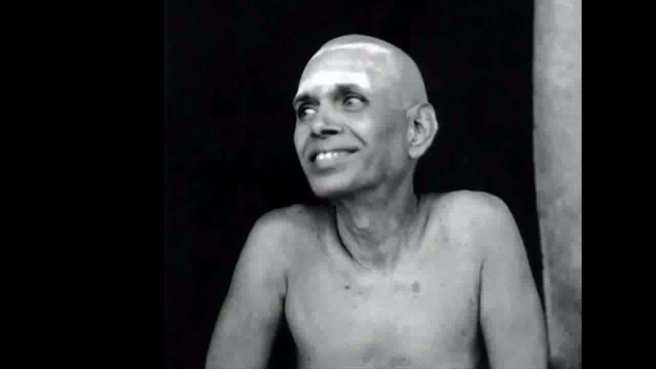
Ramana smiling

Those who have poured their minds, as a food offering to Sivam, into the surging and radiant sacrificial fire which is the discipline of true knowledge [mey jnana tavam], will truly become Siva-swarupa. Having reached this conclusion, the proper course is to worship courageously in this way and merge with the formless Sivam.

Ramana Maharshi
Guru Vachaka Kovai
Verse 353

Tom’s comments:

I chose this verse to write about because not only does it prescribe a sure footed way to the absolute, but also because I love the poetic imagery of ‘pouring your mind’ into the mouth of God in order to merge with Him. For me this ‘pouring’ invokes a sense of surrender which is effortless and complete, a total giving over of yourself to Him. And then we realise all is Him all always was Him, and what we called ‘me’ or ‘I’ was also Him.

When we merge with Him, we do not really ‘merge’ with Him, as that implies two entities becoming one. What happens is that the illusion of individuality and separation dissolves away and the reality that always was is seen for what it is.

The imagery of the verse also conjures up a sacrificial fire which envelopes and burns away the ignorance of separation, and it is this sacrifice of ego that is the real form of ‘courageous worship’. This worship is the same as ‘the discipline of true knowledge’.

The next verse drives the essential point home further:

Amongst those who have not realised that the individual-consciousness is fake, let not any of them doubt unnecessarily what state will be attained if the individual-consciousness is abandoned completely. Just as someone who lets go of a branch of a tree to which he had been clinging will automatically fall onto the ground with a thud, he who has abandoned individual-consciousness will not fail to reach the state of Self, the true consciousness

Ramana Maharshi
Guru Vachaka Kovai
Verse 354

Om shanti shanti shanti

Ramana Maharshi: How to ‘become the reality’ | Self-abidance | The ‘vision of God’ | The end of suffering

 ramana umbrella

If you remain still, without paying attention to this, without paying attention to that, and without paying attention to anything at all, you will, simply through your powerful attention to being, become the reality, the vast eye, the unbounded space of consciousness.

Ramana Maharshi
Guru Vachaka Kovai
Verse 647

Tom’s comments:

Guru Vachaka Kovai is argueably the most authoritative text on Ramana Maharshi’s verbal teachings. The instruction here is simply to be still. Not to be attentive to anything at all – just to be.

Ramana then uses the wording ‘through your powerful attention to being’. Given the first part of the verse which says not to be attentive to anything, this implies that not being attentive to any particular thing and remaining still and aware is synonymous with ‘attention to being’. This means that being is not something to be attentive of, ie. being is not an object of attention, but ‘attention to being’ is simply the state of being aware but not have your awareness focused on any particular thing.

What is the reward? The reward is that we ‘become the reality’. As Ramana has stated many times, there is actually no ‘becoming’ the reality. Reality is always already here, pure and whole, but realising this could be called ‘becoming the reality’:

There is no reaching the Self. If the Self were to be reached, it would mean that the Self is not now and here, but that it should be got anew. What is got afresh will also be lost. So it will be impermanent. What is not permanent is not worth striving for. So, I say, the Self is not reached. You are the Self; you are already That.

Ramana Maharshi, Talk with Sri Ramana Maharshi, talk no. 251

Here are 2 other verses, also from Guru Vachaka Kovai that say essentially the same thing but using different language:

348. Having become free from concepts, which are afflicting thoughts, and with the ‘I am the body’ idea completely extinguished, one ends up as the mere eye of grace, the non-dual expanse of consciousness. This is the supremely fulfilling vision of God

349. Having restrained the deceitful senses, and having abandoned mental concepts, you should stand aloof in your real nature. In that state of Self-Abidance in which you remain firmly established in the consciousness of the Heart, Sivam will reveal itself.

In verse 348 we can see how here the emphasis is on freedom from concepts and thoughts. When the ‘I am the body’ idea has been completely extinguished, then ignorance, the cause of suffering, has been rooted out, and all that remains is Reality, which in this verse Ramana calls ‘the non-dual expanse of consciousness’ or ‘God’.

It is worth noting that this is not simply an insight teaching, but also a purification teaching in which, over time, through the repeated practice of ‘self-abidance’, the ignorance ‘I am the body’ is uprooted. Only when this is done is the vision of God fully realised.

Again, in verse 349, a similar concept is explored in a slightly different way. The senses here are termed ‘deceitful’ meaning that they promise pleasure and fulfillment when really pursuit of pleasure and fulfillment through the senses actually leads only to the perpetuation of the cycle of suffering. Therefore we turn away from objects as sources of fulfillment and also we ‘abandon mental concepts’. Once we have done this, we are already standing ‘aloof in our real nature’. Standing in our real nature is not something we have to do, but it naturally arises once we stop attending to objects and thoughts (which are subtle objects).

The latter part of verse 349 says we should ‘remain firmly established’ in this stillness. Here, this state is also called ‘the Heart’. The ‘remain firmly’ implies the importance of practice, ie. remaining in this state for sometime. Only then will it have it effect of God-realisation or ‘Sivam revealing itself’, which is when the ignorance of the false ‘I’ has been rooted out through repeated practice.

Again, it is worth noting that unlike insight teachings which simply point out the presence of awareness/consciousness, this teaching goes further and asks us to ‘remain in that awareness’ in order for ignorance to be uprooted. In this context, remain in awareness is just a phrase to mean that we don’t seek outwardly through objects such as sense objects (gross objects) or thoughts and concepts (ie. subtle objects).

This is the path to ending suffering, as the next verse, also taken from Guru Vachaka Kovai, states. The word mauna refers to the state of silence or stillness beyond words and the word jiva refers to the apparent individual:

350. The true vision of reality that is free from veiling ignorance is the state in which one shines in the Heart as the ocean of bliss, the inundation of grace. In the mauna experience that surges there as wholly Self, and which is impossible to think about, not a trace of grief or discontent exists for the jiva.

OM NAMO

BHAGAVATE

SRI RAMANAYA

OM

The subject (the Witness/ Awareness/ Pure Consciousness) is an inference

All we know are objects. The existence of a subject (eg. the witness or consciousness/awareness) is an inference, a belief.

Some versed in advaita-speak then counter by asking ‘Who/what is it that knows this?’. The problem is that the very question ‘who knows’ is based on the belief that there must be a subject, a knower.

It’s similar to an argument for the existence of God in which people say look at all this marvelous creation, who is the creator? Of course, the assumption is there must be a creator, a subject who creates, and this is a false assumption (ie. it is based on false logic).

Inference does not always work as a way of understanding and knowing things, as it is only as good as the logic that underpins it. We could go on with other examples of this faulty logic in which the notions of a subject is unnecessarily believed in: Who blows the wind? Who quakes the earth? Who grows the trees?

Now strictly speaking, we are not saying there is no subject, just as we are not saying there is no God. We are just saying there is no evidence for either of these, and therefore no need to believe one way or the other in a subject.

What we are left with is ‘what is’ or ‘life’ or ‘experience’. It all just happens. It’s already happening. Everything is a part of IT.

So simple, direct, and already fully known (seen), but in essence it is mysterious and uncapturable by words.

There is a great freedom in seeing this.

Tom Das – pointing at the unspeakable (recent quotes from my Facebook page)

Here are some of my recent posts from Facebook page (my account is http://www.facebook.com/tomdas.nd)


Everything you see is yourself, calling you back to yourself.


May your ever-seeking mind be engulfed and consumed by the warm smouldering embers of surrender.


Sometimes insight alone is enough. Sometimes practice is required.


Relax, let go & enjoy.
Freedom is already fully & completely present.
No need to pay too much attention to thoughts & feelings that say otherwise.


Notice all the ways you try to avoid THIS.


How can THIS be spoken of? How can THIS be taught? In the ‘final analysis’, what is there to teach?


The freedom that we are looking for is wholly verifiable in our experience right now. We do not necessarily need to have a special experience or to obtain a special knowledge for this freedom to become apparent. Nor is belief of any kind required. Stay true to what you know directly. Don’t pretend to know something you don’t and don’t take on someone else’s beliefs.

Simply quieten your mind and notice what is happening. Examine how suffering is created and the notice the myriad of beliefs that underlie it. Notice the non-existence of an entity (‘you’) that is the author of thoughts and actions. This ‘you’/author is just an imagined product of throught.

Notice fulfillment is not to be gained through either objects, accumulative knowledge or specific/certain experiences, all of which come and go. See this for yourself. Don’t take my word for it.

Dare to seek and know what is true for yourself, and stay true to your own direct experience, even if it means you are contradicting a supposed authority in the matter.

Good luck!


When I first started teaching I tended towards just direct pointing. I quickly realised there are a whole host of reasons why people were not getting it, or if they were ‘getting it’, they quickly ‘lost it’.

I began to understand the value of emotional work, of heart opening, of regular spiritual practices, of becoming more sattvic – ie. the value of the progressive path (as well as the negatives too, eg. the reinforcement of a sense of doership/ego).

Remember that consciousness/awareness, if you want to use that concept, doesn’t need any teachings. Freedom is already here, totally and completely. It is only the mind that needs teachings.

A relatively uncluttered mind in need of little emotional work may respond to direct pointing, whereas sometimes some decluttering needs to occur first.


If emotions are not deeply felt, there is risk of emotional bypassing.
Emotional work may need to be done either prior to or after awakening, otherwise unnecessary suffering and destructive tendencies will continue on a relative level with the body-mind in question.

If you observe, you can learn the apparent mechanics of suffering and awakening, which when understood makes the teachings much more potent.

This has immense value in my experience to an apparent someone who is struggling in their belief in separation.


If you have come this far then you will also realise that ‘awareness’ is just another way of saying ‘presence/appearance of objects’. Here the subject-object distinction falls away.


The idea of a subject/awareness that is aware of objects is just that – an idea or concept.

When this is seen one can no longer even talk of awareness, as that implies a subject and object, a perceiver and perceived, and this is now just seen to be an assumption, a imagined creation of throught.

There is only ‘what-is’.

Simple, direct, unspeakable.

The concepts of the teaching, such as a ‘pure awareness’, were useful tools on the journey to remove the basic ignorance, but can now also be dispensed with once their ‘job has been done’.


wp-1481063300583.jpg

Shankara’s way to Enlightenment, with verses from Atma Bodha

Atma Bodha is a short text attributed to Shakara and was written approximately 1400 years ago. It literally means ‘Self Knowledge’ (atma = self, bodha = understanding or knowledge) and it outlines a methodology to lead a seeker from suffering to liberation. Incidentally, bodha is the same root word that forms the word Buddha, which means ‘the one who knows or understands’.

It comprises a class of scriptures called prakarana granthas. Prakarana means ‘procedure’ or ‘task’ and grantha means ‘text’. Taken together prakarana grantha means ‘instruction manual’. These instruction manuals were written for those who do not have the capacity or time to read the voluminous traditional texts such as the vedas and upanishads or for those who were looking for a synopsis of their vedantic studies, and so give us a summary teaching which we can practically apply to our lives.

Ramana Maharshi thought this text important enough to translate it from Sanskrit to Tamil so that Tamil-speaking locals who could not understand Sanskrit could still benefit from its teachings. In his introduction to his translation, Ramana describes Shankara as the one who brings forth enlightenment. Similarly in the Inchegarei Sampradaya, the lineage to which Nisargadatta Maharaj belonged, Shankara is considered an enlightened sage and his writings are studied as a matter of course.

Below are some selected quotes from Shankara’s Atma Bodha. We will see how in these quotes the basic methodology (after the entry criteria for this teaching are briefly alluded to) is:

1) Firstly viveka, or distinguishing between what is Brahman and what is not. Brahman is identified as the unchanging subject and the world of objects (ie. the body, mind and world) is said to be not-Brahman. This is an artificial duality that is temporarily set up in order to counter and remove the deeply ingrained belief in the doer-entity or ego (ahamkara). We will see how this duality is later resolved into non-duality and furthermore into non-conceptuality.

2) Once the subject-object distinction (viveka) has been properly made then this knowledge or understanding is to be practised. This is done by the practise of identification with the subject, Brahman, and turning away from the phenomena that arise in our awareness.

3) Eventually, after long practice of this, the doer-entity that we once took ourselves to be is seen to be an illusion. This ignorance is removed.

4) Once the doer-entity is seen to be unreal, then the interpretive notions of subject and object can also be done away with. Having completed their purpose, the concepts of subject and object are also seen to be false beliefs and are allowed to fall away.

5) Everything is ‘resolved into Brahman’, not literally, but in the way we label reality. Before, at the first step of viveka,  the unchanging subject was considered Brahman/Atman and the changing world of objects (the mind, body and world) were said to be not-Brahman/Atman. Now ignorance is removed, everything is seen to be Brahman and the duality set up by viveka is removed.

6) Eventually we stop needing to label reality at all. What we are left with is just this, this present experience, devoid of concepts of self or reality or even Brahman. So simple, so direct, how can it be put into words?

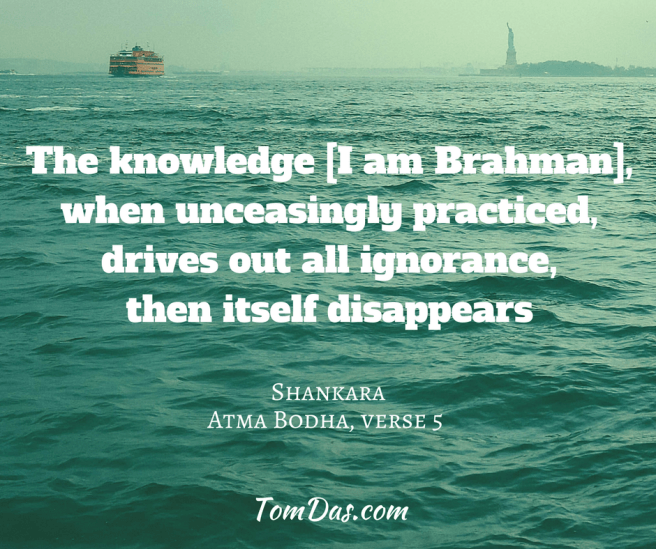
Verse 5. The knowledge [I am Brahman], when unceasingly practiced, drives out all ignorance, then itself disappears.

Shankara - the knowledge then itself disappears

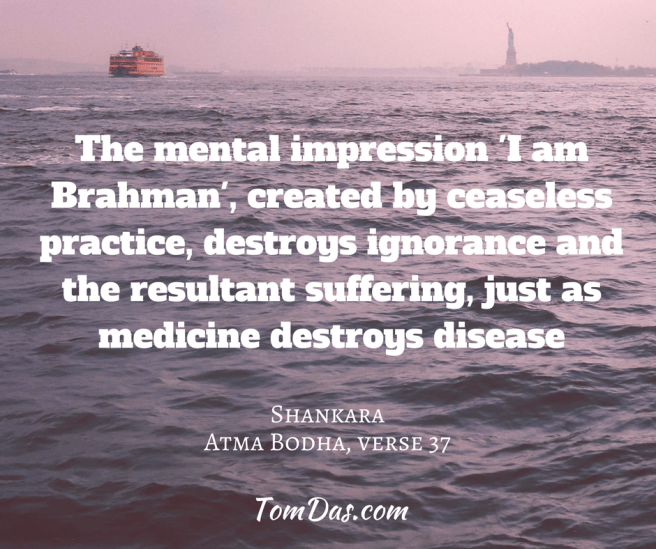
37. The mental impression ‘I am Brahman’, created by ceaseless practice, destroys ignorance and the resultant suffering, just as medicine destroys disease.

Shankara - I am Brahman destroys ignorance (1)

41. There are no distinctions such as ‘Knower’, the ‘Knowledge’ and the ‘Object of Knowledge’ in the Supreme Self

Shankara- there are no distinctions in the Supreme Self.

64. All that is perceived, or heard, is Brahman and nothing else

Shankara- All that is perceived is Brahman and nothing else

Am I the body? Am I not the body?

This post is continued from a prior post: Integrating knowledge, spontaneous action

Q. I’ve been reading Ramana Maharshi recently and he keeps on saying ‘I’m not the body’.

Tom: Yes, that’s right.

Q: But I don’t really hear you talk about not being the body.

Tom: Yes, that’s because it’s a ‘thorn’. Remember the phrase I’ve mentioned: ‘Use a thorn to remove and thorn and throw them both away’?

Q: Yes, I’ve heard you say that. Please can you explain it again?

Tom: Sure. The first thorn represents a wrong concept that is active in your mind and causes suffering, just as a thorn in your foot causes suffering. You then take a second thorn and use it as a tool to remove the first thorn, but then you throw them both away. If you don’t throw away the second thorn, then you now have a new thorn (concept) that will cause you to suffer.

Ramana often talks about rooting out the ‘I-am-the-body’ concept, and the concept ‘I-am-not-the-body’ is just to negate the initial thorn. But then you throw it away too.

Q: So I am not the body is not true either?

Tom: Exactly. Or, lets put it like this: for a moment just forget what Ramana says, forget what I say – for all you know we could both be talking a load of rubbish! Afterall, lots of intelligent people believe strange and silly things, and we could be no different, right? So forget what we say.

So let me ask you a question: do you know for sure that you are a body?

Q: Well it often seems like I am a body…

Tom: But do you know for sure?

Q: No, not for sure.

Tom: Good. Now, do you know for sure that you are not the body?

Q: No, not for sure.

Tom: Good. That’s our basic experience. We don’t know either way. The body appears and follows us around, as it were, but we don’t know exactly what it means. Is the body me? Is it not me? The truth is I don’t know. That’s it. That’s the truth. We don’t know. Isn’t that right?

Q: But when I say to myself ‘I am not the body’, it feels so good, it just feels really nice.

Tom: Yes, of course, because you are negating the concept (I-am-the-body) that causes so much suffering. It’s a good thing to practice, it’s a great practice in fact. If it works for you I recommend you practice it.

Q: Oh, I see, so it’s a practice.

Tom: Exactly. We are not saying don’t practice. We may need the second thorn, that’s why it is there, that’s why it is taught. So use that thorn, use that tool, practice ‘I am not the body’. When it has done its work, when it has weeded out the ‘I am the body’ concept, then you won’t need it any more and you can throw it away too.

Q: OK, I got it now. Wow, there are so many thorns, aren’t there?

Tom: Yes!

Q: I often get confused about whether or not the world is a dream or illusion or not, but that’s just another thorn too, right?

Tom: Exactly. ‘The world is an illusion’ – it’s a very powerful thorn, one that benefited me a lot whilst I was seeking. But again, do you know for sure if the world is an illusion?

Q: No, not for sure…I know what you’re going to ask next…

Tom: …And do you know for sure that the world is not an illusion?

Q: No, not for sure . I knew you’d say that.

Tom: (laughing) That’s it! We don’t know either way! It’s so simple – Got it?

Q: (laughing) Got it.

Tom: so you can practice these, all these thorns. All these thorns are concepts. Use them – they are most definately useful – use them if you need them. The concepts are used to weed out the beliefs. You may need to practice them for weeks or months, but when their work is done, and the suffering has dissipated, throw them away.

Also see Ranjit Maharaj talk about this.


Annamalai Swami: ‘Don’t sit and meditate’

Annamalai Swami: Bhagavan watched me very closely in the years that I served him in the ashram. One time I went to the Mother’s temple where many people were talking about worldly matters.

Bhagavan called me back, saying, ‘Why should you go to that crowd? Don’t go to crowded places. If you move with the crowd, their vasanas will infect you.’

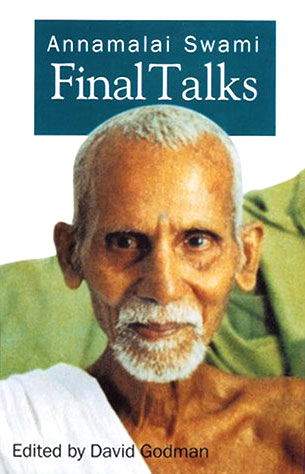
annamalai swami final talks

Bhagavan always encouraged me to live a solitary life and not mix with other people. That was the path he picked for me. Other people got different advice that was equally good for them.

But while he actively discouraged me from socialising, he also discouraged me from sitting quietly and meditating during the years that I was working in the ashram. In this period of my life, if Bhagavan saw me sitting with my eyes closed he would call out to me and give me some work to do.

On one of these occasions he told me,

‘Don’t sit and meditate. It will be enough if you don’t forget that you are the Self. Keep this in your mind all the time while you are working. This sadhana will be enough for you. The real sadhana is not to forget the Self. It is not sitting quietly with one’s eyes closed. You are always the Self. Just don’t forget it.’

Bhagavan’s way does not create a war between the mind and the body. He does not make people sit down and fight the mind with closed eyes. Usually, when you sit in meditation, you are struggling to achieve something, fighting to gain control over the mind. Bhagavan did not advise us to engage in this kind of fight. He told us that there is no need to engage in a war against the mind, because mind does not have any real, fundamental existence. This mind, he said, is nothing but a shadow. He advised me to be continuously aware of the Self while I did the ordinary things of everyday life, and in my case, this was enough.

The above is an excerpt taken from Final Talks by Annamalai Swami, p. 67