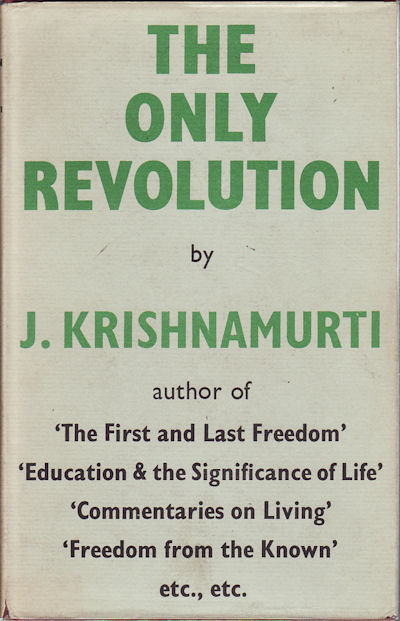
The following is an excerpt from ‘The Only Revolution’ by Jiddu Krishnamurti:
Meditation is not an escape from the world; it is not an isolating self-enclosing activity, but rather the comprehension of the world and its ways. The world has little to offer apart from food, clothes and shelter, and pleasure with its great sorrows.
Meditation is wandering away from this world; one has to be a total outsider. Then the world has a meaning, and the beauty of the heavens and the earth is constant. Then love is not pleasure. From this all action begins that is not the outcome of tension, contradiction, the search for self-fulfillment or the conceit of power.
The room overlooked a garden, and thirty or forty feet below was the wide, expansive river, sacred to some, but to others a beautiful stretch of water open to the skies and to the glory of the morning. You could always see the other bank with its village and spreading trees, and the newly planted winter wheat. From this room you could see the morning star, and the sun rising gently over the trees; and the river became the golden path for the sun.
At night the room was very dark and the wide window showed the whole southern sky, and into this room one night came – with a great deal of fluttering – a bird. Turning on the light and getting out of bed one saw it under the bed. It was an owl. It was about a foot-and-a-half high with extremely wide big eyes and a fearsome beak. We gazed at each other quite close, a few feet apart. It was frightened by the light and the closeness of a human being. We looked at each other without blinking for quite a while, and it never lost its height and its fierce dignity. You could see the cruel claws the light feathers and the wings tightly held against the body. One would have liked to touch it, stroke it, but it would not have allowed that. So presently the light was turned out and for some time there was quietness in the room. Soon there was a fluttering of the wings – you could feel the air against your face – and the owl had gone out of the window. It never came again.
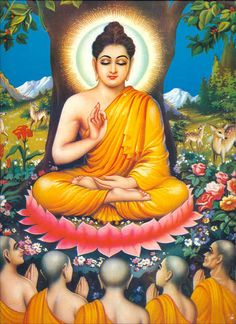
It was a very old temple; they said it might be over three thousand years old, but you know how people exaggerate. It certainly was old; it had been a Buddhist temple and about seven centuries ago it became a Hindu temple and in place of the Buddha they had put a Hindu idol. It was very dark inside and it had a strange atmosphere. There were pillared halls, long corridors carved most beautifully, and there was the smell of bats and of incense.
The worshipers were straggling in, recently bathed, with folded hands, and they walked around these corridors, prostrating each time they passed the image, which was clothed in bright silks. A priest in the innermost shrine was chanting and it was nice to hear well-pronounced Sanskrit. He wasn’t in a hurry, and the words came out easily and gracefully from the depths of the temple. There were children there, old ladies, young men. The professional people had put away their European trousers and coats and put on dhotis, and with folded hands and bare shoulders they were, with great devotion, sitting or standing.
And there was a pool full of water – a sacred pool – with many steps leading down to it and pillars of carved rock around it. You came into the temple from the dusty road full of noise and bright, sharp sunshine, and in here it was very shady, dark and peaceful. There were no candles, no kneeling people about, but only those who made their pilgrimage around the shrine, silently moving their lips in some prayer.
A man came to see us that afternoon. He said he was a believer in Vedanta. He spoke English very well for he had been educated in one of the universities and had a bright, sharp intellect. He was a lawyer, earning a great deal of money, and his keen eyes looked at you speculatively, weighing, and somewhat anxious. He appeared to have read a great deal, including something of western theology. He was a middle-aged man, rather thin and tall, with the dignity of a lawyer who had won many cases.
He said: “I have heard you talk and what you are saying is pure Vedanta, brought up to date but of the ancient tradition.” We asked him what he meant by Vedanta. He replied: “Sir, we postulate that there is only Brahman who 5 creates the world and the illusion of it, and the Atman – which is in every human being – is of that Brahman. Man has to awaken from this everyday consciousness of plurality and the manifest world, much as he would awaken from a dream. Just as this dreamer creates the totality of his dream so the individual consciousness creates the totality of the manifest world and other people. You, sir, don’t say all this but surely you mean all this for you have been born and bred in this country and, though you have been abroad most of your life, you are part of this ancient tradition. India has produced you, whether you like it or not; you are the product of India and you have an Indian mind. Your gestures, your statue-like stillness when you talk, and your very looks are part of this ancient heritage. Your teaching is surely the continuation of what our ancients have taught since time immemorial.”
Let us brush aside whether the speaker is an Indian brought up in this tradition, conditioned in this culture, and whether he is the summation of this ancient teaching. First of all he is not an Indian, that is to say, he does not belong to this nation or to the community of Brahmins, though he was born in it. He denies the very tradition with which you invest him. He denies that his teaching is the continuity of the ancient teachings. He has not read any of the sacred books of India or of the West because they are unnecessary for a man who is aware of what is going on in the world – of the behaviour of human beings with their endless theories, with the accepted propaganda of two thousand or five thousand years which has become the tradition, the truth, the revelation.
To such a man who denies totally and completely the acceptance of the word, the symbol with its conditioning, to him truth is not a secondhand affair. If you had listened to him, sir, he has from the very beginning said that any acceptance of authority is the very denial of truth, and he has insisted that one must be outside all culture, tradition and social morality. If you had listened, then you would not say that he is an Indian or that he is continuing the ancient tradition in modern language. He totally denies the past, its teachers, its interpreters, its theories and its formulas.
Truth is never in the past. The truth of the past is the ashes of memory; memory is of time, and in the dead ashes of yesterday there is no truth. Truth is a living thing, not within the field of time.
So, having brushed all that aside, we can now take up the central issue of Brahman, which you postulate. Surely, sir, the very assertion is a theory invented by an imaginative mind – whether it be Shankara or the modern scholarly theologian. You can experience a theory and say that it is so, but that is like a man who has been brought up and conditioned in the Catholic world having visions of Christ. Obviously such visions are the projection of his own conditioning; and those who have been brought up in the tradition of Krishna have experiences and visions born of their culture. So experience does not prove a thing. To recognise the vision as Krishna or Christ is the outcome of conditioned knowledge; therefore it is not real at all but a fancy, a myth, strengthened through experience and utterly invalid. Why do you want a theory at all, and why do you postulate any belief? This constant assertion of belief is an indication of fear – fear of everyday life, fear of sorrow, fear of death and of the utter meaninglessness of life. Seeing all this you invent a theory and the more cunning and erudite the theory the more weight it has. And after two thousand or ten thousand years of propaganda that theory invariably and foolishly becomes “the truth”.
But if you do not postulate any dogma, then you are face to face with what actually is. The “what is”, is thought, pleasure, sorrow and the fear of death. When you understand the structure of your daily living – with its competition, greed, ambition and the search for power – then you will see not only the absurdity of theories, saviours and gurus, but you may find an ending to sorrow, an ending to the whole structure which thought has put together.
The penetration into and the understanding of this structure is meditation. Then you will see that the world is not an illusion but a terrible reality which man, in his relationship with his fellow man, has constructed. It is this which has to be understood and not your theories of Vedanta, with the rituals and all the paraphernalia of organized religion. 7
When man is free, without any motive of fear, of envy or of sorrow, then only is the mind naturally peaceful and still. Then it can see not only the truth in daily life from moment to moment but also go beyond all perception; and therefore there is the ending of the observer and the observed, and duality ceases.
But beyond all this, and not related to this struggle, this vanity and despair, there is – and this is not a theory – a stream that has no beginning and no end; a measureless movement that the mind can never capture.
When you hear this, sir, obviously you are going to make a theory of it, and if you like this new theory you will propagate it. But what you propagate is not the truth. The truth is only when you are free from the ache, anxiety and aggression which now fill your heart and mind. When you see all this and when you come upon that benediction called love, then you will know the truth of what is being said.


 Tom Das