Books
2 new books have now been added to the recommended reading list: Maha Yoga and Sri Ramana Paravidyopanishad by Lakshmana Sarma
Two new books, Maha Yoga and Sri Ramana Paravidyopanishad, both by Lakshmana Sarma, have been added to the recommended reading list – please see the relevant section there for more information and links.
May these books help seekers determine the true path and thereby discover their true nature
Namaste & best wishes
Tom
Does the Sage (Jnani) see the world? Does the world appearance exist after liberation? Lakshmana Sarma explains verse 18 of Ramana Maharshi’s Ulladu Narpadu | Maha Yoga | Sri Ramana Paravidyopanishad
2024: More teachings from Sri Ramana Maharshi and also from Shankara on this subject here.
Many have misinterpreted Sri Ramana Maharshi’s teachings and the Vedanta/Upanishadic teachings (which both say and teach the same thing).
One devotee of Sri Ramana’s, a certain Lakshmana Sarma (LS), was unhappy about how Sri Ramana’s teachings had been misrepresented even by other devotees, so after consulting with Sri Ramana Maharshi he wrote several texts aimed at correcting these distorting teachings.
Below are some of his writings and some of Bhagavan Sri Ramana’s writings on the nature of Liberation.
Lakshmana Sarma, who was with Sri Ramana for over 20 years, was uniquely qualified to comment on Sri Ramana’s teachings as he was one of only 2 people who received personal 1 to 1 tuition from Sri Ramana on the deeper meaning of the teachings which went on for several years. He was also a Vedic and Sanskrit scholar, having studied the Upanishads and Shankara’s vast works as well as many other works too. Many of LS’s works were published during Sri Ramana’s lifetime, were written with the help of Sri Ramana and were thereafter recommended by Sri Ramana himself.
In LS’s book entitled ‘Maha Yoga‘, he explains Sri Ramana Maharshi’s teachings in the context of the Upanishads and Advaita Vedanta; and he also gives Sri Ramana’s view on how the Sage sees the world.
LS’s commentary on Ramana’s masterpiece Ulladu Narpadu (40 verses on Reality) was said by Sri Ramana to be the best available commentary on this work, which is hardly suprising as Ramana instructed LS on the deep meaning of this text over a 2-3 year period.
As a multilinguist, LS translated these texts into English himself, so we can be sure of the accuracy of the English translations too.
A caution before reading further
Whilst these teachings are open to all, these specific teachings are only for those who have a deep interest in liberation through the path of self-enquiry, as is explained in the post below.
It should be emphasised that understanding what is written in this post is NOT a prerequisite for realisation – see my personal note below for an example of this. This information is just provided for those who are interested, as it can be very helpful for some. Even if we disagree with this post, all we have to do is lovingly turn within and discover our own true nature, and then the truth (or falsehood) of this will be discovered for our self, first-hand 
Ramana cautions us not to spend time arguing whether or not the world exists or does not exist in realisation and rather our time is better spent in turning inwards in surrender and devotional self-enquiry. This entire teaching can become a distraction. Let us remember what Sri Ramana writes in Ulladu Narpadu, verses 3 and 34:
3. ‘The World is true’; ‘No, it is a false appearance’; ‘The World is Mind’; ‘No, it is not’; ‘The World is pleasant’; ‘No, it is not’ – What avails such talk? To leave the world alone and know the Self, to go beyond all thought of ‘One’ and ‘Two’, this egoless condition is the common goal of all.
34. The natural and true Reality forever resides in the Heart of all. Not to realise It there and stay in It but to quarrel ‘It is’, ‘It is not’, ‘It has form’, ‘It has not form’, ‘It is one’, ‘It is two’, ‘It is neither’, this is the mischief of maya.
Does the sage see the world?
Tom: The following is an excerpt from Maha Yoga, pages 167-8; as usual, my comments are in italiscised red:
A question was put to the Sage [Sri Ramana Maharshi]: “Does the Sage see the world as others do?”
The Sage [Sri Ramana Maharshi] replied: “The question does not arise for the Sage, but only for the ignorant. He puts the question because of his ego. To him the answer is. ‘Find out the Truth of him to whom the question occurs.’ You ask the question because you see the Sage active like other men. The fact is, the Sage does not see the world as others do. Take for an illustration, the cinema. There are pictures moving on the screen. If one goes up to them and tries to seize them, he seizes only the screen. And when the pictures disappear, the screen alone remains. Such is the case with the Sage.”
Tom: there is a false vedanta teaching that states that the Sage (jnani) sees the world just as the ignorant jiva (ajnani) does. Here above LS refutes that view when he says ‘the Sage does not see the world as others do’. We will see many more quotes like this in the rest of the post below.
The same question is answered by the Sage also as follows: “The world is real, both to the ignorant and to the Sage. The ignorant one believes the Real to be co-extensive with the world. To the Sage the Real is the formless One, the basic Substance on which the world appears. Thus great indeed is the difference between the Sage and the ignorant one.”
Tom: the above answer in italics forms verse 18 of Ulladu Narpadu, or Forty Verses on Reality, written by Sri Ramana Maharshi. The paragraphs below form LS’s explanation of the true meaning of this verse:
Here the Sage begins by saying that, superficially considered, the ignorant one and the Sage are alike. For they both say that the world is real. But it is here pointed out that what the Sage means by the words is quite the opposite of what the other means.
The ignorant man takes the world to be real as such, with all its variety of name and form and, has no idea of the basic Reality which, as shown before, is like gold to the jewels made of it – is the Substance that is real as opposed to the forms that are unreal.
The Sage rejects the unreal part of the world and takes as real only the Substratum, the formless Pure Consciousness, the Self, which is unaffected by the false appearances. “The Self is real”, says the Sage, “not the world, because He exists alone in His State of Purity as the Pure Consciousness, without the world. The world cannot exist without the Self.” Thus we have to conclude that the Sage does not see the world and has no part or lot in it.
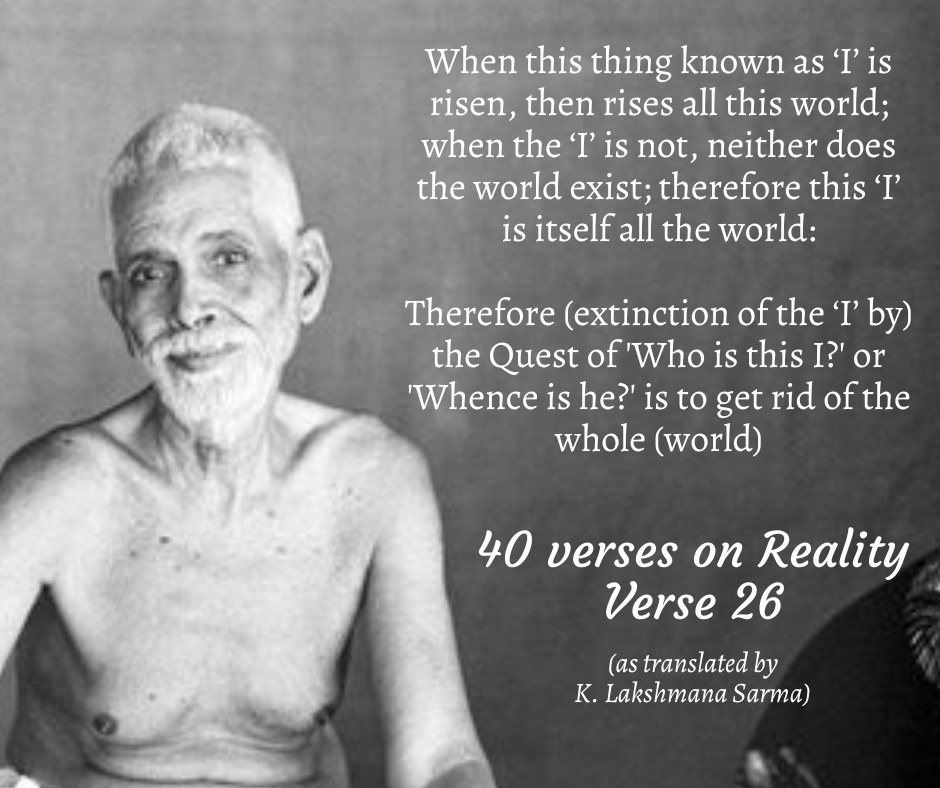
Tom: we see the same explanation given by Lakshmana Sarma in the footnotes of the first 15-20 verses of Guru Ramana Vachana Mala, and small but wonderfully comprehensive collection of Sri Ramana Maharshi’s teachings compiled by LS that are well worth reading. Also see verse 31 of LS’s translation of Ulladu Narpadu (picture quote below) which drives the same point home, even more clearly perhaps:
Tom: this is why Sri Ramana Himself wrote the following verse from Guru Vachaka Kovai:
The sage Self-realised knows not
Whether the transient body comes
And stays, or dies and leaves, even as
The senseless drunkard knows not what
Happens to his clothes.
~ SRI BHAGAVAN 24
Tom: this is also the true meaning of the Upanishadic verse, a form of which is here written by Sri Ramana, also in Guru Vachaka Kovai:
There is no creation, no destruction.
None bound, none seeking, striving,
Gaining freedom. Know that this
Is the Truth supreme.
~ SRI BHAGAVAN 28
Tom: please note that Sri Ramana wrote the above 2 verses himseld. A version of this above verse is found in the Amritabindu Upanishad in verse 10 and in the Atma Upanishad in verse 2.31. It was later incorporated by both Gaudapada (Mandukya Karika 2.32) and Shankara (Vivekachudamani verse 574) in their writings. A very similar teaching is given in the text Guru Ramana Vachana Mala, in the section that describes the Jivanmukti (the one liberated in this life):
313. As one that is profoundly alseep in a carriage in unaware of the varying states of the carriage – (its running, stoppages and unyoking of horses [Tom: – ie. the 3 states of waking, dream and deep sleep]) – so the one in the Transcendental State is unaware of the varying states of the body.
And another verse from the same text:
21. There is no mind, nor body, nor world, nor any one called a soul; the One pure Reality alone exists, without a second, unborn and unchanging, abiding in utter Peace.
We see the same teaching recorded in another text by LS, Sri Ramana Paravidyopanishad. He wrote a whole series of verses dotted throughout the text to make his point – he is one example in verse 39 (see below for more verses like this):
39. Unless and until the mind becomes utterly extinct, these three states will continue to prevail. When the mind becomes extinguished the supreme state is won, wherein this world once and for all ceases to appear.
LS then writes in his own commentary on this verse, as follows. Note that LS often uses the word ‘quest’ to refer to self-enquiry:
During the prevalence of ignorance the three states conceal the supreme state. The latter cannot be experienced because of these. To be able to experience that state the mind must be destroyed so that the world-creation will also cease. To this end, the quest must be taken up and pursued until the mind-free state is established.
We see a similar teaching, again in Maha Yoga, page 50:
So long as the Self appears to us as the world, we shall not realise Him as the Self; the world-appearance effectually conceals the Self; and it will do so until we get rid of the appearance.
And in Talks with Sri Ramana Maharshi, talk 187:
The activities of such a being [the realised Jnani] are like the feeding of a somnolent boy, perceptible to the onlooker (but not to the subject). The driver sleeping on his moving cart is not aware of the motion of the cart, because his mind is sunk in darkness. Similarly the sahaja Jnani remains unaware of his bodily activities because his mind is dead – having been resolved in the ecstasy of Chit Ananda (Self)
And in Talks with Sri Ramana Maharshi, talk 82:
Just as a passenger when asleep in a carriage is unaware of the motion, the halting or the unharnessing of the horses, so also a Jnani in sahaja samadhi is unaware of the happenings, waking, dream and deep sleep.
…In sahaja samadhi the activities, vital and mental, and the three states are destroyed, never to reappear. However, others notice the Jnani active e.g., eating, talking, moving etc. He is not himself aware of these activities, whereas others are aware of his activities. They pertain to his body and not to his Real Self, swarupa. For himself, he is like the sleeping passenger – or like a child interrupted from sound sleep and fed, being unaware of it.
And in Maya Yoga, page 120:
He that sees the unreal appearances does not see the Reality; he that sees the Reality does not see the unreal appearances.
And Maha yoga, page 125:
So too the world and the Reality are negations of each other. They cannot be seen simultaneously. The rope is unrelated to the snake; it did not give birth to the snake. So too the world and the Reality are negations of each other, in the sense that he that sees one of them does not and cannot at the same time see the other. The two cannot be experienced simultaneously. He that sees the world sees not the Self, the Reality; on the other hand he that sees the Self does not see the world. So one of them alone can be real — not both. Hence there is no real relation between them. The world did not come into existence from the Reality. The latter is wholly unrelated to the former. Therefore it is clear that the bridge that the intellect demands does not exist and cannot be built.
Or course many of you will recognise how the above quote from LS’s ‘Maha Yoga’ mimics Sri Ramana’s own writing in ‘Who Am I?’ when he writes:
Just as the knowledge of the rope, which is the base, will not be obtained unless the knowledge of the snake, the superimposition, goes, so the realization of Self, which is the base, will not be obtained unless the perception of the world which is a superimposition, ceases.
And also from Sri Ramana’s ‘Who Am I?’:
Therefore, when the world appears, Self will not appear; and when Self appears, the world will not appear
Going back to Maha Yoga, p. 138:
Deliverance is here and now – if only we lose the ego. Ignorance, bondage and the incidents of bondage, namely all this multiplicity and difference, do not exist even now. Therefore it follows that the Sage who is egoless does not see all this, which seems so real to us. For him this cinema-show of the world and its seer, the ego, have ceased; so he does not recognise its having been seen before. For him the screen alone remains, the Light of Consciousness; the moving pictures have vanished.
From Maha Yoga, p. 139:
The true Self, it is here expressly pointed out, is not Itself the cause of this variety. It has no becoming, as shown before. What becomes the universe is Maya, the mysterious power that has to be assumed as belonging to the Self, to account for the world-appearance. This Maya is the same as mind, which is the ego. Out of this Maya come forth the four, of which the individual soul is one, that is why he is unreal. Therefore it follows that this false appearance will persist only so long as the ego-sense continues, not after the extinction of the ego. Therefore we have to understand that to the Sage the world does not appear, though it may appear to others that the Sage sees the world, and though the Sage himself does not always deny seeing the world.
From Maha Yoga, p. 158:
For the Sage, therefore, nothing exists except the Self; there is neither body, nor mind, nor world, nor other persons
And in Maha Yoga page 159 it is explained that from the Jnani’s point of view, not only is there no body, mind nor world, but that these never existed in the first place, and they were never even seen as an appearance:
From his [the sage’s] point of view all the three bodies are non-existent. Not only that, he does not even recognise that they existed before. Hence it is only as a concession to the semi-ignorant disciple that the distinction is mentioned in the books. The absolute truth of Deliverance is that It is bodiless and worldless, because Deliverance is the state where the Truth [ie. the formless objectless Self] alone shines.
Some argue the world is not real but it still remains as an appearance upon realisation…
…LS explains that this view is only held by those who only have an intellectual understanding of the teaching, and who have not therefore actually discovered the Self through self-enquiry/turning within, see here from page 57 of Maha Yoga:
But when a rope is first mistaken for a serpent, and then recognised to be a rope, the serpent ceases to appear [italics to emphasise ‘ceases’ are by LS]. That does not seem to be the case with the world. Even when it is known that the world is only an appearance of the real Self, the world continues to appear. This is the objection raised by one that has heard the teaching and been more or less convinced. The correct explanation is that mere theoretical knowledge does not dissolve the world-appearance, but only the actual Experience of the Self.
In the last sentence of the above quote, LS reiterates that the ‘Experience of the Self’ does ‘dissolve the world-appearance’.
It is commonly argued that ‘dissolve the world appearance’ and ‘the world not appearing’ really just means that the world does not appear separate from the self – ie. that the world does appear, but not as a separate reality. However, note that this would be a dristi-shristi teaching and not ajata vada.
A personal note
On a personal note – I usually don’t talk too much about myself in these posts as I prefer the teachings to focus on Sri Ramana rather than myself – it may be of interest to you to know that my own personal view of the teaching when I was seeking was that the world does not disappear upon realisation but just is seen as one with the Self. I thought the types of views presented in this post were dogmatic, ideological and overly-intellectual, and were taking a too literal stance on what was meant to be a more poetic of metaphorical teaching perhaps.
It was only when my seeking ended that the direct radical truth of the teachings was actually revealed to me – there is only the formless objectless worldless Self, one without a second, with no mind to know anything, and no body to suffer. It was only then that the true meaning of the scriptures became clear to ‘me’! My mind would not let me see this truth beforehand as I could not understand, and did not even desire, the disappearance of the body, mind and world. My concept of realisation was to be happy and free in the world, or at least with the world and those I love still appearing.
Luckily for me, all I wanted was to be with Bhagavan in my Heart, and this love took me home.
Some further questions arising from this teaching
There are several obvious questions that arise from this teaching, such as is this state of liberation even desirable? (quick answer: yes, it is actually total unending freedom and bliss and what we are truly longing for), if the world does not appear for a jnani, then how does a sage function in the world? (quick answer: it only appears as if the Jnani is a person that carries out actions due to ignorance, they are actually the formless reality itself – see here and here for more on this) If the three states are no longer present for the sage, then why do I see them eating, sleeping, dreaming, etc? (quick answer is the same answer as for the previous question) Isn’t this a dualistic teaching if we are separating Reality from illusion? (quick answer – no! but see here and here for more), how to realise this for oneself (quick answer: self-enquiry, turn within) and if this world is illusory how should I live my life and what is the role of spiritual practice (quick answer: be good to yourself and others and the world/envoronment, act kindly and responsibly and engage with Bhagavan Sri Ramana’s teachings which will lead you to realisation of this for yourself) – do let me know if other questions also arise.
All these questions are answered in much more detail in the texts in the recommended reading list, such as The Path of Sri Ramana, Maha Yoga, Ramana Paravidyopanishad, Sadhanai Saram, The Happiness of Being and Manonasa, just to name a few. The articles at the end of this post also answer some of these questions too, especially the Manonasa post and the post about how a Jnani functions with no thoughts.
Most people find this strange teaching confusing or difficult to understand – it cannot truly be understood with the mind, after all – so don’t worry if you are confused (isn’t it commonly said that liberation cannot be understood with the mind? But then don’t many go on to explain the nature of liberation in detail in a way that it actually makes sense? This should be a red flag). It will all become clear if you truly have a desire for liberation – your desire for truth and reality and happiness will create the clarity that you seek.
But don’t many scriptures and texts state the Sage continues to sees the world as other do?
This is true; there are many instances of verses in the vedanta scriptures and in Sri Ramana’s teachings where it is said that the sage sees the world as others do. How can we reconcile this with the verses above and below contained in this post?
Bhagavan Sri Ramana explains that this is because these teachings that admit to the existence of the body mind and world (ie. Maya) are lower teachings for those who are not willing or able to accept there is not world or maya at all. There are many instances when after giving such a teaching to someone, once the questioner had left the room, Sri Bhagavan would therafter turn to those close devotees who remained in the room and explain to them that that was just a lower teaching given on a level that was appropriate for them.
This is rather like how we explain the workings of the universe to a child as opposed to a university graduate. It is not duplicitous, but rather it is presenting information in a way the audience of that information can understand it and therefore make use of it. Typically there are three levels on which the teachings are given, and the quotes in this post point to the highest level, ajata vada, a teaching that is rarely given, generally speaking, but a teaching which Bhagavan Sri Ramana was adamant was the only real truth.
Here is how LS describes this in Maha Yoga pages 59-60; here LS speaks of 2 levels of the teaching, the higher (true) and lower (ultimately untrue); note that LS uses the English word ‘revelation’ to refer to Shruti (the revealed scriptures consisting primarily of the Vedas and Upanishads):
The ancient lore is twofold. One part of it is addressed to those who are not conscious of being in ignorance, and therefore have no use for a teaching intended to dispel that ignorance. The other part of the ancient lore is addressed to those that are conscious of the ignorance and are in earnest to escape from it. These two parts are quite distinct. But this feature of the ancient Revelation is not known to these believers. Besides they are offended by the inevitable corollary that theirs is a lower position; they also feel it a grievance that the world, which they believe to be real, should be dismissed as unreal, and often want to quarrel with us who are followers of the Sages; we however have no quarrel with them, as the Sages have pointed out, because we realise that for them it is all right to believe as they do, and, so believing, to make the best of the world while it lasts. They are like dreamers who are persuaded that their dreams are real, and do not want to awake. We have begun to see that this worldly life is only a dream, because the Sages tell us so; and we want to awake.
How Ramana sometimes ‘watered down’ the teachings
LS testifies about how he often saw Bhagavan Sri Ramana ‘water down’ the teachings to suit those who were unwilling or unable to hear the true teachings. Even many of Sri Ramana’s devotees were unable or unwilling to accept the higher teachings. See here in Maha Yoga pages 160-161:
Even among the Sage’s disciples, there are some who cannot understand the answer [that the world is not real and has never even actually appeared]; but that is so because they are believers in a fascinating, but complicated creed, in which the chief tenet is that the world is real as such; it is therefore quite natural that they should refuse to understand the Sage’s teachings, of which the essential part is that the world is not real as such. They are dualists in fact, and as such violent haters of Advaitic teaching.
In this connection we may take note of the tenderness the Sage shows for the weaknesses of believers. The Sage observes the rule enunciated in the Gita (3.26) that no one’s faith should be disturbed. Therefore when ardent dualists are present, the Sage is very careful in what he says. He does not, while they are present, give out clear Advaitic teaching. But as soon as the dualists go out, he turns round to the Advaitis that remain, and apologetically explains to them that he had to water down the teaching to suit the dualists.
Tom: This is important to note, as Sri Ramana’s closest devotees were all in agreement about this point, that Sri Ramana’s highest teaching to those who knew him best was ajata vada, and that the body-mind-world does not even appear to a Jnani, not even as an appearance. Lower teachings stating that the world still remained were often given out to those who were not willing or able to receive these higher teachings.
In the Bhagavad Gita verse 3.26, referred to above by LS, Lord Krishna recommends that we do not disturb the minds of the ignorant who are attached to a life of doing and action (karma) and who are not yet ready to hear the higher teaching:
3.26 Let not the wise disrupt the minds of the ignorant who are attached to action, they should not be encouraged to refrain from work, but to engage in work in the spirit of devotion
He thus treats the latter as immature ones, and the Advaitis as adults who can understand that allowances have to be made to the immature. But he leaves us in no doubt at all, that the Advaitic teaching is the highest there can be*.
*On many occasions the Sage has clearly testified to this. One such occasion was this. Somebody had written in a book, that the Truth would be whole only if the world be real as such – with all its variety – not else. When this writer was reading this, the Sage exclaimed: ‘As if the Truth would be mutilated otherwise.’
How many times have we heard the (false) teaching that true non-duality would and must include the world! Here above Sri Ramana is clearly refuting this.
An example of how teachings can be subtly distorted
Interestingly, there is a PDF version of Sri Ramana Paravidyopanishad on David Godman’s website here, which has been edited and amended by David Godman. Whilst presumably this is well-intentioned, he unfortunately distorts the teaching when he changes the translation of verse 39 to:
39. Unless and until the mind becomes utterly extinct, these three states will continue to prevail. When the mind becomes extinguished, the supreme state, in which this world once and for all ceases to appear [as real], is won.
Comparing it to the original version of the verse, which was translated into English by LS himself, you can see David Godman has slightly changed the words themselves as well as the word order, but more noteably he has added ‘[as real]’ in square brackets. This small addition in square brackets could imply that the world still appears but is just somehow identified as being unreal.
Here is how the verse was originally translated by LS before David Godman edited it:
39. Unless and until the mind becomes utterly extinct, these three states will continue to prevail. When the mind becomes extinguished the supreme state is won, wherein this world once and for all ceases to appear.
Hopefully you can see how a small addition has potentially changed the meaning of the verse. I have had discussions with people who use these types of [amended] quotes to cling onto their erroneous view,something that LS comments on below in this post. Unfortunately this is not the first time I have seen distortions of these kinds in books edited by David Godman. This is a shame as LS went to such efforts to dispell these types of views!
If a distortion could happen so easily within only a few years of a text being published, it is easy to see how the older traditional scriptures can be distorted over time, even by those who have the best of intentions.
A second example of a similar distortion in the teaching
We see a similar distortion in the Sri Ramana Ashram publication of the English translation of ‘Who Am I?’ where the translator has similarly inserted text in brackets, presumably again with good intentions, but having the effect of distorting the actual meaning of the teachings. First we will see how Question and answer 4 is correctly translated:
- [Question:] When will the realization of the Self be gained?
[Answer:] When the world which is what-is-seen has been removed, there will be realization of the Self which is the seer
We can see how this teaching above is in line with the above article and this has been correctly translated; now here is the subtle distortion in the next question and answer, where the bracketed portion is not present in the original text, but has been ‘helpfully’ added by the translator:
- [Question:] Will there not be realization of the Self even while the world is there (taken as real)?
[Answer:] There will not be.
However, as the bracketed text does not appear in the original Tamil, an accurate translation should simply read:
- Q. Will there not be realization of the Self even while the world is there?
A. There will not be.
Hopefully you do not need me to re-explain how this slight alteration by the translator can distort the actual meaning of the teachings!
More Verses from Sri Ramana Paravidyopanishad on this topic
All of the verses below are taken from Sri Ramana Paravidyopanishad. ‘LS’ designates LS’s own commentary upon these verses, my comments or additions are in italicised red – enjoy!:
9 The world appearance is ignorantly superimposed by the mind upon that substratum, which is the truth of the Self. It [the world appearance] conceals that reality and shines [as if it is] real so long as the ignorance persists.
LS: Ignorance and mind are inseparable; where there is mind, there alone is ignorance; where there is no mind, there is no ignorance, since in the mind-free state the real Self is not concealed. This explains why the real Self is not known to men in general.
Tom: as a slight aside, we see the teaching that ignorance and mind are the same thing multiple times in Shankara’s Vivekachudamani, eg. in verses 169 & 180:
169. There is no Ignorance (Avidya) outside the mind. The mind alone is Avidya, the cause of the bondage of transmigration. When that is destroyed, all else is destroyed, and when it is manifested, everything else is manifested.
180. Hence sages who have fathomed its secret have designated the mind as Avidya or ignorance, by which alone the universe is moved to and fro, like masses of clouds by the wind.
For more on this teaching see here where Shankara also explains that the mind/ignorance creates the entire universe/world; see also Ramana Paravidyopanishad verse 85 below:
13 As one seeing the false snake fails to see the real rope, so, seeing the world – in which are included the personal God and the individual soul – he does not see the real Self as it really is, that is, as the supreme reality [Brahman].
Tom: Note that LS translates the word ‘Jiva’ as ‘soul’ or ‘individual soul’ as at the time of translation the notion of jiva, the (false) notion of being a seperate body-mind entity or person, was not well known in the English-speaking world.
LS: How long will this effect of ignorance continue?
14 The Self will remain concealed [in this way] as long as the world is taken to be real. It will cease to be so taken when the mind is once and for all extinguished; hence one must strive towards extinguishing the mind.
LS: The world-appearance being the obstacle to right awareness of the Self, and the mind being the cause of the world-appearance, the cure of this evil is the attainment of the mind-free state, which is done by the quest, which will now be briefly described.
15-16 The mind projects on the Self the illusory world appearance. He who, seeing the Self, becomes firmly established in the true state as that Self, thus uncovering that Self and dissolving the mind, which comprises ignorance and the whole world, will enjoy his own true state, which is without samsara, which is not covered by the vehicles, which is identical with Brahman, and which exists alone, without a second.
LS: The full significance of these revelations will be understood in due course, in the course of this book.
28 Since that state is changeless, worldless and calm, beyond the states of waking and the rest, it is called the fourth state. Such is the teaching of the Mandukya Upanishad.
LS: This means that for the one who has transcended the ignorance, the three states do not exist.
Tom: The forth state or ‘Turiya’ (literally meaning ‘the forth’), refers to the formless Self (Atman) which is beyond the 3 states (of waking, dream and deep sleep), and in which the 3 states do not appear, as explained in the Mandukya Upanishad, verse 7, as follows:
7. Turiya [the forth] is not that which is conscious of the inner (subjective) world, nor that which is conscious of the outer (objective) world, nor that which is conscious of both, nor that which is a mass of consciousness. It is not simple consciousness nor is It unconsciousness. It is unperceived, unrelated, incomprehensible, uninferable, unthinkable and indescribable. The essence of the Consciousness manifesting as the self in the three states, It is the cessation of all phenomena; It is all peace, all bliss and non—dual. This is what is known as the Fourth (Turiya). This is Atman and this has to be realised.’
We can see that Turiya is explained in the Upanishad as being the Self which ‘has to be realised’. Note the Upanishadic verse also states that in Turiya there is no consciousness of the inner world (thoughts, feelings, dreams), and also no consciousness of the outer world (ie. the waking state and gross objects).
30 The whole of this world is contained within this trinity of states. The reality of the fourth state, which is wordless, transcends these three states.
31 Deep sleep is just dreamless sleep; the other two are sleep with dream. The fourth state, being without sleep and without dream, is the abode of deliverance.
LS: Thus it is stated that, because of the underlying sleep of ignorance, the so-called waking is really a state of dream. This will be elaborated later, when the question of the reality of the world is discussed. The fourth state is in perfect contrast with the other three, being sleepless, dreamless and therefore worldless.
LS: The world-appearance, therefore, is just a dream. In fact, it often assumes the quality of a nightmare. It arises in the sleep that is ignorance of the real Self. This is stated next.
Tom: as the waking state is considered to be another form of dream, to say deliverance (liberation) is without sleep and without dream is to also say it is without the waking state; see also verse 39 below.
33 Those that are overwhelmed by this sleep of ignorance are the seers of this bad dream, the world. And so long as this ignorance does not cease by the right awareness of the real Self, the souls have to wander in this maze of the three states. The only way to escape from this bad dream is to become fully aware of the real Self.
39. Unless and until the mind becomes utterly extinct, these three states will continue to prevail. When the mind becomes extinguished the supreme state is won, wherein this world once and for all ceases to appear.
LS: During the prevalence of ignorance the three states conceal the supreme state. The latter cannot be experienced because of these. To be able to experience that state the mind must be destroyed so that the world-creation will also cease. To this end, the quest must be taken up and pursued until the mind-free state is established. This is often styled the state of knowledge. But this description is misleading for the reason stated presently.
Tom: note that LS uses the English word ‘quest’ to refer to self-enquiry
40 Though that state of being the real Self is called the state of knowledge, it is one in which there is none of the three: the knower, the object known, and the act of knowing. That being the case, what does one know there, by what means, and who is there to know? It must be understood that knowledge is just a name for the state of being the Self.
LS: That state is different from anything else because it is a state of non-duality (advaita). There is no object to be known, nor is there a knower – the soul [Jiva]– and hence there is no knowing. So ‘knowledge’ or ‘awareness’ are just arbitrary names for this state. This will be explained later.
Tom: note that LS uses the English word ‘soul’ to refer to the jiva, which is the false identification as a body-mind entity.
74 The aspirant will naturally turn away from the world at once and, with his mind turned inwards, will strive for the goal. It is by turning the mind away from the world that the quest is made, and for that reason the world is certainly to be renounced.
LS: The knowledge derived from worldly experience is ignorance. Hence, it cannot be used as evidence. If relied on, it will lead to wrong conclusions. The reason is next given briefly.
78 All worldly experience is rooted in ignorance. It is dream-like; it takes place in worldliness; it pertains to men ignorant [of the real Self]; and it is false. It is therefore no evidence for the seeker of deliverance in [this] discrimination between the real and the unreal.
LS: It has been explained that the three states of life, waking, dream and sleep, take place in the profound sleep of ignorance, and hence even waking experience is dreamlike.
84 The Guru, who is a sage, teaches the unreality of the world in accordance with his own experience, also giving reasons supporting it. The disciple who aspires to become free should accept this teaching with perfect faith and [with its help] strive for this goal.
85 The universe, comprising these three – the soul, God and the world of visible objects – is superimposed by the mind on the real Self, which is the sole reality of the supreme state. Hence all this [universe] is just an outcome of ignorance.
LS: The mind is the creator of the universe. Ignorance is the primal cause of the mind. Hence it is said here that this ignorance is the cause of the universe.
86 That being so, when this ignorance is annihilated by the light of awareness of that Self, then, along with it, the consequence of it [the world] will, like the darkness that disappears before sunlight at dawn, cease to appear.
LS: This will become more and more intelligible as we proceed. What is stated above are the actual facts of the Guru’s own experience. The conclusion that follows for the disciple is given next.
87 This universe [we see] shines in the dense darkness of ignorance, but does not shine in the great splendour of the light of Self-awareness. If this universe were real, why does it not shine in the supreme state, lit as it is by the conscious, effulgent light of the real Self?
LS: An axiomatic distinction between the real and unreal, which is implicit in vedantic metaphysics, is next enunciated.
88 That which survives in the experience of the real Self is the supreme state. [That] alone is real. All else is only unreal. This is the distinction between the real and the unreal, revealed to us by the teachings of all the sages.
LS: By this test the world is shown to be unreal. The next verse elaborates on this.
89 Since multiplicity is experienced only in the state of ignorance, it is declared to be unreal. On the other hand, because the unity of the Self is experienced on the liquidation of ignorance, that unity is real.
LS: The reality is only that which survives in the supreme state.
90 ‘The sole reality is that peaceful Self which shines by the light of its own nature as pure consciousness in the supreme state wherein the world is lost.’ Such is the teaching of our holy Guru.
LS:Here it is shown that the state is one of peace because there is no duality there. This is what we learn from all the Upanishads. This teaching is further confirmed by the analogy of the dream world.
91 As the dream world is known to be unreal for the reason that it vanishes upon waking, so this waking world is also proved to be unreal by its vanishing in the light of the real Self.
Tom: What about those who seek to discredit this teaching? Are they really interested in turning within, away from the world, and discovering the self? Let us see:
LS: It is next pointed out that those who seek to discredit this teaching are those who do not ardently aspire to the supreme state.
92 But ignorant men, who are averse to winning the supreme state, put forth an endless series of arguments, [trying to refute this teaching]. The sages clear the doubts generated by these arguments so that earnest aspirants may not be deluded by them.
LS: The teaching is addressed not to all men, but only to those who aspire to win the supreme state, because they alone are qualified to receive it.
93 This teaching of the unreality of the world is not addressed to those who look upon the body itself as the Self, or consider the Self to be the owner of the body. For these people the world is real, not unreal.
LS: The teaching has to be adapted to the person being taught. The same teaching is not good for all. Here it is shown that he who believes that the Self is not the body, but the owner of it, or the dweller therein, is for this purpose in the same category as the one who believes the body itself to be the Self.
LS: Why is it that the world is real to these people?
94 The teaching – that the trinity of the soul, God and the world is unreal – is indivisible. If one is convinced that one of these is real, the other two also will appear to be real.
LS: That is, the teaching must either be accepted as a whole or rejected wholly. There is no option to split it up and accept it partially, rejecting some of it.
95 To those who seek deliverance, the teaching is that all these three are equally unreal. This teaching must [therefore] be accepted, exactly as it is taught, by those who are earnestly seeking to win deliverance by the extinction of ignorance.
98 Everyone who is ignorant [of the real Self] thinks the world is real because it is seen. This is no proof because it proves too much. The same reason would prove the reality of the mirage, the rope in the snake, etc.
101 Only the sage who knows the substratum of the world appearance, the reality, by being firmly established in the supreme state, is competent to reveal the truth of the world.
LS: By his unawareness of that truth the common man, being a victim of his ignorance, cannot know the truth about the world.
102 When vision is focused on the outside, who can know the truth, whether of the real Self or of the world? But, with the mind turned inwards, the sage knows the truth of both by the eye of right awareness.
LS: It is with the knowledge of this uniqueness of the sage that the disciple has to approach him and listen to his teaching.
116 In the state of ignorance both the world and the Self are seen as forms. [But] on the extinction of ignorance both are [found to be] formless, because in the supreme state the infinite Self is the eye.
LS: In the true state, which is the supreme state, the Self alone is. It is described as infinite, and therefore formless. There are no objects to be seen, nor is there any real seeing. Hence, forms are unreal. If they were real, they would survive in that state.
117 By the vision of right awareness, the world, along with the soul, merges into the formless, real Self. The sages call that the vision of right awareness, wherein there is neither seer nor spectacle.
118 In that natural state [of the Self] there survives only the Self, which is consciousness, worldless, alone, and without the six modes of change, such as birth, and so on. Hence, it alone is real in its own right.
121 It is only by conceiving the formless Self as a form that one sees this world as consisting of forms. All this is really an ignorant superimposition on the formless, infinite reality, the Self.
122 It is only to him that sees himself as having a form that the names and forms appear as real. They have been fabricated by ignorance and superimposed on the nameless, formless Self, which is consciousness.
123 Thus it has been made plain by the Master that the seeing of the world is an effect of the primary ignorance. Thus, the claim that the world is real has been refuted by him. Also, it has been shown by him that the aloneness of the real Self in the true state is real.
124 Our Master confirms this teaching first by showing that the world is mental [inseparable from the mind], then by proving the unreality of the mind and the ego, and finally by teaching that even the primary ignorance is non-existent.
Tom: saying the world is mental is essentially vivarta vada, the idea that the world is a mere projection or appearance in consciousness; to say that the primary ignorance, which resulted in the world appearance, never existed, is tantamount to saying that the projection of the world never occurred, not even apparently/as an appearance. This is ajata vada.
131 The truth that the world is unreal is taught by the sages only to him who aspires to attain the highest state by the quest of the Self. It is not addressed to others, and hence the contentions of these objections are wholly in vain.
LS: The uniqueness of Vedanta is that no one is coerced by threats of hell or otherwise to accept its highly elusive teachings. It is given out only to those whose minds are ripe and have become receptive to these metaphysical truths. Indeed, Vedanta advises ordinary people not to dabble in vedantic studies.
132 No one is able to know the unreality of the dream world during the dream itself. In the same way, no one is able to know the unreality of the waking world while he is in the waking state.
144 The mind itself creates the world in the waking state, as it does in dream. But the mind does not know, either in waking or in dream, that this is its own creation.
146 This is the very nature of the mind, that it takes as real all that it creates. This is seen in day-dreaming, witnessing dramas, or listening to stories.
147 Creation is not other than seeing; seeing and creating are one and the same process. Annihilation is only the cessation of seeing and nothing else, for the world comes to an end by the right awareness of oneself.
Tom: Here we see that merely seeing objects is itself creation, jata. Therefore ajata vada, the doctrine of non-creation, states that the world was never even created, and the world never appeared, not even as an appearance.
330 There is no creation apart from seeing; seeing and creation are one and the same. And because that seeing is due to ignorance, to cease seeing is the truth of the dissolution (of the world).
334 Therefore the aspirant, being firmly convinced that space and time are unreal, should give up the whole world and seek to know the substratum, the Self, through the quest of his own true nature.
341 Therefore the aspirant must cease from thoughts of the worldly life and strive to become aware of the truth of the Self, which is the same as Brahman, by means of the quest of that Self.
448 The Supreme Being did not become mind, neither did it become the world. It remains unswerving from its true nature as pure, unmodified, consciousness, transcending time, space and the rest.
449 The world did not come into being, nor is it going to be destroyed. No one called ‘the individual self’ was really born. There is no one in bondage, no one who has become free, nor is there any spiritual seeker. This is the most excellent truth that has been clarified.
LS: This is the truth of non-becoming [ajata], demonstrated by the sage Gaudapadacharya, in his Mandukya Karikas, which is strictly in agreement with the experience of all the sages.
456 When, forgetting the Self, one thinks that the body is oneself and goes through innumerable births and in the end remembers and becomes the Self, know this is only like awakening from a dream wherein one has wandered all over the world.
LS: In a dream one may go on a world-tour and in the dream itself return home and lie down in one’s own bed; but when one awakes one knows that it was all a dream. In the same way all of one’s samsaric reincarnations are only a long-drawn out dream, at the end of which only the Self remains, unaffected by all this. There is a difference here, because it was not the Self that dreamed, but only the ego-mind.
523 How can any man understand, by the unaided power of his own intellect, one who is mind-free, bodiless and worldless?
LS: The one who is established in that state of deliverance is called a sage, or ‘Prabuddha’ or Buddha. He cannot be known because he has none of the attributes of an individual. He is one with the eternal subject, the supreme reality, and so cannot be made an object for anyone to know.
LS: Does the world survive after the egolessness is established?
541 The statement of the vedantic text that the Self swallows up the moving and the unmoving, means that the world, which is only darkness, is consumed by the effulgence of that Self.
LS: The Upanishads thus clearly state that the world, being only darkness, cannot possibly survive in the presence of the light of right awareness. The very same truth has been expressed by Bhagavan in the first verse of his Arunachala Pancharatnam, which is paraphrased here.
Tom: ‘Darkness’ in the verse above refers to ignorance, as LS confirms in the commentary on the next verse.
542 The essential nature of the Self has been sung by Guru Bhagavan in the following words: ‘The Supreme Self, named Arunachalesa [The Lord of Arunachala], shines alone without a second, having swallowed this solid-seeming universe by his own consciousness-light.’
LS: This confirms the statement that creation is composed of darkness (ignorance) alone, and has no substantial reality even now, when ignorance and ego are rampant. An inaccuracy of statement that is unavoidably made is corrected.
543 The statement that the Self, by attaining oneness with Brahman, becomes freed from the bondage of samsara is not true, because the Self never fell from its true state.
544 Just as white cloth does not acquire a new whiteness, whiteness being its nature, so the Self does not become Brahman because the Self is eternally Brahman by nature.
545 Two names are commonly in use to designate the sage, namely ‘Knower of Brahman’ and ‘Knower of the Self’. Since the sage is himself Brahman, as well as the Self, how can they become known to the sage?
LS: Neither of the two, which are identical with each other, can become the object of knowledge. The Self, as the eternal subject, is not an object to be known, and Brahman is therefore not an object. The unknowability of Brahman is due to its being the Self. So the terms, taken literally, are inapplicable. What then are their proper meanings?
552 The state of the non-dual, real Self, experienced by the sage who attains the supreme state, is not the fruit of the practice of sadhana. It is the eternal nature of that Self.
Tom: Some mistakenly think that the Self will be gained as a result of practice. Whilst it may seem this way, it is not actually the truth. There is only everlastingly the Self. The non-self never really existed at any time.
578 The sage in his worldly activities may appear to be aware of worldly differences, but he is really no more aware of them than a sleepwalker who moves about, performing actions.
583 Though he appears as embodied, he is really bodiless, being egoless. His subtle body does not survive and go forth somewhere when the gross body falls, but undergoes disintegration here.
584 Some believers in the reality of the world say that the sage has a body. Others say that the sage, being bodiless, can assume a body if he so pleases.
585 By the dawn of right awareness of the real Self, the ego, the root cause of the appearance of forms, has been lost. Therefore for the sage, all forms are unreal, and hence this talk of forms is foolishness.
586 Since it is not proper to say that this [world] existed before [enlightenment], but was lost afterwards, and since [even in ignorance] no one has a form from the point of view of the reality, how can the sage have a form?
587 In the case of the sage who is established in his own natural state, free of all the three bodies, how can a desire arise to have a body? This talk of forms is in vain, being merely a concession to the unenlightened.
592 The popular notion that there are many sages is also not true. All differences belong to the world. In the worldless state they do not exist.
593 He who says, ‘I have today seen this sage; I shall see others also,’ does not know the true nature of sages, which is reality-consciousness-bliss. This is what Bhagavan has told us on this point.
594 For him who knows not the sage who is within himself there appear many sages. For him who knows that one, which is his own Self, this plurality [of sages] is non- existent.
600 It is the deluded men with outward-turned minds, hankering for worldly enjoyments, who talk of these siddhis [Tom: special supernatural powers, the literal meaning of siddhi is attainment], namely becoming minute, etc. Revelation mentions these siddhis for attracting the dull-witted ones also to the path for deliverance.
645 The statement in revelation that prarabdha karma [the apparent actions destined for the body-mind] survives [in the liberated sage] is only in conformity with the view of the ignorant. From their point of view, those actions have results, because in their view the sage is embodied.
654 The sleeper in the carriage does not know anything about the going, the stopping and the unyoking of the horses [of the carriage]. Just so, the sage who is asleep [to the world] in the carriage, the body, does not know its changing conditions.
For more on this topic also see the following links where Sri Shankara, Sri Gaudapada and Sri Sadhu Om, amongst others, give this same teaching. The Michael Langford link also goes into great depth about this topic that is rare to find elsewhere:
Non-duality, Self-Realisation and the appearance of the world | Sri Sadhu Om
Ramana Maharshi – the 3 levels of the teaching
The entire path explained: the Path of Sri Ramana (Parts 1 and 2; PDF downloads)
Shankara: how to Realise the Self (commentary on the Brihadaranyaka Upanishad)
The nature of Liberation | Manonasa by Michael Langford
How can the Jnani (sage) function with NO THOUGHTS? Sri Ramana Maharshi
The nature of Self-Realisation according to Shankara and Gaudapada | Mandukya Upanishad and Karika
!Om Namo Bhagavate Sri Ramanaya Om!
Non-duality, Self-Realisation and the appearance of the world | Sri Sadhu Om
The following is taken from the wonderful text Sadhanai Saram written by Sri Sadhu Om. My comments are in italiscised red:
Duality only appears due to a lack of self-enquiry:
- Know that the world, soul and God have all seemingly come into existence only because of our pramada or slackness in Self-attention.
It is the unreal and illusory ego that sees the (illusory and unreal) world:
- The entire universe composed of the five elements, earth, water, fire, air and space, appears only due to our error of mistaking as ‘I’ the ego that rises from Self like a spark rising from fire, and which appears as different from Self whose nature is Being, and as identical with the mind, whose nature is rising.
Self-enquiry ends the ego illusion and duality:
- The entire appearance of this world that is seen, including we (the individual or jiva) who see it, is a mere false appearance like a dream. If we keenly scrutinize the source (the real ‘I am’) from which the seeing ego rises, and thereby enter the heart and firmly abide there, the reality will shine forth (and the appearance of the triad – the seer, seeing and object seen – will disappear).
There is no desire or fear in the Self (or in Self-realisation), both of these being due to ignorance/ego or illusion:
- If we attain the otherness-free knowledge (ananya jnana), that this world is nothing but our own Self, seen wrongly in our self by our self through our power of imagination, then the delusion of desire for or fear of the world (the objects we see in front of us), will never rise again; and we will merge in and become one with Self. This alone is our natural state.
The formless Self alone exists:
- Self alone exists. Except oneself, nothing exists. But if one takes this pure consciousness, which exists and shines as ‘I’ to be the body, every thing will assume a form and appear to exist. If one inquires, “Is this ‘I’ only the body, or is it something else?” and thereby sees the true nature of “I,” every thing will cease to exist. See thus.
A summary and reiteration of what has been stated above:
- If you ask, “For what reason is it said, that if one inquires and knows oneself, this entire world would disappear?” The reason is that the result at tained by the inquiry “Who am I?” is the destruction of the unreal individual (jiva), the ego, who is immersed in activity due to his taking the body to be himself. (That is, since the entire world-appearance depends for its seeming existence upon the ego who sees it, and since the ego itself has no real existence of its own, when the real ‘I’ is known, the ego will be found to be truly non-existent; where upon, the world-appearance will vanish, having no one to see it and thereby to give it a seeming exis tence).
The false ‘I’ is the ego, also known as maya. Enquire into the ‘I’, that is, do self-enquiry, and this illusion will vanish, along with the body, the mind and the world. Compare to Revelation Verse 31.
- The ‘I’ which cannot shine without being joined with a body-form, is alone the ghost-like ego ‘I’, the great illusion (maya). If one courageously and without fear inquires, “Who is this I?” it will become non-existent, and along with it everything else will cease to exist.
- If this ‘I’ the self-rising ego-appearance, is destroyed by the inquiry “Who am I?”, then everything else, which till then appeared only in him (in the mind) but which was seen as if existing outside of him, will cease to exist. The ever-existing Whole or purna, which then shines forth as ‘I-I’ the blissful existence which neither appears nor disappears, is the real Self, the true import of the word ‘I’.
The true Self does not come and go, unlike the body and mind and world:
- The ‘I’ which is the Whole, which is the true import of ‘I’, which shines by its own light without appearing due to the functioning of the five sense-knowledges (and disappearing when they cease to function); which is the exalted and ever unleaving experience of Self, and which is the true nature of everyone, alone is the one non-dual reality; it alone is true knowledge.
The true nature of Jnana (knowledge) is simply the Self. The Self is itself the nature of Knowledge.
- This true knowledge is not anything other than oneself; it is our own existence-consciousness ‘I am’. Why should we suffer by imagining and seeing the soul [Jiva or ego], world and God in this knowledge? Abiding firmly as mere Being, experience this knowledge correctly; then what thing other than oneself will appear there?
True destruction of maya/duality occurs with destruction of the ego:
- The destruction of the entire universe together with the space and other elements that constitute it is not the state of absolute destruction (pralaya). The state in which the wicked ego, which rises in the form of the feeling “This body of flesh is I” (abhimana), drowns in Self and is destroyed entirely, is alone the glorious state of absolute destruction (maha-pralaya).
- After being destroyed in the ordinary destruction at the end of an eon (yuga-pralaya), the heaven and earth will appear again at the proper time. The state in which the Fire of Knowledge (Jnanagni), which blazes forth on being ignited as the churning process of investigation “Who am I?” pervades and shines everywhere, having destroyed the feeling, “I am this body” (dehatma-buddhi), is alone the absolute destruction (maha-pralaya); be cause the ego, which is thus destroyed by the Fire of Knowledge (Jnana) will never appear again.
- The “I,” which continues to live even after the mind has died (as a result of the above said inquiry “Who am I?”) is indeed the Supreme Reality (Brahman), which alone exists after the universal destruction (pralaya). The mind expanding as everything, having risen from the heart (that is, the mind slipping down from the true state of Brahman due to inadvertence or lack of Self-attention (pramada), and thereby becoming the cause for the creation and sustenance of the false appearance of this en tire universe), is not the state of true power; the mind merging and abiding firmly in Self is alone the true state of supreme power.
Note by Sri Sadhu Om: The supreme and truly divine power is not the power of the mind (maya), which creates and sustains the false appearance of the universe, but is only the power of Self-abidance, which reveals the truth that illusion (maya) is ever non-existent.
The cause of duality and of liberation:
- Your appearance as an ego, an individual soul who rises in the form “I am this body,” alone is the root-cause for the appearance of this unreal world. If this root-appearance, the rising of yourself as an individual soul, does not rise even in the least, that state will be the state of liberation, which is completely devoid of the imaginary appearances of the world and God.
- If one has the ability to deny oneself and thereby to destroy the rising of the ego in its very source, what other tapas need one perform? The real Self, the source in which the ego thus subsides and dies, alone is the state which is worth to purchase and attain by selling (or renouncing) all the three worlds.
The paths of Devotion and Knowledge – Bhakti vs Jnana | Advaita Vedanta
The following is taken from the wonderful text Sadhanai Saram (The Essence of Spiritual Practice) written by Sri Sadhu Om, a direct devotee of Sri Ramana’s. This text not only gives us the essence of Sri Ramana Maharshi’s teaching, but also directs us to the true Vedanta teachings. The notes are written by Sri Sadhu Om himself. You can download the full text as a PDF using the above link.
The paths of knowledge and devotion are more fully explained in the text The Path of Sri Ramana which you can download for free here. This is one of the few texts that goes into detail into both the paths of knowledge and love.
Also see Recommended Reading: Books for Enlightenment, Liberation and Self-Realisation

The Paths of Devotion (Bhakti) and Knowledge (Jnana)
79. To the extent to which love for God arises in one’s heart, to that extent will one acquire knowledge about Him. And to the extent to which one knows the nature of God, to that extent will the mind gain steadfast love for Him. Thus, knowledge (jnana) will be increased by devotion (bhakti), and devotion (bhakti) will be increased by knowledge (jnana).
80. By means of our love for God, He will give us more knowledge of Him, and by means of our knowledge of Him, He will give us more love for Him. Therefore, of these two paths, bhakti and jnana, follow that one for which you first gain a liking, because that one path will lead you to follow the other one into the heart.
81. In the life of an aspirant who is seeking liberation, bhakti and jnana will be experienced as inseparable, like the two sides of one sheet of paper. Hence, each one is equal to the other. They are not two different things, for the true nature of both of them is one and the same; know that bhakti and jnana are merely two names for that one thing. (Garland of Guru’s Sayings (Guru Vachaka Kovai) verses 722, 731)
82. The state of abiding firmly in Self-alone is wisdom (jnana). Would it be possible to abide thus in Self if one did not have love for Self? Love for Self-alone is bhakti; abiding firmly in Self on account of that love alone is jnana. What difference is there between these two? Discriminate and know this truth. (Maharshi’s Gospel p.24)
83. If there did not exist the power of gravity, which attracts and pulls everything towards the earth, would anything remain stable on earth? On scrutiny, devotion (bhakti) is found to be similar to the gravitational power of attraction, while the state of wisdom (jnana) is found to be similar to the state of objects remaining stable on earth as a result of that attraction. If either one of these two, the power of attraction or bhakti and the state of abidance or jnana, were absent, the other one would not exist.
84. An aspirant who practices Self-inquiry, which is the path of jnana, denies his own individuality by knowing, “I, this insignificant ego, am not the doer of any action”; while a devotee denies his own individuality by knowing, “God alone is the doer of all actions.” Thus, since an aspirant who follows either of these two paths refrains from assuming the sense of doership, understand that these two paths are not different even during the time of practice, and follow either of them.
85. We should not allow our minds to become bewildered and confused by trying to deliberate and decide, “Which of these two, the practice of bhakti or the practice of jnana is the best means for attaining liberation?” For whichever path a liking arises in the heart of a person, for that person that path alone is the best.
86. According to the strength of habit continuing from former lives, in this life the mind will acquire a liking either for the path of devotion or the direct and unfailing path of Self-inquiry, and will feel that particular path to be the best and most suited to itself. Therefore, follow at least one of these two paths to its very end.
Inquiry Becoming Easy Due to Devotion
87. When, having wept and wept with intense yearning for a long time, unceasingly thinking of and adoring the Gracious Feet (of the Lord), the mind which rises (as “I am so-and-so”) dissolves and becomes pure, the blemishless Self-inquiry (jnanatmavichara) will become firmly settled (in the heart) and the experience of Self (swarupa-anubhava) will of its own accord arise very easily indeed. (Sri Muruganar, Sri Ramana Jnana Bodham v.1286)
88. O, you who say, “We have never seen you closing your eyes and practicing Self-abidance (nishtha); tell us, how did you attain the state of inner silence (mauna)?” Understanding the above verse, know the secret of (how to attain the true experience of) God, who is not seen even though one waits closing one’s eyes (for a long time in expectation of seeing His true vision).
Note: the previous verse is the answer to the above question
Tom: The paths of knowledge and love are more fully explained in the text The Path of Sri Ramana which you can download for free here. This is one of the few texts that goes into detail into both the paths of knowledge and love.
Also see:
Non-dual devotion, worship and prayer
Ramana Maharshi on those who ridicule idol-worship or image-worship
Maya & Ignorance – how and why did they arise and how to remove them? | Sadhana Saram | Sri Sadhu Om
The following verses are taken from the excellent text ‘Sadhanai Saram‘ by Sri Sadhu Om. My (Tom’s) comments are written in italiscised red:

Question: How has ignorance or illusion (maya) come about?
- Listen now to the proper reason why, in answer to those people who asked due to bewilderment of thought, “Why has this illusion or phenomenal appearance (maya) come? How has it come?” Lord Ramana did not give a direct reply by telling why or how, but instead said, “See to whom illusion (maya) has come.”
Answer:
- He who says that phenomenal existence (maya) has come into being is only you, whereas enlightened Sages (Jnanis), who have attained the great experience of Self, never accept that maya has come or that it now exists. Therefore, you, who assert that maya has come and exists, alone are the one who has the duty to investigate the truth in that assertion in order to prove its validity. Investigate thus.
How to remove this ignorance?
- If you first attend to yourself, by investigating within yourself “To whom has this illusory appearance of the world (maya) come? To whom does it exist?” then in the mind that has merged in the state of Silence due to such Self-attention, the truth that you exist as the mere consciousness ‘I am’, devoid of any differentiation, diversity or imagination (vikalpa), will spontaneously reveal itself to you.
Maya never existed, not even as an appearance:
- When the truth is known that you, the person who identifies the body as ‘I’, and who raises doubts and asks questions about phenomenal existence (maya), do not exist even in the least, then you will know as a matter of direct experience that in no place, at no time and in no way did phenomenal existence (maya) ever come or exist, and that the existence of the illusory world (maya) cannot be accepted even as a false appearance.
The questioner is itself illusion (maya):
- He (the mind) who says that the illusion of phenomenal existence (maya) has come into existence is himself an illusion (maya). Therefore, the one path of Self-attention, which puts an end to the mind, is alone the means that the pure Jnana-Guru, Sri Ramana Bhagavan, has bestowed upon us as the apt medicine to put an end to all the arguments that arise about phenomenal existence (maya).
Instead of asking ‘why is this world as it is?’, etc, we should ask ‘Who am I?’ and discover the Truth-Self:
- Even though our Guru has instructed us, “See ‘Who am I’?”, people of dull intellect ask, “Why has this world and the pleasures and pains herein come into existence?” instead of investigating “Who am I?” within themselves; only for such dull-minded people who ask thus, the Guru and the scriptures say, “Ah! That is all illusion (maya).”
Concluding verse in this section:
- But since people of pure faith who sincerely engage in the practice of Self-attention as instructed by the Guru, drown in the true consciousness ‘I’ by turning their attention again and again towards the false self (the mind) whenever it rises, to raise any kind of further questions, this talk of maya is not intended for them.
Also see this video for more on this topic:
Love and Desire | Teachings for Self-Realisation | Sri Sadhu Om | Sadhanai Saram | Sri Ramana Maharshi
The following is taken from the wonderful text Sadhanai Saram (The Essence of Spiritual Practice) written by Sri Sadhu Om, a direct devotee of Sri Ramana’s. This text not only gives us the essence of Sri Ramana Maharshi’s teaching, but also directs us to the true Vedanta teachings. The notes are written by Sri Sadhu Om himself. You can download the full text as a PDF using the above link.
- When by one’s own inexpressible power one imaginarily sees the one real Self as many objects (the soul, world and God) and thinks oneself to be one among those objects, then one’s own natural self-love, which transcends thought, will assume the form of a thought and will appear to oneself, the individual who imagines thus, as desires for those objects, which are seemingly other than oneself.
Note: What is called “love” is truly nothing but the non-dual love (ananya priya), which the real Self has for itself in the state in which it alone exists and shines. And what is called “desire” is nothing but the dual love (anya priya), which springs towards other objects, which are truly not other than Self, in the state in which the one real Self seems to be many objects. Therefore, the only way to put an end to desire is for one, by means of one’s own perfect freedom (brahma-swatantra), to use one’s own inexpressible power to see Self as one and not as many. In order to see Self thus as One, as it ever really is, one must cease attending to the many objects which seem to be other than oneself, and must instead attend only to the first person singular feeling “I”.
- Of all things, is not oneself the most beloved? When one limits oneself by imagining oneself to be a body, one sees all these things (the world and God), which are truly nothing but one’s own Self, as objects other than oneself, and hence one has desire for those objects. That desire is only a distorted form of the true self-love that is one’s own very nature.
- The love, which one always has for oneself, is not a thought; that supreme love is one’s own real Self that is existence-consciousness-bliss (sat-chitananda). When a wrong knowledge rises in the form of a thought whereby one mistakenly sees the one Self as many objects which are seemingly other than oneself, even the true self-love will become a petty thought in the form of desire.
- When self-love, which is not a thought, forsakes its own real nature of mere being and springs towards other things in the form of desires, it becomes ever-moving thoughts. When love remains as the thought-free love for Self instead of becoming thoughts in the form of desires for other things, that state of Self-abidance is true tapas (austerities or severe spiritual discipline).
- This original love for Self, which has now become the three desires, will cease to assume the form of thoughts and will remain as supreme bliss only by means of Self-realization, the state in which one sees all the five elements and the entire world constituted by those elements, as not other than oneself.
Note: The three basic human desires are: (1) the desire for relationships (uravu-asai), that is, the desire for relatives, wife, husband, children, friends or any kind of human relationship, whether sensual, emotional or otherwise; (2) the desire for possessions in any form whatsoever (porul-asai); and (3) the desire for praise, that is, the desire for fame, honor, esteem or any kind of appreciation from others (puhazh-asai). The reason for classifying these three desires is explained in more detail in verses 102 to 109 of this text.
- The love for happiness is only the love for Self, because Self alone is happiness. But if one imagines that this world, which is nothing but Self, is something other than oneself, then on account of self-love the objects of the world will seem to be objects of pleasure, and hence the love for that Self, which appears as objects other than oneself, will assume the form of desire. This is the great wrong.
- When the true knowledge dawns that everything is only “I”, then the extroverted love which desirously springs towards other objects, will remain pervading everywhere in the form of mere Being and will no longer spring towards anything else. The love that thus remains as mere Being, having ceased to move in the form of thoughts, alone is Siva, who is Self.
- Since Self is happiness itself, so long as one sees other things, which are in truth only Self (but whose names and forms are a mere appearance), how can one not think that those other things are pleasurable? This alone is the reason why all living beings, beginning with celestial beings and including men and all other creatures, are drowning and burning in the great fire of desires for external objects.
- When our true nature of mere being is transformed into the nature of rising as an ego, know that the three real aspects of our nature, namely existence, consciousness and bliss, will seemingly become their opposites, namely non-existence, igno12 A Light on the Teaching of Ramana Maharshi rance and misery, and will thus assume the form of the dyads (the pairs of opposites).
- Just as a single ray of white light becomes seven different colors when it passes through a prism, so the single and undivided existenceconsciousness “I am” is seemingly diffracted into the triads (the triputis, or three factors of objective knowledge, namely the knower, the act of knowing and the objects known) when it passes through the petty senses.
- When we limit our true nature of undivided existence-consciousness-bliss by wrongly accepting an insignificant body to be “I”, desire arises for those objects of the world that are favorable to this limited “I”, and aversion arises for those objects which are not favorable to it. This desire and aversion are a twofold reflected shadow of our real nature, which is bliss (ananda) or love (priya).
Note: Though in the realm of cause and effect happiness and love appear to be two different things, each being the cause of the other, in the state of Self-knowledge they are realized to be one and the same. That is why existenceconsciousness-bliss (sat-chit-ananda) is alternatively known as being-luminosity-love, or asti-bhatipriya. When our nature to “be” is mistaken as a nature to “rise,” the bliss aspect of our nature appears as the dyad pleasure and pain, which automatically gives rise to desire and aversion, or likes and dislikes. Thus, likes and dislikes are a two-fold reflection of the bliss or love aspect of our true nature.
(Compare with Letters from Sri Ramanasramam of April 11, 1946 (pp. 55) and Sept. 25, 1947 (pp. 253-4); also with Sri Bhagavan’s Tamil translation of Drik-Drisya Viveka, v. 20).
- Likes and dislikes are a dyad which arises as a reflection of bliss (ananda); existence and nonexistence are a two fold appearance assumed by the ever-indestructible existence (sat); knowledge and ignorance are a dyad which arises as a reflection of consciousness (chit); know this truth by abiding as Self, which is existence-consciousness-bliss.
- Only by the experience of Self-knowledge will all desires be burnt and destroyed in such a manner that they can never again revive. Nobody has ever overcome the power of desires merely by fighting and struggling for any number of years against the wandering nature of the five senses.
- Know that this indeed is the reason why our Father, Guru Ramana, always gave the advice “Know yourself” and unfailingly taught the path of Self-inquiry as the most powerful practice (sadhana), and as the only weapon to destroy all the desires existing within us.
Sense-Pleasures are Worthless | Sri Sadhu Om | Sadhanai Saram | Sri Ramana Maharshi
The following is taken from the wonderful text Sadhanai Saram (The Essence of Spiritual Practice) written by Sri Sadhu Om, a direct devotee of Sri Ramana’s. This text not only gives us the essence of Sri Ramana Maharshi’s teaching, but also directs us to the true Vedanta teachings. The notes are written by Sri Sadhu Om himself. You can download the full text as a PDF using the above link.
What is Worthy to be Desired?
- The great wealth that exists in enlightened sages (Jnanis) is only the subtle secret of how to be still, abiding in perfect peace as the mere thoughtfree existence-consciousness “I am.” Therefore, how wretched it will be if one greedily desires to attain from them mere worldly pleasures, such as gold, wealth or fame, which will only make one suffer in delusion.
Sense-Pleasures are Worthless
- Instead of eating the fruit that is in your hand, why do you desire to eat the unreal fruit which is seen in a mirror and which is merely a reflection of the fruit in your hand? Is the reflected fruit an object which can be eaten and give real enjoyment? Similarly, instead of drowning deep within the heart by keenly attending to Self and thereby enjoying the bliss of Self which is ever shining there, why do you desire to enjoy the pleasures experienced through the five senses of this perishable body, which are merely an unreal reflection of the true happiness within you?
Endeavor and Result
- For those who seek (and make effort to attain) Self, not only Self but also all other benefits will automatically be attained in full. But if one desires and makes effort to attain worldly objects (either through worldly endeavors or through spiritual practices), know that they will be attained only partially and to the extent of one’s endeavor, and that Self will not be attained at all.
The Goal
- If we deeply ponder over the natural yearning of all living beings to remove their miseries (through some means or other), it will be decidedly known that the sole aim for which the whole world is striving is only to remain always in perfectly imperishable bliss.
- If the people of the world still do not cease making efforts, the conclusion we must come to is, that they have not yet attained perfect happiness, is it not? Whoever among the people has obtained complete contentment and has therefore ceased making any kind of effort is truly one who has attained all that is to be attained.
How Vedanta teachings work | Swami Satchitanandendra Saraswati (SSS) on the method of Shankara’s Advaita Vedanta to attain liberation (Moksha)
At the end of his book ‘The Salient Features of Sankara’s Vedanta’ (see link to download PDF below), Swami Satchitanandendra Saraswati (SSS) lists the key features of Shankara’s Advaita Vedanta.
Among them is the notion that liberation can result from either hearing the teachings (Sravana), reflecting upon the teachings (Manana) or meditating upon the teachings (Nididhyasana), depending on the maturity and fitness of the aspirant (we can see Sri Ramana Maharshi give the same teachings here). Not realising this, SSS notes that various commentators either say that sravana alone is the only way or that nididhyasana alone is the only way.
SSS then goes on to state that the way that these methods lead to liberation is by turning the mind inwards towards the Subject-Self (Atman).
Let us see what SSS writes on page 82:
6. Sravana (study of sacred revelation), Manana (reflective thinking) and Nididhyasana (concentrated contemplation), are all means for realizing Atman. Highly developed souls, however, who can immediately grasp the true meaning of the Vedic teaching, do not stand in need of any additional effort.
Not taking this principle into account is responsible for the divergence of opinion among commentators of Sankara Bhashya about the relation of Sravana and Nididhyasana. Of these, some assert that Sravana is the principal means and the other two are only ancillary to it; while others insist that nididhyasana is the one means to direct realization and without it mere Sravana would be of no avail.
7. Sravana and the other means are enjoined only so far as they turn the seeker inwards and direct him to stay his mind on Atman, but the resultant knowledge is no object of any injunction.
Tom: We can see that the purpose of Sravana, Manana and Nididhyasana are to turn the mind inwards, towards the Subject-Self (Atman), and that the resultant ‘Knowledge’ is not a result of any action or practice, but a synonym for the One Eternal Infinite Blissful Self that is ever-attained, ie. Liberation.
Please see here for Sri Ramana’s teachings on this same topic.
Also see:
What is Vedantic Meditation? How Swami Satchitanandendra Saraswati (SSS) defines Nididhyasana
Shankara teaches two methods to ‘attain liberation’ | Swami Satchidanandendra Saraswati (SSS)
The Three states (Waking, Dream and Deep Sleep) and Turiya fully explained | Ajata | Self-realisation | Advaita Vedanta
The following is taken from the wonderful text Sadhanai Saram (The Essence of Spiritual Practice) written by Sri Sadhu Om, a direct devotee of Sri Ramana’s. This text not only gives us the essence of Sri Ramana Maharshi’s teaching, but also directs us to the true Vedanta teachings. The notes are written by Sri Sadhu Om himself. The sub-headings have been added by myself to aid readability. You can download the full text as a PDF using the above link.
Introduction
- If we did not have the good fortune of having attained a human body, which enables us to experience daily the three states of waking, dream and sleep, how could we have the fitness to do Selfinquiry? Therefore, this human birth is indeed superior to all other births.
- Except in this human body, all these three states are not experienced in one lifetime by any soul, whether deva (divine), animal or plant. Therefore, a very great boon indeed is the boon God has bestowed upon us in the form of this human birth, which is such a good opportunity enabling us to inquire and know the Self.
Note: Celestial beings (devas) experience only the waking state; animals experience only sleep and a dream-like waking state; plants experience only sleep**; and insentient objects like stones are always in a state like swoon. Only in the human birth, does one experience all the three states of waking, dream and sleep. Hence, even devas must take birth as human beings if they wish to attain Selfknowledge, the state of liberation.
**Note: Compare Talks, no. 617, p. 580.
- The three states of waking, dream and dreamless deep sleep are experienced daily by all human beings, are they not? If we keenly scrutinize the nature of these three states, knowledge of the state of liberation, which is the reality of these three states, will be attained by us as a direct experience.
The I AM
- In the waking state we exist as “I am”; but in this state, beside us, so many second and third person objects of various kinds are also known by the mind. How have all these come here?
- In dream also we exist as “I am”, having become the one who sees everything there; but in that state also so many second and third person objects of various kinds are again known by the mind. How did all those come there?
- In sleep also we exist as “I am”; however, in that state we do not see anything appearing as other than us. Therefore, our state of existing as “I am” alone shines always without ever slackening or being obstructed, whereas our state of knowing objects other than us undergoes change. Hence, our state of existing as “I am” is alone the one unchanging state.
- The state of our existing as “I am”, which shines in all the three states continuously and without ever coming to an end, is our exalted state of real knowledge; it is the state of purna (the Whole). Objects other than “I” do not exist in all the three states. Hence our own nature, the Self-existence “I am,” alone is the reality which ever exists.
Objects
- Since objects other than “I,” such as the body and world, do not exist unceasingly in all the three states, but rise and appear to exist only in between in the waking and dream states, they cannot be the reality, which exists always and without being obstructed. This conclusion arrived at by scrutinizing our experience in these three states, is the foundation for the practice of Self-inquiry.
- These objects other than “I,” which exist at one time and do not exist at another time, are truly non-existent even at the time when they appear to exist. When scrutinized, waking and dream are both found to be only one in nature, because the objects, which appear to exist in each of these states, unfailingly cease to exist in any other state.
Duality
- That state, in which any object seen is not experienced as other than the one who sees, is alone the state of reality. If the seer, who is an unreal ego, rises, then only will all the unreal objects other than “I” rise, and seem to exist.
The waking dream
- The dream-world – and the one who, living there identifying a dream-body as “I,” and sees that dream-world – both together constitute the dream. The waking state is also like that; that is, not only this seemingly vast world that is perceived in front of us, as if existing as other than us, and also we, the jiva who sees this waking world, both together constitute the appearance of this dream, which is called the waking state.
- In practice, waking and dream are only one and the same. Just as in waking the mind thinks, “I am this body,” so in dream also the mind projects a body by its creative power of imagination and functions there, feeling “I am this body.”
Ending the dream
- Until the root-tendency (mula-vasana) to identify a body as “I” ceases to exist, the appearances of the waking and dream states that arise due to delusion (maya) will not come to an end. If you, with a one-pointed mind keenly and incessantly attend to the consciousness of your existence, which shines as pure “I am,” the root-tendency “I am the body,” and all its products and other tendencies, will cease to exist.
Ignorance and deep sleep
- To remain inactive forgetting the feeling “I am the body,” is sleep. In the dense ignorance of this sleep, arises a creative imagination of the mind (mana-kalpana), and this alone is the cause for the appearance of dream. Therefore, it is the mind alone that projects a dream.
- Similarly, in the long sleep of ignorance (ajnana), which has engulfed us due to our forgetfulness of our true state of pure Self-consciousness, an imagination in mind (mana-kalpana) rises identifying a contemptible fleshy body as “I”, and this alone is the cause for the rising and appearance of this despicable waking state, which we are now experiencing.
Samsara (the cycle of birth and death)
- Just as sleep alone is the cause for the appearance of dream, so the sleep of forgetfulness of our true Self-Knowledge is alone the cause for the appearance of this waking state. In this long sleep of Self-forgetfulness, many dreams in the form of countless births come and go.
- Know that just like a person who without coming to the waking state, merges in deep sleep after the dream he was seeing has come to an end, if the dream of the present birth that this person has taken is brought to an end by death, before he attains the true waking state of Self-knowledge, he will merge again into the underlying ancient sleep of Self-forgetfulness.
- Just like a person who was seeing a dream and who then leaves that dream and falls into deep sleep without coming to the waking state, if the waking-body dies before we attain the state of Selfknowledge, we will fall into a state like deep sleep. Just as a dream appears as soon as the mind of a person immersed in sleep rises and begins to wander, so after the death of this waking-body, as soon as the mind rises and begins to wander on account of its former tendencies, a waking state will again arise in which a body will seemingly exist as if “I”.
- Taking birth again, having come out of the delusion-enfolded state of death, and living a life of whirling about in this waking state, and finally dying without attaining Self-knowledge, is just like a person rising as “I” from deep sleep, seeing a dream again, and finally once again merging in sleep. You will not take birth again only if you awaken into the true state of Self-knowledge. Awaken thus.
Awakening: Waking up from the dream & Turiya
- If a person who has fallen asleep and is seeing a dream suddenly wakes up, by his awakening he will attain a state in which sleep and dream have both been dispelled. Similarly, if a person awakens from the present so-called waking state by attaining the exalted state of Self-knowledge, the dream of birth and death and the underlying sleep of Self-forgetfulness will both be dispelled, and he will thereafter never again undergo either birth or death. The state of real awakening (turiya), which he thus attains, and which transcends the three ordinary states of waking, dream and sleep, is the state of liberation.
The method of Sadhana (spiritual practice) – Self-enquiry
- If the power of attention, which sees the second and third person objects existing in dream, turns to attend to itself, both the first person (who sees the dream) and the dream will disappear; the sleep that is the cause for the rising of that first person will be dispersed, and the worthy state of true awaking will be experienced.
- Similarly, if the power of attention, which knows the second person objects existing in the waking state, turns to attend to itself (the “I” who sees this waking state), the waking state will disappear; the long sleep of Self-forgetfulness which is the cause for the rising of the individual sense of “I” will be dispersed and the true waking state of Self-knowledge will be attained. Therefore, attend only to yourself, the first person consciousness “I.”
Karma and Self-Realisation
- Even before the experience of the current destiny (prarabdha karma) which caused the appearance of a dream has come to an end, if the mind is struck by intense fear, joy or suffering, its power of attention will be driven Selfwards and return to the heart, whereupon waking will result.
Note: Prarabdha is that part of one’s destiny (or karma) that has to be worked out in this life. Sanchita is one’s karma accumulated in former lives that has not yet taken effect.
- Similarly, even before all the accumulated sanchita karmas have been exhausted by being experienced in the form of prarabdha, if in this present life, which was started by prarabdha, the mind either gains firm dispassion (vairagya), being unable to bear the severe sufferings of life, or experiences intense fear of death, it will turn Selfwards and merge in the heart; whereupon the true awakening of Selfknowledge will result.
Fear, suffering and self-realisation
- When such intense fear or suffering are experienced, if the mind with mature discrimination (viveka) at once earnestly scrutinizes, “To whom does this fear or suffering arise?” then the extroverted power of attention, which was till then being dragged out towards objects other than itself, will turn inwards to face itself, whereupon the truly awakened life of Self-abidance will immediately be attained.
Self-knowledge: ending the dream
- Just as all that happens in dream is experienced as real so long as one is seeing that dream, so all that is now happening in this waking state is experienced as real. If the dream comes to an end, all that was seen there will be known to be unreal. Similarly, for those who have awakened from this so-called waking state by attaining Self-knowledge, all the happenings in this state are clearly known to be unreal.
- As soon as the inwardly awakened state of Self-abidance is attained, all the adjuncts in the form of the wrong identification that the actions of the body are one’s own actions will become devoid of reality, being found to be mere superimpositions upon one’s nameless and formless nature, just like the blue color superimposed upon the colorless sky; and the truth, that one is only the adjunct-free Self, will clearly shine forth.
Ajata
- Only in this real waking state of Self-abidance will true knowledge blossom in the form of the ajata experience, “No mundane dual activity such as birth and death has ever touched me; I am Self, the existence-consciousness which is ever devoid of the body and the senses.”
- The pure consciousness “I,” which exists in sleep devoid of all adjuncts, is the Supreme Reality (Brahman). If we do not slip down from that state of pure consciousness due to attachment to the body (dehabhimana), that itself is the Supreme Abode (parandhama). If we remain, without leaving Self, that itself is liberation.
Do you exist in deep sleep?
- Though we think sleep to be a state of darkness, because no other objects are known there, know that it is not possible for anyone to deny his own existence in sleep. When you are able to affirm your experience in sleep, “It was darkness,” “There were no thoughts” and “It was a happy state,” is it not clear that you existed in sleep? To be able to affirm thus, who was that “you” who existed in sleep? Tell me.
- Your ability to affirm all the three experiences mentioned above shows not only that you existed in sleep, but also that you knew these experiences there, does it not? This existence-knowledge, which existed and was known in sleep, is indeed the peerless existence-consciousness (sat-chit), your own state, and the real nature of self.
Deep sleep and bliss (ananda)
- In sleep, in which you existed solitarily as the mere existence-consciousness (sat-chit), you were the experiencer of sublime happiness devoid of even a single petty misery, even though you were separated from all the possessions and all the objects which you seek in the waking state for happiness, were you not? That happiness which you experienced in sleep is indeed bliss (ananda), your true nature.
Outro
- To become a hero who abides as Self, the infinite reality (paripurna Brahman) whose nature is existence-consciousness-bliss (sat-chit-ananda), devoid of the experience of any body or any world, is the fruit to be gained by proper scrutiny of the three states of waking, dream, and sleep.
- The supreme Guru Sri Ramana has given the above clues so that, having thoroughly scrutinized the three states, we may finally abide blissfully forever as Self, our own true nature which transcends the three states.
 Tom Das