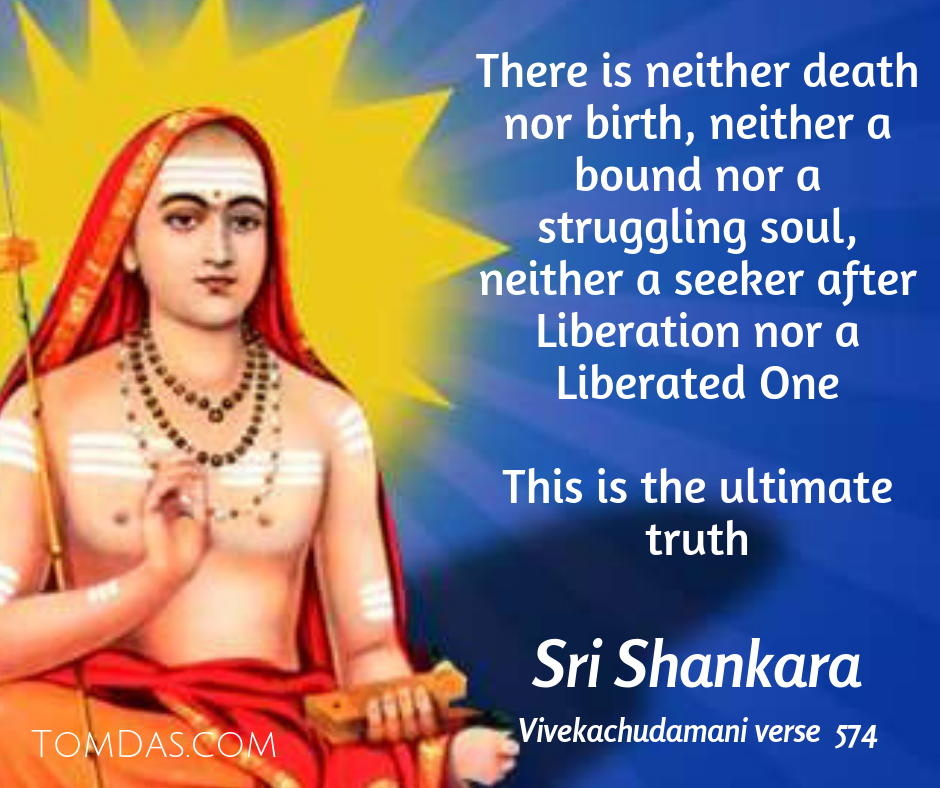
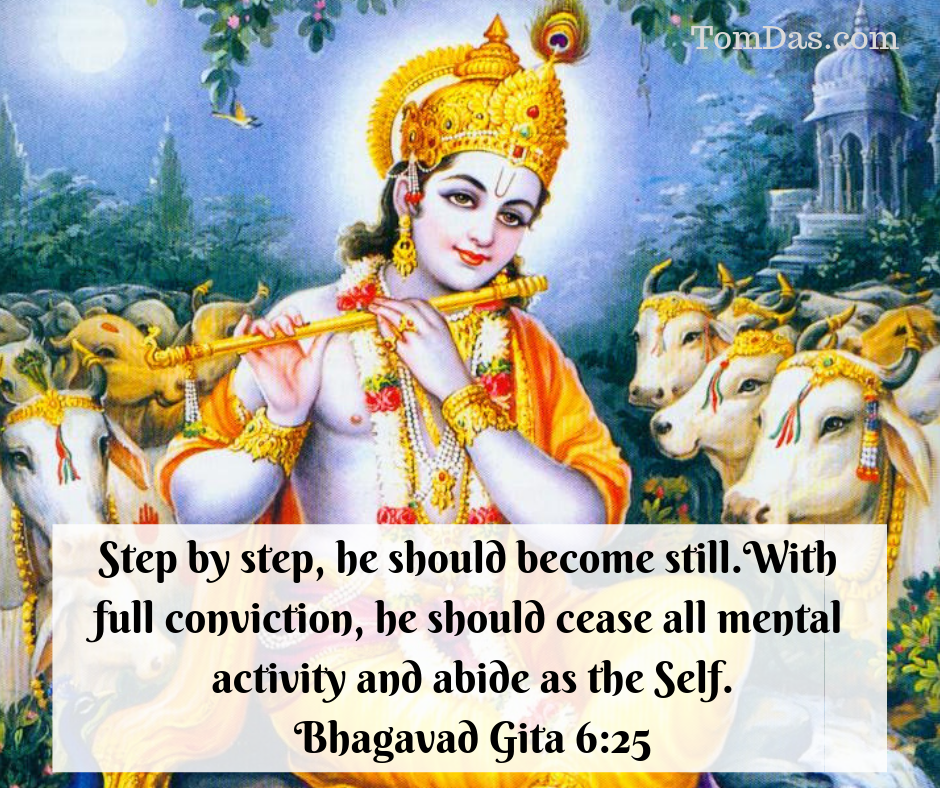
First we hear the teachings (sravana), then we think about the teachings (manana), then we realise what they are pointing to (*paroksha jnana or understanding primarily on the level of the mind, ie. indirect knowledge;).
This naturally leads to abiding as the Self (nididhyasana), which leads to deeper and deeper silence (mouna or samadhi).
Eventually all of the egoic tendencies (vasanas) are removed (vasana kshaya) resulting in destruction of ignorance (manonasa or destruction of egoic mind) which is the same as liberation (moksha) or direct knowledge (*aparoksha jnana – direct knowledge) or self-realisation (atma sakshatkara)
This entire path is then seen to have been illusory (maya)!
Where is there to go? Who/what entity is there to go anywhere? What is there to do?
In the meantime suffering will continue until the Self is realised as your own very Being, and it is Abidance in that Being as that Being that fructifies as Moksha.
*Think of ‘paroksha’ as meaning ‘mediated’, so paroksha jnana means knowledge that is mediated by something, ie. it is indirect knowledge. Conversely think of aparoksha as meaning unmediated, so aporoksha jnana refers to unmediated or direct knowledge.
I have heard some Advaita Vedanta teachers say that there is no need for faith in Vedanta. However, what do the Advaita scriptures say? Is faith simply blind belief? Is faith based on logic and conceptual knowledge? Or is faith something else?
Here we shall look at some selected quotes from Shankara and the Bhagavad Gita below which state both the importance and necessity of faith on the Path to Liberation, and explore why this is the case.
WHY IS FAITH IMPORTANT?
Why is faith important? Simply put, because without sufficient faith one will not have the dedication, love and perseverance to continue with self-enquiry (vichara), until liberation is attained. And Self-Enquiry, as taught by the Upanishads, by Shankara and by Sri Ramana Maharshi, is the only practice that ultimately leads to Moksha.
SOME TEACHERS SAY FAITH IS NOT REQUIRED
There are some teachers that say faith is not required for Vedanta as one can discover this all for oneself like a scientist can discover the various laws of nature.
Whilst this truth needs to be discovered for oneself and realised for oneself, I have noticed these teachings that push out the need for faith tend to be the teachings that predominately stay on the level of the mind. They tend to teach that prolonged meditation on the Self/Self-Enquiry is not required for liberation, and that essentially one can come to liberation through qualities such as having a keen intellect combined with exploring the nature of our present experience only.
This being the case, these teachings alone do not lead to the end of individuality, duality and suffering – ie. they do not actually lead to Moksha (liberation) at all, and the ego-separation remains.
‘FAITH PENDING RESULTS’?
Some say that Shraddha, the Sankrit word for faith, does not refer to blind faith or mere belief, but to a ‘faith pending results’, similar to the ‘faith’ required for a science student to follow a scientific experiment in order to discover the truth it yields.
Whilst there is some truth in this, it is not the whole truth, and also note that the scriptures do not define faith in this way (see the quotes section below). It is true that faith, as spoken of in the Advaita scriptures, is not the end goal in itself, meaning one doesn’t simply believe in God or in a dogma or creed of some kind and leave it at that, which would be rather superficial and on the level of the intellect predominantly. Rather faith is a ferry to take us to the shore of liberation, and this liberation is the goal, and this goal of liberation or God must be ‘experienced’ or ‘realised’ or ‘known’ for oneself, for want of a better phrase.
However, the faith spoken of in the Vedanta scriptures is much deeper than what has been described above. It is not just a mere willingness to try something until you see the results, like a scientist, or even a simple trust that the teachings will show you the way, but something that throbs in our very core, a deep conviction, in our very heart, in our Being. It is a deep resonance, a magnetic pull, intertwined with an intuitive knowing.
This faith cannot be taught, but is something that at some point in our journey springs into our very Being and takes us Home to Liberation. Perhaps it comes to us having listened to and studied the Advaita (or similar) teachings for some time, or perhaps faith dawns after having experienced the various ups and downs of life, or perhaps it comes to us unasked for, as Divine a Gift from God, a Gift of His Grace.
This true faith is inextricably linked with Bhakti, or devotional love of the Divine, which culminates in love to be with Self as Self, otherwise known as Self-Enquiry or Dhyana (meditation).
For me this Faith arose through the Presence and Teachings of Sri Ramana Maharshi, and for that I am forever grateful. His Presence and His Teachings unfailingly guide Homeward those who have come under His Spell and Grace. He is the Lord, He is the very Self, he resides within your very Heart – turn inwards and dis-cover (ie. uncover and reveal) your identity with Him.
QUOTES FROM THE VEDANTA SCRIPTURES
Let us see what kind of person, according to Vedanta, attains Jnana, or ‘divine knowledge’, otherwise known as liberation:
Bhagavan Lord Krishna states in the Gita Chapter 4, verse 39: ‘Those whose faith is deep and who have practiced controlling their mind and senses attain divine knowledge.’
But what if this faith is not present?
Lord Krishna also states in the Gita in the next verse, chapter 4, verse 40: ‘But persons who possess neither faith nor knowledge, and who are of a doubting nature, suffer a downfall. For the skeptical souls, there is no happiness either in this world or the next.’
In Chapter 5, Krishna further states in verse 17: ‘Those whose intellect is fixed in God, who are wholly absorbed in God, with firm faith in Him as the supreme goal, such persons quickly reach the state from which there is no return, their sins having been dispelled by the light of knowledge.’
What is the definition of faith?
Shankara defines faith and states it is necessary for realisation in Vivekachudamani: ‘Acceptance by firm judgment as true of what the Scriptures and the Guru instruct, is called by sages Shraddha or faith, by means of which the Reality is perceived‘
Shankara also writes in Aparokshanubhuti that Shraddha is required for liberation and defines Shraddha as follows: ‘Implicit faith in the words of the Vedas and the teachers (who interpret them) is known as Shraddha‘
Lets leave the last quote of this post to Bhagavan Sri Krishna, this time from the last verse of Chapter 6 of the Bhagavad Gita where he states: ‘Of all yogis, those whose minds are always absorbed in me, and who engage in devotion to me with great faith, them I consider to be the highest of all.’
Question: Dear Tom, how are you? I read your articles about Tony Parsons and Rupert Spira and I was wondering how you feel about the teachings of Byron Katie. Do you think with her saying ‘loving what is’, that she actually means devotion to the Self? Could this be the same? ‘Loving what is’ is like a surrender to what is, just like Bhakti devotion right?
Is loving what is, kind of the same thing as giving it to God? The same surrender? I ask this question because I hope the the teachings of Byron Katie can help, but Sri Ramana is the one for me and I think I just want the teachings to be the same
Tom: Hi _____, I’m well thanks. To answer your question, please note that most teachings that you are drawn/attracted to, as long as they are not unethical, are probably good teachings for you. There are many wonderful and varied teachings that can help us in a variety of ways. There are many ways of reducing ignorance and thinning the ego, and this will lead to less suffering and more happiness, relatively speaking. So any teaching that you are drawn to is probably right for you for now.
That said, there only very few teachings are ultimately liberating, that is, only very few teachings direct us to actually truly ending the ego and so ending duality and suffering completely by tackling the root issue.
These teachings of ‘ultimate liberation’ urge us, in essence, to turn away from objects towards the subject, and abide as the Self, as this is the only doorway to removing ignorance completely and thus end suffering, whereas all other teachings that do not advise this in some way or other perpetuate the ego and the suffering therefore continues. Here is an article on why other teachings are not ultimately liberating.
Not everyone’s ego-mind is able to accept this ‘ultimate teaching’ initially, due to attachment to worldly things and the body-mind, so often there is a process by which we gradually let go of worldly things and the body-mind until the ego-mind is ripe enough to be open to and fall in love with this True Teaching. Until then we will, generally speaking, be more attracted to other more-worldly type teachings that direct our attention to various gross and subtle objects.
Ramana Maharshi wrote down the basic sequential teachings that most go through in his text Upadesa Saram. Here is an article of mine that outlines the method to attain liberation in brief and also goes through several common objections to this teaching, as well as citing various ‘spiritual authorities’ in support of the teaching.
If you haven’t already, I also recommend you read The Path of Sri Ramana as it clearly explains both what the True Teachings are and what they are not in clear and simple language.
Question: Are there levels or stages of Realisation?
Tom: Realisation is one, there are no degrees of realisation, it has no levels. There is no really such thing as realisation. The whole point of the teachings are just to get us to abide as the Self, to turn within, to be. Not to be this or that, just TO BE. And when you realise the Self, it is just Self being the Self. You realise this has always been realised.
You don’t even realise in words, that’s just the way it has always been. It appears in ignorance that there are different levels of realisation. You can say Ramana is more realised than someone else, but there is no Ramana who is realised really. The body-mind doesn’t attain liberation. It is just Self-being the Self. There can be degrees of insight, but that is all on a level of ignorance.
Ramana said that Realisation is one, there are only levels of ignorance. So you can have thick dense ignorance and you can have very fine subtle ignorance. And thick dense ignorance will cause much more suffering, much more delusion, much more distortion than the fine silky veil of ignorance that is barely there.
The distorting capacity of the small subtle ignorance is very small. There is minimal distortion there, minimal suffering, but it’s still ignorance. When our suffering gets less and less, it gets finer and finer. Subjectively to that person, it’s still suffering. If someone else is looking at that person, he/she could think they have a great life, but from their point of view, they are still suffering.
The above conversation was transcribed by a volunteer from a live Satsang meeting with Tom Das. If you are interested in joining, please see www.tomdas.com/events
In addition to this recommended reading list, there are also a series of introductory articles which are freely available on the homepage of tomdas.com.
Whilst there are many wonderful books and texts to read, I want to focus here on books and scripture that:
comprehensively deals with the path to liberation
in a clear and unambiguous way that is easy to understand for the true and genuine seeker of liberation
with few/minimal detours
but still provides the necessary depth of teaching
in order to effectively bring about Liberation
Where possible I have provided a link to Downloadable PDF versions of each of the books recommended in the sections below. I recommend you obtain a copy of all of the books recommended. Towards the end of this post I also give various suggested orders in which you can read the books (depending on your interest and approach).
I later explain why certain books are not on my recommended reading list and I also touch upon the limitation of these books and when we should put them down.
I hope you find these resources to be of value
Best wishes & namaste
Tom
ps. I have given some further books at the end of this list which do not directly lead to liberation, but may be of value to you in your daily life – please take a look at Appendix 2 and feel free to let me know what you think.
How to read the books
The point of this list of books is not for you to simply read lots of books!
As I have only selected books which each contain the entire teaching required for liberation, a deep study of any single one of the texts is all that is required. That said, I do recommend you obtain copies of ALL the books listed as most people will benefit from slowly working their way through all the texts, as each book gives the same teaching in a slightly different way, and repetition will drive the teachings home in a progressively deeper way over time.
The purpose of the books is to outline the essential cause of suffering and the remedy for it. The theory given in the books is then meant to be put into practice. Once the essential teaching has been understood and the desire to put the teachings earnestly into practice has arisen, there is no need to read more and more, as this can get in the way of actual practice.
I should say that no single book can truly contain the entire teaching, as the true deeper teaching is ultimately wordless and is given in Silence from the Guru, or in rare cases by the Grace of God or directly from Self. All verbal formulations of the teaching will have their problems and disadvantages (as well as, hopefully, their merits and advantages, if it is a good teaching).
Attending Satsang or otherwise having contact with a teacher who has themselves non-conceptually (ie. genuinely) realised what these teachings are pointing to can therefore be most beneficial, even essential, for some.
The true teaching cannot be precisely explained in words, no matter how good the words are, and direct interaction with a teacher can help one greatly to not only intellectually understand the teaching and to increase one’s desire and motivation to practise, but also on a deeper energetic level there is a Silent Transmission of Grace, and it is this latter factor that makes all the difference and that is the True Teaching beyond all words and all books.
Back to the books though: if having read the books the teaching has not been understood or the strong desire to put the teachings into practice has not arisen, then the recommendation is to continue reading, but to read slowly. Take your time, study the teachings presented, make sure you understand them step by step but fully and deeply. Take your time to ensure you not only intellectually understand the texts but that your understanding sinks deeper into the feeling or experiential level where it can actually result in a lasting change. Staying with a single powerful quote and allowing that quote to penetrate into the depths of your being, so lasting change is created, is more useful than reading an entire volume and understanding the theory on a superficial intellectual level only.
Put the teachings into practice. If you have read the teachings several times but find you are not putting them into practice, it means that you probably haven’t grasped the depth of the teachings and perhaps you are relating to them predominantly on an intellectual level only. This may be a signal that you should slow down and take more time over each teaching point before moving on to the next teaching. Alternatively it may be a signal to speak directly to a teacher about such matters to seek clarity about the teachings.
The books
Texts by Sri Ramana Maharshi
Ramana gave many varied teachings to those who approached him. He naturally and spontaneously adapted the teachings to the level of the seeker before him, and some of these teachings therefore seem contradictory, and this can give rise to confusion about what Sri Ramana’s actual teaching was. However, in the short texts that Sri Ramana himself wrote, we see a very clear, unambiguous and consistent teaching that outlines the direct and true path to liberation.
Many state that the short text, Who am I?, written by Sri Ramana Maharshi contains all you need to attain liberation. And I would agree!
Together with two more of Sri Ramana’s writings, Upadesa Saram (The Essence of Instruction) and Ulladu Narpadu and Supplement – click on the links for downloadable PDF versions – a comprehensive set of teachings for liberation is given to us in concise form by Sri Ramana Maharshi.
The above three texts can also all be found in the Collected Works of Sri Ramana Maharshi, another recommended text, which also contains other beautiful works including Sri Ramana’s translation of Shankara’s Vivekachudamani (itself another recommended text, see below).
O Sri Ramana, The Heart: A Comprehensive Guide to Spiritual Liberation through Advaita, Devotion and the Teachings of Sri Ramana Maharshi
Update September 2026: I highly recommend my own book which is now available here on Amazon. It aims to be an accessible but comprehensive guide to liberation that blends the teachings of Advaita, Devotion and Sri Ramana Maharshi (as the title of the book suggests).
Several key points in the teaching are clarified in this book which are not mentioned in any of the books below, and this makes it especially useful for genuine seekers of liberation. The book has a conversational tone, which can be humorous at times and makes for easy reading, but that should not detract from the profound truths contained within it. The appendices and glossary are also worth reading.
Highly recommended to both read, enjoy but also to study.
The Path of Sri Ramana
This is the text I most commonly recommend reading and the book I recommend you read first: The Path of Sri Ramana by Sri Sadhu Om. Sri Sadhu Om spent several years with Sri Ramana and many consider this book to be an authority on Sri Ramana’s teachings and how to put them into practice. This text explains in detail the entire path to liberation in a way that is easy to understand.
Whilst the three texts from Sri Ramana Maharshi mentioned in the section above contain all the teachings needed, I have found that many people are unable to understand or even see what these short texts are saying despite it all being laid out. This may be in part due to the concise nature of Ramana’s own words, together with some technical terms and a language barrier, but also because the ego-mind will not always allow the true teachings to be seen.
The Path of Sri Ramana explains all the teachings clearly and in detail so the true teaching cannot be missed or ignored by the ego-mind that may be trying to distort or alter the teachings in order to avoid its own demise. It also clearly explains what the path is NOT, and so keeps the seeker away from paths that seem or appear to be similar to the true path, but are actually routes to more delusion rather than Liberation.
The Path of Sri Ramana also is one of the few texts that not only explains the path of Knowledge (Jnana) but also clearly outlines the path of Love & Devotion (Bhakti) and the path of Karma (action) in a clear and logical manner.
UPDATE 2023: a new revised translation of this text in a single volume is now available to purchase, eg. on Amazon, called ‘The Path of Sri Ramana’. There are 60 pages of new additional previously untranslated material, part 2 is now called the supplement, and the biographical section has been removed. Personally I find the older version, available as a PDF on this website, easier to read, however several people who attend satsang meetings with me have informed me they prefer the newer translation which they feel is more precise and more accurate.
Another text that is also of value is the wonderful Sadhanai Saram (The Essence of Sadhana or Spiritual Practice), also written by Sri Sadhu Om. This text contains many gems and the teachings are given through a series of verses grouped by topic. I recommend you read the Path of Sri Ramana Parts 1 and 2 before you read Sadhanai Saram to gain the full benefit of the text.
Similarly, another valuable text is The Paramount Importance of Self-Attention by Sri Sadhu Om. This text expands upon and clarifies the essential teachings given in The Path of Sri Ramana and Sadhanai Saram, giving the seeker helpful hints and pointers on how to attain self-realisation, and explains in greater detail the exact nature of self-enquiry and self-surrender. Some aspects of the teachings given in ‘The Paramount Importance of Self-Attention’ may be slightly confusing when read in isolation (they should not be confusing when read in context of the entire text). Therefore in order to avoid the teachings being distorted and taken out of context, I strongly recommend that you read The Path of Sri Ramana and Sadhanai Saram first, and take the time to fully understand the teachings in these books first, before reading this text.
Guru Vachaka Kovai (Garland of Guru’s Sayings)
Whilst not strictly written by Sri Ramana, the text Guru Vachaka Kovai was extensively checked and amended by Sri Ramana. It was written by one of his closest devotees, Sri Muruganar, and is widely considered to be the most authoritative collection of verbal teachings of Sri Ramana Maharshi. The foreword of the book published by Sri Ramana Ashram states the following about Guru Vachaka Kovai:
‘…[Guru Vachaka Kovai] provides the most precise, systematic and authoritative exposition of Sri Bhagavan’s teaching, explaining step by step the theory, the practice and the experience of jnana, the Truth supreme which is Being as Life Eternal, Pure Awareness, Perfect Bliss. Thus, the most comprehensive collection of the Maharshi’s sayings is Guru Vachaka Kovai…
My recommendation is, after having read the introduction and introductory verses, to start with the verses towards the end of the book which deal directly with the nature of liberation and work your way towards the front of the book.
There is also a small but wonderful text called Guru Ramana Vachana Mala which was written with the help of Sri Ramana Maharshi – it concisely and accurately summarises Sri Ramana’s teachings as well as the teachings of Advaita Vedanta, as per verse 3 of the text. This text takes 300 of the verses from Guru Vachaka Kovai and arranges them for easy consumption, so it is a much shorter read than the longer Guru Vachaka Kovai.
Sri Guru Ramana Prasadam
This is the English translation, by Robert Butler, of a text written by Sri Muruganar, one of the closest devotees of Sri Ramana for over 20 years, and someone who themselves attained Self Realisation in Bhagavan’s presence.
In this beautiful text Sri Muruganar describes how Sri Ramana captured his heart and led him to direct realisation of his True Self that was also the True Nature of his Guru, Sri Ramana Maharshi. Whilst all the teachings are presented here, unlike the texts above, they are not done so in an especially clear, logical or systematic way. However, the verses are infused with Bhakti and are dripping with Wisdom throughout, and they do point the direct path to liberation.
Strictly speaking this text does not meet the criteria that I have set out at the top of this page. So why have I therefore included it in this list? Well this text probably comes nearest to my own experience of Guru Sri Bhagavan Ramana and his effect on me, plus it contains many deep truths that are seldom found elsewhere – hence it is recommended! Please note that the verses by Sri Muruganar in the book The Seven Steps to Awakening are taken from Sri Guru Ramana Prasadam.
Whilst I do have a PDF copy of the book, you can easily (and cheaply) support the translator and buy the PDF for yourself here or buy it in paperback here.
UPDATE 2023: It seems the PDF version of the book is no longer available to purchase from the above link. You can download the PDF version here. Please also buy a paperback version of the book from Amazon to support the translator, thank you.
Aham Sphurana
This may be a controversial addition to the recommended reading list, but I do so, not because there is anything new in terms of teaching in this text (all the teachings I have seen so far are very much in line with the other texts in this reading list), and certainly not to covet controversy, but just because there are so many wonderful and clarifying dialogues here which drum the essential teachings home in what can be a very a fresh way. I have not read the entire text, but in terms of the teachings given, the ones I have read so far are very good and very clear and very much in line with Sri Ramana’s teachings. Many people who attend Satsang with me have told me just how helpful these dialogues have been for them in clarifying the essential teachings already provided in the above less controversial texts.
The book, being over 1000 pages long, is certainly not concise, so it does not fit all the criteria at the top of this page for recommended reading, and it may not even be an authentic work; some parts of the text seem very dubious indeed, but I still think it is worth reading, for those who are interested, and for those who are discerning – see here to find out more and download the text for free.
For clarity, the version I am recommending is the original unabridged version and not the edited selections published by others which may contain distortions to the teachings as presented in the original manuscript.
Lakshmana Sarma (LS), who often wrote under the pseudonym ‘Who?’, was a devotee of Bhagavan Sri Ramana for more than twenty years. He was one of only two devotees (the other being Sri Muruganar) who received extensive and comprehensive 1-to-1 tuition from Sri Ramana Maharshi on the meaning of his teachings, and the only devotee who received extended tuition on the text Ulladu Narpadu (40 verses on Reality, see above), which lasted several years. It is therefore unsuprising that Sri Ramana said that LS’s translation of and commentary on Ulladu Narpadu titled ‘Revelation’ was the best one available.
(After consulting with Sri Ramama, LS wrote the commentary on Ulladu Narpadu as he was unhappy at seeing how some devotees had misunderstood and misrepresented Sri Ramana’s teachings; in his other works below we can see the LS is similarly trying to share Bhagavan Sri Ramana’s true teaching and dispell false notions on what the teaching actually is.)
LS was also well-versed in Sanskrit and the traditional Vedanta scriptures and teachings. In LS’s book entitled ‘Maha Yoga‘, he explains Sri Ramana Maharshi’s teachings in the context of the Upanishads and Advaita Vedanta; this book also goes though the various misconceptions that others have made both of Sri Ramana’s teachings and of the traditonal Vedanta teachings and set’s them straight, making it a very useful text to distinguish Sri Ramana’s teachings from other similar-sounding teachings that are often promimently on offer in the spiritual marketplace.
In a similar vein is another work of LS entitled Sri Ramana Paravidyopanishad (also titled ‘The Supreme Science as Taught by Sri Ramana’). This also is a wonderful text to give the correct view of Sri Ramana’s teachings and dispel the seeker of false teachings and erroneous views. You can download a PDF copy from David Godman’s website here, but unfortunately this version has been edited and altered by David Godman; whist I am sure this has been done with the best of intentions, I have by chance found at least one example where David Godman’s edits have subtly or potentially distorted the meaning of the teaching (I have found this to be the case with several of David Godman’s publications), so if you are able to I recommend you buy a paperback copy of the original text published by Sri Ramana Ashram instead, as it is likely to be a truer representation of the teachings.
The wonderful text Guru Ramana Vachana Mala was compiled by LS, and has already been mentioned above.
Note that LS was fluent in English, in both speaking and writing, and the English translations of his works were done by himself, making them all the more valuable to non-Tamil speaking devotees who can read English.
In general the books by LS may not be as direct and detailed in how they describe self-enquiry as the books by Sri Sadhu Om and other books higher up on this list, but they do provide the reader with a good intellectual and philosophical understanding of Bhagavan Sri Ramana’s teachings and this may be of great benefit to many seekers.
Traditional Vedanta Texts
Whilst there are many wonderful traditional scriptures that one can read, there are a few traditional texts that clearly explain the entire path unambiguously for the genuine seeker of liberation, with minimal detours as possible.
Traditionally the most important of these is Vivekachudamani written by Sri Shankacharya. This is arguably today the single most important and influential scripture in Advaita Vedanta. Whilst Vedanta is primarily based upon the Upanishads, the teachings in the Upanishads are not always clearly and systematically explained. There are also different ways of interpreting these texts, and many Traditional lineages themselves have very questionable interpretations of the texts, and this can give rise to doubts. One danger is that one may end up engaging in too much extensive scriptural study, which in itself may take decades – even then one may still have doubts!
Vivekachudamani summarises and systematises the teachings of the Upanishads and has been used as a gold-standard for Advaita Teachings since it was written approximately 1400 years ago. The repetition present in the verses, the way the same topic is often spoken of in different ways, and the way the teaching is present throughout the text (ie. the teachings are given at the beginning, middle and end of the text) means that the true meaning of the text cannot easily be distorted, altered, misunderstood or wrongly interpreted.
Whilst most scholars and traditionalists agree that Vivekachudamani was likely written by Shankara, some dispute the authorship of the text and state it was written by a later Shankaracharya in the same lineage. Regardless of who the author was, there is not a single teaching present in Vivekachudamani that cannot also be found in the Upanishads, which are the source texts for Vedanta, and of course the authors of the Upanishads also remain unknown to us. Countless sages in the last 1400 years, including Sri Ramana Maharshi, have also testified the greatness of this text, stating this text teaches the way to liberation.
Sri Ramana Maharshi also translated the entirety of Vivekachudamani into Tamil and wrote an introduction to the text in which he states that Vivekachudamani reveals the direct path to liberation. Both of these by Sri Ramana are also recommended. Many other sages over the centuries have also praised Vivekachudamani as clearly showing the true path to Liberation.
Another traditional text that shows us the complete path is Advaita Bodha Deepika. It too is a text that was recommended by Bhagavan Sri Ramana Maharshi, and so I also recommend you read it. Whilst Vivekachudamani clearly explains the correct path, this text not only does this, but it also describes why other (false) paths do not work and how to avoid them. Some people find it to be more accessible as it is written in a question and answer format in prose, rather than in verse (Vivekachudamani is written in verse form).
In the Collected Works of Sri Ramana Maharshi, Sri Ramana has translated several traditional Advaita texts himself, all of which are recommended. These include texts from both the Vedanta and Tantra traditions (the Agamas are the source texts for several Hindu Tantric schools).
There are many other wonderful traditional Advaita texts such as the Upanishads, Bhagavad Gita, Avadhuta Gita, Ashtavakra Gita, Ribhu Gita, Uddhava Gita, Srimad Bhagavatam, etc, and these are also well worth reading, but the last one I want to mention here is the wonderful Yoga Vasishta. This is one of the most important traditional texts in Advaita Vedanta in which the teachings are clearly and unambiguously explained in a systematic way. It is also of historical interest as it is one of the few Vedanta Scripture that clearly gives us an idea of what Vedanta was like prior to Shankara. You can read about it more in the link I have just provided above and you will also find further links to key teachings from the text which are also well-worth exploring.
The Ribhu Gita is mentioned above and there is a text called ‘The Essence of the Ribhu Gita‘ which is a great hard-hitting Advaita text and provides a good summary of the essential Advaita teachings. It is also reported that Sri Ramana Maharshi specifically recommended recitation of Chapter 26 of the Ribhu Gita in order to attain self-realisation.
Other contemporary books
You may find that some of your favourite spiritual books do not feature on this list. It may be that I simply haven’t come across that book, but it also may be that I have come across it, but have not included it here as I do not feel it fulfils the criteria I have set out at the top of this post.
As you (hopefully) become familiar with the teachings presented in the above texts – they all present the same essential teaching by the way – you may start to see how these teachings are often NOT the same as other teachings that are more widely available in today’s contemporary spiritual marketplace. Initially it may seem that all non-dual teachings are pointing to the same essence in their own way, but as you become more familiar with the teachings, you will start to see differences emerge, and these differences can make all the difference!
If a well-known teacher is not mentioned in the above list, the chances are that I do not recommend them.
Here are some more contemporary books that I also recommend. Again, the same essential teaching that is given in the above texts are also given in these.
First is The Most Direct Means to Eternal Bliss by Michael Langford. This book’s tone may not be for everyone, but wonderful teachings are presented nonetheless. As well as outlining a path to liberation, this book also outlines various strategies the ego-mind uses to ‘prevent’ liberation from occurring. Understanding these ‘ego preservation strategies’ is very useful, especially if you can see them operating in yourself and put and end to them. I addition to The Most Direct Means to Eternal Bliss, I would also highly recommend ‘Seven Steps to Awakening‘ which is compiled by the same author.
After reading ‘The Most Direct Means to Eternal Bliss’, the book ‘How to Practice the Teachings‘ should also then be read, as this 2nd book suggests additions and changes that further enhances and clarifies the teachings.
Other books of Michael Langford’s are also well worth reading and recommended, such as ‘The Importance of Practice and Effort‘, and ‘Manonasa‘ – these books each further clarify the teachings for those who require this. The book ‘Manonasa‘ in particular clarifies the nature of liberation in particular detail for those who are interested.
Taken together, the above books by Michael Langford are some of the most powerful books I have come across with respect to enlightenment/self-knowledge/liberation, and so they are all highly recommended.
Another book I’d like to tentatively recommend is Happiness and the Art of Being by Michael James. I hesitate to and only tentatively recommend this book as it is the one book on this list I haven’t actually fully read myself – I’ve only skimmed through it and read the first few pages of the introduction – but I have been very impressed by what I have read thus far, so hence it makes this list. I feel the author has a wonderful understanding of Sri Ramana’s teachings and manages to shines a light on the true Vedanta rather than many of the ‘drier’ intellectual (ie. false) versions of Vedanta that are currently in circulation. He also studied Ramana’s teachings directly with Sri Sadhu Om, who wrote the Path of Sri Ramana (see above), and has made his own translations of Sri Ramana’s works including Guru Vachaka Kovai, so I feel fairly confident the teachings will be in line with the above teachings. There are also many gems and detailed insights in this book I have found when skimming through that I have not found elsewhere, which is another reason this book makes the cut. The author has made the book available for free online on the link above, but if you are able to, I encourage you to make a donation to help support the author.
A suggested reading order
All of the above texts contain the same essential teaching presented in slightly different ways, so if you find that you are drawn to one particular book, it is generally good to read that one first, as that is the text you will be most motivated to read. However here is my suggested reading order:
The Path of Sri Ramana Part 1 & 2 by Sri Sadhu Om – these two books clearly describe the entire spiritual path and form a great foundation for beginners and advanced seekers alike. If these texts are put into practice, no further books are required.
Sadhanai Saram by Sri Sadhu Om – this is sometimes referred to as ‘part 3’ of the above and consolidates the above teachings as well as giving further clarity to the path. The Paramount Importance of Self-Attention also gives further explanation and clarification on how exactly to do self-enquiry/self-surrender.
Who am I?, Upadesa Saram and Ulladu Narpadu & Supplement – all by Sri Ramana Maharshi. These short texts will be more fully appreciated and easier to understand having read the above 3 books by Sri Sadhu Om.
The Most Direct Means to Eternal Bliss by Michael Langford followed by ‘How to Practice the Teachings‘ by Michael Langford.
Seven Steps to Awakening, together with other books by Michael Langford
Maha Yoga and Sri Ramana Paravidyopanishad by Lakshmana Sarma. Maha Yoga explains Sri Ramana’s teachings in relation to traditional Upanishadic and Vedanta teachings and both books also take the time to point out false and incorrect understandings of Bhagavan Ramana’s teachings.
Vivekachudamani by Shankara
Advaita Bodha Deepika
Guru Vachaka Kovai & Guru Ramana Vachana Mala & Sri Guru Ramana Prasadam
Sri Ramana Gita
Advaita texts translated by Sri Ramana in the Collected Works of Sri Ramana Maharshi
Yoga Vasistha & The Essence of the Ribhu Gita
Happiness and the Art of Being
Q. I don’t really care for Sri Ramana or Vedanta, etc – I just want very clear teachings on liberation in plain language without any mystical mumbo jumbo – what books do you recommend?
In this case I recommend you read ‘The Most Direct Means to Eternal Bliss’ by Michael Langford. This is a wonderful and straight-forward presentation of the teachings stripped of mysticism and obscure language. However – these teachings may be too direct for some – you were warned!
Michael Langford has created another compilation called ‘Seven Steps to Awakening’ which is a collection of quotes from various sources which give a traditional and scriptural backing to the teachings given in ‘The Most Direct Means to Eternal Bliss’.
These two books work very well together and are 2 of the most powerful books I have come across with respect to spiritual liberation.
Q. My main interest is in Advaita Vedanta teachings – which books are best?
The best introduction to the Vedanta teachings I have come across are actually The Path of Sri Ramana Parts 1 & 2. Maha Yoga explains in detail Sri Ramana’s teachings in the context of traditional Vedanta and also explains how many have misinterpreted and distorted the teachings; similarly Sri Ramana paravidyopanishad is also very clear. After this, I would recommend the traditional texts Advaita Bodha Deepika and then Vivekachudamani, followed by the traditional Advaita texts Sri Ramana translated that can be found in the Collected Works of Sri Ramana Maharshi, and then The Essence of the Ribhu Gita and Yoga Vasistha. Lastly I would recommend you read Happiness and the Art of Being which is also a very good text on Vedanta teachings.
My main interest is in Sri Ramana Maharshi’s Teachings – what do you recommend?
I would recommend the Path of Sri Ramana Parts 1 & 2, then Sadhanai Saram, followed by the suggested reading order I gave above. If you have a particular tendency towards Devotion or Bhakti, I especially recommend Sri Guru Ramana Prasadam.
Q. Why is my favourite spiritual book not on your list of books?
It may be that I haven’t read it, or it may be that it doesn’t in my view fulfil the criteria I have outlined at the top of the post.
If a well-known teacher is not mentioned in the above list, the chances are that I do not recommend them.
The reason is that many teachers, although they may teach wonderful teachings, often subtly distort the teachings and thus change a liberating teaching into a non-liberating teachings. Why do I say their teachings may be wonderful then? Because they may be helpful for you, or at least seem to be helpful for you at your point in your (apparent) journey.
It is very easy for the teachings to be distorted and misunderstood by the ego-mind. The ego/mind likes what it can understand and what makes sense to it, and it selects teachers and teachings accordingly, according to it’s own logic. However the mind is based upon ignorance!
I acknowledge various teachings may be helpful to various seekers at various different times. However this does not mean that all teachings are equally clear or equally liberating – they are not.
Here in this list I have focused on books that clearly teach a liberating teaching only, and these teachings are rare.
Q. I know you have written various blog posts on Zen and Buddhism as well as other traditions such as Gnostic Christianity, Taoism, Tibetan Buddhism, Sufism as well as more contemporary teachers/teachings such as J Krishnamurti, Radical Non-Duality and the Law of Attraction. In fact the articles and posts on tomdas.com are some of the most varied and rich I have come across! Why do texts from these other traditions and teachers not feature on your list?
Yes, I have written several posts on Zen and Buddhism – please see the hyperlinks in the question above for examples. I do think they are wonderful traditions but I haven’t found a book from those traditions that gives a complete teaching with sufficient detail that fits the criteria at the top of the post without also creating much ambiguity and confusion about the path.
Many of the texts fall short in my view, which is not to say the traditions themselves fall short necessarily, although they may depending on how they are taught. I have found that the above recommended texts are much clearer and more straightforward, and therefore more effective. However I will let you decide!
ps. here is a post I have written comparing Buddhism with Vedanta and Sri Ramana’s teachings and here I have compared Self vs No-Self.
Regarding other teachings and traditions, the same applies: I have not found a book (and I have read many!) that clearly outlines the path to liberation in a clear way devoid of distortion. The only books I have found that clearly explain the entire path without distortion are the ones listed above.If a well known teacher is not featured on the recommended reading list, the chances are I do not recommend their books.
It is very easy for the teachings to be distorted and misunderstood by the ego-mind. The ego/mind likes what it can understand and what makes sense to it, and it selects teachers and teachings accordingly, according to it’s own logic. However the mind is based upon ignorance! And often the teachings the mind selects perpetuates the ignorance! Hence the value of these teachings recommended above which give a truly liberating teaching, even if the mind does not like what it reads!
I acknowledge various teachings may be helpful to various seekers at various different times, and this is why my various blog posts reflect these other various teachings. However this does not mean that all teachings are equally clear or equally liberating – they are not. Here in this list I have focussed on books that clearly teach a liberating teaching only, and these teachings are in my experience rare.
Q. What about books by Nisargadatta Maharaj such as ‘I Am That? and ‘Talks with Sri Ramana Maharshi’ and books containing Annamalai Swami’s teachings?’
Whilst ‘I Am That’ is a good book that has inspired many, I have found that the teachings vary a lot depending on whom Nisargadatta Maharaj is speaking to. This is because this book, and others like it, are a record of conversations, so the teaching given varies according to the context it was given it. This means that the highest teaching is not always taught.
Why is this important? What then often happens is that the ego-mind or the reader often finds a way to latch onto the lower teachings and use this as a means to perpetuate itself – this is often done unconsciously without the reader realising this. I have seen this happen many times with many seekers, and it can cause problems and confusions for them on their spiritual journey. Seekers often, through reading books like this, unknowingly emerge with an incorrect notion of what the teachings are and are not and this then hinders them in their search for liberation.
The terminology used such as the use of the phrase ‘I AM’ can also be very confusing for some, as sometimes it refers to what Ramana would call the ‘I thought’ or ego, whereas in other parts of the book ‘I AM’ refers to the Self or the Absolute. Basically the essential teaching is not always clearly taught in my view, so hence I do not recommend it.
The same critique for I Am That could be said for ‘Talks with Sri Ramana Maharshi‘, which is also a record of conversations, so although Talks with Sri Ramana Maharshi is also a wonderful book, I do not recommend it here for those who want to go directly for liberation as the essential teaching is not always clearly given. We are however very lucky that Sri Ramana wrote several short texts himselfwhich clearly point the way to liberation without the need to wade through large collections of recorded conversations.
The same goes for books containing Annamalai Swami’s teachings.
However, if one has read the above recommended books first and clearly and thoroughly understood the core teachings, then these varying teachings found in books such as ‘I Am That’ and ‘Talks with Sri Ramana Maharshi’ and Annamalai Swami books will not cause the reader confusion as the essential teaching has already been understood.
If you like Sri Nisargadatta Maharaj’s or Annamalai Swami’s teachings, then I recommend you read ‘The Seven Steps to Awakening’ which contains quotes from various sources including ‘I Am That’ by Sri Nisargadatta Maharaj and from ‘Final talks’ by Annamalai Swami. The compiler of the book, Michael Langford, has taken only the highest and most direct teachings and put them together in one place, and left out the lower teachings which often confuse seekers or put them onto the wrong path (even though the teachings were appropriate in the context given at the time). The Seven Steps to Awakening is therefore highly recommended.
Q. What about other books on Sri Ramana Maharshi’s teachings not mentioned in the above recommended reading list?
It is very easy for the teachings to be distorted and misunderstood by the ego-mind. The ego/mind likes what it can understand and what makes sense to it, and it selects teachings accordingly, according to it’s own logic. However the mind is based upon ignorance!
Apart from the above books listed, I do not generally recommend other books on Sri Ramana Maharshi’s teachings. I have found almost all other books on Sri Ramana Maharshi’s teachings that I have come across that are not on the above recommended reading list contain a level of distortion and misinterpretation. I have found that this often leads seekers away from liberation, and with an incorrect and often unhelpful idea of what self-enquiry is, even if the author or editor is well-meaning and well-intentioned.
Q. Do we at some point need to stop reading books and stop relying on these outside sources of information? What are the limitation of these books?
Appendix – a post on Sri Muruganar, Sri Sadhu Om and Lakshmana Sarma
To my knowledge, the only living human being who was said by Sri Ramana Maharshi to have attained Self-Realisation was Sri Muruganar, a devotee of Sri Ramana’s for over 25 years. Muruganar also was one of 2 people who had personal one-to-one tuition from Sri Ramana on the actual deeper meaning of the teachings (the other person was K. Lakshmana Sarma, see below).
Muruganar recorded Sri Ramana’s teaching in the text Guru Vachaka Kovai (see above in the recommended reading list), which is said by Sri Ramana Ashram to be ‘the most precise, systematic and authoritative exposition of Sri Bhagavan’s teaching, explaining step by step the theory, the practice and the experience of jnana, the Truth supreme which is Being as Life Eternal, Pure Awareness, Perfect Bliss. Thus, the most comprehensive collection of the Maharshi’s sayings is Guru Vachaka Kovai…’
Sri Sadhu Om spent many years with Sri Ramana Maharshi and after Sri Ramana’s death he spent many years with Muruganar. Muruganar said that Sri Sadhu Om was the only person who really understood Sri Ramana’s teachings. Sri Sadhu Om wrote several books on Sri Ramana’s teachings such as The Path of Sri Ramana and Sadhanai Saram (the essence of spiritual practice) and translated them into English himself.
K. Lakshmana Sarma, another long time devotee of Sri Ramana’s, was the only other person (other than Sri Muruganar) to have 1 to 1 tuition on the true meaning of Sri Ramana’s teachings; this tuition lasted several years. Lakshmana Sarma was often unhappy to see people misinterpreting and misunderstanding Sri Ramana’s teachings and he wrote several books such as Maha Yoga and a commentary on 40 verses on reality to explain Sri Ramana’s true teachings, and he translated them into English himself.
Most people, when they hear the teachings, their ego-mind immediately distorts the teaching, and this often converts a liberating teaching into a non-liberating teaching. So the person recording the teaching is of utmost importance if we want to understand the true teaching that will lead to liberation.
I therefore recommend you read the above texts if you want to discover a truly liberating teaching, free from distortion, that will quickly and effectively lead to liberation, which is eternal bliss and the cessation of suffering.
We also have the texts that Sri Ramana Maharshi himself wrote.
You may be pleased to know that I have compiled all of the above (and some more), which you can download for free, on my recommended reading list.
I hope this above information is helpful to you.
Best wishes and Namaste!
Tom
Appendix 2 – other book recommendations
These are books that contain teachings that are not directly liberating but may be helpful to you on the path. Some of these I have read myself, others are books that people I have worked with have found particularly helpful for them.
1. Jesus Calling by Sarah Young (a book for devotional practice)
This is a beautiful book, devotional in nature, written by a Christian, which encourages us to feel God’s Presence, Love and Support throughout our life. There is an entry to read for each day of the year. Whilst it is dualistic in nature, it can serve as a wonderful reminder to surrender to That Higher Power and lean on It rather than try to do everything by oneself…and much more…highly recommended for those who resonate
2. Maximum Achievement by Brian Tracy (a book for personal success in daily life)
This wonderful book, which in my opinion is a spiritual book disguised as a self-help productivity manual, contains many skills and tips on all areas of your life in order to help you attain personal success. It gives advice on health, energy levels, finances, relationships, personal fulfillment and peace of mind. Have a read, see if you like it.
3. The Astonishing Power of Emotions by Abraham Hicks (on the Law of Attraction)
This wonderful book summarises many of the teachings given by Abraham Hicks on the Law of Attraction and also helps us use our own positive and negative emotions to guide us along the way. See if it resonates with you.
4. The Righteous Mind: Why Good People are Divided by Politics and Religion by Jonathan Haidt (a book on society and politics)
I haven’t read this book myself, but some of us find the area of society and politics to be a cause of confusion, stress and worry, and several people have told me that this book has helped them. See what you think and feel free to let me know.
For the most part we can define ‘neo-advaita’ (or radical non-duality) as those teachings/communications that state all is already one/whole and there is no separate individual self, and as there is no separate self, there can be no useful practice as all practices reinforce the notion of an individual self that is carrying out the practice; therefore, according to neo-advaita, there is no path to liberation, no practice that can help one attain liberation, and no separate self to be liberated, and to say the contrary is fine but inaccurate.
This is in contrast to traditional-type Advaita teachings that for the most part acknowledge all is already one, but often state there is some kind of process or path that one can engage with and engaging with this teaching and path will in some way help ‘you attain direct realisation/liberation’ of the oneness/Self that is already present. Sri Ramana Maharshi explains this more fully here.
Which view is correct?
I think most seekers that have explored this can see the potential benefits of both approaches, but most neo-advaita types reject the practice/progress orientated paths, and vice versa.
My own view is that the neo-advaita types for the most part have only a very superficial realisation and they also do not usually point to suffering ending (unlike traditionally orientated paths), but that does not make neo-advaita entirely worthless of course, as different things resonate at different times in our journey.
I have written several posts on this which may be of interest to you, best wishes: