The subject (the Witness/ Awareness/ Pure Consciousness) is an inference

All we know are objects. The existence of a subject (eg. the witness or consciousness/awareness) is an inference, a belief.

Some versed in advaita-speak then counter by asking ‘Who/what is it that knows this?’. The problem is that the very question ‘who knows’ is based on the belief that there must be a subject, a knower.

It’s similar to an argument for the existence of God in which people say look at all this marvelous creation, who is the creator? Of course, the assumption is there must be a creator, a subject who creates, and this is a false assumption (ie. it is based on false logic).

Inference does not always work as a way of understanding and knowing things, as it is only as good as the logic that underpins it. We could go on with other examples of this faulty logic in which the notions of a subject is unnecessarily believed in: Who blows the wind? Who quakes the earth? Who grows the trees?

Now strictly speaking, we are not saying there is no subject, just as we are not saying there is no God. We are just saying there is no evidence for either of these, and therefore no need to believe one way or the other in a subject.

What we are left with is ‘what is’ or ‘life’ or ‘experience’. It all just happens. It’s already happening. Everything is a part of IT.

So simple, direct, and already fully known (seen), but in essence it is mysterious and uncapturable by words.

There is a great freedom in seeing this.

So, what happens when you die?

Branch lightQ. So, what happens when you die?

How can you know what happens when you die? No matter how you justify it, no matter how many psychic intuitions or spiritual experiences you have, the truth is that you don’t know for sure what happens after death. This question may perhaps be answered by science in the future, but we are not there yet.

Think of a time when you were utterly convinced something was true, but now you look back and realise how wrong you were. Knowledge also comes and goes. Perspectives change as we grow and mature and experience different things.

Enlightenment is beyond knowledge. Enlightenment does not depend on knowledge or the mind. Unlike knowledge and states of mind, Enlightenment cannot be attained – it is already here.

The above is an extract from the following post: Who cares about freedom?

And the winner for the Best Spiritual Practice 2017 is…

And the winner for Best Spiritual Practice 2017 is….

I got news for you: there are many ways to THIS.
Some people may need a path, a practice or a teacher, others may not.
The way that worked/is working for you may not be the way for everyone.
At the end of it all, you are right where you began: ‘here’.
But with a difference: now you know.

For more quotes see here: tomdas.com/quotes

For more Facebook posts see here: www.facebook.com/tomdas.nd

In seeing truth, love is

mountain valley light

In Freedom, you don’t care about love, or any other projected ideal.
You don’t try to be more ethical. Maybe you are more loving, maybe you are not.

That’s why this automatically tends towards love – because there is no motive, because the ego is not at play. It may go against intuition but love does not care about love.

Love just is when things are seen for what they are.
To put it more poetically, in seeing truth (of no-self), love is.

The above is an excerpt from the article Love, Happiness and Non-duality

Tom Das – the value of emotional work (recent quotes from my Facebook page)

Here are some of my recent posts from Facebook page relating to the value of emotional/psychological work (my account is http://www.facebook.com/tomdas.nd)


I think there is a relationship between self-development and realisation of freedom, although they are certainly not the same thing.

Developing a peaceful, happy and emotionally intelligent mind can aid realisation. It is also often a side effect of realisation.

Far from being new age gibberish, this is the received wisdom of most genuine traditions aiming at liberation


When I first started teaching I tended towards just direct pointing. I quickly realised there are a whole host of reasons why people were not getting it, or if they were ‘getting it’, they quickly ‘lost it’.

I began to understand the value of emotional work, of heart opening, of regular spiritual practices, of becoming more sattvic – ie. the value of the progressive path (as well as the negatives too, eg. the reinforcement of a sense of doership/ego).

Remember that consciousness/awareness, if you want to use that concept, doesn’t need any teachings. Freedom is already here, totally and completely. It is only the mind that needs teachings.

A relatively uncluttered mind in need of little emotional work may respond to direct pointing, whereas sometimes some decluttering needs to occur first.


The basic point is not to suppress/run away from/escape from emotions and feelings, but to allow them to come and go, and to understand any underlying false assumptions that may be present and fueling them.


Meet your emotions with light and love


Basically, there is usefulness and skill in feeling emotions without labels, but there is also a usefulness in labelling feelings too.

Both these skills contribute towards emotional intelligence and healing, none of which is necessarily required for Freedom to be realised, but which is useful nonetheless

If emotions are not deeply felt, there is risk of emotional bypassing.
Emotional work may need to be done either prior to or after awakening, otherwise unnecessary suffering and destructive tendencies will continue on a relative level with the body-mind in question.

We need to learn to feel without labelling feelings, so we can genuinely contact our emotional reality.

We also need to be able to accurately label our feelings and understand what we are feeling and why.

We also need to see how all feelings come and go and do not define us.

Freedom is already present.


Emotional intelligence is a useful skill for the body-mind, both prior to and following realisation of freedom.

Awareness needs no teachings, only the body-mind caught in ignorance needs these corrective teachings.


These teachings are only for those who take themselves to be a doer-entity. If that is seen through, then the teachings are unnecessary.

Having said that, emotional intelligence is a useful skill for the body-mind regardless of whether Freedom has been realised or not.


Even when the doer-entiry is seen to be non-existent, old emotional patterns of responding may still persist due to their past momentum/habit.


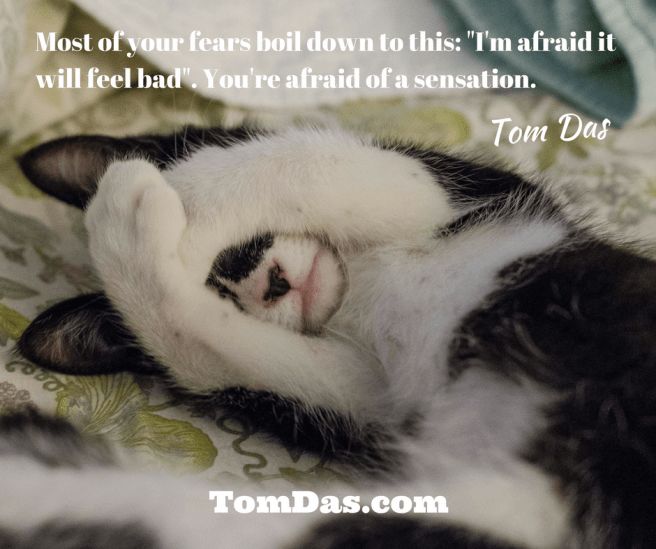
afraid-of-a-sensation


Tom Das – pointing at the unspeakable (recent quotes from my Facebook page)

Here are some of my recent posts from Facebook page (my account is http://www.facebook.com/tomdas.nd)


Everything you see is yourself, calling you back to yourself.


May your ever-seeking mind be engulfed and consumed by the warm smouldering embers of surrender.


Sometimes insight alone is enough. Sometimes practice is required.


Relax, let go & enjoy.
Freedom is already fully & completely present.
No need to pay too much attention to thoughts & feelings that say otherwise.


Notice all the ways you try to avoid THIS.


How can THIS be spoken of? How can THIS be taught? In the ‘final analysis’, what is there to teach?


The freedom that we are looking for is wholly verifiable in our experience right now. We do not necessarily need to have a special experience or to obtain a special knowledge for this freedom to become apparent. Nor is belief of any kind required. Stay true to what you know directly. Don’t pretend to know something you don’t and don’t take on someone else’s beliefs.

Simply quieten your mind and notice what is happening. Examine how suffering is created and the notice the myriad of beliefs that underlie it. Notice the non-existence of an entity (‘you’) that is the author of thoughts and actions. This ‘you’/author is just an imagined product of throught.

Notice fulfillment is not to be gained through either objects, accumulative knowledge or specific/certain experiences, all of which come and go. See this for yourself. Don’t take my word for it.

Dare to seek and know what is true for yourself, and stay true to your own direct experience, even if it means you are contradicting a supposed authority in the matter.

Good luck!


When I first started teaching I tended towards just direct pointing. I quickly realised there are a whole host of reasons why people were not getting it, or if they were ‘getting it’, they quickly ‘lost it’.

I began to understand the value of emotional work, of heart opening, of regular spiritual practices, of becoming more sattvic – ie. the value of the progressive path (as well as the negatives too, eg. the reinforcement of a sense of doership/ego).

Remember that consciousness/awareness, if you want to use that concept, doesn’t need any teachings. Freedom is already here, totally and completely. It is only the mind that needs teachings.

A relatively uncluttered mind in need of little emotional work may respond to direct pointing, whereas sometimes some decluttering needs to occur first.


If emotions are not deeply felt, there is risk of emotional bypassing.
Emotional work may need to be done either prior to or after awakening, otherwise unnecessary suffering and destructive tendencies will continue on a relative level with the body-mind in question.

If you observe, you can learn the apparent mechanics of suffering and awakening, which when understood makes the teachings much more potent.

This has immense value in my experience to an apparent someone who is struggling in their belief in separation.


If you have come this far then you will also realise that ‘awareness’ is just another way of saying ‘presence/appearance of objects’. Here the subject-object distinction falls away.


The idea of a subject/awareness that is aware of objects is just that – an idea or concept.

When this is seen one can no longer even talk of awareness, as that implies a subject and object, a perceiver and perceived, and this is now just seen to be an assumption, a imagined creation of throught.

There is only ‘what-is’.

Simple, direct, unspeakable.

The concepts of the teaching, such as a ‘pure awareness’, were useful tools on the journey to remove the basic ignorance, but can now also be dispensed with once their ‘job has been done’.


wp-1481063300583.jpg

Am I the body? Am I not the body?

This post is continued from a prior post: Integrating knowledge, spontaneous action

Q. I’ve been reading Ramana Maharshi recently and he keeps on saying ‘I’m not the body’.

Tom: Yes, that’s right.

Q: But I don’t really hear you talk about not being the body.

Tom: Yes, that’s because it’s a ‘thorn’. Remember the phrase I’ve mentioned: ‘Use a thorn to remove and thorn and throw them both away’?

Q: Yes, I’ve heard you say that. Please can you explain it again?

Tom: Sure. The first thorn represents a wrong concept that is active in your mind and causes suffering, just as a thorn in your foot causes suffering. You then take a second thorn and use it as a tool to remove the first thorn, but then you throw them both away. If you don’t throw away the second thorn, then you now have a new thorn (concept) that will cause you to suffer.

Ramana often talks about rooting out the ‘I-am-the-body’ concept, and the concept ‘I-am-not-the-body’ is just to negate the initial thorn. But then you throw it away too.

Q: So I am not the body is not true either?

Tom: Exactly. Or, lets put it like this: for a moment just forget what Ramana says, forget what I say – for all you know we could both be talking a load of rubbish! Afterall, lots of intelligent people believe strange and silly things, and we could be no different, right? So forget what we say.

So let me ask you a question: do you know for sure that you are a body?

Q: Well it often seems like I am a body…

Tom: But do you know for sure?

Q: No, not for sure.

Tom: Good. Now, do you know for sure that you are not the body?

Q: No, not for sure.

Tom: Good. That’s our basic experience. We don’t know either way. The body appears and follows us around, as it were, but we don’t know exactly what it means. Is the body me? Is it not me? The truth is I don’t know. That’s it. That’s the truth. We don’t know. Isn’t that right?

Q: But when I say to myself ‘I am not the body’, it feels so good, it just feels really nice.

Tom: Yes, of course, because you are negating the concept (I-am-the-body) that causes so much suffering. It’s a good thing to practice, it’s a great practice in fact. If it works for you I recommend you practice it.

Q: Oh, I see, so it’s a practice.

Tom: Exactly. We are not saying don’t practice. We may need the second thorn, that’s why it is there, that’s why it is taught. So use that thorn, use that tool, practice ‘I am not the body’. When it has done its work, when it has weeded out the ‘I am the body’ concept, then you won’t need it any more and you can throw it away too.

Q: OK, I got it now. Wow, there are so many thorns, aren’t there?

Tom: Yes!

Q: I often get confused about whether or not the world is a dream or illusion or not, but that’s just another thorn too, right?

Tom: Exactly. ‘The world is an illusion’ – it’s a very powerful thorn, one that benefited me a lot whilst I was seeking. But again, do you know for sure if the world is an illusion?

Q: No, not for sure…I know what you’re going to ask next…

Tom: …And do you know for sure that the world is not an illusion?

Q: No, not for sure . I knew you’d say that.

Tom: (laughing) That’s it! We don’t know either way! It’s so simple – Got it?

Q: (laughing) Got it.

Tom: so you can practice these, all these thorns. All these thorns are concepts. Use them – they are most definately useful – use them if you need them. The concepts are used to weed out the beliefs. You may need to practice them for weeks or months, but when their work is done, and the suffering has dissipated, throw them away.

Also see Ranjit Maharaj talk about this.


Discarding knowledge as ignorance

This post is continued from my previous post: Practicing knowledge

Discarding knowledge as ignorance

Once the purpose of the tool has been fulfilled, then the tool can be dispensed with. There are two main problems with this. Firstly, you can dispense with the tool too quickly, before it has done its work of rooting out ignorance. Secondly, you can cling onto the tool for too long, which essentially means that you have started to believe in it.

I see both of these errors happening all the time. People often dismiss the need for practice completely. While there are different paths to follow (including no-path ‘paths’), that does not mean that for some a path or teaching cannot be of benefit. All teachings are provisional which means that they produce limited results. This is true of all teachings and all actions/practices – they are all limited and produce limited results. But these limited results can still be of use to us in recognising what is already (and always was) present , ie. Freedom. 

Other people believe the conceptual tool. They have merely substituted one concept for another, one ignorance for another.

Hence the traditional advice is to liken these conceptual tools as being thorns, to remind you not to hold onto the second thorn, useful as it was:

Then, like the thorn used to remove a thorn, throw them both away.

See Ranjit Maharaj discuss this here.

This post is continued in the next article: Integrating knowledge/spontaneous action